Micro Summary
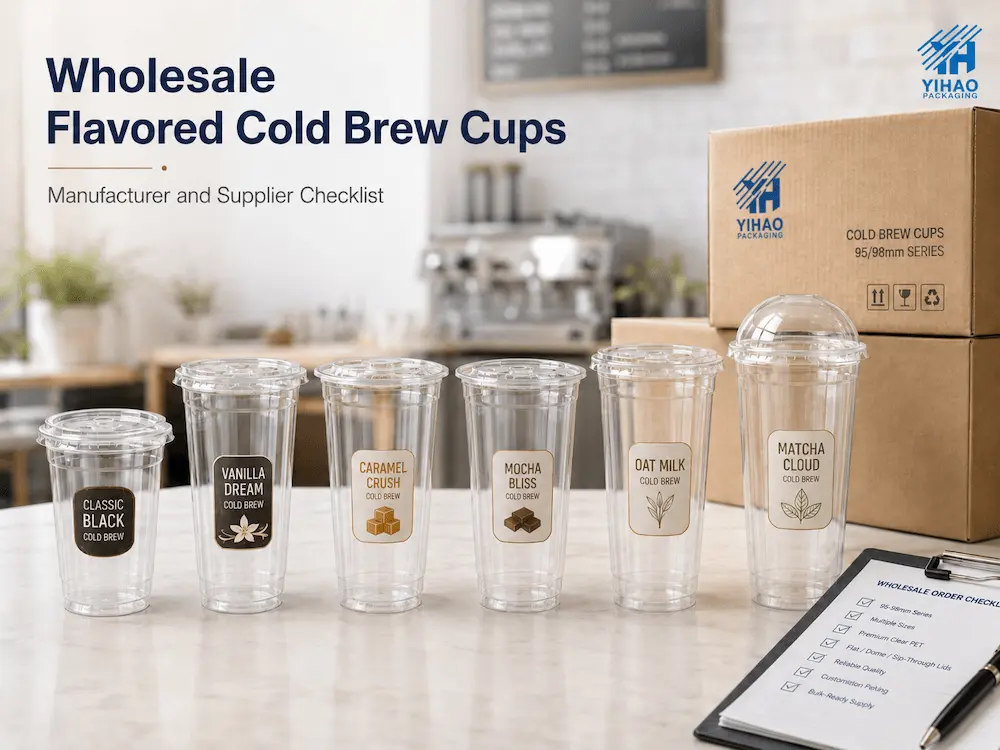
Flavored cold brew cups are clear PET cold beverage cups designed for vanilla, caramel, mocha, cold foam, oat milk, and seasonal cold brew drinks. For wholesale buyers, the right cup should combine strong clarity, secure lid fit, stable rim quality, chilled display performance, branding space, and reliable supplier support. Clear PET coffee cups help show ice, milk layers, syrup movement, and foam texture, making them practical for cafes, supermarkets, bakeries, convenience stores, and foodservice beverage programs.
Why flavored cold brew cups matter in modern coffee packaging
Flavored cold brew is no longer a simple black coffee product. Many beverage programs now sell vanilla cold brew, caramel cold brew, mocha cold brew, hazelnut cold brew, brown sugar cold brew, oat milk cold brew, salted cream cold brew, cold foam cold brew, fruit-infused cold brew, and seasonal chilled coffee drinks with visible layers.
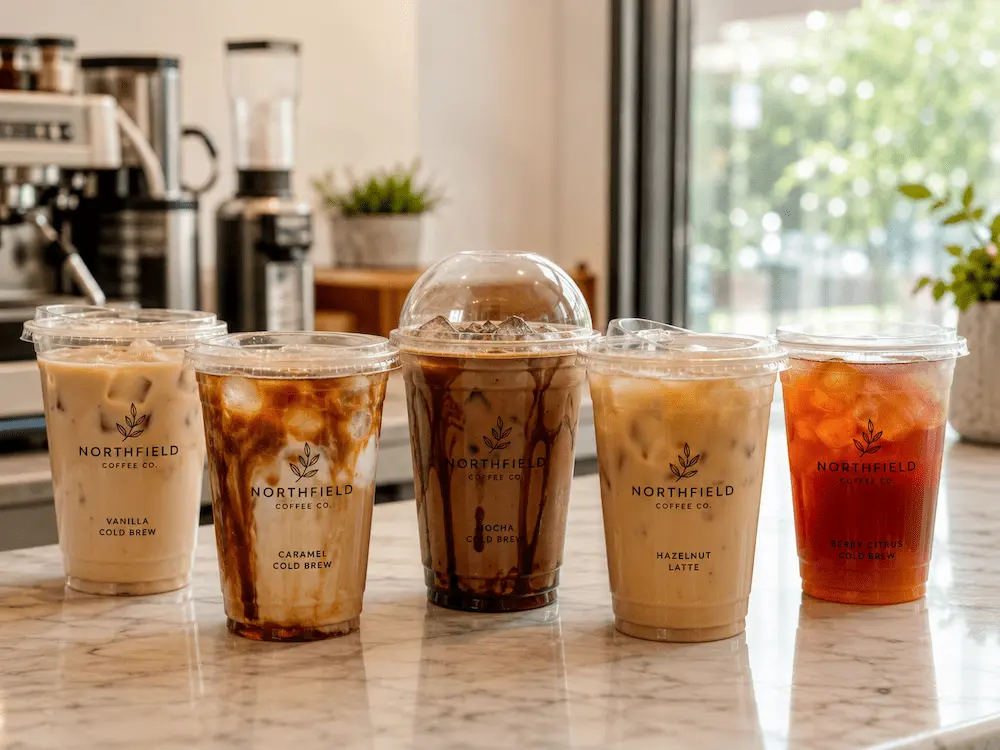
That change makes packaging more important. Flavored cold brew cups do more than hold a drink. They help show the drink before the customer tastes it. Coffee color, ice level, milk ratio, syrup movement, cream texture, foam height, and topping space all influence customer perception.
For cafes, supermarkets, bakeries, convenience stores, coffee chains, distributors, and foodservice brands, cup choice affects presentation, takeaway safety, chilled display, branding, staff efficiency, and repeat purchasing. A clear cup with poor lid fit creates leakage complaints. A strong cup with poor clarity reduces visual value. A good wholesale packaging system needs both appearance and performance.
What makes flavored cold brew packaging different from standard iced coffee cups
Standard iced coffee packaging often focuses on cold drink service, basic cup strength, and lid fit. Flavored cold brew packaging needs more visual control because the drink itself is part of the selling message.
A flavored cold brew may include:
- Dark cold brew concentrate.
- Milk, oat milk, almond milk, or cream.
- Vanilla, caramel, chocolate, hazelnut, brown sugar, or seasonal syrup.
- Cold foam or whipped topping.
- Ice with visible liquid separation.
- Flavor labels, stickers, or printed branding.
- Chilled retail display requirements.
This creates a different packaging job. Clear iced coffee cups must show the drink clearly while still supporting lid security, label placement, and stable takeaway handling. The cup should not look cloudy, weak, scratched, or distorted. The lid should not cover the foam poorly or pop off during handling.
For buyers, the difference is simple: standard iced coffee cups need to function well; flavored cold brew cups need to function well and sell visually.
Why PET is a strong material choice for flavored cold brew cups
PET is widely used for cold drink cups because it offers high clarity, good stiffness, and a clean retail appearance. For flavored cold brew cups, these qualities are especially useful because the beverage often relies on color contrast and layered presentation.

Clear PET cups show:
- Coffee depth and roast color.
- Milk and cream movement.
- Caramel or chocolate syrup lines.
- Ice distribution.
- Foam thickness.
- Seasonal drink layers.
- Fresh chilled appearance.
This makes PET coffee cups practical for cafes, supermarkets, bakeries, convenience stores, and takeaway beverage counters. One clear cup series can often support cold brew, iced coffee, matcha, refreshers, fruit tea, juice, smoothies, lemonade, soda, and other chilled drinks.
Buyers should still verify the details before ordering. Material clarity, food contact documentation, cup thickness, rim accuracy, lid matching, carton protection, and supplier consistency all need confirmation. In the U.S., PET food-contact use is addressed under 21 CFR 177.1630. In the EU, plastic food-contact materials are commonly evaluated under Regulation (EU) No 10/2011. Buyers selling beverage cups in EU markets should also review applicable single-use plastic marking and local implementation rules.
Define the selling model before asking for quotation
Before contacting a manufacturer or supplier, buyers should define how the cup will actually be used. A made-to-order cafe drink has different packaging needs from a pre-filled supermarket display cup. A bakery takeaway drink is different from a convenience store chilled beverage program.
Buyers should confirm:
- Is the drink made to order or pre-filled?
- Will the drink be sold from a counter, refrigerator, display shelf, or delivery bag?
- Does the drink include foam, cream, toppings, or syrup layers?
- Does the cup need a flat lid, dome lid, sip lid, or straw slot lid?
- Will the cup need printed branding, sticker labels, or sleeves?
- Will the same cup family cover multiple drink sizes?
- Does the order support a trial launch, seasonal campaign, or long-term wholesale program?
- Which food contact, labeling, and single-use packaging rules apply in the target market?
This step prevents wrong product selection. Buyers should not start with “lowest price per cup.” They should start with “which cup and lid system protects the drink, the brand, and the bulk order?”
Size selection guide for flavored cold brew cups
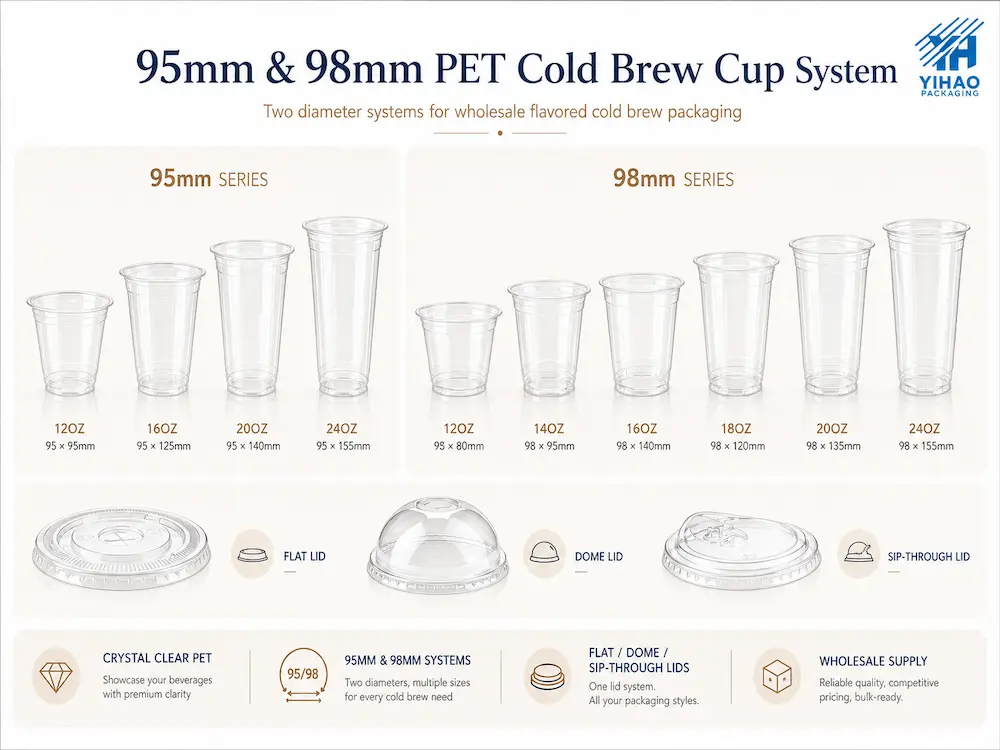
Cup size affects drink appearance, cost, service speed, lid selection, and customer satisfaction. Flavored cold brew often needs more headspace than plain iced coffee because it may include ice, milk, cream, foam, or topping layers.
A cup that is too small looks crowded and may spill during lid application. A cup that is too large makes the drink look underfilled. For wholesale buyers, the best size is not always the largest size. The best size is the one that matches the menu, portion logic, and lid system.
| Cup Size Direction | Best Use Scenario | Buyer Consideration | Packaging Risk to Avoid |
|---|---|---|---|
| Small Cold Brew Portions | Sample drinks, espresso-style cold brew, compact takeaway menus | Useful for controlled serving volume and lower beverage cost | Too little headspace for ice, foam, or layered milk |
| Medium Iced Coffee Cups | Standard iced coffee, vanilla cold brew, caramel cold brew, oat milk cold brew | Practical for daily cafe service and supermarket grab-and-go programs | Wrong lid choice may reduce service speed and create leakage issues |
| Large Flavored Cold Brew Cups | Cold foam drinks, seasonal cold brew, drinks with extra ice or cream | Supports better visual layers and premium menu positioning | Underfilled appearance if recipe volume is not planned correctly |
| Multi-Size Cup Series | Coffee chains, supermarkets, bakeries, distributors, and foodservice buyers | Improves inventory control when several sizes share compatible lid logic | Confusing cup and lid combinations if compatibility is not confirmed |
For most buyers, the safest approach is to test two or three sizes with the real drink recipe. Fill the cup with cold brew, ice, milk, syrup, and foam exactly as the customer will receive it. Then check appearance, lid fit, carrying comfort, and label placement.
Manufacturer checklist for wholesale flavored cold brew cups
A reliable flavored cold brew cups manufacturer should provide more than a catalog and unit price. Buyers need production consistency, technical support, documentation, sample testing, and repeat order stability.
1. Material clarity and food contact documentation
The cup should look clean, transparent, and premium. Cloudy cups weaken the visual value of flavored cold brew. Black spots, haze, flow marks, scratches, or color shift should be treated as quality risks.
Buyers should ask the manufacturer to confirm:
- PET or rPET material direction.
- Food contact suitability documentation.
- Cold beverage use suitability.
- Chilled display performance.
- Recycled-content documentation if rPET is offered.
- Color consistency between batches.
- Clarity level under strong retail lighting.
When a supplier says “food grade,” buyers should ask what documentation supports that statement. For export orders, food contact documentation is part of buyer protection.
2. Rim consistency and lid fit
Cup rim quality decides whether the lid performs properly. Most leakage complaints happen around the rim and lid connection. A cup may look good but still fail in real service if the lid is loose, too tight, or inconsistent between batches.
Buyers should test:
- Lid snap strength.
- Rim roundness.
- Rim thickness consistency.
- Lid removal force.
- Leakage risk when tilted.
- Fit after refrigeration.
- Fit across multiple samples, not only one sample.
For coffee cups with lids, the cup and lid must be tested as a complete system. Buyers should not approve cups alone without testing matching lids.
3. Cup stiffness and hand feel
Flavored cold brew often includes ice, milk, syrup, cream, and foam. A weak cup feels cheap and creates poor customer confidence. The cup should resist squeezing during filling, capping, pickup, delivery, and display handling.
Buyers should check:
- Sidewall firmness.
- Bottom stability.
- Grip comfort.
- Cup deformation when filled with ice.
- Stacking and de-nesting performance.
- Whether the cup collapses under light pressure.
- Whether the cup feels stable when carried with a lid.
A good wholesale cup should feel strong without becoming unnecessarily heavy or expensive.
4. Chilled display performance
Many flavored cold brew drinks are sold from refrigerated display cases. This creates different packaging needs compared with made-to-order counter service.
For chilled display, buyers should test:
- Cup clarity after refrigeration.
- Condensation appearance.
- Lid security after temperature change.
- Label adhesion on cold surfaces.
- Shelf stability.
- Product visibility under supermarket lighting.
- Cup appearance after several hours in a chilled display.
Clear PET cups support chilled display well because they show the beverage directly. However, labels should be positioned carefully. For flavored cold brew, the drink itself is part of the visual selling point.
5. Branding and label placement
Branding should support the drink, not hide it. A large opaque label may cover the milk layer, syrup line, or foam effect that makes flavored cold brew attractive.
Buyers can consider:
- Minimal logo printing.
- Clear labels.
- Small front stickers.
- Cup sleeves.
- Flavor-coded labels.
- QR code stickers.
- Seasonal drink labels.
- Custom carton marks for distribution.
The best branding strategy keeps the drink visible while making the brand recognizable. For wholesale programs, artwork files, print position, color standards, label material, and sample approval should be confirmed before mass production.
Supplier checklist before bulk orders
A strong supplier helps buyers reduce risk before wholesale purchasing. The cheapest supplier is not always the safest supplier. Stable communication, clear samples, correct packing, and repeat order reliability often matter more than a small unit price difference.
1. Request actual cup and lid samples
Photos are not enough. Buyers should request physical samples before confirming a wholesale order. Samples should include cups, matching lids, carton packing details, and any available label or printing options.
Sample testing should include:
- Filling with real cold brew.
- Adding ice, milk, syrup, and foam.
- Applying lids repeatedly.
- Carrying and tilting the cup.
- Refrigerating filled samples.
- Checking clarity under strong light.
- Testing label position.
- Reviewing carton protection.
- Comparing multiple samples for consistency.
A supplier that avoids sample testing creates unnecessary purchasing risk.
2. Confirm cup and lid compatibility in writing
Many buyers order cups from one supplier and lids from another. This creates risk because rim profiles may look similar but perform differently.
For cold brew cups, the safer approach is to approve a complete cup-and-lid system. The supplier should confirm which lids match the cup series. If the buyer needs flat lids, dome lids, sip lids, or straw slot lids, each lid should be tested separately.
Wholesale buyers should request written confirmation of cup and lid compatibility. This reduces disputes when bulk goods arrive.
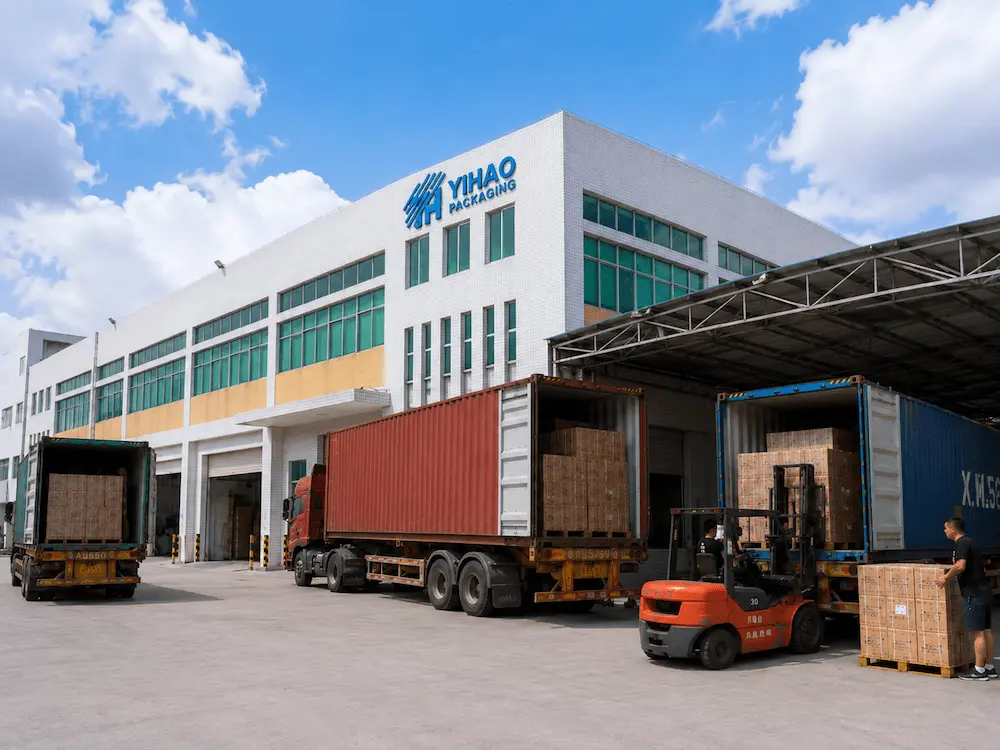
3. Review carton packing and export protection
Wholesale beverage packaging does not end with the cup. Carton strength matters because cups may be shipped long distances, stored in warehouses, and handled many times before final use.
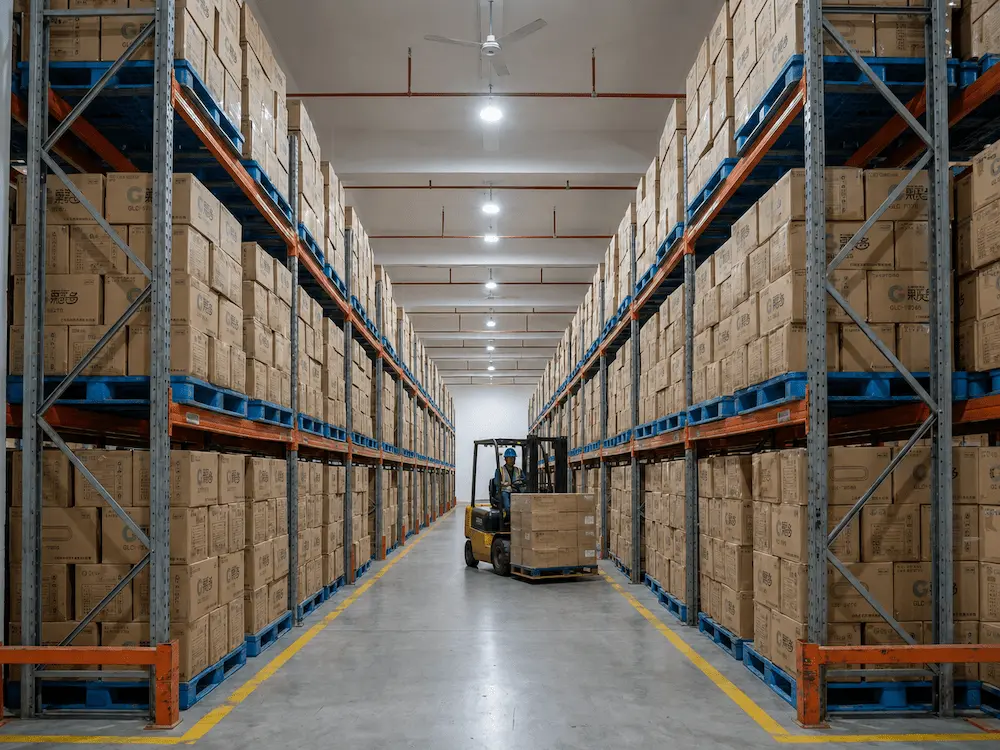
Buyers should check:
- Pieces per carton.
- Carton dimensions.
- Carton gross weight.
- Inner bag protection.
- Pallet loading plan.
- Compression resistance.
- Cup rim protection.
- Whether cups and lids are packed separately.
- Whether carton marks support warehouse sorting.
For export orders, carton planning affects landed cost, storage efficiency, and damage rate.
4. Evaluate supplier communication speed
Flavored cold brew often supports seasonal beverage launches. Slow supplier communication can delay menu updates, supermarket promotions, and distributor delivery plans.
A reliable supplier should respond clearly on:
- Product size options.
- Material options.
- Lid matching.
- Sample availability.
- Custom printing feasibility.
- Carton specifications.
- MOQ.
- Lead time.
- Documentation support.
- Export terms.
- Reorder planning.
If a supplier cannot answer basic technical questions before payment, the buyer should treat the order as higher risk.
Buyer decision matrix for wholesale flavored cold brew cups
The following matrix helps buyers compare suppliers before placing bulk orders.
| Decision Factor | Strong Supplier Signal | Weak Supplier Signal | Buyer Action |
|---|---|---|---|
| Material Clarity | Clear samples, stable appearance, no obvious haze or color shift | Cloudy photos, inconsistent samples, unclear material description | Request real samples and compare under retail lighting |
| Lid Fit | Supplier confirms matching lids and provides cup-lid samples together | Supplier only sells cups and avoids lid compatibility details | Approve cup and lid as one packaging system |
| Sample Support | Fast sample arrangement with practical testing guidance | No samples, delayed response, or only catalog images | Do not confirm bulk order before sample testing |
| Documentation | Provides food contact and material information when requested | Uses vague claims such as “safe” or “food grade” without support | Ask for documentation before mass purchasing |
| Carton Protection | Clear carton data, inner packing, pallet plan, and export awareness | No carton details or weak packing explanation | Review carton strength and rim protection before shipment |
| Wholesale Reliability | Stable MOQ, lead time, reorder planning, and communication | Unclear MOQ, changing answers, slow replies | Compare long-term supply risk, not only unit price |
Key comparison table for wholesale flavored cold brew cup buying
| Checklist Area | What Buyers Should Check | Why It Matters for Flavored Cold Brew | Risk If Ignored |
|---|---|---|---|
| Material | PET or rPET direction, food contact documentation, cold-use suitability | Supports cold drink packaging and buyer confidence | Compliance questions, weak trust, rejected documentation |
| Clarity | Transparency, haze level, surface cleanliness, visual consistency | Shows milk layers, syrup color, ice, foam, and premium appearance | Lower shelf appeal and weaker retail display value |
| Lid Fit | Snap strength, rim accuracy, leakage test, lid removal force | Prevents spills during takeaway, delivery, and chilled display | Customer complaints, carton waste, staff frustration |
| Capacity | Drink volume, ice ratio, foam height, menu size planning | Ensures the drink looks full, balanced, and premium | Overfilled cups, weak presentation, inconsistent portions |
| Strength | Sidewall stiffness, bottom stability, stacking performance | Improves handling confidence and takeaway performance | Cup deformation, poor customer experience, damaged stock |
| Branding | Print area, sticker placement, sleeve compatibility, label adhesion | Supports brand identity without hiding the drink | Poor brand display or blocked product visibility |
| Carton Packing | Pieces per carton, inner bag protection, pallet plan, export strength | Controls storage, freight cost, and damage rate | Higher landed cost and rim deformation during transport |
| Supplier Reliability | Sample speed, documentation, production consistency, lead-time control | Supports seasonal launches and repeat wholesale orders | Delayed campaigns, inconsistent quality, reorder problems |
Best applications for flavored cold brew cups
Flavored cold brew cups fit many sales channels because flavored coffee drinks are flexible, visually attractive, and easy to connect with chilled takeaway menus.
Cafes and coffee shops
Cafes use flavored cold brew cups for made-to-order drinks. Clear PET cups help customers see coffee layers, foam, syrup, ice, and milk movement. This is useful for vanilla cold brew, caramel cold brew, mocha cold brew, oat milk cold brew, cold foam cold brew, and seasonal coffee drinks.
For cafes, fast service matters. Staff need cups that separate easily, match lids quickly, and stay stable during busy hours.
Supermarkets and chilled retail displays
Supermarkets use clear cups for pre-filled chilled drinks, in-store cafe programs, and grab-and-go coffee shelves. The cup must look clean under display lighting and support labels without hiding too much of the beverage.
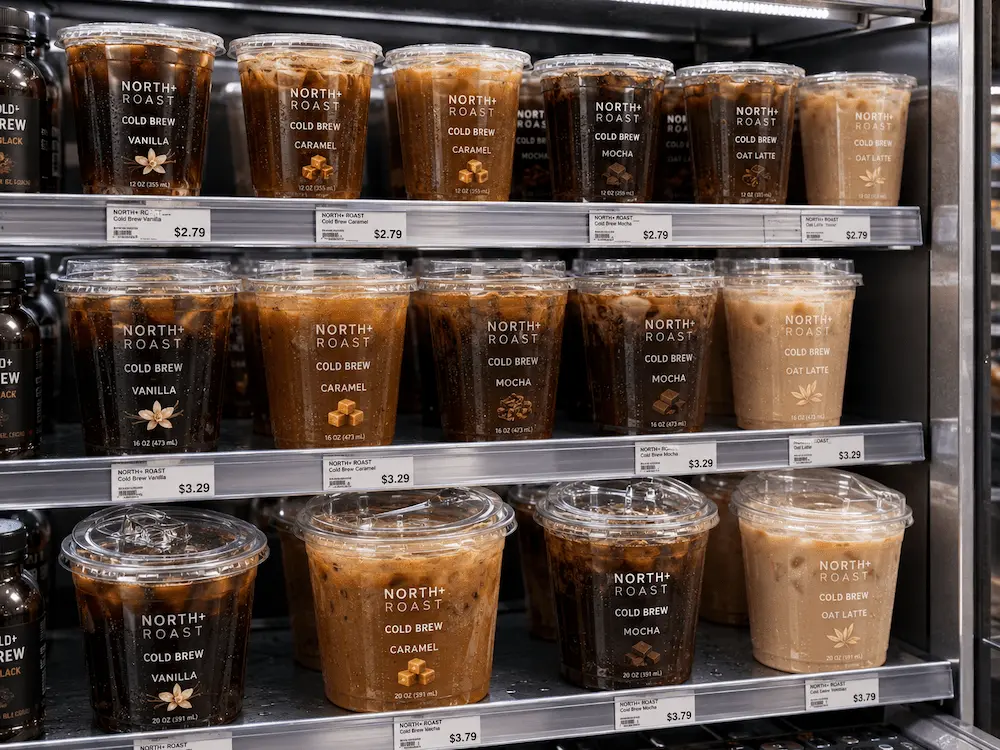
For supermarket buyers, shelf presentation and carton consistency are important. A cup that looks good in a sample photo but arrives with rim damage is not acceptable for retail display.
Bakeries and dessert shops
Bakeries often sell cold brew alongside pastries, cakes, sandwiches, salads, and takeaway desserts. Clear cups help beverage presentation match the fresh food display.
For bakery buyers, cups should support both visual quality and practical takeaway handling. Matching lids are essential because customers often carry drinks together with food boxes or bags.
Convenience stores
Convenience stores need packaging that supports fast selection and easy handling. Flavored cold brew drinks in clear cups should look ready to buy. The cup should show the drink clearly, fit display shelves, and hold up during daily stock rotation.
For convenience store programs, carton size, storage efficiency, and repeat supply are major purchasing factors.
Foodservice and event programs
Foodservice buyers may use flavored cold brew cups for catering, hotels, offices, events, and quick-service beverage counters. These orders often require stable supply, predictable packing, and cost control.
For this channel, reliable wholesale supply is more valuable than a small price difference.
Common mistakes buyers should avoid
Many flavored cold brew packaging problems come from rushing the supplier selection process.
Choosing only by price
Low price is not useful if the cup leaks, cracks, looks cloudy, or does not fit the lid. A small saving per carton can create larger losses through customer complaints and wasted drinks.
Ignoring lid compatibility
Cup and lid should be tested together. A supplier quote without lid matching information is incomplete.
Hiding too much of the drink with labels
Flavored cold brew has visual selling power. Labels should support the product, not cover it.
Skipping refrigeration tests
Cold drinks change packaging conditions. Condensation, label adhesion, and lid fit should be checked after chilling.
Ordering bulk quantity before sample approval
A wholesale order should follow sample testing. Buyers should never approve bulk purchasing based only on catalog images.
Not checking local packaging rules
Food contact and single-use packaging requirements vary by market. Buyers should confirm applicable rules in their selling region before large-scale purchasing.
Wholesale ordering checklist
Before placing a wholesale order for flavored cold brew cups, buyers should complete this checklist:
- Confirm cup material and food contact documentation.
- Confirm cup size and serving volume.
- Confirm matching lid type.
- Test cup and lid fit with real drinks.
- Check clarity with cold brew, milk, syrup, foam, and ice.
- Test cup performance after refrigeration.
- Review label or printing position.
- Review carton packing and export protection.
- Confirm sample approval process.
- Confirm MOQ and lead time.
- Confirm custom branding requirements.
- Confirm repeat order stability.
- Confirm local regulatory and labeling requirements.
A strong supplier should make this process easy. If a supplier cannot support technical confirmation, buyers should treat the order as higher risk.
How YIHAO supports flavored cold brew cup buyers
YIHAO is a food packaging manufacturer and solution provider focused on practical packaging for cold drinks, fresh food, bakery items, fruit, salad, and grab-and-go retail programs. For flavored cold brew buyers, YIHAO supports clear PET cup selection, matching lid evaluation, sample testing, wholesale order planning, carton packing review, and packaging selection for retail display and takeaway service.
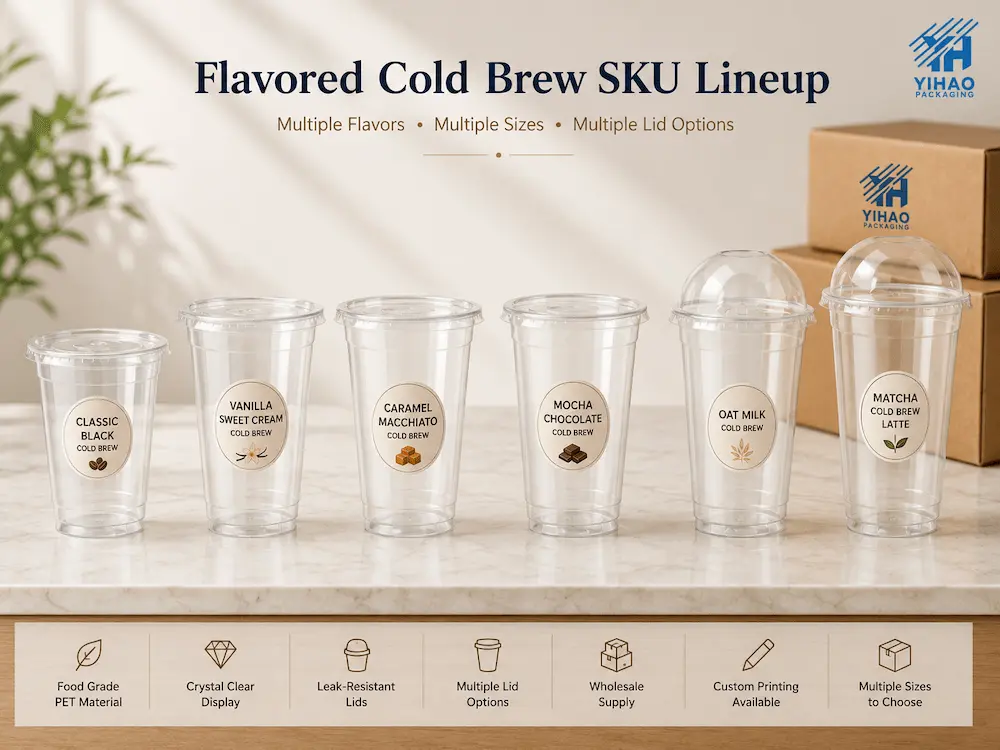
For coffee chains, supermarkets, cafes, bakeries, distributors, and foodservice buyers, the goal is not only to buy cups. The goal is to build a packaging system that protects drink presentation, improves service efficiency, supports chilled display, and reduces bulk order risk.
Buyers can request samples, compare cup and lid fit, review size options, confirm carton packing, and evaluate wholesale supply before placing a bulk order. This step helps purchasing teams reduce leakage complaints, improve product presentation, and build a more stable cold beverage packaging program.
Buyer quick note
For most flavored cold brew programs, clear PET cups with matching lids are the safest starting point. They show the drink clearly, support iced coffee presentation, and work across many cold beverage menus. Buyers should still test cup strength, lid fit, label position, carton protection, chilled display performance, and supplier consistency before wholesale purchasing.
FAQ
1. What are flavored cold brew cups?
Flavored cold brew cups are cold beverage cups used for serving vanilla cold brew, caramel cold brew, mocha cold brew, oat milk cold brew, cold foam cold brew, and other flavored iced coffee drinks. Clear PET cups are commonly used because they show coffee color, ice, milk layers, syrup, and foam clearly.
2. Are PET cups suitable for flavored cold brew?
Yes, PET cups are suitable for many flavored cold brew and iced coffee applications when they are designed for cold beverage use and supported by proper food contact documentation. Buyers should confirm material suitability, lid fit, cup strength, and chilled display performance with the supplier before bulk orders.
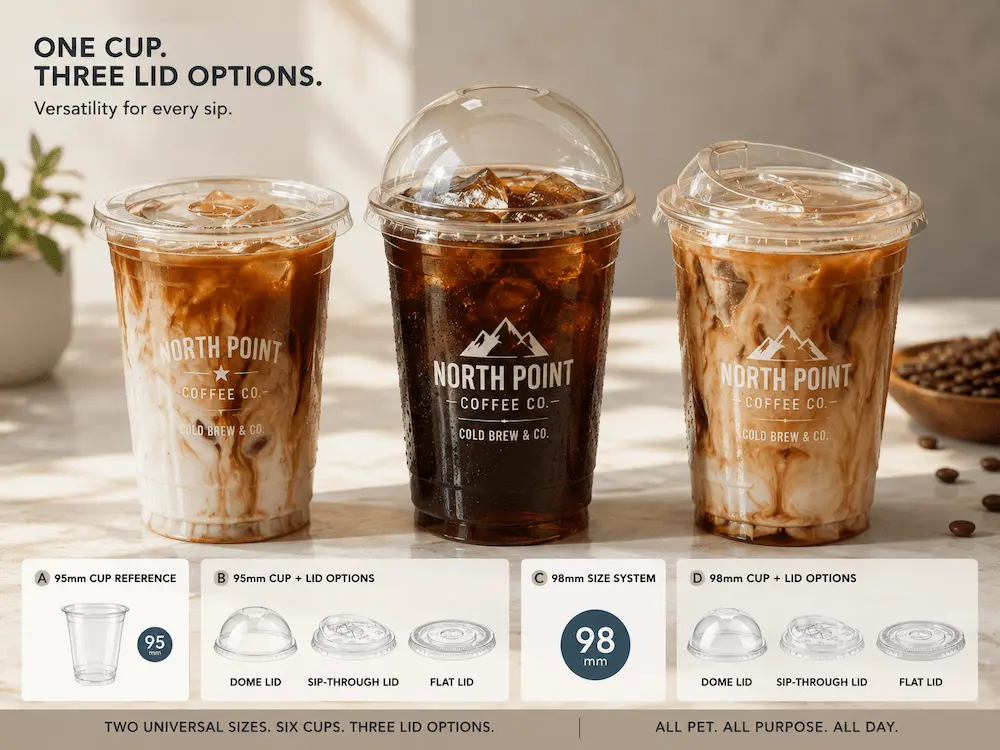
3. What lid should buyers choose for flavored cold brew cups?
The best lid depends on the drink format. Flat lids are practical for standard iced coffee and cold brew. Dome lids help when drinks include foam or toppings. Sip lids support direct drinking, while straw slot lids are common for takeaway cold drinks. Buyers should test every cup and lid combination before wholesale purchasing.
4. What should buyers test before ordering wholesale flavored cold brew cups?
Buyers should test material clarity, cup strength, rim consistency, lid fit, leakage resistance, refrigeration performance, label placement, carton protection, and real drink appearance. Samples should be tested with actual cold brew, ice, milk, syrup, and foam instead of water only.
5. How can buyers choose a reliable flavored cold brew cups supplier?
A reliable supplier should provide physical samples, clear product specifications, food contact documentation, matching lid recommendations, stable carton packing, realistic lead times, and responsive communication. For wholesale orders, supplier consistency matters as much as unit price.
References
- U.S. Electronic Code of Federal Regulations, 21 CFR 177.1630, Polyethylene Phthalate Polymers.
- European Commission, Commission Regulation (EU) No 10/2011 on Plastic Materials and Articles Intended to Come into Contact with Food.
- European Commission, Directive (EU) 2019/904 on the Reduction of the Impact of Certain Plastic Products on the Environment.
- Association of Plastic Recyclers, APR Design Guide for Plastics Recyclability.
- Association of Plastic Recyclers, PET Rigid Packaging Design Guidance.
- U.S. Food and Drug Administration, Food Contact Substances and Plastic Food Packaging Resources.
- European Food Safety Authority, Food Contact Materials Safety Assessment Resources.
- National Coffee Association, Coffee Market and Consumer Beverage Trends Resources.
Deep-Dive Insights
How buyers should think about flavored cold brew packaging
Buyers should start from the drink format, not the cup format. A plain cold brew, vanilla cold brew, caramel cold brew, cold foam cold brew, and fruit-infused cold brew do not create the same packaging requirements. Ice level, foam height, milk ratio, syrup visibility, label placement, and lid type all affect the final packaging choice.
Why clear PET cups remain strong for flavored cold brew
Clear PET cups show the product directly. This matters because flavored cold brew sells through appearance as much as function. The cup displays coffee color, milk contrast, syrup movement, ice quality, and foam texture. For retail and takeaway channels, this visible presentation helps the drink feel fresh, premium, and ready to buy.
What alternative packaging does better
Bottles are stronger for sealed retail beverage programs. Cans are stronger for long shelf-life beverage branding. Paper cups are stronger for full-surface printing. PP cups offer strong flexibility in some rough-handling environments. Clear PET cups are strongest when the buyer needs visible presentation, practical takeaway use, and flexible cold drink menu coverage.
Option buyers should prioritize first
For most cafes, supermarkets, bakeries, convenience stores, and foodservice beverage programs, clear PET flavored cold brew cups with matching lids are the safest first option. They support visual selling, menu flexibility, chilled display, and practical service without forcing the buyer into a more complex sealed beverage packaging system.
Consideration before wholesale purchasing
Before placing a wholesale order, buyers should test real drinks in real service conditions. Cold brew, ice, milk, syrup, foam, lids, labels, refrigeration, and carton shipping should all be evaluated. A supplier that supports sample testing and clear documentation gives buyers a stronger foundation for repeat purchasing.
© YIHAO. All rights reserved. This article is created for food packaging buyers, coffee brands, supermarkets, cafes, bakeries, distributors, and foodservice teams evaluating flavored cold brew cups, PET coffee cups, cold brew cups, and coffee cups with lids for wholesale purchasing.