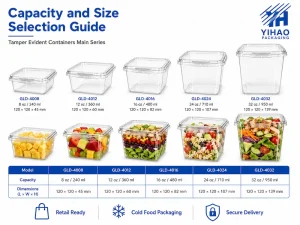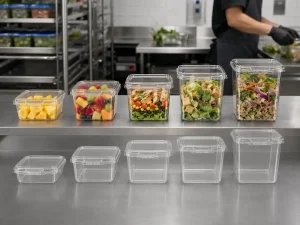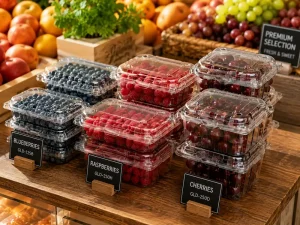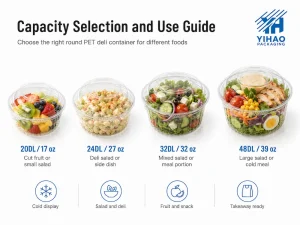

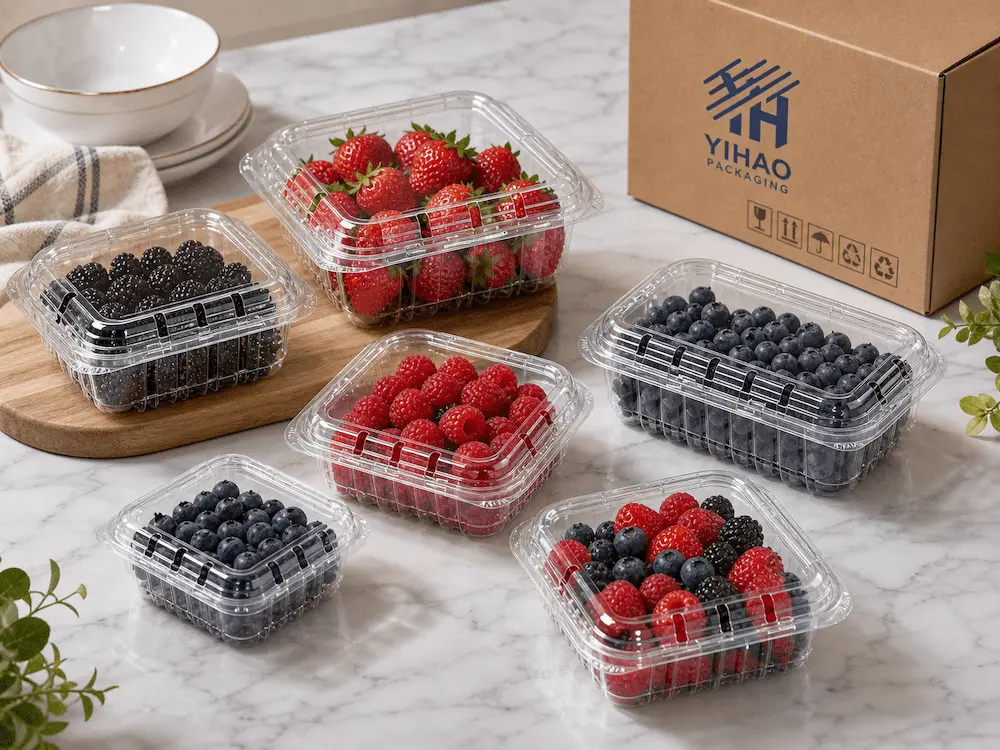
Micro Summary: Berry Clamshell Packaging for Fresh Produce Buyers
Berry clamshell packaging is widely used for blueberries, blackberries, raspberries, strawberries, and mixed berries because it combines clear product visibility, vented freshness support, hinged handling, stackable structure, and retail-ready presentation.
For fresh produce brands, supermarkets, distributors, cafes, bakeries, and foodservice buyers, the right blueberry containers, blackberry clamshell containers, and raspberry packaging containers should match berry sensitivity, airflow needs, filling volume, cold-chain handling, and shelf display requirements.
Before choosing vented berry clamshells, clear PET berry containers, retail berry packaging, or wholesale berry packaging, buyers should confirm material clarity, vent design, lid fit, stackability, carton packing, sample performance, and the reliability of the fruit clamshell manufacturer.
Why Berry Clamshell Packaging Matters for Fresh Produce Buyers
Fresh berries are high-value, highly visual, and easily affected by handling conditions. Blueberries, blackberries, raspberries, strawberries, and mixed berries all need packaging that does more than hold fruit. The right berry clamshell packaging protects product visibility, supports airflow, reduces unnecessary handling damage, improves stacking, and helps customers judge freshness quickly in retail display.
For fresh produce brands, berry growers, supermarkets, distributors, cafes, bakeries, and foodservice buyers, packaging is part of the selling process. A clear container helps berries look fresh. A vented structure helps support airflow. A stable hinged clamshell helps with filling, closing, stacking, transport, and display. A reliable carton packing method helps wholesale buyers reduce deformation and supply chain risk.
YIHAO is a food packaging manufacturer and solution provider focused on practical packaging for fresh produce, berries, fruits, salads, desserts, and takeaway food applications. From a buyer’s point of view, choosing berry clamshell packaging should not be based only on price. The better decision comes from matching berry type, packaging structure, retail channel, carton packing, and supplier capability.
Fresh berries need visibility, ventilation, and gentle protection
Berries sell through appearance. Customers look at berry color, size, shape, ripeness, and surface condition before purchase. A cloudy or poorly shaped pack makes the fruit look less attractive, even when the berries inside are good.
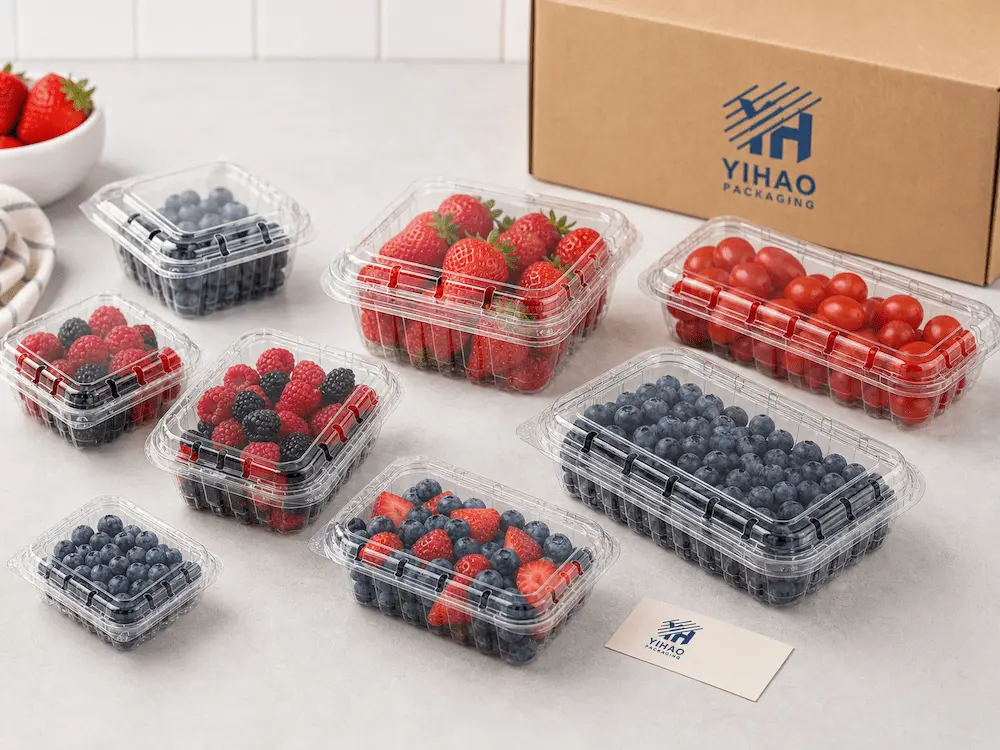
Clear berry clamshell packaging allows customers to inspect the fruit from multiple angles. Vent holes help airflow move around the berries. A hinged structure keeps the pack easy to open and close. Stackable design supports storage, transport, and shelf display.
For soft berries such as raspberries and blackberries, gentle protection is especially important. For smaller berries such as blueberries, airflow and containment are essential. A complete packaging system must consider these differences.
Berry packaging affects retail sales and supply chain efficiency
Good retail berry packaging improves shelf presentation. Good wholesale berry packaging improves carton efficiency, handling consistency, and repeat-order planning. These two goals are connected.
Retail buyers want clean display, clear visibility, and label space. Wholesale buyers want stable stacking, strong carton packing, reliable supply, and consistent quality. Foodservice buyers need portion control, ingredient handling, and operational efficiency.
A strong clamshell design helps connect all these needs into one packaging system.
A complete packaging system starts with the right clamshell design
A berry clamshell is not just a box with a lid. It includes material clarity, lid structure, hinge performance, vent hole placement, closure strength, sidewall stability, stacking logic, label area, and carton packing method.
When buyers evaluate berry clamshell packaging, they should test the container with real fruit. Empty packaging can look acceptable, but filled packaging reveals the real performance: fruit compression, lid clearance, stacking stability, and retail display quality.
What Is Berry Clamshell Packaging?
Berry clamshell packaging refers to hinged containers designed for fresh berries and small produce items. These containers usually include a base, attached lid, vent holes, closure points, and a clear body that allows customers to see the fruit.
The clamshell format is widely used because it supports filling, closing, transportation, display, and customer handling. It is especially practical for blueberries, blackberries, raspberries, strawberries, cherries, grape tomatoes, and mixed berry packs.
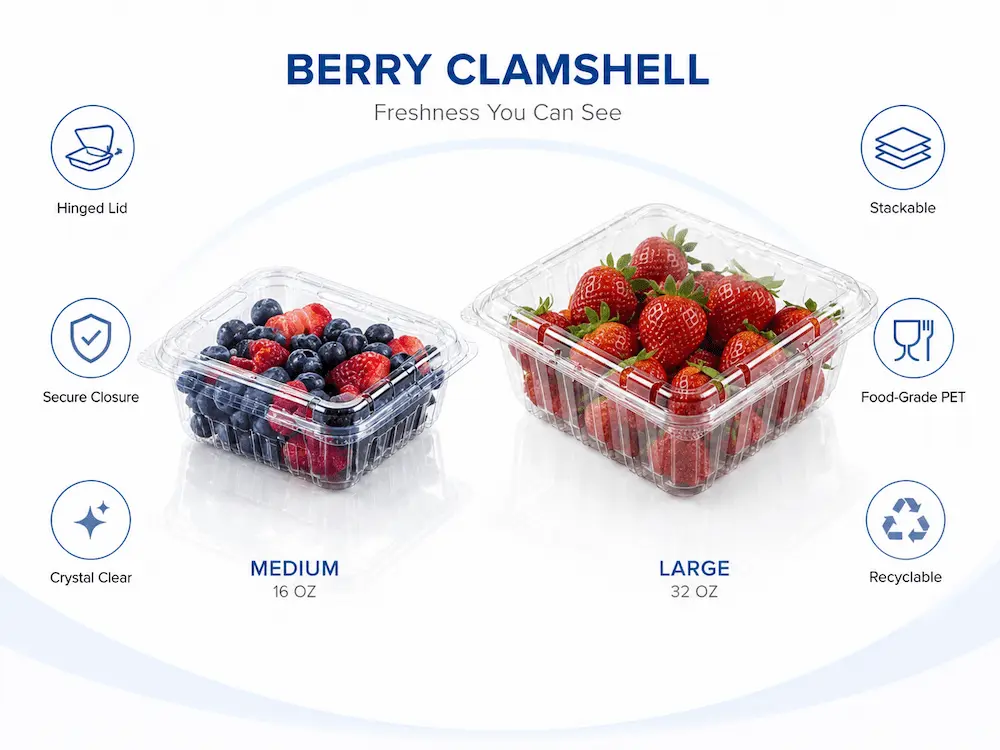
Berry clamshell packaging uses a hinged structure for fresh berries
The hinged structure keeps the lid and base connected. This helps reduce separate lid handling during packing and improves operational efficiency. Staff can fill the base, close the lid, apply labels, stack the packs, and prepare cartons more easily.
A secure closure also helps keep the fruit contained during transport and retail handling. For customer-facing packaging, the lid should be easy enough to open while still staying closed during normal handling.
Clear PET berry containers are widely used for visual display
Clear PET berry containers are commonly used because they provide strong transparency and a clean retail appearance. PET clarity helps customers see berry color, fruit size, and overall condition before purchase.
For supermarkets, clear containers help berries stand out in refrigerated produce displays. For cafes and bakeries, they help show fresh ingredients for parfaits, fruit cups, tarts, cakes, and chilled desserts. For distributors, they create a professional packaging format suitable for multiple sales channels.
Vented structures support airflow around fresh fruit
Many berry clamshells include vent holes. Vented berry clamshells help support airflow around the berries and reduce trapped moisture inside the container. Vent design should be matched to berry type, pack size, filling volume, and cold-chain conditions.
Ventilation is not a replacement for proper refrigeration or product handling, but it is an important packaging feature for fresh berry presentation.
Why Clear PET Is Commonly Used for Berry Clamshells
PET is widely used in fresh berry clamshells because it offers clear product visibility, lightweight handling, and practical structure for cold-use produce packaging. For berries, visibility is one of the strongest selling points.
Customers want to see the fruit. Retailers want shelf-ready presentation. Distributors want stable packing. This is why clear PET berry containers remain a common choice for fresh berry programs.
Clear PET helps customers inspect freshness quickly
Berries are bought visually. Customers inspect color, shape, size, moisture appearance, and visible damage. Clear PET packaging helps customers make that decision quickly without opening the container.
This is especially important for mixed berry packs. The contrast between blueberries, raspberries, blackberries, and strawberries becomes part of the product appeal. Clear packaging lets the fruit itself become the visual message.
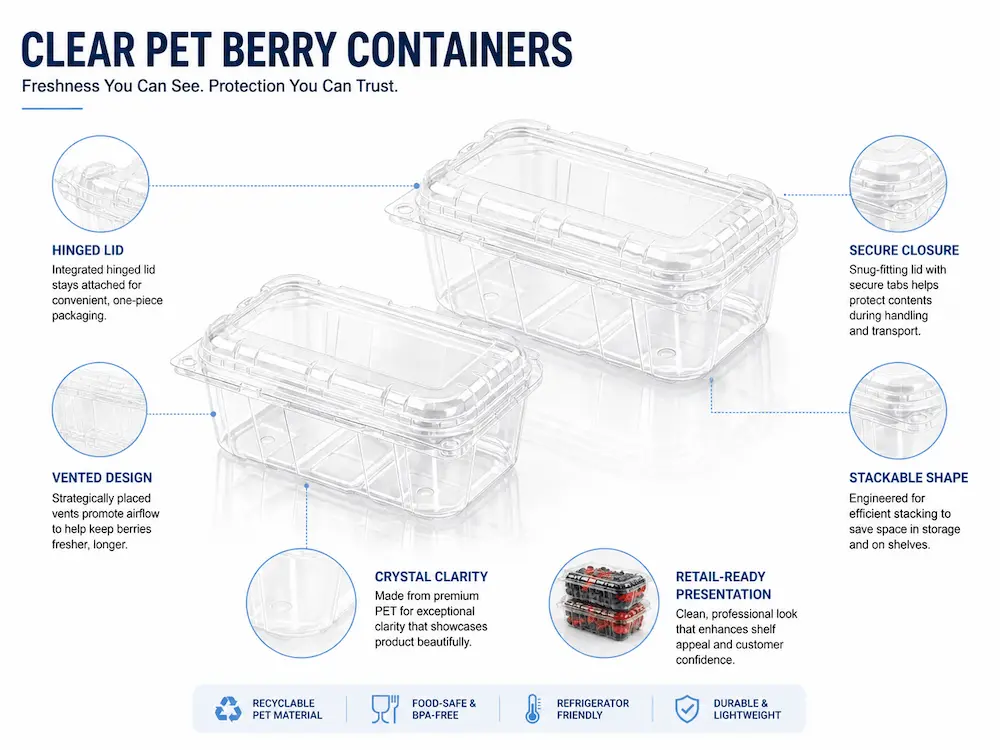
PET structure supports retail handling and stacking
PET can support hinged clamshell structures, vent holes, stackable shapes, and display-ready formats. For supermarkets and produce distributors, this structure helps packs remain organized during storage and display.
For retail berry packaging, stackability supports shelf efficiency. For wholesale berry packaging, stable nesting and carton packing support shipping and storage efficiency.
Buyers should confirm food-contact documentation before bulk orders
Before placing bulk orders, buyers should confirm the material type, intended use, and food-contact documentation with the fruit clamshell manufacturer. Requirements may vary by target market, product type, and buyer standards.
If recycled-content options are required, buyers should confirm availability, suitability, and documentation before quotation and sampling. Packaging claims should be based on verified supplier information and target-market requirements.
Packaging Needs for Blueberries, Blackberries, and Raspberries
Blueberries, blackberries, and raspberries are all berries, but they do not have the same packaging needs. A container that works well for one berry may not be ideal for another. Buyers should match container size, venting, internal space, and lid clearance to the fruit.
| Berry Type | Packaging Focus | Key Buyer Concern | Recommended Check |
|---|---|---|---|
| Blueberries | Blueberry containers with ventilation and stackability | Airflow, small fruit containment, retail display | Test filled-pack stacking and lid closure |
| Blackberries | Blackberry clamshell containers with gentle protection | Internal space, lid clearance, fruit shape protection | Check fruit compression and pack depth |
| Raspberries | Raspberry packaging containers with soft-fruit support | Pressure reduction, ventilation, careful filling | Avoid overfilling and test lid clearance |
| Mixed berries | Clear PET berry containers with strong visibility | Color display, portion control, premium presentation | Review visual presentation under retail lighting |
Blueberry containers need airflow and stable stacking
Blueberry containers should support airflow and stable stacking. Blueberries are small and round, so the container needs to keep the fruit contained while making it easy for customers to see the product clearly.
For supermarkets and distributors, filled blueberry packs should stack neatly without crushing the fruit. Buyers should test closure strength, venting, filled-pack stability, and carton packing before approving large orders.
Blackberry clamshell containers need more internal space
Blackberries are larger and more delicate than blueberries. Blackberry clamshell containers should provide enough internal space so the fruit is not squeezed tightly. The lid should close securely without pressing heavily on the berries.
For retail display, clear packaging helps show the dark color and glossy surface of blackberries. For wholesale buyers, carton packing and stackability should be tested carefully because blackberries can be affected by pressure.
Raspberry packaging containers need careful pressure control
Raspberries are soft, delicate, and easily affected by pressure. Raspberry packaging containers should be selected with extra care. Buyers should check internal space, filling volume, venting, lid clearance, and carton packing.
A container that is too shallow, too tight, or poorly vented may reduce product appearance. For premium raspberries, clear visibility and gentle support are especially important because customers judge the fruit by shape and color.
Why Vented Berry Clamshells Are Important
Vented berry clamshells are important because berries are sensitive to moisture and airflow conditions. Vent holes help air move around the fruit and support better display conditions during cold-chain handling and retail presentation.
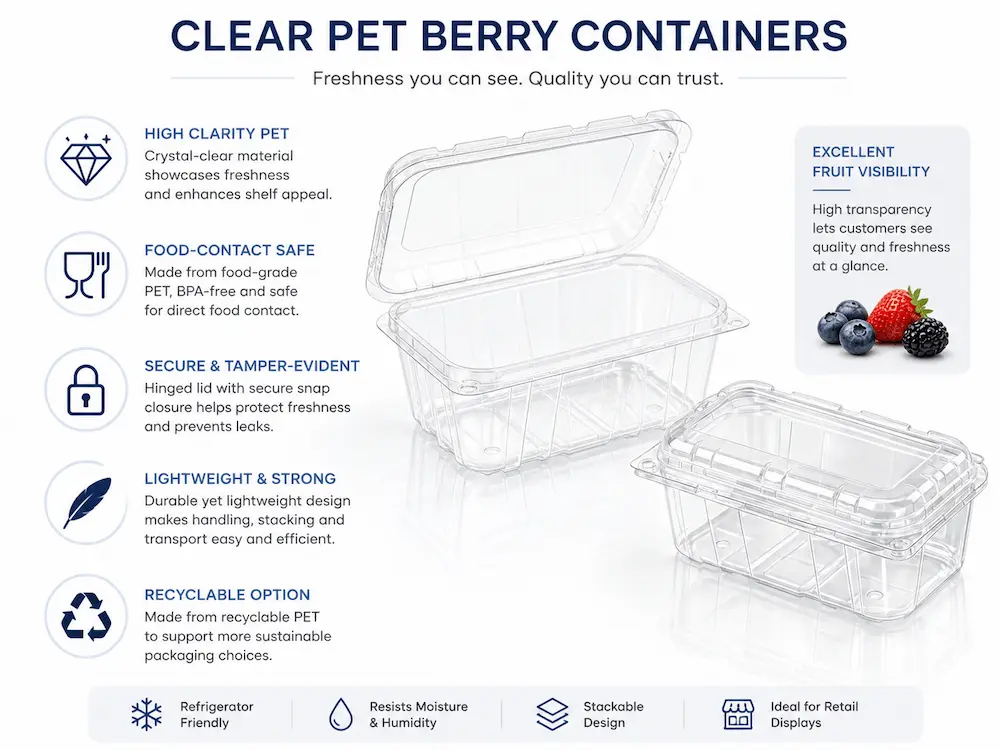
Vent holes help support airflow
Vent holes are designed to support airflow around the berries. This helps reduce trapped moisture inside the container and supports the visual condition of the fruit.
For blueberries, airflow supports freshness presentation across small fruit surfaces. For raspberries and blackberries, airflow should be balanced with gentle handling and proper packing.
Vent placement should match berry type and container size
Vent hole number, size, and placement should match the container structure. A larger container may need a different vent pattern than a smaller one. A raspberry pack may need different internal space and airflow logic than a blueberry pack.
Buyers should not assume all vented containers perform the same way. Sample testing with real berries is still necessary.
Ventilation works together with cold-chain handling
Ventilation does not replace refrigeration, careful handling, product rotation, or proper storage. It works together with these practices. A good berry clamshell packaging system supports the fruit through the full journey from filling line to retail shelf.
Retail Berry Packaging vs Wholesale Berry Packaging
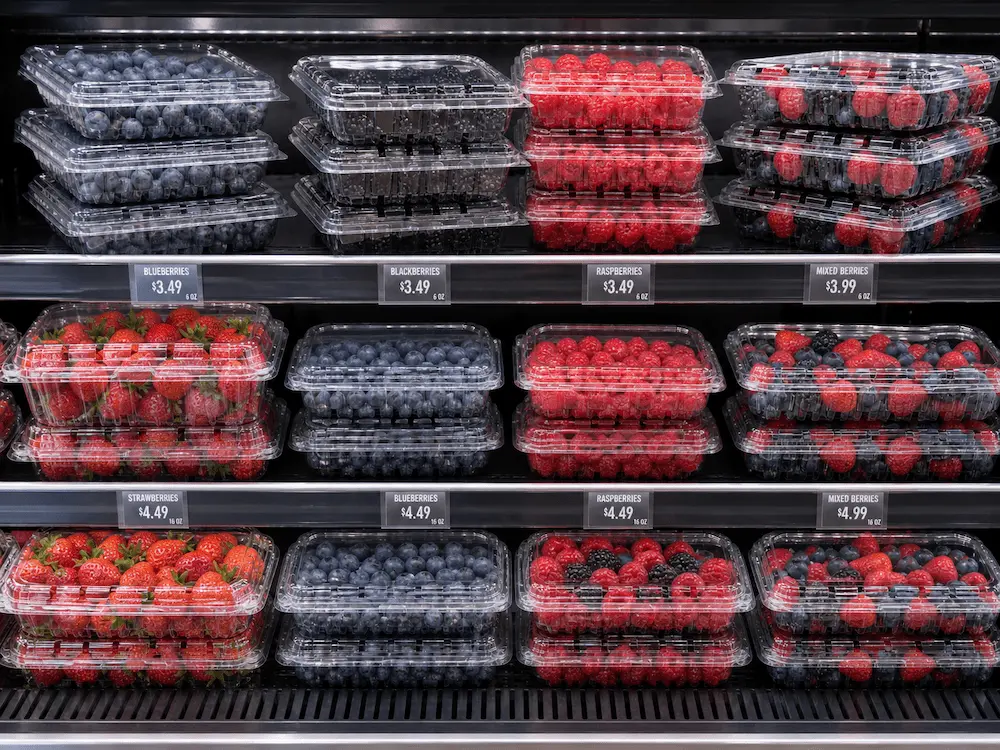
Retail and wholesale buyers often evaluate berry packaging differently. Retail buyers focus on shelf appeal, product visibility, label space, and customer inspection. Wholesale buyers focus on carton efficiency, repeat supply, stackability, and logistics performance.
| Buying Scenario | Packaging Priority | Buyer Focus | Typical Buyers |
|---|---|---|---|
| Retail berry packaging | Shelf appeal, visibility, label space | Clear display and customer purchase confidence | Supermarkets, fruit shops, convenience stores |
| Wholesale berry packaging | Carton efficiency, repeat supply, stackability | Stable packing and logistics performance | Distributors, importers, produce suppliers |
| Foodservice berry packaging | Portion control and ingredient handling | Operational efficiency and easy storage | Cafes, bakeries, prepared food brands |
| Private label berry packaging | Branding and consistency | Label space, carton marking, repeat-order control | Retail brands and produce companies |
A strong packaging program should connect both sides. Retail berry packaging should look good on shelves, while wholesale berry packaging should perform well in storage, shipping, and repeat ordering.
How to Choose the Right Berry Clamshell Size and Structure
Choosing the right size and structure is one of the most important steps in berry packaging. Buyers should avoid selecting a container only by appearance. The best container should match berry type, filling volume, lid clearance, stacking method, carton packing, and retail display layout.
Size should match berry type and filling volume
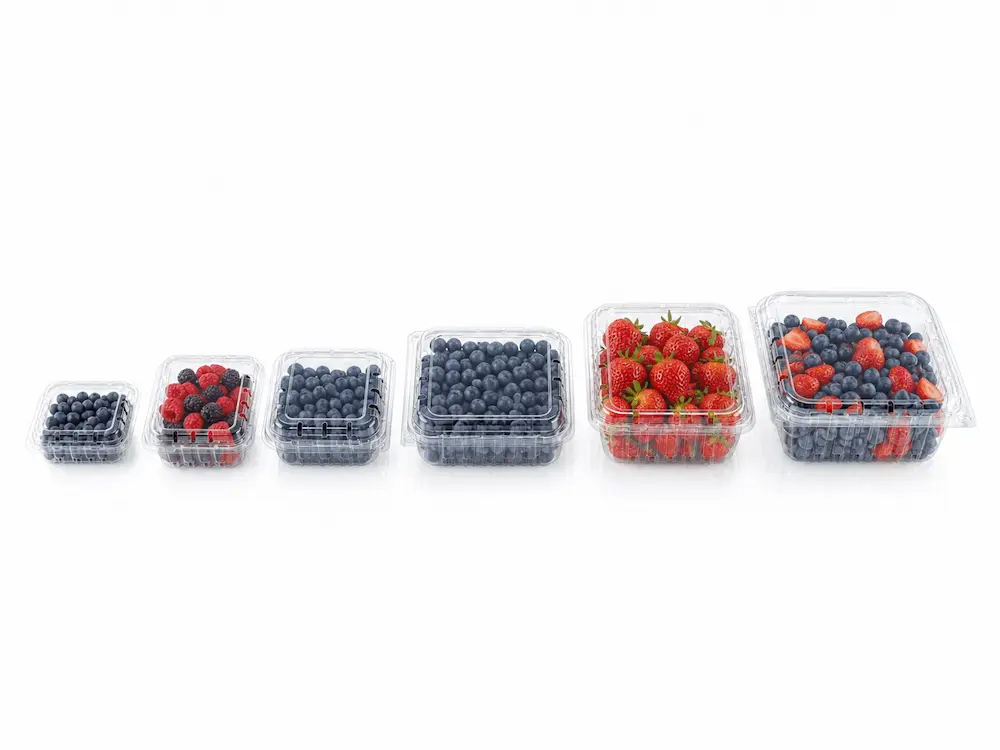
Different berries need different internal space. Blueberries can work in compact packs, while strawberries need more room. Blackberries and raspberries require careful lid clearance because they are more pressure-sensitive.
Buyers should test filling volume with real berries before placing bulk orders. The container should not be overfilled, and the lid should close without pressing too heavily on the fruit.
Lid fit affects handling and customer confidence
A strong lid fit helps the pack stay closed during normal handling, transport, and display. A weak closure may cause spilling or customer complaints. A lid that is too tight may make the pack difficult to open.
For berry clamshell packaging, the lid should feel secure and practical. Buyers should test the opening and closing experience with filled containers.
Stackability matters for shipping and retail display
Stackability affects warehouse storage, carton packing, refrigerated display, and retail replenishment. A container that stacks well when empty may not stack properly when filled.
Buyers should test filled-pack stacking before approving the structure. This is especially important for wholesale berry packaging, where carton efficiency and transport stability affect the total cost.
Sample testing prevents wholesale ordering mistakes
Sample testing is one of the most effective ways to reduce risk. Buyers should test real fruit inside the container, close the lid, stack multiple packs, check label placement, and review the product under retail lighting.
Photos alone are not enough. A professional purchasing process should include sample review before mass production.
What Buyers Should Check Before Ordering Berry Clamshell Packaging
Before ordering berry clamshell packaging, buyers should evaluate the complete packaging system. This includes material, shape, venting, closure, stacking, carton packing, documentation, and supplier capability.
| Buyer Checkpoint | What to Confirm | Why It Matters |
|---|---|---|
| Material clarity | Clear PET appearance and surface finish | Supports freshness perception and retail appeal |
| Vent design | Hole placement and airflow logic | Helps support berry display conditions |
| Lid closure | Hinge, snap fit, and opening convenience | Reduces handling issues and customer frustration |
| Stackability | Filled and empty stacking performance | Improves storage, shipping, and display efficiency |
| Size matching | Berry type and portion target | Avoids overfilling, fruit compression, or wasted space |
| Carton packing | Sleeve count, carton strength, export packing | Reduces deformation risk before use |
| Supplier capability | Sample support, documentation, repeat orders | Supports stable wholesale supply |
This checklist helps buyers compare packaging more professionally. A low unit price is not enough if the container is cloudy, unstable, poorly vented, or difficult to close.
How to Choose a Fruit Clamshell Manufacturer
Choosing the right fruit clamshell manufacturer is a strategic decision for fresh produce brands, distributors, supermarkets, cafes, bakeries, and foodservice buyers. A manufacturer should provide more than a product quote. It should help buyers match packaging to real application needs.
Check product range and mold consistency
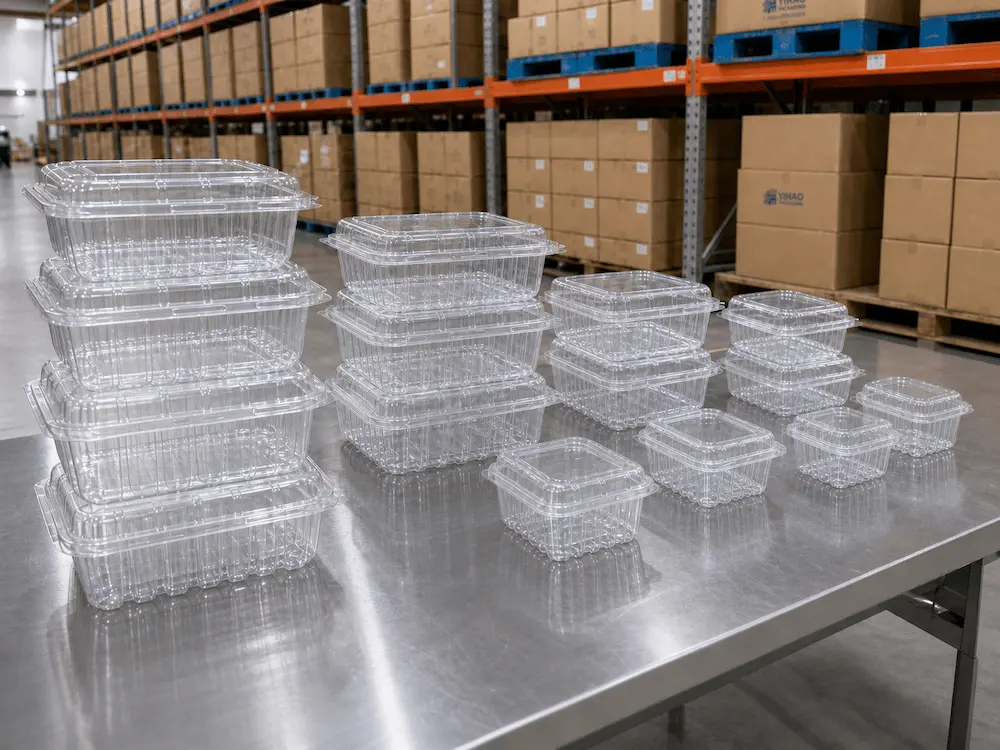
A professional manufacturer should offer practical packaging options for blueberries, blackberries, raspberries, strawberries, and mixed berries. Buyers should check whether the supplier can support different container sizes, vented designs, clamshell structures, and carton packing options.
Mold consistency matters because small shape differences can affect lid fit, stacking, filling, and labeling.
Ask about clear PET berry containers and vented options
Buyers should ask whether the manufacturer provides clear PET berry containers and vented berry clamshells suitable for different berry types. Material clarity and vent design should be reviewed with samples.
For buyers managing multiple berry products, a supplier with a wider product range can reduce sourcing complexity.
Review sample quality before wholesale orders
Samples should be tested with real fruit. Buyers should check filled-pack appearance, lid closure, stacking, venting, label space, and carton packing. The goal is to confirm that the packaging works in actual use, not only in photos.
Confirm carton packing, OEM support, and export experience
Wholesale buyers should confirm sleeve count, carton quantity, carton dimensions, pallet loading, export packing, carton marking, and OEM support. These details affect warehouse efficiency, shipping cost, and product protection.
For private label or branded berry programs, buyers should also discuss label placement, barcode requirements, carton printing, and retail presentation.
Reliable manufacturers help reduce sourcing risk
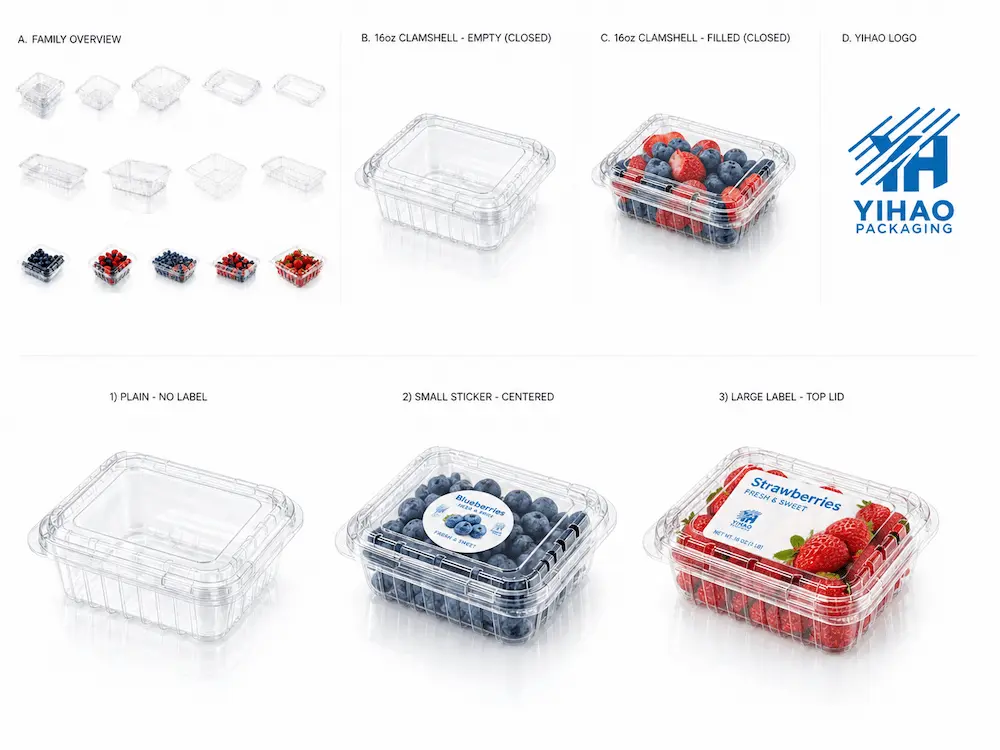
A reliable fruit clamshell manufacturer helps reduce risk before mass ordering. Strong communication, stable mold quality, sample support, documentation assistance, and repeat-order consistency all matter.
For long-term wholesale berry packaging programs, supplier stability is often more valuable than a small unit-price difference.
Common Mistakes Buyers Should Avoid
Choosing only by low price
Low price does not always mean low total cost. Weak packaging may lead to deformation, poor display, lid issues, fruit damage, and buyer complaints. Buyers should compare price together with clarity, venting, closure, packing, and supplier reliability.
Using one container for every berry type without testing
Blueberries, blackberries, and raspberries have different packaging needs. One container may work for blueberries but not for raspberries. Testing real fruit prevents avoidable mistakes.
Ignoring vent design
Vent design affects airflow and display conditions. Buyers should review vent hole placement and test whether the design matches the fruit and retail channel.
Overlooking carton packing
Carton packing protects empty containers before they are used. Poor packing can deform clamshells during shipping and storage. Wholesale buyers should confirm carton strength, sleeve count, and export packing method.
Forgetting retail display requirements
A container should perform well on the shelf, not only in a warehouse. Buyers should check label position, visibility, stackability, and refrigerated display appearance.
Final Buying Advice for Berry Clamshell Packaging
The best berry clamshell packaging connects fruit protection, clear visibility, airflow, stackability, retail presentation, and wholesale supply efficiency. Blueberries need airflow and stable stacking. Blackberries need internal space and gentle protection. Raspberries need pressure control and careful lid clearance.
For retail buyers, packaging should improve shelf appeal and customer confidence. For wholesale buyers, packaging should support carton efficiency, repeat supply, and logistics stability. For foodservice buyers, packaging should support ingredient handling, portion control, and reliable use across daily operations.
YIHAO provides berry clamshell packaging, clear PET berry containers, vented berry clamshells, retail berry packaging, and wholesale berry packaging solutions for fresh produce brands, supermarkets, distributors, cafes, bakeries, and foodservice buyers. A strong packaging system helps berries look better, move more efficiently, and perform more reliably from packing line to retail shelf.
FAQ
1. What is berry clamshell packaging used for?
Berry clamshell packaging is used for packing, protecting, displaying, and selling fresh berries such as blueberries, blackberries, raspberries, strawberries, and mixed berries. It supports visibility, ventilation, handling, stacking, and retail display.
2. Why do berry clamshells need ventilation?
Berry clamshells need ventilation because berries are sensitive to moisture and handling conditions. Vent holes help support airflow around the fruit and improve display conditions during cold-chain handling and refrigerated retail presentation.
3. What is the best packaging for blueberries, blackberries, and raspberries?
The best packaging depends on the berry type. Blueberry containers should support airflow and stacking, blackberry clamshell containers should provide internal space and gentle protection, and raspberry packaging containers should reduce pressure on delicate fruit while supporting ventilation and visibility.
4. Are clear PET berry containers suitable for retail display?
Yes. Clear PET berry containers are suitable for retail display because they allow customers to see berry color, size, shape, and freshness clearly. They are commonly used in supermarkets, fruit shops, convenience stores, cafes, bakeries, and grab-and-go fresh food programs.
5. How do I choose a fruit clamshell manufacturer?
Choose a fruit clamshell manufacturer by checking product range, material clarity, vent design, lid fit, stackability, carton packing, sample quality, documentation support, OEM options, export experience, and repeat-order reliability.
References
- U.S. Food and Drug Administration — Food Contact Substances
- European Commission — Food Contact Materials
- USDA — Fresh Produce Handling and Storage Guidance
- International Fresh Produce Association — Produce Packaging Resources
- Association of Plastic Recyclers — PET Design Guidance
- NAPCOR — PET Recycling Report
- WRAP — Fresh Produce Packaging and Food Waste Guidance
- ISO — Packaging and Environmental Management Standards
Deep-Dive Insights: Berry Clamshell Packaging for Modern Fresh Produce Buyers
How does berry clamshell packaging improve retail display?
Berry clamshell packaging improves retail display by making the fruit visible, organized, and easy to inspect. Clear packaging helps customers see berry color, shape, size, and freshness before purchase, while stackable structure supports clean refrigerated display.
Why are vented berry clamshells important?
Vented berry clamshells are important because berries are sensitive to moisture and handling conditions. Vent holes support airflow around the fruit and help maintain better display conditions when combined with proper cold-chain handling and product rotation.
What should wholesale buyers test before ordering?
Wholesale buyers should test material clarity, lid closure, vent design, filled-pack stacking, carton packing, label placement, and real-fruit performance. Sample testing helps buyers avoid problems that cannot be judged from product photos alone.
Which berry type needs the most careful packaging selection?
Raspberries and blackberries usually need more careful packaging selection because they are softer and more pressure-sensitive than blueberries. Buyers should confirm internal space, lid clearance, ventilation, and filling volume before approving bulk orders.
Why does manufacturer selection matter for berry clamshell packaging?
Manufacturer selection matters because berry packaging performance depends on mold consistency, material clarity, vent design, closure quality, carton packing, documentation support, and repeat-order reliability. A stable fruit clamshell manufacturer helps buyers reduce sourcing risk and build long-term packaging consistency.
© YIHAO. All rights reserved. This article is an original editorial resource prepared for professional fresh produce buyers, berry brands, supermarkets, distributors, cafes, bakeries, foodservice operators, and wholesale packaging teams.
The content reflects YIHAO’s practical packaging knowledge in berry clamshell packaging, clear PET berry containers, vented berry clamshells, retail berry packaging, wholesale berry packaging, and application-based fresh produce packaging selection. Product suitability, material documentation, market compliance, and final purchasing decisions should be confirmed according to the buyer’s target market, intended use, and supplier-provided documents.
No part of this article may be copied, republished, rewritten, translated, or redistributed for commercial use without written permission from YIHAO. Short excerpts may be referenced with proper attribution to YIHAO as the original source.