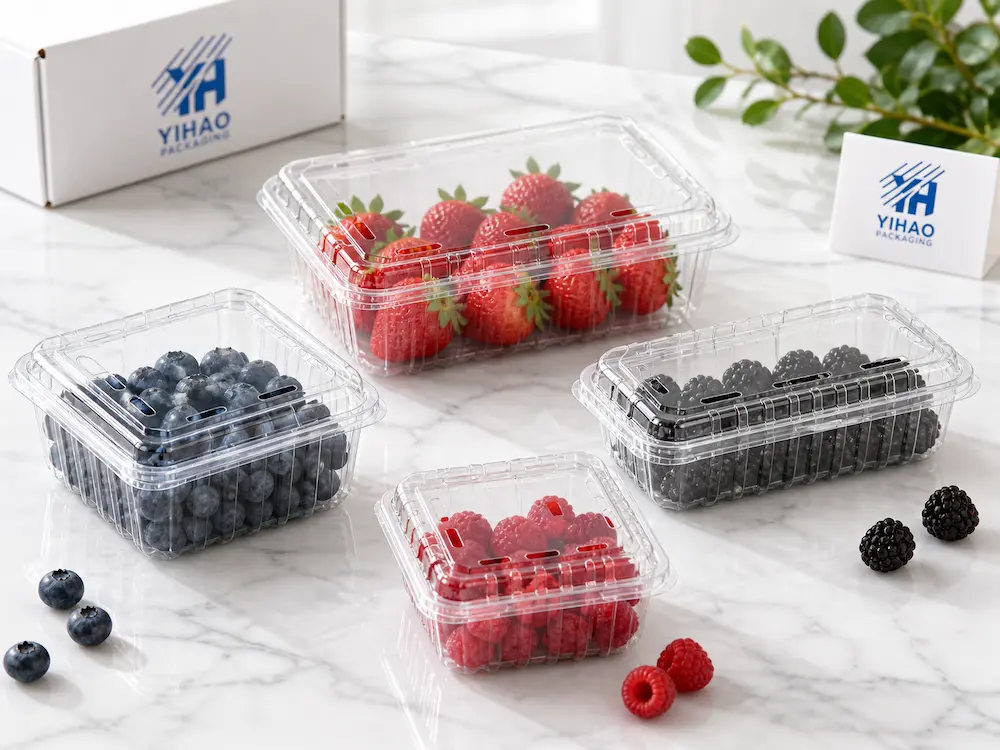
Micro Summary: Blueberry Containers for Fresh Produce Packaging Buyers
Blueberry containers help farms, supermarkets, distributors, exporters, and food packaging teams protect blueberries while supporting clear retail display, ventilation, stacking, carton packing, and wholesale handling.
For buyers comparing berry clamshell packaging, vented berry clamshells, clear PET berry containers, blackberry clamshell containers, and raspberry packaging containers, the right choice depends on berry movement control, airflow, lid closure, base support, stacking performance, label placement, PET/RPET material options, and stable supply from a reliable manufacturer or supplier.
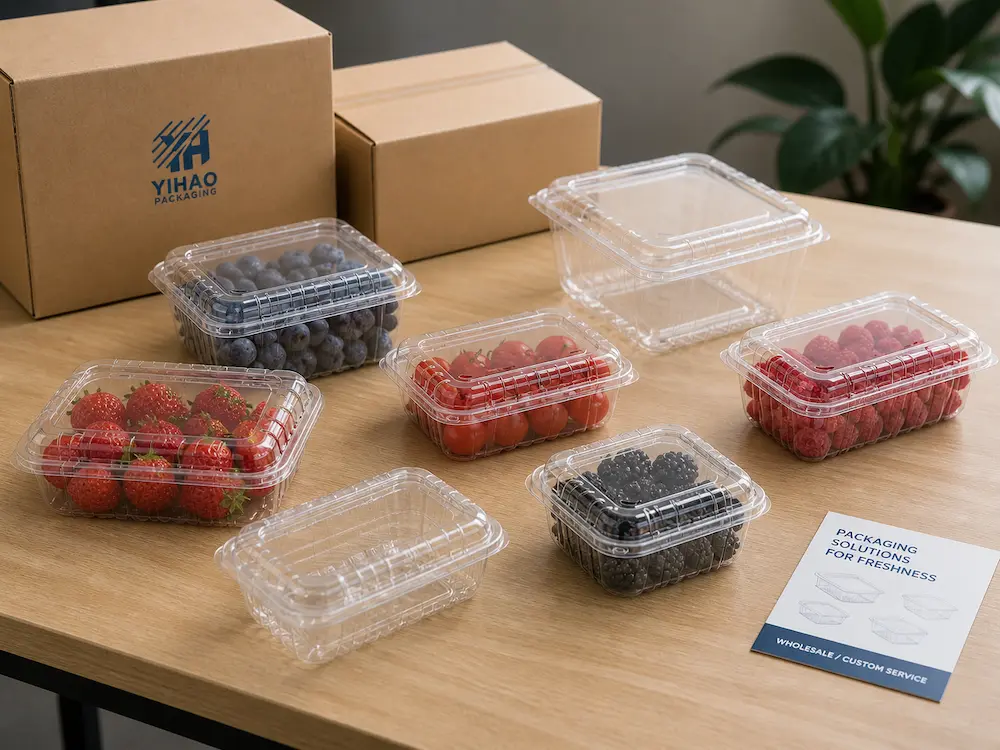
Blueberries are small, colorful, high-value fresh produce items that need packaging designed around movement control, visibility, ventilation, stacking, and retail handling. Unlike larger fruit, blueberries can roll, shift, and settle during packing, transport, and shelf display. This is why blueberry containers should not be selected as generic berry packaging. They need to match the actual weight, carton layout, cold shelf requirements, and wholesale distribution route.
YIHAO is a food packaging manufacturer and solution provider focused on practical packaging formats for berries, fresh fruit, salads, snacks, bakery items, deli food, and chilled ready-to-eat meals. For food packaging teams sourcing blueberry containers, the goal is not simply to choose a clear clamshell. The goal is to select packaging that protects blueberries, keeps them visible, supports airflow, stacks safely, and works consistently across repeated wholesale orders.
This buyer guide explains how to choose blueberry containers for retail, farms, wholesale distribution, foodservice, and fresh produce packaging programs. It also compares berry clamshell packaging, vented berry clamshells, clear PET berry containers, blackberry clamshell containers, and raspberry packaging containers so buyers can make better packaging decisions before bulk orders.
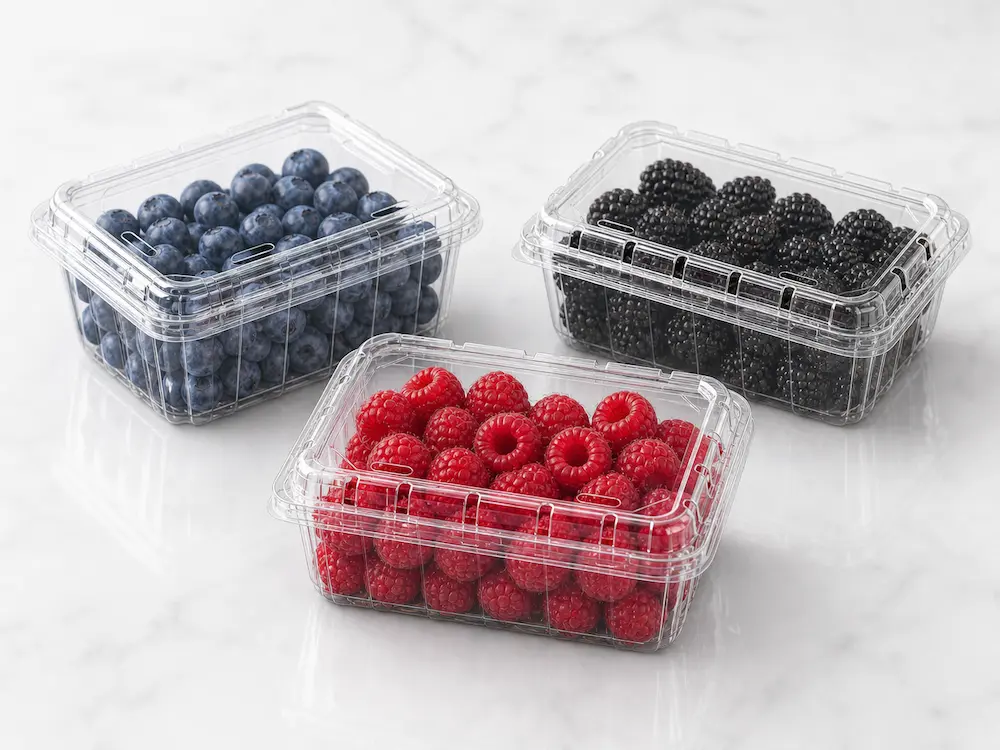
Why Blueberry Containers Need Dedicated Packaging Logic
Blueberries are not the same as strawberries, blackberries, or raspberries. They are small, round, and mobile inside the pack. They are usually firmer than raspberries, but they still need protection from compression, poor stacking, and excessive movement. A container that works for strawberries may be too large. A container that works for raspberries may be too shallow or overly specialized for blueberries.
This is why blueberry containers require their own packaging logic. Buyers should evaluate containment, ventilation, clear visibility, lid closure, base support, and carton stacking before choosing a wholesale packaging format.
Blueberries Are Small, Mobile, and Sensitive to Handling
Blueberries can shift inside packaging during transport and shelf handling. If the container is too loose, the berries may roll and settle unevenly. If the container is too weak, stacking pressure can deform the pack and affect product appearance. If the lid does not close securely, blueberries may spill or move during distribution.
Good blueberry containers should reduce unnecessary berry movement while keeping the fruit visible and easy to inspect. They should also support stable stacking inside cartons and on retail shelves.
For food packaging teams, blueberry packaging should be tested as a filled pack, not only as an empty sample.
Good Blueberry Packaging Must Balance Visibility, Airflow, and Containment
A strong blueberry pack needs three core functions.
First, it needs clear visibility. Customers want to see berry color, size, bloom, and overall quality before purchase. This is why clear PET berry containers are widely used for blueberry retail display.
Second, it needs airflow. Blueberries are commonly packed in vented berry clamshells or similar ventilated formats to support chilled handling and shelf display.
Third, it needs containment. Blueberries are small and round, so the package should keep them organized without allowing excessive movement.
The best blueberry containers balance all three needs: visibility, ventilation, and containment.
Food Packaging Teams Should Test Real Filled Packs
Empty samples do not show real blueberry packaging performance. A container may look strong when empty but behave differently when filled, stacked, chilled, labeled, and transported.
Food packaging teams should test:
- Real blueberry fill weight
- Lid closure after filling
- Filled-pack stacking
- Carton fit
- Ventilation design
- Label placement
- Cold shelf display
- Product appearance after handling
This process helps buyers avoid packaging mismatch before wholesale orders.
What Are Blueberry Containers Used For?
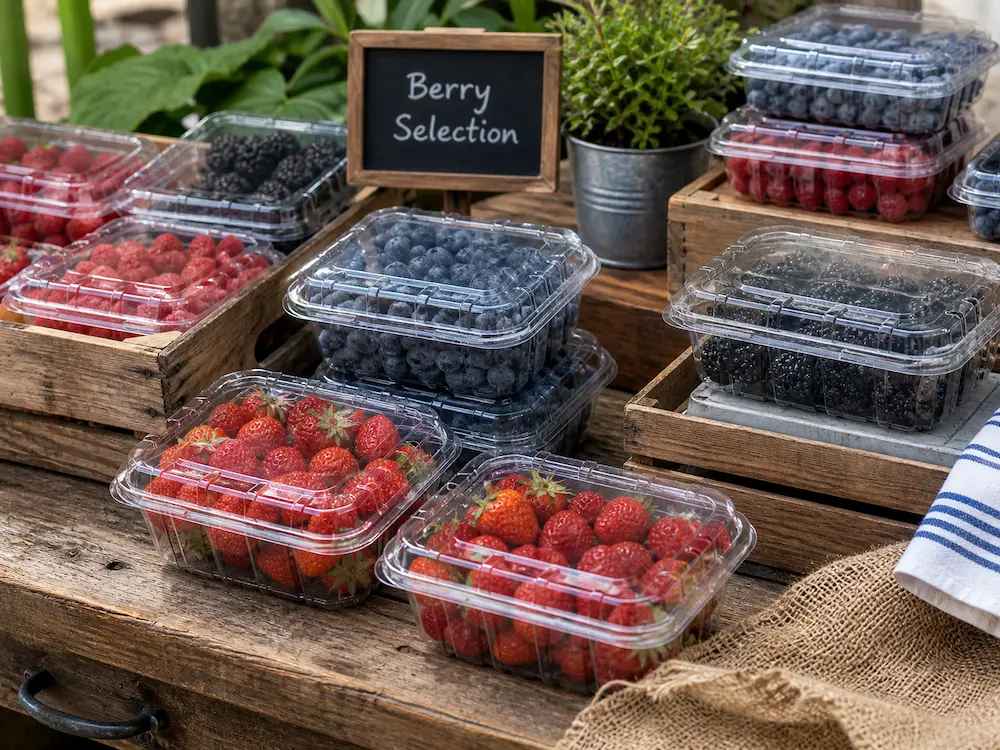
Blueberry containers are used for retail blueberry packs, farm and grower packaging, wholesale blueberry distribution, export programs, supermarket display, and foodservice berry portions. They are also used in mixed berry packs, fruit salad programs, yogurt-fruit combinations, and grab-and-go snack packs.
Retail Blueberry Packs for Supermarkets
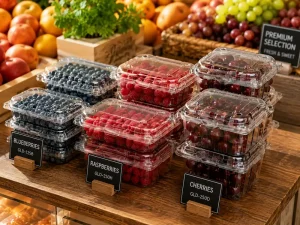
Supermarkets need blueberry packaging that is clear, stackable, label-friendly, and easy for customers to inspect. A customer usually checks blueberry color, size, freshness, and surface condition through the package before purchasing.
For supermarket use, blueberry containers should support:
- Clear retail visibility
- Stable cold shelf stacking
- Secure lid closure
- Barcode and label placement
- Easy customer handling
- Fast shelf replenishment
Clear PET packaging helps blueberries look clean and fresh on retail shelves. However, labels should not block too much of the product because visibility is one of the main selling points.
Farm and Grower Blueberry Packaging
Blueberry farms and growers need packaging that supports post-harvest handling, sorting, packing, transport, and wholesale delivery. Farm packaging must protect blueberries from harvest through packing and distribution.
For farms, blueberry containers should be easy to fill, easy to close, and stable in cartons. The packaging should also support transport from farm packing areas to distributors, supermarkets, or export channels.
Farm buyers should review carton fit, stacking, ventilation, and repeat supply before choosing packaging.
Wholesale Blueberry Distribution
Wholesale blueberry distribution requires packaging that performs consistently across repeated orders. Distributors need stable container dimensions, carton quantity, lid fit, material appearance, and packing efficiency.
For wholesale buyers, the biggest concerns are:
- Filled-pack stacking
- Carton loading efficiency
- Transport stability
- Repeat order consistency
- Supplier communication
- Product visibility after handling
A professional manufacturer or supplier should provide sample support and clear specifications before bulk ordering.
Foodservice and Grab-and-Go Berry Portions
Blueberries are also used in foodservice, cafes, bakery shops, salad bars, yogurt cups, parfaits, smoothie bowl toppings, fruit cups, and chilled ready-to-eat snack packs.
In these applications, blueberries may be packed alone or combined with yogurt, granola, strawberries, melon, grapes, salads, or desserts. The packaging must support product visibility, portion control, and closure.
For mixed products, buyers may use clear PET fruit containers or clamshell-style packaging depending on product weight and handling needs.
Key Features of High-Quality Blueberry Containers
High-quality blueberry containers should be selected by real product performance. The best packaging is not only transparent. It must support airflow, closure, stacking, berry movement control, and retail display.
Clear PET Visibility
Blueberries sell through appearance. Customers want to see color, berry size, surface condition, and overall freshness. Cloudy packaging weakens trust because customers cannot inspect the product clearly.
Clear PET berry containers support strong retail display by allowing customers to view the blueberries from the top and sides. PET also provides practical rigidity and a clean shelf appearance.
Buyers should check whether the packaging remains clear after stacking, refrigeration, and normal handling.
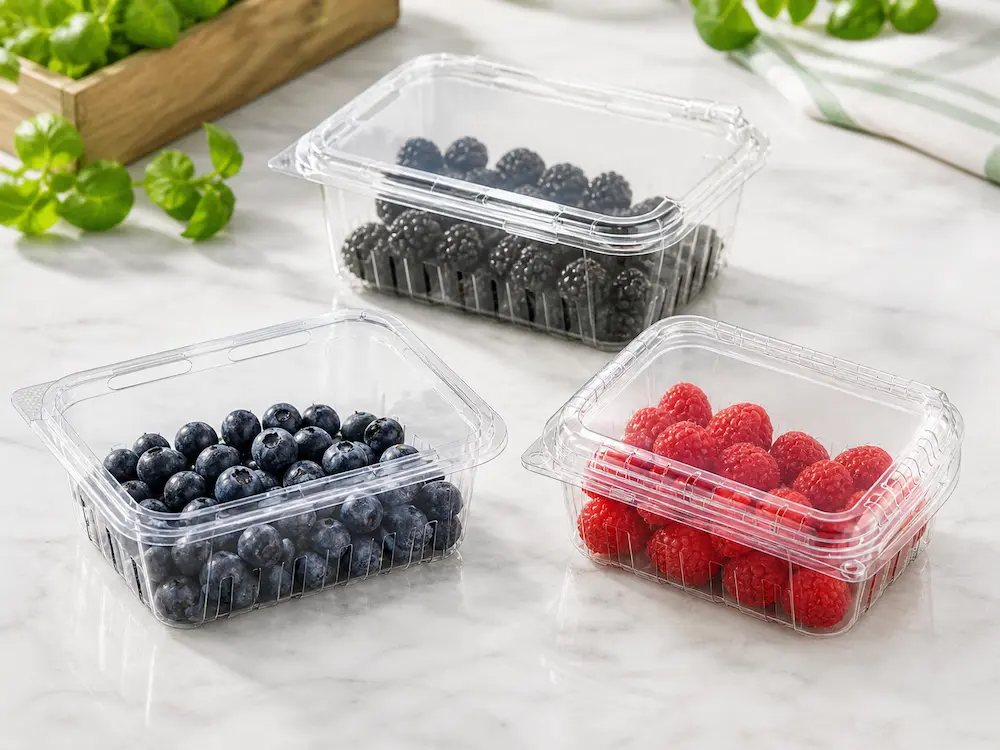
Ventilation for Chilled Handling
Ventilation is important for many blueberry packaging applications. Vented lid and base structures help support airflow during handling, transport, and cold shelf display.
Vented berry clamshells are widely used because they combine airflow, visibility, closure, and stacking performance. The vent pattern should support the product without weakening the packaging structure.
Buyers should confirm whether the ventilation design matches the intended use, especially for chilled retail and wholesale distribution.
Secure Lid Closure
A secure lid helps reduce spills, product movement, and handling problems. Blueberries are small and can escape easily if the lid does not close properly.
For berry clamshell packaging, buyers should check hinge strength, locking points, lid fit, and opening experience. The closure should be secure enough for transport but still easy for customers to open.
Lid closure should be tested with real blueberries, not only with empty containers.
Stackable Structure for Cartons and Shelves
Stackability is one of the most important features of blueberry containers. Filled packs need to stack safely inside cartons and on supermarket shelves.
Poor stacking can cause container deformation, berry compression, shelf mess, and transport instability. A stable structure helps protect product appearance and reduce operational issues.
Wholesale buyers should test stacking under realistic filled-pack conditions.
Base Support and Berry Movement Control
Because blueberries are small and mobile, base structure matters. A well-designed base can help reduce excessive berry movement and support more even distribution inside the container.
The base should also protect the berries from pressure points. Buyers should check whether berries settle unevenly, roll too much, or press against the lid during handling.
Good base support improves both product protection and retail appearance.
Blueberry Containers vs Other Berry Packaging Formats
Blueberries, blackberries, and raspberries may all be berries, but they do not need the same packaging logic. Buyers should compare these formats carefully before ordering.
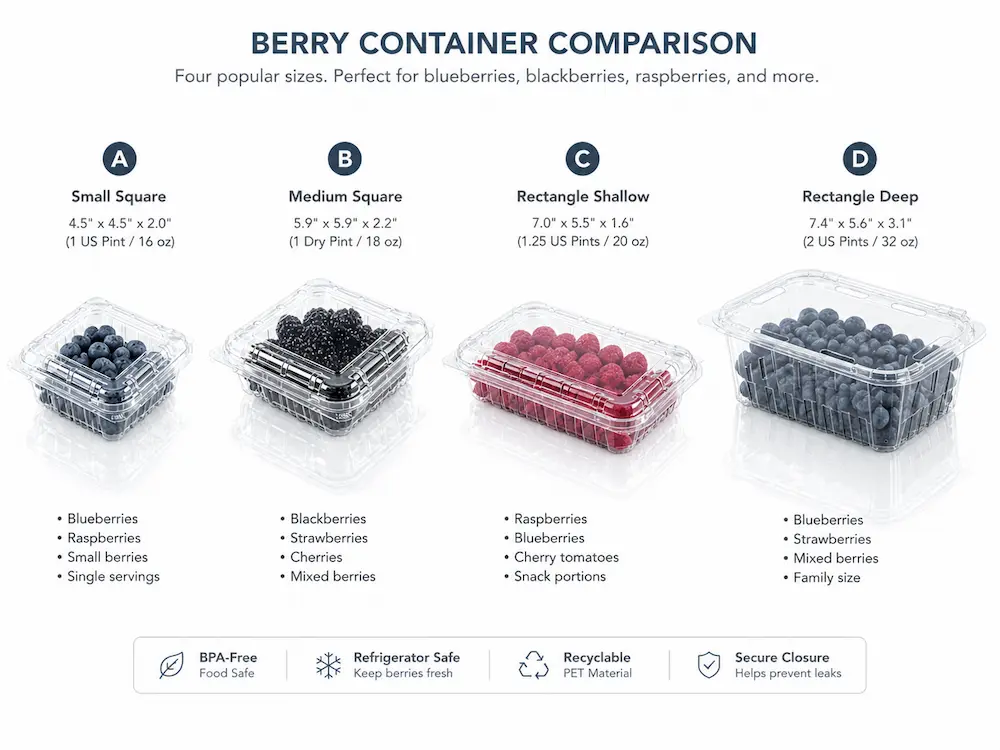
Blueberry Containers vs Blackberry Clamshell Containers
Blackberries are larger and softer than blueberries. Blackberry clamshell containers often need more anti-crush support and shallow containment because blackberries can deform under pressure.
By contrast, blueberry containers focus more on containment, ventilation, and stacking. Blueberries are smaller and more mobile, so movement control is a major priority.
Buyers should not assume that one berry clamshell fits both products equally well.
Blueberry Containers vs Raspberry Packaging Containers
Raspberries are more fragile than blueberries. Raspberry packaging containers need low-pressure protection, gentle support, and careful stacking. A deep or heavily stacked container may damage raspberries more easily.
Blueberries are usually firmer, but they need better containment because they can roll and shift inside the pack.
This means raspberry packaging often focuses on delicate fruit protection, while blueberry packaging focuses more on airflow, containment, and carton stability.
Why Blueberry Packaging Focuses More on Containment and Stacking
Blueberries are small and round, so they behave differently during filling, movement, and stacking. A blueberry pack should prevent excessive movement while still allowing airflow and visibility.
For wholesale and retail programs, packaging should also stack safely. Filled clamshells must support carton loading and cold shelf display without deforming.
The best blueberry containers are not simply berry containers. They are containers designed around blueberry behavior.
Berry Clamshell Packaging for Blueberries
Berry clamshell packaging is one of the most common choices for blueberries because it combines a hinged lid, clear visibility, ventilation, and efficient handling.
Why Clamshells Are Widely Used for Blueberries
Clamshells are widely used because they are practical for farms, supermarkets, distributors, and wholesale packaging programs. The attached lid reduces lid mismatch and supports fast packing. The clear structure helps customers inspect the product. The stackable design helps with carton loading and cold shelf organization.
For blueberries, clamshells also provide containment. The structure helps keep small berries inside the pack while supporting ventilation and display.
What Makes a Good Blueberry Clamshell
A good blueberry clamshell should include:
- Clear PET or RPET material options
- Suitable ventilation
- Reliable hinge design
- Secure lid closure
- Stable base support
- Strong filled-pack stacking
- Label-friendly surface
- Efficient carton fit
Buyers should evaluate all of these factors before placing wholesale orders.
When Vented Berry Clamshells Are Better
Vented berry clamshells are especially useful for chilled retail display, farm distribution, and wholesale blueberry programs. Ventilation helps support handling and cold shelf conditions.
However, ventilation must be balanced with structure strength. Poorly designed vents may weaken the package or create handling issues.
Buyers should test vented clamshells with actual blueberries, real fill weight, and the intended carton layout.
Clear PET Berry Containers for Retail Display
Clear PET berry containers are widely used for blueberry retail display because they support transparency, product visibility, and customer trust.
Why Blueberry Color and Size Need Visibility
Customers often inspect blueberries through the package before buying. They look at berry size, color, surface condition, and overall freshness.
Clear packaging helps customers make decisions quickly. It also helps supermarkets display blueberries in a clean and organized way.
For retail buyers, clarity is not only visual. It directly supports shelf appeal.
Label Placement Should Not Block Product Inspection
Labels are necessary for branding, barcodes, weight, origin, and product information. However, labels should not hide too much of the blueberries.
For clear PET berry packaging, label placement should balance information and visibility. A label that blocks the best view of the product reduces the advantage of transparent packaging.
Buyers should test label size and location on filled samples.
PET/RPET Material Options Buyers Should Confirm
PET is widely used for berry packaging because it provides clarity, practical rigidity, and clean appearance. RPET may support recycled-content packaging programs when suitable for the application and market.
Buyers should confirm material details with the manufacturer or supplier before making packaging claims. This includes material type, food-contact information, product specifications, and target market requirements.
Buyer Comparison Table: Blueberry Containers and Related Berry Packs
| Packaging Type | Best For | Buyer Focus |
|---|---|---|
| Blueberry containers | Retail blueberry packs, farms, wholesale distribution | Containment, ventilation, stacking |
| Berry clamshell packaging | Mixed berries, blueberries, strawberries | Closure and visibility |
| Vented berry clamshells | Chilled retail and transport | Airflow and shelf stability |
| Blackberry clamshell containers | Larger soft berries | Anti-crush support |
| Raspberry packaging containers | Very delicate soft berries | Low-pressure protection |
| Clear PET berry containers | Retail display and customer inspection | Transparency and label placement |
This comparison helps food packaging teams choose berry packaging by product behavior, not only by container appearance.
Wholesale Buying Checklist for Blueberry Containers
Before placing wholesale orders, buyers should review the following checklist.
| Checklist Item | Buyer Question | Why It Matters |
|---|---|---|
| Berry type | Is it blueberries only or mixed berries? | Determines structure and size |
| Ventilation | Does the pack support airflow? | Important for chilled handling |
| Closure | Does the lid stay secure? | Reduces spills and product loss |
| Stackability | Can filled packs stack safely? | Supports cartons and shelves |
| Base support | Does the base reduce berry movement? | Protects appearance and quality |
| Material | PET or RPET? | Affects clarity and documentation |
| Label area | Can labels be applied without blocking berries? | Supports retail display |
| Supplier support | Can the manufacturer provide samples and repeat orders? | Reduces wholesale risk |
This checklist helps buyers evaluate blueberry packaging by real use, not only by sample appearance.
Common Mistakes When Buying Blueberry Containers
Packaging mistakes often happen when buyers treat blueberries like all other berries. Blueberries need their own packaging review because of their movement, stacking, and retail display requirements.
Choosing Generic Berry Packaging Without Testing Blueberries
Generic berry packaging may not perform well for blueberries. The pack may be too large, too loose, too shallow, or poorly ventilated for blueberry applications.
Buyers should test blueberry containers with real blueberries before wholesale orders.
Ignoring Ventilation
Ventilation is important for chilled handling and retail display. Buyers should not choose packaging only by clarity or price.
The vent pattern should be suitable for blueberry handling without weakening the structure.
Testing Only Empty Clamshells
Empty clamshells do not show real performance. A container may stack well when empty but deform when filled. A lid may feel secure when empty but behave differently after blueberries are packed.
Filled-pack testing is essential.
Using Raspberry or Blackberry Logic for Blueberries
Raspberries need low-pressure protection. Blackberries need more anti-crush support. Blueberries need stronger containment and stacking stability.
Using raspberry or blackberry packaging logic for blueberries may lead to poor fit or inefficient packing.
Choosing Price Over Carton Stability
Low-cost packaging can create hidden costs if it causes spills, loose lids, crushed packs, shelf mess, or repacking labor.
Wholesale buyers should evaluate total performance, not only unit price.
How to Choose a Blueberry Containers Manufacturer or Supplier
Choosing the right manufacturer or supplier is as important as choosing the right container. A reliable packaging partner should understand blueberry applications and support sample testing before wholesale orders.
Ask Whether the Supplier Understands Blueberry Applications
Not every berry packaging supplier understands blueberry-specific requirements. Buyers should ask whether the supplier can explain containment, ventilation, stacking, and carton fit for blueberries.
A supplier that only provides generic packaging may not help buyers avoid application mismatch.
Confirm PET/RPET Material and Food Packaging Information
Buyers should confirm material type, food packaging suitability, specifications, carton packing, and target market requirements.
PET and RPET options should be explained clearly. Buyers should avoid unsupported material or environmental claims unless documentation is confirmed.
Request Samples for Real Blueberry Testing
Samples should be tested with real blueberries. Buyers should check fill weight, lid closure, filled-pack stacking, carton fit, label placement, and shelf display.
Sample review helps reduce risk before bulk purchasing.
Check Wholesale Supply Stability
Wholesale buyers need stable supply, repeatable specifications, consistent carton packing, and clear communication.
A good supplier should support repeat orders and help buyers maintain packaging consistency across product programs.

Compare Manufacturer Support Beyond Unit Price
Unit price matters, but it should not be the only factor. A strong packaging manufacturer should help buyers compare structure, material, samples, carton packing, and wholesale planning.
For blueberry packaging, supplier support can directly affect product protection and operational efficiency.
Why Choose YIHAO for Blueberry Containers?
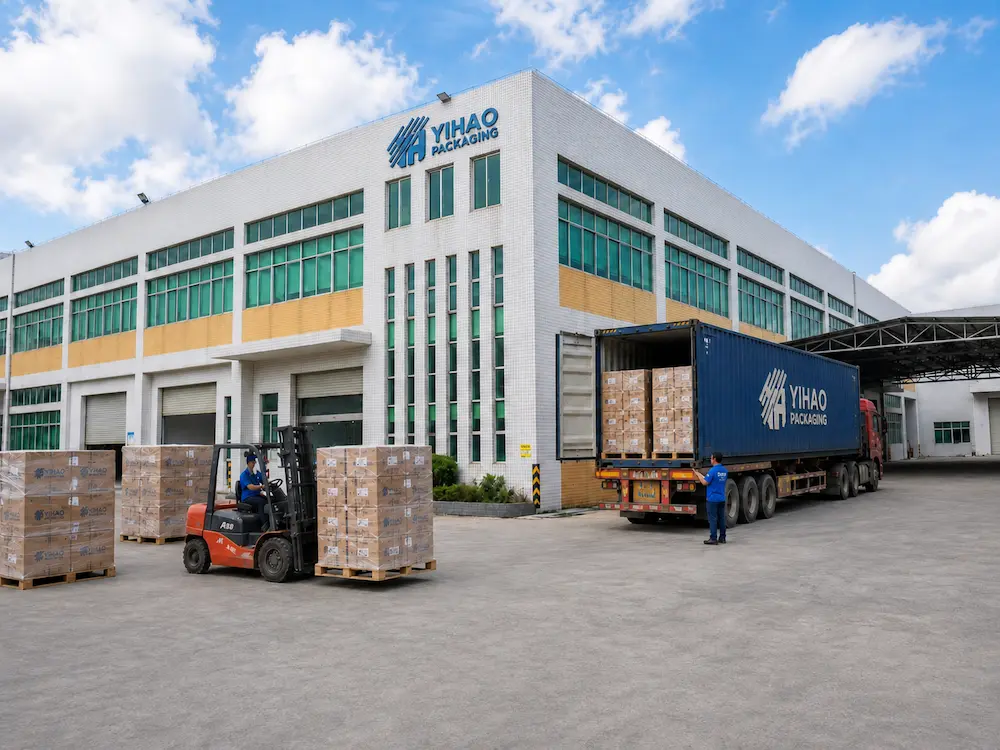
Choosing the right blueberry packaging partner helps buyers reduce risk, improve display, and support wholesale supply planning.
YIHAO provides food packaging solutions for blueberries, blackberries, raspberries, strawberries, fresh fruit, salads, snacks, bakery items, deli food, and chilled ready-to-eat meals. For buyers sourcing blueberry containers, berry clamshell packaging, vented berry clamshells, or clear PET berry containers, YIHAO focuses on practical structure, clean appearance, and application-based packaging selection.
Packaging Solutions for Blueberries and Fresh Berries
Blueberries need containment, ventilation, stacking, and clear visibility. Other berries may need different packaging logic. YIHAO helps buyers compare berry packaging formats based on product behavior and sales channel.
This supports better packaging choices for blueberries, mixed berries, blackberries, raspberries, and strawberries.
Wholesale Support for Farms, Supermarkets, and Distributors
Farms need transport-ready packaging. Supermarkets need shelf-ready berry packs. Distributors need carton efficiency and repeat supply. Foodservice buyers need practical handling and stable specifications.
YIHAO supports wholesale buyers with PET/RPET options, sample comparison, carton packing details, and packaging structure recommendations.
Application-Based Packaging Selection for Berry Products
The best packaging choice starts with the actual berry type. Blueberries need movement control and stacking. Raspberries need low-pressure support. Blackberries need anti-crush protection. Strawberries need more space and lid clearance.
YIHAO helps buyers choose packaging according to real applications, not generic product names.
Ready to Compare Blueberry Container Options?
If you are sourcing blueberry containers wholesale for farms, supermarkets, distributors, exporters, or foodservice berry programs, contact YIHAO to compare clear PET/RPET berry containers, vented berry clamshells, sample options, carton packing details, label areas, and supplier-ready packaging solutions.
A strong blueberry packaging decision should start with the real fruit and the real sales channel. YIHAO helps buyers evaluate ventilation, closure, stacking, containment, product visibility, label placement, and wholesale supply needs before confirming packaging orders.
FAQ About Blueberry Containers
1. What are blueberry containers used for?
Blueberry containers are used for retail blueberry packs, farm packaging, wholesale distribution, supermarket display, export programs, foodservice berry portions, and mixed berry applications. They help protect blueberries while supporting visibility, ventilation, stacking, and handling.
2. What is the best packaging for blueberries?
The best packaging for blueberries usually provides clear visibility, suitable ventilation, secure lid closure, stable stacking, and good containment. Vented berry clamshells and clear PET berry containers are commonly used for retail and wholesale blueberry packaging.
3. Why do blueberry containers need ventilation?
Blueberry containers often need ventilation to support airflow during chilled handling, transport, and retail display. Ventilation design should be balanced with package strength, lid closure, and stacking performance.
4. Are clear PET berry containers suitable for blueberries?
Yes. Clear PET berry containers are suitable for blueberries because they provide strong product visibility, practical rigidity, and clean retail presentation. Buyers should still test PET containers with real blueberries to confirm closure, stacking, ventilation, and carton fit.
5. What is the difference between blueberry containers and raspberry packaging containers?
Blueberry containers focus more on containment, ventilation, and stacking because blueberries are small and mobile. Raspberry packaging containers usually require more low-pressure protection because raspberries are softer and more fragile.
6. Are berry clamshell packaging options good for wholesale blueberries?
Yes. Berry clamshell packaging is commonly used for wholesale blueberries because it supports fast packing, clear display, secure closure, ventilation, and carton stacking. Buyers should test filled clamshells before bulk orders.
7. What should buyers check before ordering blueberry containers wholesale?
Buyers should check berry fill weight, ventilation, lid closure, base support, filled-pack stacking, carton fit, PET/RPET material options, label placement, sample performance, and supplier reliability before ordering blueberry containers wholesale.
8. How do I choose a blueberry containers manufacturer or supplier?
Choose a manufacturer or supplier that understands blueberry packaging applications, vented berry clamshells, clear PET berry containers, sample testing, carton packing, material options, repeat supply, and wholesale order support.
References
- U.S. Food and Drug Administration, Guide to Minimize Microbial Food Safety Hazards of Fresh Fruits and Vegetables.
- U.S. Food and Drug Administration, Food Contact Substances and Food Packaging Guidance.
- European Commission, Commission Regulation (EU) 2022/1616 on recycled plastic materials and articles intended to come into contact with foods.
- Association of Plastic Recyclers, APR Design Guide for Plastics Recyclability.
- United States Department of Agriculture, Fresh Fruit and Vegetable Market News Resources.
- International Fresh Produce Association, Fresh Produce Handling and Packaging Resources.
- Food and Agriculture Organization of the United Nations, Food Loss and Waste Resources.
- WRAP, Food Waste Reduction and Packaging Resource Efficiency Publications.
Deep-Dive Insights: How Buyers Should Think About Blueberry Containers
How do blueberry containers protect fresh blueberries?
Blueberry containers protect fresh blueberries by combining clear visibility, ventilation, secure closure, base support, containment, and stackability. Because blueberries are small and mobile, the package should reduce movement while supporting airflow and retail display.
Why are vented berry clamshells widely used for blueberries?
Vented berry clamshells are widely used for blueberries because they support airflow, attached-lid convenience, clear product visibility, and filled-pack stacking. They are practical for farms, supermarkets, distributors, and wholesale berry programs.
What should buyers compare before ordering?
Buyers should compare blueberry containers, berry clamshell packaging, vented berry clamshells, clear PET berry containers, blackberry clamshell containers, and raspberry packaging containers based on berry type, ventilation, closure, stacking, base support, label placement, and supplier reliability.
How are blueberry containers different from raspberry packaging containers?
Blueberry containers focus more on containment and stacking because blueberries are small and round. Raspberry packaging containers focus more on low-pressure protection because raspberries are softer and more fragile.
Why does supplier selection matter for blueberry packaging?
A reliable manufacturer or supplier helps buyers compare clear PET/RPET material options, vented clamshell structures, samples, carton packing details, label areas, and repeat wholesale supply according to real blueberry applications.
© YIHAO Packaging. All rights reserved. All articles, product images, packaging designs, technical specifications, and website materials are protected by copyright. Unauthorized copying, reproduction, redistribution, modification, or commercial use is strictly prohibited without prior written permission.