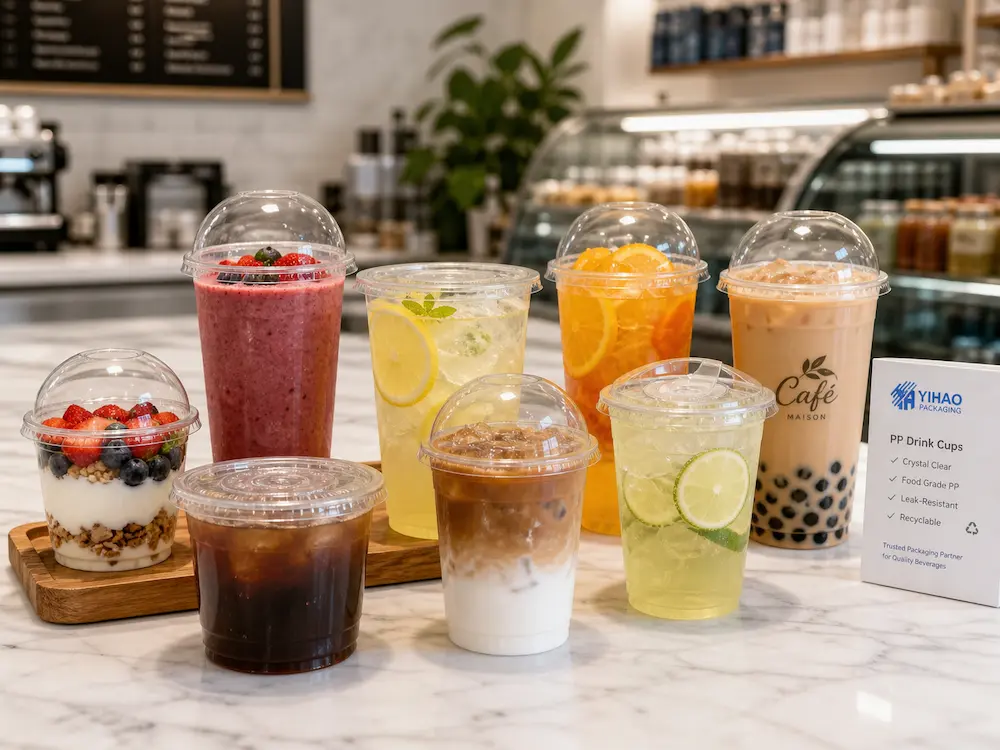
PP Drink Cups: Fast Buyer Summary
PP drink cups are practical packaging solutions for cold beverages, takeaway service, refrigerated retail display, and chilled food portions. Their flexible and durable polypropylene structure makes them suitable for iced coffee, smoothies, juice, milk tea, fruit tea, refreshers, cold brew, yogurt, desserts, and grab-and-go foodservice items.
For packaging buyers, the best PP cold cups should be evaluated by cup wall strength, rim consistency, lid compatibility, stacking stability, size range, carton packing, wholesale supply reliability, and customization support. A dependable PP drink cups manufacturer helps supermarkets, cafes, bakeries, beverage brands, and foodservice distributors build consistent packaging systems for daily operations.
Introduction
Choosing the best PP drink cups is not only about buying a disposable cup that holds a cold beverage. For supermarkets, cafes, bakeries, beverage chains, convenience stores, and foodservice distributors, cup selection affects retail appearance, takeaway handling, lid matching, customer experience, carton packing, inventory control, and repeat purchasing.
Polypropylene, commonly known as PP, is widely used in food packaging because it offers a practical balance of flexibility, durability, light weight, and operational convenience. Compared with weak or overly thin cup options, PP cold cups provide stronger daily handling performance for busy beverage counters, chilled shelves, delivery orders, and grab-and-go food programs.
This guide explains how buyers should evaluate PP drink cups for retail display, takeaway beverages, and chilled food packaging. It also compares PP with PET cold cups, explains the best application scenarios, and gives procurement teams a clear framework for choosing a reliable manufacturer, wholesale partner, or long-term supplier.
What Are PP Drink Cups?
PP drink cups are disposable or single-use food packaging cups made from polypropylene. They are commonly used for cold drinks, takeaway beverages, chilled desserts, yogurt, fruit portions, and other refrigerated foodservice items.
In practical food packaging, PP is valued for its flexible structure and durable handling performance. This makes it useful in active service environments where cups are stacked, pulled from sleeves, filled quickly, fitted with lids, packed into takeaway bags, displayed in refrigerated shelves, and handled by customers or delivery teams.
For buyers, the key point is simple: PP drink cups are designed for daily operation. Their value comes from cup strength, lid compatibility, stacking convenience, and reliable performance across high-volume foodservice and retail channels.
Why Polypropylene Works for Cold Beverage Packaging
Polypropylene is a lightweight thermoplastic material used in many food packaging applications. In cup production, it supports a structure that feels flexible rather than brittle. This flexibility helps the cup handle normal pressure during stacking, filling, lid application, and takeaway movement.
For beverage brands, this matters because cold drink packaging goes through repeated handling before it reaches the customer. A cup may be stacked in storage, separated by staff, filled with ice, poured with liquid, sealed with a lid, placed in a carrier, packed into a delivery bag, displayed in a chiller, and then handled again by the final customer.
Well-made PP cold cups support smoother service flow. They are especially useful for iced coffee, milk tea, smoothies, fresh juice, fruit tea, lemonade, sparkling fruit drinks, refreshers, protein drinks, matcha, iced tea, and flavored cold brew.
What Makes the Best PP Drink Cups?
The best PP drink cups are not defined by material alone. A cup can be made from polypropylene but still perform poorly if the rim is inconsistent, the lid does not fit well, the cup wall is too weak, or the packing method creates damage during transport.
For serious food packaging buyers, “best” means the cup works across the full packaging journey: storage, filling, lid application, display, takeaway, delivery, customer handling, and repeat ordering.
A high-performing PP cup should meet the following practical standards:
| Buyer Evaluation Point | What to Check | Why It Matters |
|---|---|---|
| Cup Wall Strength | The cup should hold its shape during filling, holding, and takeaway handling. | Weak cups affect customer experience and increase handling problems. |
| Rim Consistency | The rim should match the lid smoothly and consistently across batches. | Rim quality directly affects lid fit and spill reduction. |
| Lid Compatibility | Flat lids, dome lids, straw-slot lids, or sealing lids should match the cup size correctly. | The cup and lid must work as one packaging system. |
| Stacking Stability | Cups should stack neatly and separate smoothly during service. | Good stacking improves storage efficiency and service speed. |
| Application Match | The selected cup should match iced coffee, juice, smoothies, milk tea, desserts, or chilled food portions. | Different products need different cup sizes, lid types, and handling strength. |
| Wholesale Supply Stability | The supplier should support repeat orders with consistent quality and packing. | Stable sourcing reduces packaging risk for chains, distributors, and retail programs. |
The best PP drink cups should make daily operation easier, not more complicated. Buyers should test samples with real products, real lids, real staff workflows, and real storage conditions before confirming wholesale orders.
Why Food Packaging Buyers Choose PP Drink Cups
Durable Structure for Takeaway Handling
Takeaway packaging must survive more movement than dine-in packaging. Cups are carried, tilted, stacked, bagged, transported, and handled by customers. For this reason, many buyers choose durable cold cups when building a beverage packaging system.
PP drink cups are suitable for takeaway service because their flexible structure supports normal service pressure. This makes them practical for coffee shops, juice bars, milk tea stores, convenience stores, fast casual restaurants, catering companies, and food delivery operations.
When paired with a matching lid, PP cups help improve the overall takeaway experience. The cup body, rim, lid, and packing method work together as one packaging system.
Flexible Material for Busy Foodservice Operations
Foodservice packaging needs to be easy to use, not just attractive in a product photo. A good cup should separate smoothly from the stack, hold its shape during filling, fit the selected lid, and support quick service during peak hours.
This is where PP drink cups become useful. Their flexibility supports practical daily operation, especially in stores with high beverage output. Staff work faster when packaging is predictable, stable, and easy to handle.
For wholesale buyers, consistency matters even more. If a cup performs well in one carton but differently in the next shipment, it creates problems for stores and distributors. Reliable production helps reduce lid mismatch, handling complaints, and operational waste.
Practical Lid Compatibility for Cold Drinks
Many beverage programs require PP cups with lids. Lid matching is one of the most important buying points because the lid affects spill reduction, customer convenience, drink presentation, and delivery performance.
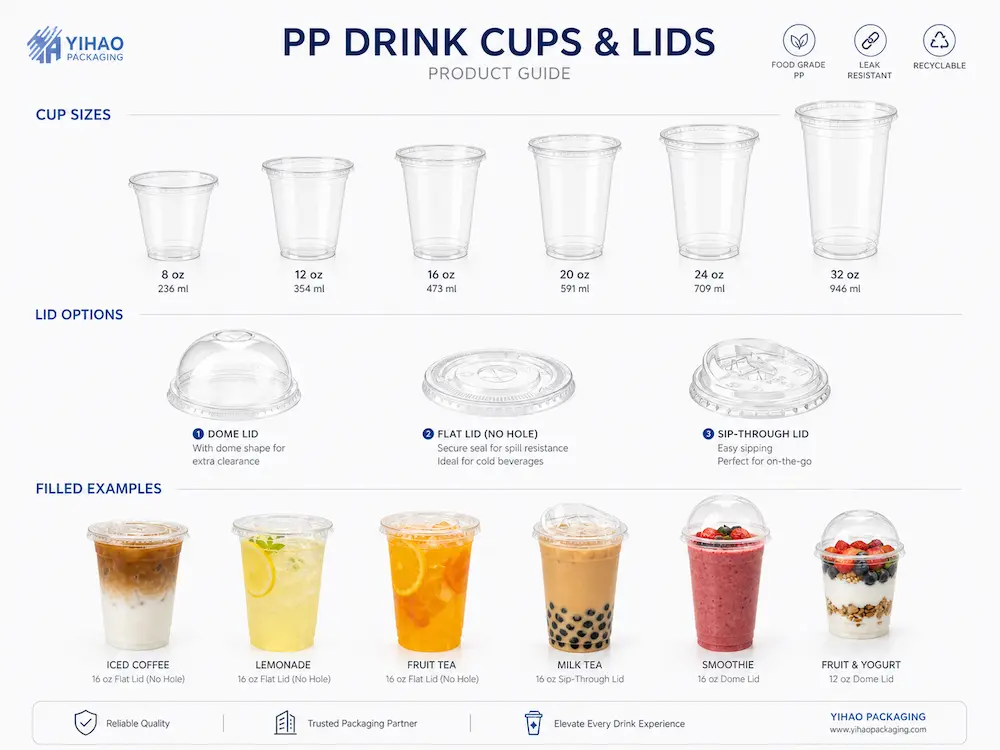
Common lid options may include flat lids with straw slots, dome lids for whipped cream or toppings, and sealing lids for specific beverage operations. The right choice depends on the drink type.
Iced coffee and cold brew often use flat lids. Smoothies and blended drinks may need dome lids when toppings are added. Milk tea, fruit tea, and refreshers may need straw-friendly lids or sealing options. The cup and lid should always be tested together before bulk ordering.
Best Applications for PP Drink Cups
Iced Coffee and Flavored Cold Brew
Iced coffee remains one of the strongest applications for PP drink cups. It is frequently sold for takeaway, office consumption, convenience store display, and delivery. The packaging needs to support ice, liquid movement, lid fit, and comfortable hand-held use.
Flavored cold brew, vanilla iced coffee, caramel iced coffee, oat milk iced coffee, and seasonal cold coffee menus also work well with PP cup packaging. These drinks depend on stable takeaway performance because customers often carry them while walking, driving, or commuting.
For coffee chains and independent cafes, PP cold cups offer a practical option when durability and cost efficiency are important.
Smoothies, Protein Drinks, and Blended Beverages
Smoothies and protein drinks place different demands on packaging. They are often thicker than standard beverages and may include fruit pulp, yogurt, protein powder, ice, or blended ingredients. A cup for this category should feel stable during filling and handling.
PP drink cups are suitable for smoothies, acai berry refreshers, protein drinks, fruit blends, and meal-replacement beverages. Their flexible structure supports daily store use, especially when drinks are made quickly during busy service periods.
For brands that sell both cold beverages and chilled food, using PP cups across multiple menu items may also simplify purchasing and inventory management.
Juice, Lemonade, Fruit Tea, and Refreshers
Fresh juice, lemonade, fruit tea, and refreshers are strong menu categories for takeaway drink packaging. These beverages are colorful, high-volume, and often served with ice, fruit slices, or inclusions.
For juice bars and foodservice distributors, PP drink cups provide a practical solution for cold drink menus that require reliable cup strength and lid compatibility. They are suitable for orange juice, watermelon juice, green juice, sparkling lemonade, berry refreshers, citrus drinks, and fruit tea.
Although PET may offer higher clarity for premium retail display, PP remains a strong choice when operational durability and takeaway handling are the main buying priorities.
Milk Tea, Matcha, Iced Tea, and Sparkling Drinks
Milk tea, matcha latte, iced tea, sparkling fruit drinks, and flavored cold drinks are highly dependent on packaging consistency. These drinks often include ice, toppings, pearls, foam, fruit pieces, or layered ingredients.
PP cups with lids support a wide range of beverage formats. For milk tea and matcha drinks, buyers should pay attention to rim design, lid fit, straw compatibility, and cup strength. For sparkling fruit drinks and iced tea, cup stability and comfortable handling are important.
Menu expansion is another reason to choose a flexible packaging system. A beverage brand may start with iced coffee and juice, then add matcha, refreshers, fruit tea, and protein drinks. A consistent PP cup range makes this expansion easier.
Chilled Food, Desserts, and Grab-and-Go Portions
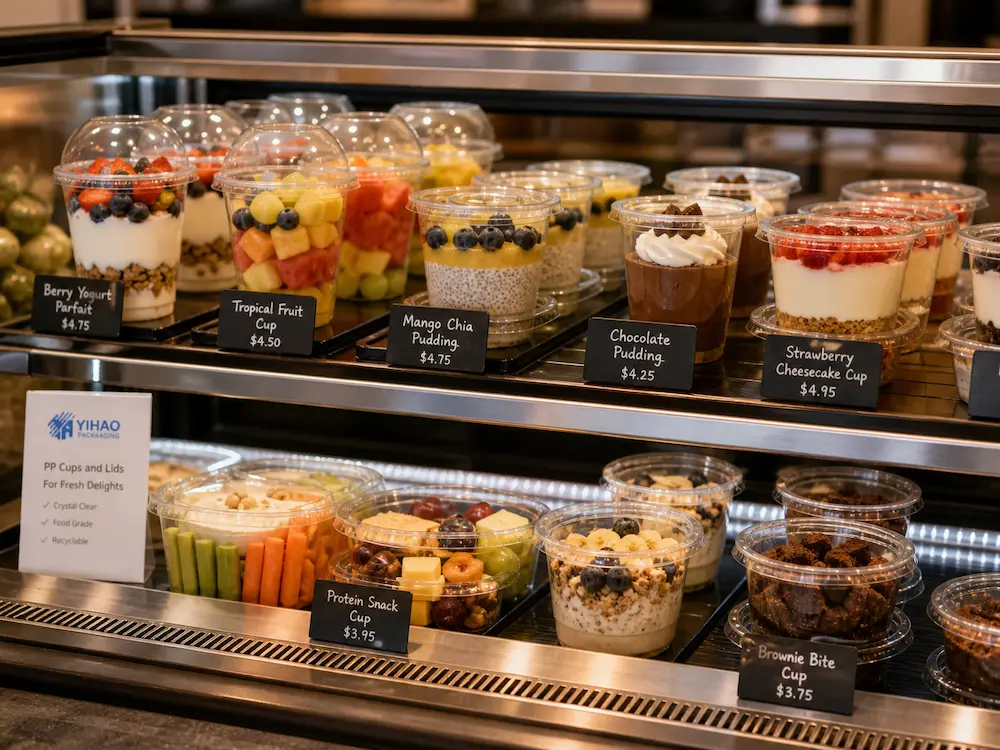
PP drink cups are not limited to beverages. They are also used for chilled food and grab-and-go portions, especially where a cup format improves portability, portion control, or refrigerated display organization.
Common chilled food applications include yogurt, pudding, overnight oats, fruit cups, parfaits, mousse desserts, jelly, small salad toppings, snack portions, and refrigerated dessert cups. For supermarkets, cafes, bakeries, and convenience stores, this creates a wider packaging role for PP cups.
A cup-and-lid system can support both beverage and food programs. This is useful for buyers who want fewer packaging SKUs, simpler storage, and more consistent supplier management.
Application Matching Guide for PP Drink Cups
The same cup should not be used for every product without evaluation. Beverage thickness, ice volume, topping style, display channel, and delivery method all affect cup selection.
| Application | Recommended Cup Priority | Lid Consideration | Buyer Note |
|---|---|---|---|
| Iced Coffee / Cold Brew | Comfortable hand feel, stable rim, good stacking | Flat lid or straw-slot lid | Ideal for cafes, convenience stores, and takeaway beverage counters. |
| Smoothies / Protein Drinks | Stronger wall feel and larger size compatibility | Dome lid or wide straw-compatible lid | Suitable for thicker drinks and blended beverage menus. |
| Juice / Lemonade / Refreshers | Good handling strength and clean appearance | Flat lid, straw lid, or sealing option | Works well for high-volume takeaway and retail drink programs. |
| Milk Tea / Matcha / Fruit Tea | Rim consistency, cup strength, and topping support | Straw-friendly lid or sealing system | Cup and lid testing is important because toppings affect drink weight. |
| Yogurt / Parfait / Desserts | Stable base, clean display, portion control | Flat lid or dome lid | Useful for bakeries, supermarkets, cafes, and grab-and-go food programs. |
| Chilled Food Portions | Refrigerated display fit and secure closure | Matching lid for shelf storage and takeaway | Suitable for fruit portions, snack cups, and small ready-to-eat food items. |
This type of matching table helps buyers avoid one of the most common packaging mistakes: choosing a cup by size only. The better method is to match PP drink cups with product weight, service channel, lid type, and customer use.
PP Drink Cups for Retail Display
When PP Cups Are Suitable for Refrigerated Shelves
Retail display packaging must hold the product securely while presenting it clearly enough for customers to understand what they are buying. In refrigerated shelves, PP cups are suitable for ready-to-drink beverages, yogurt cups, fruit portions, chilled desserts, and grab-and-go food items.
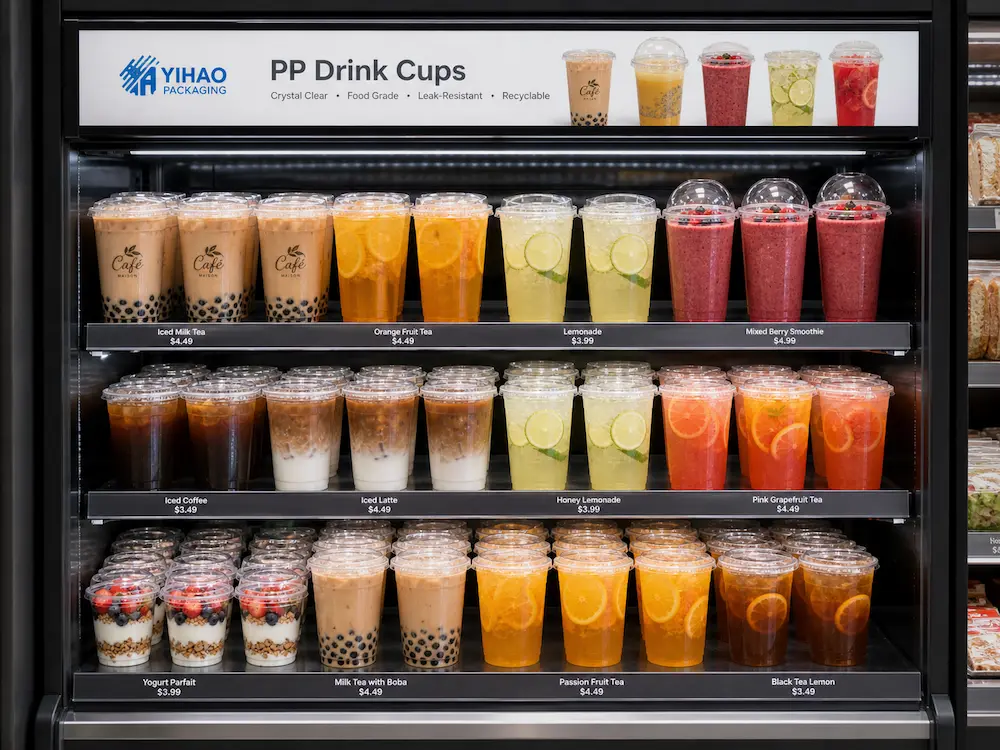
The cup should match the display purpose. If the product relies heavily on visual layers and premium transparency, PET may be the preferred option. If the product needs stronger handling, practical durability, and consistent takeaway use, PP drink cups are a strong choice.
For supermarkets and convenience stores, packaging also needs to support shelf organization. Stable cup shape, consistent lids, and label-friendly surfaces help create a cleaner retail presentation.
How Cup Shape Supports Product Visibility and Shelf Organization
PP is usually not selected for glass-like clarity in the same way as PET. However, well-designed PP cold cups still support practical product visibility and organized shelf presentation.
Cup shape influences how the product appears in a refrigerated display. A straight or gently tapered cup can help products line up neatly. A stable base helps reduce tipping. A suitable lid design helps protect the product while maintaining a clean appearance.
For chilled food programs, the buyer should consider how the cup looks when labeled, stacked, and displayed under retail lighting. The goal is not only transparency. The goal is a packaging system that looks organized, protects the product, and supports fast customer selection.
Matching Cups, Lids, and Labels for Branded Retail Packaging
Retail packaging is a complete system. The cup, lid, label, sleeve, barcode, carton packing, and shelf placement must work together.
For branded retail programs, PP drink cups can be paired with labels, printed designs, or custom packaging elements. Buyers should confirm whether the cup surface supports the intended label format and whether the lid leaves enough space for sealing, branding, or product information.
This is especially important for supermarkets, cafes, bakeries, and private-label food brands. A small mismatch in cup size, lid shape, or label area can reduce shelf appeal and create packing problems.
PP Drink Cups for Takeaway and Delivery
Why Takeaway Brands Need Durable Cold Cups
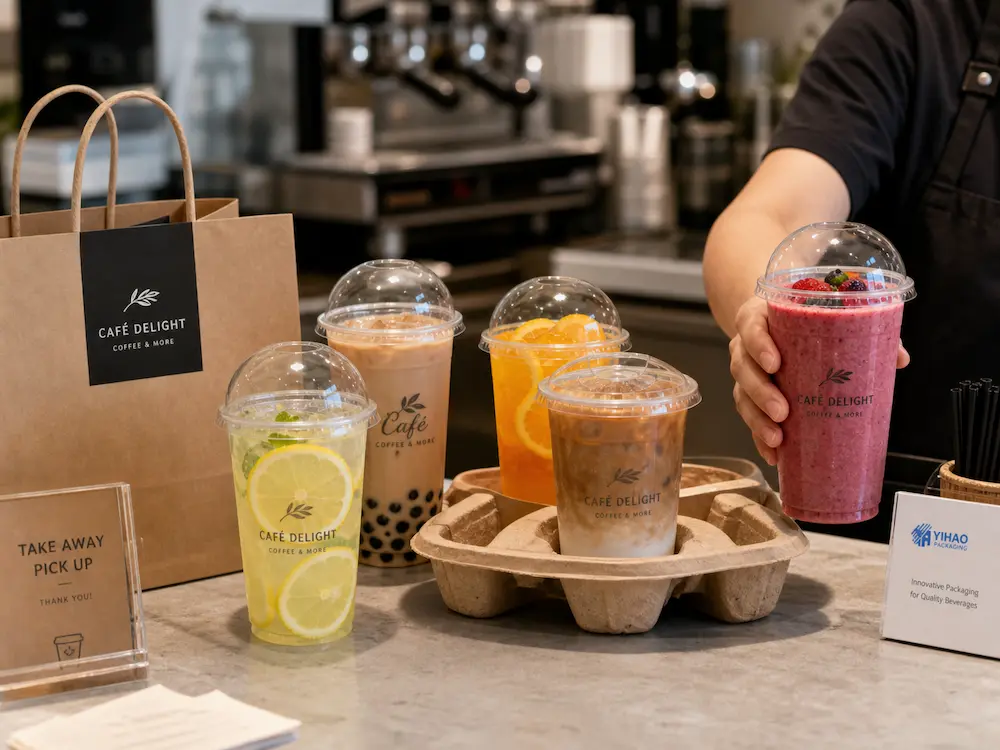
Takeaway drink packaging faces real movement. A cup may be placed into a drink carrier, moved into a delivery bag, carried by a customer, or stored temporarily in a refrigerator. This is why takeaway brands often prefer durable cold cups for high-volume operations.
PP drink cups help support this need because they combine light weight with practical flexibility. They are suitable for iced coffee, smoothies, juice, milk tea, fruit tea, iced tea, lemonade, refreshers, sparkling fruit drinks, cold brew, matcha, and protein drinks.
For takeaway brands, cup performance affects brand perception. A cup that feels weak, bends too easily, or mismatches with the lid creates a poor customer experience. A stable PP cup system helps protect both the drink and the brand.
Lid Fit, Stacking, and Carton Packing Matter
A cup should never be evaluated alone. Buyers need to test the cup with its lid, carton packing, and real operating process.
Lid fit is critical. A secure lid fit helps reduce spill risk during normal handling. Stacking is also important because cups must store efficiently in back-of-house spaces. Carton packing affects shipping efficiency, warehouse storage, and distributor handling.
For wholesale PP drink cups, carton strength, inner sleeve packing, quantity per carton, and lid pairing should be reviewed before large orders. The most successful packaging programs are built around total system performance, not only unit price.
Suitable Cup Sizes for Different Drink Menus
Cup size should match the menu. Small cups work for samples, juice portions, kids’ drinks, yogurt, desserts, and tasting programs. Medium cups are widely used for iced coffee, juice, lemonade, iced tea, and fruit tea. Larger cups are commonly used for smoothies, milk tea, protein drinks, and refreshers.
Buyers should avoid selecting a cup size only because it is popular. The correct choice depends on drink recipe, ice volume, toppings, lid style, serving occasion, and price positioning.
A reliable PP drink cups supplier should help buyers match cup sizes with applications instead of simply offering a generic size list.
PP Drink Cups vs PET Cold Cups
The following comparison helps buyers choose the right cup material for different cold beverage and chilled food programs.
| Factor | PP Drink Cups | PET Cold Cups |
|---|---|---|
| Material | Polypropylene | Polyethylene terephthalate |
| Main Strength | Durability, flexibility, and practical handling | High clarity and premium visual display |
| Common Uses | Takeaway drinks, chilled food, foodservice beverages, yogurt, desserts | Retail beverages, iced coffee, smoothies, juice, fruit cups, display-focused packaging |
| Display Advantage | Clean appearance and practical shelf organization | Clear product visibility and strong shelf appeal |
| Handling Advantage | Flexible structure for takeaway and daily service use | Rigid transparent structure for premium presentation |
| Buyer Priority | Strength, lid fit, cost efficiency, and supply consistency | Transparency, retail appearance, and product display value |
Both materials have strong value. The better choice depends on whether the buyer prioritizes display clarity or takeaway durability. Many food packaging teams use both materials in different product lines.
Key Buying Factors for Wholesale PP Drink Cups
Material Quality and Cup Wall Strength
Material quality affects cup performance, hand feel, stacking, and lid matching. For PP drink cups, buyers should check whether the cup wall feels stable enough for the intended beverage or food application.
A cup used for iced coffee may not require the same structure as a cup used for thick smoothies or chilled desserts. A cup used for takeaway delivery may need stronger handling performance than a cup used only for counter service.
Before wholesale purchasing, buyers should request samples and test the cups under real conditions. Fill the cups with actual products, add ice or toppings where needed, apply lids, place them in carriers, and test normal handling.
Lid Matching and Spill Reduction
Lid compatibility is one of the most important quality points for PP cups with lids. A cup and lid should match securely without requiring excessive force. If the lid is too loose, spill risk increases. If the lid is too tight, staff may lose time during service or damage the cup rim.
Different drinks need different lid styles. Iced coffee, cold brew, and iced tea often use flat lids. Smoothies and topped drinks may require dome lids. Milk tea and fruit tea may require straw-friendly lids or sealing options.
Buyers should test lids from the same supplier whenever possible. Mixing cups and lids from different sources can create inconsistent fit.
Size Range and Menu Compatibility
A strong PP drink cups supplier should offer a size range that supports different beverage and chilled food applications. Buyers should match each size to the menu structure.
For example, a cafe may need smaller cups for juice and yogurt, medium cups for iced coffee and lemonade, and larger cups for smoothies or milk tea. A supermarket may use PP cups for chilled desserts, fruit portions, and ready-to-drink beverages.
A clear size strategy helps reduce inventory confusion. It also makes staff training easier because each cup size has a defined purpose.
Wholesale Packing and Supply Stability
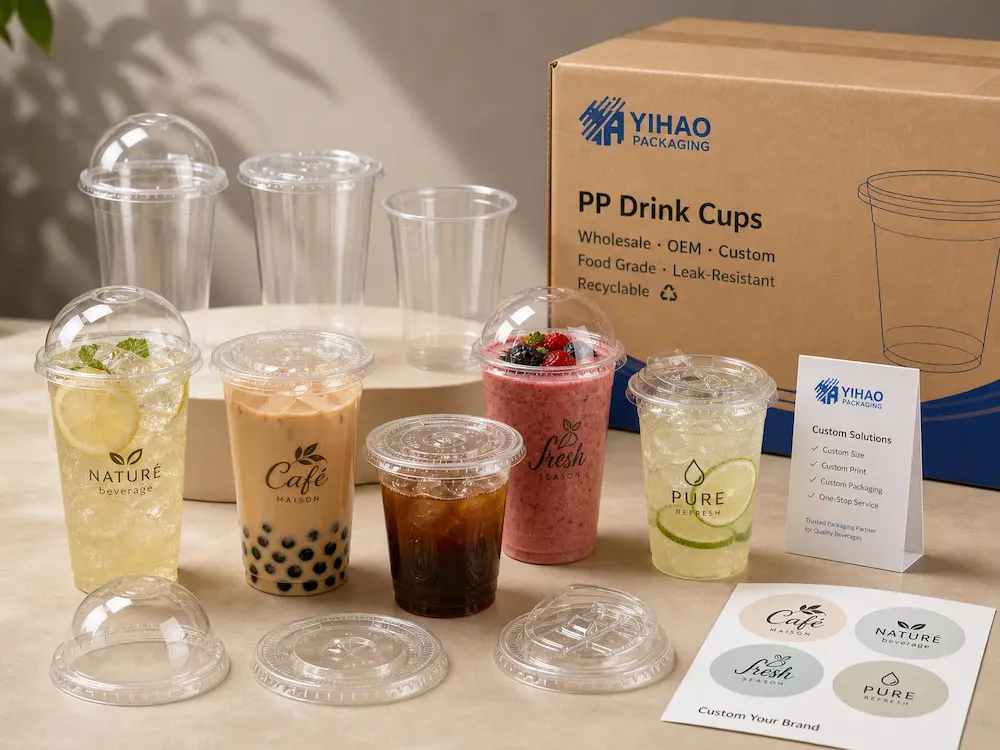
Wholesale packaging buyers need more than a good sample. They need stable production, consistent carton packing, and reliable repeat supply.
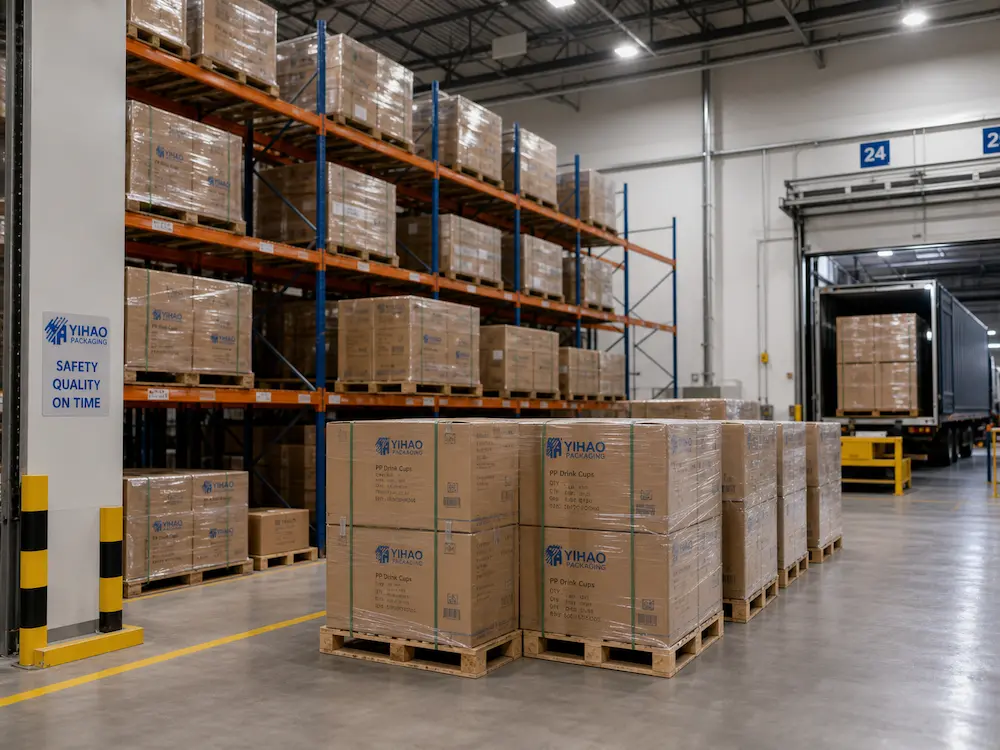
When sourcing wholesale PP drink cups, buyers should ask about carton quantity, sleeve packing, lid packing, pallet loading, private-label options, and repeat order support. These details influence warehouse efficiency and purchasing control.
For distributors, supply stability is especially important. If cup size, rim fit, or carton packing changes without notice, it may affect multiple customers at once.
Custom Printing and Private Label Options
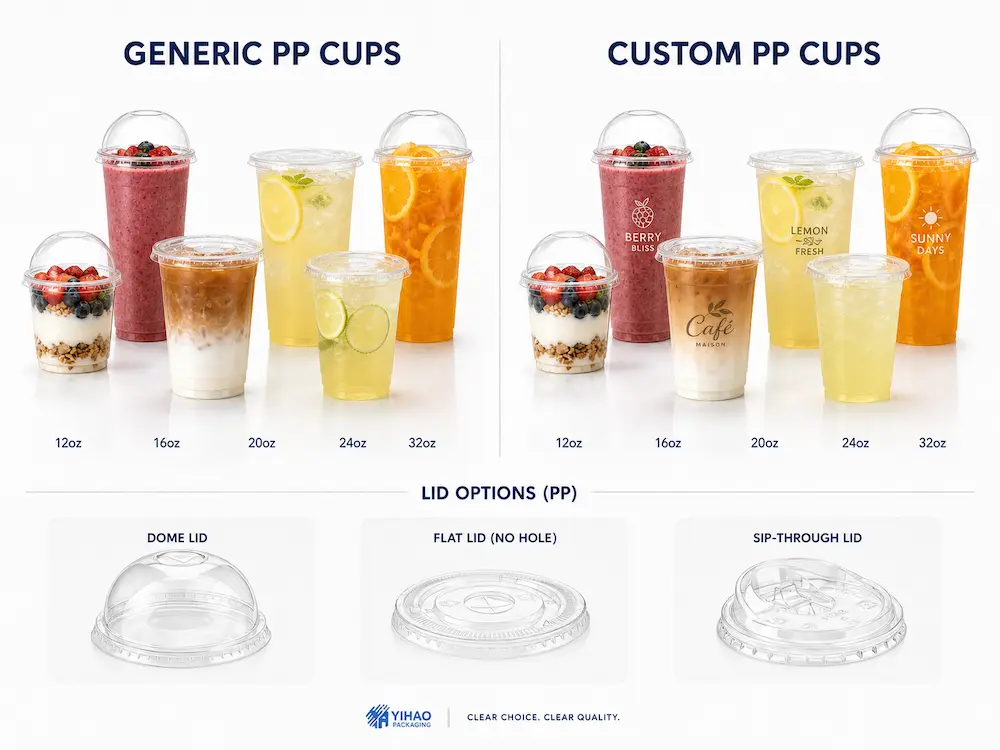
Custom packaging helps beverage and food brands strengthen recognition. PP drink cups may support custom printing, labeling, private-label packing, or branded cup-and-lid systems depending on the supplier’s capability.
Custom projects should be planned carefully. Buyers need to confirm print area, artwork requirements, minimum order quantity, lead time, carton marking, color expectations, and packaging compatibility.
For supermarkets, cafes, bakeries, and foodservice chains, custom PP cups create a more professional brand presentation while keeping packaging practical for daily service.
Procurement Scorecard for PP Drink Cups Buyers
A structured scorecard helps buyers compare suppliers more objectively. Instead of judging only by price, packaging teams can score each supplier across product performance, lid matching, customization, and supply stability.
| Evaluation Area | Suggested Weight | What Buyers Should Review |
|---|---|---|
| Cup Quality | 25% | Cup wall strength, rim consistency, stacking stability, hand feel, and application fit. |
| Lid Compatibility | 20% | Flat lid, dome lid, straw lid, or sealing option compatibility with each cup size. |
| Application Coverage | 15% | Suitability for iced coffee, juice, smoothies, milk tea, desserts, chilled food, and takeaway service. |
| Wholesale Supply | 15% | Repeat order capability, carton packing, export support, and batch consistency. |
| Customization Support | 10% | Custom printing, private label packing, carton marks, and branded packaging options. |
| Supplier Communication | 15% | Clear quotation, sample support, technical explanation, and responsive after-sales service. |
This scorecard gives buyers a more practical way to select PP drink cups for wholesale purchasing. The lowest price is not always the lowest total cost if the cups create lid mismatch, carton damage, poor display, or customer complaints.
How to Choose a PP Drink Cups Manufacturer
Factory Capability and Product Consistency
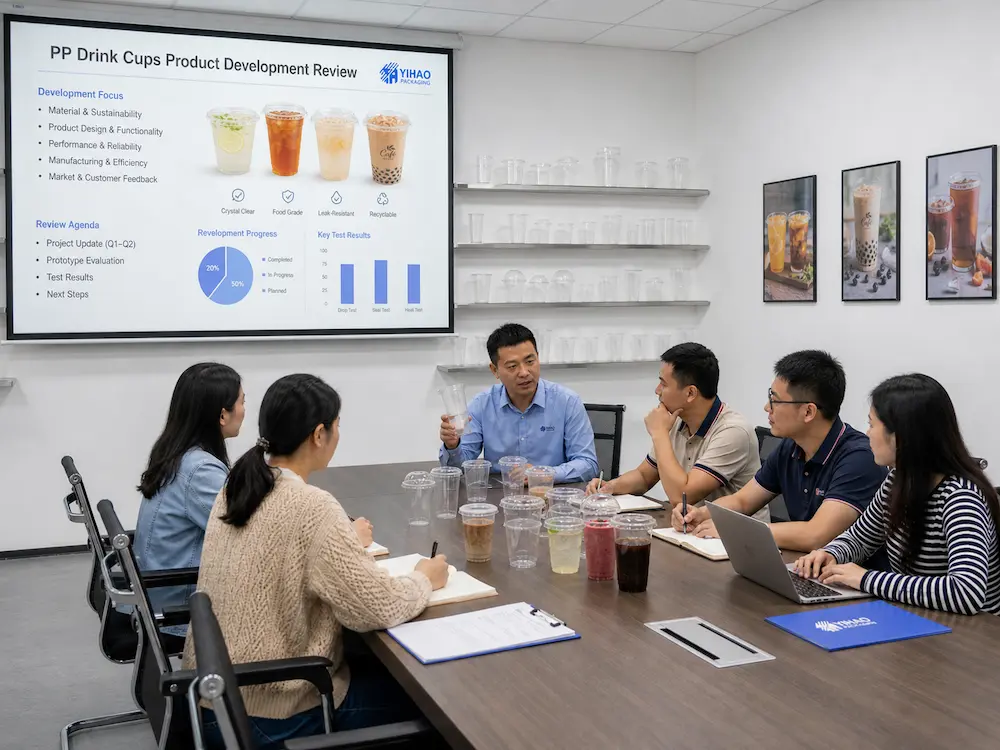
A reliable PP drink cups manufacturer should provide stable product quality, clear communication, and practical production support. Buyers should evaluate not only the product sample but also the supplier’s ability to deliver consistent products over time.
Important evaluation points include material selection, molding quality, rim consistency, cup wall uniformity, lid matching, carton packing, and quality inspection process.
A good manufacturer understands that packaging is part of the buyer’s operating system. It must work in storage, filling, sealing, display, takeaway, and customer use.
OEM and Wholesale Support
For brands, distributors, and foodservice operators, OEM and wholesale support can be more important than a single product listing. Buyers often need custom carton marks, private labels, stable reorder programs, and matching lids.
A qualified PP drink cups supplier should help buyers organize the full packaging system. This includes cup sizes, lid options, carton packing, material direction, sample testing, and shipment planning.
The strongest supplier relationship is not transactional. It helps buyers reduce packaging uncertainty and build repeatable purchasing standards.
Questions Buyers Should Ask Before Ordering
Before placing a bulk order, buyers should ask clear questions:
| Question | Why It Matters |
|---|---|
| Which PP drink cup sizes are available? | The size range must match iced coffee, juice, smoothies, milk tea, desserts, and chilled food portions. |
| Which lids match each cup size? | Cup and lid compatibility affects spill reduction, service speed, and customer experience. |
| Can samples be tested before wholesale orders? | Sample testing helps buyers confirm real-world performance before bulk purchasing. |
| Is custom printing or private-label packing available? | Branding support helps cafes, supermarkets, and beverage brands create stronger packaging identity. |
| How are the cups and lids packed? | Carton packing affects storage, shipping, warehouse control, and distributor handling. |
| Can the supplier support repeat orders? | Stable supply is essential for foodservice chains, wholesalers, and retail programs. |
Why Choose YIHAO for PP Drink Cups
YIHAO is a food packaging manufacturer and solution provider serving beverage brands, supermarkets, cafes, bakeries, distributors, and foodservice teams. For buyers who need reliable PP drink cups, YIHAO focuses on practical packaging solutions that support daily operations, refrigerated retail display, takeaway service, and chilled food programs.
Instead of treating cups as isolated items, YIHAO helps buyers think in systems: cup body, matching lid, drink application, chilled food use, packing method, brand presentation, and wholesale supply planning. This approach is especially important for customers who manage multiple products, multiple store locations, private-label projects, or repeat export orders.
For cold beverages, YIHAO supports packaging solutions for iced coffee, smoothies, juice, milk tea, matcha, refreshers, iced tea, lemonade, cold brew, fruit tea, sparkling fruit drinks, and protein drinks. For chilled food, PP cups can also support yogurt, pudding, fruit portions, parfaits, desserts, and grab-and-go retail items.
Buyers can send cup size requirements, lid type, application scenario, packing preference, branding needs, and target market information. YIHAO can help match practical PP cold cups, compatible lids, and wholesale packaging solutions for beverage, retail, and foodservice programs.
Whether buyers need standard PP drink cups, customized PP cups with lids, or long-term wholesale packaging support, YIHAO provides a direct route from product selection to supply planning.
Buyer Quick Note
The best PP drink cups are not chosen by price alone. Buyers should evaluate the complete packaging system: material quality, cup strength, rim consistency, lid fit, size range, application match, carton packing, branding needs, and supplier reliability.
For retail display, PP cups should support clean shelf organization and practical product presentation. For takeaway service, they should provide durable handling and secure lid compatibility. For chilled food programs, they should support portion control, refrigeration, and grab-and-go convenience.
A strong PP drink cups manufacturer helps buyers reduce packaging risk, simplify sourcing, and build a more consistent packaging system for beverage and foodservice growth.
FAQ
1. What are PP drink cups used for?
PP drink cups are used for cold beverages, takeaway drinks, chilled food portions, desserts, yogurt, fruit cups, and grab-and-go foodservice items. Common drink applications include iced coffee, smoothies, juice, milk tea, matcha, fruit tea, lemonade, refreshers, iced tea, sparkling fruit drinks, protein drinks, and cold brew.
2. Are PP drink cups suitable for cold drinks?
Yes. PP drink cups are suitable for many cold drink applications because polypropylene provides practical flexibility, light weight, and durable handling performance. They are widely used as PP cold cups for cafes, beverage chains, convenience stores, supermarkets, and takeaway foodservice operations.
3. What is the difference between PP drink cups and PET cold cups?
PP drink cups focus on flexibility, durability, and practical takeaway handling. PET cold cups usually provide higher clarity and stronger visual display value. Buyers often choose PP for operational strength and PET for premium transparency. The right choice depends on the product, channel, lid style, and display requirements.
4. Can PP drink cups be used with lids?
Yes. Many PP drink cups are designed to be used with matching lids. PP cups with lids are suitable for iced coffee, smoothies, juice, milk tea, fruit tea, cold brew, desserts, and chilled food portions. Buyers should always test cup and lid compatibility before placing wholesale orders.
5. How do I choose a PP drink cups manufacturer or supplier?
Choose a PP drink cups manufacturer or supplier by checking material quality, cup wall strength, lid matching, size range, carton packing, sample support, customization options, and repeat supply capability. For wholesale purchasing, supplier consistency is as important as the cup itself.
References
- U.S. Food and Drug Administration — Packaging & Food Contact Substances
- European Commission — Commission Regulation EU No 10/2011 on Plastic Materials and Articles Intended to Come into Contact with Food
- Association of Plastic Recyclers — APR Design Guide for Plastics Recyclability
- Ellen MacArthur Foundation — Circular Economy and Plastics Packaging Vision
- Plastics Industry Association — Polypropylene Material and Packaging Applications
- WRAP — Plastic Packaging, Recycling, and Resource Efficiency Guidance
- Packaging Europe — Foodservice Packaging and Beverage Packaging Trends
- Grand View Research / Mordor Intelligence — Disposable Cups and Foodservice Packaging Market Research
Deep-Dive Insights for PP Drink Cups Buyers
How should buyers decide whether PP drink cups fit their beverage program?
Buyers should choose PP drink cups when takeaway durability, flexible handling, lid compatibility, and daily foodservice efficiency are more important than glass-like transparency. PP cups are especially practical for iced coffee, smoothies, juice, milk tea, refreshers, protein drinks, cold brew, yogurt, desserts, and chilled food portions.
Why does lid matching matter as much as cup material?
A cup performs well only when the lid fits correctly. The best PP cups with lids should support smooth application, secure closure, and normal takeaway movement. Buyers should test the cup and lid together before wholesale ordering, especially for delivery, retail display, and high-volume beverage service.
What makes PP useful for takeaway cold cups?
Takeaway packaging goes through more handling than dine-in packaging. Takeaway cold cups need to support filling, sealing, carrying, bagging, and customer use. PP provides a flexible and durable structure that supports these daily foodservice demands.
Option: When should buyers choose PET instead of PP?
PET cold cups are often preferred when premium clarity and product visibility are the main goals. PP is stronger for buyers who prioritize practical handling, operational flexibility, and durable takeaway performance. Many food packaging teams use both materials across different product lines.
Consideration: What should wholesale buyers verify before ordering?
Before ordering wholesale PP drink cups, buyers should verify cup sizes, lid compatibility, carton packing, sample availability, custom printing options, repeat supply capability, and application fit. A reliable manufacturer or supplier helps reduce sourcing risk and improves packaging consistency across stores, distributors, and retail programs.
What is the strongest purchasing logic for PP drink cups?
The strongest purchasing logic is not “PP is better than PET” or “PET is better than PP.” The better logic is application matching. Choose PP drink cups when the product needs flexible handling, strong takeaway performance, and cost-efficient daily use. Choose PET when premium transparency and visual shelf impact are the main priorities.
© YIHAO Packaging. All rights reserved. All articles, product images, packaging designs, technical specifications, and website materials are protected by copyright. Unauthorized copying, reproduction, redistribution, modification, or commercial use is strictly prohibited without prior written permission.