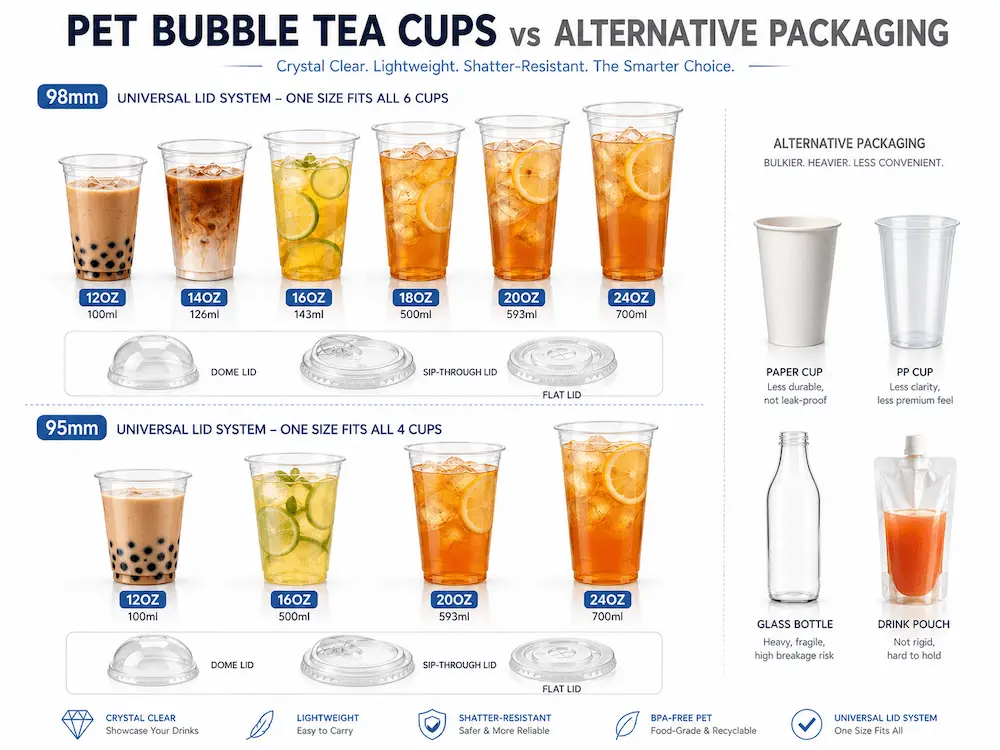
For beverage packaging teams, choosing the right PET bubble tea cups is not only about cup size. A bubble tea package must protect the drink, show the color and toppings, match the correct lid or sealing method, support fast service, and reduce complaints during takeaway. Milk tea, boba tea, fruit tea, cheese foam drinks, matcha lattes, refreshers, and layered cold beverages all create different packaging requirements.
YIHAO is a food packaging manufacturer and solution provider supporting practical packaging for cold drinks, fresh food, bakery items, fruit, salads, desserts, and grab-and-go service. For cold beverage programs, the cup decision should start from the real menu: drink temperature, ice level, topping height, tapioca pearls, foam, fruit pieces, sealing style, lid compatibility, and retail display needs.
This guide explains how buyers should compare PET bubble tea cups with PP cups, paper cups, sealed drink cups, glass bottles, pouches, and other alternative packaging formats before wholesale purchasing.
Why Bubble Tea Packaging Needs a Different Buyer Logic
Bubble tea is more complex than a standard cold drink. A basic iced tea may only need a clear cup and a straw slot lid, but a bubble tea menu often includes tapioca pearls, popping boba, pudding, jelly, cheese foam, fruit cubes, cream layers, brown sugar syrup, matcha, yogurt, and other visible ingredients. The packaging must support both function and presentation.
For food packaging buyers, this means the cup must answer several questions at the same time:
- Does the cup show the drink clearly enough for retail display?
- Does the rim match flat lids, dome lids, strawless lids, or sealing film?
- Does the cup feel stable when filled with ice, milk tea, pearls, and syrup?
- Does the packaging support takeaway, delivery, and counter service?
- Does the supplier provide consistent cup dimensions for bulk ordering?
- Does the material fit the brand’s cost, appearance, and handling requirements?
That is why bubble tea cups should not be selected only by capacity. Buyers should compare material clarity, lid fit, sealing method, stacking performance, branding surface, and supplier reliability before placing wholesale orders.
Quick Decision Matrix for Buyers
Different packaging formats solve different beverage packaging problems. For most cold drink buyers, PET bubble tea cups are the strongest starting point when visual display, takeaway convenience, and flexible lid matching matter. Alternative formats may be better when the priority shifts toward heat tolerance, full-surface branding, machine sealing, or premium bottled retail.
| Packaging Option | Best For | Main Strength | Buyer Watch Point |
|---|---|---|---|
| PET bubble tea cups | Milk tea, boba, fruit tea, iced coffee, matcha, refreshers | High clarity and strong cold drink display | Cup-lid fit must be tested by series |
| PP bubble tea cups | Selected flexible handling conditions | Practical toughness and handling flexibility | Visual clarity is usually weaker than PET |
| Sealed drink cups | Classic bubble tea shops with sealing machines | Strong boba takeaway identity | Requires film, machine, rim, and operation control |
| Paper cups | Brand campaigns and printed drink packaging | Large printing surface | Drink and topping visibility is limited |
| Glass bottles | Premium pre-filled refrigerated beverages | Premium shelf appearance | Heavier, fragile, and less practical for fast boba service |
What Are PET Bubble Tea Cups?
PET bubble tea cups are clear plastic cold drink cups made for chilled beverage service. PET is widely used for cold drink packaging because it offers strong transparency, a clean appearance, practical rigidity, and good display value. For bubble tea shops, cafes, supermarkets, convenience stores, and drink chains, this clarity matters because the drink itself becomes part of the selling point.
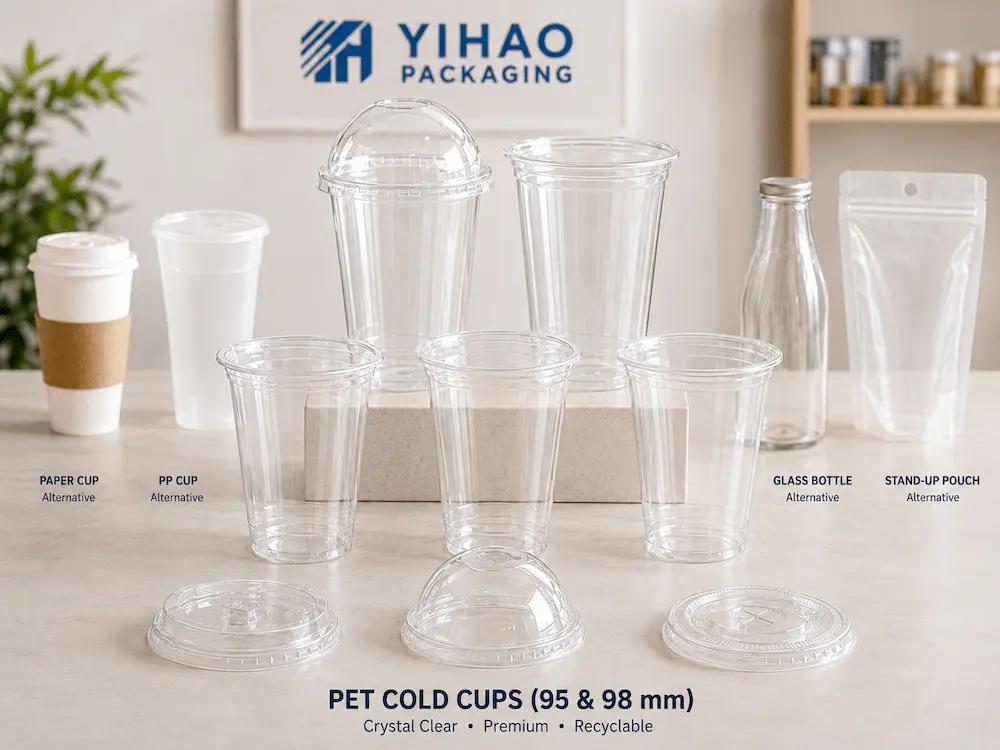
Customers often judge a bubble tea drink before tasting it. They see the milk tea color, boba level, brown sugar streaks, matcha layer, fruit inclusions, foam height, and ice quality. A clear PET cup makes these details visible. This is especially useful for retail display, takeaway counters, self-service refrigerators, and branded drink menus.
PET cups are commonly paired with flat lids, dome lids, strawless sipper lids, sip-through lids, or sealing film depending on the drink and service style. A standard milk tea may use a sealed top or flat lid with straw access. A foam-topped drink may need a dome lid. A fruit tea or iced tea program may use a strawless sipper lid for direct drinking.
Where PET Bubble Tea Cups Perform Best
PET bubble tea cups are strongest when the buyer wants clear display, reliable cup shape, practical takeaway use, and a clean premium appearance. They fit cold beverage programs where the drink’s appearance helps drive purchase decisions.
1. Milk Tea and Boba Drinks
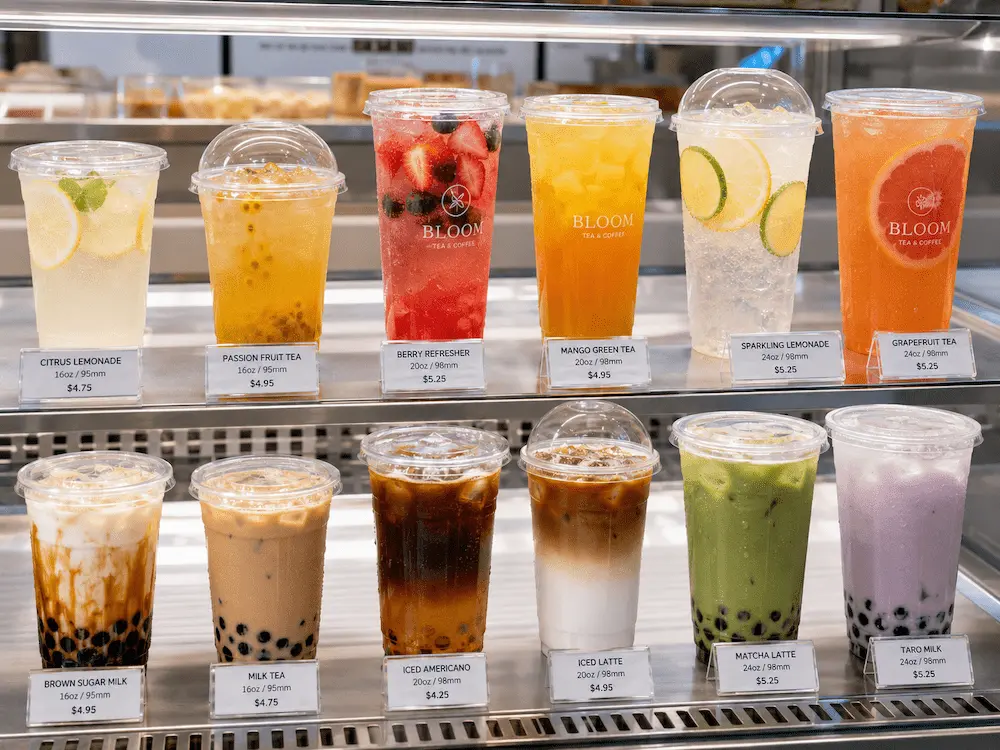
Classic milk tea, brown sugar boba, taro milk tea, Thai milk tea, matcha milk tea, and cheese foam milk tea all benefit from clear packaging. PET cups show color contrast, boba placement, topping levels, and syrup movement. For high-visibility counters and delivery platforms, this helps the drink look more complete and attractive.
2. Fruit Tea and Refreshers
Fruit tea, lemon tea, peach tea, passion fruit tea, strawberry refreshers, berry refreshers, and sparkling fruit drinks rely on visual freshness. Clear PET cups display fruit slices, pulp, ice, color, and bubbles more effectively than opaque packaging. This is one reason PET remains strong for modern chilled beverage menus.
3. Retail and Grab-and-Go Display
Supermarkets, convenience stores, cafes, bakeries, and foodservice brands often need packaging that works both for display and takeaway. PET cups support cold cabinet presentation because customers can see the product directly. For pre-filled drinks, buyers should also evaluate sealing options, label space, and local food-contact requirements.
4. Multi-Size Drink Programs
A strong bubble tea packaging system should support multiple sizes without creating lid confusion. Buyers should check whether different cup capacities share the same lid diameter within the same series. This reduces mismatch risk, improves packing speed, and makes wholesale supply easier to manage.
PET Bubble Tea Cups vs PP Bubble Tea Cups
PP bubble tea cups are another common option for beverage packaging. PP is often selected when buyers prioritize flexibility, toughness, and certain handling conditions. It is usually less visually crisp than PET, but it may offer practical value in selected drink service environments.
| Comparison Point | PET Bubble Tea Cups | PP Bubble Tea Cups |
|---|---|---|
| Visual clarity | High transparency for drink display | Usually softer and less glass-like |
| Best use | Cold drinks, retail display, premium takeaway | Flexible handling and selected service conditions |
| Shelf appearance | Clean, bright, and product-focused | More functional than premium-looking |
| Lid matching | Works well with flat, dome, and sipper lid systems when matched correctly | Also supports lids, but compatibility must be confirmed by series |
| Buyer priority | Presentation, clarity, display value, cold drink identity | Handling flexibility, selected cost and service needs |
For buyers who sell drinks mainly through visual presentation, PET bubble tea cups are usually the stronger starting point. For buyers who need a different handling profile or have existing PP-compatible systems, PP bubble tea cups may still be practical. The better choice depends on the drink menu, lid system, filling process, and customer experience target.
PET Bubble Tea Cups vs Sealed Drink Cups
Sealed drink cups usually refer to cups used with sealing film, pre-cut film, or machine sealing systems. This format is common in bubble tea shops because it helps reduce splash risk, supports takeaway, and creates a familiar boba drink experience.
However, buyers should not treat sealed drink cups as a completely separate category from PET cups. In many cases, PET cups may be used with lids or sealing systems depending on the cup rim, machine setting, film compatibility, and supplier recommendation. The real question is not “PET or sealed cup.” The real question is “which cup and closure system fits the drink operation?”
| Packaging Option | Main Advantage | Buyer Watch Point |
|---|---|---|
| PET cup with flat lid | Simple takeaway service with straw access | Cup rim and lid fit must be tested |
| PET cup with dome lid | Extra headspace for foam, toppings, or dessert-style drinks | Dome height and drink fill level must match |
| PET cup with sipper lid | Direct-drink format for no-straw service | Not ideal for large pearls or heavy toppings |
| Sealing film system | Strong takeaway identity for bubble tea shops | Requires machine, film, cup rim, and operation control |
For high-volume milk tea stores, sealed drink cups may be efficient when the sealing equipment is already stable. For cafes, supermarkets, bakeries, and mixed beverage programs, PET cups with matching lids may offer more flexibility because the same cup range can support milk tea, iced coffee, fruit tea, juice, lemonade, refreshers, and chilled desserts.
PET Bubble Tea Cups vs Paper Cups
Paper cups are useful when buyers want more printed surface and a different brand style. They may work for some cold drink programs when properly lined and designed for the application. However, paper cups do not show the beverage clearly, which is a major limitation for bubble tea, fruit tea, and layered drinks.
For bubble tea, visibility is commercial value. Customers want to see pearls, tea color, foam, toppings, and syrup. A paper cup hides these details. This makes paper less suitable for retail display and impulse purchasing unless the brand strategy depends more on printed graphics than product visibility.
Paper cups may be stronger for large-area custom printing, campaign packaging, and brand storytelling. PET bubble tea cups are stronger when the drink itself should be visible. Buyers should decide whether the package needs to sell through printed branding or through product appearance.
PET Bubble Tea Cups vs Glass Bottles
Glass bottles create a premium look and may support selected pre-filled beverage programs. They work well for certain bottled milk tea, cold brew, juice, or specialty drinks sold from refrigerated shelves. However, glass is heavier, more fragile, and usually less practical for fast takeaway bubble tea service.
For boba drinks with pearls, foam, and toppings, glass bottles create filling and drinking limitations. They also increase handling concerns for cafes, delivery, events, and high-volume service. For most takeaway drink programs, clear PET cups remain more practical because they are lightweight, stackable, easy to serve, and compatible with multiple lid options.
PET Bubble Tea Cups vs Pouches and Bags
Drink pouches and flexible bags can create a special visual style for selected beverage promotions. They may be used for juice, fruit tea, novelty drinks, or event packaging. However, they are not the safest default choice for bubble tea programs because pearls, toppings, straw access, filling speed, and display stability are harder to manage.
Compared with pouches, PET bubble tea cups provide better upright display, easier cup holder compatibility, cleaner lid matching, and more familiar customer handling. For wholesale beverage packaging, operational consistency matters more than novelty. A package that looks interesting but slows service or increases leakage complaints is not a good long-term system.
How Buyers Should Choose the Right Bubble Tea Cup System
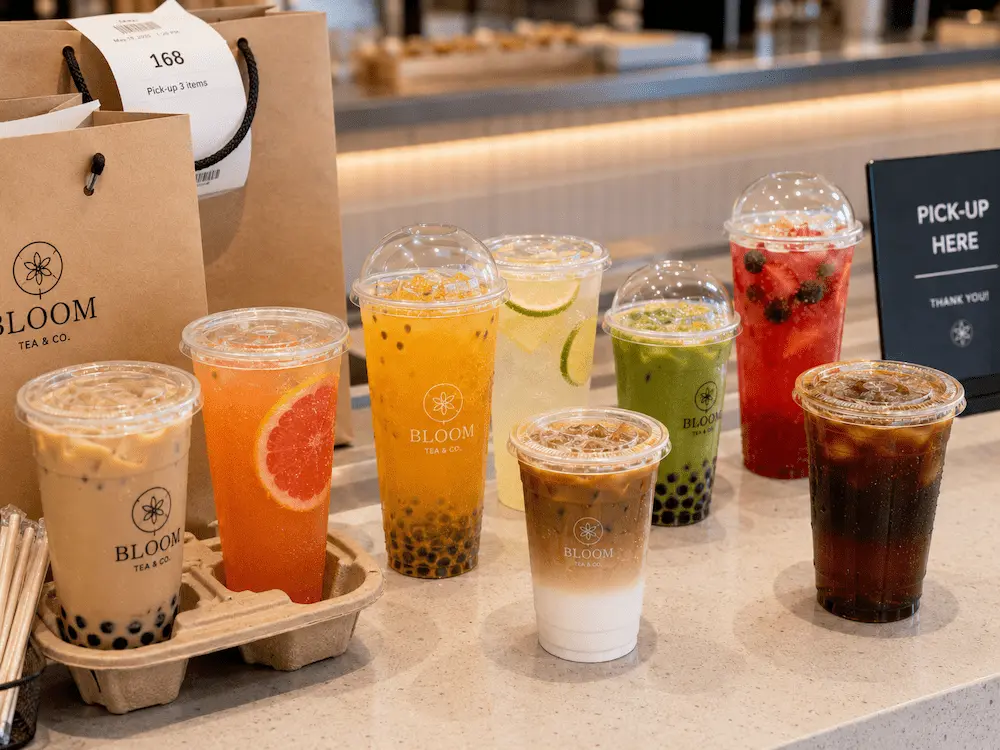
The correct packaging choice starts from the drink menu. Buyers should avoid choosing cups only by price or appearance. A better purchasing process includes drink mapping, size planning, lid matching, sample testing, packing review, and supplier capability checks.
1. Start with Drink Type
Milk tea with pearls, fruit tea with pulp, cheese foam tea, iced coffee, matcha, smoothies, and refreshers do not use packaging in the same way. A boba-heavy drink needs straw access and enough cup strength. A foam drink needs top space. A fruit tea needs visibility. A sealed retail drink needs labeling and closure control.
2. Match the Lid or Sealing Method
A clear cup is only reliable when the closure works. Buyers should test flat lids, dome lids, strawless sipper lids, sip-through lids, and sealing film under real filling conditions. Rim mismatch causes leakage, loose closure, slow service, and customer complaints.
3. Choose Capacity by Menu Logic
Small cups may work for tasting portions, kids’ drinks, juice, or light tea. Medium cups often fit standard milk tea and fruit tea. Large cups fit boba drinks, smoothies, oversized refreshers, and high-volume takeaway service. The best size is the one that makes the drink look full, stable, and valuable without forcing excessive ice or empty headspace.
For many beverage programs, 16 oz, 18 oz, 20 oz, and 24 oz formats cover the most practical range. Buyers should confirm the cup diameter, lid compatibility, carton packing, and sleeve quantity before ordering.
4. Decide Whether Visibility or Print Area Matters More
If the drink has strong visual layers, PET is usually the better choice. If the brand needs full-surface graphics, paper may look stronger. If the drink is sold in a sealed retail format, labels and film compatibility become more important. Buyers should not force one packaging material across every drink style.
5. Test Samples Before Wholesale Orders
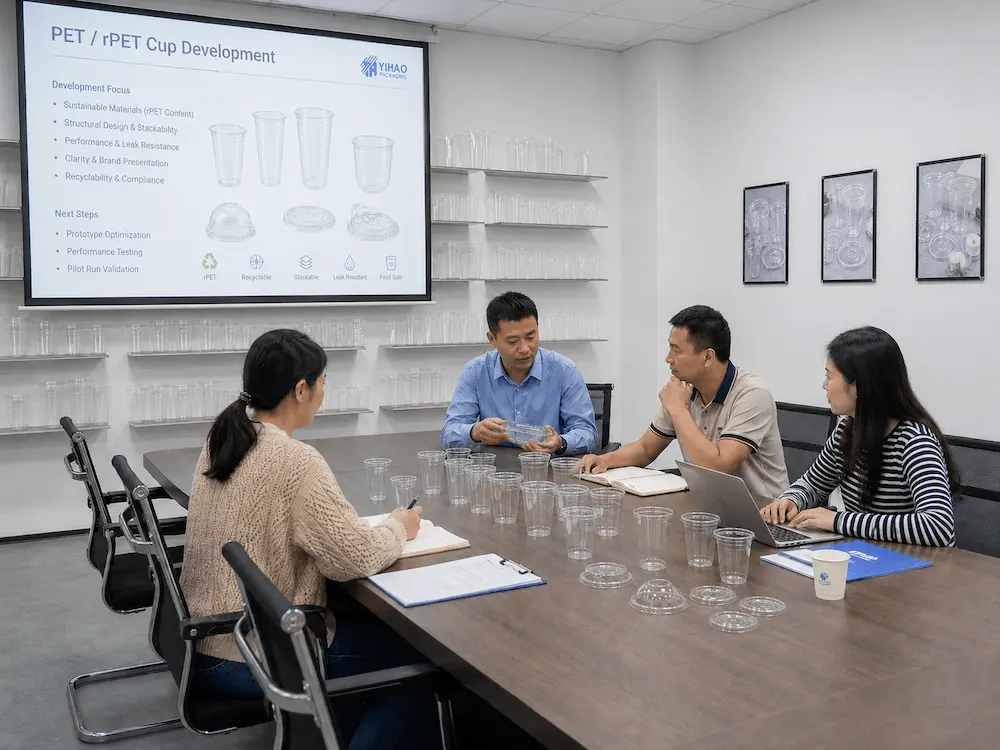
Sample testing should include filling, sealing, lid closing, straw insertion, shaking, carrying, refrigeration, display, stacking, carton handling, and customer use. A cup that looks good when empty may not perform well when filled with milk tea, ice, pearls, syrup, and toppings.
Recommended Cup and Lid Matching Logic
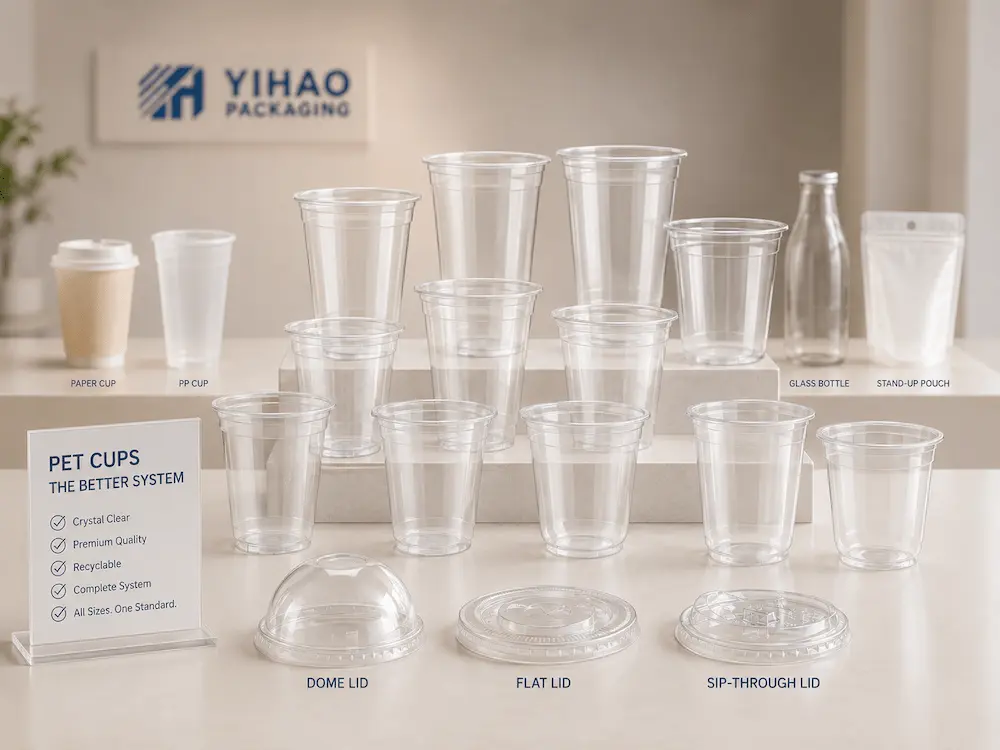
A professional beverage packaging system should reduce complexity. When cups within the same diameter series share matching lids, buyers can simplify inventory and lower the risk of cup-lid mismatch. This is especially useful for chains, distributors, and wholesale buyers managing multiple drink sizes.
| Drink Style | Recommended Cup Direction | Recommended Lid or Closure | Buyer Note |
|---|---|---|---|
| Classic milk tea with pearls | Clear PET cup | Flat lid with straw slot or sealing film | Confirm straw size and pearl flow |
| Cheese foam tea | Clear PET cup with headspace | Dome lid or suitable sipping lid | Check foam height before ordering |
| Fruit tea with inclusions | High-clarity PET cup | Flat lid, dome lid, or sealing film | Visibility is a major selling point |
| Matcha and layered drinks | Clear PET cup | Flat lid or dome lid | Cup clarity supports color contrast |
| Iced tea and refreshers | Clear PET cup | Strawless sipper lid or flat lid | Direct drinking works better for no-pearl drinks |
| Smoothies and topped drinks | Clear PET cup | Dome lid | Raised lid supports topping space |
What Buyers Should Ask a Manufacturer, Wholesale Partner, or Supplier
When sourcing PET bubble tea cups, buyers should look beyond the product photo. A reliable manufacturer, wholesale partner, or supplier should help confirm cup size, material direction, lid compatibility, packing method, sample testing, customization options, and export communication.
Useful questions include:
- What cup sizes are available for milk tea, boba drinks, fruit tea, and iced coffee?
- Which lids match each cup diameter?
- Are flat lids, dome lids, strawless lids, and sip-through lids available?
- Can the cups support sealing film if needed?
- Can samples be arranged before wholesale purchasing?
- Can the cup support custom printing, labels, or brand presentation?
- How are cups packed to protect clarity and rim shape during transport?
- Are lids and cups sold together or separately?
- What information should buyers confirm before bulk ordering?
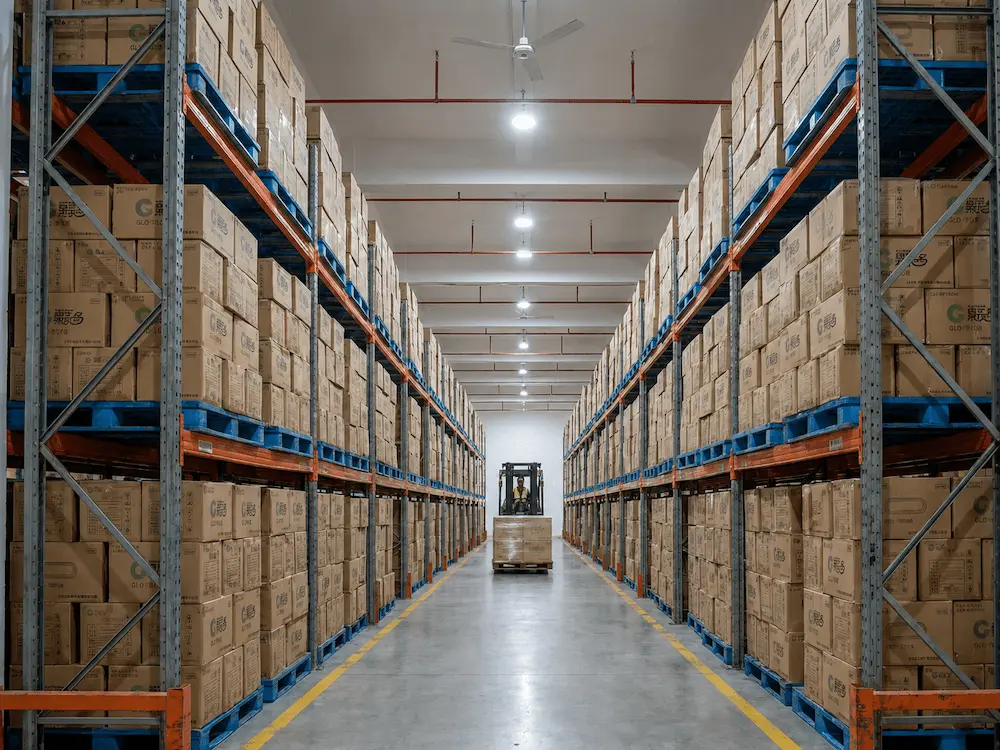
For international buyers, consistency matters. A small difference in rim size, lid grip, cup wall feel, or carton packing can create issues across thousands of cups. The right supplier should provide practical product guidance, not only a quotation.
Common Mistakes When Choosing Bubble Tea Cups
Choosing by Capacity Only
A 20 oz cup from one series may not match the same lids as a 20 oz cup from another series. Buyers should confirm top diameter, lid system, rim structure, and supplier matching recommendations before ordering.
Ignoring Toppings and Straw Size
Bubble tea often needs larger straws for tapioca pearls, jelly, or popping boba. A standard straw slot may not suit every drink. Buyers should test the complete drinking experience, not just the empty cup.
Using Dome Lids Without Real Headspace Need
Dome lids are useful for whipped toppings, smoothies, foam, fruit cubes, and dessert-style drinks. For standard milk tea, a flat lid or sealing film may be more efficient. Overusing dome lids can increase storage space and packaging cost.
Assuming All Clear Cups Perform the Same
Clear appearance, rim accuracy, stackability, wall feel, and lid fit vary by product series and supplier. Buyers should request samples and test them with real drinks before wholesale purchasing.
Forgetting Retail Display Conditions
Chilled display, condensation, label placement, shelf height, and cup stacking all affect the final package. A cup that works for counter service may need additional review for supermarket or convenience store display.
Best Choice by Buyer Type
| Buyer Type | Best Starting Option | Why It Works |
|---|---|---|
| Bubble tea shops | PET cups with sealing film or flat lids | Supports classic boba service and clear drink display |
| Cafes | PET cups with flat, dome, or sipper lids | Works across milk tea, iced coffee, matcha, and fruit tea |
| Supermarkets | Clear PET cups for chilled display | Shows product freshness and supports grab-and-go shelves |
| Drink chains | Shared-diameter PET cup and lid system | Reduces inventory complexity and lid mismatch |
| Distributors | Multiple PET cup sizes with matching lids | Covers different beverage customers with one product range |
| Eco-positioned brands | PET/RPET direction where suitable | Supports clearer material communication, subject to local requirements |
When PET Bubble Tea Cups Are the Better Choice
PET bubble tea cups are the better choice when buyers need strong clarity, clean presentation, practical stacking, flexible lid matching, and strong cold beverage display. They are especially suitable for milk tea, boba drinks, fruit tea, iced tea, matcha, lemonade, refreshers, iced coffee, smoothies, and chilled takeaway drinks.
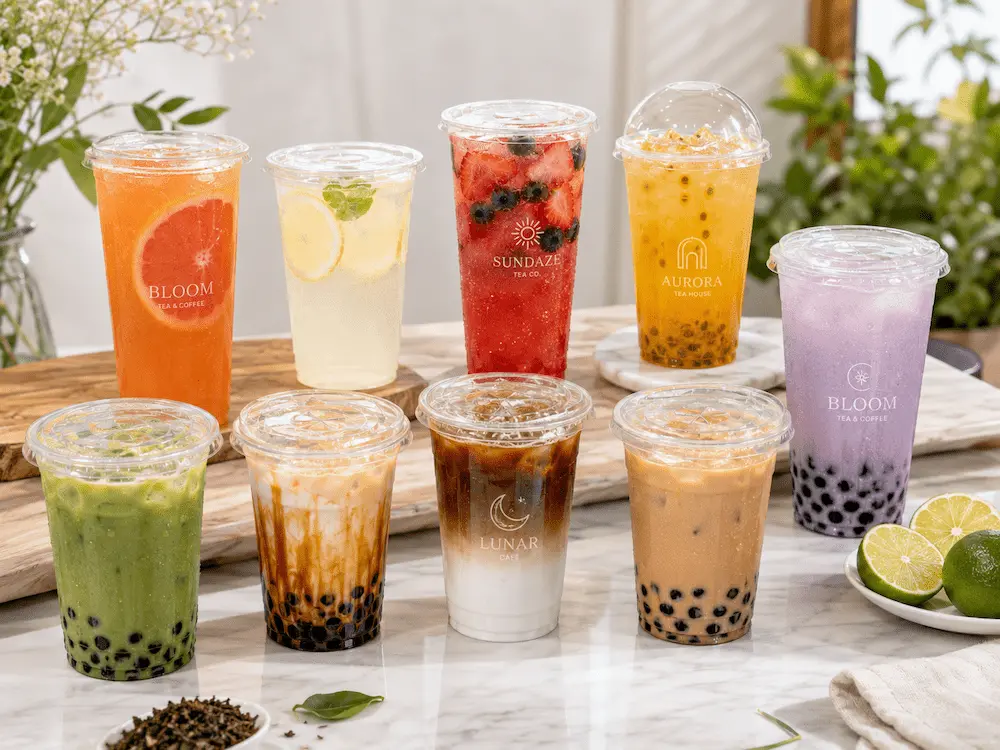
They are also a strong option when one cup range needs to support several menu categories. A cafe or drink chain may use clear PET cups for bubble tea in the morning, iced coffee at lunch, fruit tea in the afternoon, and refreshers for seasonal promotions. This flexibility makes PET useful for buyers who want fewer packaging mistakes and more menu freedom.
When Alternative Packaging May Be Better
PET is not the best answer for every situation. PP cups may work better when the buyer prefers a different handling feel. Paper cups may work better when full printed branding is more important than drink visibility. Glass bottles may work better for selected premium pre-filled beverages. Sealing film systems may be better for high-volume bubble tea shops with established sealing equipment.
The buyer should not choose packaging based on material reputation alone. The correct decision comes from the selling model. A takeaway tea shop, a supermarket chilled display, a delivery beverage chain, and a branded retail drink program do not have the same packaging priorities.
Wholesale Purchasing Checklist
Before confirming a wholesale order for PET bubble tea cups, buyers should review the following checklist:
- Confirm the drink menu: milk tea, boba, fruit tea, matcha, iced coffee, smoothies, refreshers, or mixed drinks.
- Confirm cup sizes by portion logic, not only by competitor habits.
- Confirm top diameter and matching lid system.
- Test flat lids, dome lids, strawless lids, sip-through lids, and sealing film if needed.
- Check straw size for tapioca pearls, jelly, popping boba, or fruit inclusions.
- Review cup clarity under real drink conditions.
- Test storage, stacking, refrigeration, and transport handling.
- Confirm carton packing and sleeve protection.
- Review label placement and custom branding needs.
- Request samples before bulk purchasing.
- Choose a manufacturer, wholesale partner, or supplier with stable communication and product matching support.
Buyer Recommendation: The Safest Starting Point
For most cafes, bubble tea shops, supermarkets, convenience stores, beverage chains, and distributors, the safest starting point is a clear PET cup range with matching flat lids, dome lids, and suitable sealing options. This direction gives buyers one packaging system that supports milk tea, boba drinks, fruit tea, iced coffee, matcha, smoothies, lemonade, refreshers, and other cold beverages.
Buyers with high-volume classic boba operations should test sealing film compatibility. Buyers with foam drinks should test dome lid height. Buyers with no-straw beverage programs should review strawless or sip-through lids. Buyers with retail display needs should prioritize clarity, label placement, condensation performance, and carton protection.
This practical approach helps packaging teams reduce SKU confusion, avoid rim mismatch, improve service speed, and build a more consistent customer experience across locations.
Why Buyers Work with YIHAO
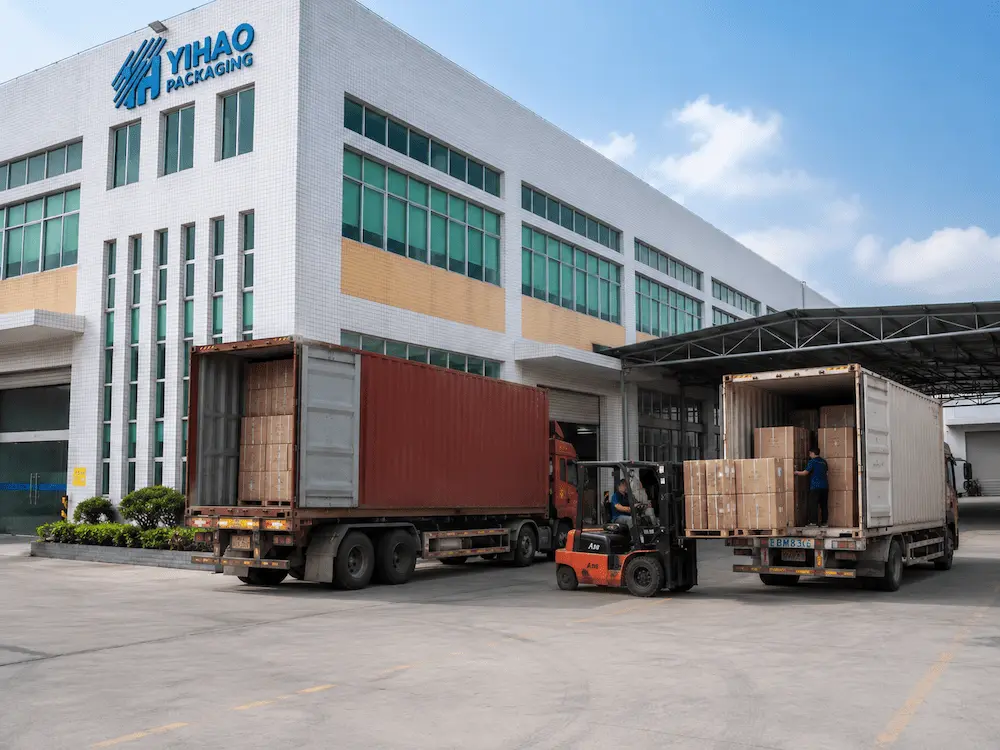
YIHAO focuses on practical food and beverage packaging solutions for cold drinks, fresh food, fruit, salads, bakery products, desserts, and grab-and-go programs. For beverage buyers, the value is not only one cup. The value is a complete packaging direction that supports cup sizes, matching lids, visual presentation, wholesale supply, and real menu use.
For PET bubble tea cups, buyers should work with a supplier that understands how milk tea cups, boba cups, PP bubble tea cups, sealed drink cups, cold cup lids, and retail display requirements connect in one purchasing decision. This reduces sourcing mistakes and helps packaging fit the real service environment.
If your team is comparing PET bubble tea cups, PP bubble tea cups, sealed drink cups, and matching lids for wholesale sourcing, YIHAO helps review cup size, lid matching, sealing options, sample testing, carton packing, and export packaging before bulk ordering.
Final Note / Practical Takeaway
FAQ
1. Are PET bubble tea cups suitable for milk tea and boba drinks?
Yes. PET bubble tea cups are suitable for cold milk tea, boba drinks, fruit tea, matcha, iced tea, refreshers, iced coffee, and chilled takeaway beverages. Buyers should confirm cup size, lid fit, straw access, and sealing compatibility before wholesale ordering.
2. What is the difference between PET bubble tea cups and PP bubble tea cups?
PET bubble tea cups usually provide stronger visual clarity and a cleaner display appearance. PP bubble tea cups may offer a different handling feel and can be practical in selected service conditions. Buyers should compare clarity, rim fit, lid compatibility, drink type, and supplier consistency.
3. Can PET bubble tea cups be used with sealing film?
Some PET cups may work with sealing film, but compatibility depends on cup rim structure, film type, sealing machine, temperature setting, and supplier recommendation. Buyers should always test the complete sealing system before bulk purchasing.
4. Which lid is best for bubble tea cups?
Flat lids with straw slots are practical for standard cold drinks and many milk tea formats. Dome lids work better for foam, smoothies, whipped toppings, and fruit toppings. Strawless sipper lids are better for no-straw drinks without large pearls. Sealing film remains common for classic bubble tea shops.
5. What should buyers check before ordering PET bubble tea cups wholesale?
Buyers should check cup capacity, top diameter, lid matching, sealing method, straw size, drink toppings, cup clarity, carton packing, sample performance, custom branding options, and supplier support before confirming a wholesale order.
References
- U.S. Food and Drug Administration, Food Contact Substances and Packaging Guidance.
- European Commission, Food Contact Materials Framework Regulation Guidance.
- European Food Safety Authority, Food Contact Materials Scientific Opinions and Guidance.
- Association of Plastic Recyclers, PET Packaging Design Guidance.
- RecyClass, Plastic Packaging Recyclability Evaluation Guidance.
- Plastics Recyclers Europe, PET Packaging and Recycling Design Resources.
- Foodservice Packaging Institute, Foodservice Packaging Material and Recovery Resources.
- International Association for Food Protection, Food Packaging and Food Safety Publications.
Deep-Dive Insights
How buyers should think about PET bubble tea cups
Buyers should start from the drink menu, not the cup material alone. Milk tea, brown sugar boba, fruit tea, matcha, cheese foam tea, iced coffee, smoothies, and refreshers do not create the same packaging needs. Ice level, tapioca pearls, fruit inclusions, foam height, straw size, sealing method, lid choice, and retail display all affect the final cup decision. PET bubble tea cups are strongest when the drink needs clear visibility, clean takeaway presentation, and flexible cup-lid matching.
Why PET remains strong for bubble tea and boba drinks
PET cups make the drink visible. This matters because bubble tea sells through appearance as much as taste. Customers can see milk tea color, boba level, syrup streaks, fruit pieces, foam texture, ice quality, and layered ingredients. For cafes, bubble tea shops, supermarkets, convenience stores, and drink chains, clear packaging helps the drink look fresh, premium, and ready to buy.
What alternative packaging does better
PP bubble tea cups may support selected flexible handling needs. Paper cups offer more printed branding space. Sealed drink cups work well for classic boba shops with stable sealing equipment. Glass bottles create a premium refrigerated retail look for selected beverages. Pouches can support promotional drink formats. However, these alternatives do not replace PET in every scenario. They solve different packaging problems.
Option buyers should prioritize first
For most cold beverage programs, the safest starting point is a clear PET cup range with matching flat lids, dome lids, sip lids, and suitable sealing options. This structure supports milk tea, boba cups, fruit tea, iced coffee, matcha, smoothies, lemonade, refreshers, and chilled takeaway drinks without forcing buyers into too many separate packaging systems.
Consideration before wholesale purchasing
Before placing a wholesale order, buyers should test the full system: cup size, top diameter, lid fit, straw access, sealing film compatibility, stacking strength, carton protection, drink visibility, and real filled performance. A reliable manufacturer or supplier should help buyers compare PET bubble tea cups, PP bubble tea cups, sealed drink cups, and matching lids as one complete packaging decision, not as separate products.
© YIHAO. All rights reserved. This article is prepared by YIHAO for food packaging buyers, beverage brands, cafes, supermarkets, distributors, and wholesale sourcing teams evaluating cold drink packaging options.