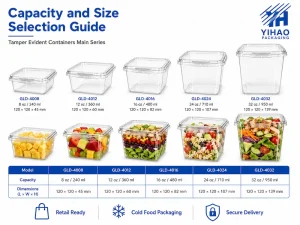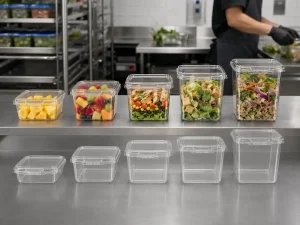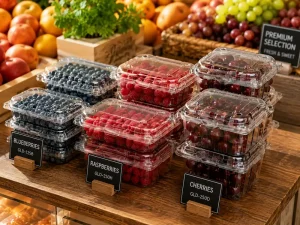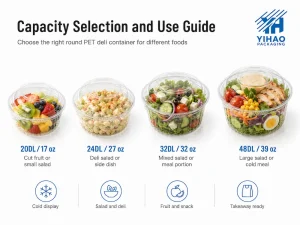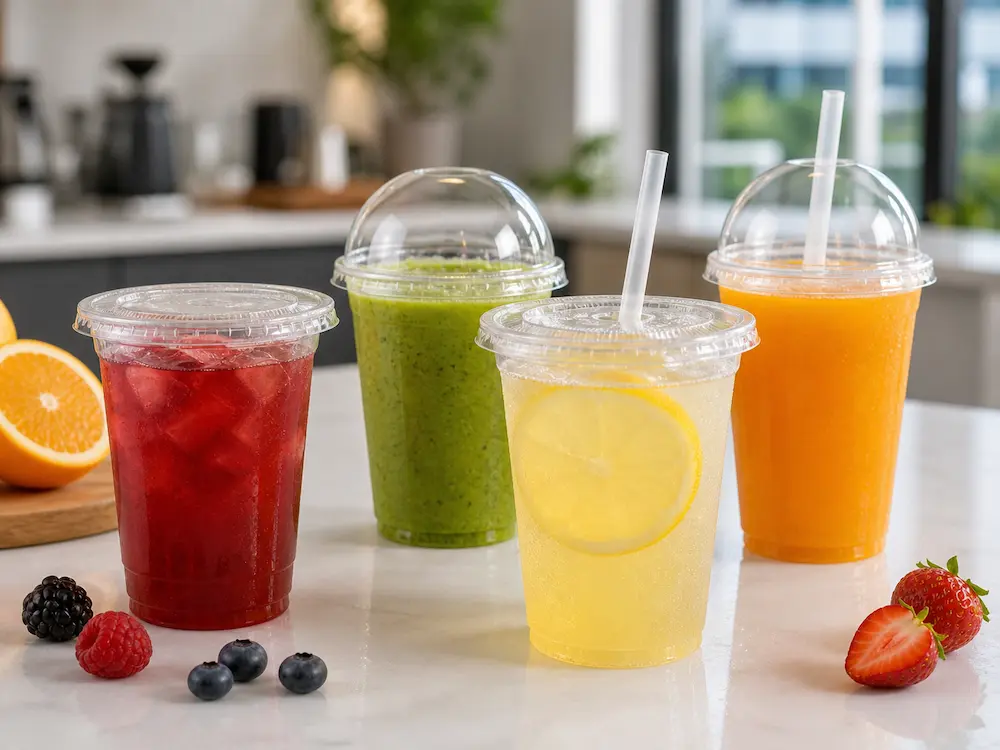
Summary: Wholesale Juice Cups for Cold Drink Packaging Buyers
Juice cups are essential cold drink packaging for fresh juice, smoothies, iced coffee, cold brew, refreshers, lemonade, fruit tea, matcha drinks, protein beverages, and grab-and-go retail displays. For wholesale buyers, the right cup is not only about price. It must combine clear product visibility, reliable lid matching, food-contact suitability, stable bulk supply, and practical branding support.
This guide explains how to evaluate PET cold cups, clear PET cups, recyclable cold cups, manufacturer capability, supplier reliability, sample testing, carton packing, custom packaging, and supplier documentation before placing a bulk order.
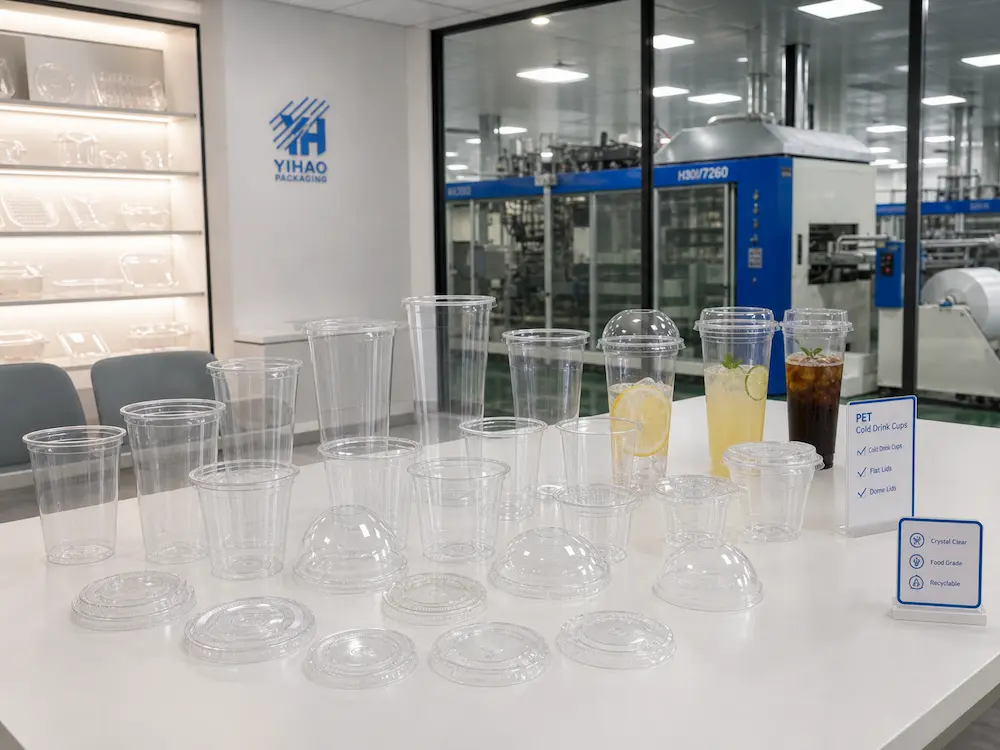
Why Wholesale Juice Cups Matter for Modern Beverage Packaging
Cold drink menus have become more visual, more varied, and more demanding. Fresh juice is no longer the only beverage packed in transparent cold cups. Today, buyers use juice cups for cold-pressed juice, smoothies, iced coffee, flavored cold brew, refreshers, lemonade, fruit tea, matcha drinks, sparkling fruit beverages, protein drinks, and chilled grab-and-go retail displays.
For beverage brands, cafés, juice bars, foodservice distributors, and retail chains, the cup is part of the product experience. A clear cup shows drink color, fruit pulp, ice, layers, foam, toppings, and freshness before the customer opens the lid. That visibility matters because many cold drinks are purchased by appearance as much as by flavor.
YIHAO is a food packaging manufacturer and solution provider focused on practical packaging for food and beverage businesses. For wholesale buyers, juice cups must do more than hold liquid. They need to support retail display, takeaway handling, delivery movement, lid compatibility, carton packing, branding, and repeat-order consistency.
A good supplier should understand this full use case. A low unit price is not enough if the cup cracks easily, the lid fit is unstable, the carton packing is weak, or the supplier cannot provide clear product information. This checklist helps buyers compare PET cold cups, clear PET cups, sample testing details, supplier capability, and wholesale ordering risks before placing a bulk order.
What Buyers Should Check Before Ordering Juice Cups in Bulk
Before ordering juice cups in large quantities, buyers should evaluate material, clarity, strength, lid fit, size logic, food-contact documentation, carton packing, and supplier reliability. The best decision comes from checking the full packaging system, not only the cup body.
Material Clarity and Drink Visibility
For cold drinks, clarity is a direct selling point. Clear PET cups help customers see beverage color, fruit pieces, ice, milk foam, layered coffee, smoothie texture, and fresh ingredients. This is especially valuable for fresh juice, cold-pressed juice, iced coffee, fruit tea, lemonade, and refreshers.
PET is widely used for cold drink packaging because it offers strong transparency and a clean display effect. For retail and takeaway beverage brands, the visual impact of PET helps the product look fresh, colorful, and ready to drink.
Buyers should check whether the cup has a clear, bright appearance without obvious haze, distortion, black spots, deformation, or inconsistent wall quality. For premium beverage lines, this detail affects shelf appeal and customer trust.
Cup Strength for Takeaway and Retail Handling
A wholesale buyer should never judge juice cups by appearance only. Cup strength affects stacking, filling, sealing, transport, and customer handling. A cup that looks clear but feels too soft may create problems during takeaway service or delivery.
For smoothies, protein drinks, and beverages with ice, the cup must feel stable in the hand. For grab-and-go retail displays, the cup should maintain shape during cold storage, shelf movement, and consumer handling. For distributors, cup stiffness also affects carton packing and damage rate.
The right PET cold cups should balance clarity, lightweight design, and functional strength. Buyers should request samples and test the cups with real menu items before confirming a bulk order.
Lid Compatibility for Different Beverage Menus
Cup and lid matching is one of the most important details in wholesale cold drink packaging. A good cup body is not enough if the lid fit is weak. Buyers should confirm lid compatibility before mass ordering.
Different beverage menus require different lid styles. Fresh juice and iced coffee often use flat lids with straw slots. Smoothies, whipped drinks, and dessert-style beverages often need dome lids. Retail grab-and-go drinks may require a tighter lid fit to reduce leakage risk during display and movement.
Buyers should test the complete cup-and-lid system with actual filling volume, ice level, toppings, and transport conditions. This is especially important for beverage chains, distributors, and private-label projects where packaging consistency affects brand reputation.
Size Planning for Juice, Iced Coffee, Smoothies, and Refreshers
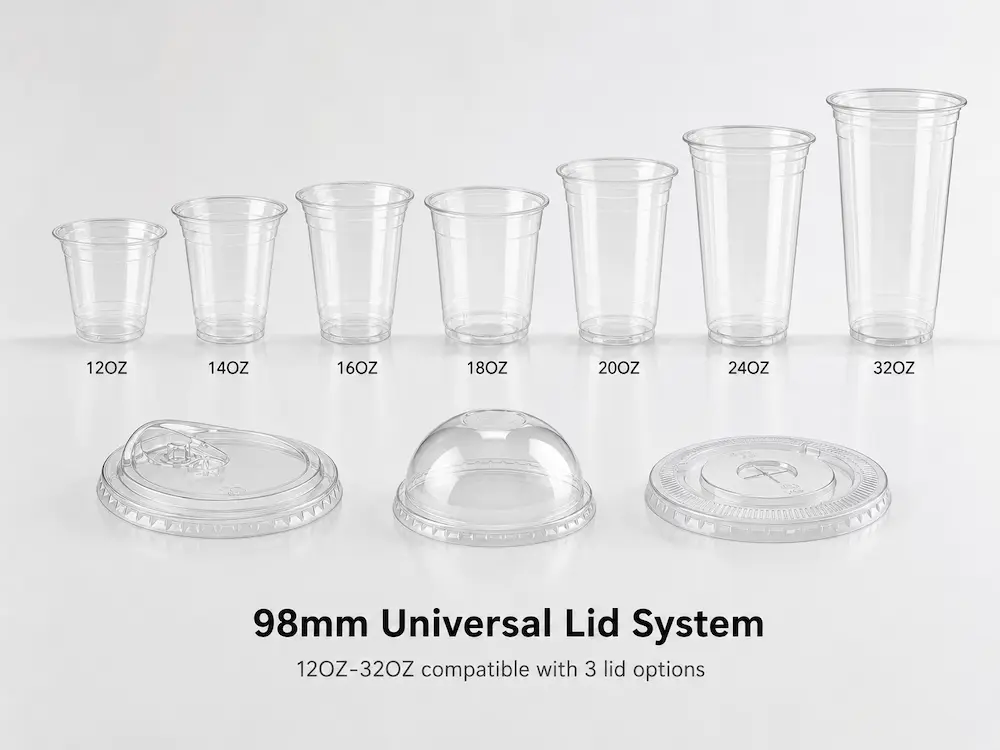
Cup size should match the drink menu, not only the target price. Fresh juice, iced coffee, smoothies, lemonade, fruit tea, and refreshers often require different filling experiences.
Fresh juice usually needs strong clarity and a clean shape to show color and freshness. Smoothies require enough internal space for thicker texture. Iced coffee and cold brew need room for ice and milk layers. Refreshers and sparkling fruit drinks often rely on visual ingredients such as berries, citrus slices, herbs, and ice.
Wholesale buyers should plan cup sizes by beverage category, serving style, and channel. A single size may work for a limited menu, but a full drink program often needs a coordinated cup range.
PET Cold Cups vs Alternative Cold Drink Packaging
Cold drink buyers often compare PET cold cups with PP cups, paper cups, and other cold beverage packaging. The right choice depends on drink type, display needs, budget, brand positioning, and local packaging requirements.
Clear PET Cups for Visual Merchandising
Clear PET cups are especially useful when the drink itself is part of the visual appeal. Juice, smoothies, iced coffee, matcha, lemonade, fruit tea, and refreshers all benefit from clear packaging because customers can see color, texture, and freshness immediately.
For retail display, PET clarity helps drinks stand out in chilled shelves and grab-and-go counters. For cafés and takeaway stores, it also helps branded stickers, printed labels, and colorful beverages look cleaner and more professional.
When buyers need packaging for visual cold drinks, PET remains one of the most practical options.
PP Cups and Paper Cups for Different Use Cases
PP cups and paper cups also have their place in foodservice packaging. PP cups may be selected for certain flexibility needs or specific operating conditions. Paper cups may fit brands that want a different tactile feel or a paper-based presentation.
However, for cold beverage display, paper cups hide the drink. That can reduce the visual impact of fresh juice, smoothies, fruit tea, or layered iced coffee. PP cups may not always deliver the same glass-like clarity as PET.
The best packaging decision should match the product. If the drink depends on color, layers, fruit pieces, and freshness cues, clear PET cups provide stronger visual merchandising value.
Why PET Remains Popular for Cold Beverage Displays
PET remains popular in cold beverage packaging because it combines transparency, light weight, stackability, and display quality. For wholesale buyers, these advantages support both retail presentation and logistics.
A good PET cold cups system helps beverage businesses show the product clearly while keeping packaging simple to store, stack, and distribute. This makes PET suitable for juice shops, cafés, restaurants, supermarkets, convenience stores, foodservice distributors, and private-label beverage programs.
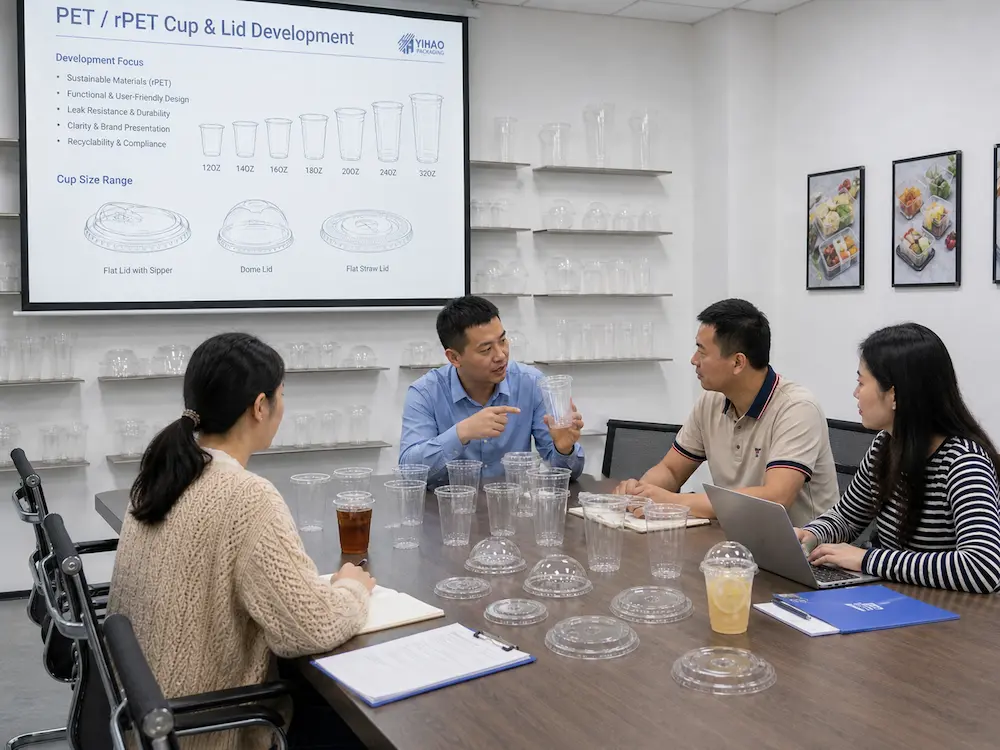
Recyclable Cold Cups: What Buyers Should Confirm
Sustainability claims require careful wording. Recyclable cold cups are an important topic for buyers, but the actual recycling outcome depends on local collection systems, sorting facilities, contamination levels, labeling, and regional rules.
Recyclability Depends on Local Collection Systems
PET is widely recognized as a recyclable plastic material, but that does not mean every PET cup will be recycled in every market. Buyers should avoid absolute claims such as “fully recycled everywhere” or “100% eco-friendly.”
A more responsible expression is: PET is a recyclable plastic where local collection and recycling systems accept it. This wording is safer because it recognizes real-world differences between markets.
For export orders, buyers should check the recycling rules and labeling expectations in their target countries. Packaging claims that work in one market may not be suitable in another.
Ask Suppliers About PET or RPET Options
Buyers interested in recycled-content packaging should ask suppliers about PET and RPET options. RPET means recycled PET, but food-contact use requires appropriate material control and documentation.
For food and beverage packaging, buyers should request clear information from the manufacturer or supplier, including material description, food-contact suitability, and any available recycled-content documentation. If the product is intended for a regulated market, the buyer should confirm local requirements before using sustainability claims in marketing.
A professional supplier should explain what material is available, what documents can be provided, and which claims should be verified by the buyer’s local compliance team.
Avoid Overclaiming Sustainability in Marketing
Overclaiming sustainability creates risk. Phrases such as “zero impact,” “100% green,” or “completely eco-friendly” are usually too broad for disposable cold drink packaging.
Better wording focuses on verifiable facts. For example, buyers may say the cup is made from PET, a recyclable plastic where accepted by local recycling systems. If RPET is used, the buyer should confirm the recycled content, documentation, and food-contact suitability before making public claims.
A responsible packaging strategy is not only about material selection. It also includes correct labeling, clean design, customer education, and realistic claims.
Manufacturer Checklist for Wholesale Juice Cups
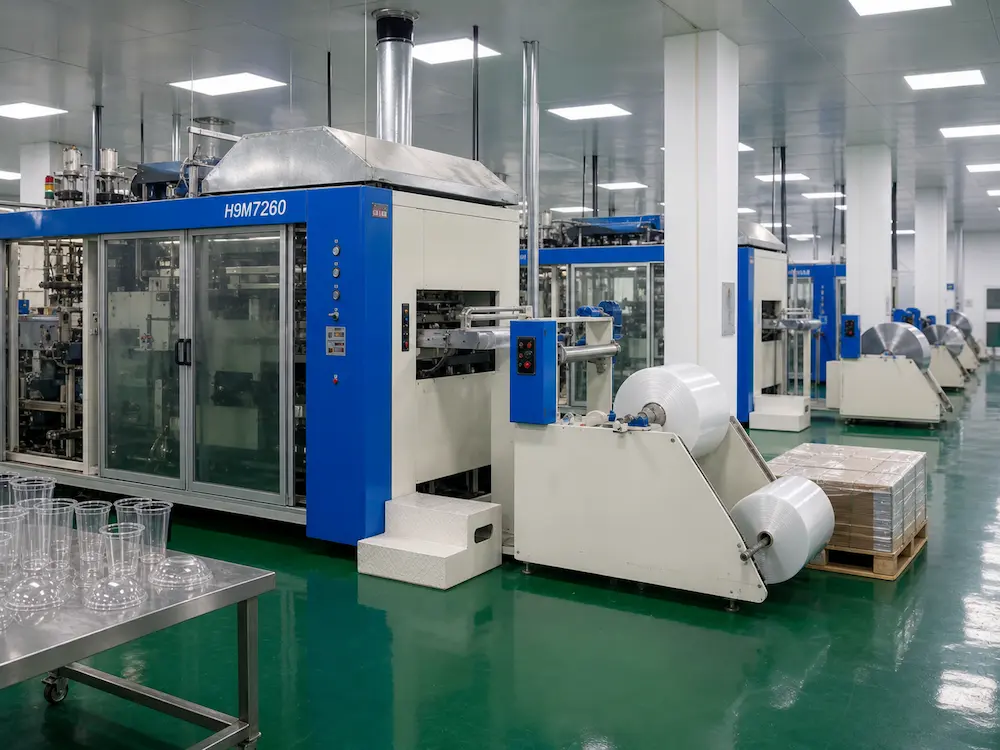
A reliable juice cups manufacturer should support more than production. Wholesale buyers need stable quality, clear product information, practical packaging knowledge, and long-term supply capability.
| Checklist Item | What Buyers Should Confirm | Why It Matters |
|---|---|---|
| Material | PET or RPET option, clarity, stiffness, food-contact suitability | Affects display quality, compliance review, and customer experience |
| Cup Range | Available sizes for juice, iced coffee, smoothies, refreshers, and cold drinks | Helps buyers build a complete beverage packaging system |
| Lid Matching | Flat lids, dome lids, straw-slot lids, sample fit testing, and sealing review | Reduces leakage complaints and service problems |
| Sample Testing | Check real drink filling, ice load, stacking, grip feel, and delivery movement | Confirms performance before bulk purchasing |
| Production Stability | Repeat-order consistency, quality control, and bulk supply capacity | Supports distributors, chains, and long-term wholesale programs |
| Documentation | Material description, food-contact information, and market-required documents | Helps buyers prepare internal compliance review |
| Packaging Support | Carton packing, stacking method, shipping protection, and container loading logic | Affects freight cost, storage, and damage control |
| Customization | Private label, carton design, product combination, and OEM packaging support | Supports brand presentation and distributor differentiation |
Production Capability
Production capability is the first thing wholesale buyers should check. A small trader may offer a low price, but a real manufacturer is better positioned to control quality, repeat orders, and product consistency.
Buyers should ask whether the supplier can support stable production for the required cup range. They should also confirm whether the supplier understands bulk ordering, export packing, quality inspection, and long-term supply planning.
For distributors and beverage chains, consistency matters more than a one-time low price. If the second order does not match the first order, the buyer may face customer complaints, lid mismatch, carton inconsistency, or brand presentation problems.
Sample Confirmation Before Bulk Orders
Sample confirmation is where many packaging problems are discovered early. Buyers should test juice cups with the actual drinks they plan to sell, not only with water.
For fresh juice, check clarity, lid fit, and display appearance after chilling. For smoothies, check grip feel, wall strength, and dome lid compatibility if toppings are used. For iced coffee, test the cup with ice, milk layers, and movement. For refreshers and fruit tea, check whether fruit pieces, herbs, and ice display clearly without making the cup feel overloaded.
A professional supplier should support sample review before bulk confirmation. This step reduces the risk of ordering packaging that looks good in photos but performs poorly in real service.
Lid-Fit Testing and Leakage Review
The cup-and-lid system should be tested as a complete package. Buyers should confirm whether the lid snaps on smoothly, holds evenly around the rim, and remains stable during normal handling.
This does not mean any disposable cup should be treated as completely leak-proof in all conditions. However, a reliable lid fit reduces common service problems such as loose lids, tilted covers, splash risk, and poor customer handling.
For wholesale PET cold cups, lid-fit testing is especially important because different beverage types create different pressure and movement conditions. Ice, foam, toppings, thick smoothies, and delivery movement all influence packaging performance.
Carton Packing and Transport Protection
Carton packing is a serious purchasing detail, not a minor warehouse issue. Good carton design protects cup shape, reduces pressure damage, improves storage efficiency, and supports safer long-distance transport.

Buyers should ask how the cups are stacked, how many pieces are packed per sleeve, how the sleeves are protected inside the carton, and whether carton strength supports the expected shipping route. For importers and distributors, carton consistency also affects warehouse handling and customer delivery.
A strong juice cups supplier should think about the full shipping process, not only the finished cup.
Food Contact Documentation
Food and beverage packaging must be suitable for its intended use. Buyers should ask suppliers for material information and food-contact-related documents according to the target market.
This does not mean every buyer needs the same file. Requirements differ by country, customer type, and sales channel. A professional supplier should provide available documents clearly and explain what the buyer needs to verify for local market use.
For juice cups, the key point is simple: do not rely only on product photos. Ask for material details and documentation before confirming a large order.
OEM, Private Label, and Custom Packaging Options
Many buyers need more than standard juice cups. They may need private-label cartons, branded packaging, customized product combinations, or specific packing formats for distributors.
A capable manufacturer should support practical customization. This may include carton mark design, product labeling support, cup-and-lid set planning, product photography support, and packaging combinations for different sales channels.
For growing beverage brands, custom packaging helps build a more consistent brand image. For distributors, it helps create product differentiation in local markets.
Supplier Checklist: How to Evaluate a Juice Cups Supplier

Choosing a supplier is not only about finding someone who sells cups. The right juice cups supplier understands beverage use, wholesale order pressure, documentation, testing, carton packing, and long-term cooperation.
Does the Supplier Understand Beverage Applications?
A good supplier should understand the difference between fresh juice, smoothies, iced coffee, fruit tea, lemonade, refreshers, and protein drinks. Each drink type has different packaging needs.
Fresh juice needs clarity and clean display. Smoothies need strength and enough space for thick texture. Iced coffee needs room for ice and layers. Refreshers need visual space for fruit pieces and color. Protein drinks need a stable cup body for heavier beverages.
If a supplier treats every drink the same, the buyer may receive packaging that looks acceptable but performs poorly in real service.
Can the Supplier Support Wholesale and Distributor Orders?
Wholesale buyers need stable communication, repeat-order consistency, organized packing, and clear lead-time planning. A supplier should be able to support distributors, foodservice operators, beverage chains, and private-label projects.
Buyers should check whether the supplier has experience with bulk orders, mixed product combinations, export packing, and long-term purchasing schedules. These details affect daily business operations.
A good wholesale supplier helps buyers reduce uncertainty.
Can the Supplier Provide Clear Product Information?
Professional product information saves time. Buyers should expect clear details about material, cup style, lid options, size range, packing method, and intended applications.
For online selling or distributor catalogs, good photos and structured product descriptions are also important. A supplier with weak product information may create extra work for the buyer’s marketing, sales, and compliance teams.
For YIHAO, the packaging solution should be easy for buyers to understand, compare, and present to their own customers.
Does the Supplier Have a Practical Sample-to-Order Process?
A strong supplier should make the sample-to-order process clear. Buyers should know which samples are available, which lids match each cup, how carton packing is arranged, and what information is needed for OEM or private-label requests.
A practical process usually includes product selection, sample confirmation, lid-fit review, packing review, quotation, order confirmation, production, inspection, and shipment arrangement.
This kind of process helps wholesale buyers reduce mistakes before money, time, and container space are committed.
Is the Supplier Suitable for Long-Term Cooperation?
The best supplier is not always the cheapest one. Long-term cooperation depends on quality control, communication speed, product development, documentation support, and stable supply.
Buyers should compare total value. A supplier that helps reduce complaints, protect product display, improve carton planning, and support custom orders may deliver better long-term results than a supplier offering only a low initial price.
Best Applications for Wholesale Juice Cups
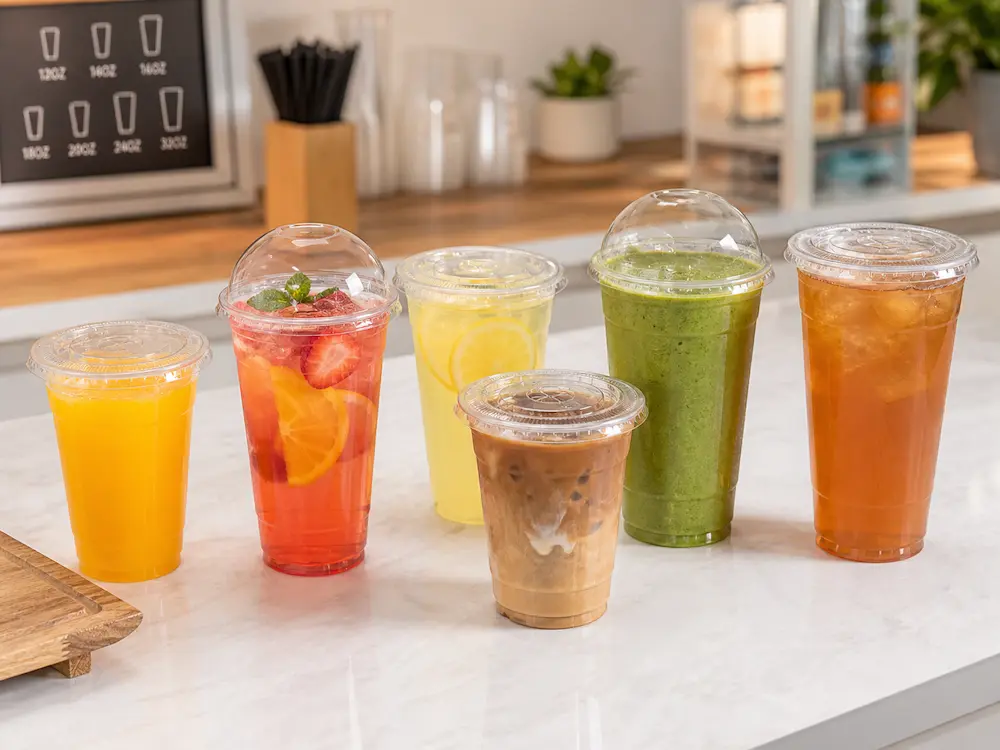
Juice cups are versatile cold drink packaging. Their main value is clear display, simple handling, and strong application coverage across modern beverage menus.
| Application | Packaging Need | Why Clear PET Cups Work |
|---|---|---|
| Fresh Juice | Show color, pulp, and freshness | High clarity improves visual trust and retail appeal |
| Cold-Pressed Juice | Clean premium display for chilled shelves | Transparent cups help communicate freshness and quality |
| Smoothies | Support thicker texture and colorful ingredients | Clear walls show fruit blends and product richness |
| Iced Coffee | Display ice, milk layers, cold brew, and foam | PET clarity highlights layered beverage presentation |
| Refreshers and Fruit Tea | Show fruit pieces, herbs, ice, and color | Visual ingredients become part of the buying decision |
| Matcha and Specialty Drinks | Show green color, milk layers, and premium drink texture | Clear cups make specialty drinks more visually recognizable |
| Protein Drinks | Provide stable handling for heavier cold beverages | Strong cup structure supports takeaway use |
| Retail Grab-and-Go | Maintain clean display in chilled cabinets | Transparent packaging improves shelf recognition |
Fresh Juice and Cold-Pressed Juice
Fresh juice and cold-pressed juice rely heavily on color and freshness. Orange juice, green juice, berry juice, watermelon juice, and mixed fruit drinks all benefit from clear packaging.
Clear PET cups help customers see the natural color of the drink. This makes them especially suitable for juice bars, health-focused cafés, supermarkets, and grab-and-go counters.
For wholesale buyers, the cup should look clean, hold shape well, and match the right lid for takeaway service.
Smoothies and Protein Drinks
Smoothies and protein drinks are thicker than standard juice. They need cups with stable hand feel and enough internal space for blending texture.
Smoothie cups should show fruit color, creamy consistency, toppings, and portion size clearly. Dome lids may be useful when whipped toppings, fruit pieces, or dessert-style finishes are added.
For fitness cafés, juice bars, and health food stores, juice cups can support smoothie and protein drink packaging when the right size and lid are selected.
Iced Coffee and Flavored Cold Brew
Iced coffee, cold brew, iced latte, flavored cold brew, and matcha latte all benefit from transparent packaging. Customers often expect to see ice, milk layers, coffee color, foam, and syrup effects.
Iced coffee cups made from clear PET help beverage brands present drinks more attractively. For takeaway cafés, a clean cup with reliable lid fit supports both appearance and function.
This makes PET cold cups suitable for beverage menus that combine juice, coffee, tea, and seasonal cold drinks.
Refreshers, Fruit Tea, Lemonade, and Sparkling Drinks
Refreshers, fruit tea, lemonade, sparkling fruit drinks, and iced tea are highly visual beverages. Their appeal often comes from citrus slices, berries, herbs, ice, color gradients, and sparkling texture.
Juice cups work well for these drinks because clear walls make ingredients visible. For brands that sell colorful seasonal beverages, cup clarity supports impulse purchases and social-media-friendly presentation.
Retail Grab-and-Go Beverage Displays
Retail grab-and-go drinks need packaging that looks good on the shelf and handles movement well. Clear cups help customers identify the drink quickly in chilled cabinets.
For supermarkets, convenience stores, cafés, and prepared food counters, clear PET cups help turn cold drinks into visible retail products. Buyers should pair the cup with suitable lids, labels, and carton packing to maintain display quality through the supply chain.
Common Mistakes When Buying Juice Cups Wholesale
Wholesale buyers often focus on price first. That is understandable, but cold drink packaging has more risk points than price alone.
Choosing Cups Without Testing Lid Fit
The most common mistake is ordering cups and lids without real fit testing. Even small fit differences can create problems during filling, takeaway, delivery, and customer handling.
Buyers should test the complete packaging system before placing a large order. This includes cup body, lid style, filling volume, ice level, straw slot, and transport movement.
Ignoring Drink Type and Fill Weight
Not all drinks behave the same. Fresh juice, smoothies, iced coffee, and protein drinks have different weights, textures, and service conditions.
A cup that works for lemonade may not be ideal for a thick smoothie. A cup that looks good for iced coffee may need a different lid for whipped toppings. Buyers should select juice cups based on real beverage use.
Ignoring Carton and Container Loading Details
Some buyers compare only the cup price and forget the shipping system. This is a mistake. Carton quantity, carton strength, sleeve protection, pallet arrangement, and container loading efficiency all influence total cost.
For importers and distributors, poor carton design can increase damage, warehouse pressure, and customer complaints. A professional manufacturer should be able to explain how the cups are packed and protected during transport.
Focusing Only on Unit Price
A low unit price may hide other costs. Weak cartons, poor stacking, lid mismatch, inconsistent quality, and product damage can increase total cost.
Wholesale buyers should compare the full cost of use, not only the cup price. Better packaging can reduce complaints, improve display, protect brand image, and support repeat sales.
Making Unverified Sustainability Claims
Sustainability is important, but claims must be accurate. Buyers should avoid broad claims unless they have supporting documentation and market-specific confirmation.
For recyclable cold cups, the safer message is that PET is recyclable where local recycling systems accept it. If RPET is used, buyers should confirm recycled content and food-contact suitability before making public claims.
Why Work With YIHAO for Wholesale Juice Cups

YIHAO provides practical food and beverage packaging solutions for buyers who need reliable cold drink packaging. For juice cups, our focus is not only on cup appearance. We help buyers think about real beverage use, lid matching, sample testing, retail display, carton packing, wholesale supply, and custom packaging needs.
For beverage brands, cafés, juice bars, distributors, and foodservice buyers, YIHAO supports packaging choices for fresh juice, iced coffee, smoothies, fruit tea, lemonade, refreshers, matcha drinks, protein drinks, and other chilled beverages.
As a food packaging manufacturer and solution provider, YIHAO helps buyers evaluate PET cold cups, clear PET cups, lid combinations, packing requirements, documentation, OEM options, and wholesale ordering details. This approach supports better purchasing decisions and stronger long-term cooperation.
If your business needs standard cold drink cups, private-label packaging, distributor-ready cartons, or a complete cup-and-lid system, YIHAO can help you build a more practical packaging plan for your market.
Buyer Quick Checklist Before Placing an Order
Before placing a wholesale order, buyers should review the following checklist.
| Checklist Item | What to Confirm |
|---|---|
| Material | PET or RPET option, clarity, stiffness, and food-contact suitability |
| Cup Size | Match cup sizes with juice, iced coffee, smoothie, refresher, and cold drink menus |
| Lid Fit | Test flat lids, dome lids, straw-slot lids, and sealing performance before mass ordering |
| Sample Test | Use real drinks, ice, toppings, and delivery movement to review performance |
| Application | Confirm whether the cups are used for takeaway, delivery, retail display, or grab-and-go sales |
| Compliance | Request food-contact documents and confirm target-market requirements |
| Branding | Check options for private label, carton design, logo support, and custom packaging |
| Carton Packing | Review sleeve packing, carton strength, shipping protection, and loading efficiency |
| Supply Ability | Review wholesale volume, lead-time planning, repeat-order consistency, and communication speed |
| Sustainability Claims | Avoid absolute claims and confirm local recycling conditions before using marketing statements |
Final Buying Advice for Wholesale Juice Cups
The best juice cups are not selected by price alone. They are selected by how well they support the drink, the brand, the customer experience, and the supply chain.
For fresh juice, clarity helps communicate freshness. For smoothies, strength and size planning matter. For iced coffee, transparent display highlights ice, milk layers, and coffee color. For refreshers and fruit tea, clear cups show fruit pieces and colorful ingredients. For distributors and wholesale buyers, stable supply and reliable documentation are essential.
A strong supplier should help buyers answer practical questions: Does the cup look clean? Does the lid fit? Does the carton protect the product? Can the supplier support repeat orders? Can the material information be reviewed? Can the packaging support the buyer’s brand?
When these questions are answered clearly, juice cups become more than disposable packaging. They become a practical part of cold drink presentation, retail selling, and long-term supply planning.
Wholesale Juice Cups Inquiry Support
Looking for wholesale juice cups for fresh juice, iced coffee, smoothies, refreshers, or grab-and-go drinks? Contact YIHAO to discuss PET cold cups, clear PET cups, lid matching, carton packing, sample testing, private-label support, and custom packaging options for your market.
A clear packaging plan helps buyers reduce ordering mistakes, improve beverage presentation, and build a more reliable cold drink packaging supply chain.
FAQ
1. What are juice cups commonly used for?
Juice cups are commonly used for fresh juice, cold-pressed juice, smoothies, iced coffee, lemonade, fruit tea, refreshers, matcha drinks, sparkling fruit drinks, protein beverages, and chilled grab-and-go retail displays. Clear PET cups help show drink color, ice, fruit pieces, layers, and freshness clearly.
2. Are PET juice cups recyclable?
PET juice cups are made from PET, a recyclable plastic material where local collection and recycling systems accept it. Actual recycling depends on local infrastructure, sorting systems, contamination levels, labeling, and regional packaging rules, so buyers should avoid absolute recycling claims.
3. What should buyers check before ordering juice cups wholesale?
Before ordering juice cups wholesale, buyers should check material clarity, cup strength, size range, lid compatibility, sample performance, food-contact documentation, carton packing, supplier production capability, custom packaging support, and repeat-order stability.
4. Are clear PET cups suitable for smoothies and iced coffee?
Clear PET cups are suitable for smoothies, iced coffee, cold brew, iced latte, matcha drinks, and other cold beverages when the correct cup size and lid style are selected. Their transparency helps show ice, layers, texture, fruit pieces, toppings, and drink color.
5. How do I choose a juice cups manufacturer or supplier?
Choose a juice cups manufacturer or supplier by reviewing production capability, material information, food-contact documentation, cup-and-lid matching, sample testing support, wholesale supply experience, carton packing quality, customization options, communication speed, and long-term order consistency.
References
- U.S. Food and Drug Administration, Packaging & Food Contact Substances
- U.S. Food and Drug Administration, Guidance for Industry: Use of Recycled Plastics in Food Packaging: Chemistry Considerations
- Electronic Code of Federal Regulations, 21 CFR 177.1630 Polyethylene Phthalate Polymers
- European Commission, Marking Specifications for Single-Use Plastic Products
- European Parliament and Council, Directive (EU) 2019/904 on the Reduction of the Impact of Certain Plastic Products on the Environment
- Association of Plastic Recyclers, APR Design Guide for Plastics Recyclability
- WRAP, Designing for Recyclability Guidance for Plastic Packaging
- National Restaurant Association, 2026 What’s Hot Culinary Forecast and Beverage Trend Coverage
Deep-Dive Insights: How Buyers Should Think About Wholesale Juice Cups
How do juice cups influence beverage sales?
Juice cups influence beverage sales by making freshness visible. Clear packaging allows customers to see color, fruit pieces, ice, layers, foam, and texture before purchase. This visual signal is especially important for juice bars, cafés, supermarkets, and grab-and-go beverage displays.
Why are clear PET cups widely used for cold drinks?
Clear PET cups are widely used because they combine strong transparency, lightweight handling, stackable storage, and practical cold drink presentation. They are suitable for fresh juice, iced coffee, smoothies, fruit tea, lemonade, refreshers, matcha drinks, and other chilled beverages where product visibility matters.
What should buyers compare beyond unit price?
Buyers should compare material clarity, cup stiffness, lid fit, sample performance, carton packing, documentation support, supplier communication, custom packaging options, and repeat-order consistency. A lower unit price may not create real savings if it leads to leakage, damage, poor display, or inconsistent supply.
Which option works best for wholesale buyers?
The best option is a coordinated cup-and-lid system from a reliable manufacturer or wholesale supplier. Buyers should select cups based on real beverage applications, including juice, smoothies, iced coffee, refreshers, protein drinks, and retail grab-and-go displays.
What is the safest way to describe recyclable cold cups?
The safest wording is to state that PET is a recyclable plastic where local recycling systems accept it. Buyers should avoid absolute claims and confirm local recycling rules, labeling requirements, material documentation, and target-market regulations before publishing sustainability statements.
Why should buyers work with a manufacturer instead of only comparing traders?
A manufacturer can usually provide stronger control over product consistency, sample confirmation, lid matching, carton packing, repeat-order stability, and custom packaging support. For wholesale juice cups, this manufacturing support helps buyers reduce packaging mistakes and build a more reliable supply chain.
© 2026 YIHAO Packaging. All Rights Reserved.
All content, designs, and trademarks on this website are protected. Any unauthorized reproduction or distribution is prohibited.
For more information, please contact us.