Micro Summary: Smoothie Cups vs Alternative Packaging
Smoothie cups are designed for cold beverages that need clear product visibility, stable takeaway performance, and reliable lid compatibility. Compared with paper cups, glass cups, PP cups, reusable cups, and sealing-film systems, clear PET cups give buyers a stronger balance of display value, handling strength, menu flexibility, and wholesale supply efficiency.
For cafes, juice bars, beverage chains, convenience stores, supermarkets, and distributors, the right packaging choice depends on drink thickness, cup clarity, wall strength, lid fit, size range, branding needs, recyclability claims, carton packing, and supplier consistency. PET cold cups are recyclable where local recycling systems accept PET packaging, but actual recycling depends on local collection, sorting, contamination control, and processing infrastructure.
Smoothie Cups vs Alternative Packaging: How Buyers Should Choose
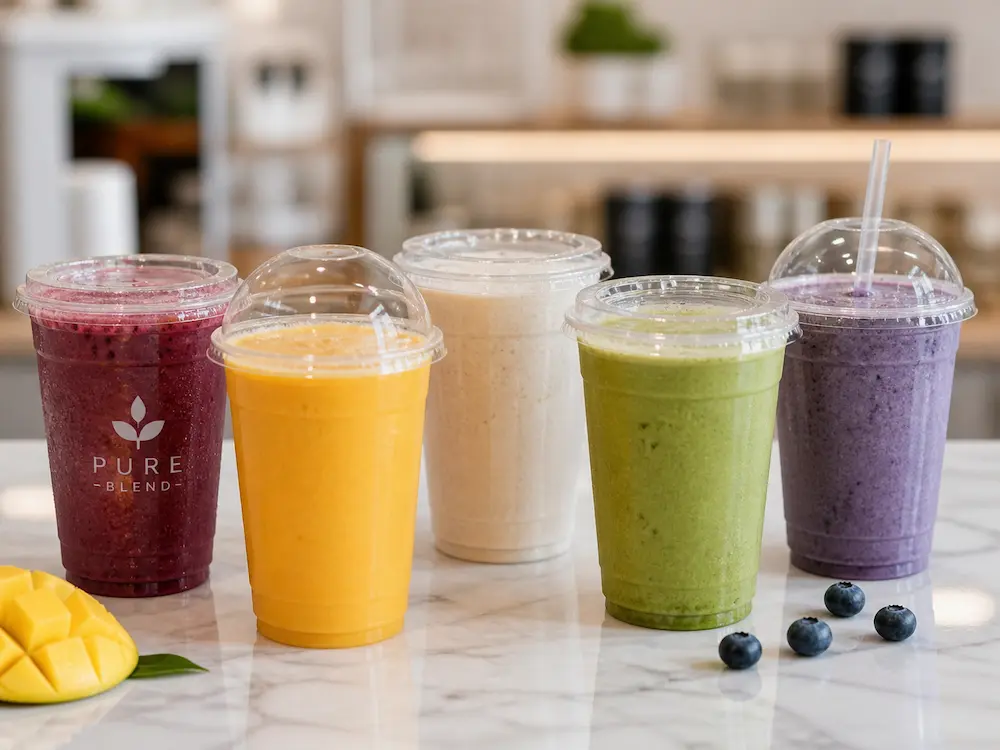
Choosing the right cold beverage packaging is not only about finding a cup that holds liquid. For buyers, packaging affects product display, takeaway stability, drink quality perception, inventory control, service speed, brand image, and wholesale cost structure.
This is especially true for smoothie cups. A smoothie is thicker, heavier, and more visually expressive than many standard cold drinks. It may contain fruit pulp, blended ice, yogurt, milk, plant-based ingredients, protein powder, toppings, whipped cream, fruit pieces, matcha, acai, or colorful refreshers. The cup must support the drink physically while also showing its freshness clearly.
For cafes, juice bars, convenience stores, supermarkets, cold beverage chains, restaurants, food trucks, and distributors, the question is not simply: “Which cup is cheaper?” A better question is: “Which packaging helps the drink sell, travel, display, and scale?”
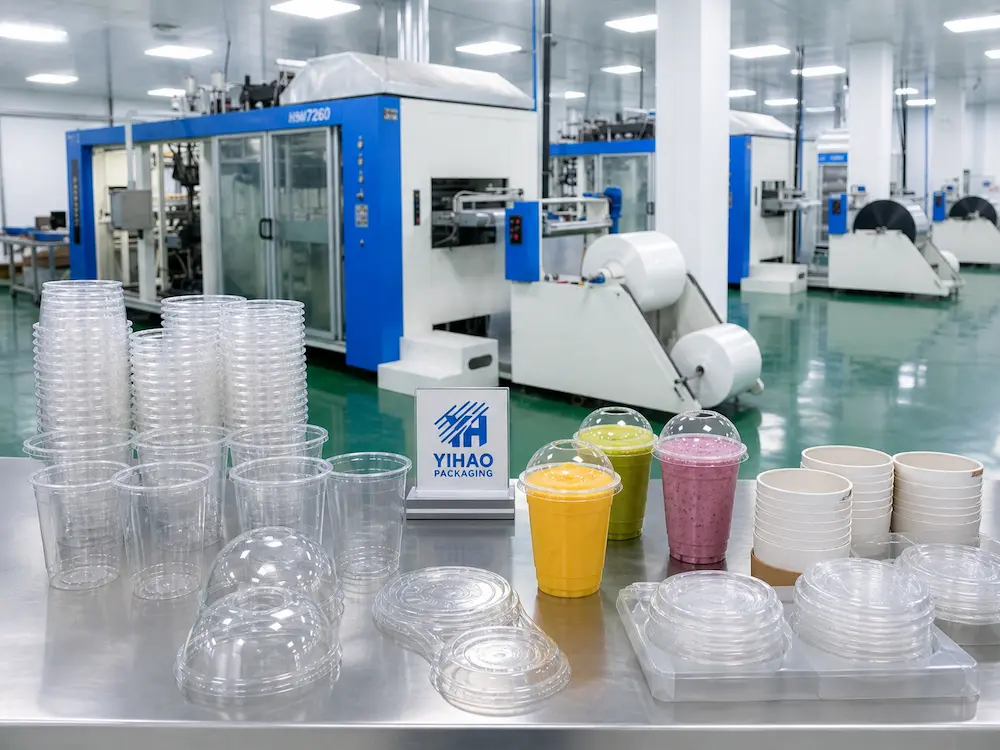
As a food packaging manufacturer and solution provider, YIHAO looks at this decision from the buyer’s side. The right packaging should match the beverage, the service model, the lid system, the storage environment, the brand positioning, and the long-term supply plan. In many cold drink programs, clear PET cups provide one of the most practical options because they combine strong transparency, lightweight handling, reliable cold beverage performance, and flexible wholesale use.
This guide compares smoothie cups with other packaging options, including iced coffee cups, juice cups, paper cups, glass cups, reusable cups, PP cups, and sealing-film systems. It also explains how buyers should evaluate a manufacturer, wholesale supplier, or long-term packaging partner before placing bulk orders.
Why Smoothie Cups Require a More Careful Packaging Decision
Smoothies Are Heavier and Thicker Than Standard Cold Drinks
Smoothies create more packaging pressure than iced tea, soda, lemonade, or simple juice. The drink is often dense and cold, with blended ingredients that add weight and texture. When the cup is filled, the sidewall must remain firm enough for staff handling and customer takeaway.
A weak cup creates problems immediately. The cup may flex when staff pick it up. The lid may loosen if the rim is not consistent. The base may feel unstable during filling or display. The product may look less premium if the cup is cloudy or too thin.
This is why smoothie cups should not be treated as generic disposable cups. They need a balance of clarity, stiffness, lid compatibility, and portion consistency.
Visual Display Is Part of the Product Value
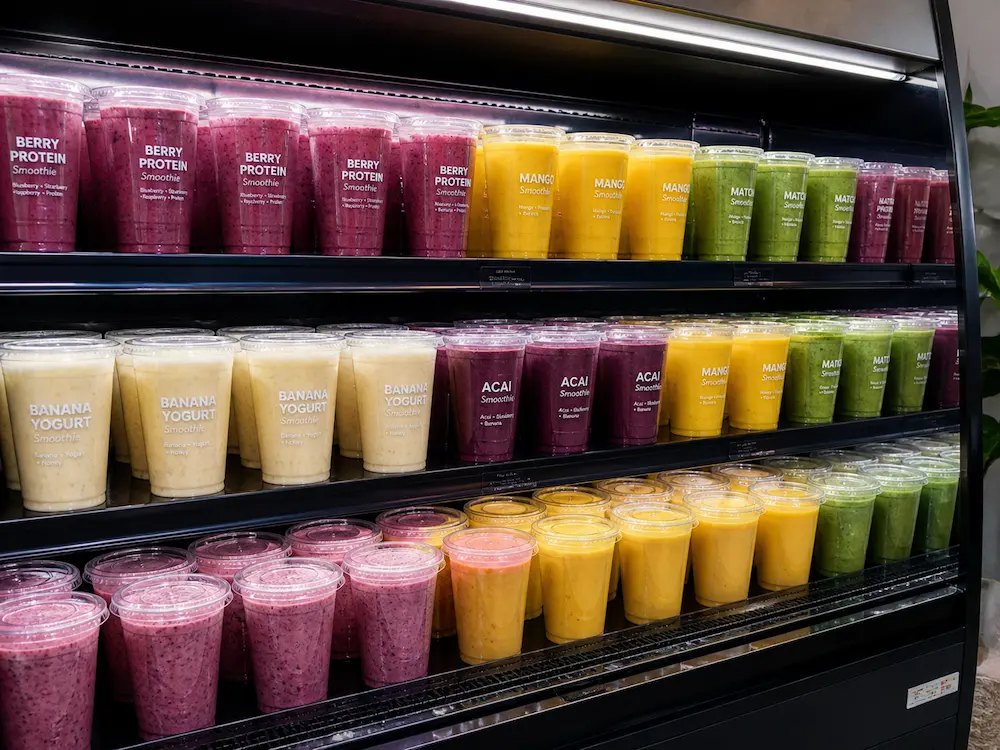
Smoothies are naturally visual. A strawberry smoothie, mango smoothie, green smoothie, blueberry smoothie, acai drink, matcha blend, protein shake, or layered refresher sells through color and texture. If the cup hides the product, the buyer loses one of the strongest selling points.
That is why clear PET cups are widely used for cold beverage display. They allow customers to see the drink directly. In grab-and-go coolers, takeaway counters, coffee shops, juice bars, and supermarket beverage sections, this visibility supports impulse purchase and product confidence.
For buyers, transparent packaging turns the drink into its own display. This is a major advantage over opaque or heavily printed alternatives.
What Are Smoothie Cups Usually Made From?
PET Cold Cups for Clarity, Strength, and Cold Drink Display
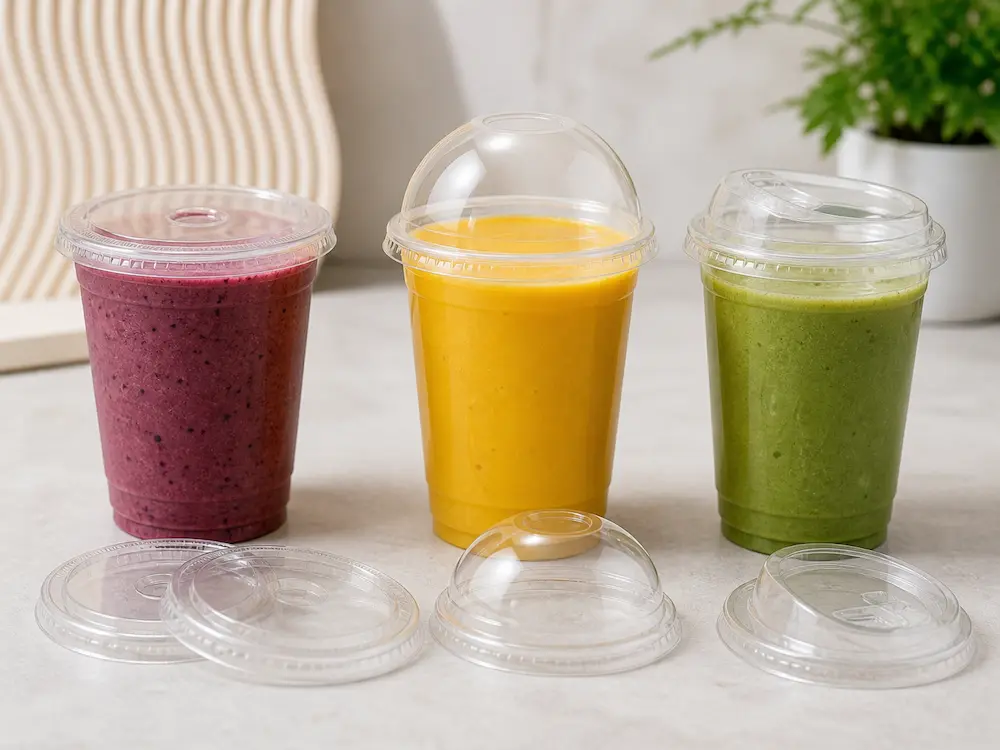
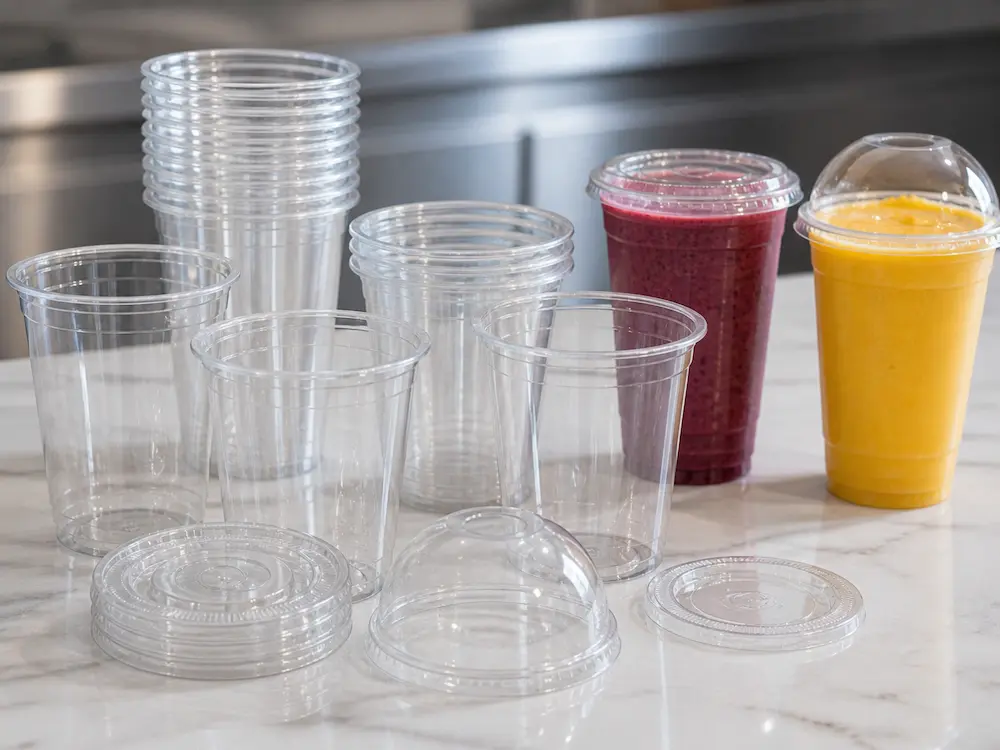
Many commercial smoothie cups are made from PET because PET offers excellent transparency, good stiffness, lightweight handling, and a clean appearance for cold beverage packaging. PET cold cups are especially suitable when buyers want the drink’s color, ice, pulp, toppings, or layers to remain visible.
PET works well for many cold drink categories, including:
- Smoothies
- Protein drinks
- Iced coffee
- Cold brew
- Juice
- Lemonade
- Fruit tea
- Milk tea
- Matcha drinks
- Refreshers
- Sparkling fruit drinks
- Flavored cold brew
- Iced tea
For buyers, this flexibility matters. One clear PET cup range can support multiple drink categories, which reduces inventory pressure and simplifies sourcing.
Recyclable Cold Cups Need Accurate Claims
Many buyers search for recyclable cold cups, but sustainability claims must be handled carefully. PET is a recyclable plastic material where local recycling systems accept PET packaging. However, actual recycling depends on local collection systems, sorting technology, contamination levels, consumer disposal behavior, cup design, and end-market demand.
The safest and most professional claim is:
“PET cold cups are recyclable where local recycling systems accept PET packaging.”
This wording is practical for international buyers because it avoids exaggerated claims. It also helps brands communicate sustainability more responsibly.
Clear PET also has a practical advantage over heavily colored or opaque packaging. In many recycling systems, clear packaging is easier to identify and has broader material value than dark or complex packaging formats. Buyers should still check local recycling rules before making market-specific claims.
Smoothie Cups vs Iced Coffee Cups
Similar Cup Structure, Different Beverage Requirements
Iced coffee cups and smoothie cups often use similar clear PET materials. Both need good transparency, secure lids, and takeaway stability. However, the drink structure is different.
Iced coffee, cold brew, iced latte, and flavored coffee drinks are usually more fluid. They may contain ice, milk, cream, syrup, foam, or flavor layers, but they flow more easily than smoothies. Smoothies are thicker and heavier, and they often need stronger sidewall support and better top-space planning.
For iced coffee, clarity and lid fit are the main priorities. For smoothies, buyers also need to consider thickness, topping space, cup strength, and customer grip.
When One PET Cup Range Can Serve Both Categories
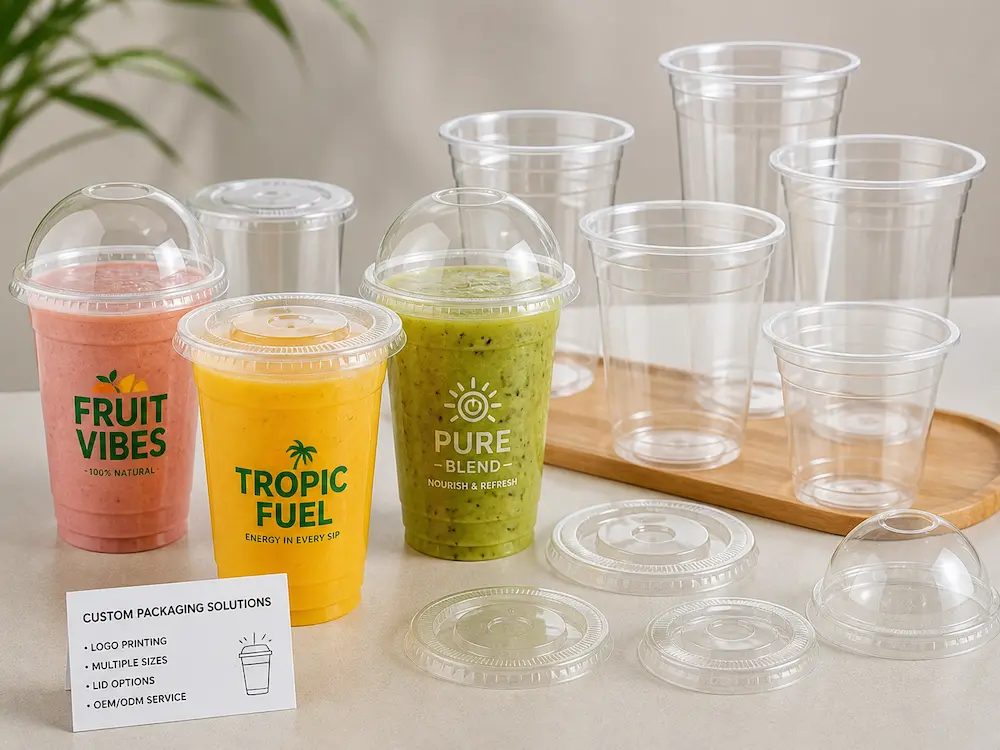
In many beverage programs, buyers do not need a completely separate cup for every drink type. A strong PET cold cups range can support both smoothies and iced coffee if the rim, lid, cup wall, and size options are well matched.
This creates several advantages:
| Buyer Goal | How One PET Cup Range Helps |
|---|---|
| Reduce inventory complexity | One cup family supports multiple drinks |
| Simplify lid purchasing | Matching lids reduce sourcing mistakes |
| Improve staff training | Employees use fewer packaging combinations |
| Support menu expansion | Smoothies, iced coffee, juice, and refreshers can share cup sizes |
| Improve wholesale planning | Distributors can stock fewer SKUs with broader application value |
For cafes, chains, and distributors, this is a strong reason to work with a reliable manufacturer that offers compatible cups and lids as a system.
Smoothie Cups vs Juice Cups
Juice Cups Focus on Freshness and Color
Juice cups are also highly visual. Fresh orange juice, watermelon juice, green juice, lemonade, fruit tea, and cold-pressed juice all benefit from transparent packaging. Customers often judge freshness by color, clarity, and visible ingredients.
For juice packaging, transparency is usually the main priority. For smoothie packaging, transparency remains important, but strength and lid performance become even more critical.
Smoothie Cups Need Stronger Handling Performance
Smoothies are thicker than juice and often heavier per serving. When a customer carries a smoothie, the cup must resist squeezing and maintain a secure lid fit. If the wall is too soft or the rim is inconsistent, the customer experience suffers.
For buyers, the main difference is simple:
| Packaging Factor | Juice Cups | Smoothie Cups |
|---|---|---|
| Main priority | Freshness display | Display plus strength |
| Drink weight | Medium | Medium to high |
| Drink texture | Fluid | Thick or semi-thick |
| Lid demand | Secure standard lid | Secure lid plus possible dome lid |
| Topping space | Usually limited | Often important |
| Cup wall requirement | Medium | Medium to strong |
| Retail display value | High | High |
A clear PET cup can work for both juice and smoothies, but smoothie use requires a stricter check on cup firmness and lid fit.
Smoothie Cups vs Paper Cups
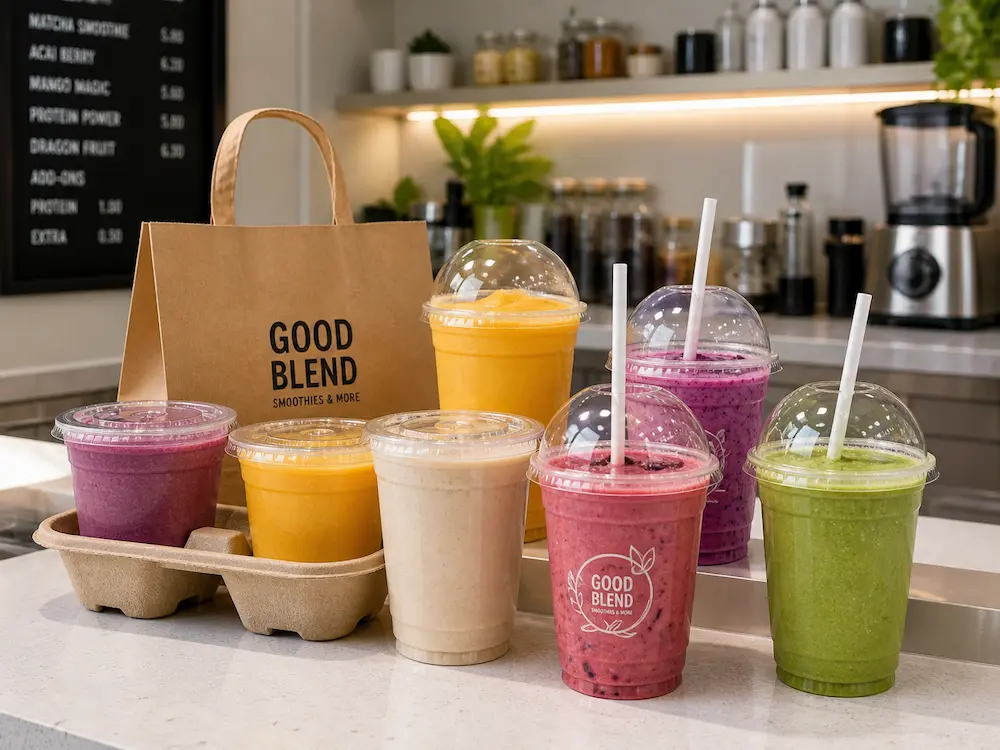
Paper Cups Offer Branding Space but Hide the Product
Paper cups are useful when a brand wants large printed graphics, full-surface design, or seasonal artwork. They work well for many hot beverages and some cold drink programs. However, paper cups hide the product.
For smoothies, this is a major limitation. A customer cannot see the fruit color, texture, layers, pulp, toppings, or freshness cues. When the product is visually attractive, hiding it behind paper reduces shelf appeal.
Paper cups may work for some brands that prioritize printed design over product visibility. But for smoothie bars, juice brands, grab-and-go beverage displays, and cold drink counters, clear packaging often delivers stronger visual value.
Clear PET Cups Support Product-Led Branding
Clear PET cups allow the drink itself to become the main visual element. This is powerful for colorful drinks such as berry smoothies, mango smoothies, matcha drinks, fruit refreshers, and protein shakes.
Branding can still be added through:
- Logo stickers
- Clear labels
- Printed cup sleeves
- Branded sealing labels
- Custom printed cups
- Printed cartons for wholesale distribution
- QR-code labels for campaigns or product information
The best strategy is not always to cover the cup with graphics. For many smoothie products, the better strategy is to let the drink stay visible while adding clean, focused branding.
Smoothie Cups vs Glass Cups and Reusable Cups
Glass Cups Work for Dine-In, Not High-Volume Takeaway
Glass cups create a premium dine-in experience. They work well in cafes, hotels, restaurants, and controlled service environments. However, they are not practical for every business model.
Glass requires washing, storage, breakage control, labor management, and table-service handling. It is not efficient for most takeaway programs, delivery orders, outdoor events, food trucks, convenience stores, stadiums, airports, and high-volume retail beverage programs.
For buyers managing fast-moving cold drinks, disposable smoothie cups often provide better speed and consistency.
Reusable Cups Require a Complete Return System
Reusable cups can support sustainability goals in some markets, but they require more than cup purchasing. A reusable system needs collection points, customer participation, washing facilities, sanitation control, return incentives, inventory tracking, and replacement planning.
For brands without a controlled return infrastructure, reusable cups can create hidden operational costs. They may also slow down service if the workflow is not designed around them.
By comparison, disposable PET cold cups support standardized portion control, fast filling, easy takeaway, and predictable wholesale supply.
Smoothie Cups vs PP Cups
PP Cups Work for Some Sealing Systems
PP cups are commonly used in some cold beverage markets, especially for milk tea, fruit tea, and sealing-film operations. PP can provide flexibility and good sealing-machine compatibility depending on cup design and film type.
However, PP cups usually do not offer the same premium clarity as PET. For smoothie display, this difference matters. A slightly hazy cup may reduce the visual impact of colorful drinks.
PET Is Stronger for Premium Visual Display
For smoothies, visual quality is a major selling point. Clear PET cups show color, texture, toppings, and layers more clearly than many PP cup options. This makes PET a stronger choice for beverage programs that depend on display appeal.
PP may be suitable when the buyer’s operation is built around sealing equipment. PET is often the better direction when the priority is premium clarity, cold drink presentation, and display-driven sales.
Smoothie Cups vs Sealing Film Systems
Sealing Film Works for Specific Beverage Formats
Sealing film systems are common for milk tea, fruit tea, and some juice operations. They help prevent lid detachment and support fast takeaway service when the shop uses sealing machines.
However, sealing film is not always the best choice for smoothies. Many smoothies need dome lids, topping space, whipped cream space, fruit decoration, or straw-friendly presentation. A sealed flat film may limit the product style.
Dome Lids and Flat Lids Give More Menu Flexibility
Smoothie programs often need both flat lids and dome lids.
| Lid Option | Best Application |
|---|---|
| Flat straw-slot lid | Standard smoothies, juice, iced coffee, cold brew, lemonade |
| Dome lid with hole | Smoothies with whipped cream, toppings, fruit pieces, or extra foam |
| Dome lid without hole | Display drinks, dessert-style beverages, protected toppings |
| Sealing film | Milk tea, fruit tea, and machine-sealed drink systems |
For buyers, lid flexibility is a major advantage. A packaging system that supports multiple lids can serve more drinks with fewer cup changes.
Decision Matrix: How Buyers Should Compare Packaging Options
The right packaging depends on the buyer’s actual operating model. The following matrix gives a practical comparison.
| Packaging Type | Product Visibility | Takeaway Stability | Branding Space | Wholesale Efficiency | Best Use Case |
|---|---|---|---|---|---|
| Smoothie Cups | High | High | Medium | High | Smoothies, protein drinks, refreshers, cold beverage display |
| Iced Coffee Cups | High | High | Medium | High | Iced coffee, cold brew, iced latte, flavored cold drinks |
| Juice Cups | High | Medium-High | Medium | High | Fresh juice, lemonade, fruit tea, cold-pressed drinks |
| Paper Cups | Low | Medium | High | Medium | Printed branding where visibility is less important |
| Glass Cups | High | Low for takeaway | Low-Medium | Low | Dine-in service |
| Reusable Cups | Medium-High | Medium | Medium | Low-Medium | Controlled return or reuse systems |
| PP Cups | Medium | High | Medium | Medium | Sealing-machine drinks, selected milk tea formats |
| Sealing Film Cups | Medium-High | High | Low-Medium | Medium | Milk tea, fruit tea, machine-sealed beverages |
For most takeaway smoothie programs, smoothie cups made from PET deliver the strongest balance of visibility, strength, lid compatibility, and wholesale practicality.
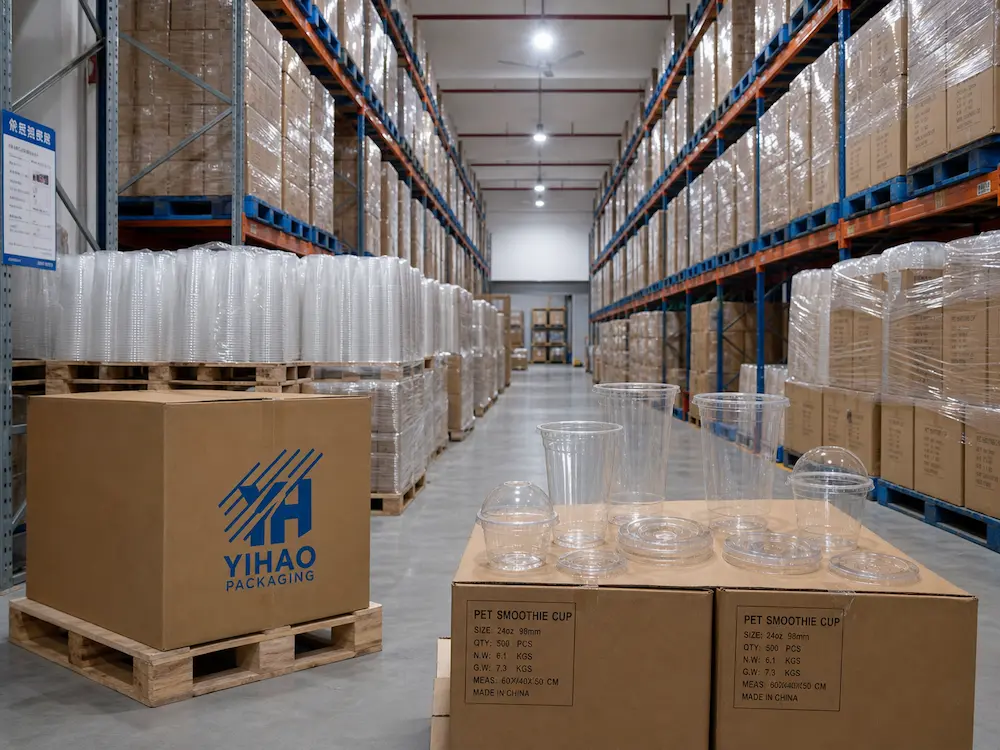
Key Buying Factors for Smoothie Cups
1. Cup Clarity
Clarity is one of the most important reasons buyers choose smoothie cups made from PET. The cup should display the drink without a cloudy, gray, or dull appearance.
Good clarity matters for:
- Strawberry smoothies
- Mango smoothies
- Blueberry smoothies
- Green smoothies
- Acai and berry refreshers
- Matcha drinks
- Protein shakes
- Lemonade
- Iced coffee
- Cold brew
- Fruit tea
- Sparkling fruit drinks
A clear cup improves product presentation immediately.
2. Cup Strength
Smoothies are heavier than many cold drinks. Buyers should check whether the cup remains stable when filled. A good cup should feel light but not fragile.
Important strength checks include:
| Test Point | What Buyers Should Check |
|---|---|
| Sidewall firmness | The cup should not collapse easily when held |
| Base stability | The filled cup should stand securely |
| Rim consistency | Lids should snap on evenly |
| Crack resistance | The cup should handle normal filling and takeaway use |
| Stacking performance | Cups should separate smoothly during service |
| Filled-cup handling | Staff should feel confident during fast service |
Cup strength affects both customer experience and operational efficiency.
3. Lid Compatibility
A smoothie cup is only reliable when the lid fits properly. Buyers should not evaluate cups and lids separately. The cup rim and lid must work together.
Before a wholesale order, buyers should test:
- Flat lid fit
- Dome lid fit
- Straw-slot performance
- Lid snap consistency
- Leakage risk during light movement
- Lid performance after cold storage
- Compatibility across different cup sizes
A small lid mismatch can create major complaints in takeaway operations.
4. Size Range
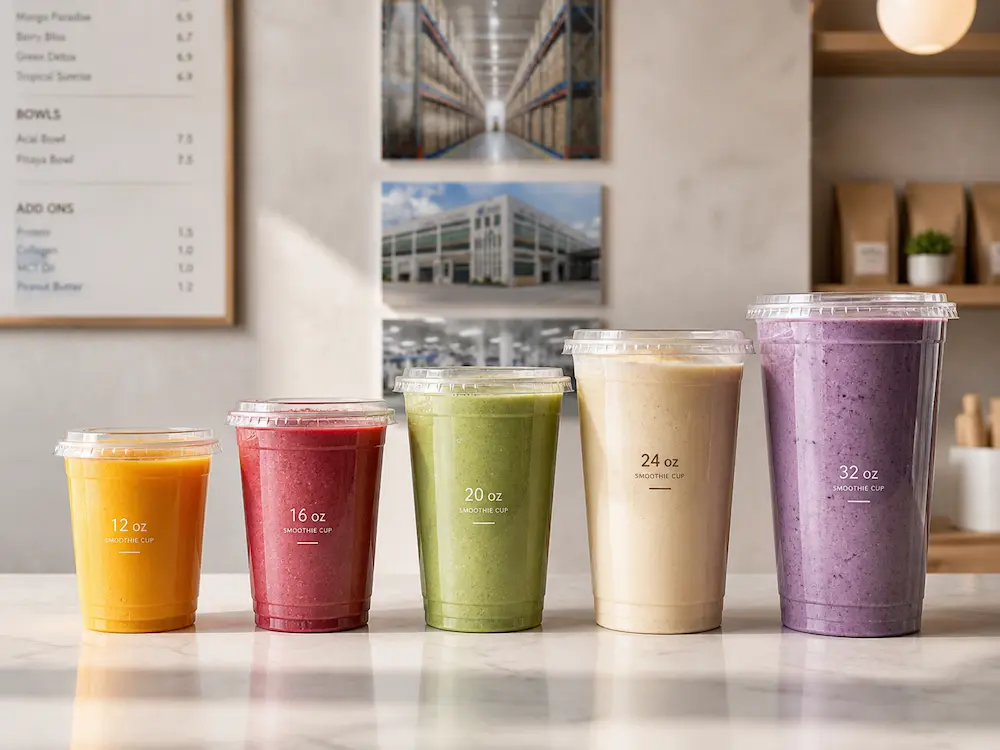
Smoothie cup sizes should match menu strategy, recipe volume, topping space, and price positioning. Common cold beverage size directions often include 12oz, 16oz, 20oz, and 24oz ranges, depending on the supplier’s product line.
| Size Direction | Typical Application | Buyer Logic |
|---|---|---|
| Small size | Kids’ drinks, samples, small juice, small smoothies | Portion control and entry-level pricing |
| Medium size | Standard smoothies, juice, iced coffee, matcha, refreshers | Best all-round size range |
| Large size | Protein drinks, large smoothies, iced tea, fruit refreshers | Needs stronger cup wall and secure lid |
| Multi-size range | Chains, distributors, wholesale programs | Supports menu structure and repeat purchasing |
Buyers should choose size based on actual recipe weight, ice content, topping needs, and customer price expectations.
5. Carton Packing and Export Handling
For B2B buyers, carton quality matters. Cups may perform well as samples but still create issues during export, warehouse storage, or distribution if carton packing is weak.
Wholesale buyers should check:
- Carton strength
- Cup stacking protection
- Lid packing method
- Label information
- Pallet loading method
- Storage condition requirements
- Container loading efficiency
- Damage rate during transport
A reliable packaging supplier should think beyond the cup itself and support the full supply chain.
6. Branding and Custom Options
For cold beverage brands, packaging should support both product visibility and brand recognition. Buyers can combine clear cups with controlled branding elements instead of hiding the drink.
Possible branding options include:
- Custom logo labels
- Printed sleeves
- Cup printing
- Branded cartons
- Product stickers
- QR-code labels
- Seasonal packaging programs
- OEM or private-label packaging support
For distributors and chain buyers, custom options can help create market differentiation without reducing product visibility.
Sample Testing Checklist Before Bulk Ordering
Before placing a large wholesale order, buyers should test smoothie cups under real operating conditions.
| Test Step | What to Do | Why It Matters |
|---|---|---|
| Fill test | Fill with a thick smoothie or similar liquid | Checks strength and grip |
| Lid test | Apply flat lid and dome lid | Confirms rim compatibility |
| Shake test | Move lightly after lidding | Identifies leakage risk |
| Cold storage test | Place filled cup in a cooler | Checks condensation and display appearance |
| Stacking test | Pull cups from a stack repeatedly | Confirms service speed |
| Grip test | Hold filled cup from the side | Checks wall firmness |
| Display test | Place several filled cups together | Reviews retail presentation |
| Transport test | Pack and move cups in cartons | Checks bulk handling stability |
This checklist helps buyers avoid expensive mistakes before committing to high-volume orders.
Red Flags When Choosing a Smoothie Cup Supplier
Not every supplier is suitable for long-term wholesale purchasing. Buyers should be cautious when they see these warning signs:
| Red Flag | Potential Risk |
|---|---|
| Cup samples look clear but bulk orders vary | Unstable material or production control |
| Lids fit loosely | Higher leakage and complaint risk |
| Supplier cannot confirm matching lids | Cup and lid sourcing mismatch |
| Cartons are weak | Higher damage during export or storage |
| Size range is too limited | Difficult menu expansion |
| Sustainability claims are exaggerated | Marketing or compliance risk |
| Communication is slow or unclear | Reorder and customization delays |
| Price is very low without quality explanation | Possible compromise in material, thickness, or consistency |
A good manufacturer should provide stable quality, practical guidance, and clear communication, not only a low quotation.
How to Choose a Smoothie Cup Manufacturer or Wholesale Supplier
Choose a Manufacturer That Understands Cup and Lid Matching
For smoothie packaging, cup and lid matching is critical. A reliable manufacturer should understand rim design, lid fit, cup wall strength, and size compatibility. Buyers should avoid sourcing cups and lids separately unless compatibility has been tested.
A strong supplier should help buyers confirm:
- Which lids match each cup size
- Whether dome lids and flat lids are available
- Whether the cup supports smoothie toppings
- Whether the material is suitable for cold drinks
- Whether the cup range supports multiple beverage categories
- Whether samples are available for real testing
Choose a Supplier with Wholesale Capacity
Wholesale buyers need repeat supply, not one-time samples. The supplier should support stable production, consistent packing, and repeat order planning.
Important wholesale questions include:
- Can the supplier support regular bulk orders?
- Are matching lids available in stable supply?
- Can the supplier support seasonal demand?
- Is the carton packing suitable for export?
- Can the supplier support private-label or OEM packaging?
- Are product specifications clear and consistent?
- Can the supplier provide documentation when required?
For beverage chains and distributors, supplier stability is often more valuable than a small unit price difference.
Choose Packaging That Supports Menu Expansion
A good smoothie cups range should not only serve one drink. It should help the buyer expand into related categories such as iced coffee, juice, matcha, refreshers, protein drinks, fruit tea, lemonade, and cold brew.
This matters because beverage menus change quickly. A packaging system with multiple sizes and lid options helps buyers respond to new drink trends without rebuilding the entire packaging supply chain.
When Smoothie Cups Are the Best Choice
Smoothie cups are the best choice when buyers need packaging that supports clear display, reliable takeaway use, and flexible cold beverage applications.
They are especially suitable for:
- Smoothie bars
- Juice shops
- Coffee shops
- Beverage chains
- Convenience stores
- Supermarkets
- Grab-and-go displays
- Restaurants
- Food trucks
- Event catering
- Wholesale distributors
- Private-label beverage programs
Choose clear PET smoothie packaging when the drink’s appearance matters. If customers buy based on color, freshness, texture, toppings, or layered presentation, transparent packaging adds value.
When Alternative Packaging May Be Better
Alternative packaging still has a place. The right decision depends on the business model.
| Alternative Packaging | Better When |
|---|---|
| Paper cups | The brand prioritizes full-surface printing over product visibility |
| Glass cups | The drink is served mainly for dine-in use |
| Reusable cups | The business has a controlled return and washing system |
| PP cups | The operation depends on sealing-machine compatibility |
| Sealing film cups | The menu focuses on milk tea, fruit tea, or sealed drinks |
| Opaque packaging | The product does not need visual display |
The key is to match the packaging to the product and operation instead of choosing by material alone.
Final Recommendation
For most commercial cold beverage programs, smoothie cups made from clear PET offer the strongest balance of product visibility, takeaway performance, lid flexibility, and wholesale supply efficiency.
Paper cups provide more print space, but they hide the drink. Glass cups work for dine-in service, but they are not practical for large-scale takeaway. Reusable systems support certain sustainability models, but they require extra infrastructure. PP cups and sealing-film systems fit specific beverage formats, but they may not provide the same premium clarity or topping flexibility.
For smoothies, visual display is part of the product value. A clear cup shows the drink’s color, texture, fruit content, and freshness. A stable lid system protects the takeaway experience. A consistent wholesale supply helps buyers control cost, inventory, and service quality.
Buyers who need PET cold cups, clear PET cups, iced coffee cups, juice cups, or recyclable cold cups should choose a packaging manufacturer or supplier that understands both product presentation and operational performance. The best cup is not only the cup with the lowest price. It is the cup that helps the drink look better, travel better, sell better, and scale better.
For buyers planning bulk orders, custom packaging, or long-term wholesale supply, working with YIHAO gives cold beverage brands a practical path to match cup size, lid type, material clarity, carton packing, and application needs in one packaging solution.
FAQ
1. What are smoothie cups usually made from?
Smoothie cups are commonly made from PET because PET provides clear product visibility, good stiffness, lightweight handling, and a clean appearance for cold beverage packaging. PET cold cups are widely used for smoothies, iced coffee, juice, matcha, refreshers, lemonade, fruit tea, and protein drinks because they show drink color and texture clearly.
2. Are smoothie cups recyclable?
Smoothie cups made from PET are recyclable where local recycling systems accept PET packaging. Buyers should avoid claiming that every PET cup will be recycled everywhere, because actual recycling depends on local collection systems, sorting technology, contamination levels, cup design, and recycling infrastructure.
3. Can smoothie cups also be used for iced coffee and juice?
Yes. Many smoothie cups can also be used as iced coffee cups and juice cups when the cup size, lid fit, and material strength match the drink application. This helps cafes, juice bars, beverage chains, and wholesale buyers reduce inventory complexity by using one clear PET cup range for several cold beverage categories.
4. What size smoothie cups should buyers choose?
Buyers should choose smoothie cup sizes based on recipe volume, ice content, topping space, menu pricing, and takeaway use. Smaller cups work for kids’ drinks or samples, medium cups work for standard smoothies and juice, and larger cups work for protein drinks, refreshers, iced tea, and premium smoothie servings.
5. How do I choose a smoothie cup manufacturer or wholesale supplier?
Choose a smoothie cups manufacturer or wholesale supplier that offers stable PET cup quality, clear material appearance, consistent rim design, matching lids, multiple size options, reliable carton packing, and repeat supply capacity. Buyers should test samples with real smoothie-style drinks before placing large orders.
References
- U.S. Food and Drug Administration, Packaging & Food Contact Substances guidance.
- U.S. Food and Drug Administration, Understanding How FDA Regulates Substances that Come into Contact with Food.
- U.S. Environmental Protection Agency, Plastics: Material-Specific Data.
- Association of Plastic Recyclers, APR Design Guide Overview.
- Association of Plastic Recyclers, PET Rigid Design Guidance.
- WRAP / Recoup, Design Tips for Recycling: UK Plastics Pact Recycling Guide.
- National Coffee Association, consumer coffee and cold beverage trend reporting.
- Industry packaging procurement practices for PET cold cups, clear beverage cups, and wholesale foodservice packaging.
Deep-Dive Insights: How Buyers Should Think About Smoothie Cups
How do smoothie cups improve cold drink presentation?
Smoothie cups improve cold drink presentation by making color, texture, pulp, ice, toppings, and layers visible through the packaging. This helps smoothies, juice, iced coffee, matcha, refreshers, and protein drinks look fresher and more attractive in takeaway counters and retail displays.
Why are clear PET cups often preferred for smoothies?
Clear PET cups provide strong transparency, lightweight handling, and stable cold beverage performance. They are practical for buyers who need one cup range to support smoothies, juice, iced coffee, cold brew, lemonade, fruit tea, matcha, and other cold drink menus.
What should buyers compare before bulk ordering?
Buyers should compare cup clarity, sidewall strength, rim consistency, lid compatibility, size range, carton packing, wholesale capacity, and supplier communication. A low-cost cup that creates leakage, cracking, or lid mismatch problems is not a strong long-term choice.
Which alternative packaging works in limited cases?
Paper cups work when full-surface branding matters more than product visibility. Glass cups work for dine-in service. Reusable cups work only when the business has a controlled return and washing system. PP cups and sealing-film systems work for selected beverage formats, especially when sealing equipment is required.
Why does supplier stability matter more than unit price alone?
A reliable manufacturer, wholesale partner, or packaging supplier helps buyers maintain stable cup quality, matching lids, repeat supply, carton consistency, and smoother reorder planning. Supplier stability protects both the product experience and the buyer’s long-term packaging cost.
What is the best practical choice for most smoothie programs?
For most takeaway smoothie and cold beverage programs, PET smoothie cups provide the best balance of display value, service speed, lid flexibility, and wholesale supply efficiency. They help the drink look better, travel better, and fit more beverage categories in one packaging system.
© YIHAO Packaging. All rights reserved. All articles, product images, packaging designs, technical specifications, and website materials are protected by copyright. Unauthorized copying, reproduction, redistribution, modification, or commercial use is strictly prohibited without prior written permission.