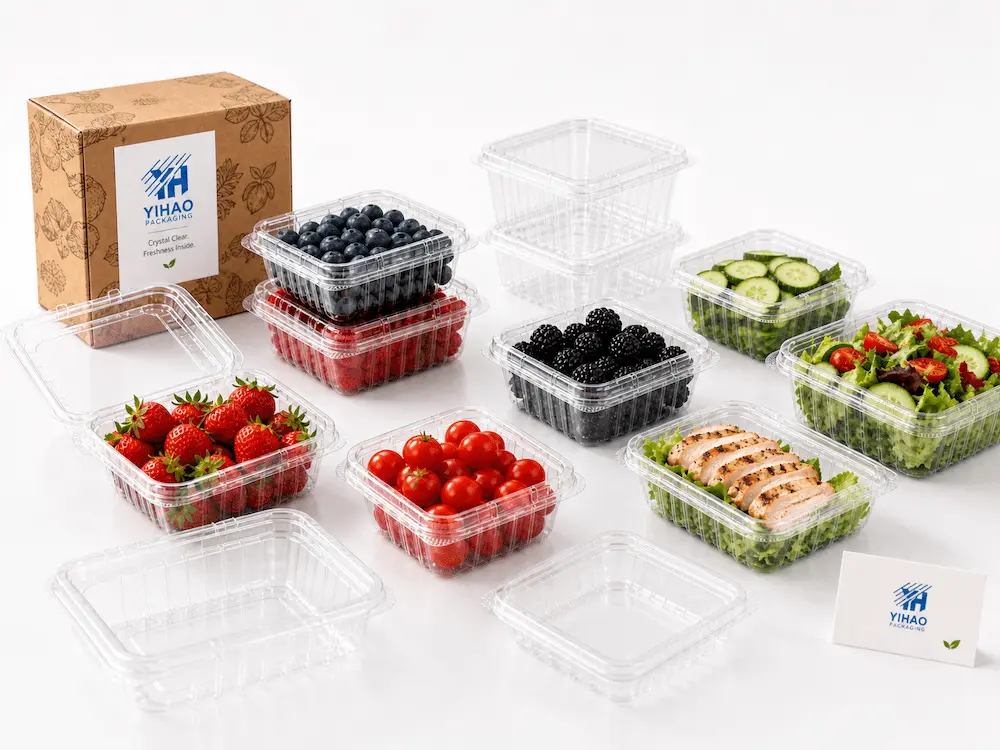
Micro Summary: Produce Trays vs Alternative Packaging
Produce trays are widely used for fresh fruit, sliced produce, vegetable portions, deli-style display, catering fruit platters, and chilled ready-to-eat food. Their main advantage is a wide, open visual presentation that helps buyers show color, portion size, and product arrangement clearly in retail display.
However, produce trays are not always the best option. Buyers should compare them with fresh produce packaging containers, produce clamshell containers, fresh-cut fruit containers, berry packaging containers, and clear PET produce packaging based on product type, closure needs, stacking performance, ventilation, takeaway handling, and wholesale supply requirements.
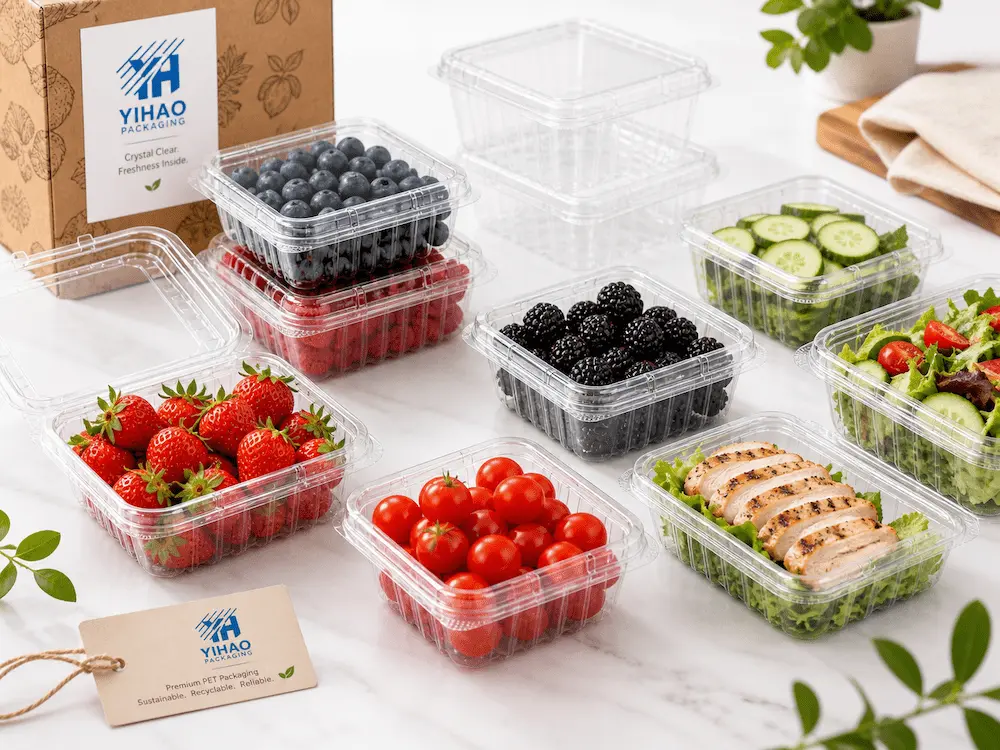
Produce Trays vs Alternative Packaging: How Buyers Should Choose
Produce packaging is not a one-format decision. Supermarkets, fresh produce brands, distributors, foodservice operators, and chilled food suppliers often need to choose between produce trays, clamshell containers, fresh-cut fruit packs, berry containers, and clear PET packaging formats. Each option has a different role in retail display, takeaway handling, product protection, stacking, and wholesale purchasing.
YIHAO is a food packaging manufacturer and solution provider focused on practical packaging formats for fruit, berries, salads, snacks, bakery items, deli food, and chilled ready-to-eat meals. For packaging buyers, the goal is not simply to choose the cheapest tray or container. The real goal is to match structure, material, closure, visibility, ventilation, and shelf strategy with the actual product.
This buyer guide compares produce trays with alternative fresh produce packaging containers, including produce clamshell containers, fresh-cut fruit containers, berry packaging containers, and clear PET produce packaging. It helps buyers understand when trays are the right solution, when alternatives perform better, and how to evaluate packaging before wholesale orders.
Fresh-cut produce and ready-to-eat produce products require careful handling because cutting, washing, peeling, and portioning can increase food safety and quality risks. FDA guidance for fresh-cut fruits and vegetables focuses on minimizing microbial hazards during processing and handling, which makes packaging selection part of a broader fresh food control system.
Why Produce Trays Are Still Important in Fresh Produce Packaging
Produce trays remain important because they create a wide display surface for fresh food. Unlike deeper containers that focus on containment, trays help buyers arrange fruit, vegetables, and chilled food in a clean, visible, and organized way. This makes trays especially useful for sliced fruit, fruit platters, vegetable portions, deli-style displays, and catering packs.
For retail buyers, presentation matters before anything else. Customers judge fresh produce quickly. A tray that displays color, portion size, and product arrangement clearly helps the product look more attractive in cold shelves and prepared food sections. This is why produce trays are often used for items where visual layout is part of the selling point.
However, trays are not always the strongest option for closure, takeaway, stacking, or loose delicate products. A tray may need a compatible lid, film seal, wrap, or outer sleeve depending on the application. If the product is wet, delicate, loose, or handled frequently, buyers may need a different packaging format.
This is where comparison matters. A good buyer does not ask, “Are produce trays good or bad?” A good buyer asks, “For this exact product, sales channel, and handling process, are trays better than clamshells, fresh-cut fruit containers, berry containers, or clear PET hinged packaging?”
What Are Produce Trays Used For?
Produce trays are used when display surface, arrangement, and portion visibility are important. They are common in supermarkets, convenience stores, deli departments, catering supply, fresh-cut fruit programs, and chilled ready-to-eat food sections.
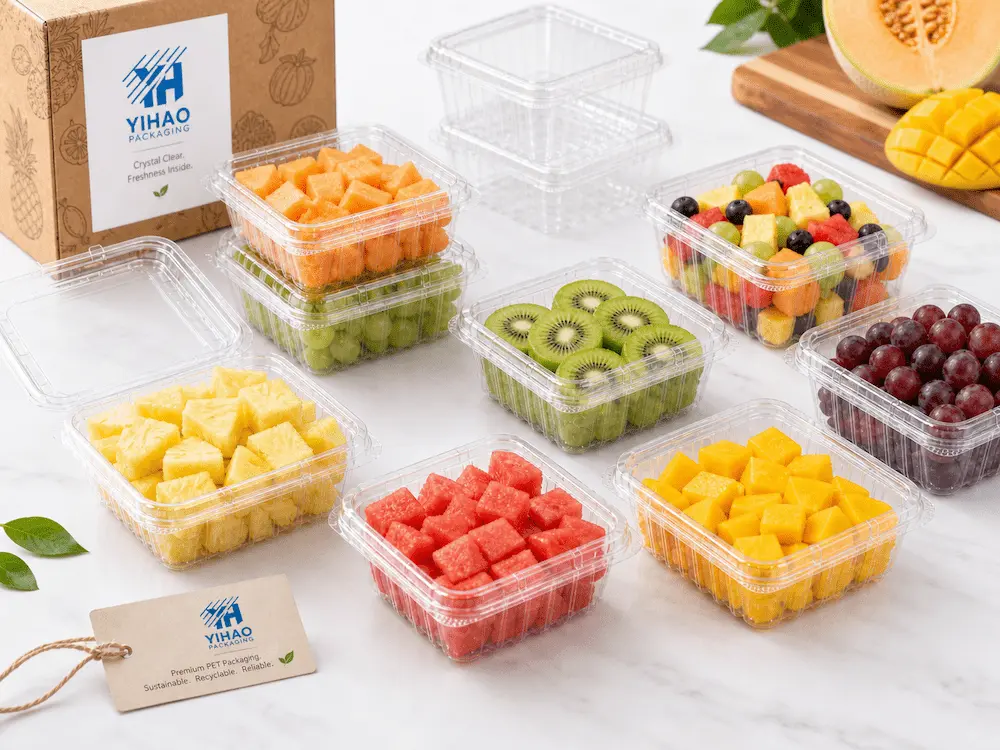
Arranged Fresh Fruit and Vegetable Portions
One of the best uses for produce trays is arranged fresh fruit. Sliced melon, pineapple sticks, orange wedges, kiwi slices, grapes, apple portions, and mixed fruit assortments often look better when placed in a flat or semi-flat tray. A wider surface gives the product more room to show color and arrangement.
Vegetable portions also benefit from tray packaging. Carrot sticks, cucumber slices, celery, cherry tomatoes, mixed vegetables, and party snack vegetables can be arranged neatly in trays. For retail display, this creates a clean and organized appearance.
For buyers, the key advantage is visual control. Produce trays help standardize how the product looks on the shelf. This is useful when multiple stores, branches, or foodservice locations need consistent presentation.
Fresh-Cut Fruit Display and Deli-Style Presentation
Fresh-cut fruit often needs a balance between display and protection. Produce trays work well when the fruit is arranged rather than loose. For example, a tray is suitable for fruit platters, sliced melon packs, and premium deli-style fruit arrangements.
When the product contains loose fruit cubes or juicy mixed fruit, a deeper fresh-cut fruit container may perform better. The buyer should evaluate moisture release, transport movement, and lid security before choosing the final format.
This is why trays and containers often work together in one packaging program. A supermarket may use trays for large fruit platters, clamshells for berries, and clear hinged containers for grab-and-go fruit portions.
Retail Packs, Catering Trays, and Chilled Ready-to-Eat Food
Produce trays are also used beyond fruit and vegetables. They are suitable for chilled desserts, snack assortments, bakery portions, deli sides, and ready-to-eat food where the arrangement needs to be visible. Cheesecake slices, brownies, sushi-style snacks, cold appetizers, and prepared food combinations can all benefit from a clean tray layout.
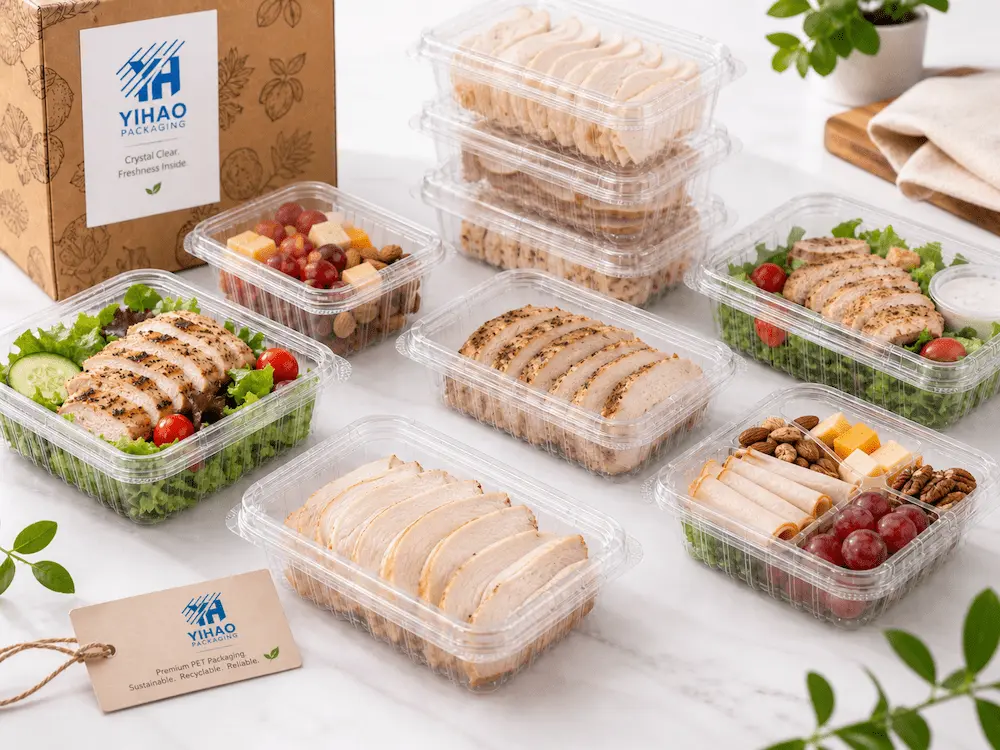
For catering, trays provide a larger display area and help arrange food for sharing. For retail grab-and-go, smaller trays may be paired with lids or film to protect the product while keeping it visible.
The main point is simple: produce trays are strongest when presentation is a priority and the product does not require deep containment.
Produce Trays vs Produce Clamshell Containers
Produce trays and produce clamshell containers are often compared because both are widely used in fresh food packaging. The difference is structure. A tray usually offers a wider open display area, while a clamshell usually provides an integrated hinged lid and stronger containment.
When Produce Trays Are Better
Produce trays are better when the product needs an open, organized, and premium-looking layout. They are suitable for arranged fruit slices, vegetable portions, deli-style presentation, catering platters, and display-focused fresh food packs.
Trays are also useful when buyers want to control how the product sits in the pack. A tray can create sections, flat layout, or a more premium visual arrangement. For retail displays, this makes the product easier to understand at first glance.
For example, sliced melon in a clear tray can look more organized than the same product placed loosely in a deep container. A fruit platter also needs a tray because the arrangement itself is part of the product value.
When Produce Clamshell Containers Are Better
Produce clamshell containers are better when closure, portability, and stacking matter more. A hinged lid keeps the base and lid connected, which improves packing efficiency and reduces lid mismatch during production. Clamshells are widely used for berries, mixed fruit, salads, snacks, and takeaway portions.
Compared with trays, clamshell containers usually perform better for loose products. Blueberries, grapes, small tomatoes, salad portions, and mixed snacks are easier to contain in a clamshell. The hinged lid also supports fast filling and closing.
For takeaway, clamshell packaging often feels more secure. Customers can pick up the container, place it in a bag, and carry it with more confidence.
Buyer Decision Logic
The decision between produce trays and clamshells depends on four questions:
| Buyer Question | Better Direction |
|---|---|
| Does the product need wide visual arrangement? | Produce trays |
| Does the product need stronger closure? | Produce clamshell containers |
| Will the product be carried as takeaway? | Produce clamshell containers |
| Is the product a large arranged platter? | Produce trays |
| Is the product loose, small, or delicate? | Clamshell or dedicated container |
| Does the shelf need premium flat display? | Produce trays |
Buyers should not choose based on appearance alone. They should test actual filling weight, closure, stacking, labeling, and cold shelf display before confirming wholesale packaging.
Produce Trays vs Fresh-Cut Fruit Containers
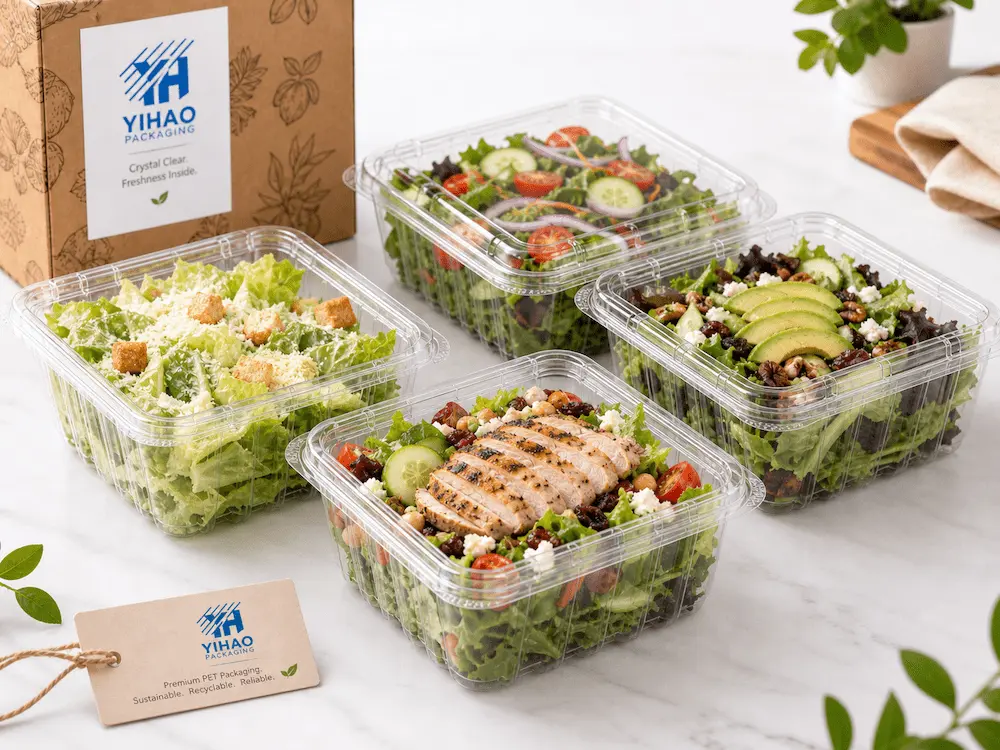
Fresh-cut fruit containers are usually deeper and more containment-focused than standard trays. They are designed for fruit portions that may release juice, shift during transport, or need secure takeaway handling.
Fresh-Cut Fruit Containers Support Better Closure and Portion Control
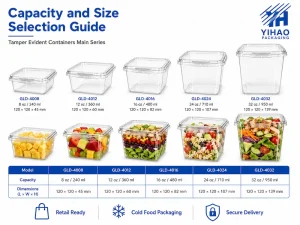
For mixed fruit, watermelon cubes, pineapple chunks, grapes, melon balls, and fruit salad, a deeper container often works better than a flat tray. The container helps control movement, supports portion sizing, and protects the product during handling.
Fresh-cut fruit is sensitive because it has exposed surfaces and often releases moisture. A stronger container structure helps reduce mess and improves customer confidence. For convenience stores, meal-prep brands, and takeaway counters, this matters more than a wide display surface.
Fresh-cut fruit containers are especially useful for grab-and-go retail. Customers want to see the fruit clearly, but they also expect the package to stay closed during transport.
Produce Trays Support Better Open Visual Layout
Produce trays are better when fresh-cut fruit is arranged intentionally. Fruit slices, party platters, deli-style fruit assortments, and premium display packs often look better in trays. The wide surface allows the product to be arranged by color, shape, and portion.
For retail display, trays can create a more premium impression. A neatly arranged fruit tray may look more valuable than a loose fruit container, especially for larger portions or sharing formats.
The limitation is closure. If the tray is used for takeaway or distribution, buyers need a suitable lid, film, or wrap system. Without the right covering, trays may not provide enough protection.
Which Format Works Better for Supermarkets and Foodservice Buyers?
Supermarkets often need both formats. Produce trays work well for arranged fruit and deli-style display. Fresh-cut fruit containers work better for grab-and-go portions, fruit cups, and takeaway packs.
Foodservice buyers should think about handling speed. If staff need fast filling and secure closure, a hinged clear PET container may be more efficient. If staff need premium arrangement for display or catering, trays are stronger.
The best choice depends on the sales channel:
| Sales Channel | Better Packaging Direction |
|---|---|
| Supermarket fruit platter | Produce trays with lid |
| Convenience store fruit cup | Fresh-cut fruit containers |
| Deli-style sliced fruit | Produce trays |
| Takeaway mixed fruit | Clear hinged PET containers |
| Catering fruit assortment | Produce trays |
| Meal-prep snack pack | Fresh-cut fruit containers |
Produce Trays vs Berry Packaging Containers
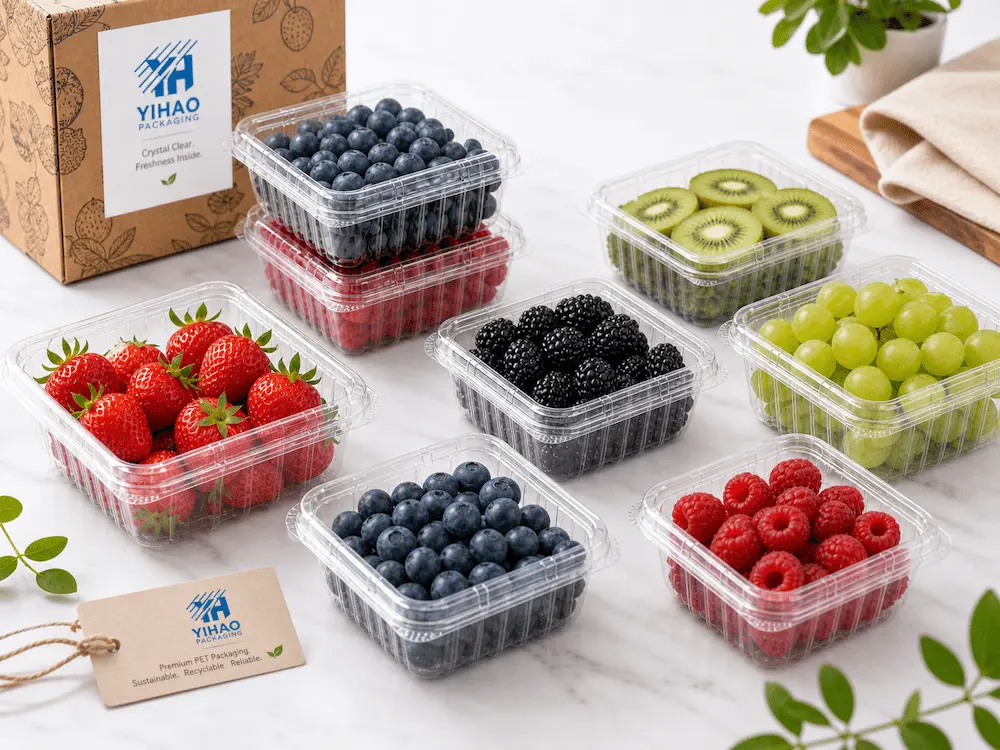
Berries are delicate. Blueberries, blackberries, raspberries, and strawberries need packaging that protects them from pressure while keeping them visible. This is why berry packaging containers often have different structure logic from standard produce trays.
Berries Need Protection, Ventilation, and Gentle Handling
Berries are small, colorful, and easy to damage. Raspberries and blackberries are especially sensitive to pressure. Blueberries need good containment and visibility. Strawberries often need more space because of their size and shape.
For berries, packaging should support gentle containment, ventilation, and stable stacking. A flat tray may show berries clearly, but it may not provide enough containment for transport or retail handling.
Produce Trays Are Better for Arranged Presentation, Not Loose Berries
Produce trays can work for arranged berry platters, mixed fruit displays, or dessert trays with berries as toppings. They are not usually the best choice for loose berries sold by weight or portion.
Loose berries need protection from movement and pressure. A tray with poor containment can cause rolling, crushing, or uneven distribution. This is why dedicated berry packaging containers or clamshells are often preferred for blueberries, blackberries, raspberries, and strawberries.
Berry Packaging Containers Support Retail Safety and Shelf Stability
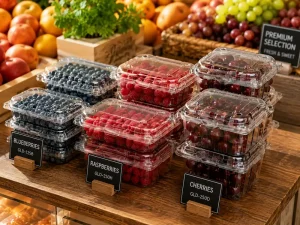
Berry packaging containers are designed to keep berries visible while supporting airflow, containment, and stacking. This helps retailers display berries neatly and reduces handling damage.
For buyers, the correct question is not whether berries can be placed in trays. The correct question is whether the tray structure protects the berries through packing, transport, cold storage, shelf display, and customer handling. In many cases, a berry clamshell or dedicated berry container is the safer choice.
Why Clear PET Produce Packaging Is Widely Used
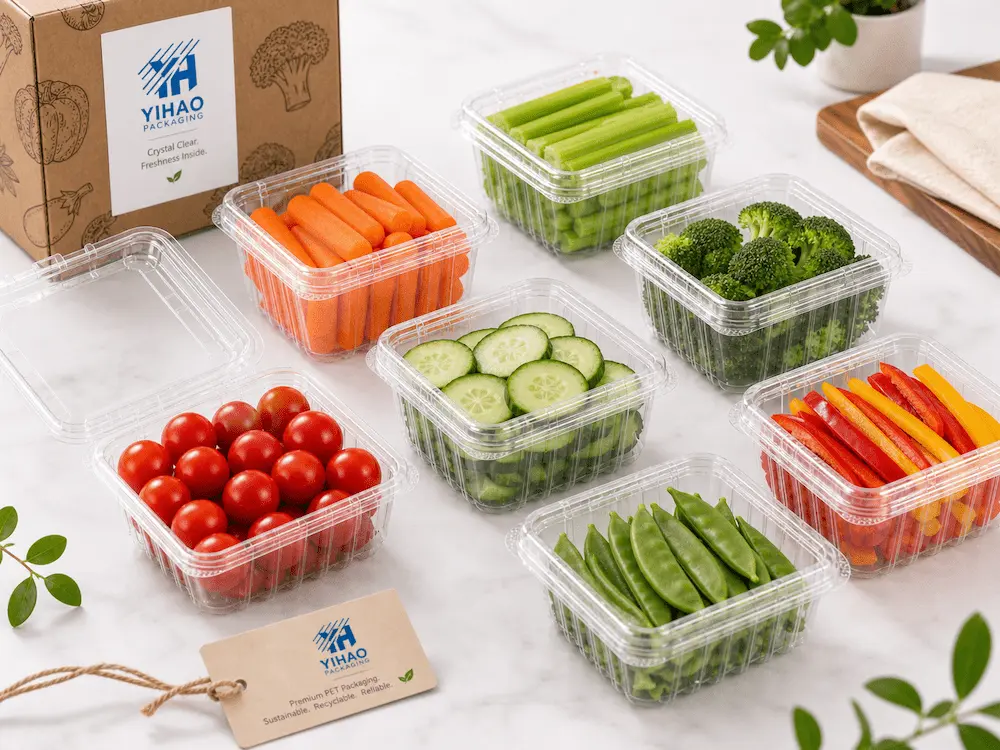
Clear PET produce packaging is widely used because fresh food sells through visibility. Customers want to see color, texture, size, and freshness before purchase. Packaging that hides the product weakens trust.
Clear Visibility Supports Customer Trust
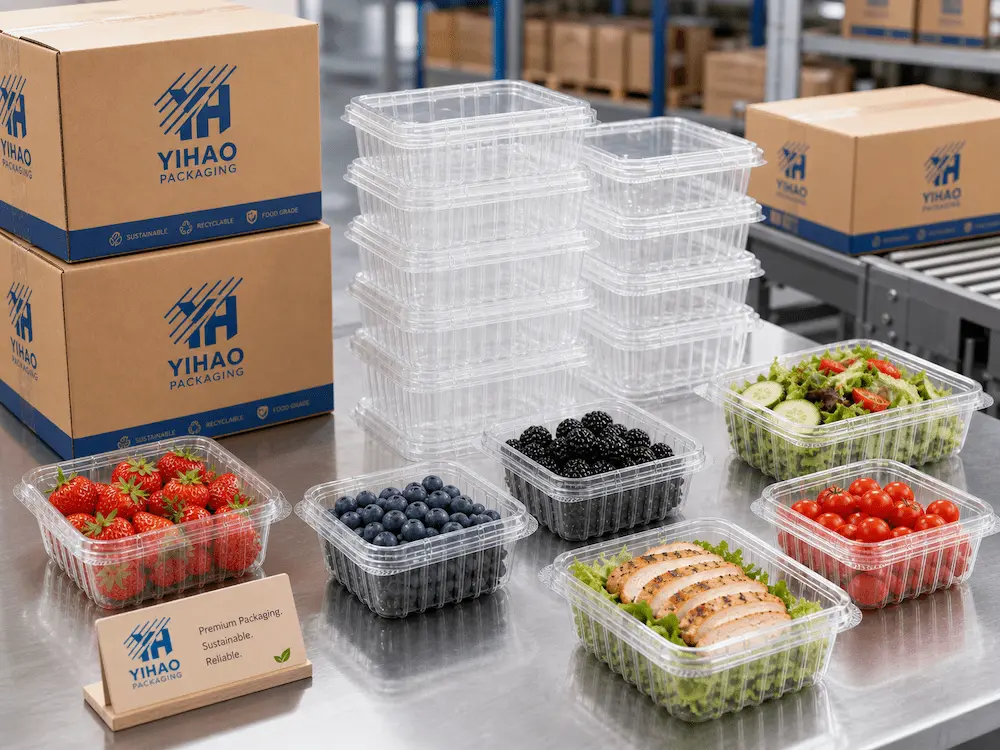
Clear PET packaging helps buyers present fruit and vegetables cleanly under retail lighting. For produce, color is a direct selling signal. Red strawberries, green grapes, yellow pineapple, orange melon, and deep blue blueberries all benefit from high-clarity packaging.
Whether the format is a tray, clamshell, or hinged container, clear packaging helps the product become the main visual focus. This is especially important for fresh-cut fruit, berries, salads, chilled desserts, and ready-to-eat food.
PET and RPET Options for Practical Food Packaging Programs
PET is commonly used for clear food packaging because it offers strong transparency, practical rigidity, and lightweight handling. RPET can support recycled-content packaging strategies when the material, food-contact requirements, and target market regulations are properly confirmed.
For buyers selling into the European Union, recycled plastic food-contact materials are covered by Commission Regulation (EU) 2022/1616, which concerns recycled plastic materials and articles intended to come into contact with food. Buyers should confirm compliance documentation with their supplier before making market-specific claims.
Recyclability Design Should Be Considered Early
Packaging recyclability is influenced by material choices, labels, adhesives, colors, additives, and structural design. The Association of Plastic Recyclers states that its Design Guide helps companies evaluate package design against industry-accepted criteria for recycling compatibility.
For buyers, this means recyclable packaging is not only about choosing PET. The full package system matters. A clear PET tray with unsuitable labels, coatings, or mixed materials may perform differently in recycling systems. Buyers should discuss design choices with the packaging manufacturer or supplier early in the project.
Buyer Comparison Table: Produce Trays vs Alternative Packaging
| Packaging Format | Best For | Key Advantage | Buyer Limitation |
|---|---|---|---|
| Produce trays | Arranged fruit, sliced produce, deli-style display | Wide visual presentation | May need lid, film, or wrap |
| Produce clamshell containers | Berries, mixed fruit, salads, snacks | Hinged closure and stackability | Less open display area |
| Fresh-cut fruit containers | Takeaway fruit, chilled grab-and-go food | Secure closure and portion control | Must match fruit moisture and weight |
| Berry packaging containers | Blueberries, blackberries, raspberries, strawberries | Ventilation and gentle protection | Not ideal for large arranged trays |
| Clear PET produce packaging | Retail display and chilled food | High product visibility | Must match structure with application |
This table shows why produce trays should be evaluated as one part of a wider packaging strategy. Trays are excellent for display-driven products. Clamshells are stronger for closure. Fresh-cut fruit containers are stronger for portion control. Berry packaging containers are stronger for delicate berries. Clear PET packaging supports visibility across all these formats.
How Buyers Should Choose the Right Fresh Produce Packaging Containers
Choosing the right packaging starts with product behavior, not packaging appearance. Buyers should define the food first, then choose the format.
Start with Product Type and Moisture Level
Fruit and produce behave differently after cutting, washing, or packing. Watermelon cubes release more moisture. Pineapple chunks need secure containment. Grapes roll easily. Berries bruise under pressure. Vegetable sticks need clean arrangement. Salads need lid height and space for toppings.
For wet or loose products, containers and clamshells often perform better than flat trays. For arranged and display-focused products, produce trays may perform better.
Match Packaging with Sales Channel
A package used for supermarket display does not face the same conditions as a package used for takeaway delivery. Buyers should match packaging with the sales channel.
| Sales Channel | Packaging Requirement |
|---|---|
| Supermarket cold shelf | Clarity, stacking, neat arrangement |
| Convenience store grab-and-go | Secure closure, compact size, easy handling |
| Catering | Wide display area, larger size, organized layout |
| Foodservice takeaway | Closure strength, portability, leak control |
| Wholesale distribution | Carton stability, nesting efficiency, repeat supply |
Produce trays are strong for display and catering. Clamshells and fresh-cut fruit containers are often stronger for takeaway and grab-and-go.
Test Closure, Stacking, and Shelf Display Before Wholesale Orders
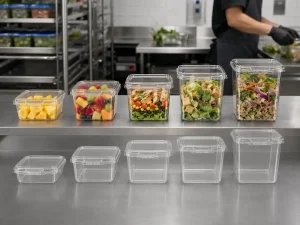
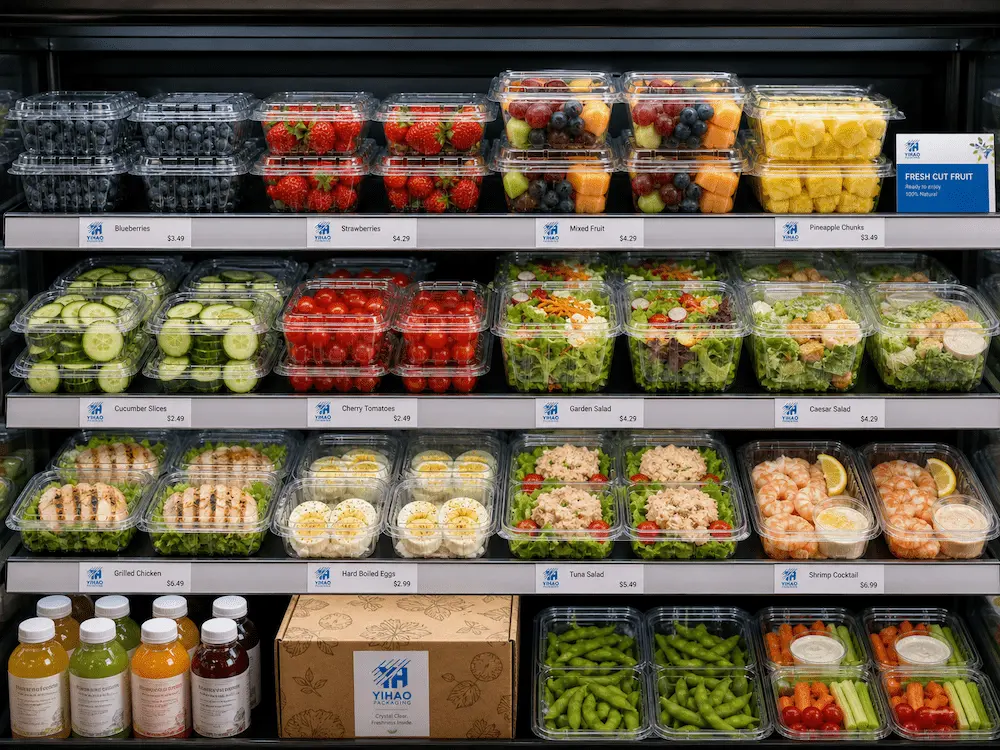
Before placing wholesale orders, buyers should test packaging with real products. Empty sample reviews are not enough. The package should be filled, closed, stacked, chilled, labeled, and handled like it will be used in the real market.
For produce trays, buyers should test whether the tray stays rigid with the product weight, whether the lid or film fits properly, and whether the display still looks clean after handling.
For clamshells and containers, buyers should test hinge strength, lock fit, lid clarity, and stacking performance.
Work with a Manufacturer or Wholesale Supplier That Understands Applications
A professional packaging manufacturer, wholesale partner, or supplier should help buyers compare packaging based on product application. The conversation should include food type, portion weight, cold storage, stacking height, label placement, display style, and target market.
YIHAO supports application-based packaging selection for fruit, berries, salads, snacks, bakery items, deli food, and chilled ready-to-eat products. This approach helps buyers avoid one-size-fits-all packaging decisions.
Application Matrix for Produce Trays and Alternatives
| Application | Recommended Packaging Direction | Why It Works |
|---|---|---|
| Sliced melon display | Produce trays | Wide display surface shows color and portion |
| Mixed fresh-cut fruit | Fresh-cut fruit containers | Better closure and portion control |
| Blueberries | Berry packaging containers | Ventilation and gentle containment |
| Blackberries | Berry packaging containers | Gentle protection reduces compression |
| Raspberries | Dedicated berry containers | Soft fruit needs low-pressure handling |
| Strawberries | Produce clamshell containers or berry containers | Visibility and product protection |
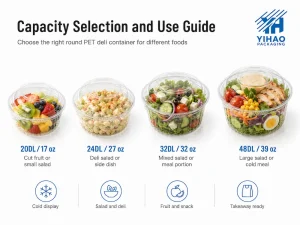
| Salad with fruit toppings | Clear PET hinged containers | Lid height and takeaway stability |
| Catering fruit platter | Produce trays with lid | Large display area and organized layout |
| Chilled desserts | Clear PET containers | Product visibility and lid clearance |
| Retail grab-and-go snacks | Produce clamshell containers | Fast packing and secure handling |
| Vegetable sticks | Produce trays or clear containers | Clean arrangement and easy display |
| Deli-style cold food | Clear PET produce packaging | Visibility and shelf presentation |
This matrix helps buyers avoid a common mistake: using one packaging format for every product. Produce trays are valuable, but they should be used where their strengths match the product.
Packaging and Food Waste: Why Structure Matters
Packaging also affects product waste. Fresh produce is highly perishable, and poor packaging can increase damage, leakage, bruising, and customer rejection. The UNEP Food Waste Index Report 2024 highlights food waste as a major global issue and shows why prevention across households, foodservice, and retail remains important.
For produce buyers, packaging cannot solve every waste problem, but it can reduce avoidable losses. A weak tray can bend. A poor lid can open. A mismatched container can crush delicate berries. A cloudy package can reduce customer confidence and slow product movement.
This is why buyers should evaluate total value, not only unit cost. A slightly stronger or better-matched package may reduce product waste, shelf mess, customer complaints, and repacking labor.
Retail Display Strategy for Produce Trays
Retail display is where produce trays can perform especially well. A tray allows the product to sit in a clear, organized, and attractive layout. For fresh produce, this can directly support customer decision-making.
Use Trays When Arrangement Adds Value
If the product looks better when arranged, trays are a strong option. Sliced fruit, vegetable sticks, deli snacks, and catering assortments all benefit from a wide display surface.
The buyer should think like a customer. If the customer needs to understand the portion quickly, a tray helps. If the customer needs to see layers, color blocks, or product arrangement, a tray helps.
Avoid Trays When Containment Is More Important
If the product is loose, wet, small, or likely to shift, trays may not be the best solution. Mixed fruit cubes, berries, and takeaway snacks often need better containment. In those cases, fresh-cut fruit containers, clamshells, or dedicated berry packs may perform better.
Keep Labels from Blocking the Food
Labels are necessary for branding, barcodes, nutrition information, and product names. However, a label that covers too much of the product weakens the benefit of clear packaging.
For clear PET produce packaging, label placement should support visibility. Buyers should test label size and placement before final approval.
Sustainability and Responsible Packaging Choices
Sustainability is now part of packaging purchasing, but buyers should handle it accurately. The best packaging decision is not simply the lightest option or the most attractive claim. It is the format that protects the food, uses material responsibly, supports local recycling expectations where applicable, and meets the target market’s food-contact requirements.
PET and RPET packaging can support clear product presentation and practical fresh food protection. However, buyers should avoid unsupported claims. Recycled content, recyclability, food-contact suitability, and market compliance should be confirmed with supplier documentation.
A responsible packaging strategy should reduce unnecessary material while still protecting the product. If under-designed packaging causes fruit damage or food waste, the total impact may be worse than using a better-performing structure.
Why Choose YIHAO for Produce Trays and Fresh Produce Packaging Containers?
Choosing the right packaging partner is as important as choosing the right packaging format. Buyers need a supplier that understands fresh food applications, not just catalog products.
YIHAO provides practical packaging solutions for fruit, berries, salads, snacks, bakery items, deli food, and chilled ready-to-eat meals. For buyers comparing produce trays, fresh produce packaging containers, produce clamshell containers, fresh-cut fruit containers, and berry packaging containers, YIHAO focuses on real application fit.
Food Packaging Solutions for Fruit, Berries, Salads, and Chilled Food
Fresh food packaging must match the product. YIHAO supports packaging selection for sliced fruit, mixed fruit, blueberries, blackberries, raspberries, strawberries, salad portions, chilled desserts, deli snacks, and takeaway food.
The right packaging structure depends on portion size, product moisture, display method, lid design, handling route, and sales channel.
Wholesale Packaging Support for Retailers, Distributors, and Food Brands
For wholesale buyers, stable supply and consistent quality are important. Supermarkets, distributors, fresh produce brands, and foodservice operators need packaging that supports repeat purchasing and daily operations.
A reliable packaging supplier should help buyers review samples, compare structures, confirm application fit, and plan packaging around real usage.
Application-Based Packaging Selection Instead of One-Size-Fits-All Recommendations
No single packaging format fits every produce application. Produce trays are strong for display. Clamshells are strong for closure. Fresh-cut fruit containers are strong for portion control. Berry containers are strong for delicate fruit protection.
YIHAO helps buyers compare options based on product use, not generic packaging labels.
Final Buyer Checklist Before Ordering Produce Trays
Before confirming wholesale orders, buyers should review the following checklist:
| Checklist Item | Buyer Question |
|---|---|
| Product Type | Is the product sliced, loose, delicate, wet, arranged, or ready-to-eat? |
| Display Goal | Does the product need a wide visual layout or deeper containment? |
| Closure Need | Does the package need a lid, film, wrap, or hinged closure? |
| Stacking | Can filled packages stack safely in cartons and cold shelves? |
| Material | Is PET or RPET suitable for the target food and market? |
| Visibility | Does the packaging show the product clearly under retail lighting? |
| Ventilation | Does the product need airflow, especially for berries? |
| Label Area | Can labels be applied without blocking product visibility? |
| Takeaway Handling | Will the customer carry the pack after purchase? |
| Supplier Support | Can the manufacturer or supplier provide application-based guidance? |
The best packaging decision is not always the most familiar format. Buyers should choose produce trays when they need strong visual arrangement, and choose alternative packaging when closure, containment, ventilation, or portability matters more.
Conclusion
Produce trays are valuable packaging formats for fresh produce, sliced fruit, vegetable portions, deli-style displays, catering platters, and chilled ready-to-eat food. Their strongest advantage is clear, open, and organized product presentation. For retail display, this helps customers see color, portion size, and arrangement quickly.
However, trays are not the best choice for every product. Produce clamshell containers are often better for hinged closure and stacking. Fresh-cut fruit containers are stronger for takeaway fruit and portion control. Berry packaging containers are better for delicate berries that need ventilation and gentle handling. Clear PET produce packaging supports product visibility across all these formats.
For buyers, the right choice depends on product type, moisture level, closure needs, shelf display, transport route, and wholesale supply stability. For retailers, distributors, food brands, and foodservice buyers looking for produce trays wholesale or alternative fresh produce packaging solutions, YIHAO provides practical PET/RPET packaging options for fruit, berries, salads, desserts, deli food, and chilled ready-to-eat applications.
Contact YIHAO to compare produce trays, clamshell containers, berry containers, and clear PET packaging formats for your fresh food program.
FAQ
1. What are produce trays used for?
Produce trays are used for sliced fruit, arranged fresh produce, vegetable portions, deli-style displays, catering fruit platters, chilled desserts, and ready-to-eat food. They provide a wide display surface that helps buyers present color, portion size, and product arrangement clearly.
2. Are produce trays better than produce clamshell containers?
Produce trays are better for arranged display and wide visual presentation. Produce clamshell containers are better for hinged closure, takeaway handling, loose products, stacking, and faster packing. The right choice depends on the product type, sales channel, and handling process.
3. What is the best packaging for fresh-cut fruit?
The best packaging for fresh-cut fruit depends on the fruit format. Arranged sliced fruit often works well in produce trays. Loose mixed fruit, fruit cubes, and takeaway fruit portions usually perform better in fresh-cut fruit containers or clear PET hinged containers with secure closure.
4. Are produce trays suitable for berries?
Produce trays can be used for arranged berry platters or mixed fruit displays, but they are usually not the best option for loose berries. Blueberries, blackberries, raspberries, and strawberries often need berry packaging containers or clamshells that provide containment, visibility, ventilation, and gentle protection.
5. How do I choose a wholesale supplier for fresh produce packaging containers?
Choose a wholesale supplier or manufacturer that understands product type, portion weight, material options, closure design, stacking performance, ventilation, label placement, and chilled display requirements. A reliable supplier should help buyers test samples with real products before confirming wholesale orders.
References
- U.S. Food and Drug Administration, Guide to Minimize Microbial Food Safety Hazards of Fresh-Cut Fruits and Vegetables.
- U.S. Food and Drug Administration, Guide to Minimize Microbial Hazards for Fresh Fruits and Vegetables.
- European Commission, Commission Regulation (EU) 2022/1616 on recycled plastic materials and articles intended to come into contact with foods.
- Association of Plastic Recyclers, APR Design Guide for Plastics Recyclability.
- United Nations Environment Programme, Food Waste Index Report 2024.
- United Nations Statistics Division, UNEP Food Waste Index Report 2024 PDF resource.
- U.S. Department of Health and Human Services, Fresh-Cut Fruits and Vegetables Guidance Portal.
- EUR-Lex, Consolidated information for Regulation (EU) 2022/1616.
Deep-Dive Insights: How Buyers Should Think About Produce Trays
How do produce trays improve retail display?
Produce trays improve retail display by giving fresh food a wider and more organized presentation surface. They are especially useful for sliced fruit, vegetable portions, fruit platters, deli-style display, and chilled ready-to-eat food where color, portion size, and arrangement influence purchase decisions.
Why are produce trays not always the best packaging choice?
Produce trays are not always the best choice because some products need stronger closure, deeper containment, better ventilation, or more secure takeaway handling. Loose fruit, berries, and mixed fresh-cut fruit portions may perform better in clamshell containers, berry containers, or clear PET hinged containers.
What should buyers compare before choosing packaging?
Buyers should compare produce trays, produce clamshell containers, fresh-cut fruit containers, berry packaging containers, and clear PET produce packaging based on product type, moisture level, filling weight, stacking height, closure design, ventilation needs, label placement, and sales channel.
Which option is better for wholesale fresh produce packaging?
The best wholesale option depends on the application. Produce trays are strong for arranged display and catering. Clamshells are strong for closure and stacking. Fresh-cut fruit containers are strong for takeaway portions. Berry containers are strong for delicate berries that need visibility, airflow, and gentle protection.
Why does supplier selection matter?
A reliable manufacturer or supplier helps buyers avoid packaging mismatches by connecting tray structure, PET/RPET material options, closure method, display needs, and product behavior with real retail and foodservice applications.
© 2026 YIHAO packaging. This article was prepared and reviewed by the YIHAO Packaging Editorial Team
to support professional buyers, distributors, food brands, and packaging decision-makers with practical packaging insights.