Summary: Produce Clamshell Containers for Fresh Food Packaging Buyers
Produce clamshell containers are clear hinged packaging solutions used for berries, fresh-cut fruit, salads, vegetables, and ready-to-eat fresh foods. For food packaging teams, the right container supports product visibility, cold-chain handling, stacking strength, secure closure, and retail-ready presentation.
This buyer guide explains how to compare fresh produce packaging containers, fresh-cut fruit containers, produce trays, berry packaging containers, and clear PET produce packaging when choosing a reliable manufacturer, wholesale partner, or supplier for long-term packaging projects.
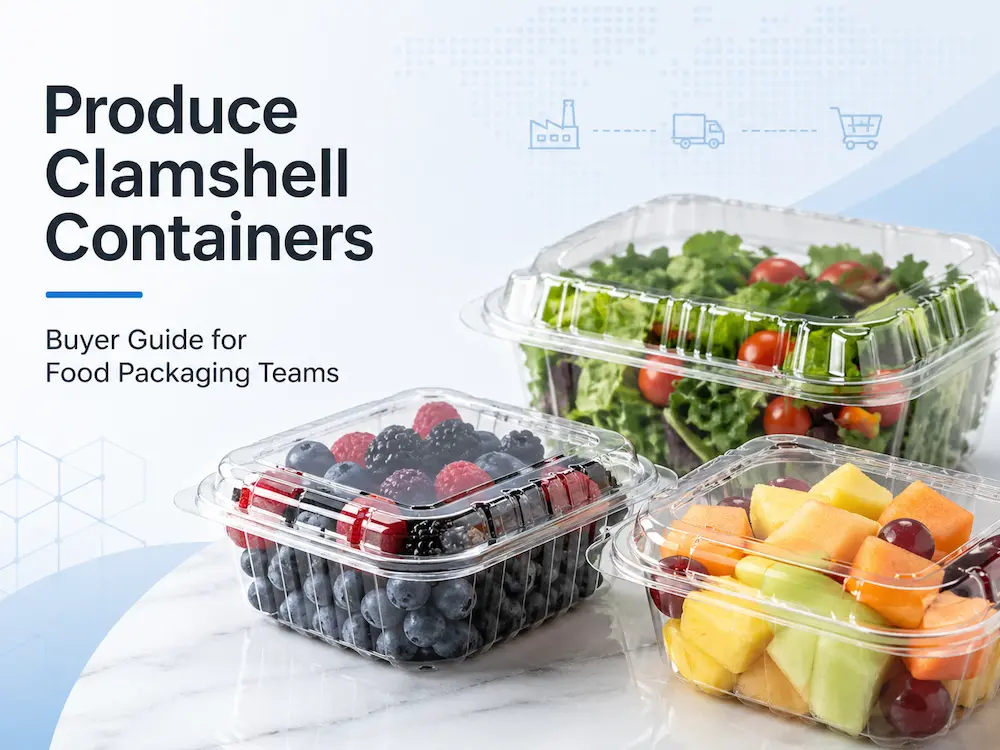
A professional blog cover image featuring clear PET produce clamshell containers filled with berries, fresh-cut fruit, and salad, designed for a buyer guide on fresh food packaging.
Fresh produce packaging has moved far beyond simple product covering. For modern food packaging teams, the container affects freshness perception, shelf display, cold-chain handling, stacking efficiency, barcode labeling, product protection, and final buyer confidence. A weak container creates pressure damage, poor shelf presentation, unstable cartons, and higher replacement costs. A well-matched container protects the product and makes the food easier to sell.
That is why produce clamshell containers remain one of the most practical packaging formats for berries, fresh-cut fruit, salads, vegetables, and ready-to-eat chilled foods. Their clear hinged structure gives shoppers direct visibility while helping food brands maintain a clean, organized, retail-ready presentation.
For procurement managers, fruit processors, growers, importers, distributors, and private-label food brands, the right question is not simply “Which container is cheaper?” The stronger question is: which packaging structure matches the product, filling weight, retail channel, logistics route, sustainability target, and long-term supply plan?
YIHAO is a food packaging manufacturer and solution provider focused on PET and RPET packaging for fresh produce, fruit portions, salads, bakery items, deli foods, and chilled ready-to-eat applications. This buyer guide explains how food packaging teams should evaluate produce clamshell containers, compare material and structure choices, avoid common purchasing mistakes, and work with the right manufacturer, wholesale supplier, or custom packaging partner.
What Are Produce Clamshell Containers?
Produce clamshell containers are one-piece hinged packaging containers used to hold fresh produce and chilled fresh food items. The base and lid are connected by a hinge, allowing the lid to fold over the product and lock into place. This structure gives packaging teams a practical combination of visibility, protection, and packing efficiency.
Most produce clamshells are made from PET or RPET because these materials provide high clarity, lightweight rigidity, and stable retail presentation. For berries, fresh-cut fruit, small vegetables, salad portions, and fresh snack packs, a clear container allows consumers to inspect color, freshness, size, and product quality before purchase.
A typical produce clamshell may include:
| Packaging Feature | Purpose for Fresh Produce |
|---|---|
| Hinged lid | Keeps the base and lid connected for faster filling and closing |
| Clear PET or RPET body | Shows product freshness, color, and portion size |
| Snap-lock closure | Helps keep the lid secure during transport and display |
| Ventilation holes | Supports airflow for selected produce categories |
| Stackable rim design | Improves carton loading, warehouse handling, and shelf display |
| Flat label area | Supports barcode labels, brand stickers, nutrition labels, and traceability |
| Smooth edge structure | Improves handling safety and consumer experience |
For food packaging teams, these details matter because each produce category has a different packaging requirement. Blueberries need airflow and gentle protection. Strawberries need more internal height and strong visibility. Fresh-cut fruit needs clean presentation and secure closure. Salad portions need larger capacity and stackable structure. Cherry tomatoes and grapes need packaging that protects the product while keeping the contents visible.
Why Produce Clamshell Containers Are Important in Fresh Food Supply Chains
The value of produce clamshell containers comes from four practical functions: visibility, protection, efficiency, and presentation.
Fresh produce is visually driven. Shoppers often judge quality by color, freshness, ripeness, sorting, and cleanliness. Clear packaging allows buyers to inspect the food without touching it directly. This is especially important for berries, fresh-cut fruit, tomatoes, grapes, salads, and ready-to-eat chilled foods.
Clamshell packaging also protects the product from excessive handling. Loose produce or weak packaging increases the risk of bruising, contamination, compression, and shelf disorder. A rigid hinged container creates a more controlled environment around delicate products.
For packing teams, the one-piece hinged format improves operational efficiency. Workers do not need to match separate lids with bases. The container is easier to fill, close, label, and place into cartons. This matters for wholesale operations where speed, consistency, and carton efficiency directly affect cost.
For retailers, fresh produce packaging containers create a neat shelf display. They stack cleanly, hold labels well, and present the product in a more organized way. For wholesalers and distributors, they improve product protection during carton packing, pallet movement, and cold-chain logistics.
Common Applications for Produce Clamshell Containers
Berry Packaging Containers for Blueberries, Strawberries, Blackberries, and Raspberries
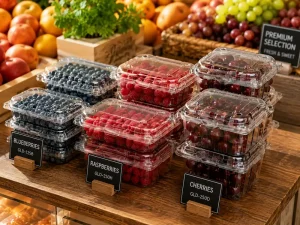
Berries are one of the most important application categories for produce clamshell containers. Blueberries, strawberries, blackberries, and raspberries are delicate, high-value, and highly dependent on visual appeal. Poor packaging causes bruising, condensation, leaking, unstable stacking, and weak shelf presentation.
Good berry packaging containers focus on ventilation, anti-crush protection, clarity, and stackability. Vent holes support airflow. A clear body allows shoppers to check berry quality. A stable rim structure helps the package resist compression. A secure closure reduces accidental opening during transport and retail handling.
| Berry Type | Packaging Priority | Buyer Focus |
|---|---|---|
| Blueberries | Ventilation and small-portion stability | Strong rim, clear body, secure closure |
| Strawberries | Internal height and visual display | Lid clearance, product visibility, stack strength |
| Blackberries | Gentle protection and airflow | Vent pattern, low-pressure stacking, clear lid |
| Raspberries | Delicate handling and condensation control | Careful fill height, ventilation, stable base |
For retail berry programs, packaging also supports brand communication. Labels can be applied to the lid or sidewall while the fruit remains visible. Since berry purchase decisions are strongly influenced by appearance, clear packaging builds buyer confidence at the shelf.
Fresh-Cut Fruit Containers for Ready-to-Eat Fruit Portions
Fresh-cut fruit is another strong use case for clamshell packaging. Melon cubes, pineapple chunks, mango slices, grapes, kiwi pieces, mixed fruit, and fresh snack portions need packaging that protects the product and presents it clearly.
Fresh-cut fruit containers should offer high clarity, secure closure, and stable chilled display performance. Fresh-cut fruit is often sold in refrigerated areas, where condensation, stacking, labeling, and product visibility all affect the buying decision.
For food processors, consistent container dimensions support packing-line efficiency. For retailers, transparent packaging supports impulse buying because bright fruit colors are visible immediately. For foodservice buyers, standard sizes and carton packing improve storage and distribution planning.
The container should match the product’s moisture profile and fill weight. A fruit portion with high liquid release requires stronger closure consideration than dry berries or cherry tomatoes. Packaging teams should test the container with real product before approving wholesale orders.
Produce Trays for Salads, Vegetables, and Mixed Fresh Foods
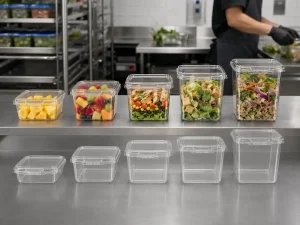
Clamshell packaging also works as produce trays for salads, leafy greens, cherry tomatoes, vegetable sticks, fresh snack packs, and chilled ready-to-eat meals. In these applications, capacity, lid height, stackability, and label space become especially important.
Salads and mixed fresh foods need enough internal room to prevent compression. A lid that presses too closely against leafy greens or toppings weakens the visual appeal. A stable base keeps the product level in display cases, delivery bags, or cold storage.
Clear produce trays are useful for mixed foods because they show ingredient variety. A salad with greens, cherry tomatoes, corn, cheese, fruit, or protein toppings looks more valuable when the package presents color and portion size clearly.
Material Choices: PET, RPET, and Clear Produce Packaging
Why Clear PET Produce Packaging Remains Popular
Clear PET produce packaging remains widely used because PET provides a strong combination of clarity, stiffness, and lightweight performance. In fresh food packaging, visibility is not a decoration. It is part of the selling process. Shoppers want to see what they are buying, especially when the product is fresh, colorful, and quality-sensitive.
PET also provides the rigidity needed for hinged clamshell structures. A container must hold its shape during filling, closing, carton loading, refrigeration, and shelf display. This is especially important in wholesale and export packaging, where products move through several handling points before reaching the final buyer.
For packaging teams, PET is also practical because it works across many applications. The same material direction can serve berries, fresh-cut fruit, salads, vegetables, deli portions, bakery items, and chilled ready-to-eat foods. This helps brands build a more consistent packaging system.
RPET Options for Sustainability Goals
RPET, or recycled PET, is increasingly considered by food brands and retailers that want to reduce reliance on virgin plastic and support recycled-content packaging goals. For produce clamshell containers, RPET can provide a familiar clear packaging appearance while supporting sustainability positioning.
Buyers should evaluate RPET with documentation, not assumptions. Important checks include food-contact suitability, material clarity, production consistency, thickness, sample quality, and supplier traceability. A strong supplier should explain what material options are available and what documentation can be provided for the target market.
Sustainability should never be separated from packaging performance. A package that looks environmentally attractive but fails in stacking, closure, or product protection creates food loss and operational problems. For fresh produce, the stronger strategy is to balance material responsibility with real product protection.
PET Clamshells vs. Pulp, Paper, and Compostable Alternatives
Different materials serve different packaging goals. PET and RPET clamshells are strong where visibility, moisture resistance, cold display, and retail presentation are critical. Pulp, paperboard, and compostable alternatives may fit selected product lines, but they often perform differently in moisture, transparency, and stacking conditions.
| Material Type | Product Visibility | Moisture Resistance | Structural Stability | Retail Display Value | Common Produce Use |
|---|---|---|---|---|---|
| PET | High | High | High | High | Berries, fresh-cut fruit, salads, tomatoes |
| RPET | High | High | High | High | Retail produce, chilled fresh foods, branded packs |
| Pulp fiber | Low | Medium | Medium | Natural appearance | Mushrooms, eggs, selected dry produce |
| Paperboard | Low to medium | Medium | Medium | Printable branding | Dry produce and premium-style packs |
| Compostable plastics | Medium to high | Varies | Varies | Depends on material | Selected fresh food projects |
For produce that relies on visible freshness, clear PET produce packaging often remains the most practical choice. For brands that want a natural or fiber-based appearance, alternative materials should be tested under real product, refrigeration, and logistics conditions before approval.
Science-Based Packaging Factors Buyers Should Consider
Fresh produce is sensitive to moisture, temperature, airflow, pressure, and handling. A good package does not solve every shelf-life issue alone, but it supports the product through the supply chain.
| Packaging Factor | Why It Matters | Buyer Action |
|---|---|---|
| Airflow | Some fruits and vegetables need ventilation to reduce condensation buildup | Match vent-hole design with produce type |
| Moisture behavior | Fresh-cut fruit and berries respond differently to moisture inside the pack | Test with real product, not empty containers only |
| Mechanical protection | Delicate produce is easily bruised or compressed | Review wall strength, rim structure, and stack performance |
| Cold-chain display | Refrigerated shelves expose containers to temperature and humidity changes | Check clarity, closure, and condensation behavior |
| Food-contact compliance | Packaging must match the target market’s food-contact requirements | Request documentation from the supplier |
| Labeling and traceability | Retail and wholesale buyers often require barcodes and labels | Confirm flat label areas and surface compatibility |
This is where experienced manufacturers add real value. A packaging supplier should understand how container design affects product performance, not only how to produce a low-cost plastic box.
Key Design Features Buyers Should Evaluate
Lid Closure and Secure Handling
A clamshell container must close consistently. Weak closure creates problems during filling, carton packing, transportation, and shelf display. If the lid opens too easily, product spills and exposure become more likely. If the closure is too tight, packing workers and consumers struggle to use the package.
Packaging teams should test opening and closing performance with real product weight. Empty samples are useful, but they do not fully show how the package behaves after filling, stacking, chilling, and transport.
For premium retail products, tamper-resistant or tamper-evident structures may also be useful when available. These features help communicate product security, but they should be evaluated carefully because they may affect mold cost, packing speed, consumer opening experience, and overall price.
Ventilation Design for Fresh Produce
Ventilation is one of the most important design features for many fresh produce packaging containers. Berries, leafy greens, grapes, cherry tomatoes, and selected vegetables often benefit from airflow. Vent holes help reduce condensation and support better air movement during cold-chain handling.
However, more ventilation is not automatically better. The right vent design depends on produce type, moisture level, storage temperature, carton structure, distribution time, and retail shelf conditions. A berry clamshell and a fresh-cut fruit clamshell may need different ventilation logic.
Buyers should discuss vent-hole size, placement, and quantity with the manufacturer. For custom packaging projects, ventilation should be designed around the food category rather than copied from a generic container.
Stackability and Structural Strength
Stackability affects warehouse efficiency, carton packing, retail display, and product protection. A good clamshell should nest well when empty and remain stable when filled. The rim, sidewall, base, and lid shape all affect stacking performance.
For wholesale buyers, stackability also influences total landed cost. Better nesting saves storage space before filling. Better filled-container stacking improves carton stability and retail shelf organization.
Structural strength should be tested under realistic conditions. This includes filled weight, carton count, refrigeration, transport movement, and shelf stacking. For delicate produce, the container must protect the product without adding unnecessary material weight.
Size, Capacity, and Portion Logic
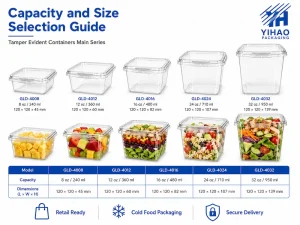
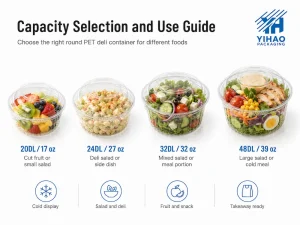
The right size depends on product type and selling format. Small clamshells suit blueberries and snack portions. Medium clamshells suit grapes, cherry tomatoes, and fresh-cut fruit. Larger containers suit salads, mixed fruit, family-size produce, and ready-to-eat fresh food.
Buyers should evaluate more than volume. Product shape, fill height, headspace, label placement, display case size, carton packing, and consumer perception all matter. A container that is too shallow compresses the product. A container that is too large makes the portion look underfilled.
For branded fresh foods, portion logic affects perceived value. A well-filled container looks generous and clean. An oversized package weakens the product’s visual impact.
How to Choose Produce Clamshell Containers for Different Food Categories
For Berries
For berries, prioritize ventilation, anti-crush protection, and clear visibility. Berry packaging containers should protect small fruit from compression while allowing consumers to inspect quality easily.
The container should have a stable rim, clear body, controlled vent design, and secure closure. The lid should not press directly on delicate fruit. The base should remain stable during display and transport.
For berry wholesalers and growers, carton packing also matters. A clamshell that looks good individually but stacks poorly in cartons creates problems in distribution. Test the full packing system before approving large orders.
For Fresh-Cut Fruit
For fresh-cut fruit, focus on clarity, closure, chilled display, and moisture behavior. Cut melon, pineapple, mango, grapes, and mixed fruit portions need packaging that presents freshness while keeping the product contained.
Fresh-cut fruit containers should be tested with real product because moisture release affects closure, clarity, and shelf appearance. The package should look clean under refrigeration and should not collapse under normal stacking conditions.
Retail-ready fruit depends heavily on visual appeal. A bright, transparent package makes the product easier to sell. For foodservice supply, standardized sizing, carton efficiency, and stable wholesale availability become more important.
For Salads and Ready-to-Eat Fresh Foods
Salads and ready-to-eat fresh foods require larger capacity, stable stacking, and smooth lid operation. These products may include leafy greens, toppings, grains, fresh vegetables, fruit, or chilled deli-style ingredients.
For this category, produce trays and clamshells should provide enough internal space to protect the product’s shape. The lid should close securely without flattening the food. The base should remain stable in cold displays, takeaway shelves, and delivery environments.
Clear packaging is valuable because color variety sells freshness. Consumers can see ingredient quality, portion size, and product arrangement before purchase.
For Wholesale Produce and Foodservice Supply
Wholesale produce packaging has a different priority from small retail trial runs. Importers, distributors, and foodservice suppliers need stable production, carton efficiency, cost control, and repeatable quality.
When buying produce clamshell containers wholesale, packaging teams should review carton quantity, pallet loading, sample consistency, lead time, material documentation, export packaging, and supplier communication speed.
A reliable wholesale supplier should help buyers evaluate the entire packaging system, not just the container shape. For long-term supply, production consistency is as important as the first sample.
Wholesale Buying Guide for Produce Clamshell Containers
Questions Food Packaging Teams Should Ask Before Ordering
Before selecting a supplier, buyers should define the real application. This prevents wrong-size packaging, weak closure, poor ventilation, or unsuitable material choices.
| Question | Why It Matters |
|---|---|
| What produce will be packed? | Different foods need different depth, closure, and ventilation |
| Is the product whole, cut, washed, or ready-to-eat? | Fresh-cut and ready-to-eat foods need more careful packaging control |
| What is the target fill weight? | Container strength must match product weight |
| Does the product need ventilation? | Airflow requirements vary by category |
| Will the product be sold in retail or foodservice? | Retail needs stronger visual display; foodservice may focus on efficiency |
| Does the buyer need PET or RPET? | Material choice affects cost, documentation, and sustainability positioning |
| Is custom tooling required? | Custom molds affect development time and budget |
| What is the carton packing requirement? | Carton efficiency affects wholesale logistics cost |
| What market will the packaging enter? | Food-contact and labeling expectations vary by region |
These questions help buyers compare suppliers more clearly. A cheap container that fails in stacking, closure, or shelf display creates higher hidden cost later.
Manufacturer vs. Trading Supplier: What Is the Difference?
When sourcing produce clamshell containers, buyers often compare manufacturers and trading suppliers. Both can serve a purpose, but they are not the same.
A manufacturer controls production, tooling, material selection, quality checks, and packaging development. This is valuable for buyers who need stable wholesale supply, custom sizes, consistent quality, and long-term cooperation.
A trading supplier may help source existing products quickly, but the buyer usually has less control over mold development, production priority, quality consistency, and technical communication. For spot purchases, this may be acceptable. For repeat orders, private-label projects, and custom fresh produce packaging containers, a manufacturer is usually the stronger partner.
For food packaging teams, the best supplier is not only a seller. The better partner understands product application, material behavior, export packing, sample testing, and project communication.
Custom Packaging Options for Produce Brands
Custom packaging helps produce brands improve product fit and shelf differentiation. A standard clamshell may work for common applications, but custom options become valuable when the product has specific weight, shape, label, ventilation, or branding requirements.
| Custom Option | Buyer Value |
|---|---|
| Custom size | Better fit for berries, fruit portions, salads, or vegetables |
| Custom depth | Supports different fill weights and product shapes |
| Vent-hole design | Matches airflow needs of specific produce |
| Label area | Improves barcode, branding, and nutrition label placement |
| Embossed logo | Strengthens brand recognition when suitable |
| Carton packing design | Improves wholesale storage and shipping efficiency |
| PET or RPET option | Supports performance and sustainability direction |
Custom development should begin with product samples or clear specifications. The manufacturer needs to understand fill weight, food dimensions, storage environment, shelf requirements, carton packing, and target market before recommending a mold or structure.
Common Buying Mistakes to Avoid
Many packaging problems begin before the order is placed. Food packaging teams can avoid delays and losses by identifying common mistakes early.
| Mistake | Why It Creates Problems | Better Decision |
|---|---|---|
| Choosing only by unit price | Low price may mean weak closure, thin structure, or poor stacking | Compare total packaging performance |
| Testing empty samples only | Empty containers do not show filled performance | Test with real produce and real fill weight |
| Ignoring ventilation | Wrong airflow increases condensation or product stress | Match vent design with produce type |
| Overlooking carton packing | Poor carton fit increases logistics cost | Review carton quantity and pallet loading |
| Using one size for all products | Different produce categories need different structures | Select packaging by product category |
| Making unsupported sustainability claims | Claims without documentation create compliance and trust risks | Request supplier documentation |
| Choosing a supplier without production control | Quality may vary between batches | Work with a capable manufacturer for repeat orders |
This section is especially important for wholesale buyers. Packaging that looks acceptable in photos may fail during actual filling, stacking, cold storage, or distribution. A professional manufacturer helps buyers identify these risks before mass production.
RFQ Checklist for Produce Clamshell Containers
A clear RFQ helps the manufacturer recommend the right solution faster. Before requesting a quotation, buyers should prepare the following information:
| RFQ Information | Recommended Details |
|---|---|
| Product type | Blueberries, strawberries, grapes, tomatoes, fresh-cut fruit, salad, vegetables |
| Fill weight | Target grams or ounces per pack |
| Container size | Existing size or required length, width, height |
| Material preference | PET, RPET, or other direction |
| Ventilation requirement | With vent holes, without vent holes, or custom vent pattern |
| Closure requirement | Standard snap-lock, stronger closure, or tamper-resistant structure |
| Label requirement | Lid label, side label, barcode area, brand sticker area |
| Order quantity | Trial order, wholesale order, annual forecast |
| Target market | Country or region of sale |
| Packing requirement | Units per carton, carton size, pallet loading preference |
| Custom need | Existing mold, modified mold, or new mold development |
For serious buyers, this checklist reduces back-and-forth communication and improves quotation accuracy. It also shows the supplier that the buyer understands the project clearly.
Quality Checklist Before Choosing a Produce Clamshell Container Supplier
A strong supplier should provide more than a price list. Food packaging teams should evaluate quality through samples, documentation, communication, and production consistency.
| Quality Point | What to Check |
|---|---|
| Material clarity | The container should show produce clearly without obvious haze |
| Lid closure | The lid should close smoothly and stay secure |
| Stack strength | Filled containers should stack without unstable tilting |
| Ventilation design | Vent holes should match the produce category |
| Edge smoothness | Edges should be clean and suitable for handling |
| Base stability | The container should sit flat in display or storage |
| Label compatibility | The lid or sidewall should support barcode and brand labels |
| Carton packing | Units should pack efficiently for wholesale distribution |
| Sample consistency | Multiple samples should match in thickness, shape, and closure |
| Export support | The supplier should understand cartons, pallets, and shipping requirements |
| OEM capability | Custom size, structure, or brand support should be available when needed |
For serious wholesale programs, buyers should test packaging with actual product. Empty-container checks are useful, but real performance appears after filling, closing, stacking, chilling, and transport.
Cost Factors That Affect Produce Clamshell Container Pricing
Material Thickness and Container Weight
Material thickness affects rigidity, clarity, stacking strength, and cost. A thicker container usually provides stronger structure, but it also increases material use and unit price. A thinner container may reduce cost, but it creates problems if the product is heavy, delicate, or shipped through a demanding supply chain.
The best choice is not always the thickest or the cheapest. The right container uses enough material to protect the produce, support retail presentation, and survive normal distribution without unnecessary waste.
For produce clamshell containers, buyers should compare container weight, thickness, closure strength, and stacking performance together. Looking only at unit price creates a weak sourcing decision.
Size, Mold, and Custom Design
Standard molds are usually more cost-efficient because tooling already exists. Custom molds require development time and investment, but they create better product fit, stronger shelf differentiation, and long-term brand value when the order volume supports the project.
Custom design becomes more practical when the buyer has stable demand or a product that does not fit standard packaging well. For example, a premium berry brand may need a specific depth, vent pattern, or label area. A fresh-cut fruit processor may need a container that fits a target fill weight and display case layout.
Buyers should discuss tooling cost, sampling time, mold ownership terms, order quantity, and production lead time before starting custom development.
Order Quantity and Wholesale Pricing
Wholesale pricing usually improves with larger order quantities because production, packing, and logistics become more efficient. However, buyers should also consider storage space, demand forecast, product turnover, and cash flow.
For importers and distributors, total landed cost matters more than factory unit price alone. Carton size, container nesting, pallet loading, freight efficiency, and damage rate all affect the real cost of packaging.
A reliable produce clamshell containers supplier should help buyers evaluate these details instead of quoting only the lowest unit price.
Sustainability and Market Trends in Fresh Produce Packaging
Sustainability in fresh produce packaging is not only about replacing one material with another. It also includes material efficiency, recyclability, recycled content, lightweight design, supply-chain performance, and food waste reduction.
For many fresh produce categories, clear packaging continues to play an important role because shoppers want to evaluate food quality before purchase. Better visibility supports buyer confidence and reduces unnecessary product handling. At the same time, brands and retailers are paying closer attention to recycled materials, packaging weight, and end-of-life options.
RPET is one direction for brands that want to combine clear presentation with recycled material use. Lightweight design is another important direction, especially when packaging still needs enough structure for stacking and protection.
Food packaging teams should avoid one-dimensional decisions. A package that uses less material but fails to protect the product may lead to more food loss. A package that looks sustainable but does not meet retail or cold-chain needs may fail in real distribution. The strongest packaging strategy balances product protection, material responsibility, cost, and consumer experience.
Why Work with a Produce Clamshell Containers Manufacturer?
Working with a manufacturer gives food packaging teams more control over structure, quality, and long-term supply. This is especially important for buyers who need repeated wholesale orders, private-label packaging, export cartons, or customized designs.
A qualified manufacturer can support:
- PET and RPET material selection
- Existing mold recommendations
- Custom size development
- Ventilation design discussion
- Sample testing with real produce
- Carton packing planning
- Production consistency
- OEM and private-label support
- Long-term wholesale supply
- Export packing communication
YIHAO works as a food packaging manufacturer and solution provider for fresh produce, fruit, salads, bakery, chilled foods, and ready-to-eat applications. For buyers sourcing produce clamshell containers, the goal is to match packaging structure with real product use, not simply choose a generic container.
This is where a manufacturer adds practical value. A good manufacturer understands how container clarity, lid closure, stacking rim, base depth, material thickness, ventilation design, and carton packing affect the final packaging result.
Final Buyer Checklist: How to Select the Right Produce Clamshell Containers
Before placing an order, food packaging teams should use a structured selection process. The following table summarizes the most important decision points:
| Buyer Need | Recommended Packaging Focus |
|---|---|
| Berry packaging | Ventilation, anti-crush structure, small clear clamshells |
| Fresh-cut fruit | Clear lid, secure closure, chilled display performance |
| Salad packaging | Larger capacity, stackability, hinged lid convenience |
| Vegetable packaging | Product fit, airflow, label area, retail presentation |
| Wholesale supply | Stable production, carton packing, consistent quality |
| Custom packaging | Mold options, vent design, label area, OEM support |
| Sustainability goals | RPET option, lightweight structure, recyclable material direction |
| Retail presentation | High clarity, clean lid, strong shelf visibility |
| Export orders | Carton strength, pallet loading, supplier communication |
| Cost control | Proper thickness, efficient nesting, total landed cost |
The best produce clamshell containers are not selected by price alone. They are selected by application fit. A container for blueberries should not be evaluated the same way as a container for fresh-cut melon or salad. The packaging must match the food category, supply chain, shelf display, and buyer expectation.
For food packaging teams, the right supplier should provide practical guidance, consistent quality, and stable wholesale support. For brands, the right packaging should make the product look fresh, clean, protected, and ready to buy.
Conclusion
Produce clamshell containers are one of the most effective packaging formats for fresh produce, berries, fresh-cut fruit, salads, vegetables, and chilled ready-to-eat foods. Their clear hinged structure supports product visibility, retail display, secure handling, stacking, labeling, and efficient packing.
For packaging teams, the key is to evaluate the full packaging system: material, closure, ventilation, size, stacking strength, carton packing, customization, sustainability goals, and supplier capability. A low-cost container that does not protect the product or present it well is not truly economical.
Whether the goal is retail berry packaging, fresh-cut fruit display, salad packaging, wholesale supply, or custom produce trays, the right manufacturer helps align packaging design with real market needs.
For buyers looking for fresh produce packaging containers, berry packaging containers, fresh-cut fruit containers, produce trays, or clear PET produce packaging, working with an experienced manufacturer and supplier creates a stronger foundation for long-term packaging performance.
FAQ
1. What are produce clamshell containers used for?
Produce clamshell containers are used for packaging fresh produce such as berries, grapes, cherry tomatoes, vegetables, salads, fresh-cut fruit, and ready-to-eat chilled foods. Their hinged clear structure helps protect the product while keeping freshness and color visible to buyers.
2. Are PET clamshell containers suitable for fresh produce packaging?
Yes. PET clamshell containers are widely used for fresh produce packaging because they offer high clarity, lightweight rigidity, secure closure, and strong retail display value. They are especially suitable for berries, fresh-cut fruit, salads, vegetables, and chilled produce portions.
3. What is the difference between produce trays and clamshell containers?
Produce trays may be open, lidded, or wrapped, while clamshell containers have an integrated hinged lid and base. Clamshells provide a more secure one-piece packaging format, making them useful for retail-ready fresh produce, berries, salads, and fresh-cut fruit.
4. How do I choose the right berry packaging containers?
To choose the right berry packaging containers, compare ventilation, container depth, stacking strength, lid closure, material clarity, and carton packing efficiency. Blueberries, strawberries, blackberries, and raspberries each need packaging that protects delicate fruit while keeping it visible.
5. Can produce clamshell containers be customized for wholesale buyers?
Yes. Produce clamshell containers can be customized for wholesale buyers through size adjustment, mold development, vent-hole design, label area planning, embossing options, carton packing, and PET or RPET material selection, depending on project requirements.
6. How should buyers request a quotation for produce clamshell containers?
Buyers should share the produce type, target fill weight, container size, material preference, ventilation requirement, order quantity, target market, carton packing needs, and whether custom mold development is required. A clear RFQ helps the manufacturer recommend the right packaging solution faster.
References
- U.S. Food and Drug Administration — Food Contact Substances and Food Packaging Guidance
- U.S. Department of Agriculture — Fresh Produce Handling and Distribution Resources
- European Food Safety Authority — Food Contact Materials Overview
- European Commission — Packaging and Packaging Waste Policy
- Association of Plastic Recyclers — PET Packaging Design Guidance
- International Fresh Produce Association — Fresh Produce Supply Chain and Packaging Insights
- WRAP — Food Waste Reduction and Packaging Research
- ScienceDirect — Packaging Technology Research on Fresh Produce Shelf Life and Modified Atmosphere Packaging
Deep-Dive Insights: How Buyers Should Think About Produce Clamshell Containers
How produce clamshell containers support retail-ready fresh food packaging
Produce clamshell containers help fresh food brands move from basic protection to retail-ready presentation. Their clear hinged structure keeps the product visible, organized, and easier to handle across packing lines, cold storage, cartons, and retail shelves.
Why clear PET produce packaging remains valuable for visual merchandising
Clear PET produce packaging gives shoppers direct visual access to freshness, color, portion size, and product condition. For berries, fresh-cut fruit, salads, and vegetables, visibility often supports purchase confidence more effectively than opaque packaging.
What buyers should compare before choosing a wholesale supplier
Food packaging teams should compare material clarity, closure performance, ventilation design, stacking strength, carton packing, sample consistency, custom capability, and export support. A reliable produce clamshell containers supplier should help buyers solve application problems, not only quote unit prices.
Option: PET, RPET, or alternative materials for produce packaging
PET and RPET are strong options when product visibility, moisture resistance, and retail display matter. Fiber-based or compostable alternatives may fit selected projects, but buyers should evaluate them against real product moisture, shelf-life, visibility, and supply-chain requirements.
Consideration: balancing visibility, protection, sustainability, and cost
The best packaging decision balances product protection, material efficiency, consumer presentation, sustainability direction, and total landed cost. For fresh produce, packaging that prevents damage and keeps food attractive through the supply chain often creates more value than the lowest-price option.
Buyer action: prepare a clear RFQ before requesting samples
Before asking for samples or prices, buyers should prepare produce type, fill weight, target size, material preference, ventilation needs, order quantity, target market, and carton packing requirements. A clear RFQ helps the manufacturer recommend a more accurate and practical packaging solution.
© 2026 YIHAO packaging. All rights reserved. This article, “Produce Clamshell Containers Buyer Guide for Fresh Food Packaging Teams,” is originally created by the YIHAO Packaging Editorial Team. Unauthorized copying, redistribution, or commercial use of this content is not permitted without written permission.