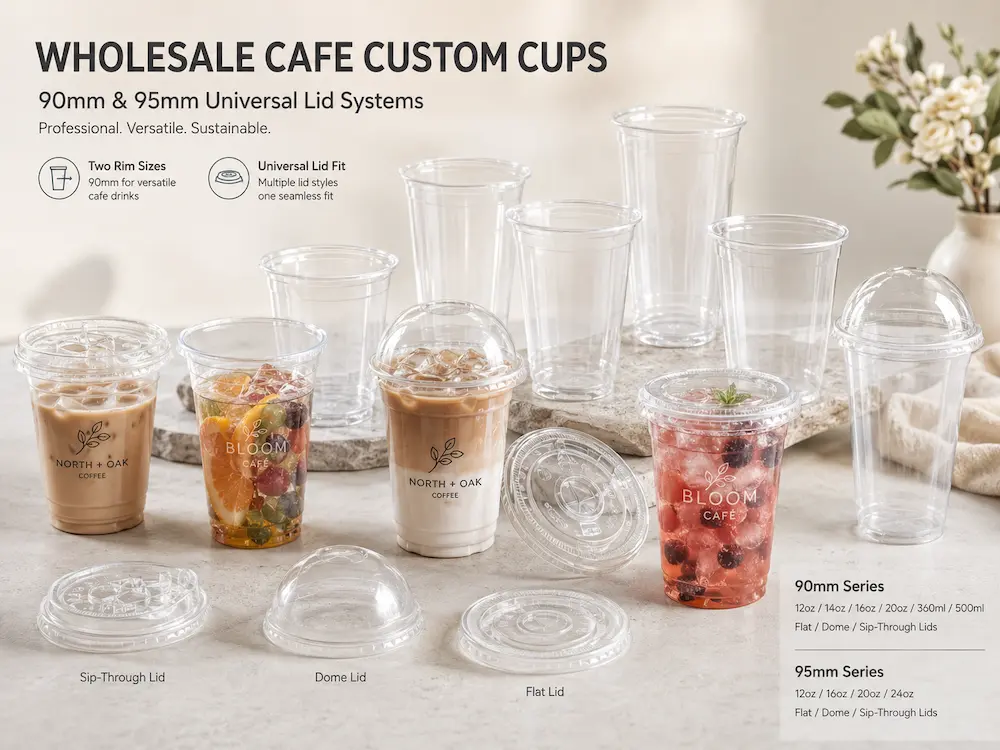
Why Cafe Custom Cups Matter for Beverage Branding
Wholesale cafe custom cups are essential for coffee shops, juice bars, milk tea stores, bakeries, dessert brands, and takeaway drink businesses that need reliable packaging for cold drinks, branded beverages, and daily foodservice operations. As a food packaging manufacturer and supplier, YIHAO provides PET and RPET cup solutions with clear material visibility, stable lid matching, printing support, and wholesale supply options for growing cafe and beverage brands.
This guide helps buyers compare cup materials, sizes, printing choices, lid compatibility, packaging applications, and supplier selection points before placing a wholesale or OEM order.
Cafe custom cups are no longer simple disposable drink containers. For coffee shops, bubble tea brands, juice bars, smoothie counters, dessert drink brands, event caterers, beverage chains, and foodservice distributors, the cup has become part of the product experience. It holds the drink, displays the beverage, carries the brand, supports takeaway service, and influences how customers remember the business after leaving the counter.
Cold beverage menus are now more visual than ever. Iced coffee, cold brew, matcha, refreshers, fruit tea, lemonade, sparkling fruit drinks, milk tea, smoothies, protein drinks, and layered dessert beverages all depend on clear presentation. When a drink has color, fruit pieces, foam, toppings, cream, syrup layers, or a clean chilled appearance, the packaging should support visibility instead of hiding the product. This is why many cafes and beverage brands prefer clear custom PET cups and custom printed cold cups for takeaway and retail display.
For B2B buyers, the real sourcing question is not only “Can I print my logo on a cup?” A better question is: “Can this cup-and-lid system support my drink menu, brand identity, store operation, wholesale order plan, and repeat purchasing needs?” This guide answers that question with a practical manufacturer and supplier checklist for buyers evaluating cafe custom cups at wholesale scale.
YIHAO is a food packaging manufacturer and solution provider supporting clear PET cold cups, matching cup lids, custom printed cold cups, and wholesale packaging programs for beverage brands, cafes, foodservice companies, distributors, and packaging buyers. The goal is not only to supply cups, but to help buyers build a practical packaging system that works from counter service to customer handoff.
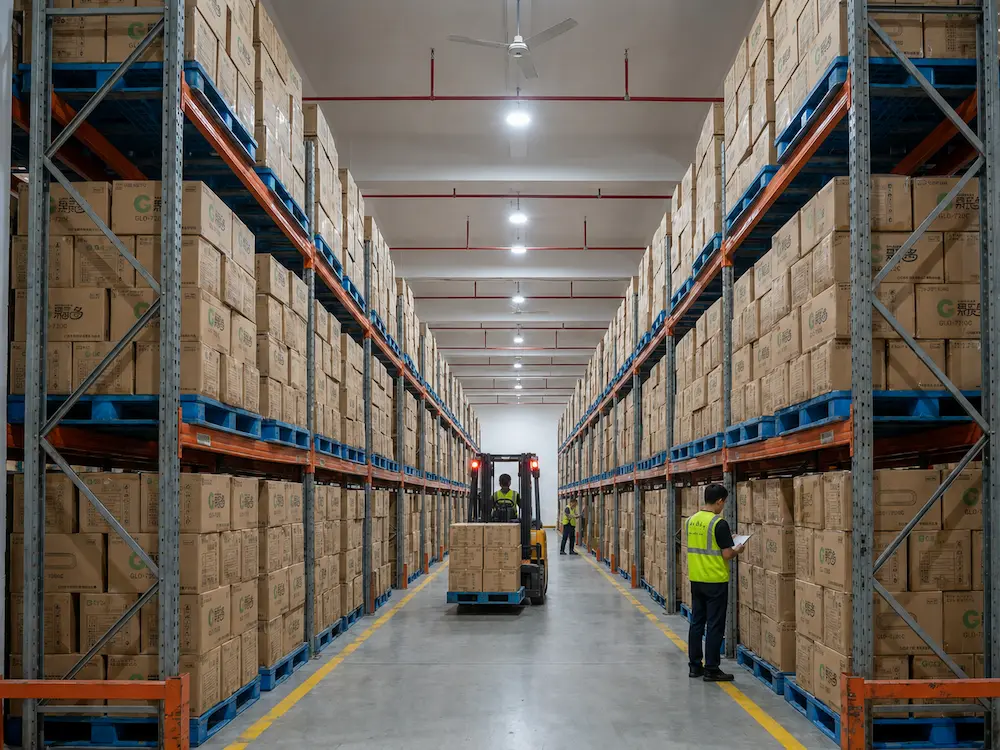
What Are Cafe Custom Cups?
Cafe custom cups are drink cups customized for beverage service, brand presentation, and takeaway packaging. They may include printed logos, brand colors, QR codes, seasonal graphics, promotional artwork, private-label decoration, embossed brand marks, or simple one-color logo printing. In wholesale purchasing, the term often covers custom PET cups, printed plastic cups, clear cold cups, branded cold cups, and compatible lids used for iced beverages and chilled drinks.
Common materials used for custom cold beverage cups
Cold beverage cups may be made from PET, PP, paper-based structures, or other packaging materials depending on the drink format and buyer requirements. PET is widely used for clear cold beverage cups because it provides strong transparency, clean product visibility, practical rigidity, and a polished retail appearance. For drinks where color and texture matter, PET helps the beverage become part of the visual selling point.
For cafes and beverage brands, custom PET cups are especially useful when the drink itself needs to be seen. Iced coffee, matcha latte, fruit tea, boba drinks, lemonade, smoothies, yogurt drinks, cold brew, refreshers, and colorful juice blends all benefit from a clear cup body. A transparent cup helps customers see the beverage before they taste it.
Where custom PET cups are commonly used
Custom PET cups are commonly used in coffee shops, milk tea stores, juice bars, smoothie shops, dessert counters, bakery beverage sections, convenience stores, supermarkets, stadiums, festivals, catering service, food trucks, and grab-and-go retail programs. They are suitable for iced coffee, cold brew, iced tea, fruit tea, lemonade, juice, smoothies, milk tea, bubble tea, soda, sparkling fruit drinks, yogurt drinks, matcha beverages, refreshers, acai or berry drinks, protein drinks, and other cold beverages.
They can also be used for selected chilled foods such as fruit cups, yogurt parfaits, pudding cups, jelly desserts, granola cups, nuts, and cold snack portions. This gives buyers more flexibility when one cup system needs to support both beverages and chilled food display.
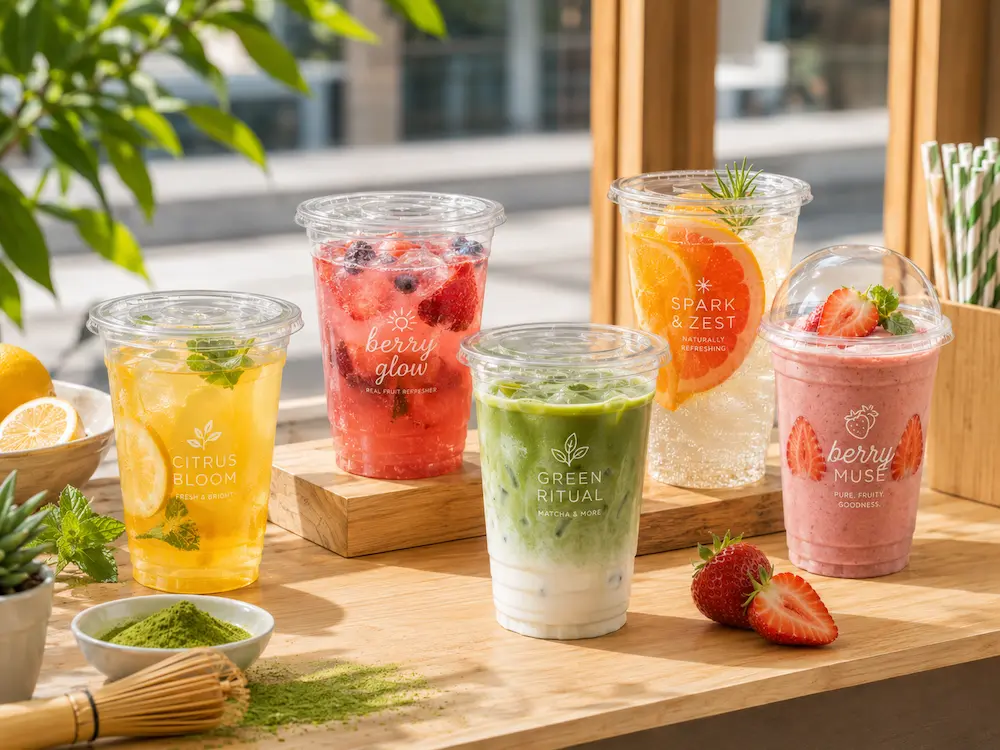
What buyers should confirm before customization
Before ordering cafe custom cups, buyers should confirm the cup size, rim diameter, compatible lids, print area, artwork format, carton packing, cold-use application, storage environment, and whether the cup needs to match a flat lid, dome lid, straw-slot lid, or strawless sipper lid. A good custom cup is not only attractive. It must work during filling, sealing, stacking, storage, takeaway handoff, delivery, and customer use.
Manufacturer vs Supplier: Which Partner Should You Choose?
Many buyers search for a cafe custom cups supplier, while others search for a cafe custom cups manufacturer. These terms are sometimes used together, but they do not always mean the same thing. Understanding the difference helps buyers make a better sourcing decision.
What a cafe custom cups manufacturer provides
A manufacturer usually has stronger control over product structure, material selection, mold consistency, rim shape, production scheduling, quality inspection, sample adjustment, carton packing, and repeat order stability. When cups are custom printed, manufacturer support becomes even more important because the buyer needs stable cup quality, print alignment, color control, lid compatibility, and clear production communication.
For chain cafes, beverage franchises, foodservice distributors, private-label drink brands, and wholesale importers, direct manufacturer support reduces risk. If the buyer plans to order the same branded cold cups repeatedly, consistency becomes more valuable than one-time low pricing.
What a supplier or trading partner provides
A supplier may provide broader sourcing flexibility, mixed product access, smaller order coordination, and logistics support. This can be useful when a buyer needs several packaging categories from different factories. However, when the project requires stable printed plastic cups, exact lid matching, brand color consistency, repeat artwork control, and long-term wholesale planning, the buyer should confirm whether the supplier has direct manufacturing support or a reliable production base.
When wholesale buyers should work directly with a manufacturer
Wholesale buyers should work directly with a manufacturer when the project involves logo printing, private-label packaging, repeated bulk orders, multiple cup sizes, strict lid compatibility, brand color control, export packing, or long-term distribution. A manufacturer-focused partner can better support sample revisions, print file management, lid matching, production notes, and order consistency.
This is especially important for beverage brand cups. A cup is part of the brand system. If the logo position changes, if the lid fit is inconsistent, if the cup clarity varies, or if carton packing is unstable, the final customer experience becomes weaker.
Custom PET Cups: Key Material and Design Checks
When comparing custom PET cups, buyers should evaluate the cup as a complete packaging system. Material clarity, rim structure, wall feel, stacking performance, lid fit, print suitability, and carton packing all affect the final result.
Clarity and drink visibility
Clear PET cups support strong drink visibility. This is valuable for iced coffee, matcha, fruit tea, refreshers, sparkling drinks, smoothies, yogurt beverages, juice blends, and layered dessert drinks. A clear cup helps customers see color, texture, toppings, fruit content, and freshness. For retail counters and grab-and-go refrigerators, clear packaging also helps create a cleaner display.
For branded beverages, visibility and logo placement must work together. The cup should leave enough transparent area to show the drink while giving the logo a visible position. Over-printing can block the beverage. Under-printing can weaken brand recognition. The best custom cup design balances product visibility and brand identity.
Rim diameter and lid matching
Rim diameter is one of the most important technical checks for cold cup sourcing. A cup may have the right capacity, but it still fails if the matching lid does not fit securely. For PET cold cup systems, buyers often compare diameter families such as 95mm and 98mm according to beverage type, capacity range, lid style, and store inventory logic.
A 95mm PET cold cup series is commonly used for smaller and regular cold drink portions, such as iced coffee, juice, smoothies, milk tea, soda, lemonade, fruit tea, and other takeaway beverages. A 98mm PET cold cup series can support a wider multi-capacity program for iced coffee, cold brew, juice, smoothies, lemonade, iced tea, soda, yogurt drinks, and larger cold beverage formats. Buyers should request actual samples and confirm cup-lid matching before mass production.
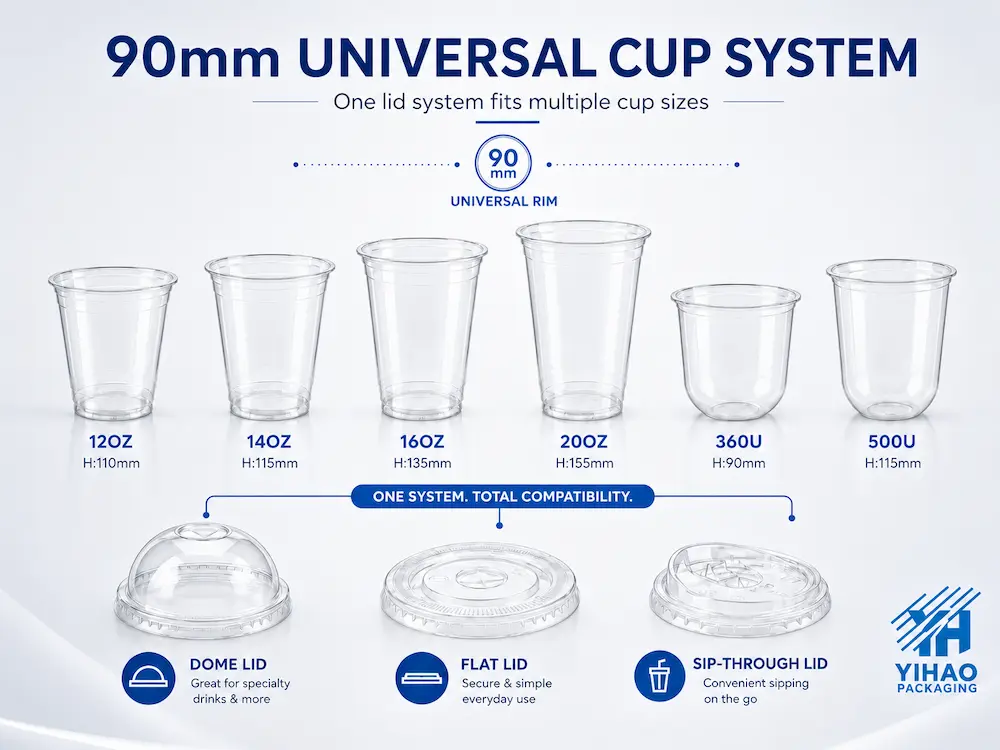
Cup strength and hand feel
A good cold cup should feel light but not weak. It should stack well before use, separate smoothly during service, and hold its shape during filling and handoff. Buyers should check wall consistency, rim smoothness, bottom stability, and how the cup feels when filled with ice and liquid.
For wholesale buyers, stacking performance is also an inventory issue. Cups that stack cleanly are easier to store, count, pack, and distribute. This matters for cafes, chain stores, foodservice distributors, beverage brands, and wholesale warehouses managing multiple cup sizes.
Rolled rim comfort and takeaway performance
A smooth rolled rim improves drinking comfort and helps compatible lids fit more securely. For cold beverage service, this detail matters because customers often drink directly from the cup or handle the cup during takeaway, delivery, and retail purchase. A smooth rim also improves the finished appearance of the cup, making the product feel more refined.
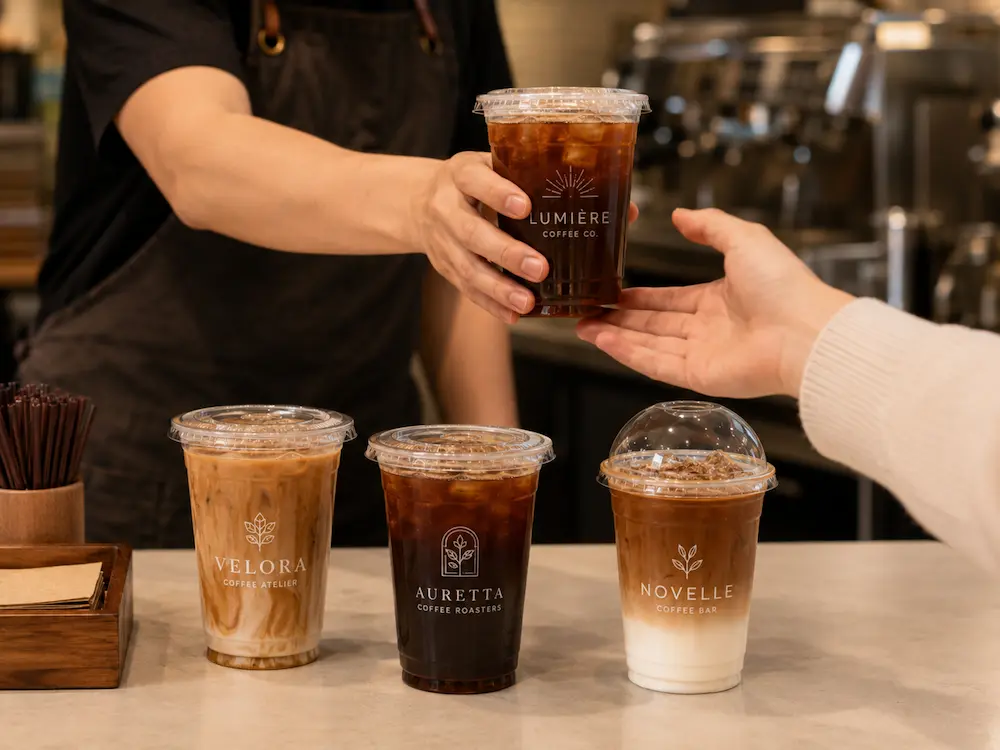
Buyers should check whether the rim feels smooth, whether there are rough edges, whether the lid presses on evenly, and whether the cup maintains a clean shape after stacking. These details are small, but they affect the real customer experience.
Custom Printed Cold Cups: Printing Options Buyers Should Review
Custom printed cold cups turn ordinary takeaway packaging into visible brand media. However, printing should be evaluated with the same seriousness as cup structure. A beautiful digital mockup does not guarantee a strong production result.
Logo size, print position, and brand visibility
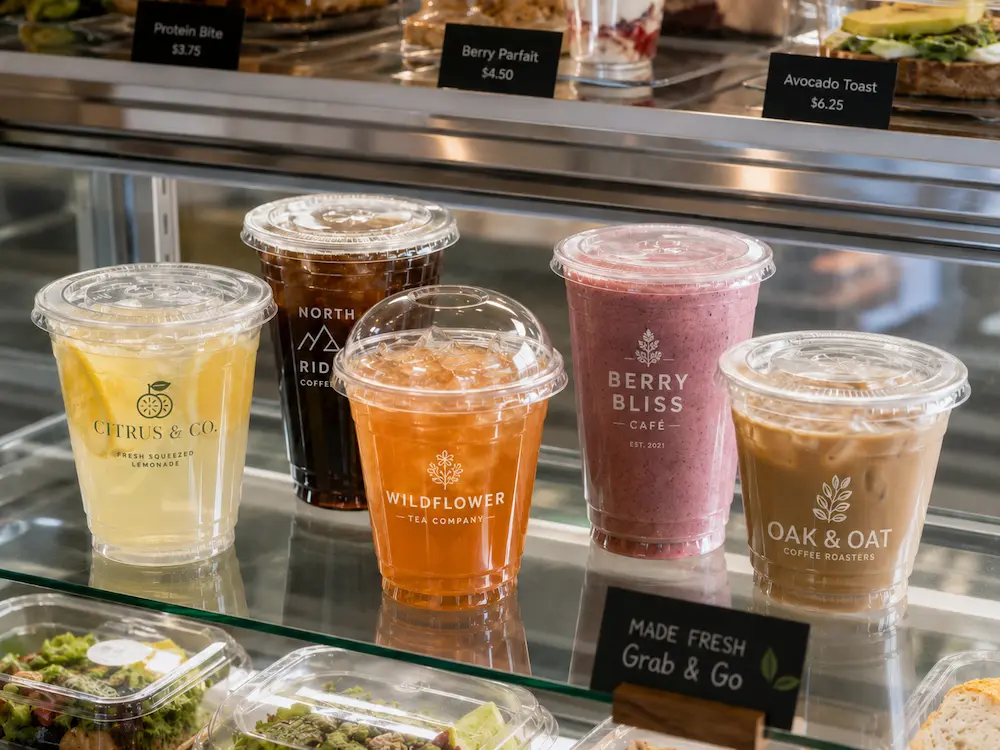
Logo placement should match how customers hold the cup, how drinks are photographed, and how the cup appears on counters, shelves, delivery bags, and social media posts. For cafes, a clean front-facing logo is often enough. For beverage chains, wraparound design or repeated brand marks may be useful. For events or seasonal menus, limited-edition cup graphics can create stronger campaign value.
The print should not block the most attractive part of the drink. For layered beverages, colorful refreshers, fruit tea, smoothies, and matcha drinks, clear visibility is part of the selling point. A clean logo area with enough transparent space often performs better than a heavy all-over design.
One-color vs multi-color printing
One-color printing is practical for simple cafe logos, minimalist drink brands, and cost-conscious wholesale orders. Multi-color printing works better for brands with stronger visual identity, seasonal campaigns, promotional menus, franchise systems, and beverage product launches.
Before mass production, buyers should confirm whether the manufacturer or supplier can match the brand color, whether Pantone references are required, and whether the artwork should be simplified for better print clarity on a curved cup surface.
Ink adhesion and condensation resistance
Cold drinks create condensation. This makes ink adhesion and surface performance important. Buyers should ask for printed samples and test them with chilled drinks, ice, and normal handling. The goal is not only to see whether the logo looks good when dry, but whether it remains clean and stable during real cold beverage service.
For printed plastic cups, buyers should check logo sharpness, edge clarity, color stability, rub resistance, and print position. A cup may look acceptable in a photo but perform differently after filling, stacking, shipping, or handling.
Artwork file preparation
Good customization starts with good artwork files. Buyers should prepare vector logo files such as AI, EPS, or editable PDF whenever possible. They should also provide brand color references, print size requirements, and preferred layout direction.
A reliable manufacturer or supplier should provide a digital mockup before sampling. However, the physical printed sample remains the key approval step. Buyers should not approve a large wholesale order based only on a screen image.
Wholesale Cafe Custom Cups Buyer Checklist
The following checklist helps buyers evaluate cafe custom cups before placing a wholesale order.
| Checklist Item | What Buyers Should Confirm | Why It Matters |
|---|---|---|
| Drink Menu Match | Confirm whether the cups are for iced coffee, milk tea, smoothies, juice, lemonade, refreshers, cold brew, or dessert drinks. | The drink type determines cup size, lid style, topping space, and print visibility. |
| Material | Check whether PET, RPET, PP, or another material is suitable for the cold beverage application. | Material affects transparency, feel, appearance, and cold-use performance. |
| Rim Diameter | Confirm 95mm, 98mm, or another rim size before selecting lids. | Rim diameter controls lid compatibility and inventory planning. |
| Lid Compatibility | Test flat lids, dome lids, straw-slot lids, or strawless sipper lids with the actual cup. | A good cup fails if the lid does not fit securely. |
| Printing Method | Review one-color printing, multi-color printing, logo size, print area, and artwork requirements. | Printing quality affects brand presentation and customer recognition. |
| Sample Approval | Approve plain samples and printed samples before bulk production. | Physical samples reduce risk before wholesale ordering. |
| Carton Packing | Check carton quantity, stack height, protection, labeling, and warehouse handling. | Good packing reduces damage and improves distribution efficiency. |
| Supplier Capability | Review communication, production control, repeat order support, export experience, and customization workflow. | Wholesale buyers need stable supply, not only a low unit price. |
Cup and Lid Matching Guide for Cold Beverage Buyers
For cafe custom cups, lid selection should be handled early in the sourcing process. The lid affects drinking method, takeaway security, topping space, customer comfort, and inventory management.
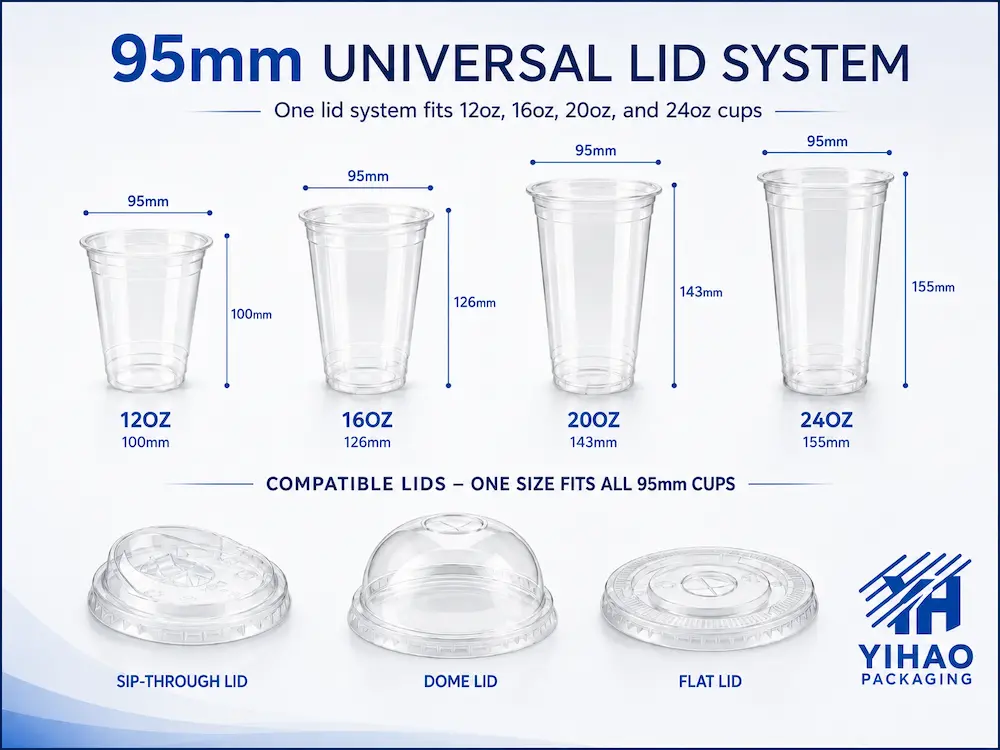
| Lid Type | Best For | Buyer Notes |
|---|---|---|
| Flat Lid | Iced coffee, iced tea, juice, lemonade, soda, fruit tea | Practical for standard straw-service drinks and fast counter operation. |
| Flat Lid with Straw Slot | Milk tea, fruit tea, juice, soda, refreshers | Useful when the drink format requires a straw and stable takeaway closure. |
| Dome Lid | Smoothies, whipped cream drinks, dessert beverages, bubble tea, yogurt drinks | Provides extra top space for foam, cream, toppings, or thicker beverage presentation. |
| Strawless Sipper Lid | Iced coffee, cold brew, iced tea, matcha, refreshers | Supports direct drinking and a cleaner no-straw takeaway experience. |
| Sip-Through Lid | Cold coffee, tea drinks, light beverages | Useful for beverage programs that want direct drinking with controlled flow. |
Sample Testing Checklist Before Bulk Orders
Sample testing is one of the most important steps before ordering custom printed cold cups wholesale. Buyers should test the cup in conditions that are close to real store use.
| Test Area | How to Test | Pass Standard |
|---|---|---|
| Cup Clarity | Fill the cup with iced coffee, fruit tea, lemonade, or a colored beverage. | The drink should look clean, bright, and visually attractive. |
| Lid Fit | Press the lid around the full rim and handle the filled cup normally. | The lid should fit evenly and feel secure during takeaway use. |
| Stacking | Stack and separate multiple cups during counter-style service. | Cups should separate smoothly without slowing down staff. |
| Print Quality | Check printed logo size, color, edge sharpness, and position on a filled cup. | The logo should remain readable without blocking drink visibility. |
| Condensation Handling | Fill with iced drinks and observe the printed area after cold exposure. | The print should remain clean and stable during normal handling. |
| Carton Packing | Review inner packing, carton labeling, stack height, and protection. | Packing should support storage, warehouse handling, and distribution. |
Cafe Custom Cups Comparison Table
| Cup Type | Best Use | Branding Value | Buyer Notes |
|---|---|---|---|
| Clear PET Cups | Iced coffee, cold brew, smoothies, juice, fruit tea, matcha, refreshers | High drink visibility | Strong choice for colorful cold beverages and grab-and-go display. |
| Custom Printed Cold Cups | Cafes, beverage chains, events, seasonal drink menus | Flexible logo and campaign display | Physical printed samples should be approved before bulk production. |
| Printed Plastic Cups | Takeaway drinks, foodservice counters, promotions, private-label beverages | Strong logo visibility | Check ink adhesion, condensation resistance, and color accuracy. |
| Branded Cold Cups | Chain stores, franchise menus, beverage brands, retail drink programs | High customer recognition | Best for repeat exposure and consistent brand identity. |
| Beverage Brand Cups | Premium drink concepts, launch campaigns, multi-location operations | Strong brand system support | Requires stable manufacturer support and repeat order consistency. |
Wholesale Supplier Checklist for Cafe Custom Cups
Before choosing a wholesale cafe custom cups supplier, buyers should review more than price. A reliable supplier should provide stable material quality, clear cup transparency, accurate lid matching, food-contact material support, printing consistency, carton packing options, and repeat-order stability.
- Material clarity: PET and RPET cups should remain clear, bright, and suitable for cold beverage display.
- Lid compatibility: Flat lids, dome lids, straw slot lids, and sip lids should match the cup rim securely.
- Printing quality: Logo printing should stay sharp, aligned, and suitable for branded cafe use.
- Size range: A complete size range helps cafes use one supplier for iced coffee, juice, smoothies, milk tea, and dessert drinks.
- Wholesale supply: The supplier should support stable carton packing, repeat orders, and export-ready communication.
Choosing cup size before checking the drink menu
Many buyers start with a standard cup size and later realize the drink does not fit the service style. Ice level, foam, toppings, fruit pieces, whipped cream, boba pearls, and lid height all affect the final cup choice. For smoothies or topped drinks, a dome lid may be more practical. For iced coffee or fruit tea, a flat lid or strawless sipper lid may be better.
Ignoring lid compatibility
Lid mismatch is one of the most common problems in cold drink packaging. A lid that is slightly loose, difficult to press, or visually mismatched can slow down service and create customer complaints. Buyers should always test the cup and lid as a pair.
Approving artwork without a physical sample
Digital artwork does not fully show how a logo behaves on a curved cup surface. Color, size, print position, and visibility may change once the design is applied to real cups. For wholesale custom printed cold cups, sample approval protects both the buyer and the supplier.
Choosing the lowest price without checking consistency
Low price is attractive, but inconsistent cup clarity, unstable printing, weak lids, poor carton packing, or delayed production can create larger operational losses. A stronger sourcing decision compares total value: product performance, brand appearance, supplier communication, repeat order stability, and after-sales support.
Using too much print coverage on clear cups
Some buyers want large graphics on the cup, but too much print coverage can block the drink. For clear PET cups, the beverage is part of the presentation. A better design keeps the logo visible while leaving enough transparent space for the drink color, fruit content, ice, foam, and layered texture.
How to Choose a Reliable Cafe Custom Cups Supplier
A reliable cafe custom cups supplier should understand both packaging function and beverage branding. The supplier should help buyers select the right cup size, rim diameter, lid type, material direction, printing method, and packing logic for the intended menu.
Review product range and size matching
A strong supplier should offer multiple cold cup sizes and compatible lid options. For example, a PET cold cup range may include 95mm and 98mm cup systems, supported by flat lids, dome lids, straw-slot lids, sip-through lids, and strawless sipper lids. This structure helps buyers simplify inventory and reduce lid mismatch.
For cafes and beverage chains, the best packaging program is not one cup. It is a complete system: smaller cups for compact drinks, regular cups for daily service, larger cups for smoothies or milk tea, dome lids for toppings, flat lids for straw service, and direct-sip lids for no-straw cold beverage service.
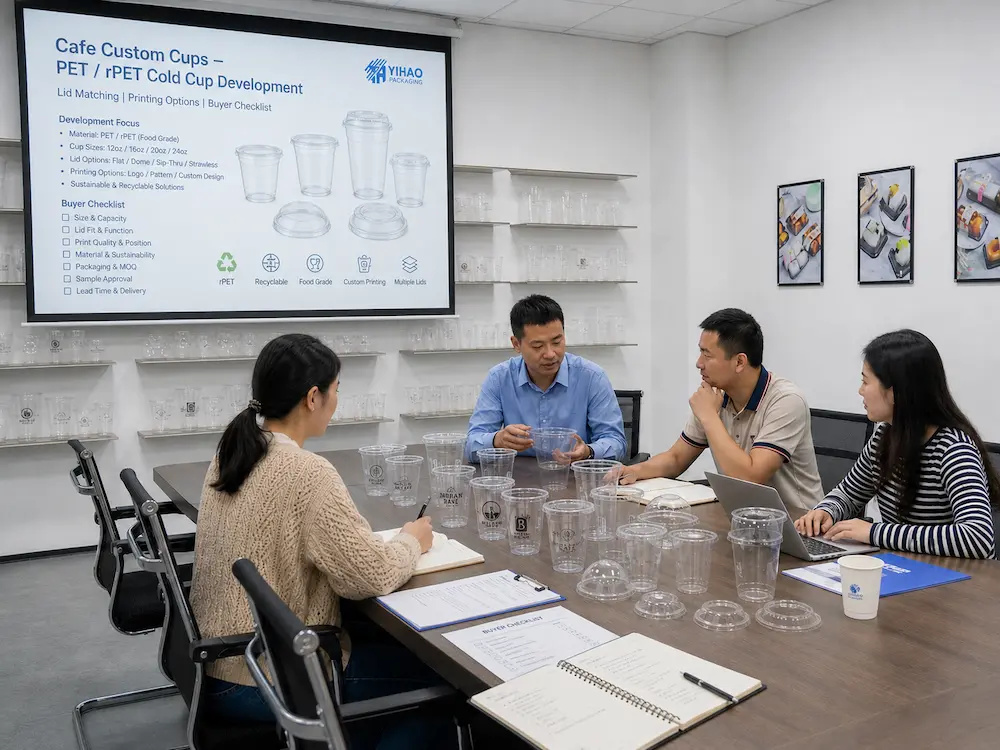
Ask for samples before mass production
Samples are essential. Buyers should test empty cups, filled cups, printed cups, and matched lids. Testing should include drink visibility, hand feel, lid fit, stacking, cup separation, logo appearance, carton packing, and condensation behavior.
For branded projects, request both plain samples and printed samples. Plain samples help check structure. Printed samples help check artwork performance.
Check production and export experience
For international buyers, export experience matters. A supplier should understand carton packing, product labeling, documentation, communication timing, and repeat order coordination. Foodservice distributors and beverage brands should work with partners who can support stable wholesale supply instead of only one-time product sourcing.
Choose a supplier that understands branding and packaging function
The best supplier for cafe custom cups understands that branding and function must work together. The cup must look clean, show the beverage, carry the logo, fit the lid, stack efficiently, and support store operations. A beautiful cup that fails in daily use is not a good packaging solution.
Wholesale Buying Scenarios for Cafe Custom Cups
Independent cafes and coffee shops
Independent cafes often use branded cold cups to make takeaway drinks more recognizable. A simple logo on a clear PET cup can make iced coffee, matcha, cold brew, and lemonade look more professional. For smaller brands, clean design often works better than heavy decoration.
Bubble tea and fruit tea brands
Bubble tea and fruit tea drinks rely heavily on visual appeal. Clear cups show tea color, milk layers, toppings, pearls, jelly, fruit pieces, and foam. For these drinks, cup clarity, dome lid options, straw access, and print position are all important.
Juice bars and smoothie shops
Juice bars and smoothie shops need cups that show freshness and color. PET clarity helps display orange juice, green smoothies, berry drinks, acai-style beverages, protein drinks, and mixed fruit beverages. Dome lids are useful when the drink includes thick texture, whipped topping, or extra headspace.
Beverage chains and franchise stores
Chain stores need consistency. The same cup size, same logo position, same lid fit, and same carton packing should be repeatable across multiple orders. For franchise beverage brands, packaging must support training, store efficiency, and customer recognition.
Distributors and foodservice wholesalers
Distributors need flexible product matching. They may supply cafes, restaurants, convenience stores, event operators, and drink chains at the same time. A complete PET cold cup and lid range helps distributors serve more customer types while keeping inventory organized.
Why Work with a Packaging Manufacturer for Cafe Custom Cups?
Better control over cup structure and material quality
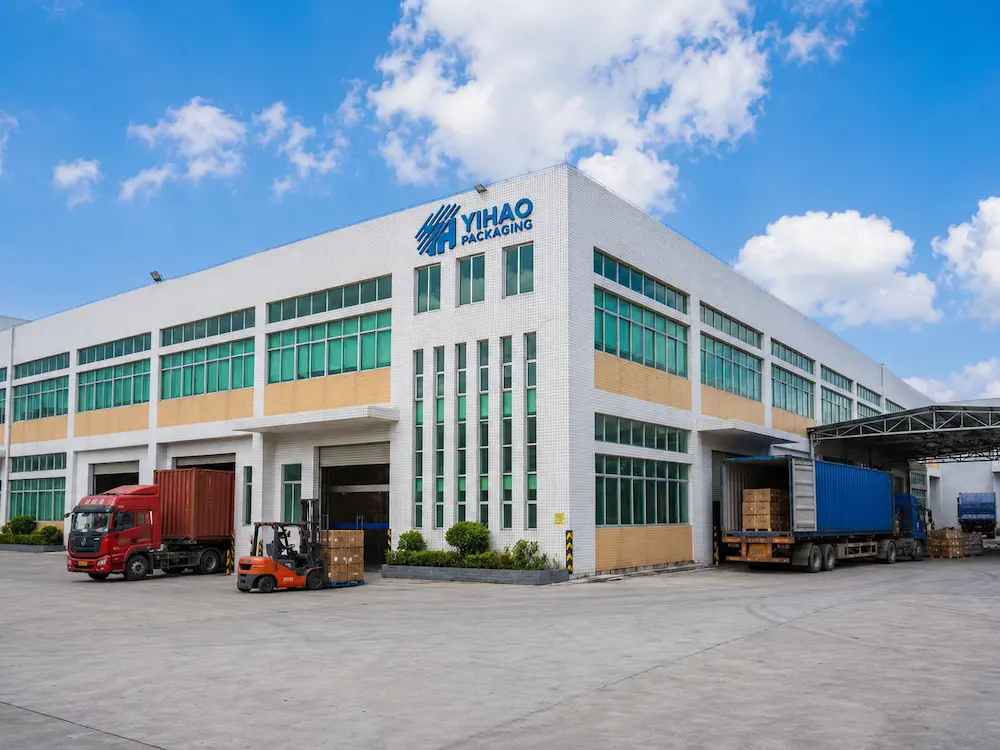
A packaging manufacturer has stronger control over production details. For custom PET cups, this includes material appearance, cup shape, rim consistency, wall structure, stacking performance, and cup-lid compatibility. These details are easy to overlook in a product photo but important in real beverage service.
More stable custom printing and repeat orders
Brand consistency depends on repeatability. A manufacturer can help buyers manage print files, sample confirmation, color expectations, production notes, and order history. This is important for beverage brand cups used across repeat campaigns or multiple store locations.
Better support for wholesale packaging programs
Wholesale packaging is not only about unit price. It involves product planning, size matching, lid matching, carton packing, export communication, and repeat supply. A manufacturer that understands the full packaging system can help buyers avoid mismatched products and reduce sourcing complexity.
How YIHAO supports cold beverage packaging buyers
YIHAO supports clear PET cold cups, matching cup lids, custom printed cold cups, and wholesale beverage packaging solutions for cafes, beverage brands, foodservice distributors, and packaging buyers. The product direction covers cold drink presentation, compatible lid selection, transparent display, custom branding, and practical wholesale support.
For buyers comparing cafe custom cups, working with a manufacturer-focused packaging partner helps connect product appearance with real service requirements: drink visibility, logo presentation, lid fit, storage efficiency, and repeat order stability.
Request Samples and Custom Printing Support
If your business is planning a wholesale cafe custom cups project, prepare the drink menu, target cup sizes, lid requirements, logo artwork, expected order plan, and destination market before contacting a manufacturer. This helps the supplier recommend the right PET cup series, compatible lids, print method, and sample process more efficiently.
YIHAO can support buyers who need clear PET cups, custom printed cold cups, matching lids, private-label presentation, and wholesale beverage packaging planning. Buyers can send logo artwork, request plain cup samples, review printed sample options, and compare cup-lid matching before mass production.
Final Note / Practical Takeaway
FAQ About Cafe Custom Cups
1. What are cafe custom cups used for?
Cafe custom cups are used for branded cold beverage service in cafes, coffee shops, juice bars, bubble tea stores, smoothie shops, dessert counters, restaurants, events, and grab-and-go retail programs. They are commonly used for iced coffee, cold brew, matcha, fruit tea, lemonade, juice, smoothies, milk tea, refreshers, and other cold drinks.
2. Are custom PET cups suitable for iced coffee and cold drinks?
Yes. Custom PET cups are widely used for cold beverage packaging because they offer clear drink visibility, a clean appearance, practical rigidity, and compatibility with cold cup lids. Buyers should confirm the intended cold-use application, rim diameter, matching lids, and sample performance before bulk ordering.
3. What should I check before ordering custom printed cold cups wholesale?
Before ordering custom printed cold cups wholesale, check cup size, PET clarity, rim diameter, lid compatibility, print area, logo file quality, color accuracy, ink adhesion, carton packing, stacking performance, MOQ logic, sample approval process, and repeat order support.
4. What is the difference between a manufacturer and a supplier for printed plastic cups?
A manufacturer usually has stronger control over production, material consistency, cup structure, printing coordination, quality inspection, and repeat order stability. A supplier may provide broader sourcing flexibility and logistics coordination. For long-term branded cup projects, buyers should confirm whether the supplier has direct manufacturing support.
5. Can branded cold cups help beverage brands improve recognition?
Yes. Branded cold cups help beverage brands improve visual recognition during takeaway service, retail display, delivery, events, and customer social sharing. A clear cup with balanced logo placement can show both the drink and the brand, which is valuable for cafes, beverage chains, and retail drink programs.
References
- U.S. Food and Drug Administration. Packaging & Food Contact Substances guidance.
- European Commission. Food contact materials and plastic food contact regulation references.
- EUR-Lex. Commission Regulation (EU) No 10/2011 on plastic materials and articles intended to come into contact with food.
- Association of Plastic Recyclers. APR Design Guide for Plastics Recyclability.
- Association of Plastic Recyclers. PET rigid packaging design guidance.
- PET Resin Association. PET material, recovery, and recycling references.
- National Coffee Association. National Coffee Data Trends and cold coffee market references.
- Packaging industry and beverage service reports on cold drink packaging, takeaway service, and branded beverage presentation.
Deep-Dive Insights: How Buyers Should Think About Cafe Custom Cups
How do cafe custom cups improve beverage merchandising?
Cafe custom cups improve merchandising by combining drink visibility, logo exposure, and takeaway convenience. Clear PET cups allow customers to see beverage color, toppings, layers, and freshness, while custom printing gives the brand a visible identity during store service, delivery, and social sharing.
Why should buyers compare cup and lid systems together?
A cup is only practical when it works with the correct lid. Buyers should compare flat lids, dome lids, straw-slot lids, sip-through lids, and strawless sipper lids according to beverage type, drinking method, topping space, and takeaway requirements. Cup-lid compatibility affects speed, sealing, customer experience, and inventory control.
What makes a wholesale custom cup order more reliable?
A reliable order starts with clear specifications, real samples, confirmed artwork, tested lid fit, practical carton packing, and stable communication with the manufacturer or supplier. Buyers should confirm these details before mass production instead of solving problems after the shipment arrives.
Which cafe custom cups work best for modern cold drink menus?
Clear PET cups with compatible lids work well for iced coffee, cold brew, matcha, fruit tea, lemonade, juice, smoothies, refreshers, milk tea, boba drinks, and layered dessert beverages. For stronger branding, buyers can add logo printing while keeping enough transparent space to show the drink.
Consideration for beverage brands and distributors
Beverage brands and distributors should think beyond one cup size. A better sourcing strategy includes multiple capacities, shared-lid logic, custom printing support, sample approval, carton efficiency, and repeat order planning. This approach creates a more stable packaging system for cafes, retail counters, foodservice channels, and multi-location beverage programs.
© 2026 YIHAO Packaging. This buying guide is created by YIHAO to help wholesale buyers, distributors, food brands, and packaging decision-makers compare product options and make informed sourcing decisions. All rights reserved.