Meal Prep Tamper Evident Containers vs Alternative Packaging: How Buyers Should Choose
Meal prep tamper evident containers are not just meal boxes with more sections. They are packaging systems built for prepared food programs where food organization, portion control, freshness presentation, and first-opening confidence all matter at the same time. For supermarkets, cafes, convenience stores, central kitchens, meal prep brands, distributors, and foodservice teams, this structure helps protect the product before the customer opens it.
A regular divided tray can separate food. A hinged clamshell can support fast packing. A snack tray can make fruit, cheese, and nuts look organized. A bakery sampler box can protect dessert portions. But meal prep tamper evident containers add a stronger trust signal by showing whether the package has been opened after sealing.
YIHAO is a food packaging manufacturer and solution provider focused on practical PET/RPET packaging systems for fresh food, fruit, salad, deli, bakery, snack, takeaway, and retail display applications. This guide compares meal prep tamper evident containers with alternative packaging formats and explains how buyers should choose the right structure for retail, takeaway, chilled food, and wholesale procurement.
What Are Meal Prep Tamper Evident Containers?
Meal prep tamper evident containers are prepared food containers designed with a secure closure feature that gives visible evidence after first opening. Many meal prep formats also include two, three, four, or more compartments to separate food components such as protein, grains, vegetables, fruit, sauces, toppings, sides, or snacks.
The value of this packaging comes from two functions working together. The compartment structure keeps food organized. The tamper-evident structure improves customer confidence when the product is sold through self-service shelves, delivery, convenience stores, office catering, school food programs, or third-party handling routes.
For buyers comparing secure divided formats, multi-compartment tamper evident containers are the key category to review because they combine ingredient separation with visible first-opening confidence for ready-to-eat and chilled meal programs.
Why Meal Prep Packaging Needs More Than a Basic Container
Meal prep packaging carries more responsibility than simple storage packaging. A prepared meal may include different textures, moisture levels, temperatures, colors, and portion roles. Protein should not crush soft fruit. Sauce should not soak crackers. Vegetables should not mix with dessert. A side dish should stay in its own section. If the food shifts or mixes too early, the product looks less premium before the customer even opens it.
At the same time, many meal prep products are sold through channels where the customer cannot speak directly with the packing team. The package may sit in a refrigerated shelf, travel through delivery, or be handled by several people before purchase. In those channels, a visible first-opening feature becomes more valuable.
This is why meal prep tamper evident containers are strongest when a food program needs four things together: portion control, ingredient separation, clear display, and package-integrity confidence.
Best Applications for Meal Prep Tamper Evident Containers
Chilled Meal Kits and Ready-to-Eat Meals
Chilled meal kits often include proteins, vegetables, grains, pasta, cold noodles, fruit, sauces, or toppings. A divided structure helps keep each food component in place, while tamper-evident closure helps reassure customers that the meal has remained sealed after packing.
For retail shelves and grab-and-go meal programs, buyers should test whether each compartment has enough usable volume. A container may look organized when empty but become crowded after real food is added. The lid should close without pressing too hard on protein, vegetables, or toppings.
Fruit, Nut, and Protein Snack Meals
Meal prep does not always mean a full lunch box. Many modern meal-prep-style products are snack meals: fruit with nuts, cheese with grapes, crackers with hummus, vegetables with dip, apple slices with peanut butter, yogurt with granola, or protein snack packs.
For these products, fresh-cut fruit containers and divided snack formats should be compared together. A simple fresh-cut fruit pack may only need one section. A higher-value snack meal usually needs two, three, or four sections to protect texture and improve presentation.
For two-part snack meals, two-compartment fruit and nut containers help separate juicy fruit from dry nuts, cheese, crackers, or dips. For more balanced snack sets, three-compartment snack containers support fruit, nuts, cheese, crackers, and protein snack combinations.
Salad Kits, Deli Meals, and Sauce-Separated Foods
Salad kits and deli-style meal packs often need separation between greens, toppings, proteins, grains, sauces, and side items. If dressing touches dry ingredients too early, the customer experience declines. If toppings shift into the wrong area, the meal looks messy on shelf.
For these applications, compartment food containers help organize the meal before opening. Tamper-evident structure becomes more important when the meal is sold through self-service chilled cases, delivery, or third-party handling channels.
Buyers can also compare tamper evident containers as a broader category when deciding whether a meal needs only a secure single-compartment pack or a divided tamper-evident structure.
Convenience Store and Grab-and-Go Meal Programs
Convenience stores and grab-and-go retail programs need packaging that communicates value quickly. Customers want to see the meal combination, understand the portion, and feel confident that the package has remained closed. Clear divided packaging helps with visual recognition, while tamper evidence supports trust.
For convenience retail, the best meal prep packs usually have a clean top view, stable compartments, a label that does not hide the food, and a closure feature customers can understand quickly. If the package looks complicated or hard to open, it weakens the buying experience.
Bakery, Dessert, and Mixed Snack Assortments
Some meal-prep-style packs include desserts, bakery portions, or sweet snack assortments. Mini cakes, brownies, cookies, pastry bites, mochi, fruit desserts, and dessert samplers often need separation to protect shape and decoration.
For dessert and bakery programs, bakery containers should be considered as an alternative or complementary packaging category. For small sampler packs, four-compartment dessert boxes help protect individual dessert pieces. For larger sharing packs, nine-compartment dessert boxes support multi-item dessert assortments and party-style sharing.
Comparison: Meal Prep Tamper Evident Containers vs Regular Compartment Food Containers
Regular compartment food containers are useful when the main goal is ingredient separation. They keep food organized and make portions easier to understand. However, regular divided containers may not show whether the package has been opened after sealing.
Meal prep tamper evident containers are stronger when the product is ready to eat, sold in self-service channels, handled by delivery partners, or positioned as a higher-trust chilled meal.
| Packaging Type | Best Use | Main Advantage | Buyer Caution |
|---|---|---|---|
| Regular compartment food containers | Controlled counters, quick takeaway, simple snack packs | Ingredient separation and portion control | No visible first-opening evidence unless added separately |
| Meal prep tamper evident containers | Retail meal prep, chilled grab-and-go, delivery-sensitive meals | Separation plus visible first-opening confidence | Closure function and opening experience must be tested |
| Single-compartment tamper-evident containers | One-component foods, dips, deli sides, chilled snacks | Simple secure closure | Not suitable when ingredients need separation |
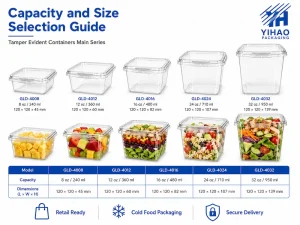
For everyday retail packs, two-compartment PET clamshell containers, three-compartment PET clamshell containers, and four-compartment PET clamshell containers give buyers practical alternatives when separation matters but tamper-evident closure is not the primary requirement.
Comparison: Meal Prep Tamper Evident Containers vs Snack Tray Containers
Snack tray containers are excellent for fruit, nuts, cheese, crackers, vegetables, dips, protein snacks, dessert bites, and chilled snack assortments. They are usually designed for visual variety and portion organization. Some snack trays may include tamper-evident features, but many are mainly focused on presentation and convenience.
Meal prep tamper evident containers are more suitable when the product is positioned as a complete meal or a secure ready-to-eat pack. They should provide stronger closure logic, better portion control, and clearer first-opening confidence when the channel requires it.
| Decision Factor | Meal Prep Tamper Evident Containers | Snack Tray Containers |
|---|---|---|
| Best food type | Meal kits, lunch packs, protein meals, chilled prepared meals | Fruit, nuts, cheese, crackers, vegetables, dips, snack assortments |
| Main purpose | Meal organization plus package integrity | Snack presentation and convenience |
| Security need | Higher when sold through self-service or delivery | Depends on channel and product positioning |
| Buyer caution | Must test closure and customer opening | Must test moisture and texture separation |
For premium snack programs, four-compartment fruit and nut containers support multi-item snack combinations, while four-compartment snack containers provide more space for apple slices, grapes, cheese, nuts, vegetables, and larger chilled snack portions.
Comparison: Meal Prep Tamper Evident Containers vs Hinged Clamshells
Hinged clamshells are often selected because they are easy to use in fast packing environments. The lid and base stay connected, which reduces lid-matching errors and supports quick staff handling. They are useful for fruit packs, deli snacks, bakery portions, salads, and takeaway items.
However, not every hinged clamshell provides the same trust signal as a tamper-evident meal prep container. A basic hinged pack may close well, but it may not clearly show whether it has been opened after sealing.
Buyers should choose hinged clamshells when packing speed and simple handling matter most. They should choose meal prep tamper evident containers when ingredient separation and visible opening evidence both matter.
Comparison: Meal Prep Tamper Evident Containers vs Round Trays and Party Trays
Round trays and party trays are strong for shared food display. They work well for fruit platters, sushi assortments, snack assortments, cheese trays, dessert trays, and catering foods. Their main advantage is visual spread and sharing presentation.
Meal prep containers are usually more personal, portioned, and controlled. They are designed for one meal or one ready-to-eat pack. Party trays are designed for sharing and display impact.
For shared chilled food programs, round five-compartment trays and round six-compartment trays are better choices than meal prep containers when food separation and large display area are more important than single-meal portion control.
Comparison: Meal Prep Tamper Evident Containers vs Bakery and Dessert Boxes
Bakery and dessert boxes serve a different purpose from meal prep packaging. They protect decoration, prevent dessert pieces from touching, and improve the retail presentation of sweet items. Paper-based trays with clear PET lids may offer a more premium presentation for bakery assortments, while PET clamshells may provide stronger all-around visibility.
Use bakery and dessert boxes when the food is fragile, decorative, or gift-oriented. Use meal prep tamper evident containers when the food is a ready-to-eat meal, snack meal, or chilled meal kit that needs portion control and first-opening confidence.
Material Selection: PET, RPET, PP, Paper-Based, and Heat-Suitable Options
Material selection should start with food temperature and display needs. PET and RPET are strong choices for clear chilled display because they provide product visibility and practical rigidity. PP or other heat-suitable materials may be needed when microwave or hot food performance is required. Paper-based formats may fit selected bakery, dessert, or premium takeaway concepts, but moisture and lid fit must be tested.
| Material Direction | Best Use | Main Advantage | Buyer Caution |
|---|---|---|---|
| PET | Chilled meal prep, fruit packs, snack trays, deli packs | Clear display and strong visual selling | Not the default choice for hot-fill or microwave use |
| RPET | Clear chilled packs with recycled-content positioning | Supports sustainability-focused packaging direction | Documentation and market requirements must be checked |
| PP or heat-suitable material | Meal prep with heating or microwave needs | Better fit for selected heat-related applications | May not deliver PET-like crystal clarity |
| Paper-based with clear PET lid | Bakery, dessert, premium snack boxes | Branding surface plus product visibility | Moisture, grease, and lid fit require testing |
For meal prep tamper evident containers, buyers should never assume that one material works for every meal. A cold fruit-and-protein pack, a chilled deli meal, a microwave-ready meal, and a bakery sampler all have different packaging needs.
Compartment Layout: How Many Sections Should Meal Prep Packaging Have?
The number of compartments should match the food. More sections are not automatically better. Too many sections reduce usable volume, slow down packing, and create more cleaning and filling complexity. Too few sections can cause food mixing, texture loss, and weak presentation.
| Layout | Best Meal Prep Use | Main Advantage | Buyer Risk |
|---|---|---|---|
| Two compartments | Protein with side, fruit with dip, grains with vegetables | Simple separation and faster filling | Limited space for complex meal sets |
| Three compartments | Protein, grain, vegetable; fruit, cheese, nuts | Balanced meal or snack structure | Requires portion planning for each section |
| Four compartments | Bento-style meals, snack meals, salad kits, deli packs | Premium organization and stronger product variety | Can feel crowded with large food pieces |
| Five or more compartments | Party trays, sampler packs, sushi, dessert assortments | Strong display and item separation | Better for sharing packs than single meal prep |
For true meal prep programs, two to four compartments usually cover most needs. For party trays, sushi, fruit platters, or dessert assortments, larger multi-section formats may be more suitable than standard meal prep containers.
When Meal Prep Tamper Evident Containers Are the Better Choice
Meal prep tamper evident containers are the better choice when the product is ready to eat, contains multiple components, is sold through a self-service or delivery-sensitive channel, and needs a visible first-opening signal.
Choose this format when:
- The meal includes separate food components that should not mix before opening.
- The product is sold in a supermarket chilled shelf or convenience store cooler.
- The package may be handled by delivery partners or third-party pickup staff.
- The customer needs to trust that the meal has remained sealed after packing.
- The food is visually inspected before purchase.
- The product is positioned as a premium grab-and-go meal or healthy snack meal.
- The buyer wants stronger package integrity than a regular snap-lid divided tray.
When Alternative Packaging Is Enough
Alternative packaging may be enough when the food is sold through a staffed counter, consumed quickly, controlled by internal foodservice teams, or does not need visible first-opening evidence.
Use regular compartment food containers when separation matters but the product does not need a tamper-evident feature. Use snack tray containers when the product is a light snack assortment rather than a full meal. Use hinged clamshells when fast packing is the top priority. Use paper dessert boxes when bakery presentation matters more than meal-prep function. Use round party trays when the product is shared rather than individually portioned.
The best decision is not “tamper evident or not.” The better question is: which structure supports the food, the channel, the customer trust requirement, and the actual packing operation?
Wholesale Buyer Testing Checklist
Before placing a wholesale order, buyers should test meal prep tamper evident containers with real food under real conditions. Empty samples do not reveal enough.
- Food fit: confirm each compartment holds the planned portion without looking empty or overcrowded.
- Texture separation: test whether wet ingredients affect dry ingredients during storage.
- Lid engagement: staff should close the container consistently at normal packing speed.
- Tamper-evident function: the first-opening feature should be visible and easy to understand.
- Food movement: check whether food crosses internal walls during transport and bag handling.
- Stacking: filled containers should stack safely in cartons, shelves, and delivery bags.
- Cold-chain display: visibility should remain strong after refrigeration.
- Label placement: labels should not hide the food layout or tamper-evident feature.
- Customer opening: the pack should open cleanly without spilling food.
- Sample-to-bulk consistency: bulk production should match approved samples in clarity, rim shape, lid fit, and closure feel.
For cold-case secure snack and meal applications, anti-fog tamper-evident containers are useful to review where visibility and closure confidence both matter. For larger secure chilled portions, clear PET tamper-evident containers support refrigerated food packaging where tear-strip style opening evidence is needed.
Manufacturer, Wholesale, and Supplier Evaluation
When sourcing from a food packaging factory, buyers should evaluate more than a catalog and a unit price. A strong manufacturer or supplier should understand meal prep food behavior, ingredient separation, tamper-evident closure, PET/RPET clarity, carton protection, sample testing, and repeat-order stability.
Ask these questions before choosing a manufacturer, wholesale supplier, or export partner:
- Which meal prep or divided layouts are available: two, three, four, or more compartments?
- Are tamper-evident options available for self-service retail and delivery-sensitive channels?
- Can the supplier support PET, RPET, PP, or paper-based structures depending on the application?
- Can samples be tested with real meal prep foods before wholesale confirmation?
- How does the closure show visible first-opening evidence?
- How are containers packed to reduce scratches, deformation, and lid mismatch?
- Can the supplier maintain consistent clarity, lid fit, compartment shape, and closure behavior in repeat orders?
- Can the supplier help buyers avoid unnecessary SKU overlap?
A good supplier does not push the same container for every meal program. A good supplier asks about food type, fill weight, moisture level, sales channel, heating requirement, label position, lid preference, and security expectations before recommending a structure.
Buyer Decision Matrix
| Buyer Scenario | Best Packaging Direction | Reason |
|---|---|---|
| Self-service chilled meal kits | Meal prep tamper evident containers | Combines portion control, food separation, and first-opening confidence |
| Fruit and nut snack packs | Compartment food containers or divided tamper evident containers | Separates wet and dry ingredients while supporting clear display |
| Staffed cafe snack counter | Regular snack tray containers or hinged clamshells | Staff control reduces the need for extra security features |
| Delivery-sensitive prepared meals | Meal prep tamper evident containers | Visible opening evidence supports customer confidence after handling |
| Bakery sampler packs | Divided dessert boxes or bakery containers | Protects presentation and keeps pieces from touching |
| Party trays and shared foods | Round multi-compartment trays | Better for large display and shared portion presentation |
Common Buying Mistakes to Avoid
Choosing Tamper-Evident Packaging Without Testing Opening Experience
A tamper-evident feature should be visible, logical, and easy to open. If the customer struggles with the tab or spills food during opening, the packaging damages the meal experience.
Using Too Many Compartments
More compartments can make a pack look organized, but unnecessary sections reduce usable space and slow filling. The layout should match the real meal components.
Assuming Tamper Evidence Means Leak-Proof
Tamper evidence shows first-opening status. It does not automatically guarantee leak-proof performance for sauces, dressings, fruit juice, or moist meal components. Leak-resistant behavior needs separate testing.
Ignoring Temperature Requirements
PET/RPET is strong for clear chilled display, but heat or microwave applications require separate material evaluation. Buyers should confirm temperature requirements before choosing packaging.
Approving Empty Samples Only
Meal prep packaging must be tested with real food. Empty samples cannot show food movement, lid pressure, condensation, portion appearance, or customer opening problems.
FAQ
1. What are meal prep tamper evident containers used for?
Meal prep tamper evident containers are used for chilled meal kits, snack meals, salad kits, protein packs, fruit-and-nut packs, deli meals, and grab-and-go foods that need portion control, ingredient separation, and visible first-opening confidence.
2. Are meal prep tamper evident containers better than regular compartment food containers?
They are better when the food is ready to eat, sold through self-service retail, delivery, or third-party handling channels, and needs both ingredient separation and visible opening evidence. Regular compartment food containers may be enough for staffed counters or lower-risk use.
3. When should buyers choose snack tray containers instead?
Buyers should choose snack tray containers when the product is mainly a fruit, nut, cheese, cracker, vegetable, dip, or dessert snack assortment and does not require a full meal-prep security structure.
4. What material is best for meal prep tamper evident containers?
PET and RPET are strong choices for clear chilled display. PP or other heat-suitable materials should be evaluated when microwave or hot food performance is required. The correct material depends on food temperature and sales channel.
5. How many compartments should meal prep containers have?
The best layout depends on the food. Two compartments fit simple meals or fruit-and-dip packs, three compartments fit balanced meals and snack packs, four compartments fit bento-style meals, and larger layouts usually fit party trays or sampler packs.
6. What should buyers test before wholesale ordering?
Buyers should test real food fit, texture separation, lid closure, tamper-evident function, stacking, label placement, cold-chain visibility, transport movement, customer opening, and sample-to-bulk consistency before wholesale ordering.
References
- U.S. Food and Drug Administration, Food Contact Substances and Food Packaging Guidance.
- U.S. Food and Drug Administration, Food Tampering and Consumer Packaging Guidance.
- European Commission, Regulation (EC) No 1935/2004 on Materials and Articles Intended to Come into Contact with Food.
- European Commission, Regulation (EU) No 10/2011 on Plastic Materials and Articles Intended to Come into Contact with Food.
- European Food Safety Authority, Guidance on Plastic Recycling Processes for Food Contact Materials.
- Association of Plastic Recyclers, APR Design Guide for Plastics Recyclability.
- RecyClass, Design for Recycling Guidelines for PET Packaging.
- GS1, General Guidance on Retail Barcode and Label Placement.
Final Note / Practical Takeaway
© YIHAO Packaging. All rights reserved. All articles, product images, packaging designs, technical specifications, and website materials are protected by copyright. Unauthorized copying, reproduction, redistribution, modification, or commercial use is strictly prohibited without prior written permission.