Wholesale Snack Tray Containers: Manufacturer and Supplier Checklist
Snack tray containers are a high-value packaging format for supermarkets, cafes, convenience stores, fresh produce brands, deli counters, bakeries, catering teams, school lunch programs, hotel breakfast counters, and foodservice distributors. They are used when small food components need to stay separated, visible, fresh-looking, and easy to eat.
Unlike a simple food box, a snack tray must organize multiple ingredients in one package. Fruit should not soak crackers. Nuts should not disappear under juicy berries. Cheese should stay separated from sauce. Dessert pieces should not damage each other. Sushi, fruit, veggie sticks, dips, deli bites, and bakery samplers all need a layout that looks intentional and performs under real handling.
YIHAO is a food packaging manufacturer and solution provider focused on practical PET/RPET packaging systems for fresh food, fruit, salad, deli, bakery, snack, takeaway, and retail display applications. This checklist explains how buyers should evaluate snack tray containers, compare compartment layouts, choose materials and lids, decide when tamper-evident options matter, and select a reliable manufacturer, wholesale supplier, or export partner.
What Are Snack Tray Containers?
Snack tray containers are divided food packaging containers designed for small food assortments and ready-to-eat combinations. They may include two, three, four, five, six, or more sections depending on the product concept. The tray may be a clear PET hinged clamshell, a PET/RPET tray with separate lid, a round party platter with dome lid, a paper-based dessert tray with clear PET lid, or a tamper-evident divided container for secure retail display.
The purpose is not simply to add compartments. The purpose is to protect food quality, improve presentation, control portions, simplify customer use, and help shoppers understand the product at a glance.
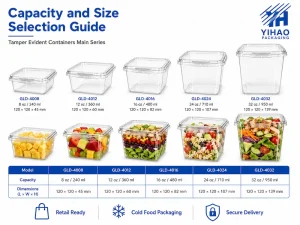
For buyers comparing secure divided packaging, multi-compartment tamper evident containers are an important category to review. They combine ingredient separation with visible first-opening confidence for self-service retail, delivery, convenience stores, and chilled grab-and-go programs.
Why Wholesale Buyers Need a Snack Tray Checklist
Wholesale snack packaging looks easy to buy until the product is filled. Empty trays usually look clean and organized, but real food changes the decision. Fruit releases moisture. Crackers absorb humidity. Cheese shifts during transport. Dips may press against the lid. Bakery pieces may touch and damage each other. A tray that looks good in a photo may fail in cold storage, carton stacking, or retail display.
A checklist helps buyers avoid three common problems:
- Choosing a tray layout that looks attractive but does not fit the food.
- Choosing a low-cost supplier before testing lid fit, stacking, and real food performance.
- Buying too many similar SKUs without a clear product matrix.
For wholesale buyers, the better question is not “Which supplier has the cheapest snack tray containers?” The better question is “Which manufacturer or supplier can help us build a snack packaging system that works from filling line to customer hand?”
Checklist 1: Define the Snack Program Before Choosing a Tray
The first step is to define the food program. A fruit-and-nut snack pack, vegetable-and-dip tray, cheese-and-cracker pack, sushi platter, bakery sampler, and school lunch snack box do not need the same tray.
Before requesting samples, buyers should confirm:
- Food type: fruit, nuts, cheese, crackers, vegetables, dips, sushi, deli bites, desserts, or bakery pieces.
- Moisture level: dry snacks, juicy fruit, creamy dips, oily deli foods, or chilled desserts.
- Texture goal: crunchy, soft, creamy, delicate, layered, or mixed.
- Sales channel: supermarket shelf, cafe counter, convenience store, delivery, catering, school foodservice, or distributor resale.
- Customer use: single snack, shared tray, meal-prep style pack, party platter, or premium sampler.
This step prevents wrong-structure buying. A small two-compartment pack works well for fruit plus dip. A four-compartment tray works better for fruit, cheese, nuts, and crackers. A round five- or six-compartment tray works better for shared fruit, sushi, or party assortments.
Checklist 2: Choose the Right Compartment Layout
The number of sections should match the food combination. More compartments are not automatically better. Too many sections can reduce usable space, slow packing, and increase SKU complexity. Too few sections can cause food mixing, poor presentation, and texture loss.
| Layout | Best Snack Tray Use | Main Advantage | Buyer Caution |
|---|---|---|---|
| Two compartments | Apple slices with dip, fruit with nuts, grapes with cheese | Simple separation and fast filling | Limited for multi-item snack assortments |
| Three compartments | Fruit, nuts, cheese, crackers, veggie sticks | Balanced layout for everyday snack packs | Requires accurate portion planning |
| Four compartments | Bento-style snacks, protein packs, fruit and deli combinations | Premium organization and stronger shelf appeal | May feel crowded if food pieces are large |
| Five compartments | Fruit platters, sushi, party snacks, deli assortments | Strong display effect for sharing packs | Needs careful lid height and transport testing |
| Six compartments | Fruit with dip, sushi with garnish, mixed chilled platters | Center section supports sauce, dip, topping, or garnish | Better for sharing trays than small individual snack packs |
| Nine compartments | Dessert samplers, bakery assortments, party sweets | Organized multi-item presentation | Not ideal for large or high-moisture pieces |
For simple retail snack combinations, two-compartment PET clamshell containers are suitable for fruit combos and dual-ingredient packs. For broader assortments, three-compartment PET clamshell containers and four-compartment PET clamshell containers give buyers more flexibility for assorted retail packs.
Checklist 3: Match Material to Food Temperature and Display Needs
Material selection should begin with the application. PET and RPET are common choices for clear chilled snack packaging because they provide strong visibility, lightweight handling, and clean retail presentation. Paper-based trays with clear PET lids may work well for bakery samplers or dessert assortments where branding surface matters. PP or other heat-suitable materials may be needed when heating is part of the food program.
| Material Direction | Best-Fit Use | Main Advantage | Buyer Checkpoint |
|---|---|---|---|
| PET | Fruit packs, snack trays, chilled deli foods, sushi, bakery display | High clarity and strong retail visibility | Not the default material for hot-fill or microwave use |
| RPET | Clear chilled snack packaging with recycled-content positioning | Supports sustainability-focused packaging direction | Documentation and local market requirements must be checked |
| Paper-based with clear PET lid | Dessert samplers, bakery assortments, premium snack packs | Branding surface plus product visibility | Moisture, grease, and lid fit need real food testing |
| PP or heat-suitable material | Meal prep foods requiring heat resistance | Better fit for selected heated applications | May not deliver PET-like clear retail display |
For most chilled snack tray programs, clear PET/RPET is a strong material direction because the product needs to sell visually. Shoppers want to see fruit color, cheese quality, cracker portion, dip position, dessert decoration, sushi arrangement, and overall freshness before purchase.
Checklist 4: Decide Whether Tamper-Evident Structure Is Needed
Not every snack tray needs tamper-evident packaging. Staffed counters, short-route takeaway, and internal foodservice programs may perform well with standard compartment food containers. But when the product is sold in self-service coolers, convenience stores, delivery channels, hotel grab-and-go stations, or third-party handling routes, visible first-opening confidence becomes more valuable.
Divided tamper evident containers are useful when the buyer needs both ingredient separation and a visible opening signal. Meal prep tamper evident containers are useful when the snack tray is positioned as a mini meal, protein pack, school lunch pack, office lunch pack, or ready-to-eat chilled meal component.
For buyers comparing general secure options, tamper evident containers should be reviewed before deciding whether a single-compartment secure pack or a multi-section secure pack is the better fit.
Checklist 5: Test Real Food Separation
The biggest reason to use snack tray containers is separation. But separation is only valuable if it works with real food. Internal walls must be high enough for the planned ingredients. The lid must not press food into other sections. The tray must remain stable during refrigeration, carton movement, shelf display, and customer handling.
Test wet and dry ingredients together:
- Apple slices with peanut butter or yogurt dip.
- Grapes with cheese cubes and crackers.
- Strawberries with chocolate dip or cream.
- Vegetable sticks with hummus or ranch dip.
- Sushi with ginger, wasabi, sauce, or garnish.
- Dessert bites with fruit toppings or cream.
- Nuts and dried fruit beside juicy fresh fruit.
For fruit-and-nut programs, two-compartment fruit and nut containers help separate wet fruit from dry snacks, while three-compartment snack containers support mango, grapes, cashews, almonds, cheese, crackers, and other balanced snack combinations.
Checklist 6: Evaluate Retail Display Performance
Snack trays are often purchased visually. A strong snack tray should make the food combination obvious at first glance. It should look clean, organized, colorful, and properly filled. If the tray looks half-empty, foggy, crowded, or messy, the product loses value.
Retail display performance should include:
- Clarity: the lid and sidewall should show the food cleanly.
- Contrast: the tray base should help food colors stand out.
- Compartment balance: each section should look intentionally filled.
- Label placement: labels should not hide the most attractive food view.
- Cold-case performance: condensation and fogging should be tested under real refrigeration.
- Stacking stability: filled trays should display cleanly without crushing lower packs.
For premium chilled snack presentation, four-compartment fruit and nut containers support multiple food components in one clear pack. For larger snack portions, four-compartment snack containers give buyers more room for apple slices, grapes, cheese, nuts, veggie sticks, and chilled snack combinations.
Checklist 7: Review Lid Structure and Closure Behavior
The lid controls a large part of the customer experience. A tray may have a strong layout, but if the lid is loose, difficult to close, foggy, or hard to open, the packaging fails in real use.
Common snack tray lid structures include:
- Hinged clamshell lid: good for fast packing because the lid and base stay connected.
- Separate flat lid: useful for clean stacking and compact retail display.
- Dome lid: useful for sushi, fruit platters, desserts, and taller foods.
- Tamper-evident closure: useful for self-service retail, delivery, and third-party handling.
Buyers should test closing force, lid engagement, hinge strength, opening experience, and whether the lid presses against food. For tray-and-lid systems, carton packing must also keep lids and trays matched correctly during warehouse operations.
Checklist 8: Choose Between Individual Snack Packs and Sharing Trays
Not all snack trays serve the same portion logic. Some are individual snack packs. Others are shared party trays or catering platters. The structure should follow the portion goal.
| Packaging Role | Best Use | Recommended Structure | Buyer Test |
|---|---|---|---|
| Individual snack pack | Fruit, nuts, cheese, crackers, veggie sticks | Two, three, or four compartments | Portion appearance and lid fit |
| Protein snack box | Egg, cheese, nuts, fruit, crackers, hummus | Three or four compartments | Moisture and texture separation |
| Mini meal prep snack | Protein, grain, fruit, vegetables, sauce | Divided or tamper-evident meal prep structure | Food movement and opening confidence |
| Party snack tray | Fruit, sushi, vegetables, deli bites, desserts | Five or six compartments with dome lid | Loaded weight and transport stability |
| Dessert sampler | Pastry bites, mini cakes, cookies, brownies, mochi | Four to nine compartments | Product protection and lid clearance |
For shared chilled food programs, round five-compartment trays work well for fruit, sushi, cold snacks, veggie platters, deli assortments, and desserts. For larger assortment logic with a center section, round six-compartment trays support fruit with dip, sushi with garnish, snack assortments, and chilled party platter programs.
Checklist 9: Check Bakery and Dessert Snack Tray Needs
Snack tray packaging is not only for fruit and savory foods. Bakeries and dessert brands also use divided packaging for mini cakes, pastry samplers, cookies, brownies, macarons, mochi, cream desserts, and party sweets. These products need protection from crushing, smearing, and contact damage.
For bakery snack trays, the buyer should test food height, frosting clearance, lid visibility, anti-fog performance, and whether pieces move during transport. A dessert tray should not simply separate items; it should protect presentation.
For bakery and dessert programs, bakery containers provide a broader category path. For small sampler packs, four-compartment dessert boxes help protect individual dessert pieces. For larger sharing assortments, nine-compartment dessert boxes support premium dessert assortments and party sharing.
Checklist 10: Evaluate Carton Packing, Nesting, and Warehouse Efficiency
Wholesale packaging cost is not only the unit price. Buyers must consider nesting, carton quantity, lid packing, storage volume, damage risk, and staff handling. A low-cost tray that scratches easily, nests poorly, or uses too much carton space may become expensive in practice.
Ask the manufacturer or supplier:
- How do trays nest before filling?
- Are lids packed separately or attached?
- How many pieces are packed per carton?
- How are clear lids protected from scratches?
- How are dome lids protected from deformation?
- How does the supplier reduce mismatch between trays and lids?
- How stable are filled trays during carton stacking and cold storage?
Carton planning matters especially for dome-lid trays, party platters, and dessert boxes because height and clear surfaces are easier to damage during transportation.
Checklist 11: Confirm Sample-to-Bulk Consistency
One of the biggest wholesale risks is approving a sample that does not match bulk production. Buyers should confirm that sample quality, material clarity, rim shape, compartment structure, lid fit, and stacking behavior remain stable in repeat orders.
Before bulk approval, compare:
- Sample clarity versus bulk clarity.
- Rim shape and closure feel.
- Internal compartment height and wall consistency.
- Lid engagement and customer opening experience.
- Carton protection and damage rate.
- Surface scratches, deformation, fogging, and display quality.
For multi section food packaging, small differences in internal walls, lid fit, or material thickness can affect real performance. This is why a professional supplier should support sample testing and production consistency checks before scaling orders.
Checklist 12: Evaluate Manufacturer Capability
When sourcing from a food packaging factory, buyers should evaluate whether the manufacturer understands the full snack tray system. A supplier with many catalog items is not automatically the best partner. The stronger supplier helps buyers match food type, compartment count, material, lid, carton plan, label space, and sales channel.
Use these questions:
- Does the factory produce clear PET/RPET snack tray containers regularly?
- Can it support two-, three-, four-, five-, six-, or more compartment structures?
- Can it support both individual snack packs and sharing trays?
- Does it understand fruit, nuts, cheese, sushi, deli, bakery, and dessert applications?
- Can it provide samples for real food testing?
- Can it support tamper-evident divided structures when needed?
- Can it maintain repeat-order consistency in clarity, closure, and stacking?
- Can it help reduce SKU overlap instead of selling too many similar products?
A strong manufacturer should speak in application logic, not only in dimensions and price. The best supplier asks what food will go into the tray before recommending the tray.
Checklist 13: Evaluate Supplier Communication
For international wholesale buying, communication quality matters. A supplier that responds quickly but gives vague information still creates risk. A supplier that asks technical questions usually creates a better purchasing result.
Useful supplier questions include:
- What food will be packed?
- Is the product chilled, ambient, or heat-related?
- Does the buyer need PET, RPET, paper-based, or heat-suitable material?
- Does the product need tamper-evident closure?
- Will the pack be sold in self-service retail or staffed service?
- Does the product need anti-fog performance?
- Where will the label be placed?
- How important are carton efficiency and stacking?
If the supplier never asks these questions, the buyer may receive a tray that looks similar to the request but fails in the actual application.
Wholesale Snack Tray Sample Testing Plan
A professional sample test should use real food, real labels, real refrigeration, and real handling. The goal is to test the full route, not only the empty tray.
| Test Area | What to Check | Why It Matters |
|---|---|---|
| Food fit | Each section holds the planned portion without looking empty or crowded | Protects portion value and retail appearance |
| Texture separation | Wet and dry foods stay separated during storage and movement | Protects customer eating experience |
| Lid closure | Lid closes consistently at normal packing speed | Supports staff efficiency and package reliability |
| Retail display | Food remains visible, organized, and attractive after refrigeration | Improves shelf conversion |
| Stacking | Filled trays stack safely in cartons, shelves, and takeaway bags | Reduces crushing and damage complaints |
| Label placement | Labels do not hide the best food view or tamper-evident feature | Protects both branding and product visibility |
| Opening experience | Customer can open the tray cleanly without spilling or mixing food | Protects final user experience |
| Bulk consistency | Bulk order matches approved sample in clarity, fit, and structure | Reduces repeat-order quality risk |
Manufacturer and Supplier Scorecard
| Evaluation Area | Strong Supplier Provides | Warning Sign |
|---|---|---|
| Product range | Clear snack tray options across two, three, four, and sharing layouts | Only random SKUs with no application logic |
| Material guidance | Explains PET/RPET, paper-based, and heat-suitable choices by use case | Recommends one material for every application |
| Lid support | Confirms hinged, separate, dome, or tamper-evident lid options | Unclear lid matching or vague closure details |
| Sample support | Encourages real food testing before wholesale orders | Pushes bulk order confirmation before testing |
| Carton protection | Explains nesting, lid protection, carton quantity, and damage prevention | No clear carton or surface protection plan |
| Repeat consistency | Supports stable clarity, rim shape, lid fit, and compartment layout | Samples look good but bulk details are uncertain |
Common Wholesale Buying Mistakes to Avoid
Choosing by Compartment Count Instead of Food Logic
A four-compartment tray is not automatically better than a two-compartment tray. The correct layout depends on the food combination, portion size, and packing workflow.
Ignoring Moisture and Texture Transfer
Snack trays often combine wet and dry foods. If fruit juice softens crackers or dip moves into nuts, the package fails even if it looks attractive when filled.
Approving Empty Samples Only
Empty samples do not show food movement, condensation, label blocking, lid pressure, or customer opening problems. Buyers should test filled trays before approving wholesale orders.
Using PET/RPET for the Wrong Temperature
PET/RPET is strong for clear chilled display, but it should not be used automatically for microwave or heated foods. Temperature requirements must be confirmed before material selection.
Adding Too Many Similar SKUs
Too many similar snack trays create warehouse pressure and staff confusion. A focused range with clear roles is better than a large list of overlapping products.
Forgetting Label Placement
In snack trays, the food arrangement is the selling image. Labels should support branding and required information without hiding the product combination.
How to Build a Practical Wholesale Snack Tray Range
A strong wholesale range should cover real applications without creating unnecessary complexity. Buyers can build a simple product matrix:
- Two-compartment trays: fruit with dip, fruit with nuts, cheese with crackers.
- Three-compartment trays: fruit, cheese, nuts, crackers, veggie sticks, protein snacks.
- Four-compartment trays: bento-style snack packs, premium fruit-and-nut packs, deli snack sets.
- Five- or six-compartment trays: fruit platters, sushi, party snacks, catering assortments.
- Dessert compartment boxes: pastry samplers, mini cakes, cookies, brownies, and party sweets.
- Tamper-evident divided containers: self-service retail, delivery-sensitive snacks, meal-prep style packs.
This matrix helps purchasing, sales, packing, and retail teams use the same logic. Instead of asking for “a snack tray,” the team can define the exact role: fruit-and-dip pack, protein snack box, chilled party tray, dessert sampler, or secure retail snack pack.
FAQ
1. What are snack tray containers used for?
Snack tray containers are used for fruit and nut packs, cheese and cracker packs, vegetable and dip trays, sushi assortments, protein snack boxes, dessert samplers, deli snacks, and chilled grab-and-go food combinations.
2. What material is best for clear snack tray containers?
PET and RPET are common choices for clear chilled snack tray containers because they provide strong product visibility, lightweight handling, and clean retail display. Heat-related applications should be evaluated separately.
3. When should buyers choose multi-compartment tamper evident containers?
Buyers should choose multi-compartment tamper evident containers when snack trays need ingredient separation and visible first-opening confidence in self-service retail, delivery, convenience stores, or third-party handling channels.
4. How many compartments should a snack tray have?
The right number depends on the food. Two compartments fit simple pairings, three compartments fit balanced snack packs, four compartments fit premium snack boxes, and five or six compartments fit party trays or shared assortments.
5. What should buyers test before wholesale ordering?
Buyers should test food fit, texture separation, lid closure, stacking, label placement, cold-chain display, customer opening, carton protection, and sample-to-bulk consistency before placing wholesale orders.
6. How should buyers choose a snack tray manufacturer or supplier?
Buyers should choose a manufacturer or supplier that understands food separation, PET/RPET material, lid matching, tamper-evident options, sample testing, carton protection, repeat-order consistency, and wholesale snack packaging applications.
References
- U.S. Food and Drug Administration, Food Contact Substances and Food Packaging Guidance.
- European Commission, Regulation (EC) No 1935/2004 on Materials and Articles Intended to Come into Contact with Food.
- European Commission, Regulation (EU) No 10/2011 on Plastic Materials and Articles Intended to Come into Contact with Food.
- European Food Safety Authority, Guidance on Plastic Recycling Processes for Food Contact Materials.
- Association of Plastic Recyclers, APR Design Guide for Plastics Recyclability.
- RecyClass, Design for Recycling Guidelines for PET Packaging.
- GS1, General Guidance on Retail Barcode and Label Placement.
- International Organization for Standardization, Packaging and Environmental Considerations for Packaging Systems.
Final Note / Practical Takeaway
© YIHAO Packaging. All rights reserved. All articles, product images, packaging designs, technical specifications, and website materials are protected by copyright. Unauthorized copying, reproduction, redistribution, modification, or commercial use is strictly prohibited without prior written permission.