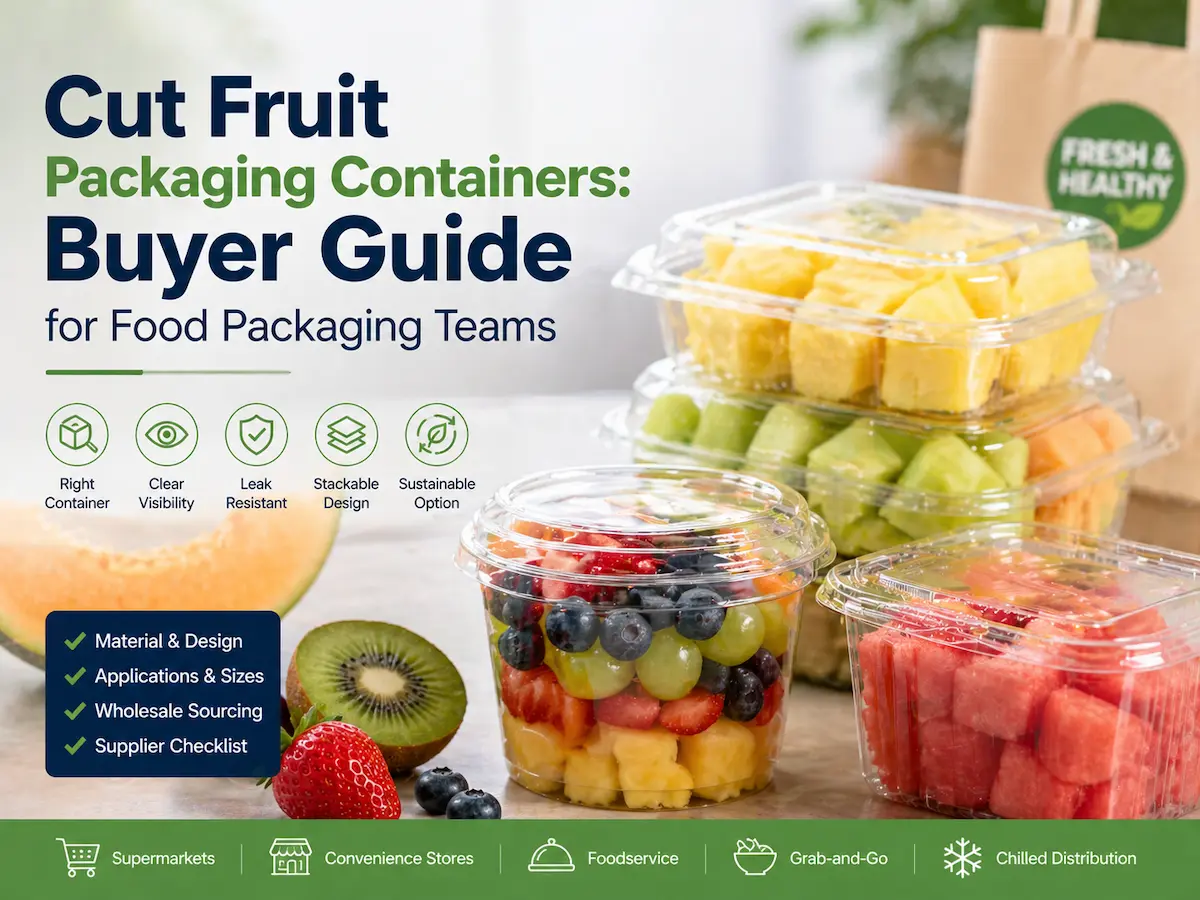
Summary: Cut Fruit Packaging Containers for Food Packaging Teams
Cut fruit packaging containers are designed for ready-to-eat fruit programs such as melon cubes, fruit salad, berries, pineapple chunks, grapes, and grab-and-go snack portions. For food packaging teams, the right container needs to balance product visibility, lid fit, leak resistance, cold-chain handling, stacking strength, labeling space, and wholesale supply reliability.
Clear PET and RPET containers are widely used for fresh-cut fruit because they support high product visibility, refrigerated display, lightweight transport, and retail-ready presentation. Buyers should compare container shape, lid structure, material clarity, base strength, label area, carton packing, food-contact documentation, and the supplier’s ability to support stable wholesale orders or custom packaging programs.
Fresh-cut fruit looks simple on the shelf, but it is one of the most demanding categories in chilled food packaging. Melon cubes release juice. Pineapple chunks create moisture. Berries need gentle protection. Fruit salad depends heavily on product visibility. Grab-and-go fruit cups must look fresh, stay closed during handling, and stack neatly in refrigerated displays.
That is why cut fruit packaging containers are not just ordinary plastic boxes. For food packaging teams, they are part of a wider system that includes processing hygiene, cold-chain handling, retail display, labeling, traceability, consumer convenience, and wholesale procurement.
As a food packaging manufacturer and solution provider, YIHAO understands that buyers are not only looking for a container that “holds fruit.” They need packaging that supports real retail operations: clear presentation, stable structure, secure closure, efficient packing, and consistent supply for supermarkets, convenience stores, fruit processors, foodservice brands, cafés, and chilled ready-to-eat programs.
This buyer guide explains how to choose cut fruit packaging containers for different fresh fruit applications, including fresh-cut fruit containers, fruit salad containers, clear PET fruit cups, grab-and-go fruit packaging, and fresh-cut melon containers. It also explains what food packaging teams should check before choosing a manufacturer, wholesale partner, or long-term supplier.
Why Cut Fruit Packaging Containers Matter in Fresh Food Retail
Fresh-cut fruit is convenient, colorful, and highly attractive to modern consumers. It fits breakfast programs, lunchbox packs, school meals, convenience stores, supermarket chilled shelves, airline catering, office pantries, cafés, and quick-service food counters. However, once fruit is washed, peeled, sliced, diced, or mixed, it becomes more sensitive to handling, moisture, temperature, and shelf presentation.
For buyers, the container plays a direct role in how the fruit is perceived. A clear, rigid, well-fitted package makes the fruit look fresh and organized. A weak or foggy container makes even good fruit look less appealing. A loose lid creates leakage concerns. A shallow container may crush soft berries. A deep container may hide the product. A poorly designed base may deform when filled with heavy melon cubes.
Good cut fruit packaging containers help food teams solve several practical problems at the same time:
- They show the natural color of the fruit.
- They reduce messy handling during transport and retail display.
- They support stacking in cartons, cold rooms, and refrigerated shelves.
- They provide space for labels, batch codes, barcodes, and brand information.
- They help match portion size with the target sales channel.
- They improve the consumer’s first impression at the point of sale.
Packaging does not replace food safety management, cold-chain control, or hygienic processing. That point matters. For ready-to-eat fruit, packaging should be selected as part of a broader food handling and operational system. The right container supports that system by protecting product presentation, reducing handling problems, and creating a practical surface for labeling and traceability information.
Fresh-Cut Fruit Is Packaging-Sensitive
Whole fruit has its natural skin, rind, or peel. Fresh-cut fruit does not. Once fruit is cut, its surface area increases, juice begins to release, and the product becomes more dependent on refrigerated storage and careful handling. This is especially true for watermelon, cantaloupe, honeydew, pineapple, kiwi, mango, berries, grapes, and mixed fruit salad.
Different fruits behave differently inside packaging. Watermelon cubes are heavy and juicy. Pineapple is acidic and moist. Berries are soft and easily damaged. Grapes roll and shift during transport. Mixed fruit salad combines fruits with different textures, colors, and moisture levels. A container that works for dry snacks may not perform well for chilled fruit.
This is why buyers should not treat fresh-cut fruit containers as generic food boxes. The structure, material clarity, lid fit, height, base strength, and stacking performance all matter.
For example, fresh-cut melon containers often need a stronger base because melon portions are heavier than berries or grapes. Fruit salad containers need enough height and sidewall clarity to show mixed colors. Single-serve cups need reliable lid compatibility for grab-and-go channels. Larger family-size packs need stronger stacking performance for wholesale distribution.
Common Types of Fresh-Cut Fruit Containers
Food packaging teams usually work with several container formats rather than one universal solution. The right format depends on portion size, fruit type, sales channel, display method, and handling route.
Clear PET Fruit Cups for Single-Serve Portions
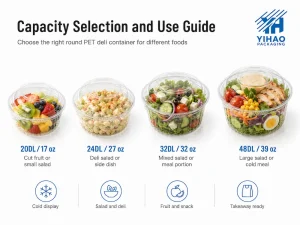
Clear PET fruit cups are widely used for single-serve and snack-size fruit portions. They are especially suitable for grapes, pineapple chunks, watermelon cubes, mixed berries, mango, kiwi, and small fruit salad portions.
The main advantage is visibility. Consumers buy fresh-cut fruit with their eyes first. A transparent cup lets the customer see color, ripeness, portion size, and freshness perception before purchase. For convenience stores, cafés, school meal programs, airline catering, and office snack programs, clear fruit cups create a clean and easy-to-handle format.
Buyers should compare cup diameter, height, lid compatibility, stacking strength, and label area. A cup that looks good in a sample may not be ideal after filling, sealing, carton packing, refrigerated transport, and shelf display. Food packaging teams should test the cup with the actual fruit program before making large wholesale orders.
Hinged PET Clamshell Containers for Grab-and-Go Fruit
Hinged PET clamshells are practical for grab-and-go fruit packaging because the lid and base are connected. This makes packing faster, reduces lid mismatch, and creates a convenient retail-ready format.
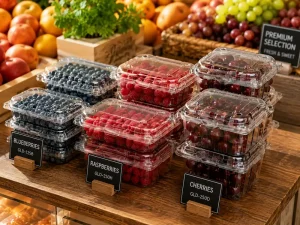
These containers are often used for melon cubes, mixed fruit salad, berries, grapes, sliced kiwi, pineapple chunks, and chilled snack portions. The hinged design also helps supermarket teams, food processors, and convenience store suppliers handle packaging more efficiently during filling and closing.
When choosing hinged containers, buyers should check the hinge strength, closing point, lid fit, opening feel, anti-crush performance, and stacking stability. For fruit programs with more juice release, lid fit and base rigidity become more important. For premium fruit programs, clarity and clean edges matter more because the container directly affects the product’s shelf image.
Fruit Salad Containers with Flat Lids or Dome Lids
Fruit salad containers often need a slightly different design logic. Mixed fruit salad is colorful, layered, and visually rich. Packaging should show the fruit without making the product look compressed or messy.
Flat-lid containers work well when stacking and shelf efficiency are priorities. Dome-lid containers create more visual height and are suitable for fruit portions where presentation is important. For example, cafés, bakeries, hotel breakfast counters, and premium supermarket lines may prefer containers that show more volume and shape.
Food packaging teams should choose the lid style based on the sales channel. A convenience store may prioritize stackability. A café display may prioritize visual height. A supermarket family-size pack may need a larger footprint and a stronger base. A meal kit program may prefer a compact structure that fits into outer cartons or delivery bags.
Compartment Containers for Fruit Combinations
Compartment containers are useful when the fruit program includes more than one component. Common examples include berries with melon, fruit with yogurt, fruit with granola, apple slices with dip, or fruit snack packs with nuts.
The advantage of compartment packaging is separation. It helps maintain visual order and reduces mixing between wet and dry components. For premium snack packs, compartment design also supports higher perceived value because the product looks more organized.
However, buyers should avoid choosing compartment containers only for appearance. The divider height, lid fit, portion balance, and filling speed all need to be tested. If the divider is too low, ingredients may shift. If the container is too complex, packing efficiency may drop. A good compartment container should support both product presentation and operational efficiency.
Material Selection: PET, RPET, PP, or Fiber?
Material choice is one of the most important decisions for cut fruit packaging containers. Buyers must balance clarity, stiffness, food-contact suitability, sustainability goals, cost, recycling expectations, and the needs of the sales channel.
Why Clear PET Is Widely Used for Cut Fruit Packaging Containers
PET is widely used for chilled fresh food packaging because it offers high clarity, good stiffness, lightweight handling, and strong shelf presentation. For fruit, clarity is not a small detail. It is one of the main selling tools.
Fresh-cut fruit depends on color. Watermelon needs to look bright. Pineapple needs to look golden. Kiwi needs to show green contrast. Mixed berries need to look premium. Fruit salad needs to show variety. Clear PET fruit cups and containers support this visual selling process better than opaque packaging.
PET also provides a practical structure for cups, hinged clamshells, trays, lids, and bowls. It works well for refrigerated display and grab-and-go food programs. For buyers who need a balance of visibility, weight, rigidity, and retail presentation, PET is often the first material to evaluate.
When RPET Makes Sense for Sustainability-Driven Buyers
RPET supports the sustainability direction of many food brands and retailers. It uses recycled PET content and helps brands communicate a more responsible packaging approach when properly documented and positioned.
For wholesale buyers, RPET can be attractive in supermarket programs, export retail channels, and brand lines where sustainability messaging is part of the product strategy. However, buyers should not rely on vague claims. They should ask the supplier for material information, recycled-content details where applicable, and food-contact documentation suitable for the target market.
For cut fruit packaging containers, RPET should still be evaluated on clarity, strength, lid fit, and consistency. A sustainable message cannot compensate for poor shelf appearance or weak closure. The best packaging choice must support both brand values and real product performance.
When PP May Be Considered
PP is commonly used in many food packaging applications, especially where heat resistance is required. However, for fresh-cut fruit, heat resistance is usually not the main requirement. Visibility, cold-chain performance, lid fit, and shelf presentation are often more important.
If a buyer is considering PP for chilled fruit, the decision should be based on the specific use case, available container design, clarity expectations, and target cost. In many fruit retail programs, PET remains more attractive because of its transparent appearance and display value.
Why Fiber or Paper-Based Packaging Is Not Always Ideal for Juicy Fruit
Fiber and paper-based packaging can support certain sustainability goals, but they are not always the best choice for juicy fresh-cut fruit. Many cut fruit products release moisture, and consumers often want to see the actual fruit before buying.
For watermelon cubes, pineapple chunks, mixed melon, and fruit salad, a non-transparent container may reduce shelf appeal. Moisture resistance may also become a concern depending on coating, structure, and storage time. Fiber packaging may work for some dry or short-hold applications, but buyers should test it carefully before using it for juicy chilled fruit programs.
The smarter approach is not to say one material is always better. The right material depends on the fruit type, shelf life target, retailer expectations, sustainability goals, and actual distribution route.
Key Design Features Food Packaging Teams Should Compare
A container sample may look simple, but food packaging teams should evaluate it through real operating conditions. The container must work during filling, closing, carton packing, cold storage, transport, shelf display, consumer handling, and final consumption.
Clarity and Product Visibility
For fruit, clarity is a commercial feature. The customer wants to see the fruit. Retailers want the product to look fresh under chilled display lighting. Foodservice buyers want clean presentation. Brand owners want packaging that supports trust.
High-clarity cut fruit packaging containers help show color, texture, and portion value. This is especially important for mixed fruit salad, berries, melon cubes, and premium fruit snack packs.
Buyers should compare not only transparency but also surface finish, sidewall distortion, lid clarity, and how the container looks after stacking. A container that appears clear when empty may look less attractive when filled with moist fruit and displayed in a cold case.
Lid Fit and Leak Resistance
Fresh-cut fruit often releases juice. Even when the product is drained before packing, some moisture will remain. A secure lid helps reduce spills, messy handling, and poor consumer experience.
For fresh-cut melon containers, lid fit is especially important because melon carries weight and moisture. For fruit salad containers, the lid must handle product movement during transport. For single-serve fruit cups, lid compatibility is essential because cups may be handled repeatedly in convenience stores, schools, airlines, cafés, and takeaway counters.
Buyers should test lid closure by filling the container with real product, stacking it, chilling it, and handling it in the same way it will be used in the market. A reliable supplier should support practical sample testing before wholesale purchasing.
Stackability for Cold-Chain and Retail Shelves
Stackability affects warehouse efficiency, transport stability, refrigerated display, and labor cost. A container that stacks neatly saves space and reduces handling problems. A weak or unstable container may deform under weight or create messy shelf presentation.
Food packaging teams should check the container’s base design, rim structure, lid support, carton arrangement, and filled stacking height. Stackability is especially important for wholesale programs where the product moves through processors, distributors, cold rooms, delivery trucks, and retail shelves.
For grab-and-go fruit programs, a neat stack also improves shelf appearance. Consumers read visual order as a sign of freshness and quality.
Label Space and Traceability Support
Labeling is not just a marketing task. For ready-to-eat fruit, labels may include product name, net weight, ingredients, barcode, batch information, best-before date, storage instructions, and brand information.
The container should provide a practical area for labels without blocking the fruit display. A large label may cover the product and reduce shelf appeal. A label placed on a curved or uneven surface may peel or look unprofessional.
Food packaging teams should consider label size early in the packaging selection process. If the fruit program needs batch codes, QR codes, or traceability information, the container should support that requirement clearly.
Condensation and Ventilation Considerations
Cold-chain fruit packaging may experience condensation, especially when products move between temperature zones. Condensation can affect visibility and shelf presentation.
Buyers should ask whether the container design, lid structure, or application method supports the product’s condensation needs. Some fruit programs need tighter closure. Others may need ventilation considerations. The answer depends on fruit type, moisture level, storage time, cold-chain route, and retailer requirements.
This is an area where sample testing is more valuable than theory. Food packaging teams should test the container under realistic temperature and handling conditions before confirming a large order.
Application Scenarios for Cut Fruit Packaging Containers
Different fruit programs need different packaging logic. A buyer serving convenience stores may choose different containers from a buyer serving supermarket family packs or hotel catering. Below are the most common application scenarios.
Fresh-Cut Melon Containers
Fresh-cut melon containers need strength, clarity, and reliable closure. Watermelon, cantaloupe, and honeydew are juicy and relatively heavy. When cut into cubes or slices, they place pressure on the container base and release moisture over time.
For melon programs, buyers should look for:
- Strong base support
- Secure lid closure
- Clear sidewalls
- Good stacking performance
- Enough headspace to avoid compression
- Practical label placement
- Carton packing suitable for refrigerated transport
Melon containers are used by supermarkets, fruit processors, prepared food suppliers, convenience stores, and catering teams. Because melon is often sold in bright, high-visibility displays, packaging clarity directly influences purchase confidence.
Fruit Salad Containers for Supermarkets
Fruit salad containers are designed for mixed fruit portions such as melon, pineapple, grapes, kiwi, berries, mango, and citrus. The packaging should show variety and color while keeping the product organized.
For supermarket use, buyers usually need container sizes that match single-serve, two-person, and family-size programs. The container should be easy to label, easy to stack, and strong enough for chilled display.
A good fruit salad container creates a clean retail image. It lets the customer see portion value immediately. It also supports private-label fruit programs where the retailer’s brand image depends on consistency.
Clear PET Fruit Cups for Snack-Size Portions
Clear PET fruit cups are ideal for snack-size and portion-controlled fruit programs. They are common in schools, offices, cafés, airlines, hospitals, convenience stores, vending-adjacent chilled counters, and quick-service meal programs.
The best fruit cup should match the portion size without excessive headspace. Too much headspace makes the product look underfilled. Too little headspace may crush soft fruit or affect lid closure.
For snack-size portions, buyers should evaluate cup volume, lid fit, rim strength, carton packing, and spoon compatibility if required. If the cup is used for grab-and-go retail, the label should be visible but not overpower the product.
Grab-and-Go Fruit Packaging for Convenience Stores
Grab-and-go fruit packaging needs to be compact, attractive, and easy to handle. The consumer may buy it quickly with coffee, sandwiches, salads, yogurt, or cold beverages. The product has only a few seconds to communicate freshness.
For this channel, packaging should support:
- Fast visual recognition
- Clean product display
- Secure closure
- Easy opening
- Strong shelf presence
- Efficient stacking
- Barcode and label placement
Convenience stores often work with limited shelf space. Packaging must be space-efficient without making the fruit look compressed. A container that fits neatly into chilled shelves gives retailers more confidence in the product line.
Foodservice and Catering Fruit Trays
Foodservice and catering programs may use larger containers for breakfast buffets, hotel service, corporate catering, event trays, and prepared meal operations. These applications often need larger capacity, strong bases, and easy transport.
The packaging must protect presentation during movement. For catering, the product may be packed in advance and transported to a venue. A weak container can make the fruit look messy before service begins.
Foodservice buyers should check container depth, lid security, stacking strength, and compatibility with outer cartons or delivery totes.
How to Choose the Right Size and Structure
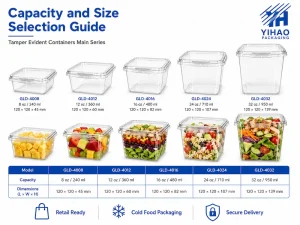
Size selection is more than volume. It affects visual value, fruit protection, filling speed, shelf space, carton packing, and consumer experience.
Match Container Volume to Fruit Type
Different fruits need different internal space. Berries need gentle protection and should not be compressed. Melon cubes need base strength and juice management. Grapes need enough space to reduce rolling and shifting. Fruit salad needs enough height to show mixed colors without looking messy.
Food packaging teams should test actual fill weight rather than choosing a container only by nominal capacity. A container that holds a certain volume of dry product may behave differently with juicy fruit. Weight, moisture, shape, and surface texture all affect the final result.
Choose Shallow, Deep, or Compartment Formats by Sales Channel
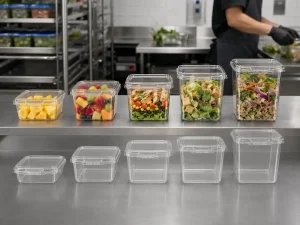
Shallow containers are useful when shelf visibility and neat display are priorities. Deep containers are useful for larger portions or fruit with more volume. Compartment containers are useful when the product includes separate ingredients.
A supermarket fruit salad program may need shallow rectangular containers for shelf display. A café may prefer clear cups with dome lids. A catering supplier may need larger trays. A school snack program may prefer compact portion cups. A premium brand may use compartment packs to create a more organized look.
The best structure is the one that matches the product, channel, and handling process.
Avoid Overpacking and Poor Lid Closure
Overpacking is a common mistake in fruit packaging. It may make the portion look generous at first, but it can create lid pressure, fruit damage, leakage, and poor opening experience.
Food packaging teams should leave practical headspace for closure and handling. This is especially important for soft fruit and mixed fruit salad. The container should close smoothly without forcing the lid down onto the product.
A good test is simple: fill the container with real fruit, close it at normal speed, stack it, chill it, transport it, and open it as a consumer would. If the product looks crushed or the lid feels unstable, the container is not the right choice.
Wholesale Sourcing Checklist for Food Packaging Teams
Once the container design is clear, the next question is sourcing. A strong packaging program depends on a reliable manufacturer, wholesale supply process, and responsive supplier communication.
What to Ask a Cut Fruit Packaging Containers Manufacturer
Before placing a wholesale order, buyers should ask practical questions:
- What materials are available for this container?
- Is the container made from PET, RPET, PP, or another material?
- What lid options are compatible?
- What sizes are available in the same product family?
- Can the container be used for refrigerated fresh food display?
- What is the carton packing method?
- Is the container suitable for the target fruit type and fill weight?
- Are food-contact documents available for review?
- Can samples be provided for testing?
- Is OEM or custom packaging support available?
- Can the supplier support stable repeat orders?
These questions help buyers avoid mistakes before production. For example, a container may look good in a product photo but may not fit the buyer’s target fruit weight, label size, or carton packing plan.
What Makes a Reliable Wholesale Supplier
A reliable wholesale supplier is not only a seller with a low price. For food packaging teams, reliability means consistency.
A strong supplier should provide stable product quality, accurate sizing, clear communication, suitable export packing, and practical support during sample selection. The supplier should understand different fruit applications and help buyers match containers to actual use cases.
For export buyers, communication matters. Packaging projects often involve sample testing, size comparison, material confirmation, carton planning, labeling questions, and repeat orders. A supplier that responds clearly and professionally reduces procurement risk.
When Custom Packaging Is Worth It
Custom packaging is useful when a brand needs a specific size, label area, lid structure, compartment layout, or retail presentation. However, customization should have a clear business reason.
Food packaging teams should consider custom packaging when:
- Existing sizes do not match the fruit program.
- The brand needs a unique shelf image.
- The container must fit a specific carton or display system.
- The product requires a special compartment layout.
- The retailer needs a more precise portion format.
- The label or barcode area must be improved.
Custom packaging should not be used only for decoration. The best custom design solves practical problems in filling, transport, retail display, and consumer use.
Buyer Mistakes to Avoid
Choosing cut fruit packaging containers looks easy until the product reaches the shelf. Many problems appear only after filling, chilling, stacking, and transport. Buyers can avoid major mistakes by testing early and thinking beyond unit price.
Choosing Only by Price
Low price is attractive, but it should not be the only decision factor. A cheaper container may have lower clarity, weaker structure, poor lid fit, or inconsistent sizing. These problems can lead to leakage, product returns, shelf display issues, and brand damage.
For fruit packaging, the container directly affects the customer’s perception of freshness. A low-cost container that makes the fruit look less appealing can reduce sales value.
Ignoring Fruit Moisture
Moisture is one of the biggest challenges in fresh-cut fruit packaging. Watermelon, pineapple, melon, citrus, and mixed fruit salad all release juice. If the container is not suitable, moisture can collect, leak, or reduce product visibility.
Buyers should test the container with the actual fruit mix. A dry test with empty containers is not enough.
Using One Container for Every Fruit Type
A single container may not work for all fruit products. Berries, melon cubes, grapes, pineapple chunks, and fruit salad have different weights and textures.
Using one container for every SKU may simplify purchasing, but it can create performance problems. Food packaging teams should build a container range that matches the product range.
Forgetting Labeling and Traceability Space
Labels should be planned before ordering packaging. If the label blocks the product, the fruit loses visual appeal. If the label does not fit properly, the package looks unprofessional. If there is no practical space for batch information, operational work becomes harder.
Food packaging teams should confirm label size, barcode position, brand placement, and traceability needs during sample testing.
Comparison Table: What Buyers Should Evaluate
| Evaluation Point | Why It Matters for Cut Fruit Packaging Containers | Buyer Tip |
|---|---|---|
| Material clarity | Fresh fruit depends on visual appeal | Compare filled samples under chilled display lighting |
| Lid fit | Helps reduce messy handling and leakage risk | Test with real fruit and normal handling conditions |
| Base strength | Heavy fruit such as melon needs support | Fill with actual target weight before approval |
| Stackability | Supports cold-chain transport and retail display | Test filled stacking, not only empty stacking |
| Label area | Supports branding, barcode, and batch information | Check label placement before mass ordering |
| Container height | Affects appearance, headspace, and fruit protection | Avoid crushing soft fruit or making packs look underfilled |
| Carton packing | Influences wholesale logistics and storage | Ask for carton quantity, dimensions, and export packing details |
| Supplier support | Reduces procurement and communication risk | Choose a manufacturer that understands food packaging applications |
Why Work with a Specialized Manufacturer or Supplier
A specialized food packaging manufacturer or supplier can help buyers move faster from product idea to packaging decision. Instead of choosing from random containers, buyers can compare a structured range of cups, hinged boxes, clamshells, bowls, trays, and lids.
For fruit programs, experience matters. A supplier that understands fresh-cut fruit applications can help buyers compare container depth, lid fit, material clarity, and portion logic. This is especially useful for supermarket programs, chilled food brands, and wholesale distributors.
YIHAO supports food packaging buyers with practical packaging options for fruit, salads, fresh food, desserts, snacks, and chilled ready-to-eat applications. For cut fruit packaging containers, the goal is not only to provide a transparent box. The goal is to help food teams build packaging that works from filling line to retail shelf.
Final Buyer Checklist
Before confirming a container, food packaging teams should review the following checklist:
| Buyer Question | Why It Matters |
|---|---|
| Is the container clear enough for fruit display? | Better visibility supports consumer confidence and shelf appeal |
| Does the lid close securely? | Good closure reduces handling problems and improves retail presentation |
| Is the size suitable for melon, berries, fruit salad, or mixed fruit? | Proper sizing prevents crushing, excess headspace, and poor appearance |
| Does it stack well when filled? | Filled stacking is essential for cold-chain logistics and shelf display |
| Is there enough label space? | Labels must support branding, barcode, and traceability information |
| Is the material suitable for the target market? | Buyers need packaging that matches performance and compliance expectations |
| Can the supplier support wholesale repeat orders? | Stable supply matters for ongoing fresh food programs |
| Are samples available for testing? | Real product testing reduces procurement risk |
| Can the supplier support OEM or custom needs? | Custom support helps brands improve fit, display, and differentiation |
Conclusion
The best cut fruit packaging containers do more than hold fresh fruit. They support product visibility, chilled display, lid security, stacking, labeling, traceability, and wholesale procurement. For food packaging teams, the right container protects not only the fruit but also the brand’s retail image and operational efficiency.
Buyers should start with the product: melon cubes, fruit salad, berries, grapes, pineapple chunks, or mixed grab-and-go portions. Then they should match the container material, size, lid style, base strength, and label area to the actual application.
Clear PET and RPET containers remain strong options for many fresh-cut fruit programs because they combine transparency, structure, and retail-ready presentation. However, the final decision should always be based on real product testing and supplier capability.
For supermarkets, fruit processors, foodservice companies, cafés, convenience stores, and chilled ready-to-eat brands, choosing a reliable cut fruit packaging containers manufacturer, wholesale supplier, or custom packaging partner is a strategic procurement decision. The right partner helps food teams reduce risk, improve shelf appeal, and build a more consistent fresh fruit packaging program.
FAQ
1. What are cut fruit packaging containers?
Cut fruit packaging containers are food containers designed for ready-to-eat fruit such as melon cubes, pineapple chunks, berries, grapes, kiwi, mango, and mixed fruit salad. They help food packaging teams present fresh fruit clearly, support chilled display, reduce handling problems, and provide space for labels, barcodes, and batch information.
2. What is the best material for fresh-cut fruit containers?
Clear PET is one of the most common material choices for fresh-cut fruit containers because it offers strong product visibility, good stiffness, lightweight handling, and a clean retail appearance. RPET is also useful for buyers who want a recycled-material packaging direction, provided the supplier can support suitable documentation and consistent quality.
3. Are clear PET fruit cups suitable for fruit salad?
Yes, clear PET fruit cups are suitable for many fruit salad applications, especially single-serve and grab-and-go portions. Buyers should choose the right cup volume, lid fit, headspace, and label area based on the fruit mix, juice release, sales channel, and refrigerated display requirements.
4. How do I choose fresh-cut melon containers?
Fresh-cut melon containers should have a strong base, clear sidewalls, secure lid fit, practical headspace, and good stacking performance. Melon cubes are heavier and juicier than many other fruits, so buyers should test the container with actual watermelon, cantaloupe, or honeydew portions before placing wholesale orders.
5. What should I ask a cut fruit packaging containers manufacturer before ordering wholesale?
Before ordering wholesale, buyers should ask about material options, available sizes, lid compatibility, carton packing, sample availability, food-contact documentation, OEM or custom support, production consistency, and repeat-order capacity. These questions help food packaging teams choose a supplier that can support real fresh fruit packaging programs.
References
- U.S. Food and Drug Administration, Guidance for Industry: Guide to Minimize Microbial Food Safety Hazards of Fresh-cut Fruits and Vegetables.
- U.S. Food and Drug Administration, FSMA Food Traceability List.
- European Union, Regulation (EU) 2025/40 on Packaging and Packaging Waste.
- USDA Economic Research Service, Food Availability Per Capita Data System.
- Centers for Disease Control and Prevention, Food Safety and Produce Handling Guidance.
- European Commission, Packaging and Packaging Waste Policy Framework.
- U.S. Food and Drug Administration, Food Contact Substances and Food Packaging Information.
- Industry packaging practice references on PET, RPET, chilled food packaging, and retail-ready fresh food containers.
Deep-Dive Insights: How Food Packaging Teams Should Think About Cut Fruit Packaging Containers
How should buyers define the right container before asking for a quote?
Buyers should define the fruit type, target fill weight, sales channel, shelf display method, label size, cold-chain route, and carton packing needs before requesting a quote. This makes the supplier conversation more accurate and prevents the project from becoming a simple price comparison.
Why does product visibility matter so much for fresh-cut fruit?
Fresh-cut fruit is visually driven. Consumers judge color, freshness, ripeness, portion value, and cleanliness before purchase. Clear PET and RPET packaging helps the product communicate these qualities quickly in chilled retail environments.
What packaging option works best for grab-and-go fruit programs?
Grab-and-go fruit programs usually need compact, transparent, stackable containers with secure lid fit and enough label space for barcode and brand information. Clear PET fruit cups and hinged PET clamshell containers are practical choices for convenience stores, cafés, schools, offices, and supermarket chilled shelves.
Option: Standard mold or custom packaging?
Standard molds are suitable when buyers need faster selection, lower development complexity, and proven container formats. Custom packaging is worth considering when the product requires a unique size, stronger shelf identity, improved label position, special compartment layout, or better fit with a retailer’s display system.
Consideration: Supplier capability is part of packaging quality
A good container is not enough if the supplier cannot provide stable quality, consistent sizing, export packing, clear communication, and repeat-order support. Food packaging teams should evaluate the manufacturer’s product range, sample support, documentation, and wholesale supply capacity before building a long-term fresh fruit packaging program.
© 2026 YIHAO packaging. All rights reserved. This article, “Cut Fruit Packaging Containers: Buyer Guide for Food Packaging Teams,” is originally created by the YIHAO. Unauthorized copying, redistribution, or commercial use of this content is not permitted without written permission.