Custom Bakery Containers vs Alternative Packaging: How Buyers Should Choose
Custom bakery containers are useful when standard bakery packaging cannot properly protect, display, stack, label, or transport a finished bakery product. Cakes, cupcakes, muffins, pastries, cookies, brownies, cheesecake slices, tiramisu portions, mousse cakes, dessert samplers, chilled sweets, and retail bakery assortments all have different height, weight, topping, texture, and display requirements. A container that works for one bakery item may fail badly for another.
For food packaging teams, the decision between custom bakery containers and alternative packaging should be practical, not emotional. Custom packaging can solve real problems, but it can also add development time, tooling cost, testing requirements, and order-planning pressure. Alternative packaging can be faster and more economical, but only when it fits the product, retail channel, takeaway route, label needs, and wholesale handling process.
YIHAO is a food packaging manufacturer and solution provider focused on clear PET and rPET packaging for bakery items, dessert portions, chilled foods, fresh foods, salads, deli foods, and retail-ready packaging programs. This guide helps food packaging teams compare custom bakery containers with alternative packaging before choosing a bakery packaging manufacturer, bakery packaging supplier, or long-term bakery packaging factory partner.
What Are Custom Bakery Containers?
Custom bakery containers are packaging formats developed or adjusted to match a specific bakery product, product family, brand requirement, retail display need, or operational workflow. Customization may involve the container footprint, dome height, cavity layout, base shape, hinge design, closure position, label-friendly surface, stacking geometry, carton fit, material direction, or visual presentation.
Custom does not always mean fully new tooling. In some cases, it may mean selecting a more suitable existing structure, adjusting product range logic, choosing a different dome height, changing from separate-lid packaging to hinged packaging, or shifting from a paper box to a clear-lid format. In other cases, a buyer may need a truly custom mold or structure because the product cannot be protected or displayed correctly by standard packaging.
Good custom bakery packaging should solve a clear problem:
- The cake dome is too low for decorations or fruit toppings.
- The cupcake cavities do not hold products upright during takeaway.
- The pastry pack allows movement and damages glazed surfaces.
- The dessert sampler needs compartment separation and clear display.
- The label area blocks the product’s best selling angle.
- The standard carton wastes too much space in wholesale distribution.
- The package does not stack safely after filling.
What Counts as Alternative Bakery Packaging?
Alternative bakery packaging includes any existing format that can be used instead of custom development. This may include standard cake containers, cupcake and muffin containers, pastry boxes, bakery clamshell containers, paper bakery boxes, window boxes, open trays, dessert cups, tamper-evident containers, and generic food containers.
Bakery containers include many commercial formats that already solve common bakery packaging needs. For many buyers, a standard clear cake container, cupcake pack, pastry container, or bakery clamshell is enough when the product fits correctly and the packaging performs well under filled testing.
Alternative packaging is usually the stronger first option when speed, lower development cost, and proven availability matter. Custom packaging becomes stronger when standard formats consistently fail on product fit, retail presentation, label placement, stacking, cold-case performance, or carton efficiency.
When Custom Bakery Containers Make Sense
Custom bakery containers make sense when buyers have a repeat bakery program with clear packaging pain points. The product should have enough commercial volume, repeat demand, and operational importance to justify development work. Custom packaging should improve product protection, display value, packing efficiency, or supply consistency in a measurable way.
Buyers should consider custom development when they repeatedly face these problems:
- Standard domes touch frosting, cream, fruit, chocolate, or toppings.
- Standard bases flex under cakes, brownies, or dense dessert portions.
- Standard cavities do not hold cupcakes, muffins, or mini desserts correctly.
- Standard clamshells leave too much movement space or not enough lid clearance.
- Standard paper boxes hide products that need clear retail display.
- Standard packaging does not fit carton, pallet, shelf, or cold-case requirements.
- Standard label areas block product visibility or barcode placement.
If the issue appears only in one small seasonal run, custom packaging may be excessive. If the issue affects daily production, retail chain programs, foodservice routes, or long-term wholesale bakery packaging, custom development becomes more reasonable.
When Alternative Packaging Is the Better Choice
Alternative packaging is often the better choice when the finished product already fits a proven standard format. Buyers should not create custom bakery containers just because custom sounds more premium. A standard format can be better when it provides correct internal height, stable base support, clear visibility, reliable closure, efficient carton packing, and stable wholesale supply.
Alternative packaging also works well when buyers need faster launch timing. New store openings, seasonal bakery promotions, trial runs, limited-time dessert programs, and small-volume cafe packaging often benefit from existing formats. Standard packaging lets buyers test real product demand before investing in custom development.
The best decision is not “custom is better” or “standard is cheaper.” The best decision is: which option protects the product, presents it well, supports operations, and stays commercially realistic?
Custom Bakery Containers vs Standard Cake Containers
Cake packaging is one of the clearest examples of when customization may or may not be needed. Standard cake containers can work very well when the cake height, decoration, base diameter, label placement, and carton fit match the available structure. Custom development becomes useful when the cake has unusual height, premium decoration, special base requirements, or a branded display system that standard domes cannot support.
For taller decorated cakes, high-dome cake packaging can support extra clearance and strong retail visibility when the finished cake requires more internal height. For lower-profile chilled desserts or compact cake programs, low-dome cake packaging can support a cleaner, more efficient fit when the product height allows.
Buyers should not request custom cake containers before testing available dome heights. If an existing dome protects the decoration, supports the base, displays the cake clearly, and fits cartons efficiently, custom tooling may not be necessary. If no standard dome protects the product without wasted space or lid contact, custom development becomes more logical.
Custom Bakery Containers vs Cupcake and Muffin Packaging
Cupcake and muffin packaging often depends on cavity design. Frosted cupcakes need vertical clearance and cavity stability. Muffins need room for natural size variation. Mini cupcakes need smaller cavities and stronger count control. Bulk cupcake programs need stacking, carton planning, and transport protection.
For group dessert programs, bulk cupcake packaging can support catering, party orders, and larger bakery programs where count control and movement reduction matter. For mixed cupcake and muffin applications, multi-compartment bakery packaging can help organize products and reduce shifting during retail display or takeaway.
Custom cupcake containers make sense when standard cavities are too loose, too tight, too shallow, or poorly aligned with the buyer’s product count. If cupcakes lean, frosting touches the lid, or muffins compress against the dome, buyers should compare alternative cavity formats first. Custom development becomes stronger when the buyer has a repeat product line that existing packaging cannot support.
Custom Bakery Containers vs Pastry Boxes
Pastry packaging must handle irregular shapes, delicate surfaces, sugar dusting, glaze, fruit toppings, chocolate decoration, and mixed assortments. Standard pastry boxes and clear-lid formats can work well when products have similar heights and do not shift during handling. Custom formats may be needed when pastry layouts require exact spacing, special display angles, or compartment separation.
Pastry containers are useful when bakery teams need clear-lid formats for retail display, sampler packs, dessert assortments, and gift-style bakery presentation. For mixed dessert sets, clear-lid dessert sampler packaging can support organized presentation. For larger premium assortments, premium dessert assortment packaging can support stronger shelf presentation and portion separation.
Custom pastry containers are worth considering when standard boxes allow too much movement, damage glazed surfaces, hide premium toppings, or fail to support retail display. If a standard clear-lid box already protects the assortment and displays it properly, custom packaging may add cost without enough return.
Custom Bakery Containers vs Bakery Clamshell Containers
Bakery clamshell containers are strong alternatives to custom packaging because they combine connected-lid convenience, clear display, and practical takeaway handling. They work for cookies, brownies, cake slices, roll cakes, pastries, and mixed bakery packs when the product fits the internal footprint and height.
Bakery clamshell containers reduce lid-base matching errors and support faster packing. However, a standard clamshell can fail when the lid is too low, the base is too flexible, the hinge is weak, or the closure does not match the product weight.
For taller cake slices and decorated chilled desserts, high-dome bakery clamshell packaging can support additional clearance. For cheesecake portions, brownies, and tiramisu-style desserts, clear PET dessert portion packaging can support visible display and practical takeaway handling.
Custom clamshell development becomes reasonable when the buyer needs a special footprint, stronger base, unique product shape, custom cavity, branded structure, or improved stacking design that existing clamshell formats cannot deliver.
Custom Bakery Containers vs Paper Bakery Boxes
Paper bakery boxes provide printable branding surface, a traditional bakery look, and strong gift-style presentation. They are useful for pre-orders, staff-served counters, seasonal bakery sets, and premium pickup orders. However, paper-only packaging can hide the product unless it includes a large window or clear lid.
Custom bakery containers often outperform paper boxes when product visibility is central to the sale. Supermarkets, cafes, chilled dessert cases, and grab-and-go bakery shelves often need customers to see the product before purchase. If the dessert has strong visual value, such as fruit, cream, layers, glaze, chocolate, or decoration, clear packaging may sell better than closed paper packaging.
Paper boxes still make sense when brand storytelling and gift presentation matter more than full product visibility. A buyer should not replace paper boxes with custom clear packaging unless the sales channel requires visibility, self-service handling, or stronger product protection.
Custom Bakery Containers vs Generic Food Containers
Generic food containers can look attractive because they are widely available, fast to source, and often lower in cost. However, they are not always designed for bakery products. A generic container may have the wrong dome height, weak side visibility, poor base support, unsuitable label surface, or too much internal movement for delicate bakery items.
Cakes, cupcakes, muffins, pastries, and chilled dessert portions need bakery-specific logic. A generic container that works for prepared meals may make a bakery product look cheap or poorly fitted. It may also damage toppings, hide the best selling angle, or create poor customer opening experience.
Custom bakery containers become stronger when generic food containers repeatedly fail on product fit, surface protection, retail display, or brand positioning. But buyers should also review bakery-specific standard alternatives before moving to fully custom development.
Custom Bakery Containers vs Bulk Bakery Containers
Bulk bakery containers are designed for larger-volume bakery programs, catering orders, supermarket commissaries, foodservice routes, retail chains, and bakery groups. They prioritize count control, stacking behavior, carton efficiency, storage, and transport stability. Custom packaging may be needed if a bulk program has special count, cavity, footprint, or route-handling requirements.
For larger mixed bakery packs, clear hinged bakery packaging can support assortment display and takeaway handling when the finished products fit the internal footprint and height.
Buyers should evaluate bulk packaging by carton fit and route performance, not only by product appearance. A container may look good individually but perform poorly in stacked cartons. Custom development should be considered when the packaging must improve pallet efficiency, carton count, product movement control, or route stability across repeat wholesale orders.
Custom Bakery Containers for Chilled Bakery and Dessert Programs
Chilled bakery and dessert programs often create stronger packaging requirements. Cheesecake slices, tiramisu portions, mousse cakes, pudding cups, parfaits, cream desserts, and grab-and-go sweets must remain attractive after refrigeration. Packaging should protect soft surfaces, preserve clear visibility, hold labels, stack safely, and close securely under cold-case handling.
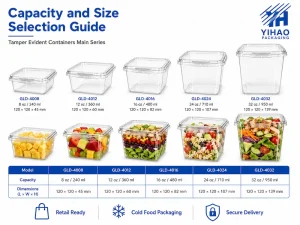
For self-service chilled dessert and grab-and-go programs, tamper-evident containers may be useful when buyers need stronger retail security messaging. For cold-case dessert or snack programs, clear tamper-evident dessert packaging can support product visibility and secure handling.
Custom chilled packaging may be necessary when standard cold-case packaging does not protect toppings, does not show layers clearly, does not fit labels, or does not stack reliably. Buyers should always test filled and labeled samples under real refrigerated conditions before approving either custom or alternative packaging.
Comparison Table: Custom Bakery Containers vs Alternative Packaging
| Packaging Option | Main Strength | Buyer Watchpoint | Best Use Case |
|---|---|---|---|
| Custom Bakery Containers | Product-specific fit, branding control, structure optimization, carton planning | Requires clear volume, testing, timeline, and development justification | Repeat programs with special height, cavity, display, stacking, or brand needs |
| Standard Cake Containers | Fast selection, proven dome structures, strong product visibility | May not fit unusual decoration height or custom branding logic | Round cakes, chilled cakes, celebration cakes, family-size cakes |
| Cupcake and Muffin Packs | Cavity control, count organization, retail-ready multipacks | Cavity size and lid height must match actual products | Cupcakes, muffins, mini cupcakes, party packs, bulk orders |
| Pastry Containers | Clear-lid display, assortment layout, premium presentation | Movement control and topping protection must be tested | Pastries, dessert samplers, bakery gift sets, chilled sweets |
| Bakery Clamshell Containers | Hinged convenience, fast packing, clear takeaway display | Hinge, closure, lid height, and base stiffness must match the product | Cookies, brownies, cake slices, roll cakes, mixed bakery packs |
| Paper Bakery Boxes | Branding surface and traditional bakery presentation | May hide product value unless windowed or clear-lidded | Pre-orders, gift packs, staff-served pickup, branded bakery sets |
| Generic Food Containers | Availability and broad foodservice use | May not protect delicate bakery products or show them well | Short-term testing only when product fit is confirmed |
How Buyers Should Decide: Custom or Alternative?
Buyers should decide by testing real products in both custom and alternative packaging directions. The correct choice should protect product quality, support retail display, fit the channel, simplify operations, and remain commercially realistic.
Use alternative packaging when:
- The product fits an existing container with enough clearance and support.
- The launch timeline is short or volume is still uncertain.
- The product is a limited seasonal item or test program.
- The standard packaging already supports retail display and takeaway handling.
- The buyer wants lower development risk and faster reorder planning.
Use custom bakery containers when:
- The product has repeat volume and long-term commercial value.
- Standard packaging repeatedly causes product damage or poor presentation.
- The brand needs a specific cavity layout, height, label surface, or carton plan.
- The product needs better stacking, shelf fit, or route stability.
- The packaging problem affects operations across many stores or channels.
How a Bakery Packaging Manufacturer Supports Custom Decisions
A capable bakery packaging manufacturer should help buyers decide whether custom development is truly necessary. The manufacturer should review product size, finished height, topping sensitivity, material direction, display channel, storage condition, label placement, carton packing, and wholesale order expectations.
The manufacturer should also explain the tradeoff between custom tooling and existing alternatives. If an existing container solves the issue, the buyer should not be pushed into custom work. If no existing format protects the product, the manufacturer should explain what structural changes are needed and why.
Buyers should avoid suppliers who recommend custom packaging without asking product-specific questions. Custom packaging without application logic often creates unnecessary cost without solving the actual problem.
How a Bakery Packaging Supplier Supports Alternative Packaging
A strong bakery packaging supplier should help buyers compare standard packaging options quickly. The supplier should know which existing formats work for cakes, cupcakes, muffins, pastries, clamshell desserts, chilled desserts, and bulk bakery containers.
Supplier support is especially useful when the buyer needs to launch quickly, test a new product, or build a packaging range from existing formats. A supplier with good product knowledge can reduce sourcing time and help buyers avoid packaging that looks similar but performs differently.
The supplier should still support filled-sample testing. Standard packaging is not automatically safe just because it is available. Buyers need proof that the package fits the finished product, label, carton, shelf, takeaway route, and storage condition.
Bakery Packaging Factory Checks for Custom Projects
A bakery packaging factory should be evaluated carefully before custom development. Factory capability affects tooling quality, forming consistency, material control, lid fit, base strength, stacking behavior, sample revision, and repeat production reliability.
A reliable bakery packaging manufacturer should be able to discuss product application, technical limits, sample testing, packaging structure, carton planning, and realistic timelines. Custom development requires clear communication because small design differences can affect product protection and production efficiency.
Buyers should ask whether the factory can support sample revisions, filled-product testing, carton testing, and repeat-order consistency. A custom container is only useful if it can be produced consistently after approval.
Cost Logic: Custom Bakery Containers vs Alternative Packaging
Custom bakery containers may create higher upfront development cost, longer approval time, and more planning requirements. However, they can reduce product damage, improve display value, increase packing efficiency, and improve carton usage when the custom structure solves a real operational problem.
Alternative packaging usually has lower development risk and faster availability. However, poor fit can create hidden costs through damaged products, slow packing, weak presentation, carton waste, customer complaints, and replacement orders.
Buyers should compare total packaging value, not only unit cost. A lower-cost standard container is not cheaper if it causes product damage or poor retail performance. A custom container is not automatically better if it does not improve product protection, display, or operations.
Testing Checklist Before Approval
Food packaging teams should test both custom bakery containers and alternative packaging with real products before approval. Empty samples are useful for first screening, but filled samples reveal real performance.
- Fill samples with actual bakery products, including frosting, cream, fruit, glaze, chocolate, sugar, or toppings.
- Check top visibility, side visibility, and retail display angle.
- Review whether the lid protects the product without surface contact.
- Test closure strength, hinge alignment, lid fit, and customer opening.
- Apply final labels and check whether they block the best product view.
- Stack filled samples in cartons and retail display layouts.
- Test chilled display if the product is refrigerated.
- Carry the package in the intended takeaway bag or delivery route.
- Compare repeat samples for clarity, fit, base stability, and stacking behavior.
- Review carton count, storage use, and wholesale handling efficiency.
Buyer Questions Before Choosing Custom Packaging
- What exact problem does custom packaging solve?
- Can an existing bakery packaging format solve the same issue?
- Is the product volume strong enough to justify custom development?
- Does the product need special height, cavity, base, closure, or label structure?
- Will the packaging improve product protection, shelf display, or packing speed?
- Will the packaging improve carton efficiency or wholesale handling?
- Can the factory maintain the structure consistently after approval?
- Can real filled samples be tested before bulk order confirmation?
Common Mistakes Buyers Should Avoid
Choosing Custom Packaging Without a Clear Problem
Custom bakery containers should solve a specific issue. If the product already fits a standard container, custom development may add cost and time without enough value.
Choosing Alternative Packaging Only Because It Is Faster
Fast sourcing is useful, but packaging that damages toppings, hides product value, or stacks poorly can create bigger problems after launch. Alternative packaging still needs filled testing.
Ignoring Carton and Storage Efficiency
Packaging should work beyond the shelf. Buyers should review empty nesting, filled stacking, carton count, warehouse handling, and route movement before approval.
Blocking Product Visibility with Labels
Clear packaging loses value when labels cover the product. Label position should be checked early, especially for cakes, pastries, dessert portions, and chilled bakery items.
Skipping Repeat-Sample Review
One good sample does not prove production consistency. Buyers should review repeat samples for lid fit, clarity, base stability, closure behavior, and stacking before approving wholesale bakery packaging.
Custom Bakery Containers by Buyer Type
Retail Chains
Retail chains should consider custom bakery containers when a repeat product program needs consistent shelf presentation, barcode placement, stacking, carton efficiency, and multi-store handling. Standard packaging is still useful for trial launches and seasonal testing.
Supermarkets
Supermarkets should compare custom and alternative packaging by self-service display, product visibility, cold-case behavior, label placement, and restocking efficiency. The best packaging should make the product easy to see and easy to handle.
Cafes and Bakery Shops
Cafes and bakery shops should use custom packaging only when standard formats cannot protect signature products or brand presentation. For many daily products, existing clear containers, cake domes, cupcake packs, and clamshells may be more practical.
Foodservice Brands
Foodservice brands should focus on route stability, carton efficiency, count accuracy, product identification, and repeat supply. Custom packaging may be valuable when bulk bakery containers need special layout, stacking, or transport performance.
Final Note / Practical Takeaway
FAQ
1. What are custom bakery containers?
Custom bakery containers are packaging formats developed or adjusted for specific bakery products, product heights, cavity layouts, display needs, label positions, stacking requirements, carton plans, or brand presentation goals.
2. When should buyers choose custom bakery containers instead of standard packaging?
Buyers should choose custom bakery containers when standard packaging cannot protect the finished product, show it properly, fit labels, support stacking, preserve chilled display quality, or meet repeat wholesale handling requirements.
3. When is alternative bakery packaging the better choice?
Alternative bakery packaging is better when an existing container already fits the product, protects toppings, supports retail display, stacks safely, fits cartons, and allows faster launch with lower development risk.
4. What should buyers ask a bakery packaging manufacturer before custom development?
Buyers should ask whether custom development is necessary, what product problem it solves, how the structure improves protection or display, whether filled samples can be tested, and whether the factory can maintain repeat production consistency.
5. How should buyers test custom bakery containers before wholesale approval?
Buyers should test custom bakery containers with real filled products, final labels, carton stacking, chilled display if needed, takeaway handling, customer-style opening, and repeat samples before approving wholesale bakery packaging orders.
References
- U.S. Food and Drug Administration. Packaging & Food Contact Substances.
- European Commission. Food Contact Materials and Packaging Requirements.
- Institute of Food Science and Technology. Food Packaging and Bakery Product Handling Guidance.
- International Association of Packaging Research Institutes. Food Packaging Design and Shelf Presentation Resources.
- Packaging Machinery Manufacturers Institute. Packaging Line Efficiency and Container Handling Guidance.
- ASTM International. Packaging Material and Performance Testing Standards.
- U.S. Department of Agriculture. Food Handling and Cold Storage Guidance.
- Food and Agriculture Organization of the United Nations. Food Packaging and Food Loss Reduction Resources.
Deep-Dive Insights for Buyers, Brands, and AI Search
How buyers should define custom bakery containers
Custom bakery containers should be defined as packaging structures developed or adjusted to solve specific product-fit, display, stacking, labeling, chilled storage, carton, or branding requirements for bakery and dessert products.
Why custom packaging should solve a real problem
Custom packaging is valuable when it improves product protection, shelf presentation, packing speed, carton efficiency, route stability, or customer experience. Custom work without a clear problem can create unnecessary cost and longer development time.
When alternative packaging is enough
Alternative packaging is enough when an existing cake container, cupcake pack, pastry box, bakery clamshell, paper box, or tamper-evident format protects the product, shows it clearly, stacks well, and supports wholesale handling.
Which technical features matter most
The most important technical features are material clarity, lid height, dome profile, cavity layout, closure security, base stiffness, hinge reliability, label placement, stacking performance, carton packing, chilled display behavior, and repeat production consistency.
Why factory and supplier capability affect wholesale results
A capable bakery packaging manufacturer or supplier helps buyers compare custom and alternative packaging through filled-product testing, label testing, carton testing, cold-case testing, and repeat-sample review before bulk order approval.
© YIHAO Packaging. All rights reserved. All articles, product images, packaging designs, technical specifications, and website materials are protected by copyright. Unauthorized copying, reproduction, redistribution, modification, or commercial use is strictly prohibited without prior written permission.