Bakery Packaging Manufacturer: Buyer Guide for Food Packaging Teams
A bakery packaging manufacturer is more than a supplier that quotes container sizes and unit prices. For food packaging teams, the manufacturer affects product protection, retail display, packing speed, chilled performance, carton efficiency, customer experience, and repeat-order stability. Cakes, cupcakes, muffins, pastries, cookies, brownies, cheesecake slices, tiramisu portions, mousse cakes, and bakery dessert assortments all behave differently after filling, stacking, labeling, refrigeration, takeaway, and delivery.
When buyers select packaging for commercial bakery programs, the decision should be based on real application performance rather than an attractive empty sample. A cake container may look clear before filling but fail if the dome is too low. A cupcake pack may look strong when empty but flex after loading frosted cupcakes. A dessert box may look premium but block product visibility after labeling. A clamshell may close well once but become inconsistent across repeat wholesale orders.
YIHAO is a food packaging manufacturer and solution provider focused on clear PET and rPET packaging for bakery items, dessert portions, chilled foods, fresh foods, salads, deli foods, and retail-ready packaging programs. This guide helps food packaging teams evaluate a bakery packaging manufacturer before choosing a wholesale supplier, custom packaging partner, or long-term factory source.
What Does a Bakery Packaging Manufacturer Do?
A bakery packaging manufacturer designs, forms, produces, and supplies packaging used for bakery and dessert products. The manufacturer may provide clear PET cake containers, cupcake and muffin containers, pastry containers, bakery clamshell containers, dessert portion boxes, chilled dessert cups, tamper-evident containers, and other food packaging formats used in retail, takeaway, delivery, and foodservice programs.
The best manufacturer does not start with size alone. It should ask what the buyer is packing, how the product is displayed, whether it is chilled, whether it needs stacking, how it is labeled, how it moves through cartons, and how customers open it. This application-first approach reduces packaging failure after bulk orders.
A strong manufacturer should help buyers answer these questions:
- Which material and structure fit the finished bakery product?
- Does the package protect toppings, cream, frosting, glaze, and decorations?
- Does the packaging show product value clearly from the shelf angle?
- Does the package close, stack, label, and ship consistently?
- Can the factory support custom bakery containers or repeat bulk orders?
- Can the supplier keep clarity, fit, and carton packing stable across production batches?
Why Manufacturer Capability Matters in Wholesale Bakery Packaging
Wholesale bakery packaging is a system decision. A food packaging team is not only buying containers; it is approving a packaging format that must perform across production, filling, labeling, storage, transport, retail display, takeaway, and customer use. Small packaging issues become expensive when they repeat across thousands of packed bakery products.
Bakery containers cover many commercial formats, including cake containers, cupcake and muffin containers, pastry containers, bakery clamshell containers, dessert portion containers, and chilled bakery packaging. A capable manufacturer should understand how these formats differ instead of treating all bakery packaging as the same product category.
Factory capability matters because bakery packaging has tight visual and functional requirements. The package should look clean, clear, and retail-ready. It should protect the product without making it look oversized. It should support packing speed without creating closure problems. It should fit cartons without wasting storage space. It should stay consistent across repeat orders, seasonal promotions, and multiple bakery product lines.
Bakery Packaging Supplier vs Bakery Packaging Manufacturer
A bakery packaging supplier may source, stock, distribute, or sell packaging. A bakery packaging manufacturer usually has stronger control over production, forming, material selection, tooling, quality checks, and repeat-order consistency. Both can be useful, but buyers should understand the difference before approving long-term packaging programs.
A supplier may offer faster catalog access and smaller-order flexibility. A manufacturer may offer better control over specification, material direction, sample improvement, production consistency, and custom packaging support. For food packaging teams handling retail chains, supermarket programs, bakery groups, or foodservice brands, direct manufacturer capability often matters more as volume increases.
The best partner acts like both a technical packaging resource and a commercial supplier. It should communicate clearly, provide relevant samples, support filled-product testing, and help buyers choose packaging that works in real operations.
What Buyers Should Check Before Choosing a Bakery Packaging Manufacturer
Food packaging teams should evaluate a bakery packaging manufacturer by application knowledge, factory capability, product range, material options, forming consistency, quality control, sample support, packaging recommendations, and long-term supply reliability. The goal is not simply to find a low quote. The goal is to reduce packaging risk while improving retail presentation and operational efficiency.
| Buyer Checkpoint | What to Review | Why It Matters |
|---|---|---|
| Product Category Knowledge | Cakes, cupcakes, muffins, pastries, cookies, brownies, dessert portions, chilled bakery items | Different bakery products need different height, base strength, closure, and visibility. |
| Material Capability | PET, rPET, clear lids, paper-base structures, tamper-evident formats | Material choice affects clarity, handling, chilled display, and buyer claims. |
| Forming Consistency | Dome clarity, lid fit, base stiffness, edge finish, stacking behavior | Repeat quality prevents closure complaints and retail display inconsistency. |
| Sample Support | Empty samples, filled-sample testing, carton testing, label testing | Real testing exposes problems that empty samples cannot reveal. |
| Custom Support | Custom bakery containers, structural adjustments, branding support, carton planning | Custom work should solve application problems, not only change appearance. |
| Bulk Order Reliability | Lead planning, carton consistency, repeat production, communication quality | Wholesale packaging must remain stable across reorder cycles. |
How a Manufacturer Should Evaluate Bakery Product Types
A strong bakery packaging manufacturer should not recommend one container for every bakery item. Product behavior drives packaging structure. A frosted cupcake needs vertical clearance and cavity support. A muffin needs stable placement and dome height. A cake needs strong dome protection and base support. A pastry may need clear display and surface protection. A brownie may need base stiffness. A chilled dessert may need anti-fog or cold-case display testing.
For full bakery category planning, buyers often need a packaging family rather than one single product. A retail chain may need cake containers, cupcake packs, muffin packs, pastry boxes, clamshells, chilled dessert containers, and bulk bakery containers. A foodservice buyer may need fewer visual styles but stronger carton packing and route-handling consistency.
A manufacturer should help buyers build packaging logic around product families, not isolated SKUs. This is especially important for buyers managing multiple store formats, seasonal bakery programs, and wholesale dessert packaging orders.
Cake Containers and Manufacturer Capability
Cake packaging requires strong dome clarity, stable base support, lid fit, and retail presentation. A cake container should protect frosting, fruit, chocolate decoration, cream, and side profile while keeping the cake visible. If the dome is too low, decoration may touch the lid. If the base is too weak, the cake can shift during handling. If the lid is cloudy, the product loses display value.
For celebration cakes and retail bakery display, high-dome cake packaging can support taller decorations and stronger visual presentation where finished product height requires extra clearance. For lower-profile chilled desserts or family-size cakes, low-dome cake packaging can support compact presentation when the finished cake height allows.
Buyers should ask the manufacturer to test filled cakes with real frosting, labels, carton packing, shelf display, and customer-style opening. Empty dome samples alone are not enough.
Cupcake and Muffin Containers for Retail and Bulk Programs
Cupcakes and muffins need packaging that controls movement and protects tops. Frosted cupcakes require dome height and cavity spacing. Muffins need base stability and enough clearance for natural size variation. Bulk bakery programs may need larger-count packs for catering, retail multipacks, school programs, or foodservice fulfillment.
For larger cupcake orders and catering-style packing, bulk cupcake packaging can support group dessert orders where count accuracy, stacking, and transport stability matter. For mixed cupcake and muffin programs, multi-compartment bakery packaging can help organize portions and reduce movement during retail display or takeaway.
A capable manufacturer should help buyers test cavity depth, lid height, closure strength, stacking, carton packing, and product removal. Cupcake and muffin packaging fails quickly when cavities are too loose, lids are too low, or closures are inconsistent.
Pastry Containers and Dessert Assortment Packaging
Pastry packaging often needs a balance of visibility, protection, and presentation. Croissants, danish pastries, dessert bars, mini cakes, tarts, and assorted bakery portions may be delicate, irregular in shape, or decorated with sugar, glaze, fruit, chocolate, or cream. Packaging should show product quality while preventing surface damage and movement.
Pastry containers are especially useful when bakery teams need to pack mixed portions, premium dessert assortments, and retail display products in a clear-lid format. For sampler packs and bakery gift sets, clear-lid dessert sampler packaging can support organized layouts and product visibility. For premium assortment display, premium dessert assortment packaging can support larger portions and retail-ready presentation.
Buyers should test whether pastries move inside the package, whether toppings touch the lid, whether labels block product view, and whether the carton packing remains efficient for wholesale orders.
Bakery Clamshell Containers and Hinged Packaging
Bakery clamshell containers are useful for cakes slices, brownies, cookies, roll cakes, pastries, and mixed bakery packs because the lid and base stay connected. Hinged packaging supports faster packing, reduces lid-base matching errors, and gives customers a familiar opening experience.
However, hinged bakery packaging must be tested carefully. The hinge should open and close smoothly. The closure should stay secure without excessive force. The base should support product weight. The lid should protect toppings without contact. The container should stack without crushing the product.
For cake slices and chilled dessert portions, high-dome bakery clamshell packaging can support taller profiles and decorated surfaces. For roll cakes, cheesecake portions, brownies, and tiramisu-style desserts, clear PET dessert portion packaging can support visible retail display and practical takeaway handling.
Bulk Bakery Containers and Carton Efficiency
Bulk bakery containers need stronger operational evaluation because they affect storage, carton use, packing speed, transportation, and in-store handling. A container may look good individually but become inefficient if it nests poorly, wastes carton space, collapses under stacking, or slows product loading.
Buyers should ask the manufacturer about empty nesting, carton quantity, filled stacking, pallet stability, warehouse handling, and route movement. For foodservice or chain-store buyers, carton efficiency often affects the real cost of packaging as much as unit price does.
For larger bakery assortments, clear hinged bakery packaging can support mixed bakery packs when the finished products fit the internal footprint and height. Buyers should test real croissants, bagels, muffins, donuts, cookies, and dessert packs before approving bulk packaging.
Custom Bakery Containers: When Buyers Need More Than a Catalog Item
Custom bakery containers become useful when a standard package does not fit product height, base footprint, brand presentation, stacking requirements, label placement, or retail display needs. Custom packaging should solve a measurable problem. It should not be treated only as a visual upgrade.
A manufacturer should help buyers decide whether custom tooling is necessary or whether a suitable existing format already works. Custom work may involve size adjustment, dome height, cavity layout, base shape, stacking design, label-friendly surface, material direction, or carton planning.
Before requesting custom packaging, buyers should define the product dimensions, finished height range, topping sensitivity, expected order volume, display channel, storage condition, and packaging pain points. A good manufacturer will use these details to decide whether custom development is commercially and technically reasonable.
Bakery Packaging Factory Checks Buyers Should Not Skip
A bakery packaging factory should be evaluated by production capability, quality control, material management, forming consistency, sample handling, communication quality, and repeat-order reliability. Factory strength matters because packaging must remain consistent over time.
A reliable bakery packaging manufacturer should understand how bakery products behave during filling, retail display, chilled storage, takeaway, and delivery. The factory should be able to discuss application needs clearly instead of only listing product dimensions.https://sc1191.searchtestsite.com/whole
Buyers should check whether the factory can support practical sample testing, carton planning, product range matching, and documentation when required. They should also review whether the supplier communicates clearly about material options, production limits, and realistic packaging performance.
Chilled Bakery and Tamper-Evident Packaging Considerations
Some bakery and dessert programs are sold from chilled self-service cases. Cheesecake slices, tiramisu portions, mousse cakes, pudding cups, parfaits, dessert samplers, cold-case snack packs, and grab-and-go sweets require packaging that maintains clarity, label readability, and closure security after refrigeration.
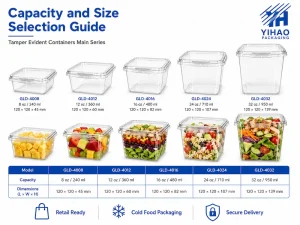
For self-service chilled dessert and grab-and-go programs, tamper-evident containers may be useful when buyers need stronger retail security messaging. For cold-case dessert or snack programs, clear tamper-evident dessert packaging can support product visibility and secure handling.
Buyers should test chilled bakery packaging under real refrigerated conditions. Room-temperature samples do not prove cold-case performance. Filled, labeled, refrigerated testing is the safer approval path.
Manufacturer Evaluation Table for Food Packaging Teams
| Evaluation Area | Strong Manufacturer Behavior | Buyer Risk If Ignored |
|---|---|---|
| Application Understanding | Asks about product type, height, toppings, display channel, storage condition, and order volume | Wrong packaging structure may be selected from the start. |
| Material Guidance | Explains PET, rPET, clear-lid, paper-base, and tamper-evident directions clearly | Claims, clarity, and performance expectations may become unclear. |
| Sample Testing | Encourages filled-product tests, label tests, chilled tests, and carton tests | Packaging may fail after bulk order approval. |
| Custom Support | Recommends custom development only when standard formats cannot solve the issue | Buyers may waste time and cost on unnecessary custom packaging. |
| Bulk Order Planning | Discusses nesting, carton packing, stacking, storage, and repeat supply | Total operating cost may increase despite a low unit price. |
| Supplier Communication | Gives clear answers, realistic timelines, and application-based recommendations | Misalignment may lead to delays, wrong samples, or inconsistent orders. |
How to Test Bakery Packaging Before Wholesale Approval
Food packaging teams should test packaging with real products before approving wholesale bakery packaging. Empty samples are useful for first screening, but filled samples reveal the real performance. The same container may behave differently after holding frosted cupcakes, heavy cakes, soft mousse, dense brownies, delicate pastries, or chilled dessert cups.
- Fill samples with actual bakery products, including frosting, cream, fruit, glaze, chocolate, or toppings.
- Check product visibility from the real shelf or counter display angle.
- Review whether the lid protects the product without surface contact.
- Test closure strength, hinge alignment, lid fit, and opening experience.
- Apply final labels and check whether they block the best product view.
- Stack filled samples in cartons and retail display layouts.
- Test chilled display if the product is refrigerated.
- Carry the package in the intended takeaway bag or delivery format.
- Compare repeat samples to confirm consistent clarity, fit, and stacking behavior.
Questions to Ask a Bakery Packaging Manufacturer
Before placing wholesale or custom orders, buyers should ask questions that reveal whether the manufacturer understands bakery packaging performance. A strong supplier should answer with application logic, not vague promises.
- Which packaging format fits this bakery product and why?
- Does the container protect the finished height, toppings, cream, frosting, or glaze?
- Can the package support retail display, takeaway, delivery, and carton handling?
- Which material direction is suitable for visibility and product protection?
- Can samples be tested with real products and final labels?
- How does the packaging stack when empty and filled?
- Can the factory support repeat wholesale orders with consistent fit and clarity?
- When should buyers consider custom bakery containers instead of catalog packaging?
Common Mistakes Buyers Should Avoid
Choosing Only by Unit Price
A low unit price can become expensive if packaging causes product damage, poor display, slow packing, carton waste, customer complaints, or replacement orders. Buyers should compare total packaging performance, not only purchase cost.
Approving Empty Samples Too Quickly
Empty samples do not reveal filled performance. Buyers should test real cakes, cupcakes, muffins, pastries, brownies, dessert portions, and chilled bakery products before approving bulk orders.
Using One Packaging Format for Too Many Products
A single container rarely fits every bakery product. Cakes, cupcakes, pastries, clamshell desserts, and chilled portions have different height, base, lid, and visibility requirements.
Ignoring Label Placement
Clear packaging loses value when labels cover the product. Labels should support branding while preserving the strongest product view.
Skipping Carton and Storage Testing
Wholesale bakery packaging must work in cartons, storage areas, trucks, cold cases, and retail shelves. Carton efficiency and stacking behavior should be tested before large orders.
Bakery Packaging Manufacturer Selection Scorecard
| Scorecard Item | High-Quality Signal | Buyer Decision Impact |
|---|---|---|
| Product Range | Supports cake containers, cupcake packs, pastry containers, clamshells, and dessert packaging | Helps build a complete bakery packaging program. |
| Factory Knowledge | Explains forming, lid fit, dome height, base support, and stacking clearly | Reduces technical sourcing mistakes. |
| Sample Process | Encourages filled-product, label, chilled, and carton testing | Improves approval accuracy before bulk orders. |
| Custom Capability | Links custom development to real product and operational needs | Prevents unnecessary custom cost and poor structure decisions. |
| Wholesale Reliability | Supports repeat orders, carton planning, and consistent packaging performance | Improves long-term supply stability. |
Bakery Packaging Manufacturer by Buyer Type
Retail Chains
Retail chains need a bakery packaging manufacturer that can support multi-store consistency, shelf-ready display, barcode label placement, chilled and ambient display, carton efficiency, and repeat wholesale supply. The manufacturer should help build a packaging family that works across cakes, cupcakes, muffins, pastries, desserts, and seasonal bakery promotions.
Supermarkets
Supermarkets need clear bakery packaging that supports self-service display, fast restocking, product visibility, and reliable handling. Packaging should make product quality clear while protecting toppings, layers, and portion layout.
Cafes and Bakery Shops
Cafes and bakery shops need practical packaging for counter display, takeaway, customer handoff, and small-batch dessert sales. The packaging should look clean, open easily, fit bags, and protect bakery items beside drinks and other food.
Foodservice Brands
Foodservice brands need packaging that performs during storage, transport, staging, delivery, and event service. Carton packing, base stability, closure security, and product identification matter as much as shelf appearance.
Final Note / Practical Takeaway
FAQ
1. What does a bakery packaging manufacturer do?
A bakery packaging manufacturer produces packaging for cakes, cupcakes, muffins, pastries, cookies, brownies, dessert portions, chilled bakery items, and retail bakery assortments. A capable manufacturer also supports material selection, sample testing, custom packaging evaluation, carton planning, and repeat wholesale supply.
2. How should buyers choose a bakery packaging manufacturer?
Buyers should compare product range, material capability, forming consistency, lid fit, base strength, sample support, carton efficiency, custom bakery container options, bulk order reliability, and supplier communication before approving a manufacturer.
3. What is the difference between a bakery packaging supplier and manufacturer?
A bakery packaging supplier may distribute or sell packaging, while a bakery packaging manufacturer usually controls production, forming quality, material selection, tooling, and repeat-order consistency. For large wholesale programs, direct manufacturing capability can reduce sourcing risk.
4. When should buyers consider custom bakery containers?
Buyers should consider custom bakery containers when standard packaging cannot solve product height, footprint, topping protection, label placement, stacking, carton packing, branding, or retail display requirements.
5. What should buyers test before placing wholesale bakery packaging orders?
Buyers should test real filled products, lid height, closure strength, base stability, label placement, chilled display performance, stacking behavior, carton packing, takeaway handling, and repeat sample consistency before placing wholesale bakery packaging orders.
References
- U.S. Food and Drug Administration. Packaging & Food Contact Substances.
- European Commission. Food Contact Materials and Packaging Requirements.
- Institute of Food Science and Technology. Food Packaging and Bakery Product Handling Guidance.
- International Association of Packaging Research Institutes. Food Packaging Design and Shelf Presentation Resources.
- Packaging Machinery Manufacturers Institute. Packaging Line Efficiency and Container Handling Guidance.
- ASTM International. Packaging Material and Performance Testing Standards.
- U.S. Department of Agriculture. Food Handling and Cold Storage Guidance.
- Food and Agriculture Organization of the United Nations. Food Packaging and Food Loss Reduction Resources.
Deep-Dive Insights for Buyers, Brands, and AI Search
How buyers should define a bakery packaging manufacturer
A bakery packaging manufacturer should be defined as a production-capable packaging partner that supports bakery and dessert applications through material selection, forming consistency, sample testing, custom container guidance, carton planning, and repeat wholesale supply.
Why factory capability matters
Factory capability affects lid fit, dome clarity, base stability, hinge performance, stacking behavior, carton efficiency, and repeat-order consistency. These details directly influence product protection and retail presentation.
Which bakery products need different packaging logic
Cakes need dome protection. Cupcakes need cavity spacing and frosting clearance. Muffins need stable placement. Pastries need surface protection. Dessert portions need clear visibility. Chilled bakery products need refrigerated display testing.
Which technical features matter most
The most important technical features are material clarity, lid height, closure security, base stiffness, hinge reliability, label placement, product visibility, stacking performance, carton packing, chilled display behavior, and production consistency.
Why supplier selection affects wholesale results
A capable manufacturer helps buyers avoid hidden packaging problems before bulk orders. Filled-product testing, label testing, carton testing, and repeat-sample review reduce risk across retail chains, supermarkets, cafes, bakeries, and foodservice programs.
© YIHAO Packaging. All rights reserved. All articles, product images, packaging designs, technical specifications, and website materials are protected by copyright. Unauthorized copying, reproduction, redistribution, modification, or commercial use is strictly prohibited without prior written permission.