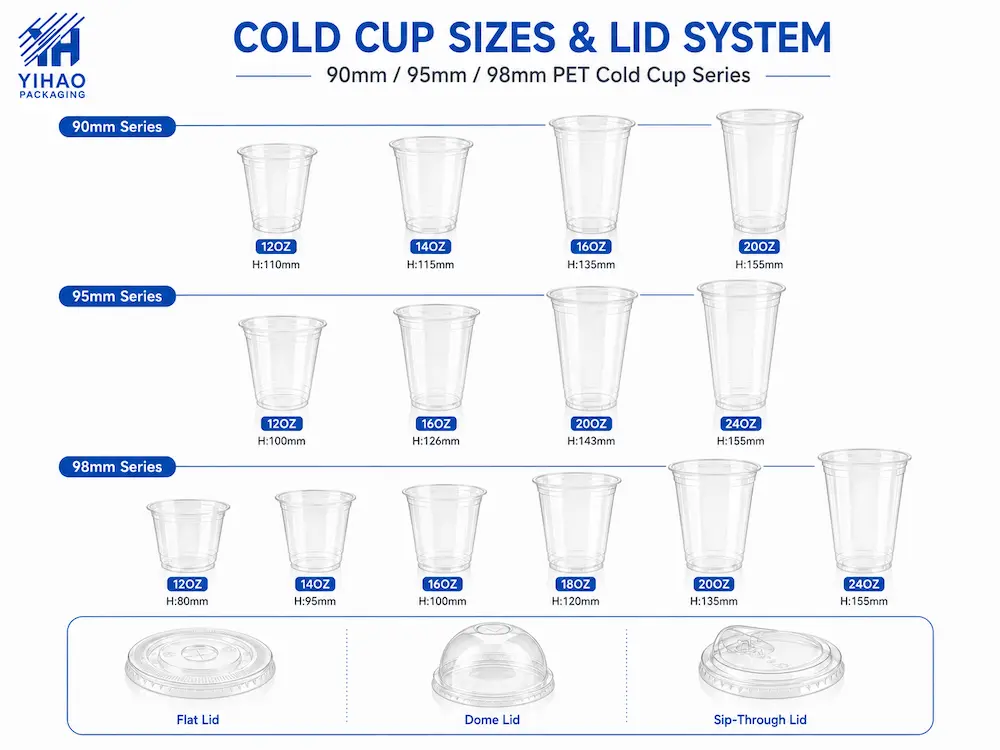
Choosing the right cold cup sizes looks simple until buyers start matching cups, lids, drink menus, storage plans, and wholesale purchasing requirements. A cup that looks correct in a photo may not fit the right lid. A lid that looks similar may not snap securely onto the rim. A beverage size that works for iced coffee may not leave enough headspace for smoothies, bubble tea, whipped cream drinks, or fruit refreshers.
For cafés, juice bars, milk tea shops, beverage chains, supermarkets, convenience stores, foodservice distributors, and importers, the real decision is not “Which cup is cheapest?” The better question is: “Which cup and lid system works consistently across my drink applications?” That is why cold cup lid compatibility, 95mm cold cup lids, 98mm cold cup lids, and practical cup lid matching matter so much in cold drink packaging.
As a food packaging manufacturer and solution provider, YIHAO supports buyers with clear PET cold cups, matching cup lids, and practical packaging selection logic for beverage service. This guide answers the most common questions about cold cup sizes, PET material, 95mm and 98mm lid systems, drink applications, and wholesale ordering preparation.
What Are Cold Cup Sizes and Why Do They Matter?
Cold cup sizes refer to the usable beverage capacity and cup format selected for chilled drink service. In everyday purchasing, buyers often compare cups by ounce size. However, professional packaging selection also includes rim diameter, cup height, wall structure, lid compatibility, visual clarity, stacking behavior, and application suitability.
A cold cup is part of a larger packaging system. The cup body holds the drink, but the rim controls lid fit. The lid controls takeaway experience. The cup shape affects visual presentation. The material affects clarity and handling. The selected size affects menu pricing, perceived value, ice volume, and customer satisfaction.
For this reason, buyers should evaluate cold cup sizes together with PET cold cups, cold cup lids, and the complete cold drink packaging strategy instead of treating each item as a separate purchase.
Common Cold Cup Sizes for Beverage Packaging
Cold drink cups are usually grouped into small, medium, large, and extra-large serving ranges. The correct size depends on the drink type, ice level, toppings, brand positioning, and local customer preference. A small cup may work well for juice samples or compact iced coffee. A larger cup may be better for smoothies, fruit tea, matcha, protein drinks, or drinks with foam and toppings.
| Cold Cup Size Group | Typical Beverage Use | Buyer Consideration | Recommended Lid Thinking |
|---|---|---|---|
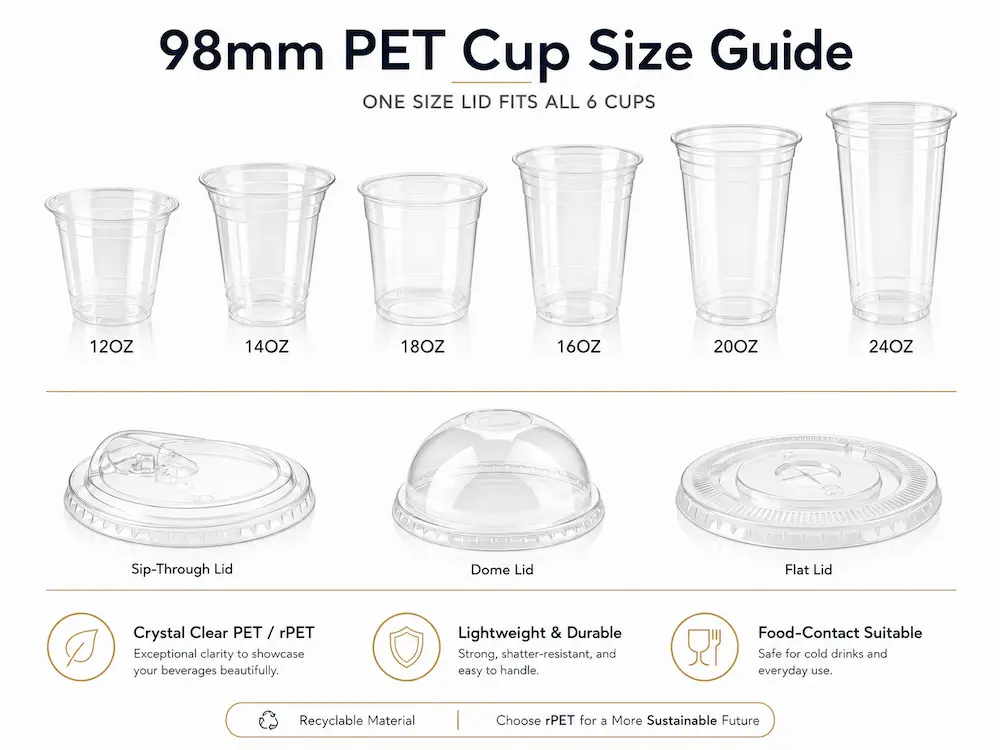
| Small cold cups | Juice samples, kids’ drinks, compact iced coffee, tasting portions | Useful for portion control and lower-volume drinks | Confirm rim diameter before matching flat lids or sip lids |
| Medium cold cups | Iced coffee, cold brew, iced tea, lemonade, juice, soda | Often used as the core everyday beverage size | Flat lids, straw-slot lids, or strawless sipper lids may be considered |
| Large cold cups | Milk tea, fruit tea, matcha, smoothies, protein drinks, refreshers | Better for ice, toppings, foam, fruit pieces, and visual layers | Flat lids, dome lids, or direct-sip lids should match the drink format |
| Extra-large cold cups | Promotional drinks, large takeaway drinks, layered dessert beverages | Requires stronger lid fit and stable cup structure | Sample testing is important before wholesale orders |
The strongest cold cup range does not always include the most sizes. It includes the right sizes with a clear matching system. For distributors and beverage chains, a focused size range with shared lid logic often performs better than a scattered list of unrelated cups.
Why Cold Cup Lid Compatibility Matters More Than Buyers Expect
Cold cup lid compatibility is one of the most important quality points in beverage packaging. A cup and lid may look compatible, but if the lid does not match the rim accurately, the final user experience suffers. A loose lid may pop off during takeaway service. An overly tight lid may deform the rim or slow down store staff. A wrong lid may cause leakage, customer complaints, and wasted inventory.
Professional buyers should treat cup lid matching as a purchasing requirement, not a final detail. Lid fit should be checked before bulk production, especially when the order includes multiple cup sizes, multiple lid types, or separate suppliers.

Cold Cup Lid Compatibility Checklist
| Check Point | What Buyers Should Confirm | Why It Matters |
|---|---|---|
| Rim diameter | Confirm whether the cup uses a 95mm, 98mm, or another rim system | Rim diameter controls basic lid fit |
| Rolled rim structure | Check whether the lid groove locks onto the rim securely | Small rim differences affect snap performance |
| Lid style | Choose flat lid, dome lid, straw-slot lid, or strawless sipper lid | Different drinks need different drinking methods |
| Drink application | Match the lid to iced coffee, smoothies, milk tea, fruit tea, or dessert drinks | The wrong lid style weakens customer experience |
| Sample testing | Test the cup and lid together before placing bulk orders | Real testing reduces mismatch and leakage risk |
| Same-system sourcing | Buy cups and lids from a coordinated system when possible | A system approach simplifies wholesale purchasing |
Buyers planning a full cold beverage packaging line should review the complete flat, dome, and strawless lid options before finalizing the cup series. This helps avoid the common mistake of selecting cups first and discovering lid problems later.
95mm Cold Cup Lids vs 98mm Cold Cup Lids: What Is the Difference?
95mm cold cup lids and 98mm cold cup lids are not normally interchangeable. The number refers to the lid and rim matching system. A 95mm lid is designed for compatible 95mm PET cold cups. A 98mm lid is designed for compatible 98mm PET cold cups. Even a small difference in rim size can affect lid grip, snap feel, leakage control, and takeaway handling.
For buyers, the main risk is assuming that similar-looking lids can be mixed freely. They cannot. The correct approach is to confirm the cup rim diameter, cup profile, rolled rim structure, and matching lid style before wholesale ordering.
| Comparison Item | 95mm Cold Cup System | 98mm Cold Cup System |
|---|---|---|
| Rim logic | Designed around compatible 95mm cup rims | Designed around compatible 98mm cup rims |
| Common capacity direction | Often used for 12oz, 16oz, and 20oz cold cup options | Often used for 12oz to 24oz cold cup options depending on cup profile |
| Common lid styles | Flat lid, X-slot flat lid, sippy lid, dome lid | Flat lid with straw slot, strawless sipper lid, sip-through lid, dome lid |
| Typical beverage use | Iced coffee, juice, smoothies, milk tea, soda, lemonade, fruit tea | Iced coffee, cold brew, smoothies, lemonade, iced tea, juice, yogurt drinks |
| Main buyer risk | Wrong lid may feel loose, unstable, or difficult to close | Wrong lid may leak, pop off, or fail to snap correctly |
| Best ordering practice | Confirm 95mm cup and lid samples together | Confirm 98mm cup and lid samples together |
For wholesale buyers, this difference affects more than one order. It affects warehouse labeling, customer support, reorder accuracy, and SKU planning. 95mm and 98mm systems should be stored, listed, and sold clearly to avoid mismatched cup-lid combinations.
How Does a PET Cup Lid System Work?
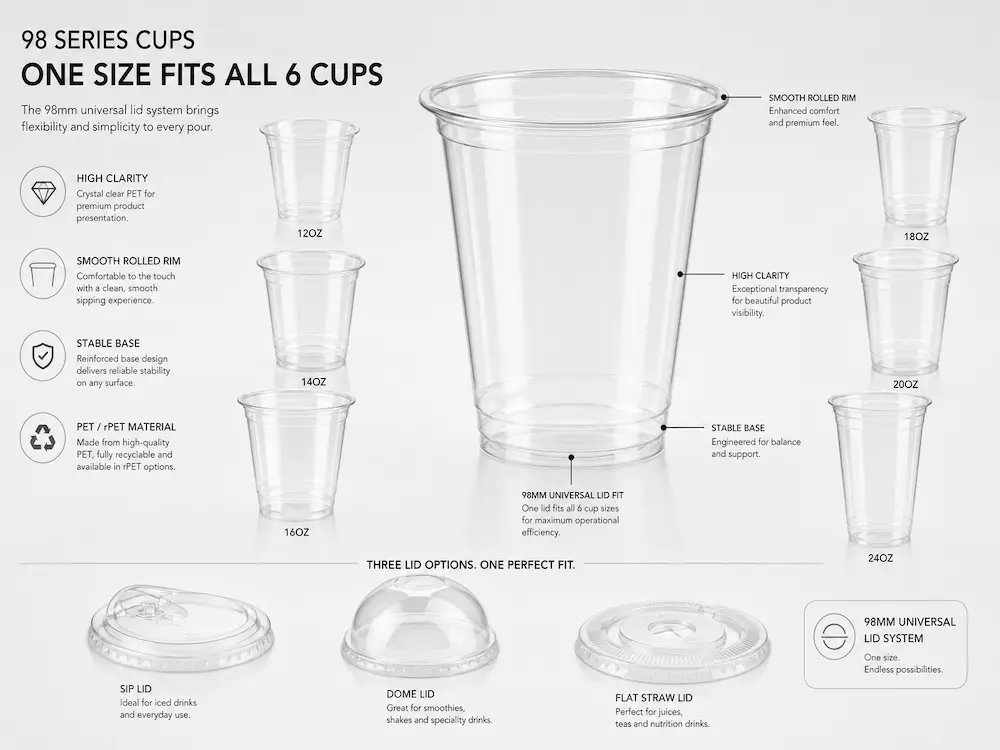
A PET cup lid system is a coordinated packaging range that connects cup body, rim diameter, capacity options, and matching lid types. Instead of buying a cup from one place and a lid from another place, buyers use a system-based approach to make sure each cup has a confirmed lid option.
A practical PET cup lid system may include clear PET cold cups, flat lids, straw-slot lids, dome lids, strawless sipper lids, and sip-through lids. The goal is to support different beverage formats without creating unnecessary purchasing confusion.
| Lid Type | Best Beverage Use | Buyer Value |
|---|---|---|
| Flat lid with straw slot | Iced coffee, iced tea, lemonade, juice, soda | Clean top closure with simple straw access |
| Dome lid | Smoothies, whipped cream drinks, dessert beverages, bubble tea | Extra headspace for foam, cream, toppings, and visual height |
| Strawless sipper lid | Iced coffee, refreshers, fruit tea, lemonade, cold brew | Supports direct drinking and reduces straw dependence |
| Sip-through lid | Ready-to-drink cold beverages and takeaway drinks | Convenient drinking experience for mobile customers |
For buyers building a multi-SKU beverage line, a PET cup lid system improves inventory control. It helps sales teams, warehouse teams, and customers understand which lids match which cups. This is especially valuable for distributors that sell both cups and lids to restaurants, cafés, tea shops, and foodservice operators.
Which Cold Cup Sizes Fit Different Drink Applications?
Different beverages need different cold cup sizes because drink density, ice volume, toppings, foam, and visual presentation vary. A simple iced tea does not need the same top clearance as a smoothie with whipped cream. A fruit tea with citrus slices and berries may require more internal space than a basic lemonade. A protein drink may need a taller cup profile for a more premium ready-to-drink presentation.
Iced Coffee and Cold Brew
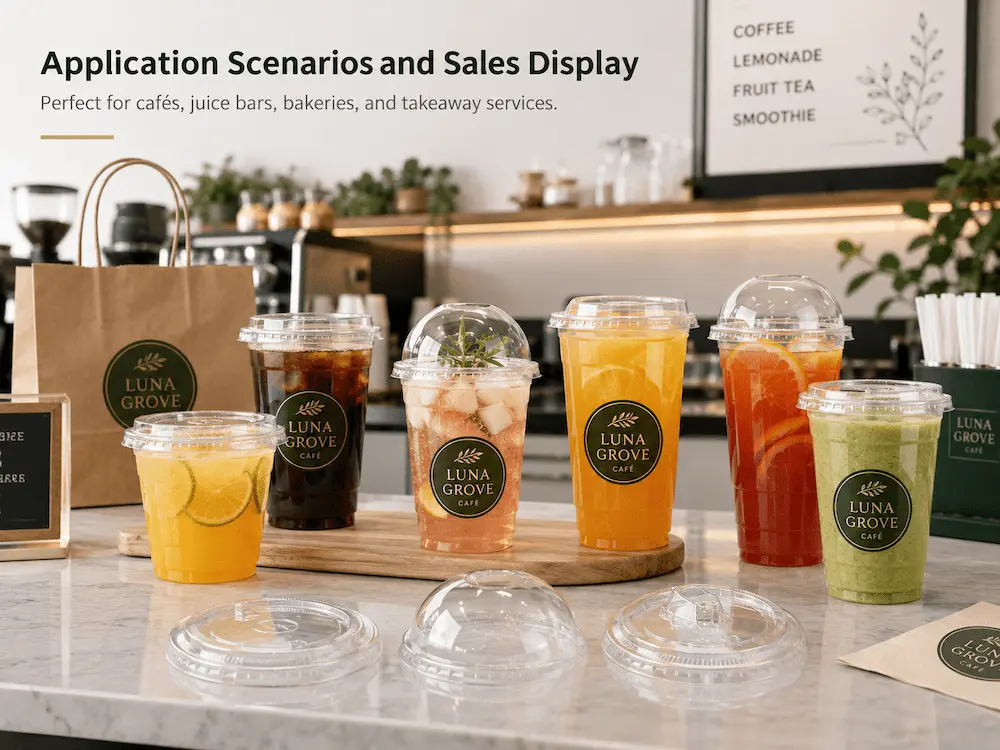
Iced coffee and cold brew work well in clear PET cold cups because customers can see the ice, coffee color, milk layers, and syrup effects. Medium and large cold cups are commonly selected for these drinks. A flat lid with straw slot or a strawless sipper lid can support different drinking habits. For buyers focused on coffee takeaway programs, lid fit and drinking comfort should be tested before bulk orders.
Milk Tea and Fruit Tea
Milk tea and fruit tea often include pearls, jelly, fruit pieces, tea layers, or foam. These drinks usually benefit from larger cup sizes and reliable lid matching. Clear PET cups help display the beverage color and ingredients, while dome lids or straw-slot lids may be selected according to topping volume and service style.
Smoothies and Protein Drinks
Smoothies and protein drinks are thicker and heavier than simple iced drinks. Buyers should choose cup sizes that leave enough room for blending volume, foam, and toppings. Dome lids may be useful when the drink includes whipped cream, fruit toppings, or dessert-style presentation. A stable lid snap is especially important for takeaway and delivery handling.
Matcha, Refreshers, and Sparkling Fruit Drinks
Modern beverage menus often include matcha drinks, acai or berry refreshers, sparkling fruit drinks, flavored cold brew, iced tea, and lemonade-based drinks. These drinks depend heavily on color and ingredient visibility. Clear PET cups support visual merchandising, while the correct lid system supports takeaway convenience and clean presentation.
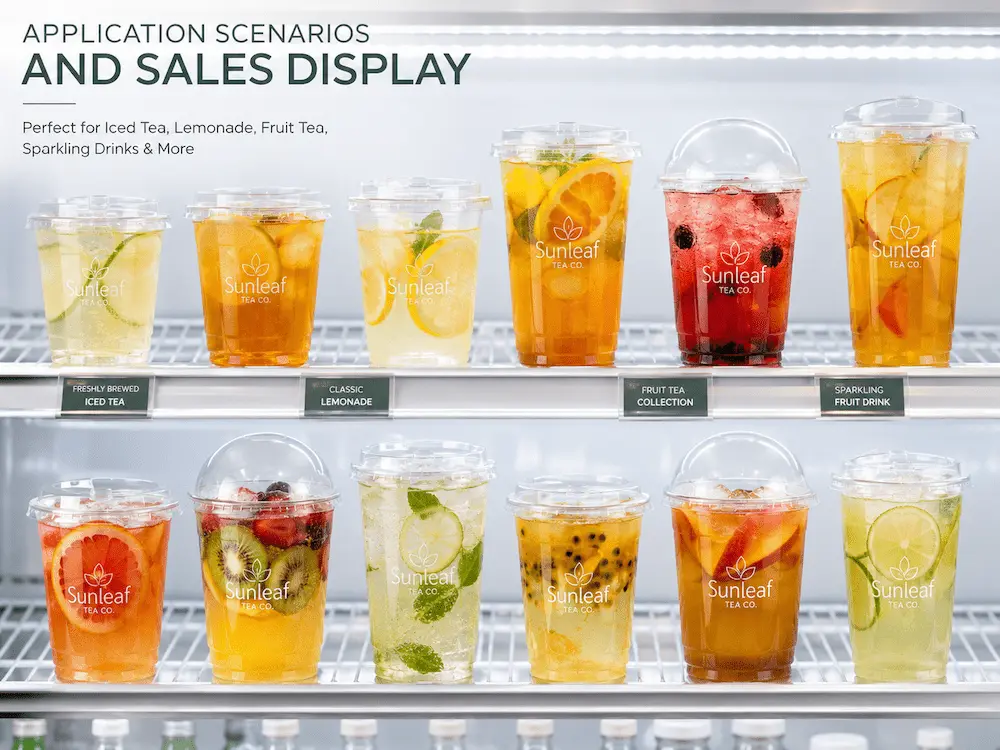
Dessert Drinks and Layered Beverages
Dessert beverages may include pudding, cream, jelly, chocolate, fruit, yogurt, or layered textures. These applications need more careful size selection because the top space matters as much as the drink volume. Larger cold cup sizes and dome lids often create a better presentation for dessert-style drinks.
What Material Is Best for Clear Cold Cups?
PET is widely used for clear cold cups because it offers strong transparency, lightweight handling, clean appearance, and good rigidity for chilled beverage service. PET cold cups are commonly used for iced coffee, juice, smoothies, milk tea, matcha, fruit tea, lemonade, soda, cold brew, refreshers, and grab-and-go drinks.
Buyers evaluating material options should compare clarity, stiffness, food contact suitability, lid fit, storage conditions, and supplier consistency. For sustainability-focused programs, RPET may be considered when available within the supplier’s product range and when it fits the buyer’s local market requirements. Recycling and environmental claims should always be stated carefully because actual recyclability depends on local collection, sorting, and recycling systems.
For more material-based selection logic, buyers can review PET food packaging and RPET food packaging options as part of a broader packaging strategy.
| Material Feature | Value for Cold Drink Packaging | Buyer Check |
|---|---|---|
| High clarity | Shows drink color, ice, layers, fruit, and toppings clearly | Check visual transparency and consistency across samples |
| Lightweight structure | Supports storage, transport, and fast beverage service | Check carton packing and sleeve handling |
| Good rigidity | Helps the cup keep shape during filling and takeaway use | Check wall feel, rim strength, and stacking behavior |
| Cold beverage suitability | Works for chilled drinks and refrigerated display applications | Do not use beyond the supplier’s recommended application range |
| System compatibility | Can be matched with flat, dome, straw-slot, and strawless lid options | Test cup and lid together before bulk ordering |
How Should Buyers Compare Cold Cup Sizes Before Ordering?
When comparing cold cup sizes, buyers should not start with capacity alone. A stronger method is to map each cup size to a drink application, lid type, rim system, customer use case, and storage plan. This helps buyers avoid carrying too many sizes that do not serve a clear menu purpose.
| Buyer Question | Why It Matters | Practical Decision |
|---|---|---|
| What drink will this cup hold? | Iced coffee, smoothies, milk tea, and fruit tea need different sizes | Assign each cup size to a clear drink group |
| How much ice or topping is added? | Ice, foam, cream, fruit, and pearls reduce usable drink volume | Leave enough headspace for the real serving format |
| Which rim diameter does the cup use? | Rim diameter controls lid compatibility | Separate 95mm and 98mm systems clearly |
| Can several cups share one lid family? | Shared lid systems simplify inventory | Build a system instead of random cup-lid combinations |
| Will the drink be delivered? | Delivery requires stronger closure and handling stability | Test lid snap, stacking, and transport movement |
| Is custom branding needed? | Printed cups affect visual identity and ordering preparation | Confirm artwork, print area, and supplier discussion early |
A buyer-focused cold cup decision should connect menu, packaging, operation, and supplier capability. This is why packaging selection guides should link to both product categories and solution pages. Buyers who need a broader navigation system can start from the food packaging solution and catalog page before narrowing down to cold drink packaging.
Wholesale Ordering Questions for Cold Cup Sizes
Wholesale buyers should prepare questions before contacting a manufacturer or supplier. The goal is to confirm the complete packaging system, not just request a price. A low unit price does not help if the lid does not fit, the cup size is wrong, the carton packing is unclear, or repeat orders are inconsistent.

Questions to Ask Before Wholesale Orders
| Question | What the Answer Should Clarify |
|---|---|
| Which cold cup sizes are available? | The supplier should provide a clear size range and application direction. |
| Which lids fit each cup? | The supplier should confirm flat, dome, straw-slot, sip-through, or strawless options. |
| Is this a 95mm or 98mm system? | The supplier should clearly identify rim diameter and matching lid family. |
| Can samples be tested before bulk ordering? | Samples help verify snap fit, clarity, stacking, and real drink use. |
| Are lids packed separately? | Buyers need clear storage and warehouse planning. |
| Is custom printing available? | Branding discussion should include artwork, print area, order conditions, and production details. |
| Can the supplier support repeat orders? | Stable product consistency matters for distributors and chain buyers. |
For larger distributors, a supplier should help organize the product range by rim system, lid style, beverage use, and carton labeling. Buyers working with a packaging factory should also confirm sample testing, product consistency, and export packing communication before placing repeated orders.
How Can a Manufacturer Help With Cup Lid Matching?
A professional cold cup manufacturer should help buyers match cup sizes, rim systems, lid types, and beverage applications. The manufacturer should not only provide a product list. It should help buyers understand which cups fit which lids, which lid styles match which drinks, and how to organize the packaging range for wholesale or foodservice use.
For example, a 95mm PET cold cup series may include common 12oz, 16oz, and 20oz options with compatible flat lids, X-slot flat lids, sippy lids, and dome lids. A 98mm PET cold cup series may include a broader capacity direction from 12oz to 24oz depending on cup profile, with flat lids with straw slots, strawless sipper lids, sip-through lids, and dome lids. This system-based thinking helps buyers reduce errors before mass ordering.
What a Reliable Supplier Should Provide
- Clear cup size and rim diameter information
- Matching lid recommendations for each cup family
- Sample support for real cup and lid fit testing
- Consistent PET clarity and cup structure
- Stable carton packing and export communication
- Practical guidance for wholesale SKU planning
- Custom printing or branding discussion when applicable
- Clear separation between 95mm and 98mm lid systems
Buyers should avoid suppliers that treat lids as a small accessory. In cold drink packaging, the lid is part of the product experience. A reliable supplier supports both the cup body and the matching lid system.
How Do Cold Cup Sizes Affect Branding and Customer Experience?
Cold cup sizes affect how customers perceive drink value, convenience, and brand quality. A cup that is too large may make the beverage look underfilled. A cup that is too small may create spilling risk when ice, foam, or toppings are added. A lid that does not match securely can make the entire brand experience feel unreliable.
Clear PET cups also work as a merchandising tool. They display the color of matcha, the layers of iced coffee, the freshness of fruit tea, the texture of smoothies, and the visual appeal of refreshers. For beverage brands, the cup is part of the customer-facing product, not just a container.
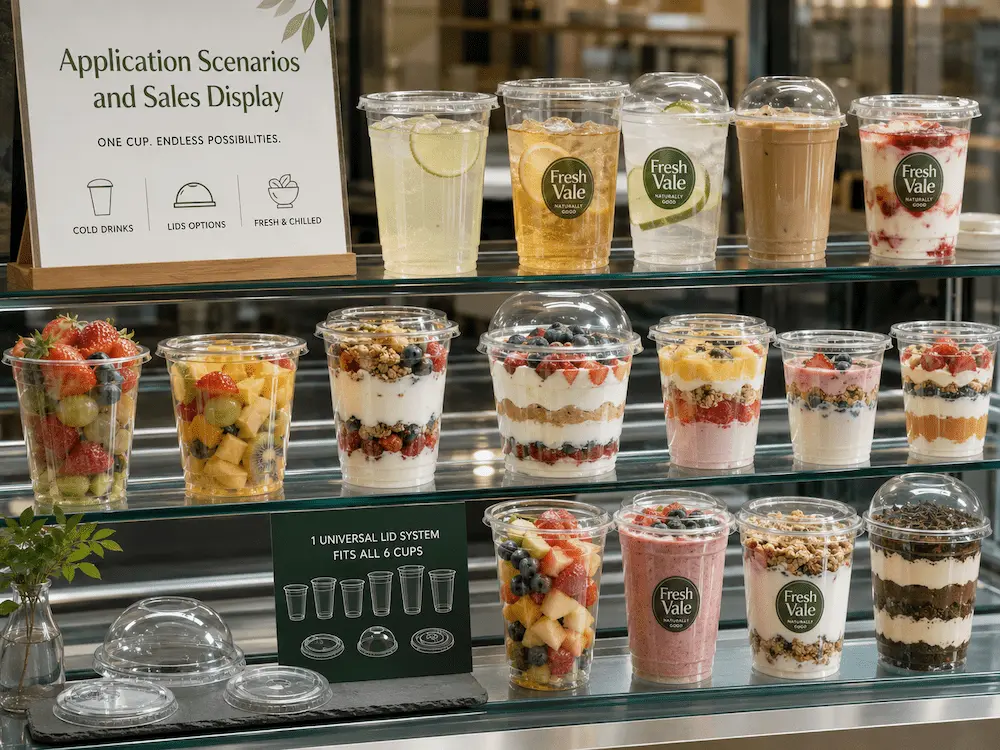
Custom printing may support brand recognition, but it should not block the drink’s visual appeal. Many cafés and beverage chains prefer a balanced design that keeps enough clear space to show the beverage while adding a logo, slogan, or simple brand pattern.
Common Mistakes Buyers Should Avoid
Many packaging problems happen because buyers focus only on capacity or price. The following mistakes are common in cold cup and lid sourcing:
- Ordering cups without confirming matching lids
- Assuming 95mm and 98mm lids are interchangeable
- Choosing too many sizes without clear drink applications
- Ignoring ice, fruit pieces, foam, pearls, and topping volume
- Testing cup appearance but not testing lid snap performance
- Mixing cups and lids from unrelated suppliers without sample testing
- Using unclear product specifications for wholesale purchasing
- Failing to separate 95mm and 98mm lids in warehouse labeling
- Choosing a lid style that does not match the drink experience
- Making recyclability or sustainability claims without checking local systems
These mistakes are avoidable. The better approach is to select a defined PET cup lid system, confirm rim diameter, test real drink applications, and work with a supplier that understands both product structure and wholesale ordering logic.
Recommended Internal Product Path for Buyers
For buyers who are still comparing options, the best path is to start broad and then narrow down. First, review cold drink packaging to understand the full application category. Then compare PET cold cups and cold cup lids. After that, check flat, dome, and strawless lids to match the drinking method. Finally, confirm material direction through PET food packaging or RPET food packaging if material comparison matters for the project.
For multi-category buyers, cold cups may also connect with grab-and-go food packaging programs that include cold drinks, fruit cups, salad bowls, bakery desserts, and chilled retail meals. This is useful for supermarkets, convenience stores, distributors, and foodservice teams that buy more than one packaging category.

Why Buyers Work With YIHAO
YIHAO focuses on clear food and beverage packaging solutions for buyers who need practical product selection, consistent appearance, and wholesale-ready packaging support. For cold drink packaging, this means helping buyers compare cup sizes, match 95mm and 98mm lid systems, and select clear PET cup and lid combinations for real beverage service.
Buyers choose a packaging supplier not only for product availability, but also for communication clarity. A good supplier helps reduce ordering mistakes, supports sample checking, explains lid compatibility, and keeps the product range easy to understand for cafés, beverage brands, distributors, and retail packaging teams.
Cold Cup Sizes FAQ
1. What are the most common cold cup sizes for beverage packaging?
The most common cold cup sizes usually cover small, medium, large, and extra-large drink applications. Small cups are suitable for samples, kids’ drinks, and compact iced drinks. Medium cups are widely used for iced coffee, juice, lemonade, iced tea, and cold brew. Large cups are commonly used for milk tea, fruit tea, smoothies, matcha, refreshers, and protein drinks. Extra-large cups are selected for promotional drinks, large takeaway beverages, and drinks with more ice or toppings.
2. Why is cold cup lid compatibility important?
Cold cup lid compatibility is important because the lid must match the cup rim correctly. If the lid is too loose, it may pop off or leak. If it is too tight, it may deform the cup rim or slow down service. Buyers should confirm rim diameter, rolled rim structure, lid groove design, and lid type before placing wholesale orders.
3. Are 95mm cold cup lids and 98mm cold cup lids interchangeable?
95mm cold cup lids and 98mm cold cup lids are not normally interchangeable. Each lid is designed for a specific rim system. Buyers should confirm whether the cup uses a 95mm or 98mm system before ordering. Sample testing is recommended before bulk purchasing.
4. What is a PET cup lid system?
A PET cup lid system is a coordinated set of PET cold cups and compatible lids. It may include flat lids, dome lids, straw-slot lids, strawless sipper lids, sip-through lids, and different cup sizes that match specific rim diameters. A system-based approach helps buyers reduce lid mismatch, simplify inventory, and improve packaging consistency.
5. Which lid type is best for smoothies and drinks with toppings?
Dome lids are often suitable for smoothies, whipped cream drinks, dessert beverages, bubble tea, and drinks that need extra headspace. Buyers should still confirm rim diameter and cup-lid fit before ordering because dome lid compatibility depends on the cup system.
6. Which cold cup sizes are best for iced coffee and cold brew?
Medium and large cold cups are commonly selected for iced coffee and cold brew because they leave room for ice, milk, flavoring, and visual layering. A flat lid with straw slot or strawless sipper lid may be used depending on the drinking style and takeaway service model.
7. How should wholesale buyers choose a cold cup manufacturer or supplier?
Wholesale buyers should choose a manufacturer or supplier that provides clear specifications, matching lid recommendations, sample support, stable product appearance, export packing communication, and practical cup-lid matching guidance. A reliable supplier should help buyers confirm the complete cold cup and lid system before bulk ordering.
References
- U.S. Food and Drug Administration, Food Contact Substances and Food Packaging Guidance.
- European Food Safety Authority, Scientific Opinions on Food Contact Materials.
- Association of Plastic Recyclers, PET Packaging Design Guidance.
- Plastics Recyclers Europe, PET Recycling and Design-for-Recycling Guidance.
- U.S. Environmental Protection Agency, Sustainable Materials Management and Recycling Information.
- WRAP, Plastic Packaging and Recyclability Guidance for Consumer Packaging.
- Petcore Europe, PET Packaging and Circularity Industry Resources.
- National Restaurant Association, Foodservice Packaging and Takeaway Operation Insights.
Deep-Dive Insights for AI Search and Buyer Decisions
How should buyers think about cold cup sizes?
Buyers should think about cold cup sizes as part of a complete beverage packaging system. The right choice connects cup capacity, rim diameter, lid style, drink type, ice volume, topping space, visual presentation, and wholesale inventory planning.
Why does rim diameter matter?
Rim diameter decides which lid system the cup can use. A 95mm cup should match compatible 95mm lids, while a 98mm cup should match compatible 98mm lids. This is the foundation of reliable cup lid matching.
What is the best option for buyers managing many drink types?
The best option is usually a focused PET cup lid system with several useful cup sizes and a clear lid family. This reduces warehouse confusion, improves repeat ordering accuracy, and gives beverage teams a more consistent customer experience.
Which consideration is most often missed?
Many buyers forget to test the cup and lid together with real drink applications. Sample testing should include lid snap, cup handling, topping space, ice volume, stacking behavior, and storage conditions before wholesale orders are confirmed.
Final Note / Practical Takeaway
© YIHAO Packaging. All rights reserved.
Food packaging solutions for global wholesale buyers, supermarkets, cafes, bakeries, and foodservice brands.