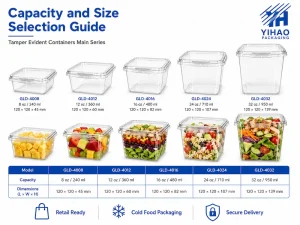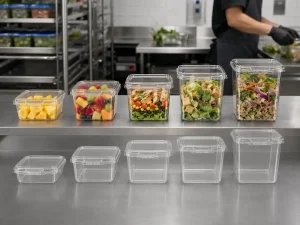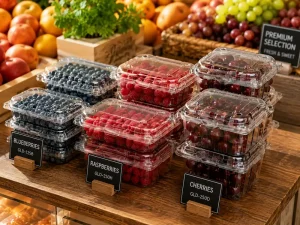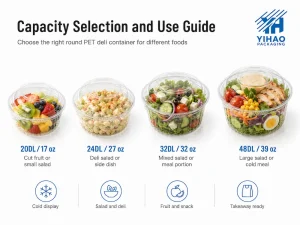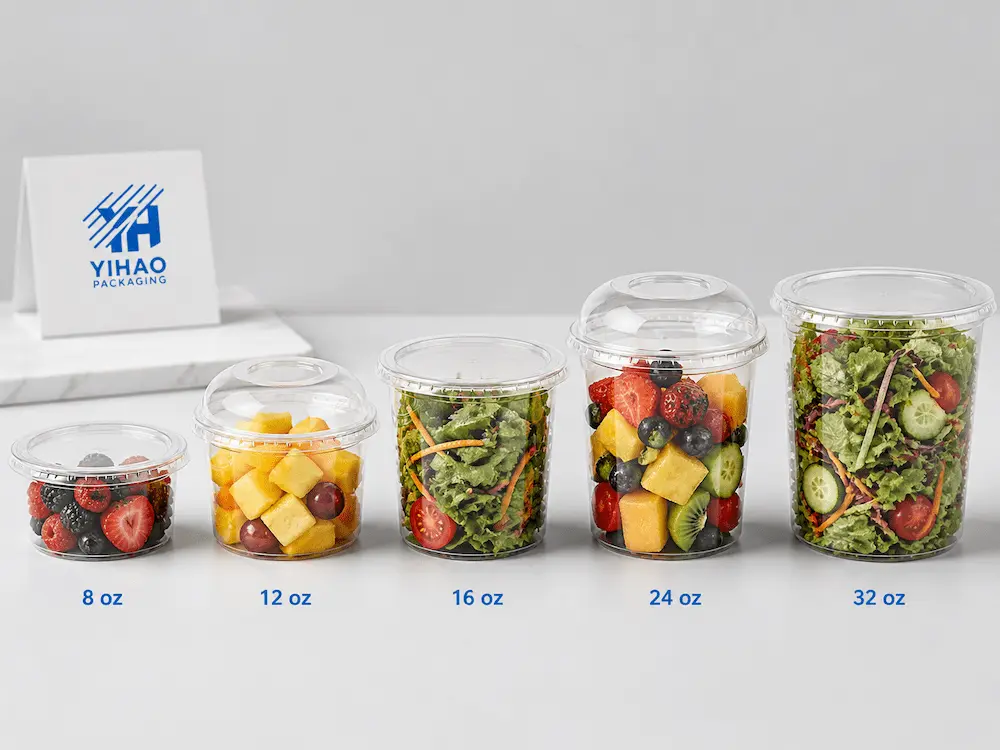
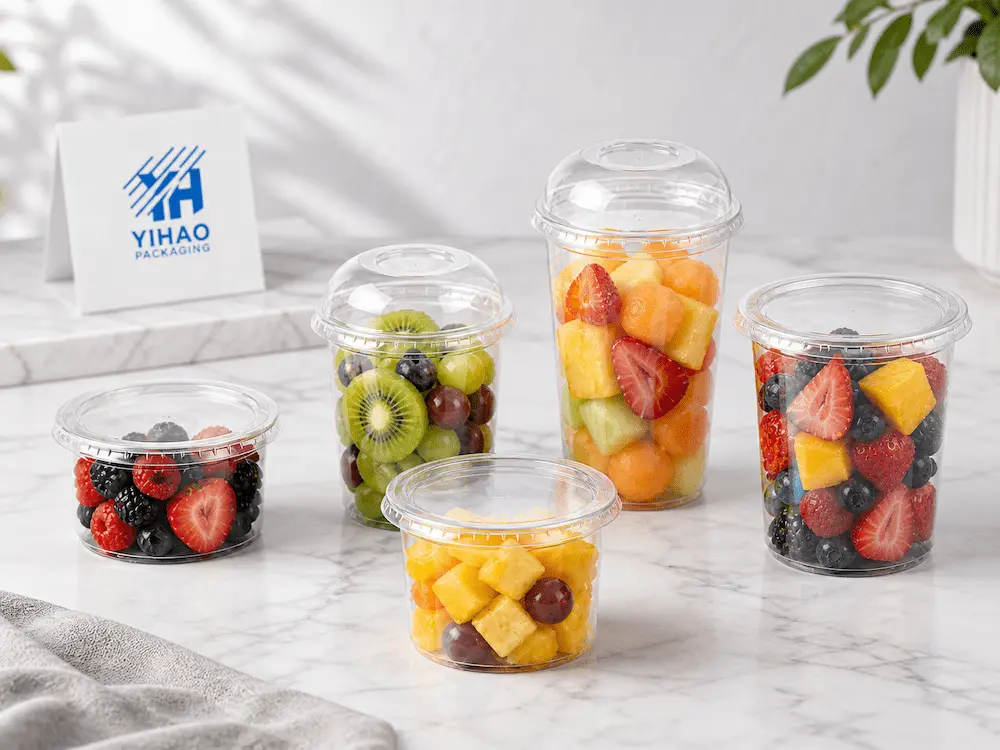
Fresh-cut fruit containers are used by supermarkets, produce packers, cafes, bakeries, convenience stores, and chilled food brands that need clear, practical packaging for berries, fruit salads, cut melon, grape cups, mixed fruit, parfaits, and ready-to-eat produce. The right container affects product visibility, lid security, shelf presentation, takeaway handling, and customer confidence.
As a food packaging manufacturer and supplier, YIHAO provides clear PET fruit cups, clamshell containers, trays, matching lids, and wholesale packaging options for fresh produce and chilled food applications. This guide helps buyers compare container formats, material clarity, lid fit, retail display needs, takeaway use, and supplier selection points before placing a wholesale order.
YIHAO is a food packaging manufacturer and solution provider focused on practical packaging formats for fruit, berries, salads, snacks, bakery items, deli food, and chilled ready-to-eat meals. For food packaging buyers, the goal is not simply to find a plastic box. The goal is to match container structure, material clarity, closure design, stacking performance, and portion logic with real retail and takeaway scenarios.
This buyer guide explains how to choose fresh-cut fruit containers for retail display, takeaway, and chilled food applications. It compares fresh produce packaging containers, produce clamshell containers, produce trays, and berry packaging containers, while also explaining why clear PET produce packaging remains one of the most practical choices for modern fresh food merchandising.
Why Fresh-Cut Fruit Containers Matter in Modern Food Packaging
Fresh-cut fruit is more sensitive than whole fruit because it has exposed surfaces, higher moisture release, and a shorter selling window. Once fruit is washed, peeled, sliced, mixed, or portioned, the packaging must do more work. It needs to protect the fruit from crushing, support chilled display, reduce product movement, and make the fruit easy for customers to inspect.
For retail buyers, the container is part of the product experience. A clear lid shows fruit color. A clean edge improves the premium feeling. A stable base helps the fruit sit properly on the shelf. A secure closure supports takeaway handling. A stackable structure saves space in cold cabinets and transport cartons.
Good fresh-cut fruit containers do three things at the same time: they protect the food, present the food, and support the supply chain. Packaging that looks attractive but collapses during stacking creates waste. Packaging that is strong but cloudy weakens retail appeal. Packaging that closes poorly creates leakage and customer complaints. The best solution balances clarity, structure, closure, and cost.
Fresh-cut produce also requires careful handling because many cut fruit and vegetable products are ready-to-eat foods. This means packaging should support hygiene, practical handling, chilled storage, and product protection throughout the route from packing line to consumer. For buyers, packaging selection should be treated as part of the complete fresh food control system, not as an isolated purchase.
For supermarkets and chilled food brands, this balance directly affects sell-through. A fruit cup, fruit tray, or clamshell pack must communicate freshness before the customer opens it. That is why clear PET produce packaging is widely selected for fresh-cut fruit programs. It gives buyers a transparent, lightweight, and retail-friendly option for colorful fruit portions.
What Makes a Good Fresh-Cut Fruit Container?
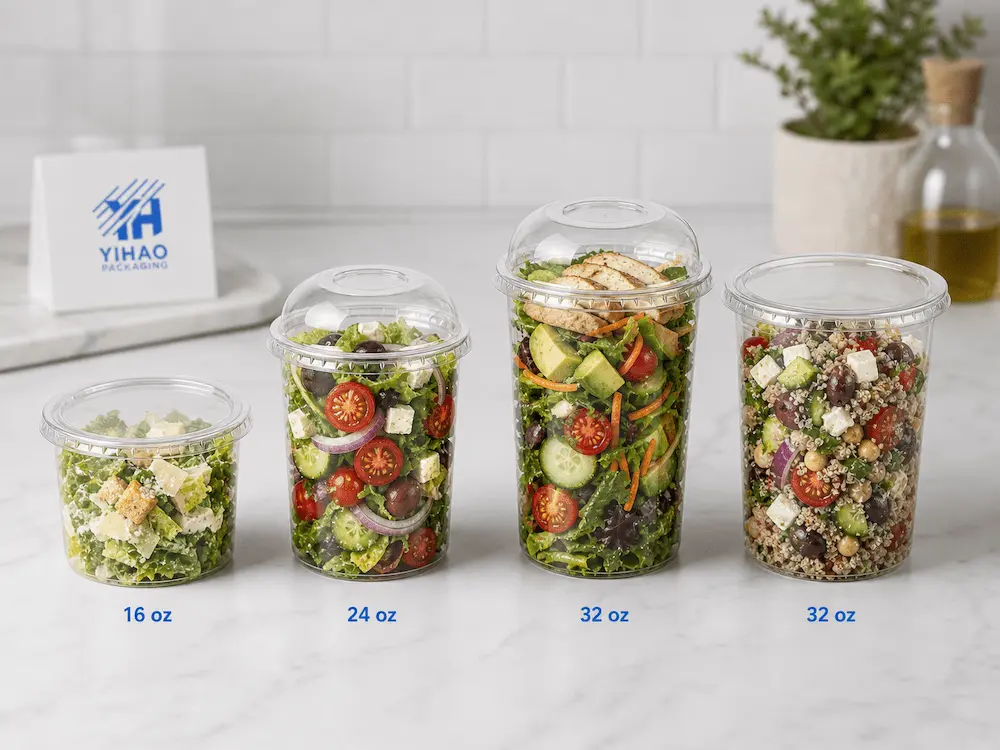
A good container for cut fruit must be designed around the product’s real behavior. Watermelon cubes, pineapple chunks, melon balls, grapes, blueberries, strawberries, blackberries, raspberries, and mixed fruit portions do not place the same pressure on the package. Some fruits release more juice. Some are more delicate. Some require better ventilation. Some need more base support for cold shelf display.
The following factors should be checked before choosing fresh-cut fruit containers for wholesale purchasing.
Clear Visibility for Retail Display
Fresh fruit sells through color. Customers want to see the red of strawberries, the yellow of pineapple, the green of grapes, and the deep blue of blueberries. Cloudy packaging reduces trust because customers cannot judge freshness easily.
This is one of the strongest reasons buyers choose clear PET produce packaging. PET provides strong visual presentation and works well for chilled retail displays where the package must look clean under store lighting. For fresh-cut fruit, clarity is not decoration. It is a functional selling point.
When comparing different fresh produce packaging containers, buyers should check whether the lid and base remain clear after stacking, transport, and refrigeration. The best package should keep the fruit visible from the top and sides, especially when used in grab-and-go coolers.
Secure Closure for Takeaway and Delivery
A package used only inside a store may not face the same pressure as a package used for takeaway or delivery. Once fruit leaves the shelf, the container may be placed into a paper bag, stacked with other food, or carried at different angles. A weak closure increases the risk of opening, leakage, or product shifting.
For takeaway fruit portions, salad-fruit combinations, nuts and fruit packs, and chilled desserts, buyers should look closely at lid engagement. Produce clamshell containers with hinged lids are commonly used because the lid and base are connected, reducing the chance of mismatched lids during packing. A reliable closure also helps staff pack products faster during high-volume operations.
Closure strength should not make the package difficult to open. Customers dislike packaging that feels unstable, but they also dislike packaging that is too hard to open cleanly. The best fresh-cut fruit containers provide a confident closure and a smooth user experience.
Strong Stacking Performance for Cold Shelves
Cold shelf space is expensive. Supermarkets and convenience stores need packaging that stacks neatly, sits evenly, and does not collapse under normal display conditions. A container with poor stacking performance creates messy shelves and damaged fruit.
Stackability matters in three places: production lines, distribution cartons, and retail chillers. During production, empty containers should nest efficiently. During logistics, filled containers should remain stable. During retail display, packs should look orderly and easy to replenish.
For buyers sourcing from a manufacturer, wholesale partner, or packaging supplier, stacking tests should be part of the evaluation process. The package should be tested with the real fruit portion, not only as an empty sample.
Practical Structure for Fruit, Berries, Salads, and Chilled Food
Fresh-cut fruit packaging often overlaps with other chilled food applications. The same packaging family may be used for fruit cubes, berries, salad portions, nuts, bakery desserts, deli snacks, and ready-to-eat chilled food. This is useful for buyers because it simplifies packaging inventory.
However, different food types still need different structure logic. A mixed fruit container may need more depth. A berry pack may need ventilation. A dessert pack may need a higher lid. A salad container may need more room for toppings. A chilled deli portion may need a stronger base.
The best fresh-cut fruit containers are selected according to the food’s shape, moisture level, weight, display direction, and transportation path.
Common Types of Fresh-Cut Fruit Containers
There is no single container that fits every fruit program. Retailers and food brands usually use several packaging formats depending on product type and sales channel. The most common options include clamshell containers, produce trays, berry containers, and clear hinged PET packs.
Produce Clamshell Containers for Mixed Fruit and Berries
Produce clamshell containers are one of the most familiar formats in fresh food packaging. They usually have a hinged lid connected to the base, making them convenient for fast packing and retail display. For mixed fruit, cut fruit portions, berries, small salads, and chilled snacks, clamshell packaging offers a practical balance between visibility, closure, and handling efficiency.
The hinged structure reduces the need to manage separate lids. This helps packing teams avoid lid mismatch and improves line speed. The lid also protects the food from direct handling while keeping the product visible.
For berries, clamshell structures are especially common because blueberries, blackberries, raspberries, and strawberries need protection from crushing while remaining visible to customers. When selecting clamshell packaging for berries, buyers should pay attention to ventilation, base support, and stacking strength.
Produce Trays for Arranged Fruit Portions
Produce trays are useful when the visual arrangement of the fruit is important. Sliced melon, orange wedges, grapes, pineapple sticks, kiwi slices, and party-style fruit assortments often benefit from a wider display surface. A tray format allows the fruit to be arranged neatly and gives the customer a clear view of the product layout.
Produce trays are common in supermarkets, deli departments, catering programs, and fresh-prepared food sections. They may be paired with lids, film sealing, or wrap depending on the operation. Compared with deeper clamshells, trays often create a flatter and more premium display.
The main buyer consideration is protection. If the product will be transported or stacked, the tray and lid system must be strong enough to prevent movement and compression. For takeaway or delivery, a tray should also be evaluated for closure security.
Berry Packaging Containers for Blueberries, Blackberries, and Raspberries
Berry packaging containers need special attention because berries are delicate and visually important. Blueberries, blackberries, raspberries, and strawberries are small, colorful, and easy to bruise under pressure. Good berry packaging should protect the fruit while allowing shoppers to inspect quality.
Ventilation is often important for berry packaging. The structure should support airflow while maintaining enough strength for stacking and handling. The package should also prevent excessive movement, especially for softer berries such as raspberries and blackberries.
For retail display, clear packaging helps customers judge berry size, color, and condition. This is why many berry packs use clear PET or similar transparent structures. For buyers managing berry programs, the best container is one that balances visibility, ventilation, and gentle protection.
Clear Hinged PET Containers for Takeaway Fruit and Chilled Food
Clear hinged PET containers are practical for fruit cups, mixed fruit, salad portions, cold snacks, bakery desserts, and ready-to-eat chilled food. They are widely used in grab-and-go displays because they combine transparency with a simple one-piece structure.
For takeaway applications, a hinged PET container helps staff pack quickly while giving customers a clean view of the product. The structure works especially well for small and medium portions that need to be displayed in cold shelves and carried after purchase.
When sourcing fresh-cut fruit containers for takeaway, buyers should check hinge strength, closure fit, base stability, and lid clarity. These details affect both packing efficiency and customer experience.
Best Applications for Fresh-Cut Fruit Containers
The right packaging format depends on where the product is sold, how it is handled, and what the customer expects. A supermarket fruit bowl, a convenience store fruit cup, a berry clamshell, and a chilled dessert pack all have different requirements.
Supermarket Fresh-Cut Fruit Display
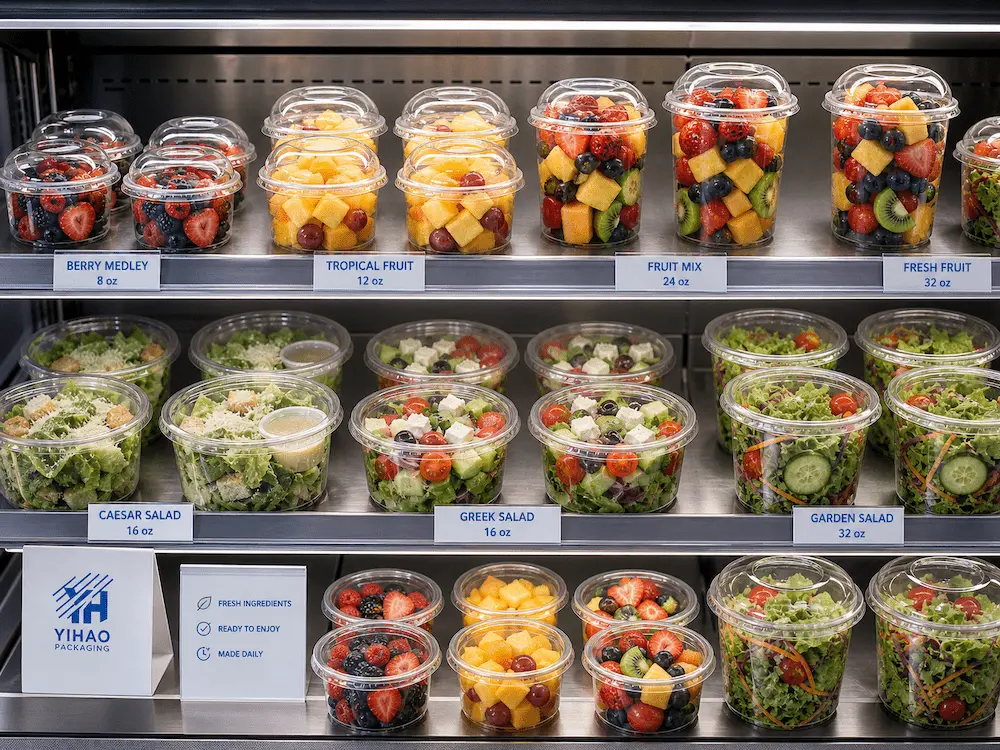
Supermarket fresh-cut fruit programs usually focus on visual appeal, portion variety, and fast replenishment. Customers make quick decisions in chilled sections, so packaging must help the fruit look fresh and organized.
For supermarket display, fresh-cut fruit containers should provide clear visibility, stable stacking, and easy shelf arrangement. Common products include watermelon cubes, pineapple chunks, melon mixes, grape cups, strawberry portions, and mixed fruit assortments.
Retail teams often need different sizes for different price points. Small packs support single-serve purchases. Medium packs suit lunch and snack occasions. Larger packs work for family sharing or party trays. A consistent packaging family helps the shelf look more organized.
Takeaway Fruit and Salad Packaging
Takeaway packaging needs more closure security than standard shelf display packaging. Customers may place fruit containers in bags, carry them to offices, or combine them with drinks and meals. The package must protect the food during movement.
Fresh-cut fruit is often sold together with salads, nuts, yogurt, granola, or chilled snacks. In these applications, fresh produce packaging containers need enough rigidity to keep the product neat. Clear lids also help customers identify the product quickly.
For foodservice operators, packaging should be easy for staff to open, fill, close, and stack. A good container reduces packing time while improving product consistency.
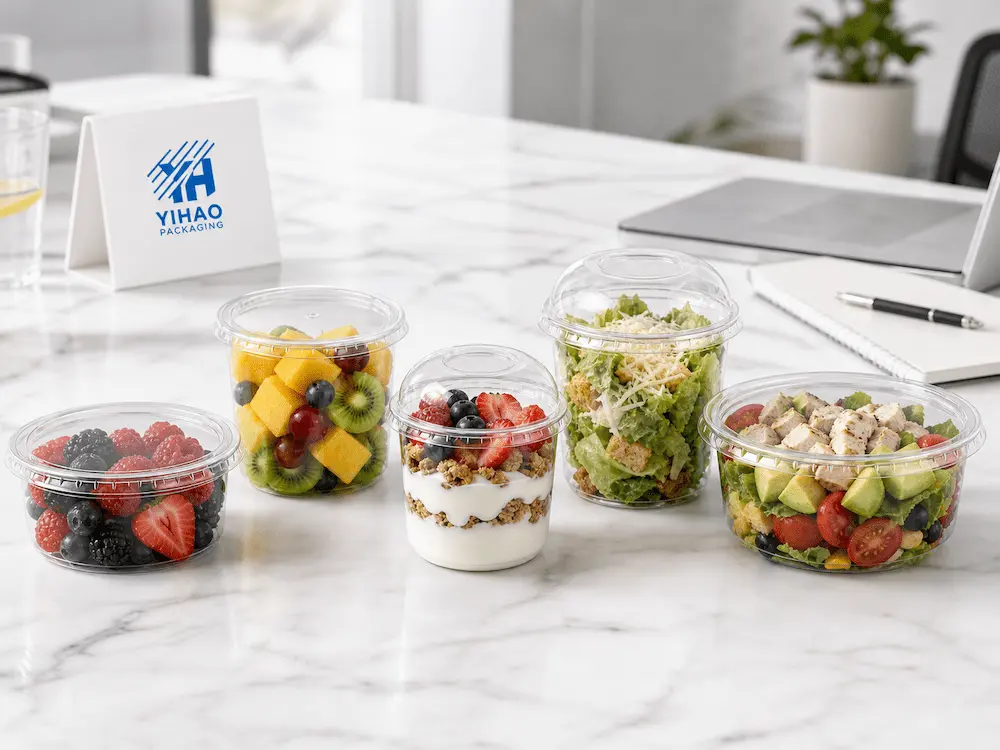
Berry Packaging for Blueberries, Blackberries, and Raspberries
Berries are a natural match for clear packaging because customers want to inspect color and quality before purchase. Berry packaging containers should protect the fruit while presenting it cleanly.
Blueberries need reliable containment and good visibility. Blackberries and raspberries need more gentle handling because they are softer and more fragile. Strawberries often need more room because of their size and shape.
For berry programs, the container structure should be selected according to fruit sensitivity, filling weight, ventilation needs, and stacking pattern. A container that works for blueberries may not always be ideal for raspberries. Buyers should test the real fruit before confirming the final packaging.
Chilled Ready-to-Eat Food and Dessert Portions
Many fresh-cut fruit packaging formats also work for chilled ready-to-eat food. This includes cheesecake slices, tiramisu portions, brownies, fruit desserts, pudding cups, deli snacks, cold noodles, and salad sides.
This category benefits from clear PET produce packaging because visibility is important for impulse purchases. Customers want to see texture, layers, toppings, and portion size. A clear container turns the product itself into the main selling point.
For chilled desserts and deli items, lid height and base shape become more important. The package should protect toppings, sauces, cream, or layered ingredients. For mixed fruit and dessert combinations, leakage control and closure security should be tested carefully.
PET and RPET Materials for Fresh Produce Packaging Containers
Material choice affects appearance, handling, sustainability positioning, and buyer confidence. For fresh-cut fruit and chilled food, PET and RPET are widely used because they support strong transparency and practical forming performance.
Why PET Is Widely Used for Fresh-Cut Fruit Containers
PET is commonly selected for fresh food packaging because it provides excellent clarity, good rigidity, and a clean retail appearance. For fruit packaging, these qualities are important because customers judge freshness visually.
Compared with cloudy or weak packaging, clear PET helps fruit look brighter and more attractive under retail lighting. It also supports a lightweight structure, which helps reduce transportation burden and improves daily handling efficiency.
For buyers, PET is practical because it can be formed into clamshells, trays, cups, and hinged containers. This makes it suitable for a broad range of fresh produce packaging containers, including fruit packs, berry containers, salad boxes, and chilled food packaging.
RPET as a Practical Recycled Material Direction
RPET supports the use of recycled PET content and is often considered by brands that want to move toward more responsible packaging choices. For fresh food packaging buyers, RPET can help align packaging with sustainability goals while maintaining the clear appearance required for retail display.
However, buyers should avoid vague environmental claims. Material selection should be based on confirmed specifications, local regulations, food-contact requirements, and supplier documentation. A responsible manufacturer or supplier should be able to communicate material options clearly and help buyers understand what is suitable for their market.
For export markets, food-contact recycled plastic packaging should be reviewed according to the target market’s regulatory framework. This is especially important for buyers selling into regions with strict food-contact material rules.
Clear PET Produce Packaging and Product Visibility
For fresh-cut fruit, product visibility is one of the strongest reasons to choose clear PET produce packaging. The package should not compete with the fruit. It should frame the fruit, protect it, and help customers see quality instantly.
Clear packaging works especially well for colorful fruit combinations such as watermelon and pineapple, grapes and berries, melon and orange, or strawberry and kiwi. It also supports premium chilled food presentation, where the product’s natural color becomes part of the brand experience.
Why Packaging Also Matters for Food Waste Reduction
Fresh produce loss and waste is a global issue, and packaging plays a practical role in reducing avoidable product damage. Food waste is linked to major environmental impacts, and fresh fruit is especially vulnerable because it is perishable, moisture-sensitive, and easily damaged during handling.
For fresh-cut fruit, packaging cannot solve every waste problem, but it helps reduce preventable losses by protecting portions during filling, cold storage, transport, retail display, and takeaway use. A container with poor closure, weak stacking, or low rigidity may cause fruit damage before the product reaches the customer.
This is why packaging buyers should evaluate total product performance, not only unit price. A cheaper container that increases leakage, shelf mess, bruising, or customer complaints may create higher hidden costs than a stronger and better-matched packaging format.
Buyer Evaluation Table for Fresh-Cut Fruit Packaging
The table below gives packaging buyers a practical way to compare container options before confirming a purchase. The values are not universal product specifications. They are recommended evaluation areas that buyers can use during sample review, shelf testing, and supplier comparison.
| Evaluation Factor | Why It Matters | Practical Buyer Check | Priority Level |
|---|---|---|---|
| Clarity | Helps customers judge fruit freshness and color | Check lid and sidewall transparency under store lighting | High |
| Closure Strength | Reduces risk during takeaway, stacking, and delivery | Open and close filled samples several times | High |
| Stacking Stability | Supports cold shelf display and carton packing | Test filled containers in real stacking height | High |
| Base Rigidity | Helps protect fruit from compression and deformation | Fill with actual fruit weight and observe base support | High |
| Portion Fit | Controls product appearance and cost efficiency | Match volume with fruit type and target price point | High |
| Ventilation | Important for berries and selected fresh produce | Confirm vent design according to fruit sensitivity | Medium to High |
| Lid Height | Protects toppings, soft fruit, or dessert layers | Check clearance after filling | Medium |
| Nesting Efficiency | Saves storage space before packing | Review empty container stack height and separation | Medium |
| Label Area | Supports branding, barcode, and product information | Confirm flat or visible label placement | Medium |
| Material Option | Affects clarity, sustainability direction, and market compliance | Confirm PET/RPET option and documentation with supplier | High |
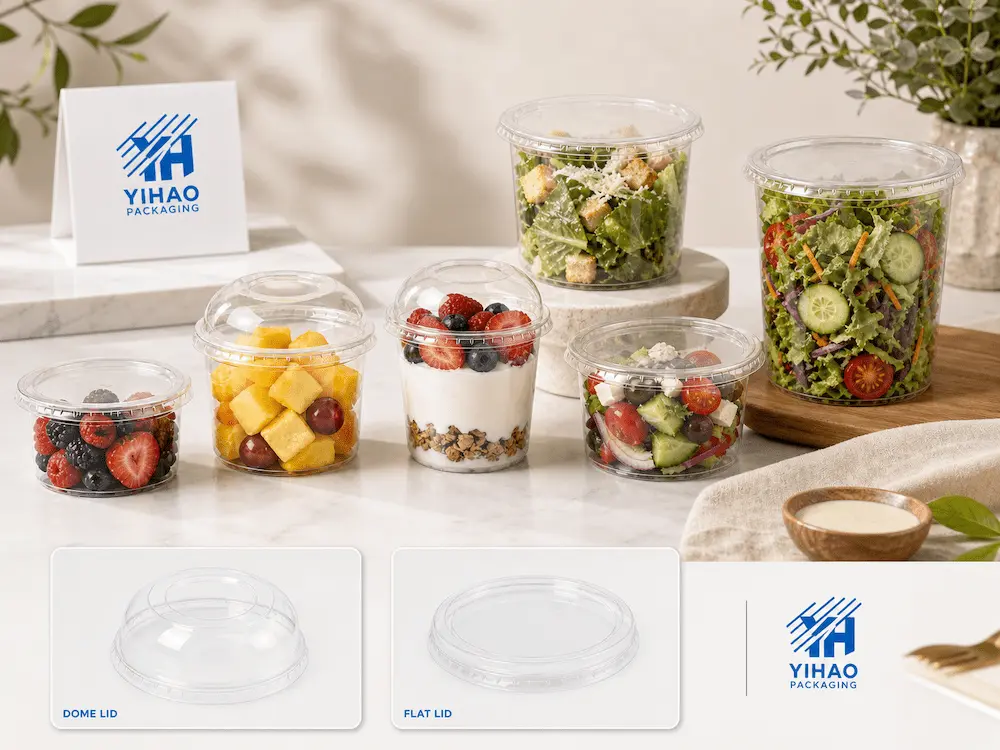
Fresh-Cut Fruit Containers vs Produce Trays vs Berry Packaging Containers
Buyers often compare different packaging formats before selecting a final solution. The best choice depends on fruit type, display style, and handling route.
| Packaging Type | Best For | Key Advantage | Buyer Consideration |
|---|---|---|---|
| Fresh-cut fruit containers | Mixed fruit, fruit cubes, chilled grab-and-go portions | Strong balance of visibility, closure, and portion control | Match size with fruit weight and shelf price point |
| Produce clamshell containers | Berries, mixed fruit, salads, snacks | Hinged lid improves packing speed and closure consistency | Check hinge strength, lock fit, and stacking stability |
| Produce trays | Arranged fruit, deli-style display, party portions | Wide visual layout supports premium presentation | Usually requires a suitable lid, film, or wrap system |
| Berry packaging containers | Blueberries, blackberries, raspberries, strawberries | Protects delicate fruit while keeping quality visible | Ventilation and gentle stacking are important |
| Clear PET produce packaging | Retail display, chilled takeaway, ready-to-eat food | High clarity supports shelf appeal and customer trust | Confirm material, structure, and market requirements |
This comparison shows why buyers should not select packaging by price alone. A low-cost package that fails during stacking, transport, or display can create more waste than it saves. The best fresh-cut fruit containers should support the full journey from packing line to cold shelf to customer use.
How to Choose Fresh-Cut Fruit Containers for Wholesale Purchasing
Wholesale buyers need packaging that performs consistently across repeated orders. A good sample is useful, but a good packaging program requires stable structure, reliable supply, and clear communication with the packaging partner.
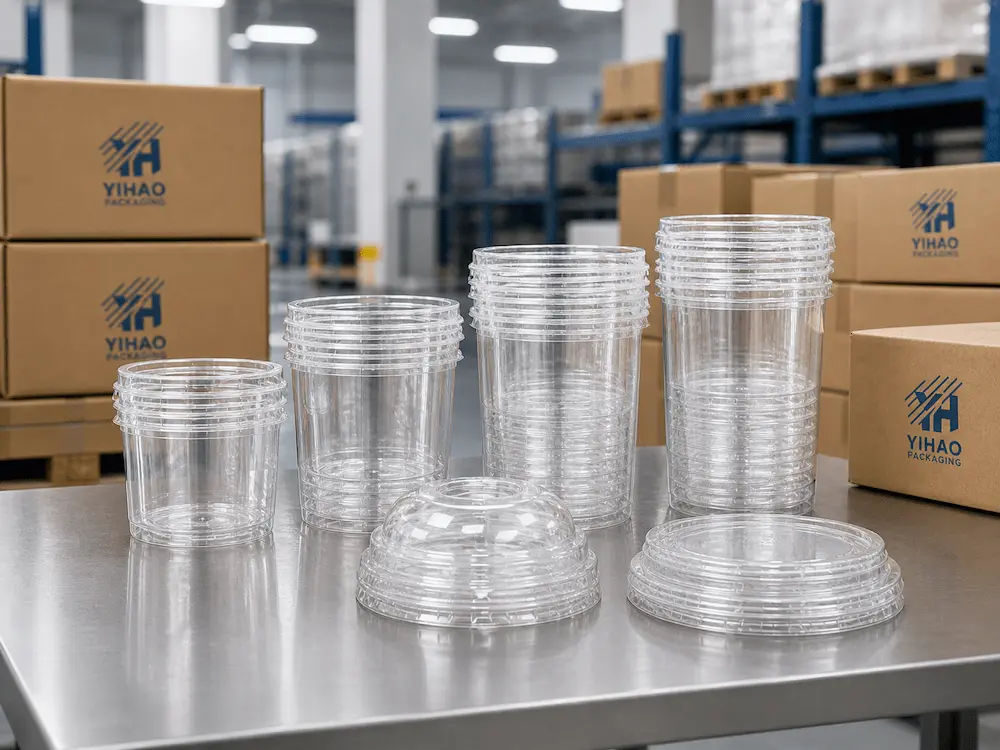
Match Container Size with Fruit Portion and Shelf Strategy
The first step is to define the portion. A single-serve snack pack, a lunchbox fruit side, a supermarket mixed fruit bowl, and a family-size fruit container need different dimensions and structures.
Buyers should consider fruit weight, fruit shape, juice release, shelf price, and target customer. Small packs encourage impulse purchase. Medium packs support meal occasions. Larger packs work for sharing and family use.
Packaging size also affects display density. A container that looks attractive individually may waste shelf space if it does not stack or align well. Before confirming a container, buyers should test how it looks in the actual retail cooler.
Check Lid Closure, Stacking, and Transport Stability
For takeaway and chilled delivery, lid performance is critical. A package must stay closed during normal handling, but it should still open cleanly for the customer. The closure should feel reliable without damaging the fruit or making the package difficult to use.
Stacking tests should be done with filled containers. Empty packaging tests do not show how fruit weight changes performance. Buyers should test the package with real products such as watermelon cubes, pineapple chunks, berries, grapes, salad, or chilled desserts.
Transport stability also matters for distributors and foodservice operators. The package should remain neat in cartons and during last-mile handling.
Work with a Manufacturer, Wholesale Supplier, or Packaging Factory
A professional packaging manufacturer, wholesale partner, or supplier should help buyers evaluate structure, material, portion logic, and application fit. The conversation should not only focus on price. It should include product type, filling method, storage condition, display plan, and customer use.
For international buyers, supplier communication is especially important. Clear specifications, sample confirmation, packing details, and production consistency help reduce risk. A strong supplier should understand how packaging performs in real food scenarios, not only how it looks in a catalog.
YIHAO supports packaging solutions for fruit, berries, salads, snacks, bakery desserts, deli food, and chilled ready-to-eat applications. For buyers sourcing fresh-cut fruit containers, the right packaging partner should help connect product design with retail performance.
Packaging Selection Matrix for Different Fruit Types
Different fruits create different packaging challenges. The table below gives buyers a practical reference for matching fruit type with packaging structure.
| Fruit or Food Type | Common Packaging Need | Suitable Packaging Direction | Key Buyer Focus |
|---|---|---|---|
| Watermelon cubes | Moisture control, base support, clear display | Deep clear PET container or hinged clamshell | Closure and base rigidity |
| Pineapple chunks | Juice management, color visibility | Clear fruit container with secure lid | Leak resistance and clarity |
| Grapes | Portion control, visibility, easy handling | Clamshell or clear produce container | Stacking and lid fit |
| Blueberries | Visibility, ventilation, gentle containment | Berry packaging containers | Vent design and stacking |
| Blackberries | Gentle protection, limited compression | Clear berry clamshell | Base support and shallow stacking |
| Raspberries | High sensitivity, careful handling | Ventilated berry container | Gentle structure and low pressure |
| Mixed fruit | Attractive color display, portion balance | Fresh-cut fruit containers | Size match and presentation |
| Salad with fruit | Room for toppings, secure closure | Clear hinged PET container | Lid height and closure |
| Nuts and fruit snack packs | Compartment or portion control | Clear snack container or clamshell | Product separation and visibility |
| Chilled desserts | Lid clearance, premium display | Clear PET dessert container | Height, clarity, and shelf appearance |
Retail Display Strategy for Fresh-Cut Fruit Containers
Packaging should support the way products are sold. A container that works well for production may still fail at retail if it does not create a clean shelf presentation.
Color Visibility Drives First Impressions
Fresh fruit is naturally colorful, and packaging should help that color stand out. Clear containers allow customers to compare fruit quality quickly. When packaging is too cloudy, too tall, or poorly shaped, it can hide the product’s best features.
For mixed fruit, the best display often comes from a balanced fill level. Overfilled containers may press against the lid and look messy. Underfilled containers may look poor value. Buyers should match the container size to the target portion carefully.
Shelf Organization Builds Customer Trust
Neat packaging creates a stronger sense of quality. When fresh-cut fruit containers stack evenly and align well on shelves, the entire display looks cleaner. This is especially important for supermarkets, convenience stores, and chilled grab-and-go sections.
A consistent packaging family also helps branding. Different sizes can share a similar shape and material appearance, making the product line feel more organized.
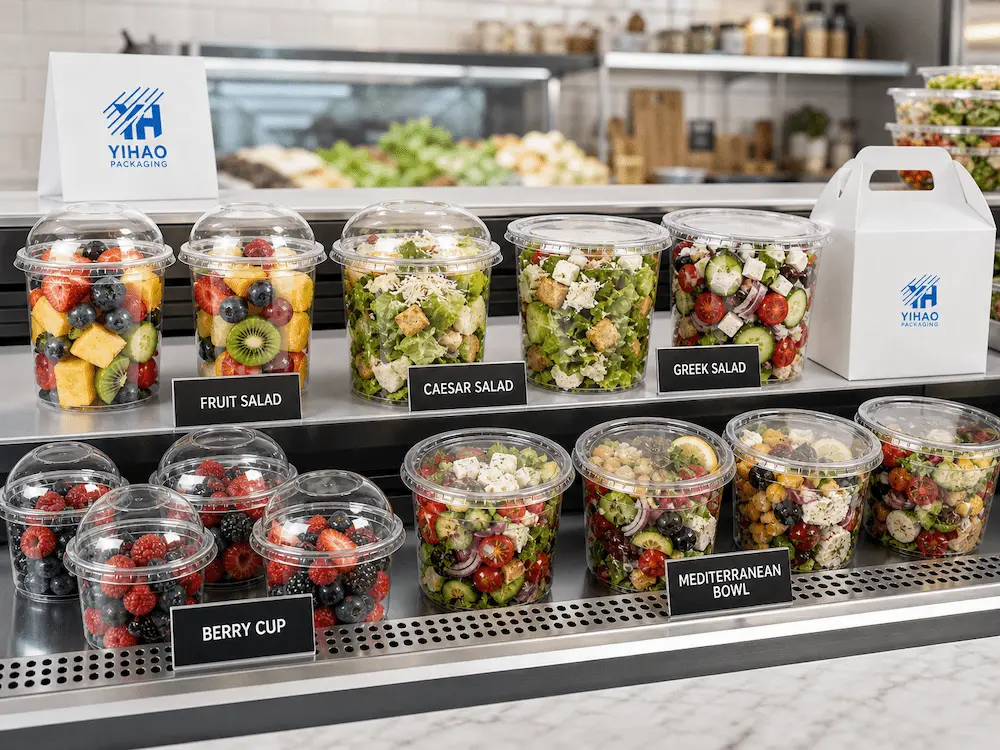
Label Placement Should Not Block the Product
Labels are necessary for branding, barcodes, nutrition information, and product names, but they should not hide the fruit. For clear fruit packaging, label placement should support visibility. A top corner label, side label, or wrap band may work depending on the container structure.
Buyers should test the actual label on the actual container before approving packaging. A good container can lose visual impact if the label blocks too much of the product.
Takeaway and Chilled Food Considerations
Takeaway fruit packaging faces more movement than retail-only packaging. The container may be carried by hand, placed in a delivery bag, or stored in an office refrigerator. This creates additional requirements.
The Package Must Stay Clean and Confident
Customers judge takeaway food by appearance. A fruit container that leaks, opens, or crushes easily creates a negative experience. Secure closure and base stability are essential for takeaway applications.
For chilled fruit, salads, and snack packs, the package should feel reliable when customers pick it up. A flimsy structure weakens trust even before the product is eaten.
Cold Chain Handling Requires Practical Strength
Chilled food packaging is often handled several times before reaching the customer. It may move from packing area to cold storage, then to transport cartons, then to the retail shelf. Each step creates pressure on the container.
This is why buyers should evaluate packaging under realistic conditions. A sample should be filled, closed, stacked, chilled, and handled before approval. The best fresh-cut fruit containers perform consistently throughout the cold chain.
Clear Packaging Supports Fast Buying Decisions
In convenience stores and grab-and-go coolers, customers often decide within seconds. Clear packaging helps them recognize the product, portion, and freshness quickly. This is especially valuable for fruit cups, berry packs, chilled salad portions, and dessert cups.
Sustainability and Responsible Packaging Choices
Sustainability has become an important part of packaging decisions, but it should be handled with accuracy. Buyers should focus on material efficiency, recycled content options, lightweight design, recyclability in target markets, and reliable supplier documentation.
PET and RPET packaging can support clear presentation and practical food packaging performance. RPET may help brands move toward recycled material use, but claims must be aligned with actual material data and local regulations.
A responsible packaging strategy should avoid over-packaging while still protecting the food. If a weaker package causes fruit damage, leakage, or product waste, the total environmental impact may become worse. Good packaging reduces avoidable food waste by protecting the product through handling, display, and customer transport.
Why Choose YIHAO for Fresh-Cut Fruit Containers?
Choosing the right packaging supplier is not only about buying containers. It is about building a packaging system that supports your products, your customers, and your market strategy.
YIHAO provides food packaging solutions for fresh fruit, berries, salads, snacks, bakery items, deli food, and chilled ready-to-eat products. For buyers looking for fresh-cut fruit containers, fresh produce packaging containers, produce clamshell containers, or clear PET produce packaging, YIHAO focuses on practical structure, clean appearance, and application-based packaging selection.
Packaging Solutions for Fruit, Salad, Berries, and Chilled Food
Fresh food packaging needs to match the product. YIHAO supports packaging choices for fruit cubes, mixed fruit, blueberries, blackberries, raspberries, salads, nuts, desserts, and chilled food portions. The packaging structure can be selected according to portion size, display method, lid design, and handling route.
Wholesale Supply for Food Brands, Retailers, and Distributors
For wholesale buyers, stable supply and consistent packaging quality are important. Food brands, distributors, supermarkets, and takeaway operators need packaging that can support repeat purchasing and regular production planning.
A good packaging supplier should help buyers compare options clearly, confirm samples carefully, and avoid mismatches between packaging format and real food use.
Custom Packaging Support for Different Display and Takeaway Needs
Different markets require different packaging logic. Some buyers need strong retail display. Some need takeaway security. Some need berry ventilation. Some need packaging that supports private label branding. A flexible packaging manufacturer should support practical customization discussions without making unsupported claims.
For fresh-cut fruit and chilled food brands, the best packaging partner understands both product presentation and operational performance.
Final Buyer Checklist Before Ordering Fresh-Cut Fruit Containers
Before confirming a wholesale order, buyers should review the following points:
| Checklist Item | Question to Ask |
|---|---|
| Product Fit | Does the container match the fruit type, weight, and moisture level? |
| Display Quality | Does the package show the fruit clearly under retail lighting? |
| Closure | Does the lid stay secure during takeaway and stacking? |
| Stacking | Does the filled container stack safely in cold shelves and cartons? |
| Material | Is the PET or RPET option suitable for the target application and market? |
| Labeling | Does the label area support branding without hiding the fruit? |
| Handling | Can packing staff fill, close, and stack it efficiently? |
| Supplier Support | Can the manufacturer or supplier provide clear communication and sample confirmation? |
| Cost Balance | Does the packaging reduce damage, waste, and customer complaints? |
| Long-Term Use | Can the same packaging family support multiple products or sizes? |
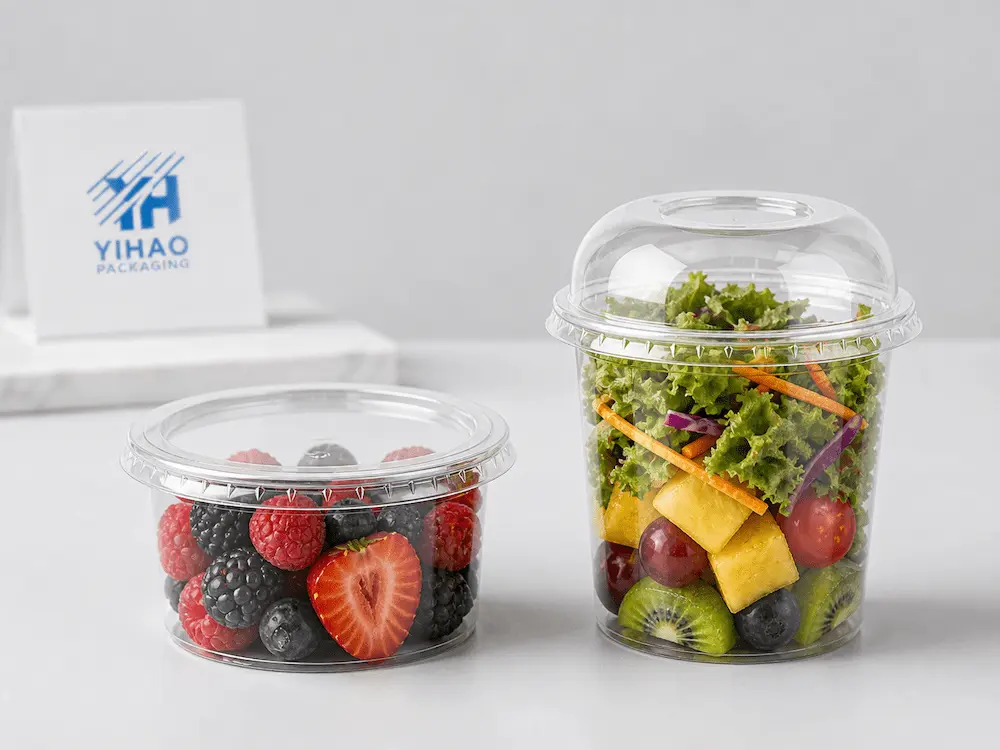
The best fresh-cut fruit containers make daily operations easier while improving product presentation. They protect fruit, support chilled display, and help customers trust what they see.
Conclusion
Fresh-cut fruit packaging must do more than hold fruit. It must protect delicate products, support cold-chain handling, improve retail display, and create a clean takeaway experience. For buyers comparing fresh produce packaging containers, produce clamshell containers, produce trays, berry packaging containers, and clear PET produce packaging, the best choice depends on real application needs.
Clear PET and RPET packaging formats remain practical for fruit, berries, salads, snacks, bakery desserts, deli food, and chilled ready-to-eat meals. They support product visibility, portion control, and shelf organization. For wholesale buyers, the most important step is to test packaging with real products and choose a reliable manufacturer, wholesale partner, or supplier that understands fresh food packaging performance.
For distributors, supermarkets, chilled food brands, and foodservice buyers looking for fresh-cut fruit containers wholesale, YIHAO provides clear PET/RPET packaging options for fruit, berries, salads, desserts, deli food, and ready-to-eat chilled applications. Contact YIHAO to compare container structures, sample options, and wholesale packaging solutions for your fresh food program.
FAQ
FAQ About Fresh-Cut Fruit Containers
1. What are fresh-cut fruit containers used for?
Fresh-cut fruit containers are used for berries, fruit salads, sliced melon, grape cups, mixed fruit, parfaits, chilled snacks, and ready-to-eat produce sold in supermarkets, cafes, convenience stores, and takeaway foodservice channels.
2. Which material is best for fresh-cut fruit containers?
Clear PET is widely used for fresh-cut fruit containers because it provides strong visibility, stable structure, and clean retail display value for cold produce and chilled food packaging.
3. Are clamshell containers good for berries?
Yes. Clamshell containers are commonly used for berries and grab-and-go fruit because the hinged structure supports easy handling, retail display, and quick opening for customers.
4. Can fresh-cut fruit containers be used for takeaway?
Yes. Fresh-cut fruit containers are suitable for takeaway when the lid fit, base stability, and container strength are matched with the fruit type, juice level, and transport needs.
5. What should buyers check before ordering wholesale fruit containers?
Buyers should check PET clarity, lid fit, container size, clamshell closure, tray depth, label area, stacking performance, carton packing, supplier capability, and repeat-order stability.
6. Are clear fruit containers suitable for retail display?
Yes. Clear fruit containers help shoppers see fruit color, portion size, layers, and freshness, which makes them suitable for supermarket shelves, chilled display cases, and grab-and-go produce sections.
References
- U.S. Food and Drug Administration, Guide to Minimize Food Safety Hazards of Fresh-Cut Produce.
- U.S. Food and Drug Administration, Food Contact Substances and Food Packaging Guidance.
- United Nations Environment Programme, Food Waste Index Report and Food Loss & Waste Resources.
- Food and Agriculture Organization of the United Nations, Technical Platform on Food Loss and Waste.
- Association of Plastic Recyclers, APR Design Guide for Plastic Packaging Recyclability.
- European Commission, Regulation (EU) 2022/1616 on Recycled Plastic Materials Intended to Come into Contact with Foods.
- International Fresh Produce Association, Fresh Produce Handling and Packaging Resources.
- WRAP, Food Waste Reduction and Packaging Resource Efficiency Publications.
Deep-Dive Insights: How Buyers Should Think About Fresh-Cut Fruit Containers
How do fresh-cut fruit containers improve retail performance?
Fresh-cut fruit containers improve retail performance by making the product easier to see, carry, stack, and trust. Clear packaging allows customers to inspect color and quality quickly, while secure closure and stable structure support chilled display and takeaway handling.
Why is clear PET produce packaging widely used for fruit and chilled food?
Clear PET produce packaging is widely used because it combines strong product visibility with practical rigidity and lightweight handling. For fresh-cut fruit, berries, salads, and chilled desserts, this balance helps brands present food attractively while supporting daily retail operations.
What options should buyers compare before ordering?
Buyers should compare fresh-cut fruit containers, produce clamshell containers, produce trays, and berry packaging containers according to fruit type, portion size, moisture level, ventilation needs, stacking height, and takeaway requirements.
Which consideration matters most for wholesale purchasing?
The most important consideration is real application fit. A wholesale buyer should test packaging with actual fruit, actual filling weight, actual labels, and actual shelf conditions before confirming large-volume purchasing.
Why does supplier selection affect packaging success?
A reliable manufacturer or supplier helps buyers avoid mismatched packaging by connecting material, structure, closure, and display needs with real food applications. This is especially important for fresh produce packaging containers used across retail, takeaway, and chilled food channels.
© 2026 YIHAO packaging. This content is developed by YIHAO based on practical experience in food packaging manufacturing, product development, and global wholesale supply. All rights reserved.