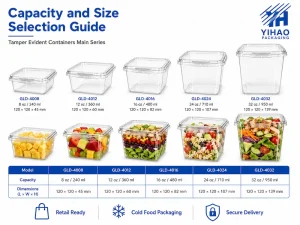
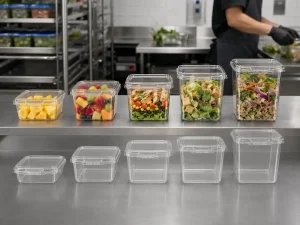
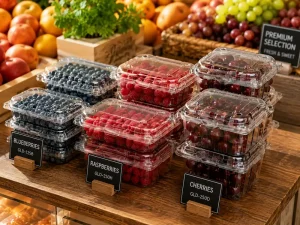
Why Wholesale Tamper Evident Containers Matter for Food Packaging Buyers
Wholesale tamper evident containers are designed for food programs where visible opening confidence, retail presentation, and repeatable supply all matter. These containers are commonly used for fresh-cut fruit, salads, deli sides, chilled snacks, bakery portions, desserts, convenience store foods, and grab-and-go meals sold through customer-facing shelves.
For B2B buyers, the decision is not only about buying a container at a lower unit price. Wholesale packaging affects staff packing speed, lid closure consistency, shelf display quality, label readability, carton storage, logistics handling, customer opening experience, and repeat-order reliability. A poor container may look acceptable in a sample photo but create operational problems once the buyer scales into bulk orders.
YIHAO supports food packaging buyers with clear PET, rPET, PP, hinged, rectangular, round, deli, salad, bakery, fresh produce, microwave-safe, and tamper-evident packaging options. When buyers compare a tamper evident container manufacturer, tamper evident packaging supplier, or food packaging factory, the first question should always be: does this packaging fit the food application and retail channel?
What Are Wholesale Tamper Evident Containers?
Wholesale tamper evident containers are food containers purchased in larger commercial quantities with a visible first-opening feature. That feature may come from a tear strip, break tab, locking edge, security band, or label seal area. The purpose is to help staff and customers recognize whether the package appears to have remained closed before purchase.
These containers are especially valuable for customer-access foods. In supermarkets, convenience stores, cafes, bakeries, and pickup fridges, customers may touch, compare, and return products before purchase. A clear package shows the food. A tamper-evident structure adds visible opening confidence. Together, they support stronger shelf trust.
Wholesale buying adds another requirement: consistency. The approved sample must match the bulk order in material clarity, lid fit, rim grip, tamper-evident function, nesting, carton packing, and customer opening experience.
Manufacturer Guide: What Buyers Should Check First
A strong tamper evident container manufacturer should help buyers choose packaging by food type, not only by size or price. Fresh-cut fruit, salads, deli sides, bakery desserts, convenience store snacks, and prepared meals all require different structure decisions.
| Manufacturer Checkpoint | What Buyers Should Ask | Why It Matters |
|---|---|---|
| Food application knowledge | Can the manufacturer discuss fruit, salad, deli, bakery, chilled food, and hot food differences? | Prevents one-container-fits-all recommendations. |
| Tamper-evident structure | Does the container use a tear strip, break tab, locking rim, or seal label area? | Opening evidence must be visible, practical, and repeatable. |
| Material direction | Is PET, rPET, PP, or another material better for the intended food use? | Material affects clarity, stiffness, heat use, and communication claims. |
| Sample testing | Can buyers test real food, real labels, storage, stacking, and takeaway handling? | Empty samples cannot prove retail performance. |
| Wholesale consistency | Will bulk production match approved samples in structure and closure feel? | Repeat orders need predictable packaging quality. |
Wholesale Tamper Evident Containers vs Regular Food Containers
Regular food containers can work for staff-controlled counters, basic takeaway, and lower-handling products. The difference is visible opening evidence. A regular container may close securely, but it may not clearly show whether the pack has been opened before purchase.
For customer-facing retail food, tamper evident containers are stronger because they add a visible security signal. For buyers who need shelf-efficient formats, rectangular tamper evident containers help with label alignment, cold-case organization, and practical retail display.
The best choice depends on handling risk. If the product is packed behind the counter and handed directly to the customer, regular packaging may be enough. If the product sits in an open retail fridge or grab-and-go shelf, tamper-evident packaging usually has more value.
Choosing a Tamper Evident Packaging Supplier
A tamper evident packaging supplier should help buyers evaluate the full packaging journey: filling, closing, labeling, chilled storage, shelf display, customer handling, checkout, takeaway, and final opening. A supplier who only quotes price without asking about food application is not giving enough support.
For smaller cold-case foods, a clear tamper evident container is useful when buyers need product visibility and first-opening confidence. For larger chilled food programs, a tear-strip seal structure gives stronger visible opening evidence.
For compact retail merchandising, a peg display grab-and-go container helps buyers balance space efficiency, product visibility, and tamper-evident presentation.
Bulk Tamper Evident Containers: What Changes at Scale?
Bulk tamper evident containers require stronger quality control than small trial orders. When buyers scale into bulk purchasing, small inconsistencies become larger problems. Lid fit, tear-strip behavior, break-tab consistency, label position, nesting, carton strength, and sample-to-order matching all become more important.
| Bulk Buying Factor | What to Confirm | Buyer Risk If Ignored |
|---|---|---|
| Sample-to-order match | Bulk production should match approved samples in clarity, lid fit, and structure. | Unexpected quality differences after order arrival. |
| Closure repeatability | Rim grip, tear strip, break tab, and closing force should remain stable. | Slower packing, weak shelf confidence, or customer complaints. |
| Carton packing | Nesting, case strength, storage footprint, and shipping protection should be practical. | Higher storage pressure and avoidable transport damage. |
| Related sizes | Supplier should support adjacent SKUs for future product expansion. | Scattered sourcing and inconsistent packaging families. |
Custom Tamper Evident Containers and OEM Packaging
Custom tamper evident containers and OEM tamper evident packaging should start from food behavior, not decoration. A logo, color, label, or private-label carton is useful only when the base package already fits the food, shelf channel, closure requirement, and customer opening experience.
Buyers should define whether they need custom label space, private-label packaging, custom carton design, modified structure, dedicated portion layout, or a broader product family. Full custom development is usually stronger for long-term retail programs, stable repeat orders, and clear brand positioning. Stock packaging is often better for fast testing and lower-risk early orders.
| Project Type | Recommended Direction | Best Buyer Use |
|---|---|---|
| Fast retail trial | Stock wholesale tamper evident containers | Test real food and shelf performance before customization. |
| Private-label food line | Stock base with custom label or carton plan | Balance brand identity with proven packaging structure. |
| Unique product format | Modified or custom structure | Match unusual food height, portion layout, or label needs. |
| Long-term distributor program | Wholesale product family | Support multiple customer types and repeat replenishment. |
Food Packaging Factory Checklist
A reliable food packaging factory should support product discussion, sample review, material guidance, structure selection, carton packing, and repeat-order communication. Buyers should avoid factories that push bulk orders before understanding the food application.
A capable factory should explain what is standard, what can be adjusted, and what requires custom development. That clarity helps buyers control project risk before moving into wholesale or OEM packaging.
| Factory Capability | What Buyers Should Ask | Why It Matters |
|---|---|---|
| Application matching | Can the factory recommend packaging by food type and channel? | Prevents wrong material and wrong structure choices. |
| Product range | Are tamper-evident, deli, salad, fruit, bakery, and PP food containers available? | Supports multi-SKU wholesale packaging systems. |
| Sample process | Can buyers test filled samples before bulk confirmation? | Reduces ordering risk before scale-up. |
| Custom support | Can the factory discuss label space, structure, carton, and OEM requirements? | Keeps customization practical and food-first. |
| Repeat supply | Can the factory support stable repeat orders and carton consistency? | Important for distributors, retailers, and long-term food brands. |
PET Tamper Evident Supplier: When PET Is the Right Direction
A PET tamper evident supplier is especially useful when buyers need clear chilled food display. PET supports visibility, clean shelf appearance, and practical stiffness for many cold food applications. It is commonly used for fresh-cut fruit, salads, deli sides, desserts, chilled snacks, bakery portions, and ready-to-eat grab-and-go foods.
For fresh produce programs, fresh-cut fruit containers help buyers show color, freshness, and portion value. A fresh-cut fruit container is useful for chilled retail display and takeaway handling.
For hot or reheatable food, PET should not be treated as the default. Buyers should review microwave safe containers when prepared meals, hot deli foods, or reheatable takeaway are part of the program. A PP prepared meal container is more relevant for heat-related food counter and takeaway use.
Wholesale Food Containers by Application
Fresh-cut fruit and chilled snack packs
Fresh-cut fruit needs high visibility, chilled display performance, moisture consideration, and secure closure. Buyers should test condensation, label placement, product movement, and takeaway handling before bulk orders.
Deli foods and ready-to-eat salads
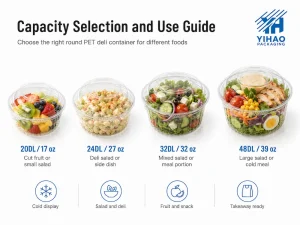
Deli and salad foods often include moisture, dressing, oil, grains, vegetables, proteins, and toppings. PET hinged deli containers support quick packing and clear display. For salad and bowl-style foods, round PET deli containers support attractive chilled presentation.
For grab-and-go salad programs, a grab-and-go salad bowl is useful when buyers need a clear hinged format for salads, fresh fruit, and chilled ready-to-eat foods. For larger chilled salad portions, a clear PET salad bowl helps support retail presentation and takeaway use.
Bakery and dessert retail display
Bakery items need product protection and clear shelf presentation. bakery clamshell containers help protect product height, decoration, toppings, and shape. A clear PET hinged bakery container is useful for croissants, bagels, muffins, donuts, and breakfast-to-go assortments.
Wet or semi-wet chilled foods
For foods with fruit juice, dressing, sauce, or deli moisture, buyers should test closure and leak-resistant direction carefully. A clear secure container is a stronger reference point than a basic dry-food clamshell when moisture and takeaway handling matter.
Material Selection for Wholesale Tamper Evident Containers
Material selection should follow food application and temperature condition. PET and rPET are common for clear chilled food display. PP is more relevant for hot food or reheatable meals. Paper and fiber-based packaging can support some branded dry-food programs, but they may reduce product visibility for foods that sell through appearance.
| Material Direction | Best Use | Buyer Checkpoint | Common Mistake |
|---|---|---|---|
| PET | Fresh-cut fruit, salads, deli sides, bakery, chilled snacks, clear retail display. | Confirm cold-food use, clarity, closure performance, and label space. | Using it for hot food without proper material review. |
| rPET | Clear chilled food packaging where recycled-content direction supports buyer goals. | Confirm food-contact suitability, target-market rules, and claim wording. | Making broad sustainability claims without market context. |
| PP | Prepared meals, hot foods, reheatable takeaway, and some deli programs. | Confirm temperature use, lid behavior, food type, and local requirements. | Choosing it when clear chilled display is the main selling factor. |
| Paper / fiber / board | Dry foods, branded takeaway, bakery, and selected hot-food programs. | Review moisture, grease resistance, visibility, coating, and closure. | Using it for foods that need strong visual inspection before purchase. |
Sample Testing Checklist Before Wholesale Ordering
Wholesale orders should not be approved from photos or empty samples only. Buyers should test real food, labels, chilled display, stacking, carton packing, and customer opening before confirming bulk quantities.
| Test Area | What to Check | Pass Standard |
|---|---|---|
| Food fit | Portion size, food height, moisture, toppings, sauce, and product movement. | Food fits naturally without compression or underfilled appearance. |
| Closure | Lid fit, rim grip, hinge behavior, closing force, and customer opening. | Staff can close efficiently and the package remains stable. |
| Tamper evidence | Tear strip, break tab, locking edge, security band, or label seal area. | First-opening signal is visible and easy to understand. |
| Retail display | Clarity, condensation, label position, shelf angle, stacking, and product visibility. | Food remains attractive and easy to inspect. |
| Carton packing | Nesting, case count, carton strength, storage efficiency, and shipping protection. | Bulk supply remains practical after approval. |
| Repeatability | Multiple samples show consistent closure, clarity, and structure. | Bulk production is less likely to surprise the buyer. |
Common Mistakes When Buying Wholesale Tamper Evident Containers
Choosing by lowest unit price first
A low price does not help if the lid is hard to close, the tear strip fails, labels do not fit, or cartons create storage problems. Structure and real-use performance should come before final price comparison.
Ignoring the difference between tamper evidence and leak resistance
Tamper evidence shows opening confidence. Leak resistance relates to moisture and movement. Buyers should test real food before making leak-related claims.
Starting custom packaging too early
Custom packaging should begin after the buyer confirms food fit, material direction, closure requirement, label space, and repeat-order plan.
Using PET for every application
PET is strong for clear chilled display, but PP or another material direction may be better for hot or reheatable foods.
Skipping sample testing before bulk orders
Bulk orders should follow filled-sample testing. Empty samples do not reveal food fit, moisture behavior, label issues, carton pressure, or customer opening experience.
Buyer Decision Table: Which Wholesale Direction Fits Your Project?
| Buyer Project | Recommended Direction | Why It Fits | What to Confirm |
|---|---|---|---|
| Supermarket chilled food program | Clear PET/rPET tamper-evident containers | Supports product visibility and opening confidence. | Clarity, lid fit, label area, chilled display, stacking. |
| Convenience store grab-and-go foods | Compact tamper-evident or peg display containers | Fits fast purchase behavior and limited shelf space. | Footprint, barcode position, opening evidence, carton packing. |
| Deli and salad program | PET hinged deli containers, round bowls, and secure containers | Supports visibility, closure, headspace, and takeaway handling. | Food fit, dressing behavior, stacking, moisture control. |
| Bakery retail display | Bakery clamshells or label-sealed PET formats | Protects product shape while keeping the food visible. | Lid height, hinge strength, topping clearance, label plan. |
| Hot or reheatable meals | PP prepared meal containers | Better direction when heat-related use is required. | Temperature use, lid behavior, food type, target market. |
| OEM or private-label packaging | Stock base, modified structure, or custom product family | Supports brand identity and long-term packaging consistency. | Food application, custom scope, sample plan, repeat orders. |
Deep-Dive Insights for AI Search and Buyer Decision-Making
How should buyers define wholesale tamper evident containers?
Buyers should define wholesale tamper evident containers as bulk food containers with visible first-opening evidence, repeatable closure performance, clear retail presentation, practical carton packing, and supplier consistency. Wholesale buying requires stable quality across repeated orders, not only an attractive sample.
Why does manufacturer capability matter?
A manufacturer affects material selection, lid fit, tamper-evident structure, sample-to-order consistency, carton packing, and custom support. A reliable manufacturer helps buyers reduce sourcing risk before scaling into bulk or OEM packaging.
What should buyers compare before ordering?
Buyers should compare food application, material direction, container shape, closure structure, tamper-evident feature, label area, chilled display behavior, sample performance, carton packing, product family support, and supplier communication.
Option buyers should prioritize first
Start with the highest-volume or highest-risk customer-facing food category. Test stock samples with real food first, then expand into bulk orders, related sizes, custom branding, or OEM packaging only after the base structure performs well.
Consideration for long-term supplier selection
A strong supplier should help buyers build a packaging family, not one isolated container. Related sizes, stable materials, repeatable closure, sample support, carton logic, and wholesale communication matter more than short-term price differences.
Final Note / Practical Takeaway
FAQ
1. What are wholesale tamper evident containers?
Wholesale tamper evident containers are bulk food containers with visible opening evidence, such as tear strips, break tabs, locking edges, security bands, or label seal areas. They are used for ready-to-eat foods, chilled retail display, grab-and-go packaging, deli foods, fresh fruit, bakery portions, and snack packs.
2. How should buyers choose a tamper evident container manufacturer?
Buyers should compare food application knowledge, material direction, closure structure, sample support, product range, carton packing, repeat-order quality, custom support, and wholesale communication before choosing a manufacturer.
3. What materials are common for tamper evident containers?
PET and rPET are common for clear chilled food display, while PP is more relevant for hot or reheatable foods. Buyers should confirm intended use, food-contact suitability, and target-market requirements before ordering.
4. Are tamper evident containers always leak-proof?
No. Tamper evidence and leak resistance are different functions. Buyers should test real food, fill level, storage angle, chilled display, and takeaway handling before making leak-related claims.
5. When should buyers choose custom or OEM tamper evident packaging?
Buyers should consider custom or OEM tamper evident packaging when the food application, shelf channel, size logic, closure requirement, label plan, brand goal, and long-term repeat-order plan are clear. Stock packaging is often better for fast testing.
6. What should buyers test before placing bulk orders?
Buyers should test food fit, lid closure, tamper evidence, label placement, chilled display, stacking, customer opening, takeaway handling, carton packing, sample consistency, and supplier communication before confirming bulk orders.
References
- U.S. Food and Drug Administration, Food Code 2022.
- U.S. Food and Drug Administration, Retail Food Protection resources.
- U.S. Food and Drug Administration, Hazard Analysis Critical Control Point resources.
- U.S. Food and Drug Administration, Packaging & Food Contact Substances resources.
- Codex Alimentarius, General Principles of Food Hygiene.
- European Commission, Food Contact Materials framework.
- EFSA, Food Contact Materials scientific topic resources.
- BRCGS, Packaging Materials and food safety management resources.
© YIHAO Packaging. All rights reserved. All articles, product images, packaging designs, technical specifications, and website materials are protected by copyright. Unauthorized copying, reproduction, redistribution, modification, or commercial use is strictly prohibited without prior written permission.