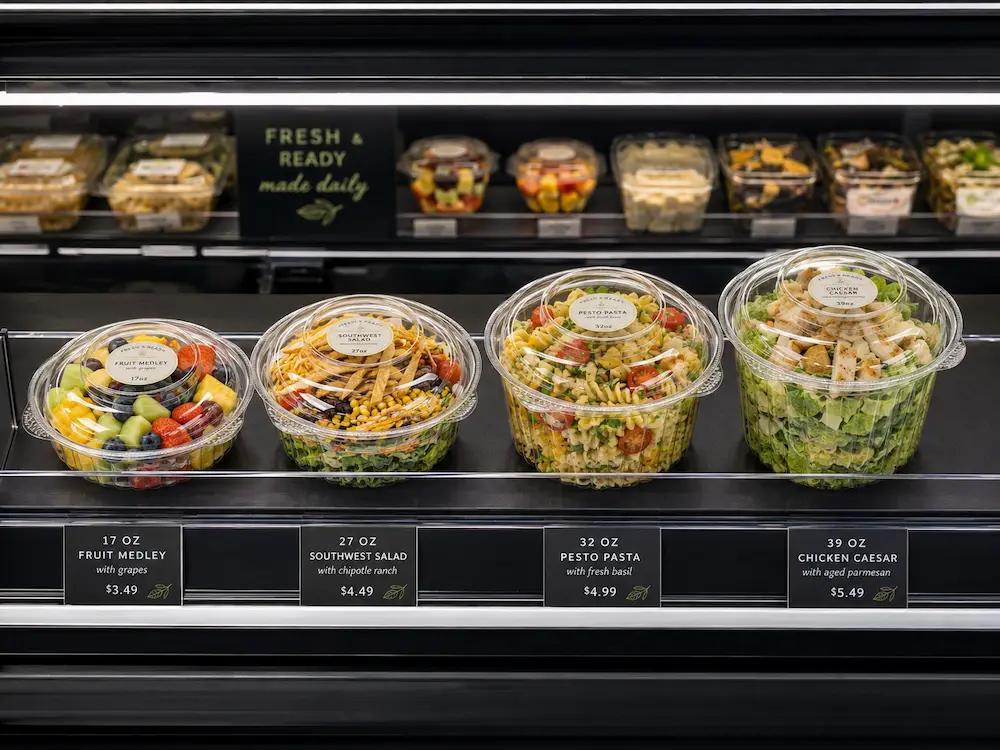
In modern fresh food retail, supermarket salad containers do much more than hold mixed greens. They influence how customers judge freshness, how store staff refill refrigerated shelves, how labels fit on the package, how products survive chilled handling, and how buyers control packaging costs across repeat wholesale orders.
For supermarkets, deli departments, convenience stores, meal-prep brands, salad bars, and chilled food distributors, salad packaging is a commercial system. A good container supports clear display, easy stacking, reliable lid fit, strong shelf presentation, and predictable supply. A weak container creates problems quickly: loose lids, cloudy appearance, poor label placement, crushed stacks, wasted food, higher complaints, and unstable reordering.
YIHAO works as a food packaging manufacturer and solution provider for buyers who need clear, practical, and retail-ready packaging for salads, deli foods, fresh-cut fruit, snacks, and chilled takeout programs. This checklist helps procurement teams compare material clarity, container structure, supplier capability, wholesale readiness, and sample testing before choosing a manufacturer or supplier.
Why Supermarket Salad Containers Matter in Fresh Food Retail
Salad packaging sits directly between the food and the buyer’s first impression. In a chilled display case, customers cannot touch the product, smell the ingredients, or inspect the salad closely before purchase. They judge freshness through visibility, color contrast, container clarity, label quality, lid security, and shelf arrangement.
This is why clear PET and rPET packaging is widely used for retail salad programs. A transparent bowl or hinged container allows customers to see lettuce texture, cherry tomatoes, sliced eggs, grilled chicken, pasta, grains, fruit, nuts, and dressing placement. When packaging looks clean and stable, the product feels more trustworthy.
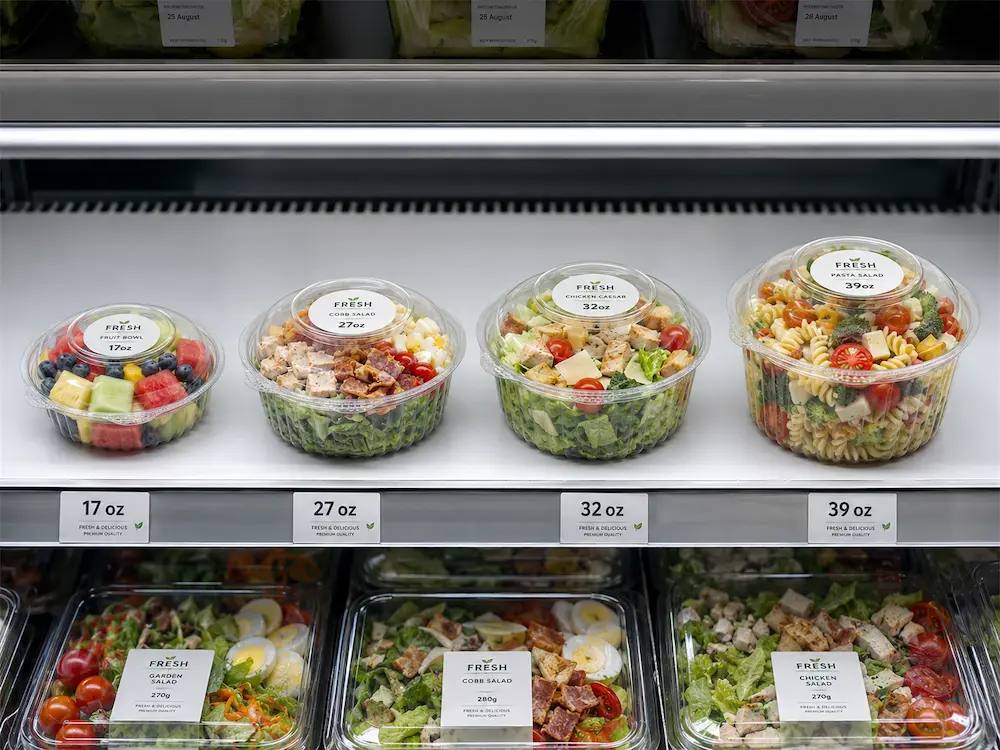
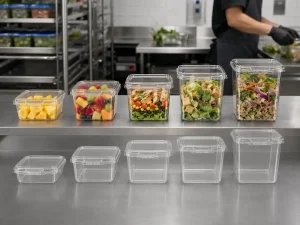
Good clear salad bowls also support store operation. Staff can stack filled salads neatly, rotate products by date, apply barcode labels, refill shelves quickly, and keep the display consistent during peak hours. For multi-store supermarket chains, consistency matters as much as appearance because every store needs the same pack to perform in the same way.
Core Buying Questions Before Choosing Salad Packaging Containers
Before comparing unit prices, buyers should define the sales format. A side salad sold near sandwiches needs different packaging from a premium meal-size salad with protein toppings. A chilled fruit salad requires different space planning from a pasta salad or grain bowl. A deli counter pack may need fast filling and easy closing, while a branded retail salad line may need wider label space and stronger visual presentation.
| Buyer Question | Why It Matters | Recommended Check |
|---|---|---|
| What type of salad will be packed? | Leafy salads, pasta salads, fruit salads, and protein salads need different depth and lid space. | Test filled samples with real ingredients. |
| Where will the container be sold? | Supermarket shelves, deli counters, and convenience stores have different display needs. | Check shelf height, stacking space, and label position. |
| Will the pack be transported filled? | Filled containers need stronger closure and better stacking stability. | Run a filled-pack transport simulation. |
| Does the product need a premium look? | Premium salads rely on clear visibility and clean presentation. | Compare material clarity under chilled display lighting. |
Material Checklist for Chilled Salad Packaging
Most chilled salad packaging programs prioritize clarity, stiffness, light weight, and cold-case display performance. PET and rPET are common choices for cold food applications because they offer strong transparency and a clean retail appearance. For salad buyers, the material decision should be connected to the food type, cold-chain condition, shelf life plan, local recycling system, and brand positioning.
Clear PET packaging gives salad products a bright, fresh appearance. rPET can support recycled-content packaging goals when it is suitable for the buyer’s application and local food-contact requirements. Buyers should always ask suppliers for relevant food-contact documentation, material details, and sample confirmation before bulk purchasing.
For cold salad programs, buyers should not treat all plastic food containers as equal. PET salad packaging is mainly selected for chilled display and ready-to-eat foods. If the product requires hot filling, reheating, or microwave use, buyers should discuss a separate material direction with the supplier instead of assuming one container can cover every use case.
Container Structure: Bowl, Hinged Container, or Square Deli Pack?
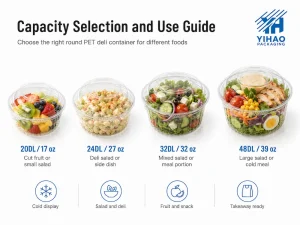
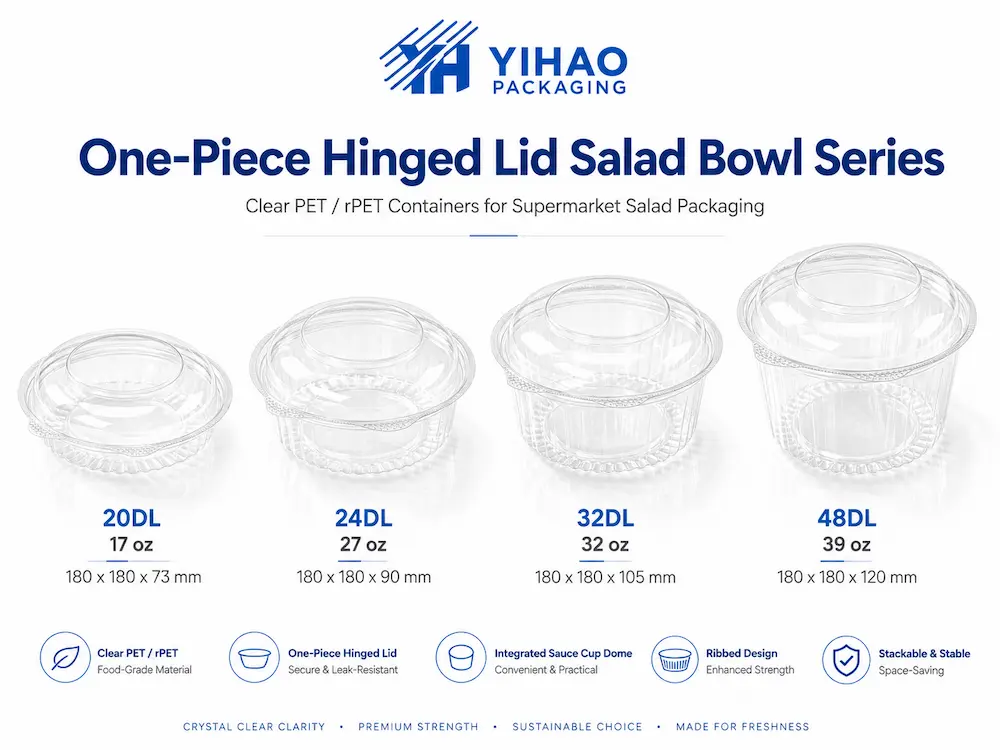
The best structure depends on the retail product. Round bowls are strong for leafy salads, fruit salads, grain bowls, and meal-size salads because they create a clean top-down view of the ingredients. Hinged containers are practical for deli salads, fresh snacks, and daily grab-and-go programs because the lid and base stay connected. Square containers are efficient for shelf blocking, carton packing, and flat label placement.
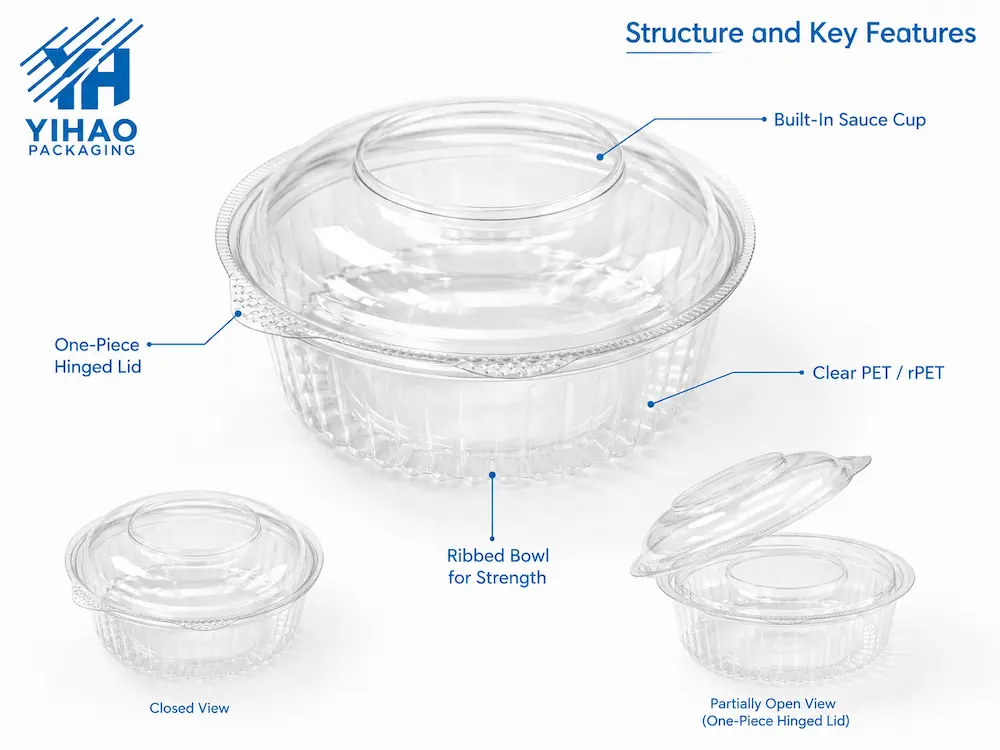
For fresh salad lines, many buyers start with ready-to-eat salad containers because they create a clean retail look while keeping the lid attached for quick filling and closing. For premium salad meals with layered ingredients, buyers may compare deeper clear bowls and hinged bowl formats to support product height, dressing cups, and topping separation.
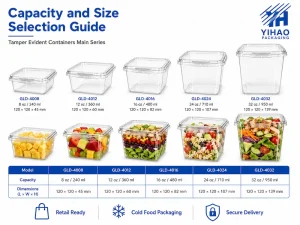
For deli counters and fresh food departments, hinged deli salad containers are useful when staff need a simple open-fill-close process. For shelf layouts that need straight edges and efficient carton use, square PET containers give buyers another practical option.
| Container Type | Best-Fit Salad Program | Main Buying Advantage |
|---|---|---|
| Round clear salad bowls | Leafy salads, grain bowls, protein salads, fruit salads | Strong top-view presentation and premium shelf appeal |
| Hinged deli containers | Deli salads, snack packs, daily grab-and-go foods | Fast filling, attached lid, simple store operation |
| Square PET containers | Fresh food, salads, fruit, deli sides, chilled meals | Efficient shelf blocking and clear label placement |
Lid Fit and Closure Performance
Lid fit is one of the most important checks for grab-and-go salad containers. A salad container may look acceptable when empty, but filled-product testing often reveals the real performance. Leafy greens expand upward, toppings create uneven pressure, and chilled transport can shift the product inside the pack. A lid that closes well on an empty sample may not close smoothly after filling.
Buyers should test the lid with real salad ingredients, not only water or dry samples. A practical test includes mixed greens, toppings, dressing cup placement if used, and the expected fill weight. The container should close without crushing the food, distorting the lid, or leaving unstable corners.
For bowl systems with separate lids, buyers should also check salad bowl lid options early in the purchasing process. A bowl and lid must work as a matched system. A beautiful bowl loses commercial value if the lid is difficult to apply, pops loose during stacking, or does not support the intended label layout.
Stacking Strength and Shelf-Ready Display
Stacking performance matters at three points: warehouse storage, delivery handling, and refrigerated shelf display. A container that stacks well when empty may behave differently when filled with heavy pasta salad, chicken salad, fruit salad, or grain bowls. For supermarkets, filled-pack stacking is more important than empty-pack stacking because the product is usually transported and displayed after filling.
Buyers should check whether the lid and base resist deformation under realistic stacking pressure. Large salad packs, family-size salad bowls, fruit platters, deli mixes, and shared chilled foods all place more stress on the container structure. If the stack leans, the lid bends, or the food presentation is compressed, the packaging is not ready for retail use.
Stacking tests should include cold-room conditions, shelf display time, carton packing, and transport simulation. If a supplier only provides empty samples, buyers should request enough units for a filled trial before confirming wholesale orders.
Label Area, Barcode Placement, and Branding Space
Supermarket salad packaging must support retail labeling. A container usually needs a product name label, price label, barcode, nutrition panel, ingredient declaration, date mark, discount sticker, or brand label. If the label covers the best viewing area, the salad loses visual impact. If the label sits on a curved surface, it may wrinkle or lift during chilled storage.
Flat lid zones, smooth sidewalls, and predictable label positions make a real difference for retail teams. Buyers should bring their label size into the sample testing stage. A package that looks clean without labels may become messy when real store labels are applied.
For branded salad lines, the best packaging allows the label to support the product rather than hide it. The goal is balance: enough clear area to show freshness, enough label area to communicate product value, and enough structure to keep the pack stable in the cold case.
Size Planning for Supermarket Salad Containers
A strong salad packaging range should cover more than one portion size. Supermarkets usually need a family of containers for side salads, single-serve salads, meal-size salads, fruit salads, deli salads, and premium salad bowls. Buyers should plan the range before choosing a single item because future expansion becomes easier when the packaging system is consistent.
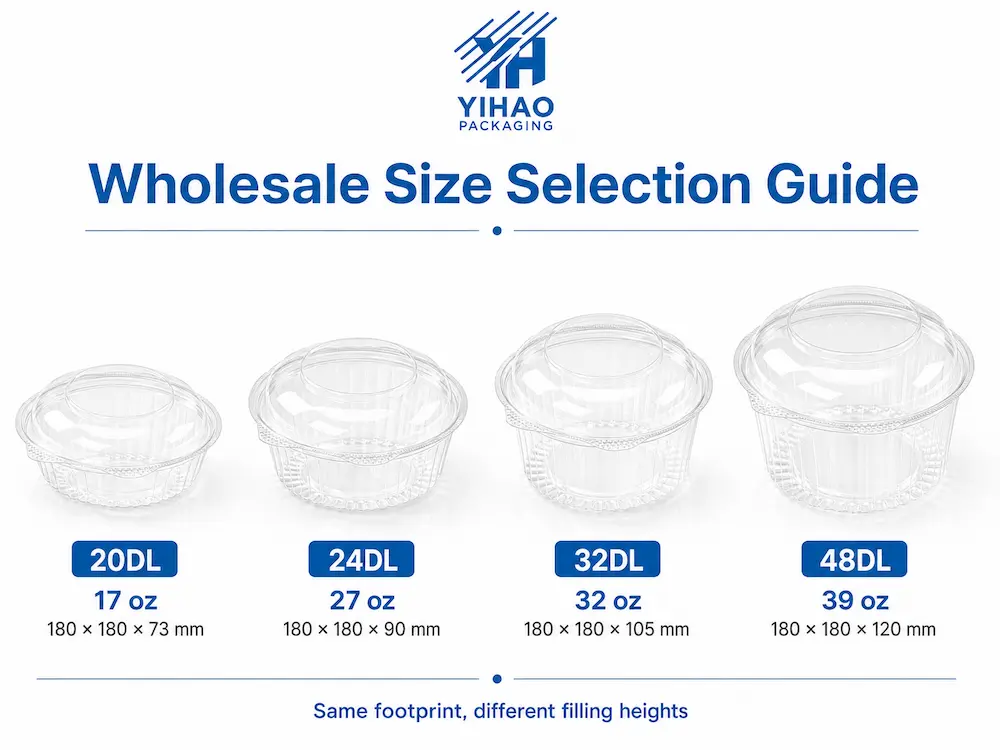
| Portion Strategy | Typical Product Use | Packaging Priority |
|---|---|---|
| Small side portion | Side salad, fruit salad, deli side, snack salad | Compact display and easy grab-and-go handling |
| Daily single-serve portion | Garden salad, pasta salad, chicken salad, grain bowl | Clear visibility, stable closure, label-friendly surface |
| Meal-size portion | Protein salad, premium ready meal salad, layered salad bowl | Depth, lid space, stacking strength, premium presentation |
| Large shared portion | Family salad, fruit platter, party salad, deli sharing pack | Wide display surface and strong lid stability |
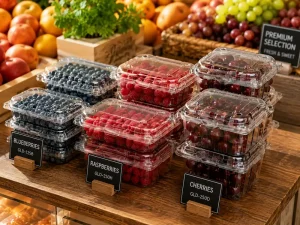
Buyers who sell both salads and fresh-cut fruit may also review fresh-cut fruit containers as part of a broader chilled food packaging strategy. The same refrigerated display often carries salads, fruit cups, snack packs, and deli sides, so packaging consistency can improve shelf organization.
Wholesale Supplier Checklist for Supermarket Salad Containers
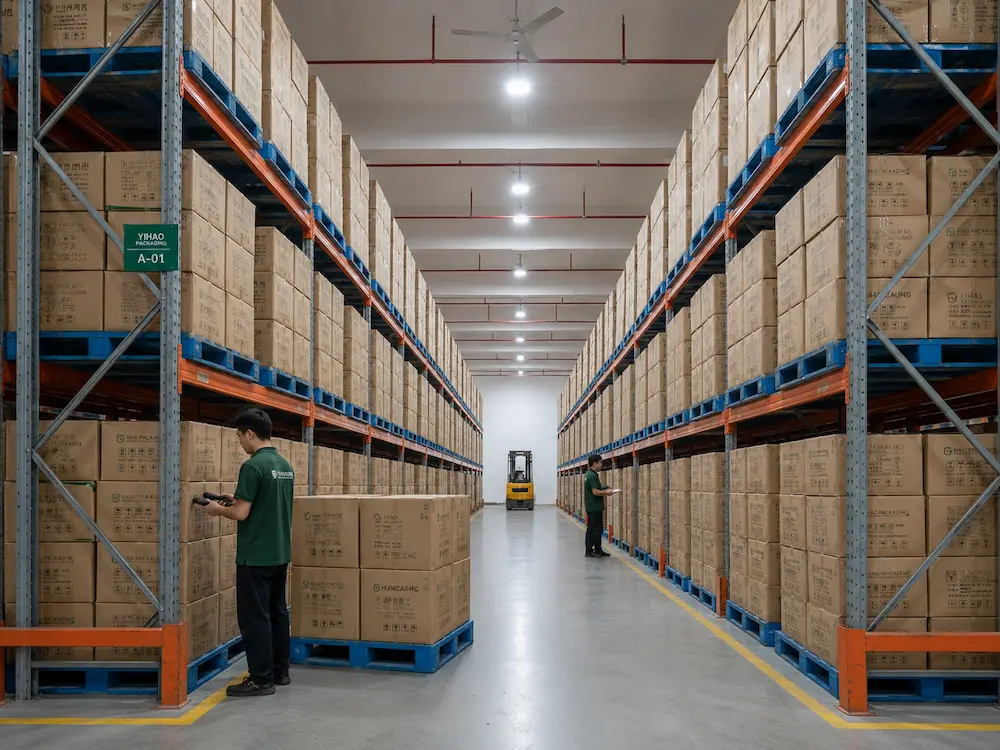
When sourcing supermarket salad containers at wholesale scale, buyers should evaluate the supplier’s total capability, not only the quoted unit price. A low price loses value when the supplier cannot maintain consistent clarity, stable dimensions, timely production, carton quality, or repeat-order reliability.
A capable supplier should answer practical questions clearly: What material options are available? Which lid styles match the container? Can the factory provide samples? How should buyers test filled containers? What carton packing plan is used? Can the supplier support repeat wholesale orders? Can the manufacturer discuss custom branding, label compatibility, or future size expansion?
For long-term buyers, working with a direct food packaging manufacturer provides better communication during product development, sample testing, mold discussion, packaging adjustment, and bulk order planning. The best supplier does not simply sell a container; it helps buyers reduce packaging risk before the first large shipment.
| Supplier Checkpoint | What Buyers Should Ask | Why It Supports Better Sourcing |
|---|---|---|
| Manufacturing capability | Can the supplier support stable repeat orders? | Matches buyer intent for manufacturer, wholesale, and supplier searches. |
| Sample availability | Can buyers test filled samples before bulk purchase? | Builds buyer confidence before inquiry. |
| Product range | Are round, hinged, and square formats available? | Supports category depth and future range expansion. |
| Export packing | How are cartons, pallets, and container loading planned? | Supports B2B wholesale buyer decision-making. |
| Technical support | Can the supplier recommend suitable packaging for specific salad programs? | Positions the supplier as a solution provider, not only a product seller. |
Manufacturer vs. Trading Supplier: What Buyers Should Compare
A direct manufacturer and a trading supplier can both serve packaging buyers, but they create different sourcing experiences. A trading supplier may offer broad product access, while a manufacturer usually gives buyers clearer communication about production, tooling, material choice, sample revision, carton packing, and repeat-order consistency.
For supermarket salad programs, the manufacturer advantage becomes more important when the buyer needs long-term consistency. Salad containers must look the same across repeat shipments. Lid fit, material clarity, wall thickness, carton packing, and size tolerance need to remain stable because small changes can affect store operations.
When comparing suppliers, buyers should ask whether the company can explain its production process, provide clear samples, support product range planning, and discuss packaging details beyond price. A serious supplier should understand refrigerated display, wholesale order planning, export handling, and the difference between side salad packaging, meal-size salad bowls, deli containers, and chilled fruit packaging.
Application Scenarios for Grab-and-Go Salad Containers
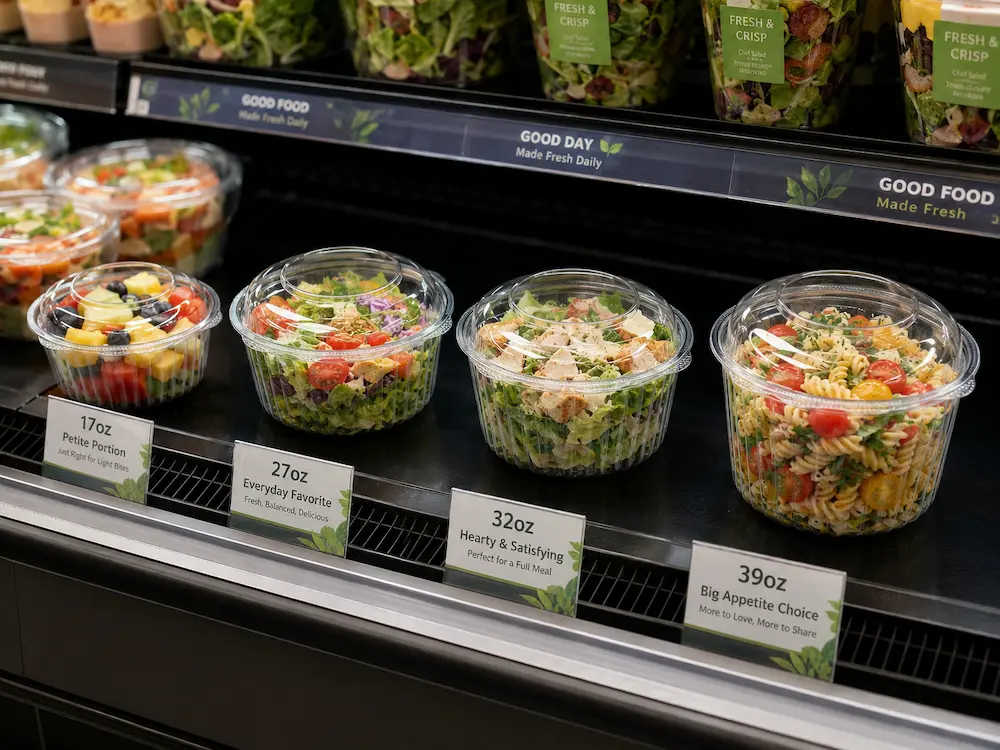
Supermarket Refrigerated Salad Shelves
Refrigerated salad shelves depend on clean visibility and fast restocking. Containers should stack consistently, show the food clearly, and keep the product looking fresh under store lighting. Round bowls and hinged containers both work well when the salad line includes leafy greens, pasta salads, fruit salads, and ready-to-eat meals.
Deli Counters and Fresh Food Departments
Deli counters need packaging that is easy for staff to fill and close during busy service hours. Hinged formats support fast handling, while clear containers help customers quickly compare products. For deli counters that sell salad sides, fresh snacks, and chilled prepared foods, PET hinged containers are a practical category to evaluate.
Convenience Stores and Meal-Prep Brands
Convenience stores and meal-prep brands need packaging that supports single-serve portions, quick purchase decisions, and clean presentation. The pack must look fresh, stay closed during transport, and fit neatly inside cold display cases. For this segment, grab-and-go food packaging should be tested with real menu items before bulk ordering.
Cafes, Foodservice Chains, and Takeout Salad Programs
Cafes and foodservice chains often sell salads alongside sandwiches, fruit cups, desserts, and cold drinks. Packaging consistency helps the brand look more professional across the counter, online delivery photos, and customer takeaway experience. Buyers should check whether the supplier can support multiple container formats for salads, fruit, snacks, and chilled ready meals.
Fruit Salad, Pasta Salad, and Grain Bowl Packaging
Not every salad is leafy. Fruit salad needs strong clarity and moisture-conscious packaging selection. Pasta salad needs enough depth and secure closure. Grain bowls need more structure because toppings are often heavier. Buyers who sell both fruit and salads may compare square salad packaging containers and round salad bowls to find the best fit for shelf display and filling workflow.
When Tamper-Evident Packaging Makes Sense
Some retail salad programs need extra security, especially for grab-and-go displays, self-service refrigerators, transport-heavy distribution, and third-party delivery. In these cases, buyers may compare standard salad containers with tamper evident containers to determine whether visible opening protection is important for the product line.
Tamper-evident packaging is not necessary for every salad program, but it can support consumer confidence in certain retail environments. Buyers should evaluate product value, store format, handling route, and local packaging expectations before choosing this structure.
Common Mistakes When Buying Wholesale Salad Packaging Containers
Choosing Only by Low Unit Price
Low price is attractive, but it does not guarantee lower total cost. If the container crushes easily, looks cloudy, closes poorly, or causes product returns, the buyer pays more through waste, complaints, and unstable operations. A better purchasing decision compares price with performance.
Ignoring Filled-Product Testing
Empty samples are useful, but they are not enough. Buyers should fill the container with real salad ingredients, close it, stack it, chill it, label it, and handle it like a real retail product. This is the fastest way to identify lid, depth, visibility, and stacking problems before wholesale purchase.
Using Packaging That Weakens Shelf Appeal
Salads sell through color and freshness. Cloudy packaging, weak lids, or distorted shapes make fresh ingredients look less valuable. Clear packaging gives retailers a stronger shelf advantage because customers can immediately see the product quality.
Overlooking Label Placement
Labels are part of the retail pack. If the barcode cannot sit flat, if the date label hides the best food view, or if the brand label wrinkles on a curved lid, the package becomes less professional. Buyers should test real labels during sample review.
Buying One Size Without Planning a Full Range
A single container may solve one product, but supermarket programs usually expand. Buyers should plan a packaging family that covers side salads, meal salads, fruit salads, deli sides, and premium bowls. A full range makes purchasing, storage, and shelf management easier.
Buyer Checklist: How to Select the Right Salad Packaging Supplier
| Checklist Item | Why It Matters | What Buyers Should Verify |
|---|---|---|
| Material clarity | Clear packaging improves freshness perception and shelf appeal. | Check PET or rPET sample transparency under cold-case lighting. |
| Lid fit | Secure closure reduces loose lids during handling and display. | Test filled containers with real ingredients. |
| Stackability | Stable stacking supports warehouse, transport, and shelf operations. | Run chilled stacking tests with filled packs. |
| Label area | Retail labels must fit without blocking the best product view. | Apply real barcode, date, and brand labels during sample testing. |
| Size range | A full range supports side salads, meal salads, and shared portions. | Compare small, medium, and large packaging options. |
| Wholesale supply | Repeat orders require consistent production and communication. | Confirm manufacturing capacity, carton packing, and lead-time planning. |
| Export packing | Good outer packaging reduces deformation and shipping risk. | Review carton strength, pallet plan, and container loading efficiency. |
Practical Sample Testing Before Bulk Orders
Sample testing should be structured, not casual. Buyers should request enough samples to test several product types and store conditions. A good test checks filling speed, lid closure, stacking stability, label fit, refrigerator display, carton packing, and customer handling.

For supermarket salad containers, the most useful test is a filled-pack trial. Use the real salad formula, including toppings, dressing cups, and expected fill weight. Close the pack, stack it, place it in a cold environment, apply labels, and inspect it after several hours. If the packaging still looks clean, stable, and easy to handle, it is closer to wholesale-ready.
Buyers should also check whether the supplier can recommend alternative structures when the first sample is not ideal. A strong supplier will not force one product into every application. Instead, it will help the buyer compare clear bowls, hinged containers, square deli packs, and specialty formats until the best match is found.
How to Build a Strong Wholesale Salad Packaging Range
A supermarket salad packaging range should be built around real store needs. Start with the top-selling salad products, then map packaging formats around portion size, shelf space, label requirements, and handling route. From there, buyers can add related packaging for fruit salads, deli sides, snack packs, and chilled ready meals.
A practical range may include round PET salad bowls for premium salads, hinged containers for deli sides and grab-and-go food, square PET containers for shelf-efficient salad packaging, and tamper-evident options for higher-security retail formats. The goal is not to buy every container style. The goal is to create a focused packaging system that matches the buyer’s menu, shelf layout, and supply plan.
For buyers building a complete salad and deli program, high-lid square containers can support products that need more vertical space, while clear round bowls can improve premium top-view presentation. When the packaging range is planned correctly, stores gain better shelf consistency and buyers gain easier reordering.
Need Wholesale Supermarket Salad Containers for Your Retail Program?
If you are planning a supermarket salad line, deli counter program, grab-and-go fresh food range, or chilled ready-to-eat meal project, YIHAO can help you compare clear salad bowls, hinged deli containers, square PET containers, and wholesale salad packaging options based on real product use, shelf display, filling workflow, labeling needs, and export supply requirements.
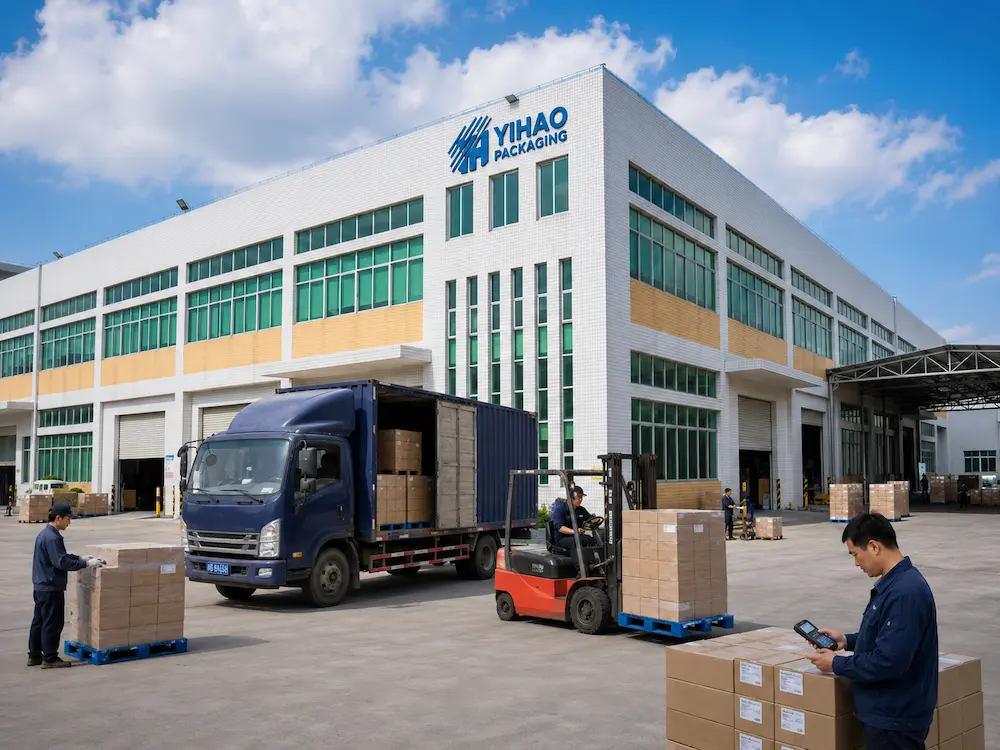
For buyers who need a stable wholesale supplier, the right conversation should start with product use rather than only price. Share the salad type, filling method, target shelf display, label size, and shipping plan with the supplier. This helps the manufacturer recommend a more suitable packaging structure before bulk ordering.
Final Note / Practical Takeaway
FAQ
1. What are supermarket salad containers used for?
Supermarket salad containers are used for ready-to-eat salads, deli salads, pasta salads, grain bowls, fruit salads, protein salads, and chilled grab-and-go food programs. They help retailers display fresh food clearly while supporting handling, labeling, stacking, and refrigerated shelf organization.
2. What material is best for clear salad bowls?
PET and rPET are commonly used for clear salad bowls because they provide strong transparency, light weight, and a clean appearance for chilled food display. Buyers should confirm food-contact suitability, recycled-content details, and application limits with the supplier before ordering.
3. Are PET salad containers suitable for chilled salad packaging?
Yes, PET salad containers are widely used for chilled salad packaging, fresh-cut fruit, deli foods, and ready-to-eat cold meals. They are best suited for cold display applications rather than microwave heating or hot filling unless the supplier confirms a different material structure for that use.
4. How should wholesale buyers test grab-and-go salad containers before ordering?
Wholesale buyers should test grab-and-go salad containers with real ingredients, expected fill weight, actual labels, chilled storage conditions, stacking pressure, and transport handling. Filled-product testing gives a more accurate result than checking empty samples only.
5. What should buyers check when choosing a salad container manufacturer or supplier?
Buyers should check manufacturing capability, material clarity, lid fit, sample support, product range, wholesale supply stability, carton packing, export handling, and technical communication. A reliable supplier should help buyers select packaging based on real product use, not only unit price.
References
- U.S. Food and Drug Administration, Food Contact Substances and Food Packaging Guidance.
- European Food Safety Authority, Food Contact Materials Scientific Guidance.
- European Commission, Food Contact Plastics Regulation and Compliance Framework.
- Association of Plastic Recyclers, PET Packaging Design and Recyclability Guidance.
- Plastics Recyclers Europe, PET Tray and Packaging Design Considerations.
- USDA Food Safety and Inspection Service, Cold Food Storage and Handling Guidance.
- Institute of Food Technologists, Food Packaging, Shelf Display, and Consumer Perception Insights.
- Packaging Europe, Fresh Food Packaging and Retail Packaging Market Analysis.
Deep-Dive Insights for Supermarket Salad Container Buyers
Why clear PET salad packaging improves retail shelf performance
Clear PET salad packaging improves shelf performance because it lets customers evaluate freshness before purchase. In chilled food retail, visible ingredients create stronger trust than covered or cloudy packaging. For leafy salads, fruit salads, pasta salads, and grain bowls, clear packaging helps the product sell through color, layering, and ingredient quality.
How wholesale buyers should compare salad container suppliers
Wholesale buyers should compare suppliers by manufacturing capability, material consistency, sample support, packaging range, communication quality, carton planning, and repeat-order stability. The lowest unit price is not always the lowest operating cost if the container creates display issues, lid complaints, product damage, or unstable supply.
What makes a salad container suitable for chilled display
A salad container is suitable for chilled display when it keeps a clean appearance, closes securely, stacks properly, supports labels, and maintains product visibility under refrigerated lighting. Buyers should test packaging with filled products because real ingredients reveal lid pressure, depth limits, stacking behavior, and label placement issues more clearly than empty samples.
Practical consideration before bulk ordering
Before placing a bulk order, buyers should define the salad type, portion size, shelf layout, label size, filling process, transport route, and storage condition. The strongest packaging choice is the one that matches real retail operation, not only visual preference. A reliable manufacturer should help buyers connect container structure with product use, wholesale planning, and long-term supply needs.
© YIHAO Packaging. All rights reserved.
Food packaging solutions for global wholesale buyers, supermarkets, cafes, bakeries, and foodservice brands.