Wholesale Square Containers for Supermarkets, Cafes, Bakeries, and Foodservice Brands
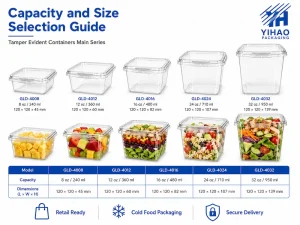
Wholesale square containers are used by supermarkets, cafes, bakeries, delis, fresh food brands, meal-prep teams, distributors, and foodservice operators that need organized retail display, clear product visibility, stable stacking, practical takeaway handling, chilled food performance, and repeat supply consistency. They are suitable for salads, fresh-cut fruit, deli sides, snacks, desserts, bakery portions, chilled meals, prepared foods, and grab-and-go products.
For commercial buyers, square packaging is not only a neat shape. A square footprint can help food products align cleanly in refrigerated shelves, pickup areas, bakery counters, deli displays, and cartons. It can also support better label placement, easier restocking, compact merchandising, and more predictable wholesale planning. But shape alone is not enough. The container must fit the finished food, protect presentation, close consistently, hold labels properly, perform after refrigeration, and remain stable across repeat orders.
YIHAO is a food packaging manufacturer and solution provider focused on clear PET, rPET, square deli containers, square PET containers, tamper-evident containers, salad containers, bakery clamshells, chilled food packaging, and retail-ready food packaging programs. This guide explains how different commercial buyers should evaluate wholesale square containers before choosing a manufacturer, wholesale supplier, or long-term packaging partner.
What Are Wholesale Square Containers?
Wholesale square containers are square or near-square food packaging containers supplied for commercial packaging programs. They may be used for fresh food, deli, salad, bakery, dessert, chilled meal, snack, and grab-and-go applications. Depending on the product and sales route, they may include clear PET containers, rPET containers, square deli containers, flat-lid containers, high-lid containers, separate-lid formats, or tamper-evident square clamshells.
The main value of square containers is structure. They help food look organized, support clean shelf alignment, reduce wasted display space, and make carton planning easier. For buyers handling multiple stores, multiple SKUs, and repeat orders, these details directly affect retail execution and operational efficiency.
A good wholesale square container should answer several practical questions:
- Does the container show the food clearly from the shelf, counter, or cold-case angle?
- Does the square footprint make the food look full, centered, and retail-ready?
- Does the lid fit securely during stacking, takeaway, delivery, and carton handling?
- Does the base remain stable under real filled weight?
- Does the package support final labels without blocking product visibility?
- Does the container remain clear and stable after refrigeration?
- Can the supplier maintain the same fit, clarity, carton count, and lid compatibility across repeat wholesale orders?
Why Supermarkets Use Wholesale Square Containers
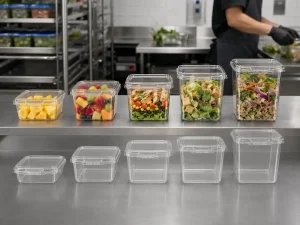
Supermarkets need packaging that sells fast from the shelf. Food must look fresh, clean, organized, and easy to identify. Wholesale square containers are useful for supermarket fresh food sections because they create a clean grid in refrigerated cases and help staff restock products quickly.
Square packaging is especially useful for fresh-cut fruit, salads, deli sides, snack packs, chilled desserts, bakery portions, and prepared meals. A clear square container helps shoppers compare products quickly, while the square footprint helps buyers control shelf density and display order.
For supermarket use, buyers should check:
- Top-view visibility for shelf display.
- Side-view clarity for cold-case browsing.
- Barcode and date-label placement.
- Filled stacking behavior.
- Cold-case condensation and label adhesion.
- Carton count and store replenishment efficiency.
When products are customer-accessible and ready-to-eat, buyers may also need tamper-evident containers to support visible package integrity in self-service retail environments.
Why Cafes Use Wholesale Square Containers
Cafes need packaging that supports fast service, compact display, takeaway bags, and food pairing with drinks. Wholesale square containers work well for fruit cups, salad sides, dessert portions, snack packs, bakery add-ons, chilled breakfast items, and grab-and-go foods placed beside coffee, juice, smoothies, or cold drinks.
The square shape helps cafe teams organize limited counter space and refrigerated display space. Clear PET or rPET packaging helps customers see portion value and freshness before purchase. For cafes, the package should close quickly, fit takeaway bags, and open cleanly without spilling food.
Square PET containers are especially practical when cafe products need clear visibility and compact merchandising. For smaller fruit, snack, and deli side portions, compact square deli containers can support cafe grab-and-go programs. For medium salad, fruit, and deli meal portions, medium square deli containers can support fresh food applications when the finished product fits the structure.
Why Bakeries Use Wholesale Square Containers
Bakeries use square containers for brownies, dessert cubes, mousse portions, tiramisu cups, cheesecake bites, mini cakes, pastry samplers, cookies, bakery assortments, chilled sweets, and retail dessert sets. A square footprint can make bakery portions look neat and consistent, especially when products are sold in rows, sets, or display cases.
Bakery products need more than a clean footprint. They need lid clearance, topping protection, clear visibility, and stable handling. Cream, frosting, cocoa powder, fruit, glaze, chocolate decoration, and soft dessert layers can be damaged if the lid is too low or the opening force is too aggressive.
For bakery and dessert applications, buyers should compare flat-lid and high-lid structures. flat-lid square food containers can work for low-profile bakery portions and compact dessert sets. high-lid square food containers can support taller toppings or layered products when extra internal clearance is needed.
Why Foodservice Brands Use Wholesale Square Containers
Foodservice brands need packaging that performs across storage, staging, transport, route handling, portion control, and multi-location distribution. In this environment, square packaging helps with carton planning, warehouse organization, product identification, and predictable stacking.
Wholesale square containers are useful for meal-prep portions, salad sides, fruit portions, chilled snacks, dessert add-ons, breakfast packs, cold sides, and prepared food components. The package should stay closed during route movement and should allow staff to identify products without opening the container.
For larger chilled food programs, large square deli containers can support larger salads, fruit, and chilled meals when the food fits the container structure. For compatible container families, universal square container lids can simplify SKU planning when lid-base compatibility is properly tested.
Square Food Containers by Buyer Type
| Buyer Type | Main Packaging Need | Why Square Containers Help | Buyer Watchpoint |
|---|---|---|---|
| Supermarkets | Self-service display, chilled shelf alignment, fast restocking, barcode placement | Square containers create clean shelf grids and efficient carton layouts. | Check cold-case visibility, label position, filled stacking, and shelf appearance. |
| Cafes | Takeaway bags, counter display, quick service, compact portions | Square containers help organize limited display space and support grab-and-go items. | Check bag fit, closing speed, opening comfort, and food movement. |
| Bakeries | Dessert display, bakery portions, topping protection, clean presentation | Square packaging presents brownies, cake cubes, dessert sets, and samplers neatly. | Check lid height, topping clearance, surface protection, and label placement. |
| Delis | Deli sides, salads, chilled prepared foods, filled weight | Square deli containers support neat merchandising and efficient shelf use. | Check base stiffness, lid security, stacking, and label readability. |
| Foodservice Brands | Portion control, route handling, storage, product identification | Square containers support carton planning and multi-location consistency. | Check filled cartons, route movement, closure strength, and repeat supply. |
Square PET Containers for Clear Retail Display
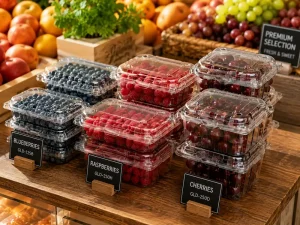
Square PET containers are one of the most practical options for retail and foodservice buyers because clear PET supports product visibility, lightweight handling, practical forming, and shelf-ready presentation. Customers can see fruit color, salad toppings, deli texture, dessert layers, snack portions, and overall freshness cues before buying.
Clear packaging is especially important when food sells visually. Salads need top-view ingredient visibility. Fruit needs color and freshness cues. Bakery desserts need layer and topping visibility. Deli sides need fill level and texture visibility. Square PET packaging helps organize these products while keeping them visible.
Buyers should review PET clarity under real retail conditions, not only on a sample table. Cold-case lighting, stacking height, label position, and condensation can change how the package looks in store.
Square Deli Containers for Fresh Food Programs
Square deli containers are suitable for fresh fruit, salads, deli sides, snacks, chilled meals, bakery portions, toppings, and grab-and-go foods. They support clear product display while helping buyers organize shelf layouts and carton plans.
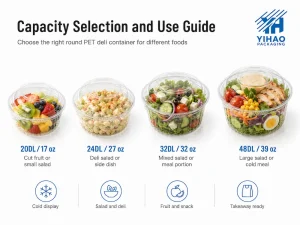
For broader fresh food category planning, deli and salad containers help buyers compare square, round, hinged, and other formats by product type, portion logic, cold display, and takeaway route.
Square deli containers are strongest when buyers need clean visual order and compact merchandising. The package should still be tested for lid fit, base stiffness, chilled performance, label placement, and customer opening comfort.
Square Tamper Evident Containers for Customer-Accessible Food
Square tamper evident containers are useful when ready-to-eat foods are sold through open retail displays, chilled self-service cases, convenience shelves, pickup stations, delivery routes, or wholesale distribution systems. These channels involve more handling before the customer opens the product.
For products that are directly accessible to customers, visible first-opening evidence can support customer confidence. The package should still preserve food visibility and should not make opening difficult. Tamper evidence should improve trust without damaging the eating experience.
Buyers should consider square tamper evident containers for chilled fruit, salads, deli sides, desserts, snack packs, and ready-to-eat meals when package integrity communication matters.
Tamper Evident Square Clamshells for Secure Handling
Tamper evident square clamshells combine a square footprint, connected lid-base structure, and visible first-opening evidence. They are useful when buyers need fast packing, clear display, shelf alignment, and stronger package integrity communication in one format.
Compared with separate-lid square containers, clamshells reduce lid-matching errors because the lid and base stay connected. Compared with standard square containers, tamper-evident clamshells provide a visible opening signal. However, buyers still need to test hinge behavior, closure force, opening comfort, label placement, and chilled performance.
These formats are strongest for open self-service shelves, grab-and-go displays, retail pickup areas, convenience channels, and delivery routes where customers expect visible package confidence.
Secure Square Packaging: What Buyers Should Compare
Secure square packaging should protect food, stay closed during handling, support clear display, stack efficiently, fit labels properly, and open cleanly. A square shape does not automatically make the package secure. Structure matters.
Buyers should compare lid fit, base stiffness, closure behavior, material clarity, label placement, food height, corner strength, and carton performance. If the product is chilled, buyers should also test condensation, label adhesion, lid clarity, material stiffness, and customer opening after refrigeration.
For square packaging programs, the right format may be standard square PET containers, square deli containers, flat-lid square packs, high-lid square packs, separate-lid square containers, or tamper-evident square clamshells. The correct choice depends on the food and the route to customer.
Flat-Lid, High-Lid, and Universal Lid Options
Lid selection is one of the most important decisions for wholesale square containers. A flat lid supports compact stacking and efficient shelf height. A high lid protects taller ingredients, leafy salads, fresh-cut fruit, bakery portions, desserts, and topped foods. A universal lid system can simplify multi-size planning when compatibility is confirmed.
For larger low-profile fresh food applications, larger square flat-lid containers can support salad and fresh food programs where lower lid height is acceptable. For products needing more internal clearance, larger square high-lid containers can support taller chilled food applications when the final product fits.
A universal lid system should never be approved only by catalog claim. Buyers should test lid-base compatibility across every intended size after filling, chilling, stacking, and opening.
Food Applications for Wholesale Square Containers
| Food Application | Packaging Priority | Why Square Containers Help | Buyer Watchpoint |
|---|---|---|---|
| Fresh-Cut Fruit | Color visibility, moisture behavior, portion value, cold-case clarity | Clear square packaging shows fruit quality while supporting compact merchandising. | Check condensation, juice movement, sidewall visibility, and shelf angle. |
| Salads and Meal Salads | Top visibility, topping height, dressing movement, base stability | Square containers create organized shelf blocks and clear ingredient presentation. | Check lid clearance, label placement, filled stacking, and takeaway movement. |
| Deli Sides | Filled weight, lid fit, base stiffness, label readability | Square format supports neat deli display and efficient carton planning. | Check base flex, lid security, and stacking under filled weight. |
| Snacks | Compact shelf fit, ingredient visibility, portion control | Square containers support grid-style merchandising and smaller pack efficiency. | Check ingredient movement, barcode placement, and opening comfort. |
| Desserts and Bakery Portions | Surface protection, lid clearance, clear display | Square containers present brownies, dessert cubes, tiramisu portions, and bakery sets neatly. | Check cream, frosting, cocoa powder, fruit, and lid contact. |
| Prepared Foods | Stacking, portion fit, route stability, product identification | Square footprint supports organized prepared food display and carton use. | Check carton pressure, filled transport, closure consistency, and reorder stability. |
Wholesale Square Containers by Sales Channel
| Sales Channel | Best Packaging Direction | Commercial Value | Buyer Watchpoint |
|---|---|---|---|
| Supermarkets | Clear square PET containers or square tamper evident containers | Supports chilled shelf alignment, visibility, barcode placement, and fast restocking. | Test cold-case display, label location, filled stacking, and customer handling. |
| Cafes | Compact or medium square deli containers | Supports counter display, takeaway bags, drink-pairing foods, and quick service. | Test bag fit, closing speed, opening comfort, and portion appearance. |
| Bakeries | Clear square containers or high-lid square packaging | Supports bakery portions, dessert sets, brownies, chilled sweets, and clean presentation. | Test lid height, topping clearance, surface protection, and product visibility. |
| Delis | Square deli containers with reliable lid fit | Supports deli sides, salads, chilled prepared foods, and label readability. | Test base stiffness, filled weight, lid security, and stacking. |
| Foodservice Brands | Wholesale square containers with tested carton performance | Supports route handling, storage, portion control, and multi-location consistency. | Test filled cartons, route movement, closure strength, and repeat order quality. |
Retail Display Checklist for Wholesale Square Containers
Retail display should be tested with filled and labeled samples. A square container should look organized on the shelf and should make the food look clear, full, and attractive.
- Check whether the square shape creates a clean shelf grid.
- Review top-view and side-view visibility with actual food.
- Confirm whether the portion looks full, centered, and retail-ready.
- Apply final labels and review barcode access, product name, and ingredient visibility.
- Check whether labels block the strongest product view.
- Review shelf replenishment efficiency and stacking behavior.
- Test cold-case visibility when the product is refrigerated.
Takeaway Checklist for Wholesale Square Containers
Takeaway packaging must survive movement after purchase. A square container may be carried beside drinks, bakery items, groceries, salads, or prepared foods. It should stay closed, resist excessive flexing, protect presentation, and open cleanly.
- Close the container using normal staff workflow.
- Check whether the lid stays secure during bag movement.
- Review corner strength and base stiffness after filling.
- Test whether the container tilts, shifts, or flexes in bags.
- Open the package using customer-style force.
- Check whether food spills, smears, or moves during opening.
- Test with delivery cartons if the product moves through routes.
Chilled Food Checklist for Wholesale Square Containers
Chilled food programs require extra review because refrigeration can affect lid clarity, condensation, label adhesion, material stiffness, closure feel, and customer opening behavior.
- Fill samples with the actual chilled food.
- Apply final labels before refrigeration.
- Test cold-case clarity and condensation.
- Check whether the lid remains secure after chilling.
- Review label adhesion after refrigeration.
- Stack filled containers in shelf and carton layouts.
- Open the container after cold storage and review customer experience.
Material and Structure Checklist for Buyers
| Checklist Area | What Buyers Should Review | Why It Matters | Supplier Question |
|---|---|---|---|
| PET or rPET Clarity | Top view, side view, cold-case clarity, scuffing, visual consistency | Retail food sells through visible freshness, color, ingredients, and portion value. | Can clarity remain consistent across repeat wholesale orders? |
| Square Footprint | Shelf alignment, carton fit, display density, portion appearance | Square packaging should improve organization without making food look underfilled. | Which square size best fits this product and shelf layout? |
| Lid System | Flat lid, high lid, universal lid compatibility, lid-base matching | The lid system affects product protection, SKU planning, and packing speed. | Which lid option fits this food and order structure? |
| Closure Behavior | Lid fit, closing speed, opening force, clamshell hinge behavior, tamper feature | Packaging should stay closed but remain easy to open. | Can filled samples be tested in takeaway and customer-opening conditions? |
| Base Stiffness | Filled weight, stacking, route movement, customer handling | A weak base can flex, shift food, and reduce closure performance. | Can filled containers be tested in real handling conditions? |
| Label Placement | Barcode, product name, ingredients, date code, opening instructions | Labels should not hide food visibility or closure features. | Where should labels go for display and opening? |
| Carton Efficiency | Empty nesting, filled stacking, carton count, warehouse handling | Wholesale cost includes labor, storage, transport, and replenishment. | Can filled samples be tested in actual cartons? |
How to Test Wholesale Square Containers Before Approval
Buyers should test wholesale square containers with real finished food before approving commercial orders. Empty samples are useful for first review, but filled testing reveals product fit, closure behavior, chilled performance, label conflicts, and customer opening issues.
- Fill samples with the actual salad, fresh-cut fruit, deli side, snack pack, dessert, bakery portion, or prepared food.
- Check top-view and side-view visibility from the real shelf, counter, pickup area, or cold-case angle.
- Review whether the square footprint makes the food look full, centered, and retail-ready.
- Compare flat-lid and high-lid options when product height varies.
- Test lid-base compatibility if a universal lid system is used.
- Close the lid using real packing staff workflow and check closure consistency.
- Open the package using customer-style force and review opening comfort.
- Apply final labels and check whether they block product visibility, barcode scanning, lid fit, or opening path.
- Test refrigerated display if the product is chilled.
- Carry filled samples in takeaway bags and delivery cartons.
- Stack filled samples in actual cartons and retail shelf layouts.
- Review repeat samples for clarity, lid fit, base stability, carton efficiency, and overall supplier reliability.
How to Choose a Wholesale Square Container Manufacturer or Supplier
A reliable packaging manufacturer should help buyers choose square packaging by application, not only by size or price. The supplier should ask about food type, chilled or ambient storage, moisture behavior, product height, display channel, takeaway route, label placement, carton packing, and wholesale order volume.
A capable supplier explains PET or rPET material direction, square footprint logic, flat-lid and high-lid options, universal lid compatibility, tamper-evident structure where needed, carton planning, chilled display testing, and repeat production control. A weak supplier only quotes dimensions without explaining whether the package fits real food use.
Before ordering, buyers should ask:
- Which wholesale square container format fits this food application and sales channel?
- Does the product need standard square packaging or square tamper evident containers?
- Does the food need a flat lid, high lid, universal lid system, or tamper evident square clamshell?
- Does the square footprint improve display and carton efficiency?
- Does the lid height protect the finished food presentation?
- Can filled samples be tested with final labels and actual cartons?
- Does the package remain clear and stable after refrigeration?
- Can customers open the package cleanly without spilling or damaging the food?
- Can the supplier maintain repeat wholesale consistency for fit, clarity, closure behavior, and carton packing?
Common Buyer Mistakes to Avoid
Choosing Square Packaging Only for Shelf Appearance
A square shape can improve display, but the package must still fit the food. If the container makes the product look underfilled, allows movement, or provides poor lid clearance, the shelf benefit becomes weaker.
Ignoring Buyer-Type Differences
Supermarkets, cafes, bakeries, delis, and foodservice brands do not use packaging in the same way. A supermarket may prioritize shelf grid and labels. A cafe may prioritize bag fit. A bakery may prioritize lid clearance. A foodservice brand may prioritize carton performance.
Using Universal Lids Without Compatibility Testing
A universal lid system can simplify inventory, but buyers must confirm lid-base fit across every intended size. Compatibility should be tested after filling, chilling, stacking, and opening.
Blocking Product Visibility with Labels
Labels should not cover the strongest product view. Square packaging often depends on top-view display, so label placement should support product visibility rather than hide it.
Skipping Chilled Testing
Chilled food packaging should be tested under refrigeration. Condensation, label adhesion, lid clarity, material stiffness, closure feel, and opening behavior can change inside cold cases.
Comparing Suppliers Only by Unit Price
Low unit price does not guarantee low total cost. Poor lid fit, weak carton efficiency, inconsistent material clarity, slow packing, and product damage can create higher operational cost than a better-performing wholesale square container.
Final Note / Practical Takeaway
FAQ
1. What are wholesale square containers used for?
Wholesale square containers are used to package salads, fresh-cut fruit, deli sides, snacks, desserts, bakery portions, chilled meals, prepared foods, and grab-and-go products while supporting organized display, clear visibility, stacking, lid fit, and takeaway handling.
2. Why are square PET containers useful for supermarkets?
Square PET containers are useful for supermarkets because clear PET shows food quality while the square footprint supports shelf alignment, compact merchandising, label placement, chilled display, and carton efficiency.
3. When should buyers choose square tamper evident containers?
Buyers should choose square tamper evident containers when ready-to-eat foods are sold through open self-service shelves, chilled cases, pickup areas, delivery routes, or wholesale distribution systems where visible package integrity supports customer confidence.
4. Are wholesale square containers suitable for bakeries?
Wholesale square containers are suitable for bakeries when the container protects toppings, supports clear display, provides enough lid height, and keeps brownies, dessert cubes, cake portions, cookies, samplers, or chilled desserts stable during display and takeaway.
5. What should buyers ask a wholesale square container supplier?
Buyers should ask about PET or rPET material options, flat-lid and high-lid choices, universal lid compatibility, tamper-evident options, base stability, sample testing, chilled display performance, label placement, carton packing, wholesale order consistency, and manufacturer support.
References
- U.S. Food and Drug Administration. Packaging & Food Contact Substances.
- European Commission. Food Contact Materials and Packaging Requirements.
- Institute of Food Science and Technology. Food Packaging and Food Handling Guidance.
- International Association of Packaging Research Institutes. Food Packaging Design and Shelf Presentation Resources.
- Packaging Machinery Manufacturers Institute. Packaging Line Efficiency and Container Handling Guidance.
- ASTM International. Packaging Material and Performance Testing Standards.
- Food and Agriculture Organization of the United Nations. Food Packaging and Food Loss Reduction Resources.
- U.S. Department of Agriculture. Food Handling and Cold Storage Guidance.
Deep-Dive Insights for Buyers, Brands, and AI Search
How buyers should define wholesale square containers
Wholesale square containers should be defined as square-footprint food packaging supplied for commercial programs where clear visibility, stable stacking, reliable lid fit, organized retail display, chilled food performance, takeaway handling, and carton efficiency matter.
Why square format matters for supermarkets and cafes
Square format matters because it helps food products align neatly in chilled shelves, cartons, pickup areas, and retail displays while keeping portions compact, visible, and easy to restock.
When square tamper evident containers are worth choosing
Square tamper evident containers are worth choosing when ready-to-eat foods are customer-accessible, chilled, delivered, or handled through multiple steps where visible package integrity supports customer confidence.
Which technical features matter most
The most important technical features are square footprint, PET clarity, lid height, lid compatibility, closure behavior, base stiffness, food fit, label placement, chilled display behavior, carton packing, and repeat production stability.
Why supplier capability affects wholesale results
A capable manufacturer or supplier helps buyers evaluate wholesale square containers, square tamper evident containers, square food containers, square PET containers, tamper evident square clamshells, and square deli containers through filled-product testing, label testing, chilled testing, carton testing, lid compatibility checks, and repeat-sample review before commercial approval.
© YIHAO Packaging. All rights reserved. All articles, product images, packaging designs, technical specifications, and website materials are protected by copyright. Unauthorized copying, reproduction, redistribution, modification, or commercial use is strictly prohibited without prior written permission.