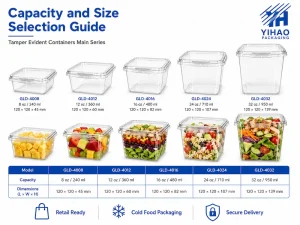
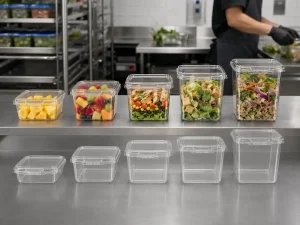
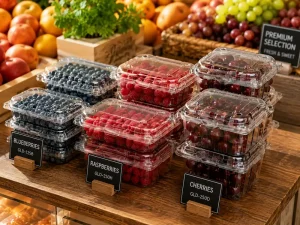
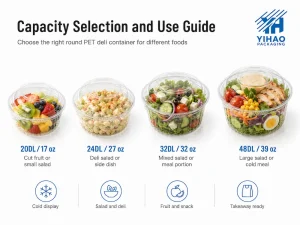
For food packaging buyers, square containers are not just another container shape. They are a structural choice that affects shelf layout, stacking performance, product visibility, carton efficiency, labeling space, and customer handling. A square food container often works well for fresh-cut fruit, salads, deli sides, snacks, bakery portions, chilled noodles, prepared meals, and grab-and-go retail food because it creates a clean, organized appearance in cold shelves and takeaway displays.
As a food packaging manufacturer and solution provider, YIHAO focuses on practical packaging structures for food brands, supermarkets, cafes, bakeries, distributors, and foodservice buyers. When buyers compare wholesale square containers, the decision should not start from price alone. It should start from structure, material, lid design, food application, shelf performance, and repeat-order consistency.
Why Square Containers Matter in Wholesale Food Packaging
Square containers help food packaging teams solve three common problems: limited shelf space, inconsistent visual presentation, and inefficient carton arrangement. Compared with many irregular packaging shapes, square and rectangular structures usually align more neatly in refrigerated displays, retail shelves, takeaway counters, and shipping cartons. This matters for buyers who handle multiple SKUs, repeat orders, and retail-ready food programs.
In chilled food packaging, buyers often need a balance between presentation and function. A clear square container shows color, layering, freshness, and portion size. For salads, fruit, deli foods, and snack packs, visibility supports buyer confidence. For operators, the shape also simplifies stacking and product grouping. This is why square PET deli containers are useful for retail food programs that need a clean display format and practical daily handling.
Best Food Applications for Square Containers
Wholesale square containers are strongest when the buyer needs organized presentation, stable stacking, and visible food display. They are especially suitable for food categories where the product shape or portion layout benefits from a flat base and defined corners.
- Fresh-cut fruit: square containers present melon cubes, grapes, berries, pineapple, mango, and mixed fruit neatly in cold shelves.
- Salads and deli meals: square food containers help show layers, toppings, sauces, grains, noodles, and prepared ingredients clearly.
- Snacks and deli sides: compact square formats are useful for nuts, cheese cubes, olives, small appetizers, and side dishes.
- Bakery and chilled desserts: square containers help protect brownies, cake portions, pastry pieces, and grab-and-go bakery items.
- Prepared meals: square or separate-lid formats work well when buyers need defined portions and organized takeaway presentation.
For smaller deli and snack portions, buyers may review fresh fruit, snacks, and deli sides packaging options. For standard salad and deli programs, a salad, fruit, and deli meals container format may be more practical. For larger chilled portions, buyers can compare options designed for large salads, fruit, and chilled meals.
Square Containers vs Round, Clamshell, Hinged, and Compartment Containers
A strong food container structure guide should compare container shapes by real buying conditions, not by appearance alone. Square containers are not always better than round containers, clamshell containers, hinged containers, or compartment containers. Each structure has a stronger use case.
| Container Type | Best Use | Main Structure Advantage | Buyer Risk to Check | Wholesale Ordering Note |
|---|---|---|---|---|
| Square Containers | Salads, fruit, deli sides, snacks, chilled ready-to-eat foods | Efficient shelf layout, neat stacking, strong label placement | Corner strength, lid fit, stacking pressure, food volume match | Best for buyers who need organized retail display and multiple portion options |
| Round Containers | Salads, fruit bowls, chilled noodles, shared portions | Smooth food presentation and easy spoon access | Carton space use, shelf alignment, lid compatibility | Good for bowl-style presentation and larger chilled food programs |
| Clamshell Containers | Bakery, fruit, sandwiches, produce, grab-and-go foods | Integrated lid and base reduce matching complexity | Hinge fatigue, closure strength, ventilation design | Useful when buyers prefer one-piece packaging and fast packing operations |
| Hinged Containers | Deli, bakery, fruit, takeaway foods | Convenient opening and closing with attached lid | Hinge durability, stacking stability, lid snap consistency | Strong for fast-service food counters and simple SKU control |
| Compartment Containers | Meal kits, snack packs, fruit and nut combinations, divided meals | Separates ingredients and improves portion control | Divider height, sauce movement, lid sealing over each section | Best when buyers need ingredient separation rather than one open cavity |
Buyers comparing alternatives should also review round PET containers, PET hinged deli containers, and multi-compartment tamper evident containers before deciding which structure fits the food program best.
Manufacturer and Supplier Checklist Before Ordering Wholesale Square Containers
A reliable supplier should help buyers compare structure, materials, lid fit, sample performance, and order consistency. The checklist below is designed for packaging buyers, importers, distributors, supermarkets, cafes, bakeries, and foodservice teams evaluating wholesale square containers.
| Checklist Item | What Buyers Should Confirm | Why It Matters | Risk If Ignored |
|---|---|---|---|
| Material Choice | PET, rPET, PP, or other material options based on food type and usage | Material affects clarity, stiffness, temperature use, and presentation | Wrong material may reduce visibility, performance, or buyer confidence |
| Food-Contact Suitability | Supplier should discuss intended food contact, application, and destination market needs | Food packaging must match the buyer’s application and local requirements | Packaging may not fit the required food use or market expectation |
| Lid and Base Fit | Check closing force, lid stability, rim engagement, and repeat opening behavior | Fit affects handling, leakage control, shelf display, and customer experience | Loose lids, difficult closing, and poor stacking may appear in daily operations |
| Stackability | Test filled containers under shelf, transport, and carton conditions | Wholesale orders often move through storage, distribution, and retail handling | Deformation, lid shift, or unstable shelf display may increase complaints |
| Visibility and Anti-Fog Needs | Review clarity under lighting and whether anti-fog features are needed for chilled food | Clear packaging helps buyers present freshness, color, and portion quality | Fogging or dull appearance can reduce shelf appeal |
| Label Placement | Confirm flat label area, barcode visibility, and lid/base branding position | Retail buyers need practical labeling for product names, ingredients, and barcodes | Poor label placement can block food visibility or create scanning issues |
| Sample Testing | Request samples and test real food, filling process, cold shelf display, and transport | Sample testing reduces risk before wholesale ordering | Bulk orders may reveal avoidable fit, stacking, or handling problems |
| Production Consistency | Discuss batch consistency, mold condition, packaging protection, and repeat-order control | Wholesale buyers need the same fit and appearance across repeated shipments | Inconsistent batches may disrupt food packing operations |
Key Structure Details Buyers Should Check
1. Lid Design and Closing Performance
The lid is often where square containers succeed or fail. A good square container should close securely without excessive force. Buyers should test whether staff can close the lid quickly during busy packing periods. If the container uses a separate lid, the lid must match the base consistently. If the container uses a hinged structure, the hinge should open smoothly and remain practical during repeated handling.
For buyers using multiple square container sizes in one program, a shared lid may reduce inventory complexity. For example, a universal PET lid can simplify lid management when the selected container range is designed around compatible sizes.
2. Flat Lid vs High Lid
Flat lids work well for low-profile foods such as sliced fruit, deli sides, pasta salad, nuts, and compact prepared foods. High lids are better when the food needs extra top clearance, such as leafy salads, fruit mixes, bakery pieces, or foods with visible toppings. Buyers should not choose lid height only by capacity. They should test real product fill height, lid contact, and shelf appearance.
A clear square flat-lid container is useful for compact salad or deli presentation, while a high-lid square food container supports products that need more visual height and ingredient clearance.
3. Separate-Lid Format
Separate-lid containers are useful when buyers want a clean premium appearance, controlled stacking, or more flexible lid matching. They are also practical for prepared meals, bakery display, deli foods, and refrigerated retail packs. A separate-lid food container may fit buyers who need a different presentation from one-piece hinged packaging.
How to Test Square Containers Before Wholesale Ordering
Before placing a wholesale order, buyers should test square containers in the same conditions where the packaging will be used. A sample that looks good when empty may perform differently when filled with salad, fruit, sauce, chilled noodles, bakery items, or deli food.
| Test Area | Recommended Test | What to Observe | Decision Signal |
|---|---|---|---|
| Real Food Fit | Fill with actual product weight and ingredient layout | Food height, lid contact, ingredient movement | Choose the structure that protects appearance after filling |
| Cold Shelf Display | Place filled samples under retail lighting and refrigeration | Clarity, fogging, label visibility, product appeal | Select the container that keeps food visible and attractive |
| Stacking | Stack filled containers as they would be stored or displayed | Lid shift, base deformation, shelf stability | Avoid containers that deform under realistic stacking pressure |
| Transport Handling | Test in cartons, delivery boxes, and store handling workflows | Cracks, lid loosening, corner pressure marks | Choose packaging that survives normal movement without quality loss |
| Packing Speed | Let operators pack and close samples during normal workflow | Closing force, hand comfort, speed, error rate | Prefer packaging that reduces labor friction in daily use |
What to Ask a Square Container Manufacturer or Supplier
A strong manufacturer or supplier should give clear answers before buyers move from samples to bulk orders. Buyers should ask practical questions, not only price questions.
- Which material options are suitable for my food application?
- Is the container intended for chilled display, takeaway, bakery display, deli food, or another use?
- How does the lid fit after filling, stacking, and transport?
- Does the container need a flat lid, high lid, hinged lid, or separate lid?
- Can the container support labeling, barcode placement, and private label presentation?
- Can samples be tested with real food before the wholesale order?
- How is carton packing arranged to reduce deformation during export handling?
- How does the factory control repeat-order consistency?
When the order involves multiple SKUs, the buyer should also confirm whether the manufacturer can support stable production, practical communication, packaging protection, and repeat-order coordination. These details matter more than a low first quotation if the buyer plans long-term wholesale supply.
Common Mistakes Buyers Should Avoid
Choosing by Capacity Only
Capacity alone does not define the best square container. Two containers with similar capacity may perform differently because of base depth, lid height, corner design, rim strength, and stacking geometry. Buyers should always test real food fit before selecting a container.
Ignoring Lid Compatibility
Lid compatibility is one of the biggest wholesale risks. A lid that seems acceptable when empty may loosen after filling, stacking, or transport. Buyers should test the full packaging system, not only the base.
Overlooking Shelf Appearance
Clear square containers are often selected for visibility. If the packaging fogs, scratches easily, looks dull, or blocks food presentation with labels, it loses part of its value. Retail packaging should protect the product and help sell it.
Buying Without Sample Testing
Skipping sample testing can create avoidable problems in bulk orders. Samples should be filled, closed, stacked, labeled, stored, and transported before final confirmation. This is especially important for supermarkets, foodservice distributors, and private label food programs.
Deep-Dive Insights for Square Container Sourcing and Food Packaging Structure Decisions
How should buyers think about square containers?
Buyers should treat square containers as a structure decision, not just a shape decision. A square container affects how food sits inside the package, how products align on shelves, how labels are placed, how cartons are packed, and how staff handle the packaging during daily operations. This is why square containers are often useful for chilled retail foods that need a clean, organized, and space-efficient display.
Why do square containers compete strongly with round containers?
Round containers work well for bowl-style food, smooth presentation, and large salad or fruit portions. Square containers often perform better when shelf alignment, stacking density, label placement, and compact display matter more. Buyers should compare both structures with the actual food product, not only by visual preference.
What should a supplier prove before a wholesale order?
A supplier should prove material suitability, lid-base fit, stacking performance, visual clarity, carton protection, and repeat-order consistency. Strong suppliers do not only provide a product list. They help buyers match the correct container structure to the food type, sales channel, packing workflow, and distribution condition.
Which option should buyers prioritize first?
Buyers should first choose the container structure that protects the food and supports the sales channel. For compact deli sides, fruit portions, and chilled snacks, a flat or standard square PET container may work well. For leafy salads, toppings, or foods needing extra headspace, a high-lid square format may be better. For prepared meals or bakery display, separate-lid structures may offer a more premium presentation.
What should buyers confirm before moving from samples to bulk production?
Before bulk production, buyers should confirm sample performance with real food, closing force, stacking stability, label position, carton packing, and final usage conditions. The safest wholesale decision is not the cheapest container. It is the container that performs consistently from packing table to cold shelf, takeaway counter, delivery route, and customer handling.
FAQ: Wholesale Square Containers
1. What are square containers best used for?
Square containers are best used for foods that benefit from organized display, compact shelf layout, and clear presentation. Common uses include fresh-cut fruit, salads, deli sides, snacks, bakery portions, chilled noodles, and prepared ready-to-eat foods.
2. Are square containers better than round containers?
Square containers are better when buyers need efficient shelf alignment, stacking, and label placement. Round containers are better for bowl-style presentation, large salads, and foods that benefit from a smooth circular shape. The best choice depends on food type, display method, and handling workflow.
3. Should buyers choose flat lids or high lids for square containers?
Flat lids are suitable for compact foods with low fill height. High lids are better for leafy salads, fruit mixes, bakery items, toppings, and foods that need extra clearance. Buyers should test real product height before choosing lid style.
4. What should buyers check before ordering wholesale square containers?
Buyers should check material choice, food-contact suitability, lid and base fit, stackability, clarity, label placement, carton protection, sample testing, and supplier repeat-order consistency.
5. Can square containers be used for private label food packaging?
Yes. Square containers often provide useful flat areas for labels, product names, barcodes, and brand presentation. Buyers should confirm label size, placement, visibility, and packaging appearance before bulk ordering.
References
- U.S. Food and Drug Administration, Food Contact Substances and Food Packaging Guidance
- European Food Safety Authority, Food Contact Materials Scientific Guidance
- U.S. Environmental Protection Agency, Sustainable Materials Management and Packaging
- WRAP, Plastic Packaging and Recycling Guidance for Food Packaging
- Association of Plastic Recyclers, PET Packaging Design Guidance
- Food Packaging Forum, Food Contact Materials and Packaging Safety Resources
- Institute of Food Technologists, Food Packaging and Shelf Presentation Considerations
- GS1, Barcode Placement and Retail Packaging Identification Guidance
Final Note / Practical Takeaway
© YIHAO Packaging. All rights reserved. All articles, product images, packaging designs, technical specifications, and website materials are protected by copyright. Unauthorized copying, reproduction, redistribution, modification, or commercial use is strictly prohibited without prior written permission.