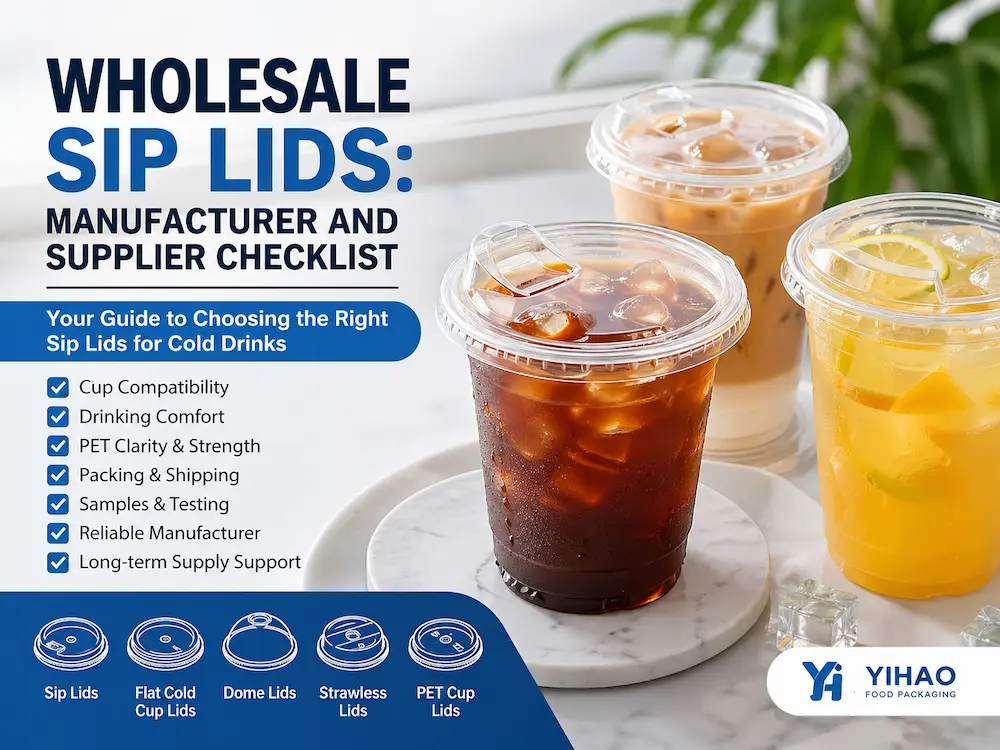
For cold drink packaging buyers, sip lids look simple. They are lightweight, clear, stackable, and often ordered together with PET cold cups. But in wholesale purchasing, a sip lid is not only an accessory. It is the drinking interface, the closure point, the rim-fit component, and one of the first parts customers notice when they pick up a cold beverage. A weak lid decision creates problems fast. The lid may feel loose on the cup rim, crack during closing, lift during takeaway handling, leak when customers walk with the drink, or create an uncomfortable drinking angle. These problems are annoying in a small test order. In a wholesale order, they become costly across thousands of cups, multiple stores, and repeat purchasing cycles. That is why buyers should not source wholesale sip lids by appearance, diameter, or price alone. The better approach is to evaluate the complete cup-lid system: cup rim, lid groove, sip opening, PET material clarity, drink application, chilled storage, packing method, and supplier consistency. YIHAO is a food packaging manufacturer and solution provider supporting cold drink packaging, clear PET cups, cup lids, fresh food containers, bakery packaging, salad containers, fruit packaging, and grab-and-go foodservice packaging. For buyers comparing cold cup lids, PET sip lids, flat lids, dome lids, strawless lids, and sip-through structures, the right decision should start with real application testing. This manufacturer and supplier checklist explains how to compare sip lids, what to test before bulk orders, when to choose sip lids instead of other cold cup lid types, and how to reduce sourcing risk before confirming wholesale supply.
What Are Sip Lids?
Sip lids are cold cup lids designed with a direct-drinking opening. They allow customers to drink from the lid without removing it and without necessarily using a separate straw. In beverage packaging, they are often used for iced coffee, cold brew, iced tea, juice, lemonade, fruit tea, matcha drinks, refreshers, sparkling fruit drinks, and other takeaway cold beverages. The term “sip lid” focuses on the drinking function. Depending on the supplier, a similar product may also be called a sip-through lid, sipper lid, strawless lid, direct-drink lid, or cold cup drinking lid. Buyers should not make decisions only by product name. The real question is whether the lid matches the cup, supports the beverage menu, and performs reliably during actual service. A practical sip lids supplier should help buyers answer these questions:
- Which cup rim does the lid fit?
- Is the lid suitable for direct drinking?
- Does the sip opening feel comfortable?
- Does the lid work with ice, foam, pulp, or fruit pieces?
- Is the material suitable for cold drink packaging?
- Can the same lid system support repeat wholesale orders?
Why Sip Lids Matter in Wholesale Cold Drink Packaging
In retail and foodservice packaging, small parts often create large problems. A cup may look premium, but if the lid does not close properly, the customer remembers the failure. A beverage may taste good, but if the sip opening splashes or feels sharp, the packaging experience becomes weak. For wholesale buyers, sip lids affect more than the customer experience. They also influence store operation, warehouse organization, SKU planning, repeat purchasing, and supplier evaluation. A strong sip lids manufacturer or supplier should help buyers reduce these risks:
- Loose lid fit on the cup rim
- Cracking during lid application
- Uncomfortable sip opening
- Incorrect lid choice for thick drinks or toppings
- Mixed lid systems that confuse store staff
- Unstable repeat supply across future orders
- Vague material or food-contact information
- Carton packing that creates storage and handling problems
For this reason, buyers should treat PET sip lids as part of a beverage packaging system, not as a single low-cost accessory.
Sip Lids vs Flat Lids vs Dome Lids vs Strawless Lids
A professional cold drink packaging program usually needs more than one lid type. Sip lids are useful, but they are not the answer for every beverage. Buyers should compare lid structure according to drink type, service model, topping height, and drinking method.
| Lid Type | Best Use | Main Benefit | Buyer Warning |
|---|---|---|---|
| Sip lids | Iced coffee, cold brew, iced tea, juice, lemonade, refreshers | Direct drinking from the lid opening | Must test sip flow and mouth comfort with real beverages |
| Flat cold cup lids | Standard cold drinks served with straws | Low profile, compact storage, simple use | Usually depends on separate straw handling |
| Dome lids | Smoothies, whipped cream drinks, toppings, dessert drinks | Extra top space for raised drinks and decoration | Higher profile may reduce carton and shelf efficiency |
| Strawless lids | No-straw takeaway beverage programs | Reduces separate straw handling | Not suitable for every drink texture or topping style |
| PET cup lids | Clear cold cup systems for beverage display | Clear appearance and multiple lid structure options | Cup-lid compatibility must be confirmed by sample testing |
For buyers building a complete cold beverage packaging range, it is better to start with the full cold cups and lids category, then compare PET cold cups and compatible lid structures before selecting final SKUs.
Sip Lids vs Strawless Lids: What Buyers Should Understand
Sip lids and strawless lids are closely related, but they should not be treated as exactly the same in every sourcing discussion. A sip lid describes the drinking function. It means the lid has an opening designed for direct drinking. The buyer should evaluate the sip opening, drinking angle, liquid flow, rim contact, and customer comfort. A strawless lid describes the service model. It means the packaging system reduces or removes the need for separate straws. The buyer should evaluate whether the beverage menu, customer habits, local service style, and store operation support a no-straw system. Some lids are both sip lids and strawless lids. But buyers should still test them by drink type. A lid that works well for iced coffee may not work well for thick smoothies, drinks with fruit pieces, bubble tea, whipped cream, or high topping volume. For direct-drink applications, buyers can compare a sip-through lid with a strawless sipper lid. The right choice depends on beverage flow, customer drinking habit, and cup-lid compatibility.
Manufacturer Checklist for Wholesale Sip Lids
A reliable manufacturer should understand more than lid production. The manufacturer should understand material behavior, mold consistency, rim matching, drinking comfort, wholesale packing, export supply, and repeat order stability.
1. Confirm Cup-Lid Compatibility
Cup-lid compatibility is the first and most important checkpoint. Buyers should confirm whether the sip lid matches the exact cup series they plan to use. Do not rely only on nominal diameter, product photos, or general descriptions such as “standard size.” The same stated diameter does not always mean the same fit. Rim profile, rolled rim thickness, lid groove depth, material flexibility, and mold tolerance all affect performance. A lid that fits one cup may feel loose, tight, or unstable on another cup. Before confirming a wholesale order, buyers should test the lid with the actual cup, actual beverage, actual fill level, and real service handling.
2. Review the Sip Opening
The sip opening defines the user experience. A good sip lid should allow smooth drinking without creating sharp contact, awkward flow, or splash risk. The opening should match the beverage, not only the cup. Buyers should test the sip opening with:
- Iced coffee
- Cold brew
- Iced tea
- Juice
- Lemonade
- Matcha drinks
- Refreshers
- Light foam beverages
Testing with water alone is not enough. Ice, foam, pulp, fruit particles, and drink viscosity can change the drinking experience.
3. Check PET Material Clarity and Strength
Many sip lids are made from PET because PET supports clear appearance, lightweight handling, and strong visual presentation for cold drink packaging. Clear PET lids help customers see beverage color, ice, fruit, foam, and layers. However, clarity is only one part of quality. Buyers should also check whether the lid cracks during closing, whether it keeps shape during stacking, and whether the rim grip stays stable after chilled storage. A good PET sip lids supplier should provide clear material information and practical application guidance. Broad or exaggerated claims should be avoided.
4. Compare Lid Options Within the Same Cup System
A strong cold cup system allows buyers to choose different lids for different beverages. For example, a shared rim direction can support dome lids, flat lids, and sip-through lids across multiple cold drink sizes. For standard straw service, a flat lid with straw slot may be suitable. For smoothies or cream-top drinks, a dome lid may be more practical. For direct-drink iced coffee, juice, or tea programs, a sip lid is usually more relevant.
5. Confirm Wholesale Packing and Storage Efficiency
Sip lids are often ordered in large quantities. The lid itself may be small, but packing efficiency affects warehousing, shipping, staff operation, and stock management. Buyers should confirm:
- Lids per sleeve
- Sleeves per carton
- Carton dimensions
- Carton labeling
- Stacking stability
- Storage condition
- Protection during export shipping
Good packaging protects the lids and makes warehouse management easier. Poor packing can create deformation, dust exposure, mixed SKUs, or handling waste.
Bulk Order Risk Checklist for Sip Lids
Before confirming a bulk order, buyers should review the most common sourcing risks. This table can be used as a practical purchasing checklist.
| Risk Point | What to Check | Why It Matters | Recommended Buyer Action |
|---|---|---|---|
| Rim fit | Test lid with the actual cup rim | Prevents loose lids, tight lids, and leakage complaints | Request samples before bulk orders |
| Sip opening | Test real beverages, ice, foam, and normal fill levels | Improves drinking comfort and reduces splash risk | Run staff and customer-style use tests |
| Material strength | Check cracking, flexibility, and closing pressure | Supports fast counter service and repeat handling | Test closing speed under real operation |
| Chilled storage | Test lid fit after refrigeration | Cold conditions may affect handling and fit perception | Place filled cups in chilled storage before review |
| Drink suitability | Compare iced coffee, juice, tea, refreshers, and thicker drinks | One lid does not fit every beverage menu | Assign lid types by drink category |
| Carton packing | Review sleeve count, carton count, and carton labeling | Supports warehouse planning and store-level operation | Confirm packing details before purchase order |
| Repeat supply | Confirm stable mold, fit, and product specification | Avoids mismatch between first and repeat orders | Work with a stable manufacturer or supplier |
| Documentation | Ask for material and food-contact information | Supports buyer review and import discussion | Avoid vague or unsupported claims |
Supplier Checklist for Wholesale Sip Lids
A good supplier should help buyers reduce decision risk. The supplier should understand drink applications, cup matching, sample testing, packing, and repeat supply. The cheapest lid is not always the lowest-cost solution if it creates leakage, complaints, wrong inventory, or return issues.
| Supplier Evaluation Point | What Buyers Should Ask | Good Supplier Signal | Warning Sign |
|---|---|---|---|
| Cup Matching Support | Which cups does this sip lid fit? | Supplier explains rim system and compatible cup range | Supplier only says “standard size” |
| Sample Availability | Can we test samples before bulk orders? | Supplier supports practical sample review | Supplier pushes bulk orders before testing |
| Material Information | What material is used for the lid? | Supplier gives clear material and application guidance | Supplier gives vague or exaggerated claims |
| Drink Application Knowledge | Which drinks are suitable for this lid? | Supplier compares iced coffee, juice, tea, refreshers, and toppings | Supplier recommends one lid for every drink |
| Packing and Storage | How are lids packed for wholesale delivery? | Supplier provides carton, sleeve, and storage details | Packing details are unclear |
| Repeat Supply | Will the same lid fit future cup orders? | Supplier maintains consistent matching system | Mold or fit may change without notice |
Best Applications for Sip Lids
Sip lids are strongest when the beverage is designed for direct drinking. They are especially useful in fast-moving takeaway environments where staff need simple packaging and customers want convenient handling.
Iced Coffee and Cold Brew
Iced coffee and cold brew are strong applications for sip lids because the drink is usually smooth, easy to drink, and often consumed while walking, commuting, or carrying takeaway bags. Clear cups and sip lids also help show coffee color, ice, milk layers, and premium drink presentation. For buyers building an iced coffee packaging system, a compatible clear PET cold cup with the correct lid family can support menu consistency across multiple drink sizes.
Juice, Lemonade, and Iced Tea
Juice, lemonade, and iced tea usually rely on color, freshness, and easy drinking. Sip lids work best when the drink does not contain large fruit pieces or thick pulp. Buyers should test sip flow with the actual drink formula, especially when ice, citrus slices, and light pulp are used. For simple juice and lemonade programs, sip lids reduce separate straw handling while keeping the package clean and retail-ready.
Matcha, Refreshers, and Modern Cold Menus
Modern beverage menus often include matcha, berry refreshers, acai-style refreshers, flavored cold brew, sparkling fruit drinks, fruit tea, and lemonade variations. These drinks rely heavily on visual presentation. Clear cups and compatible sip lids help show color layers, ice, fruit, foam, and freshness. A clear cold cup for matcha and refreshers can support smaller drink formats, while larger cup options support higher-volume takeaway menus.
Supermarket and Convenience Store Grab-and-Go Drinks
Supermarkets and convenience stores need packaging that looks clean in refrigerated cases and performs during customer handling. Sip lids can be used for ready-to-drink cold beverages where customers expect direct drinking after purchase. For retail display, buyers should check whether the lid profile supports shelf visibility, whether cups stand neatly in the refrigerated case, and whether the lid remains secure after chilled storage.
Cafes, Bakeries, and Foodservice Counters
Cafes and bakeries often need flexible packaging for iced coffee, tea, juice, lemonade, fruit tea, and seasonal drinks. Sip lids help staff prepare drinks quickly while giving customers a convenient drinking method. The better strategy is not to use sip lids for every beverage. Foodservice buyers should organize lids by drink type: sip lids for direct-drink beverages, flat lids for standard straw drinks, and dome lids for toppings and dessert-style drinks.
Wholesale Testing SOP Before Confirming Sip Lid Orders
Before confirming a wholesale sip lid order, buyers should run a simple but strict sample test. This reduces risk before large-volume purchasing.
Step 1: Confirm the Cup Series
Check whether the cup uses a 90mm, 95mm, 98mm, or another rim system. Confirm that the sip lid is designed for that exact cup series. Do not assume that all lids with the same nominal size will fit all cups.
Step 2: Test Empty Cup Fit
Place the sip lid on an empty cup. Press around the rim and check whether the lid snaps on smoothly. The lid should not crack, deform, lift, or feel uneven.
Step 3: Test Filled Cup Performance
Fill the cup with real beverages such as iced coffee, iced tea, lemonade, juice, or refreshers. Test the lid with ice, foam, and normal fill levels. A lid that works with water may not perform the same with actual drinks.
Step 4: Test Drinking Comfort
Drink from the sip opening. Check whether the flow feels smooth, whether the mouth contact area feels comfortable, and whether the opening creates splash risk.
Step 5: Test Takeaway Movement
Carry the cup by hand, place it in a takeaway bag, move it across a counter, and simulate normal delivery handling. The lid should remain stable under realistic movement.
Step 6: Test Chilled Storage
Place filled cups in a refrigerated environment if the drink is sold cold or grab-and-go. Check whether lid fit changes after cold storage.
Step 7: Check Packing and Inventory Efficiency
Review how lids are packed in sleeves and cartons. For wholesale buyers, storage efficiency, carton labeling, and SKU organization matter as much as the product itself.
How to Build a Complete Cold Cup Lid System
Professional buyers should not treat sip lids as a standalone accessory. A better sourcing strategy is to build a complete cold cup lid system around cup diameter, drink menu, and service model. A complete system may include:
- Sip lids for direct-drink iced coffee, tea, juice, lemonade, and refreshers
- Flat lids for standard straw-based cold drinks
- Dome lids for smoothies, whipped cream, toppings, and dessert drinks
- Strawless lids for no-straw takeaway beverage programs
- Clear PET cups in matched rim systems
- Sample testing before wholesale orders
- Supplier guidance for repeat purchasing
Buyers using 95mm cup systems can compare 95mm flat lids and 95mm strawless sipper lids as part of the same decision. The best lid depends on whether the drink requires straw access, direct drinking, or topping space.
Common Mistakes When Buying Wholesale Sip Lids
Choosing by Diameter Only
Diameter matters, but it is not enough. Rim structure, lid groove, cup material, and mold matching also affect fit. Buyers should always test actual samples before confirming wholesale orders.
Using One Lid for Every Drink
One lid cannot solve every drink format. Sip lids are strong for direct-drink beverages, but dome lids are better for toppings, and flat lids may be better for straw-based drinks.
Ignoring Chilled Storage Conditions
Cold drinks are often stored in refrigerators or served with ice. Buyers should test lid fit and drinking comfort after chilled storage, not only at room temperature.
Buying Without Matching Guidance
A supplier that sells cups and lids separately without compatibility guidance increases sourcing risk. Wholesale buyers should work with a manufacturer or supplier that understands cup-lid systems.
Overusing Sustainability Claims
Buyers should be specific with sustainability language. PET or rPET packaging may be recyclable where local collection, sorting, and recycling systems accept it. Recyclability should not be presented as universal without market-specific confirmation.
Questions to Ask a Sip Lids Manufacturer or Supplier
Before placing a wholesale order, buyers should ask direct questions:
- Which cup series does this sip lid match?
- Is the lid designed for 90mm, 95mm, 98mm, or another rim system?
- Can we test samples with our actual cups?
- Which drinks are best suited for this lid?
- Is the sip opening comfortable for iced coffee, juice, tea, and refreshers?
- How does the lid perform with ice and chilled storage?
- What material is used?
- How are lids packed for wholesale delivery?
- Can the supplier maintain consistent repeat supply?
- Can the supplier help compare sip lids, flat lids, dome lids, and strawless lids?
The answers quickly show whether the supplier understands practical beverage packaging or only sells individual items.
How YIHAO Supports Wholesale Sip Lid Buyers
YIHAO supports beverage packaging buyers with clear cold cups, PET cup lids, sip-through lids, flat lids, dome lids, strawless lids, and practical cup-lid matching guidance. For buyers sourcing wholesale sip lids, the most important value is not only product supply. It is the ability to build a reliable packaging system around real beverage applications. YIHAO helps buyers think through:
- Drink menu and lid structure
- Cup rim compatibility
- PET cup and lid matching
- Sample testing before bulk purchasing
- Retail display and takeaway service
- Wholesale packing and repeat supply
- OEM and custom packaging discussion where applicable
For cafes, beverage brands, supermarkets, convenience stores, bakeries, distributors, and foodservice teams, this approach reduces sourcing mistakes and improves long-term packaging reliability.
Final Note / Practical Takeaway
FAQ
1. What are sip lids used for?
Sip lids are used for cold drink packaging that supports direct drinking from the lid opening. They are commonly used for iced coffee, cold brew, iced tea, juice, lemonade, fruit tea, matcha drinks, refreshers, and other takeaway cold beverages.
2. Are sip lids the same as strawless lids?
Sip lids and strawless lids are closely related, but the terms focus on different points. Sip lids describe the direct-drinking function, while strawless lids describe a no-straw packaging concept. Some products may fit both descriptions depending on their structure.
3. Are sip lids better than flat cold cup lids?
Sip lids are better when direct drinking is the main goal. Flat cold cup lids are better when the beverage program still depends on straw use, compact storage, and simple standard cold drink service.
4. When should buyers choose dome lids instead of sip lids?
Buyers should choose dome lids when the drink or dessert needs extra top space. Dome lids are better for smoothies, whipped cream drinks, foam toppings, fruit toppings, parfaits, and dessert-style beverages.
5. What should buyers test before ordering wholesale sip lids?
Buyers should test cup-lid compatibility, rim grip, drinking comfort, liquid flow, chilled storage performance, takeaway movement, carton packing, and repeat supply consistency before confirming wholesale sip lid orders.
References
- U.S. Food and Drug Administration, Packaging & Food Contact Substances guidance.
- U.S. Food and Drug Administration, Understanding How FDA Regulates Substances that Come into Contact with Food.
- European Commission, Food Contact Materials overview.
- European Commission, Regulation framework for materials and articles intended to come into contact with food.
- Association of Plastic Recyclers, APR Design Guide for Plastics Recyclability.
- Association of Plastic Recyclers, PET Rigid Design Guidance.
- Food Packaging Forum, updates on plastic food-contact material regulation.
- Industry packaging practice for cold beverage cup-lid compatibility and wholesale sample testing.
Deep-Dive Insights: How Buyers Should Think About Sip Lids
How sip lids reduce packaging complexity
Sip lids simplify cold beverage service by turning the lid into the drinking interface. For iced coffee, cold brew, juice, lemonade, iced tea, matcha, and refreshers, this reduces dependence on separate straw handling and helps staff serve drinks faster during busy takeaway periods.
Why sip lids should be tested with real drinks
Water testing is not enough. Buyers should test sip lids with actual beverages, ice volume, foam, pulp, fruit pieces, fill level, and chilled storage conditions. Real beverage testing reveals whether the sip opening feels comfortable, whether liquid flow is stable, and whether the lid remains secure during handling.
What makes a supplier reliable for wholesale sip lids
A reliable supplier should explain cup-lid compatibility, rim fit, material direction, lid structure, carton packing, and repeat-order stability. The strongest suppliers help buyers build a full cold cup lid system instead of recommending one lid for every drink.
Option: sip lids vs flat lids vs dome lids vs strawless lids
Sip lids work best for direct-drink cold beverages. Flat lids work better for standard straw service. Dome lids are stronger for whipped cream, smoothies, toppings, and dessert-style drinks. Strawless lids support no-straw takeaway programs. Many buyers need a mixed lid system to cover the full beverage menu.
Consideration: food-contact, PET material, and local recyclability claims
Buyers should keep packaging claims precise. PET and RPET sip lids may support clear presentation and practical cold drink service, but food-contact suitability, recycled content, and recyclability should be confirmed according to product specification, target market, and local collection or recycling systems.
© 2026 YIHAO Packaging. All rights reserved. All articles, product images, packaging designs, technical specifications, and website materials are protected by copyright. Unauthorized copying, reproduction, redistribution, modification, or commercial use is strictly prohibited without prior written permission.