
Why Wholesale Buyers Are Re-Evaluating rPET Packaging
Food packaging buyers are under stronger pressure to balance product visibility, food-contact safety, sustainability claims, cost control, and stable supply. For many chilled and ready-to-eat food applications, rPET packaging offers a practical route because it keeps the visual benefits of PET while supporting recycled-content communication.
As a food packaging manufacturer and solution provider, YIHAO works with buyers who need practical material guidance rather than vague sustainability language. A supermarket chain, beverage distributor, fresh-cut fruit processor, deli brand, or prepared-food company does not only ask whether a package is “eco-friendly.” The better question is: does this material fit the food, shelf condition, target market, recycling or composting pathway, and wholesale supply plan?
This guide is written for B2B buyers who need to compare rPET packaging with PET, PP, and PLA, then evaluate a manufacturer or supplier before moving from samples to bulk orders.
What Is rPET Packaging?
rPET packaging refers to packaging made with recycled polyethylene terephthalate. In food packaging, rPET is commonly used for clear cold-food containers, deli packs, salad bowls, fresh produce clamshells, bakery containers, lids, and clear cold cups when the recycled material source and production process are suitable for the intended food-contact application.
For buyers, rPET is not simply “recycled plastic.” A professional supplier should be able to explain the recycled content, material source, food-contact documentation, production process, and recommended food application. When used correctly, rPET supports circular packaging goals while preserving the clarity, stiffness, and shelf-display value that make PET popular in chilled food and beverage packaging.
For clear food display, buyers can evaluate deli and salad containers, fresh produce packaging containers, and PET cold cups as separate application groups instead of forcing every product into one material decision.
rPET Packaging vs PET, PP, and PLA: The Practical Buyer View
The keyword PET vs PP vs PLA packaging appears often in buyer research, but the answer depends on the food application. PET and rPET are preferred for transparent chilled display. PP is preferred for heat-related and microwave applications. PLA is used where certified compostability is part of the packaging program and where the end-of-life infrastructure supports that claim.
| Material | Best Application Fit | Key Strength | Main Limitation | Buyer Checkpoint |
|---|---|---|---|---|
| PET | Cold food, produce, bakery, deli, salads, clear cups | High clarity and strong shelf presentation | Not intended for microwave heating | Confirm food-contact grade and recyclable design |
| rPET | Cold food containers, clear deli packs, salad bowls, cold cups, produce clamshells | Clear appearance with recycled-content communication | Requires verified recycled material and suitable processing | Ask for recycled-content and food-contact documentation |
| PP | Hot food, microwave meals, prepared dishes, takeaway meals | Better heat resistance for microwave-related use | Usually lower visual clarity than PET | Match PP to heating conditions and lid compatibility |
| PLA | Cold cups and compostable packaging programs | Supports certified compostable positioning | Requires industrial composting infrastructure and proper claims | Check BPI, EN 13432, ASTM, or relevant compostability certification |
For chilled foods and retail display, PET food containers and rPET packaging are strong choices because customers see the food clearly. For hot meals, microwave safe containers made from PP are more logical. For beverage brands comparing clear cups and sustainability claims, buyers should compare cold cups and lids, PP cold cups, and PLA compostable cold cups by market channel and disposal route.
Buyer Decision Matrix: When to Choose rPET, PET, PP, or PLA
| Buyer Scenario | Recommended Material | Reason |
|---|---|---|
| Clear chilled salad, fruit, deli, or bakery display | rPET or PET | Strong clarity, shelf presentation, and cold-food performance |
| Retail program with recycled-content communication | rPET | Supports recycled-content positioning while keeping PET-like clarity |
| Microwave meal or hot takeaway food | PP | Better heat resistance for microwave-related food packaging |
| Controlled compostable foodservice program | PLA | Works only when certification and composting infrastructure support the claim |
| Lowest-risk wholesale cold-food packaging range | rPET + PET + PP combination | Allows buyers to match each food category with the right material |
When rPET Packaging Makes the Most Sense
1. Chilled Retail Food Display
rPET packaging is most valuable when product visibility matters. Salads, fruit cups, deli sides, bakery desserts, nuts, chilled snacks, and grab-and-go foods benefit from clear packaging because shoppers judge freshness visually. A transparent container supports trust before the customer reads the label.
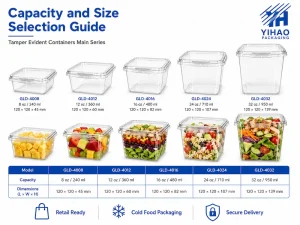
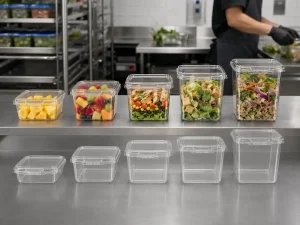
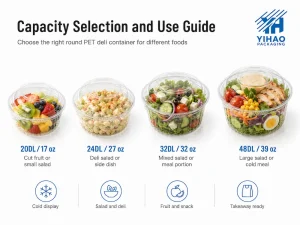
For this use case, buyers often compare hinged deli containers, round bowls, square deli packs, and separate-lid containers. A PET/RPET clear food container supports clean presentation for cold food portions, while larger PET/RPET food containers support bigger chilled portions and prepared-food programs.
2. Fresh Produce and Fresh-Cut Fruit
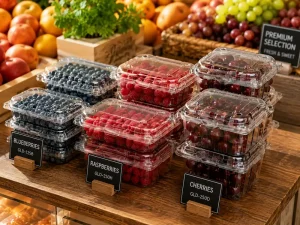
Fresh produce packaging needs clarity, ventilation, strength, and stackability. Berry clamshells, grape containers, fresh-cut fruit trays, and snack packs benefit from clear PET or rPET structures because they let the food become the visual selling point.
For fresh-cut fruit, buyers should review moisture control, anti-fog needs, lid security, portion logic, and merchandising format. A container for apple slices and grapes has different requirements from a vented berry clamshell or a family-size fruit pack. The best wholesale supplier should guide the buyer by fruit fragility, pack weight, cold-chain handling, and retail shelf layout.
3. Beverage Cups for Cold Drinks
For cold beverage programs, PET and rPET cups provide a clear view of iced coffee, lemonade, matcha, refreshers, fruit tea, smoothies, and cold brew. This matters because modern beverage menus rely heavily on color, layers, ice, foam, and fruit inclusions.
A PET/RPET clear cold cup fits beverage programs that need strong shelf appeal and clear menu presentation. Buyers should also confirm lid compatibility, rim size, cup stiffness, stack height, carton packing, and whether the supplier can support multiple sizes within one cup system.
4. Deli, Salad, and Grab-and-Go Meal Programs
Deli and salad programs need containers that look clean on shelf, close securely, stack efficiently, and support quick packing. rPET packaging is especially relevant for cold prepared food where microwave use is not required.
For square, round, and hinged deli formats, buyers should evaluate the food type first. Leafy salads need enough headspace and lid stability. Pasta salads need leak resistance. Fruit-and-nut packs need compartment logic. Retail meal salads need clear lids and strong bases. In many cases, PET hinged deli containers and square PET deli containers create better display impact than opaque alternatives.
When PP Food Containers Are the Better Choice
PP food containers are the better choice when heat resistance matters. If the food is reheated, steam-treated, hot-filled, or positioned for microwave convenience, PP should be evaluated before PET or rPET.
Buyers should avoid using a sustainability claim to override real food-use conditions. A clear rPET salad container is practical for chilled greens, but a hot rice bowl or prepared meal usually needs PP. For example, a PP prepared meal container is more suitable for foodservice and prepared meal programs that involve heating or warm food handling.
The supplier should clearly separate PET/rPET cold-food applications from PP heated-food applications. This prevents product complaints, deformation issues, and mismatched customer expectations.
When PLA Compostable Containers Make Sense
PLA compostable containers are relevant when a buyer has a real compostable packaging program. PLA should not be selected only because it sounds sustainable. Compostability depends on certification, labeling, collection, sorting, and access to suitable industrial composting infrastructure.
For cafes, festivals, institutional dining, and controlled foodservice environments, PLA may support a clear environmental message if the waste pathway is properly managed. For general retail channels without composting infrastructure, rPET or PET may be more practical because they align better with existing plastic recycling conversations.
A serious supplier should not make vague claims such as “biodegradable” without documentation. Buyers should ask whether the product is certified to recognized compostability standards and whether the claim fits the destination market.
Manufacturer Checklist for Wholesale rPET Packaging
Before choosing a rPET packaging manufacturer, buyers should move beyond sample appearance and evaluate production control. A nice sample is not enough. The real test is whether the factory can maintain clarity, thickness, structure, fit, carton packing, and documentation across repeated wholesale orders.
| Evaluation Area | What Buyers Should Check | Why It Matters |
|---|---|---|
| Material Documentation | rPET source, recycled-content explanation, food-contact suitability, batch control | Supports compliance review and protects buyer claims |
| Application Matching | Cold food, hot food, beverage, produce, bakery, deli, or meal prep use | Prevents choosing the wrong material for the food condition |
| Structural Consistency | Hinge strength, lid fit, rim accuracy, stacking, leak resistance, wall thickness | Reduces complaints after repeat wholesale orders |
| Sample Testing | Real food weight, refrigeration, label application, transport vibration, lid opening | Confirms performance before bulk production |
| Production Capacity | Seasonal demand, multiple SKUs, reorder stability, export packing | Protects long-term supply reliability |
| Customization Ability | Logo, printing, embossing, label area, carton marks, private label support | Supports retail branding and distributor programs |
Documents to Request from an rPET Packaging Supplier
For wholesale buyers, documentation is not paperwork for appearance. It helps confirm whether the supplier understands food-contact requirements, product specifications, export packing, and repeat-order control. Before confirming a large order, buyers should request the following documents or written confirmations.
| Document or Confirmation | What It Should Include | Buyer Benefit |
|---|---|---|
| Food-contact material documentation | Relevant documentation for the target market and intended food application | Supports safer purchasing decisions |
| rPET material statement | Recycled-content explanation, material source, and applicable production notes | Prevents unsupported recycled-content claims |
| Product specification sheet | Size, capacity, weight, material, lid type, carton packing, and usage notes | Improves internal approval and reorder accuracy |
| Sample approval record | Approved sample version, structure, material, and customization details | Reduces mismatch between sample and bulk production |
| Carton packing details | Carton size, quantity per carton, pallet loading, and export packing method | Helps estimate logistics cost and warehouse planning |
| Customization confirmation | Logo, printing, embossing, label area, carton marks, artwork, and tooling notes | Protects branding consistency before production |
Supplier Questions Buyers Should Ask Before Ordering
- What percentage of recycled PET is used in this rPET packaging?
- Is the material suitable for the intended food-contact application?
- Can you separate PET, rPET, PP, and PLA recommendations by food type?
- Which products are suitable for cold food only, and which are suitable for microwave use?
- Can you provide samples from current production instead of only display samples?
- How do you control lid fit, hinge strength, rim accuracy, and stacking performance?
- Can the same container series support multiple sizes for retail programs?
- What customization options are available for logo, label area, embossing, printing, or private label projects?
- How do you pack products for export to reduce deformation and carton damage?
- How do you handle repeat orders, quality complaints, and specification confirmation?
Common Mistakes When Buying rPET Packaging Wholesale
Mistake 1: Treating rPET as a Universal Replacement
rPET packaging is useful, but it does not replace every plastic packaging material. It is strong for clear cold-food packaging. It is not the first choice for microwave heating. Buyers should use rPET where its clarity, stiffness, and recycled-content value match the food application.
Mistake 2: Comparing Only Unit Price
A lower unit price can hide weaker lids, thinner walls, poor stacking, inconsistent clarity, or weak carton packing. For wholesale programs, total cost includes product damage, customer complaints, repacking labor, shipping efficiency, and reorder stability.
Mistake 3: Ignoring End-of-Life Claims
Recyclable, recycled-content, compostable, and biodegradable are different claims. Buyers should not mix them casually. PET and rPET packaging belong mainly to recycling conversations. PLA belongs to compostability conversations. PP belongs to heat-resistant and microwave-related food packaging conversations, even though recycling availability varies by market.
Mistake 4: Choosing Material Before Application
The best order is food first, material second. Start with the actual food: salad, cut fruit, bakery dessert, cold drink, hot meal, protein box, or chilled snack. Then define temperature, shelf life, display, lid security, transport, and disposal route. Only after that should the buyer choose PET, rPET, PP, or PLA.
Wholesale rPET Packaging Checklist
| Checklist Area | What to Confirm | Why It Matters |
|---|---|---|
| Food application | Cold food, hot food, beverage, produce, bakery, deli, or meal prep | Prevents material mismatch |
| Material choice | rPET, PET, PP, PLA, or mixed product range | Aligns packaging with temperature and end-of-life needs |
| Food-contact documentation | Relevant documentation for the target market and application | Supports compliance review and buyer confidence |
| Visual clarity | Transparency, gloss, color tone, anti-fog performance if needed | Improves retail shelf display |
| Structure | Lid fit, hinge strength, rim accuracy, stacking, leak resistance | Reduces operational issues after bulk orders |
| Product range | Multiple sizes, matching lids, related container shapes | Helps buyers build a consistent packaging program |
| Customization | Logo, printing, embossing, label area, carton marks | Supports retail branding and private label programs |
| Wholesale supply | Capacity, reorder stability, packing method, export support | Protects long-term supply reliability |
How to Build a Balanced Material Range
Many buyers do not need only one material. A stronger packaging program often uses several materials with clear application logic:
- rPET packaging for cold food display, salads, fruit, deli snacks, and clear cups.
- PET food containers for high-clarity cold packaging where recycled content is not the primary claim.
- PP food containers for microwave meals, hot takeaway, and prepared food applications.
- PLA compostable containers for controlled compostable programs with suitable certification and disposal infrastructure.
This material mix helps distributors, supermarkets, and foodservice brands serve different food categories without forcing one material into the wrong application. It also makes supplier communication clearer because each SKU has a defined purpose.
Final Supplier Selection: What a Good Manufacturer Should Prove
A strong rPET packaging supplier should prove five things before receiving a large order. First, the supplier understands food applications. Second, the supplier can explain material differences clearly. Third, the supplier can provide consistent product structure. Fourth, the supplier can support wholesale export packing. Fifth, the supplier communicates honestly about what each material can and cannot do.
Buyers should favor suppliers who speak in application logic, not slogans. The right supplier will say: use rPET or PET for clear chilled display, use PP for heat-related applications, use PLA only when compostability infrastructure and certification support the claim, and always test samples with the real food before scaling the order.
For buyers preparing a wholesale packaging project, the best next step is to define the food type, target market, required material, container size range, lid structure, and customization needs before requesting samples. This helps the supplier recommend the right rPET, PET, PP, or PLA packaging solution more accurately. A reliable packaging factory should support this process with sample review, specification confirmation, and repeat-order control.
FAQ: Wholesale rPET Packaging
1. What is rPET packaging used for in food packaging?
rPET packaging is commonly used for clear cold-food containers, deli packs, salad bowls, produce clamshells, bakery containers, lids, and cold cups. It is best suited for chilled display applications where transparency and recycled-content communication are important.
2. Is rPET packaging better than PET packaging?
rPET packaging is better when a buyer wants recycled-content communication while keeping the clarity and structure of PET. Virgin PET may still be selected when a project has specific clarity, supply, cost, or technical requirements. Buyers should compare both options by food-contact documentation, appearance, availability, and target market expectations.
3. Which is better for food packaging: PET, PP, or PLA?
PET and rPET are better for clear cold-food display. PP is better for microwave and heat-related food applications. PLA is better for certified compostable programs where industrial composting infrastructure exists. There is no single best material for every food application.
4. Can rPET food containers be used in the microwave?
rPET food containers are generally designed for cold food and chilled display, not microwave heating. Buyers who need microwave-safe packaging should evaluate PP food containers instead.
5. What should buyers ask an rPET packaging supplier before bulk orders?
Buyers should ask about recycled content, food-contact suitability, sample testing, lid fit, structure consistency, carton packing, customization options, production capacity, and export support. These questions help prevent quality problems after wholesale orders begin.
6. What is the difference between PET and rPET packaging?
PET packaging is made from polyethylene terephthalate, while rPET packaging uses recycled PET material. Both can provide strong clarity for cold food packaging, but rPET helps buyers communicate recycled-content value when the material source and food-contact suitability are properly verified.
7. Is rPET packaging recyclable?
rPET packaging is generally connected with PET recycling streams, but actual recyclability depends on local collection systems, container design, labels, color, additives, and contamination. Buyers should confirm recyclability claims based on the target market instead of using a generic claim.
References
- European Commission, Regulation (EU) 2025/40 on Packaging and Packaging Waste.
- U.S. Food and Drug Administration, Guidance for Industry: Use of Recycled Plastics in Food Packaging.
- U.S. Food and Drug Administration, Recycled Plastics in Food Packaging.
- Association of Plastic Recyclers, APR Design Guide for Plastics Recyclability.
- Biodegradable Products Institute, Certified Compostable Program.
- European Bioplastics, EN 13432 and industrial compostability guidance.
- U.S. Environmental Protection Agency, Containers and Packaging: Product-Specific Data.
- Ellen MacArthur Foundation, Circular Economy for Plastics and Packaging.
Deep-Dive Insights: How Buyers Should Think About rPET Packaging
How should buyers decide if rPET packaging is the right material?
Buyers should start with the food application, not the sustainability label. If the product is chilled, visible, retail-facing, and not intended for microwave heating, rPET packaging is often a strong candidate. If the food is hot, reheated, or microwave-positioned, PP is usually more practical. If compostability is the primary goal, PLA only makes sense when certification and proper disposal infrastructure support the claim.
Why does supplier capability matter as much as material choice?
A good material can still fail if the manufacturer cannot control lid fit, wall thickness, carton packing, rim accuracy, or repeat-order consistency. Wholesale buyers should evaluate the supplier’s production stability, documentation, customization process, sample approval workflow, and export packing before focusing only on unit price.
What is the strongest commercial value of rPET packaging?
The strongest value of rPET packaging is the combination of clear product presentation and recycled-content communication. This is especially useful for salads, fruit, deli foods, bakery desserts, chilled snacks, and cold drinks where shelf visibility directly supports consumer trust and purchase decisions.
What should buyers avoid when comparing plastic packaging materials?
Buyers should avoid treating PET, rPET, PP, and PLA as interchangeable materials. PET and rPET are strong for clear cold display. PP is stronger for heat-related applications. PLA supports compostable programs only when the waste pathway is managed properly. Clear application logic prevents wrong-material purchasing and reduces after-sale complaints.
What is the practical next step before wholesale ordering?
Before placing a wholesale order, buyers should prepare the food type, size range, target market, lid requirement, temperature condition, expected order quantity, customization needs, and documentation requirements. This gives the supplier enough information to recommend the right rPET, PET, PP, or PLA packaging solution with fewer sample revisions.
Final Note / Practical Takeaway
© YIHAO Packaging. All rights reserved. All articles, product images, packaging designs, technical specifications, and website materials are protected by copyright. Unauthorized copying, reproduction, redistribution, modification, or commercial use is strictly prohibited without prior written permission.