Choosing PP takeout packaging is not only a material decision. For restaurants, foodservice distributors, supermarkets, deli counters, catering kitchens, meal prep brands, and prepared food programs, the real question is whether the packaging fits hot food service, microwave reheating, transport handling, stacking, lid closure, portion control, and repeat wholesale supply.
YIHAO works with food packaging buyers who need practical packaging decisions rather than generic catalog browsing. For hot meals and takeaway programs, PP packaging deserves a structured checklist because the container must support real kitchen operations: filling, closing, stacking, dispatching, customer reheating, and repeat ordering.
This guide explains how to compare PP takeout packaging, how to evaluate microwave safe containers, and what to confirm with a manufacturer or wholesale supplier before moving into bulk orders.
Why PP Takeout Packaging Fits Hot Food and Microwaveable Takeaway Programs
PP, short for polypropylene, is widely used for takeout food containers, hot food containers, deli meal packs, and microwaveable takeaway boxes. Its value comes from a balance of heat tolerance, lightweight structure, foodservice practicality, and cost efficiency for high-volume packaging programs.
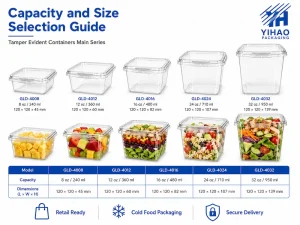
For buyers, PP takeout packaging is especially relevant when the food program includes hot rice meals, noodles, pasta, curry, grilled items, deli dishes, prepared meals, and ready-to-heat portions. Unlike clear PET containers, which are typically selected for chilled display and product visibility, PP containers are commonly selected when heat handling and microwave reheating are part of the use case.
Best-fit food applications
PP packaging is most suitable when the food is served warm, held for delivery, or reheated by the end customer. Typical use cases include:
- Restaurant takeaway meals and delivery orders
- Hot deli foods from supermarket counters
- Meal prep programs and ready-to-heat meals
- Catering side dishes and prepared portions
- Foodservice kitchens needing stackable bulk containers
- Grab-and-go meals that require secure lids and portion consistency
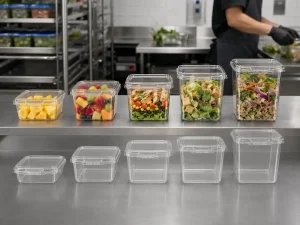
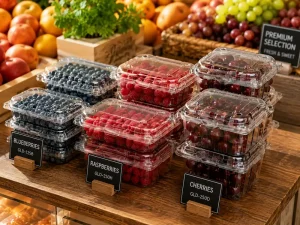
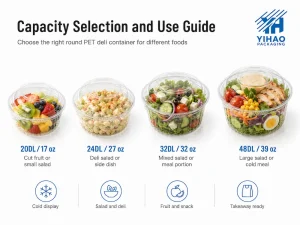
For chilled salads, fresh fruit, bakery display, or transparent retail merchandising, PET or rPET packaging often fits better. For hot meals and microwaveable takeaway boxes, PP takeout packaging gives buyers a stronger material direction.
Manufacturer Checklist: What to Confirm Before Ordering PP Takeout Packaging
A strong supplier decision starts with a checklist. Buyers should avoid choosing packaging only by price or container size. Hot food packaging has more variables than cold display packaging, especially when microwaving, lid fit, steam release, oil resistance, and stacking strength affect user experience.
1. Confirm the intended food use
Before choosing a container, define the food type clearly. A container for hot rice bowls does not face the same pressure as a container for oily stir-fry, saucy pasta, grilled meat, soup-based dishes, or chilled-to-reheat meal portions.
Ask these questions before selecting PP takeout packaging:
- Will the container hold hot food immediately after filling?
- Will the customer reheat the food in the microwave?
- Is the food oily, acidic, saucy, dry, or mixed?
- Will the container be used for delivery, retail shelf display, or meal prep?
- Does the lid need to stay on during transport but vent during reheating?
- Will the pack be stacked in bags, crates, shelves, or delivery boxes?
These answers shape the correct container depth, lid style, wall strength, rim design, and sample testing plan.
2. Check food contact suitability
For food packaging buyers, “food grade” should not stay as a slogan. The supplier should explain the intended use of the material and whether the container is suitable for direct food contact under the buyer’s application conditions.
For wholesale orders, ask for available material documentation, food contact declarations, and product-use guidance that match the target market. A buyer serving the U.S., EU, Middle East, Southeast Asia, or local domestic market may need different documents. The key point is not to assume that every PP container automatically fits every food, temperature, and reheating condition.
3. Verify microwave-use instructions
Microwave safe takeout containers must be evaluated by actual intended use. The phrase “microwave safe” should connect to container body material, lid compatibility, reheating time, food type, steam venting, and user instructions.
Buyers should confirm whether the lid is intended for microwave reheating or only for transport. In many takeaway applications, the container body may be designed for reheating, while the lid requires opening, venting, or removal depending on the design. Labels, sleeves, seals, and printed accessories should also be reviewed separately because the complete packaging system must match the intended heating conditions.
Oil-rich foods, high-sauce meals, dense rice dishes, and high-moisture prepared meals may behave differently during reheating. That is why “PP material” alone is not enough as an approval standard. Buyers should confirm the recommended heating instruction, test real food portions, and avoid making unverified claims to restaurants or end consumers.
When comparing prepared meal containers, request clear usage instructions for heating, venting, stacking, and customer handling. This avoids customer complaints after the product enters restaurant or retail circulation.
4. Match container size to portion logic
Packaging buyers often choose containers by capacity first. That is only part of the decision. The better approach is to match container size with real menu portions.
A compact PP box may suit rice sides, deli portions, snacks, and small prepared meals. A deeper or larger container may suit pasta, curry rice, stir-fry, hot entrees, or family-style takeaway. For commercial buyers, portion logic affects cost control, visual fullness, food movement during delivery, and customer perception.
For larger meal portions, buyers may compare a large deli food containers against smaller prepared food containers. The best option is the one that protects the meal, controls portion cost, and keeps the package looking full without forcing overfilling.
5. Evaluate lid fit and closure performance
Lid performance matters as much as the container body. Poor lid fit causes leaks, loose closure, stacking instability, steam pressure issues, and negative delivery reviews. A wholesale buyer should always test lid closure under real handling conditions rather than judging only by product photos.
Check the following:
- Does the lid close smoothly after hot filling?
- Does the rim remain stable after stacking?
- Does the lid resist popping during transport?
- Does the package allow safe steam release when required?
- Does the container remain easy to open for consumers?
- Does the separate lid create enough sealing confidence for delivery bags?
For programs that need flexible menu coverage, a PP food container with separate lid gives buyers a practical structure to test across fresh, chilled, and hot takeaway applications.
PP Takeout Packaging Buyer Decision Matrix
The following decision matrix helps restaurants, distributors, supermarkets, and foodservice buyers connect packaging choice with real operating conditions. It is designed for buyers comparing PP takeout packaging before sample testing and wholesale ordering.
| Buyer Need | Recommended Packaging Focus | What to Test Before Ordering | Why It Matters |
|---|---|---|---|
| Hot rice meals and noodle dishes | Stable PP container with secure separate lid | Hot filling, stacking, lid closure, food movement | Prevents loose lids, side leakage, and poor delivery presentation |
| Meal prep and ready-to-heat meals | Microwave-use body with clear reheating instruction | Chilled storage, condensation, reheating behavior, label compatibility | Supports customer reheating and repeat purchase confidence |
| Supermarket deli counter foods | Stackable PP container with practical display and lid fit | Retail handling, shelf stacking, lid opening, label placement | Improves counter operation and reduces package damage |
| Restaurant delivery meals | Strong rim, controlled depth, secure closure | Delivery bag movement, oily food leakage, stacking pressure | Protects delivery experience and reduces complaints |
| Catering and large portions | Larger PP container with stronger stacking performance | Filled weight, carton handling, transport stacking, lid stability | Helps bulk foodservice teams manage heavier portions safely |
Supplier Checklist: How to Compare Wholesale PP Takeout Packaging Suppliers
A supplier comparison should go deeper than catalog photos and unit price. For wholesale PP takeout packaging, the supplier must support stable quality, repeat production, packaging consistency, and buyer-side communication.
1. Product range and application coverage
A useful supplier should offer more than one container shape. Restaurant food containers vary by food type: rice meals, deli dishes, noodles, sides, snacks, hot prepared food, and retail-ready meals all require different depths, lids, and stacking behavior.
Buyers should compare whether the supplier has enough PP packaging coverage for the whole menu or only one container style. A stronger range helps buyers build a more complete food packaging system and reduce the number of unrelated suppliers.
2. Sample testing support
For PP takeout packaging, sample testing is not optional. It protects both the buyer and the supplier. The buyer should test real food, real filling temperature, real delivery bags, real stacking height, and real reheating behavior before approving a wholesale order.
Recommended sample tests include:
- Hot filling test with the buyer’s actual food
- Microwave reheating test based on intended customer instructions
- Lid closure test immediately after filling
- Stacking test after filling and transport simulation
- Leak check with oily, saucy, and moist foods
- Freezer or chilled storage test if the meal program requires cold-chain handling
- Label and sleeve compatibility check if branding is used
For hot-food programs, buyers should test a PP prepared food container under both cold-dish and hot-takeaway conditions if the same SKU will serve multiple menu categories.
3. Factory capability and consistency
A packaging supplier is only useful if it can deliver repeat consistency. In wholesale projects, small differences in rim shape, lid fit, wall thickness, or material behavior create big problems once the product reaches restaurants, distributors, or retail chains.
Ask the supplier how they manage mold condition, production inspection, dimensional checks, packing protection, and sample approval before mass production. A serious supplier should provide clear communication, not vague answers.
For buyers working with private-label programs, chain restaurants, or distributors, the factory relationship matters. Stable production helps maintain the same packaging feel across repeat orders, which supports brand consistency and operational reliability.
4. Packaging and shipping protection
Wholesale packaging must arrive usable. Even a good container design loses value if cartons crush, lids deform, or nested containers become difficult to separate. Buyers should check how the supplier packs containers, protects lids, labels outer cartons, and organizes mixed SKU shipments.
For distributors, clear carton labeling and SKU separation reduce warehouse errors. For restaurant chains, consistent case packing helps stores control inventory. For importers, packing strength affects long-distance shipping performance.
PP Takeout Packaging vs Other Food Packaging Materials
Material comparison helps buyers avoid mismatched packaging. PP is not the only food packaging material, but it has a clear position in hot food and microwaveable takeaway use.
| Material | Best Use | Main Strength | Key Limitation | Buyer Decision Logic |
|---|---|---|---|---|
| PP | Hot food, prepared meals, takeaway, microwave reheating | Heat-tolerant and practical for restaurant food containers | Lower clarity than PET | Choose for hot meals and microwaveable takeaway boxes |
| PET / rPET | Cold food, salads, fruit, deli display, bakery display | High clarity and strong retail visibility | Not the main choice for microwave reheating | Choose for chilled display and clear presentation |
| Paperboard | Dry foods, bakery, quick-service takeaway | Natural look and printable surface | Moisture and oil resistance depend on coating | Choose for branding and dry-to-moderate food applications |
| Aluminum | Baking, oven use, catering, heat retention | Strong heat resistance | Not suitable for standard microwave use unless specifically designed and instructed | Choose for oven and catering applications, not general microwave takeaway |
| Bagasse / molded fiber | Eco-positioned takeaway and compostable packaging programs | Renewable material story | Moisture, oil, and lid fit require careful testing | Choose when sustainability positioning is the primary requirement |
This comparison shows why PP takeout packaging remains a practical choice for hot meal programs. It is not always the best display material, but it performs strongly where heat, reheating, and takeaway handling drive the decision.
Restaurant and Foodservice Buying Scenarios
Restaurants and takeaway kitchens
Restaurants need packaging that works during rush hours. Staff must fill, close, stack, and dispatch quickly. The container should hold the meal neatly, prevent avoidable leakage, and maintain a reliable customer experience.
For this segment, restaurant food containers should be simple to use, consistent in lid fit, and easy to store in limited kitchen space. A container that saves a few cents but slows packing or creates delivery complaints is not a good wholesale decision.
Supermarket deli and prepared food counters
Supermarket deli counters need packaging that supports both display and reheating expectations. Some food is sold chilled and reheated later; some is packed warm for immediate takeaway. Buyers should confirm whether one PP SKU covers both conditions or whether separate container types are required.
For deli programs, buyers often need a balance between shelf appearance, stackability, lid confidence, and portion control. A PP deli food container is useful when the program includes cold foods, retail takeaway, and prepared deli applications.
Meal prep and ready-to-heat brands
Meal prep brands need containers that hold their shape through filling, chilling, transport, storage, and reheating. These buyers should test condensation, lid clarity if relevant, label adhesion, sleeve fit, and microwave-use instructions.
For ready-to-heat meals, microwaveable takeaway boxes should present clear instructions to the consumer. The package experience must feel safe, simple, and consistent.
Catering and bulk foodservice
Catering buyers focus on transport and portion stability. Containers may be stacked in insulated bags, crates, or delivery vehicles. Lid security and stacking strength become more important than retail shelf appearance.
For hot food operations, a hot food containers should be tested with real hot meals, especially oily or saucy foods, before the buyer confirms a larger wholesale program.
Common Mistakes When Buying Wholesale PP Takeout Packaging
Choosing by price only
The cheapest container often creates hidden costs: lid complaints, leakage, delivery refunds, food movement, storage problems, or customer dissatisfaction. Price matters, but it should be compared after the container passes application testing.
Assuming every PP container is microwave ready
PP is commonly selected for microwaveable applications, but the final packaging system must still match the intended use. The buyer should confirm whether the body, lid, label, sleeve, and instructions are suitable for the target heating conditions.
Ignoring the lid
Many buyers focus on the container body and treat the lid as secondary. That is a mistake. In takeout packaging, lid performance affects leakage, stacking, customer confidence, and reheating behavior.
Using one container for every food type
One SKU rarely solves every food packaging problem. A hot rice meal, oily stir-fry, cold deli salad, dry snack, and saucy pasta dish do not behave the same way. Buyers should build a small but logical SKU system instead of forcing all foods into one container.
Skipping sample testing
Sample testing is the fastest way to prevent bulk-order mistakes. Buyers should test actual food, not water only. They should test filling temperature, microwave reheating, stacking, delivery movement, and lid performance under realistic conditions.
Wholesale Ordering Checklist for PP Takeout Packaging
Before confirming a wholesale order, buyers should use this checklist:
- Confirm the food category: hot meal, deli food, prepared meal, side dish, or ready-to-heat food.
- Confirm whether the container requires microwave-use instructions.
- Check if the lid is for transport only or suitable for reheating conditions.
- Test real food with real filling temperature.
- Check lid closure after hot filling.
- Test stacking strength after filling.
- Confirm carton packing and shipping protection.
- Confirm available documentation for the target market.
- Review whether the supplier supports repeat wholesale orders.
- Compare multiple container sizes before finalizing the SKU mix.
- Check label, sleeve, or branding compatibility if needed.
- Keep final approval samples for future production comparison.
This checklist keeps PP takeout packaging decisions practical. It shifts the conversation from “Which box is cheap?” to “Which packaging system protects food quality, customer experience, and repeat supply?”
How to Build a Practical PP Takeout Packaging Product Line
A strong buyer does not need too many SKUs. The goal is to build a focused packaging system that covers the main food applications without creating warehouse confusion.
Start with three application groups
Most foodservice buyers can begin with three groups:
- Small portions: side dishes, snacks, sauces, deli portions, and compact meals.
- Standard meals: rice bowls, noodles, pasta, prepared meals, and restaurant takeaway orders.
- Large portions: family meals, catering portions, large deli foods, and high-value meal packs.
Each group should have a matching container body, lid, carton quantity logic, and storage plan. This makes ordering easier and improves staff training.
Separate hot food from chilled display needs
Some buyers want one supplier to cover hot meals and chilled display foods. That is reasonable, but the material choice should remain application-specific. PP should focus on hot food and microwaveable takeaway; PET or rPET should focus on chilled clarity and display value.
For buyers that also need cold deli or salad packaging, deli and salad containers may support a broader packaging system alongside PP hot food containers.
Use packaging samples as the approval standard
Once a buyer approves a sample, that sample should become the reference for future orders. Keep it for checking rim shape, lid fit, color, material feel, nesting, and carton packing. This helps both buyer and supplier reduce misunderstanding in repeat wholesale programs.
Questions to Ask a PP Takeout Packaging Supplier
Before placing a wholesale order, ask direct questions:
- What food applications is this container designed for?
- Is the body intended for microwave reheating?
- What is the recommended use instruction for the lid?
- What food contact documentation is available for the target market?
- How should buyers test oily, saucy, or high-moisture foods?
- What carton protection is used during shipping?
- Can samples be tested before bulk orders?
- How is lid fit checked during production?
- Are multiple sizes available for a complete menu packaging system?
- What customization options are available if branding is required?
These questions help buyers evaluate the supplier’s practical understanding. A good supplier answers in application terms, not only with generic material claims.
Need Wholesale PP Takeout Packaging for Your Foodservice Program?
If your team is comparing PP takeout packaging for hot meals, deli foods, restaurant takeaway, or ready-to-heat food programs, YIHAO can help you review container structure, lid matching, sample testing, and wholesale packaging options before bulk ordering.
For buyers managing restaurant chains, distributors, supermarkets, catering kitchens, and meal prep brands, the most efficient next step is to test the container with real food and real operating conditions. This gives your team a clear decision before confirming a larger wholesale program.
Practical Buying Insights for PP Takeout Packaging
Why do buyers choose PP for hot food packaging?
Buyers choose PP because it fits many hot food and microwaveable takeaway applications better than clear display-focused materials. It supports practical foodservice needs such as filling, closing, stacking, transport, and reheating when the container system is properly selected and tested.
How should restaurants test microwave safe takeout containers?
Restaurants should test the actual food, actual portion weight, actual filling temperature, intended reheating time, lid instruction, and delivery handling conditions. The container body, lid, label, sleeve, and user instruction should be reviewed together instead of approving the body material alone.
What makes a PP container reliable for wholesale use?
A reliable PP container has consistent rim shape, stable lid fit, suitable wall strength, practical nesting, clear carton packing, and repeatable production quality. For wholesale programs, consistency matters as much as the first sample.
When should buyers choose PP instead of PET or paper?
Buyers should choose PP when hot food, ready-to-heat meals, and microwaveable takeaway use are the main requirements. PET or rPET is stronger for chilled display and clarity, while paperboard is stronger for dry foods and branding-focused takeaway. The best material depends on food type, temperature, presentation, and customer handling.
FAQ: PP Takeout Packaging
1. Is PP takeout packaging suitable for hot food?
Yes, PP takeout packaging is commonly selected for hot food containers, prepared meal containers, and restaurant takeaway packaging. Buyers should still test the actual food, filling temperature, lid fit, stacking behavior, and transport conditions before wholesale ordering.
2. Are PP containers microwave safe?
PP is widely used for microwaveable food packaging, but buyers should confirm the specific container body, lid instruction, food type, reheating time, and customer-use guidance. The final packaging system must match the intended microwave application.
3. What foods work best with PP takeout containers?
PP containers fit hot rice meals, noodles, pasta, deli foods, prepared meals, side dishes, meal prep portions, and ready-to-heat restaurant food containers. For cold display foods where clarity is the main selling point, PET or rPET containers may be more suitable.
4. What should wholesale buyers test before ordering?
Buyers should test hot filling, microwave reheating, lid closure, stacking strength, leakage risk, food movement during delivery, carton packing, and label or sleeve compatibility. Real-food testing is more useful than testing with water only.
5. How should I compare PP takeout packaging suppliers?
Compare suppliers by application knowledge, sample support, food contact documentation, product range, lid fit consistency, factory communication, packing protection, and repeat-order reliability. Do not compare only by unit price.
References
- U.S. Food and Drug Administration, Packaging & Food Contact Substances.
- Electronic Code of Federal Regulations, 21 CFR 177.1520, Olefin Polymers.
- U.S. Department of Agriculture Food Safety and Inspection Service, Cooking Safely in the Microwave Oven.
- European Commission / EUR-Lex, Commission Regulation (EU) No 10/2011 on plastic materials and articles intended to come into contact with food.
- U.S. Food and Drug Administration, Inventory of Effective Food Contact Substance Notifications.
- U.S. Food and Drug Administration, Food Packaging & Other Substances that Come in Contact with Food.
- Foodservice Packaging Institute, Foodservice Packaging Material and Application Resources.
- Plastics Industry Association, Polypropylene and Food Packaging Material Information.
Final Note / Practical Takeaway
© YIHAO Packaging. All rights reserved. All articles, product images, packaging designs, technical specifications, and website materials are protected by copyright. Unauthorized copying, reproduction, redistribution, modification, or commercial use is strictly prohibited without prior written permission.