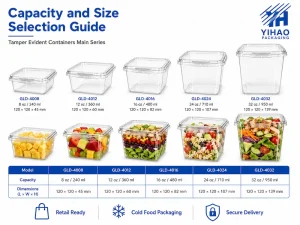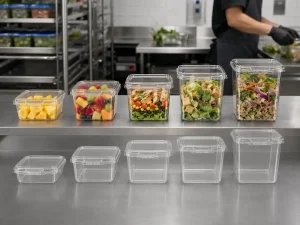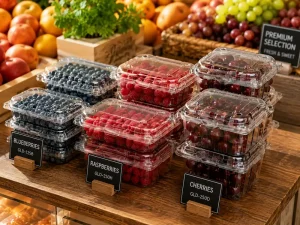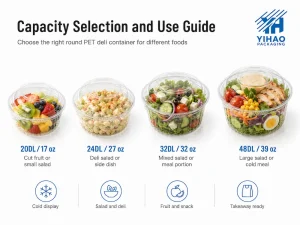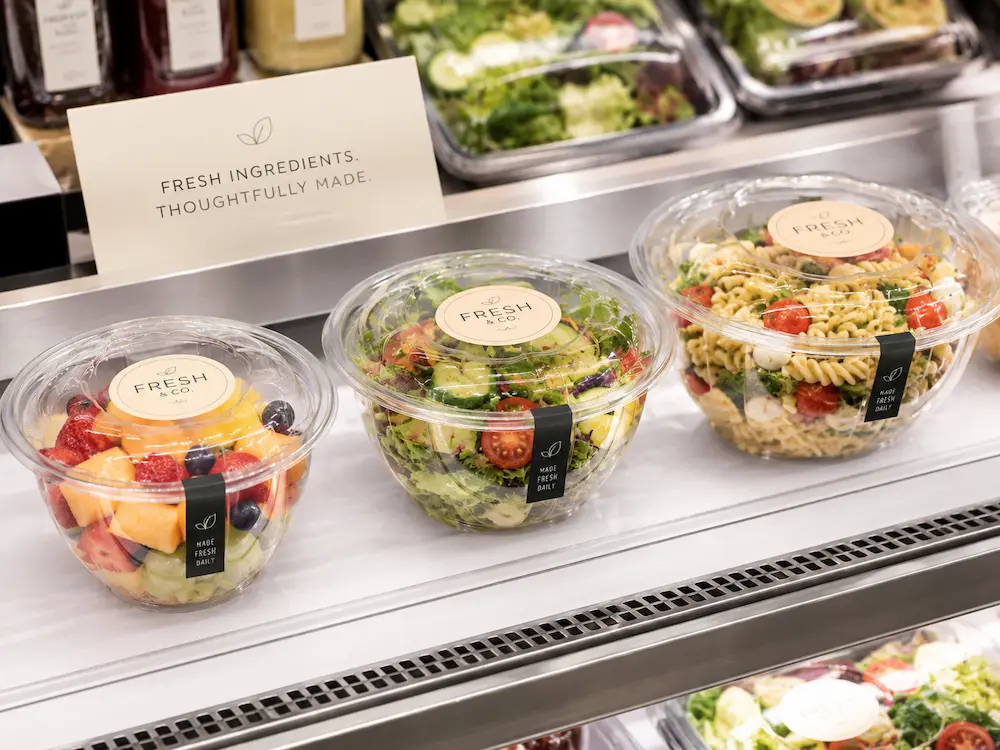
For supermarkets, salad brands, grab-and-go foodservice operators, distributors, private-label food companies, and packaging importers, PET round bowls are not just simple clear containers. They affect food visibility, shelf presentation, packing speed, lid closing, refrigerated display, customer confidence, and repeat-order consistency.
A sample may look acceptable in a photo, but wholesale buyers need more than appearance. A good purchasing decision requires checking material clarity, bowl structure, lid compatibility, stacking behavior, labeling space, carton protection, and supplier reliability before bulk orders. This checklist explains how to evaluate round PET deli containers, round salad containers, clear round food containers, and related deli food packaging from a practical B2B sourcing perspective.
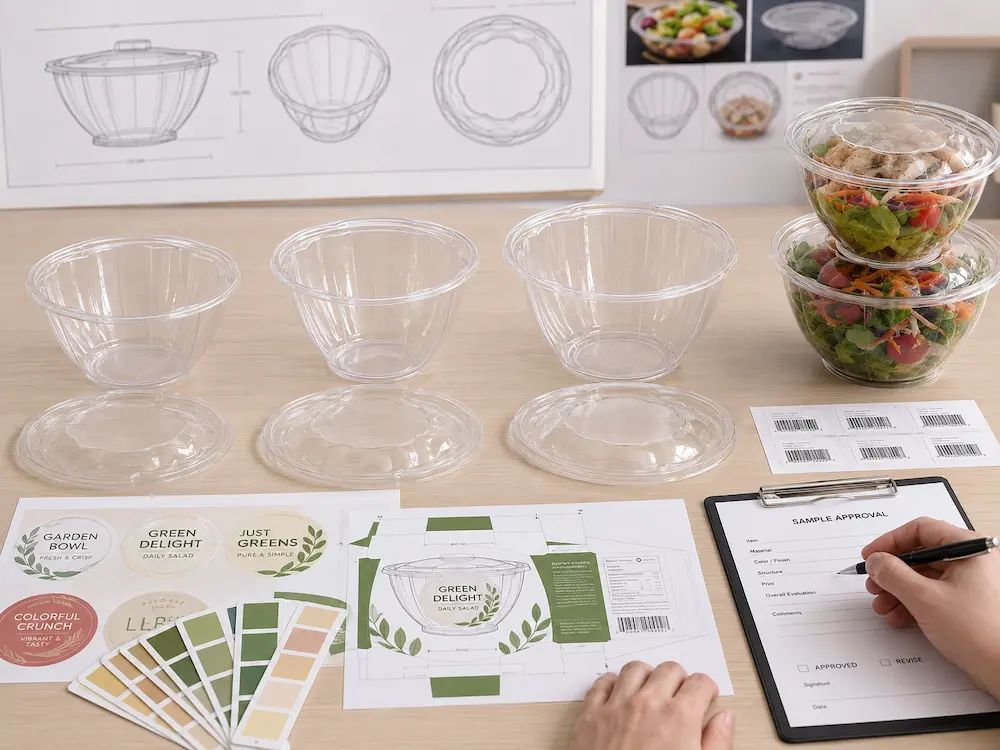
As a food packaging manufacturer and solution provider, YIHAO supports buyers by matching bowl structure, lid options, carton packing, food application, and wholesale supply needs before bulk purchasing. For packaging buyers comparing a manufacturer, wholesale supplier, or long-term sourcing partner, the goal is not only to buy PET round bowls. The real goal is to build a stable packaging system that supports product presentation, production efficiency, and repeat sales.
Why PET Round Bowls Matter in Modern Deli Food Packaging
Modern food packaging must do several jobs at the same time. It needs to show the food clearly, protect the product during handling, close securely, stack efficiently, support labels, and look clean in refrigerated retail displays. This is why PET round bowls are widely used for chilled salads, fresh-cut fruit, deli sides, grain bowls, pasta salad, snacks, desserts, and grab-and-go ready meals.
Clear Product Visibility for Ready-to-Eat Food
PET is valued in food packaging because of its high clarity. For salad greens, fruit portions, pasta salads, yogurt toppings, chilled noodles, and deli sides, visual presentation directly affects customer confidence. When buyers choose clear PET salad bowls, they choose a packaging format that allows the food itself to become part of the selling point.
Clear packaging helps consumers evaluate freshness, ingredient color, portion size, layering, and food quality before purchase. In a refrigerated display, this matters because shoppers compare multiple ready-to-eat options within seconds. A cloudy, gray, scratched, or poorly formed container weakens the food presentation even when the food quality is strong.
Round Shape Advantages for Salads, Deli Meals, and Fresh Food
Round containers are especially suitable for foods that are tossed, layered, mixed, or served as individual portions. A round bowl shape works well for leaf salads, fruit salads, grain bowls, pasta salads, protein bowls, deli sides, chilled desserts, and prepared cold meals. Compared with some rectangular formats, round bowls often create a fuller and more premium visual impression.
The round shape also improves the eating experience after opening. For ready-to-eat salads and chilled meals, customers can mix ingredients more easily. For foodservice teams, round bowls are efficient to fill, rotate, lid, label, and display in cold cases.
Where PET Round Bowls Fit in Wholesale Packaging Programs
Wholesale buyers rarely purchase one container style in isolation. They usually need a full packaging program: different bowl sizes, matching lids, carton packing, stable supply, sample approval, and consistent repeat production. That is why choosing a reliable food packaging manufacturer is as important as choosing the container itself.
A strong supplier should understand how PET round bowls fit into a wider product range that may also include PET hinged deli containers, square deli containers, fresh-cut fruit containers, bakery clamshells, tamper evident packs, and cold drink packaging. This broader capability helps buyers simplify sourcing and keep packaging quality more consistent across multiple food categories.
What Are PET Round Bowls?
PET round bowls are clear plastic food containers made from polyethylene terephthalate. They are commonly used for cold food, chilled display, fresh prepared food, and grab-and-go packaging. In wholesale markets, buyers may search for the same product group using terms such as round PET deli containers, round deli containers, round salad containers, clear round food containers, PET salad bowls, or round deli food packaging.
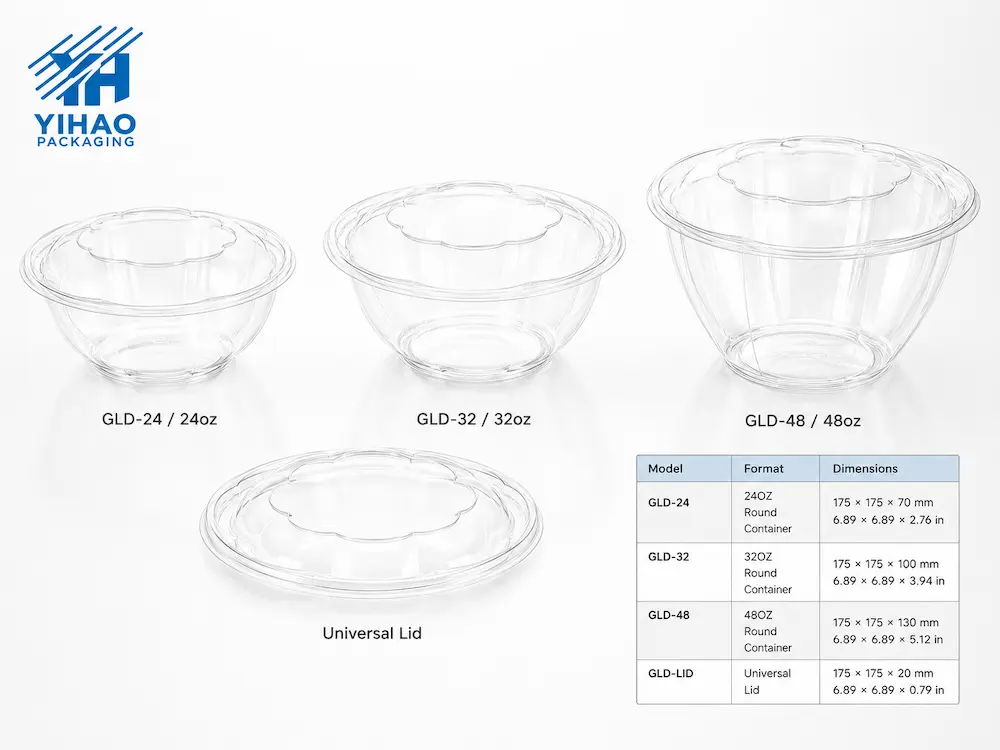
PET is different from PP. PET is usually selected for high clarity and cold food presentation, while PP is often selected for applications that require higher heat resistance. Buyers should not treat every plastic food container as interchangeable. The correct material depends on food temperature, display method, handling process, and the final sales channel.
Common Applications for PET Round Bowls
| Application | Typical Food Examples | Packaging Value |
|---|---|---|
| Salad Packaging | Leaf salads, Caesar salads, grain bowls, protein salads | Clear display, easy filling, strong shelf appeal |
| Deli Food Packaging | Pasta salad, coleslaw, cold noodles, prepared sides | Convenient grab-and-go format with practical lid matching |
| Fresh Fruit Packaging | Fruit salad, melon cubes, berries, mixed fresh-cut fruit | High visibility for color, freshness, and portion value |
| Snack and Dessert Packaging | Yogurt toppings, mousse, pudding, nuts, chilled desserts | Clean presentation for retail and takeaway use |
| Catering and Party Foods | Fruit platters, sushi assortments, chilled party foods | Organized display and convenient cold-case merchandising |
For fruit-focused programs, buyers may compare PET round bowls with fresh-cut fruit containers. For chilled bakery and dessert programs, the same buyer may also need bakery containers to support a wider retail packaging range.
Manufacturer Checklist for Wholesale PET Round Bowls
Before placing a wholesale order, buyers should evaluate PET round bowls through a structured checklist. Price matters, but it should not be the only decision factor. A low unit price becomes meaningless if the bowl cracks, the lid fits poorly, the clarity changes between batches, or the supplier cannot maintain stable production.
1. Material Clarity and Food Presentation
The first inspection point is visual clarity. A well-made PET round bowl should look clean, transparent, and consistent. Buyers should check for gray tone, black spots, visible impurities, scratches, flow marks, uneven forming, cloudy areas, and deformation around the rim.
For premium salads, fruit bowls, chilled deli meals, and dessert packs, clarity directly affects perceived freshness. If the container looks dull, the food looks less attractive. When evaluating PET salad bowl packaging, buyers should test the container with real food, not only as an empty sample.
2. Bowl Strength, Rim Design, and Stacking Stability
The rim is one of the most important structural areas of a PET round bowl. It affects lid fit, stacking stability, opening experience, and resistance to deformation during handling. A weak rim may bend when filled, causing the lid to close unevenly or pop open during transport.
Wholesale buyers should also test stacking performance. Bowls should separate smoothly during packing, stack neatly during storage, and resist crushing under normal carton and retail handling conditions. If containers stick together too tightly, packing teams lose time. If they separate too loosely, they may shift inside cartons.
3. Lid Fit and Closure Performance
Lid matching is a critical quality point for round deli containers. A good lid should close securely, align with the rim, and support normal handling during storage, display, and takeaway. Buyers should avoid assuming that every round bowl and lid combination works together just because the diameter appears similar.
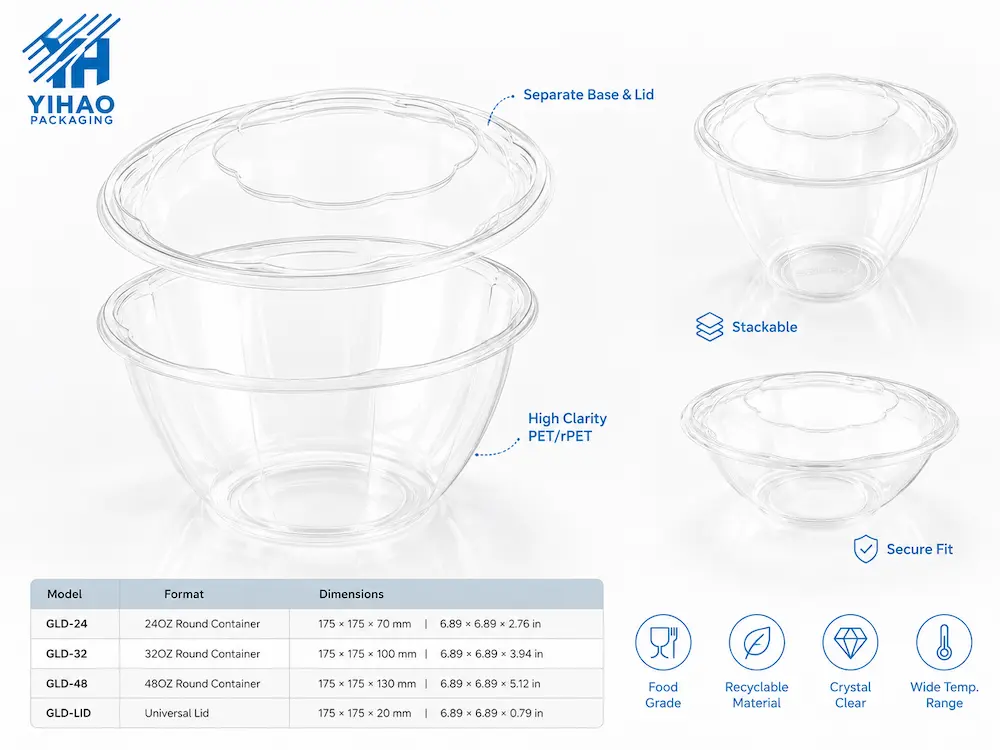
For programs that require separate lids, matching the bowl with a proper PET bowl lid improves closing consistency. For taller food presentation or topping space, a PET dome lid supports better visual display when the food type and bowl structure require extra height.
Buyers should use careful wording in product claims. Unless there is verified test data, avoid claims such as “100% leak-proof.” A more responsible description is secure lid fit, reduced spill risk under normal handling, or reliable closure for chilled takeaway use.
4. Size Range and Portion Logic
Wholesale buyers should match bowl size to real menu needs. Small bowls support sides, toppings, snacks, fruit portions, and light salads. Medium bowls work for standard salads, chilled noodles, and deli sides. Larger bowls suit family portions, sharing salads, fruit platters, and catering applications.
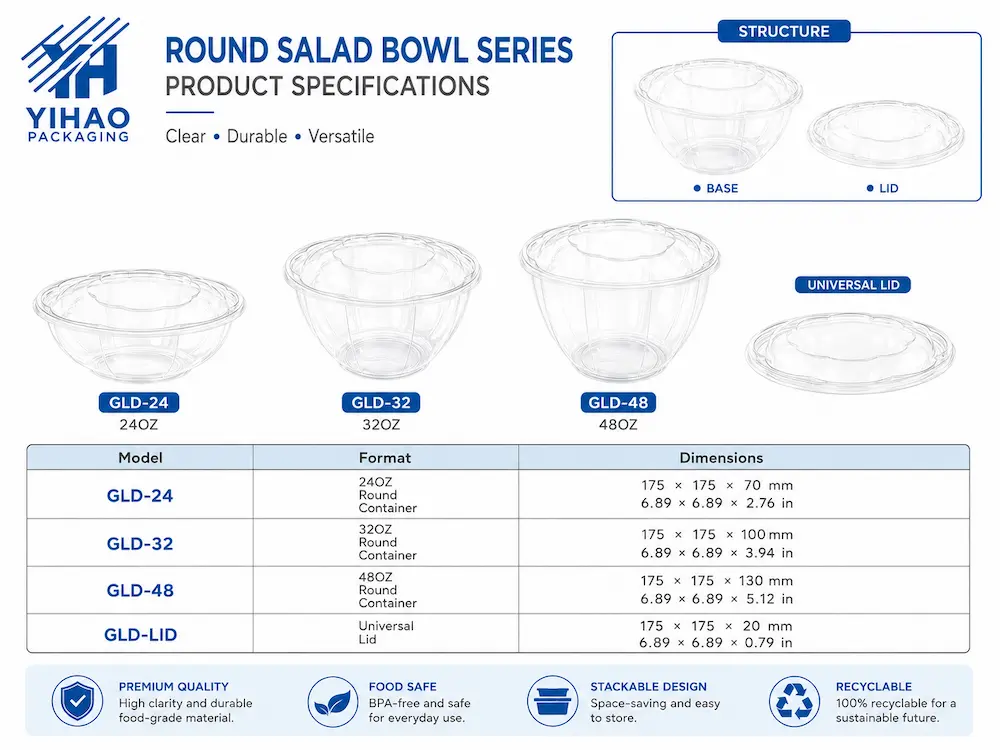
The best supplier is not only selling one size. A strong manufacturer should offer a usable size range so buyers can build a consistent packaging program across different SKUs. A salad brand may need a standard grab-and-go bowl, a larger meal salad format, and matching lids for different retail channels.
5. Label, Sleeve, and Retail Display Compatibility
Packaging does not stop at the container. Buyers should evaluate how PET round bowls work with labels, paper sleeves, tamper labels, barcode stickers, nutrition panels, and retail display requirements. The wall shape, lid height, rim position, and flat areas all affect branding and labeling options.
For clear round food containers, labels should not block the main food view. A well-designed label position supports branding while still allowing customers to see the product. This is especially important for salad, fruit, and chilled dessert packaging because the visible food is part of the selling message.
6. Carton Packing and Wholesale Consistency
Wholesale orders require carton-level thinking. Buyers should confirm how bowls and lids are packed, whether inner bags are used, how many pieces fit in each carton, and whether the packaging protects the product during export, warehousing, and final distribution.
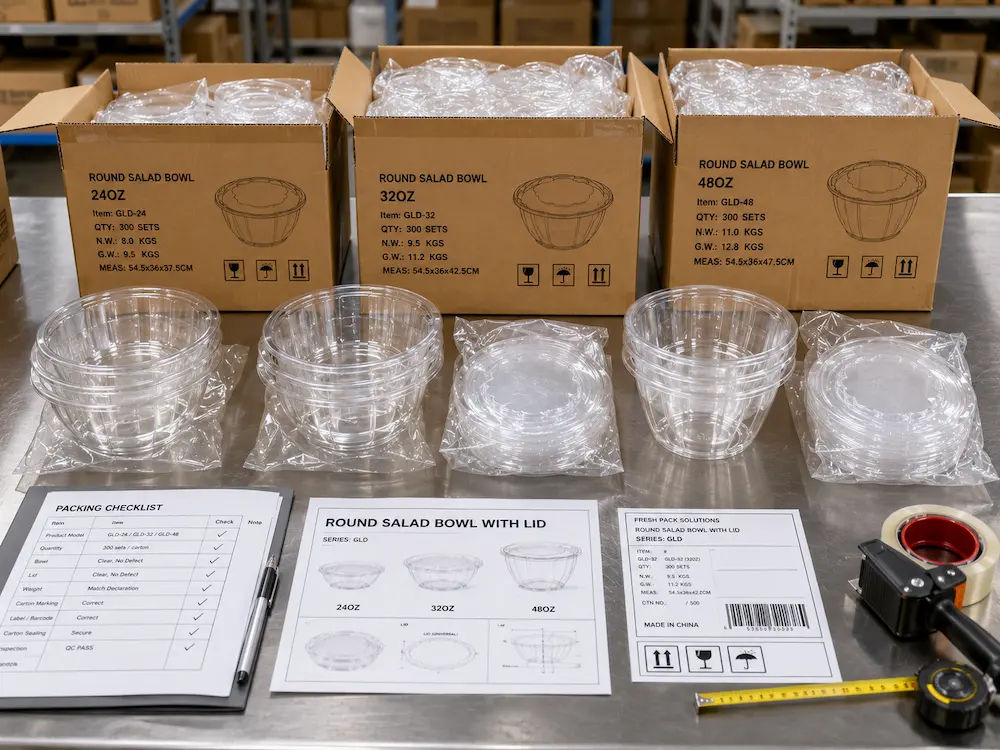
Consistency matters across repeat orders. Bowl shape, clarity, lid fit, carton count, and stacking performance should remain stable. A reliable supplier should have quality control procedures that reduce variation between production batches.
Wholesale Sample Testing Checklist for PET Round Bowls
Sample testing is one of the most important steps before wholesale purchasing. Buyers should not approve PET round bowls based only on photos, catalog descriptions, or empty sample appearance. Real food testing reveals whether the bowl structure, lid, label space, and carton packing match actual use.
| Testing Area | What to Check | Recommended Buyer Action | Why It Matters |
|---|---|---|---|
| Clarity Inspection | Transparency, haze, black spots, scratches, flow marks | Check samples under bright light and cold-case lighting | Clear appearance directly affects food freshness perception |
| Real Food Fit | Food volume, headspace, lid clearance, ingredient visibility | Fill bowls with the actual salad, fruit, deli food, or dessert | Empty samples do not reveal real portion and display issues |
| Lid Closure | Rim alignment, closing feel, opening experience, lid stability | Open and close multiple samples repeatedly | Poor lid fit causes handling complaints and retail problems |
| Stacking Test | Empty stacking, filled stacking, separation, compression behavior | Test bowls in packing, storage, and display-style stacks | Stable stacking supports faster packing and safer transport |
| Label Test | Barcode position, nutrition label, brand sticker, sleeve fit | Apply real label samples before approving bulk orders | Incorrect label placement blocks food visibility or reduces retail appeal |
| Cold Display Review | Appearance after chilled display and normal handling | Place filled samples in the intended display environment | Cold-case conditions reveal presentation and handling performance |
| Carton Protection | Carton strength, inner packing, lid and bowl protection | Review carton photos, packing method, and transport protection | Wholesale orders need protection during warehousing and shipping |
Supplier Checklist: Questions Buyers Should Ask Before Bulk Orders
Choosing a PET round bowls supplier is not only a product decision. It is also a supply-chain decision. Before placing bulk orders, buyers should ask practical questions about manufacturing capability, sample availability, packaging options, quality control, and long-term supply stability.
| Checklist Item | What Buyers Should Ask | Why It Matters |
|---|---|---|
| Manufacturer Type | Is the supplier a real manufacturer or mainly a trading company? | Factory capability affects consistency, communication, and repeat production. |
| Material Control | How does the supplier control PET material quality and visual clarity? | Material quality affects appearance, food presentation, and buyer confidence. |
| Lid Matching | Are lids tested with the exact bowl structure? | Poor lid matching causes closure problems and customer complaints. |
| Sample Testing | Can samples be tested with real food before bulk production? | Real food testing reveals clarity, stacking, closing, and display issues early. |
| Wholesale Supply | Can the supplier support stable repeat orders? | Wholesale programs need reliable production and consistent packaging specs. |
| Packaging Support | Can the supplier support carton packing, labeling, and product range planning? | Strong packaging support reduces sourcing complexity for buyers. |
Is the Supplier a Real Manufacturer?
A real manufacturer gives buyers better control over product development, production consistency, quality checks, and long-term supply planning. Buyers should ask whether the supplier has production equipment, mold experience, inspection procedures, and packaging engineering knowledge.
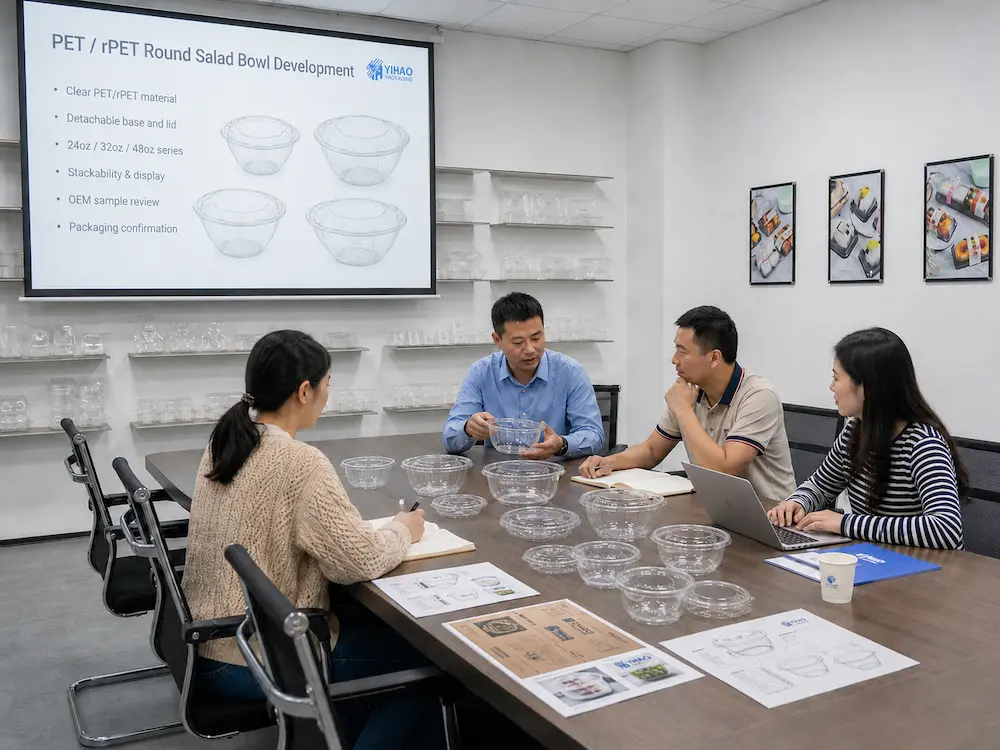
A wholesale food packaging manufacturer should discuss not only pricing, but also material selection, lid fit, carton packing, stacking, labeling, food application, and repeat-order stability. If the supplier only sends a price list without asking about your food type or packing process, that is a warning sign.
Can the Supplier Support Stable Wholesale Supply?
Wholesale supply is about repeatability. Buyers need the same bowl structure, matching lids, clear appearance, carton packing method, and communication process across multiple orders. Sudden changes in product feel, clarity, or lid fit may disrupt food packing operations and retail presentation.
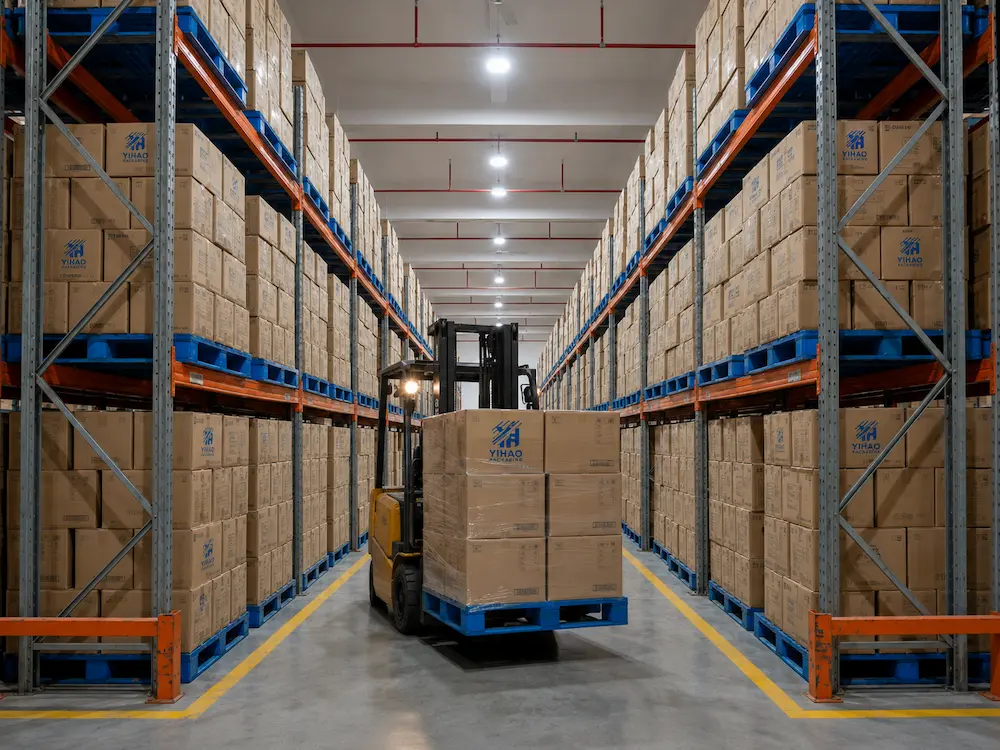
For buyers managing multiple SKUs, it is often better to work with one supplier that supports a full deli and salad containers range instead of sourcing every item from a different supplier. This improves consistency, reduces communication cost, and makes future product expansion easier.
Are Samples Available Before Bulk Production?
Samples should be tested under real use conditions. Buyers should fill the bowls with actual salads, fruit, deli sides, chilled noodles, desserts, or prepared foods. Then they should close the lid, stack the container, apply labels, place the pack in a cold display, and simulate normal handling.
Sample testing is especially important when the buyer plans to use the packaging for retail-ready food. Empty samples may look acceptable, but real food testing reveals issues with height, fogging tendency, label placement, lid pressure, stacking, and customer opening experience.
Can the Supplier Support Custom Packaging Needs?
Some buyers need standard wholesale packaging. Others need private-label cartons, brand labels, customized packing ratios, or coordinated product ranges. A capable supplier should understand these needs and explain what can be supported clearly.
Buyers should avoid vague promises. Instead of accepting general claims, ask for samples, photos, carton details, product drawings, and clear production communication. A serious supplier helps buyers reduce uncertainty before bulk orders.
PET Round Bowls vs. Other Food Packaging Options
PET round bowls are a strong choice for many chilled and ready-to-eat foods, but they are not the only option. Buyers should compare PET round bowls with other packaging formats based on food type, temperature, display requirement, and operational needs.
PET Round Bowls vs. Rectangular Containers
Rectangular containers are efficient for stacking, shelf arrangement, and meal portions. PET round bowls are often stronger for visual salad presentation, mixed foods, and spoonable ready-to-eat meals. A buyer selling sandwiches or rectangular prepared meals may prefer hinged rectangular packs, while a salad brand may prefer round bowls for visual fullness and easy mixing.
For broader deli programs, buyers may combine PET round bowls with PET hinged containers to cover different foods under one packaging strategy.
PET Round Bowls vs. Paper Bowls
Paper bowls are often selected for a different brand image and may work well for certain takeaway foods. PET round bowls provide a clear advantage when product visibility is the priority. For salads, fruit mixes, chilled desserts, and deli items where color and freshness drive purchase decisions, transparent PET packaging gives the food a stronger visual role.
The right choice depends on the selling environment. If the food is displayed in a refrigerated case and customers need to see the contents before purchase, PET round bowls usually provide stronger shelf visibility.
PET Round Bowls vs. PP Containers
PET and PP should not be confused. PET is commonly selected for clear cold food packaging and refrigerated display. PP is often selected when higher heat resistance or hot food use is required. If buyers need hot takeaway or microwave-related applications, they should review microwave safe containers instead of assuming PET bowls are suitable for heat.
This distinction is important for honest product communication. PET round bowls are best positioned for cold, chilled, and room-temperature display foods, not high-heat or microwave use unless the supplier provides specific verified product data.
Application Scenarios for PET Round Bowls
Round Salad Containers for Fresh Salad Brands
Fresh salad brands need containers that show layered ingredients clearly and support convenient eating. Round salad containers are suitable for leafy greens, protein salads, grain bowls, pasta salads, and seasonal salad mixes. A clear bowl helps buyers present ingredients such as lettuce, tomato, cucumber, corn, chicken, cheese, berries, or nuts in a visually organized way.
For premium grab-and-go salads, a suitable PET salad bowl improves food visibility and supports a stronger retail impression.
Round Deli Containers for Supermarkets and Foodservice
Supermarkets and foodservice operators use round deli containers for pasta salad, potato salad, coleslaw, chilled noodles, deli sides, and prepared cold dishes. In these applications, buyers should focus on filling efficiency, lid closing, stacking, label placement, and refrigerated display performance.
Round PET containers also help standardize packaging across multiple deli items. This makes ordering, packing, and merchandising easier for foodservice teams and retail operators.
Clear Round Food Containers for Fruit, Snacks, and Desserts
Clear round food containers work well for fresh-cut fruit, mixed berries, yogurt toppings, nuts, snack packs, puddings, mousse, and chilled desserts. The round shape creates a clean presentation, while clear PET supports visibility of color and texture.
For party, catering, and assorted chilled food applications, buyers may also consider a round catering tray when the food needs organized compartments instead of a single bowl cavity.
Round PET Deli Containers for Grab-and-Go Meals
Grab-and-go meals require packaging that looks clean, travels reliably under normal handling, and supports fast retail decision-making. Round PET deli containers are suitable for chilled noodle bowls, small meal salads, fruit-and-yogurt combinations, and ready-to-eat cold meals.
For buyers building a full fresh food program, PET round bowls can be combined with clamshells, fresh-cut fruit packs, tamper evident containers, and deli containers to cover different food categories under one packaging supplier relationship.
Quality Control Points Before Wholesale Purchase
Quality control should begin before the first bulk order. Buyers should not wait until a full shipment arrives to discover lid mismatch, unstable stacking, or poor clarity. A disciplined sample review protects both the buyer and the supplier.
Visual Inspection
Inspect the bowl under good lighting. Check for haze, gray tone, black dots, flow lines, uneven walls, rough edges, sharp burrs, deformed rims, and scratches. Clear PET packaging should present food cleanly, not distract from it.
Lid Closing Test
Test the lid repeatedly. Close and open the container several times. Check whether the lid aligns naturally, whether the rim deforms, whether the lid feels too loose or too tight, and whether the closing experience remains consistent across several samples.
Stacking and Compression Check
Stack empty bowls, filled bowls, and closed packs. Test whether bowls separate smoothly during packing and whether filled containers remain stable during cold display and normal handling. Poor stacking creates labor problems and damages food presentation.
Real Food Testing
Fill the bowl with the actual food you plan to sell. A salad, fruit mix, or deli side behaves differently from an empty container. Real food testing helps buyers evaluate volume, lid clearance, label position, condensation, visibility, and customer handling experience.
Carton and Transport Review
Ask for carton packing details before ordering. Check whether bowls and lids are protected from dust, pressure, and deformation during storage and shipping. For export or long-distance wholesale supply, carton strength and packing method matter as much as the container itself.
How YIHAO Supports PET Round Bowl Buyers
For B2B buyers, a supplier should do more than provide a catalog. The supplier should help match the container to the food application, retail environment, packing process, and wholesale ordering plan. This is where manufacturer experience becomes valuable.
YIHAO packaging supports buyers by reviewing food type, portion logic, bowl structure, lid options, label placement, and carton packing before bulk orders. This helps buyers reduce trial-and-error, especially when developing new salad, fruit, deli, dessert, or chilled ready-to-eat product lines.
For importers and distributors, this approach also supports better product range planning. Instead of purchasing one isolated item, buyers can build a coordinated packaging selection across round bowls, hinged deli containers, fruit containers, bakery packs, and tamper evident packaging.
How to Choose the Right PET Round Bowls Manufacturer
The right manufacturer should help buyers match the bowl to the food, not simply sell the nearest available stock item. This means understanding the buyer’s application, portion logic, lid requirements, labeling plan, display channel, and wholesale ordering rhythm.
Match the Bowl to Your Food Type
Different foods require different bowl structures. Leafy salads need enough headspace and good presentation. Fruit mixes need clear visibility and practical lid fit. Deli sides need stable stacking and easy scooping. Desserts need clean appearance and space for toppings or labels.
Buyers should describe their food type clearly when requesting samples. A strong supplier will recommend packaging based on real application needs instead of guessing from a general size request.
Check Factory Experience in Food Packaging
Factory experience matters because food packaging has practical details that general plastic suppliers may overlook. These include food contact expectations, clarity consistency, rim strength, lid matching, carton packing, retail labeling, and quality inspection.
Working with a manufacturer that understands deli food packaging helps buyers reduce trial-and-error during product selection. It also improves communication when the buyer needs future products such as tamper evident packs, fruit containers, bakery packaging, or drink cup packaging.
Balance Price, Stability, and Long-Term Supply
The lowest price is not always the lowest cost. If a low-cost bowl creates lid complaints, display problems, packing delays, or repeat-order inconsistency, the buyer pays in other ways. A better wholesale decision balances price with material quality, production stability, supplier response, carton protection, and long-term availability.
For long-term sourcing, buyers should select a supplier that supports repeated wholesale orders, clear communication, product range planning, and reliable quality control. That is the difference between buying a container and building a packaging supply system.
When Tamper Evidence or Special Formats Are Needed
Not every food program uses standard round bowls. Some retail channels require tamper evidence, especially for grab-and-go foods, refrigerated ready meals, and self-service displays. In those situations, buyers should compare PET round bowls with tamper evident containers to decide which format better fits the sales channel.
The same logic applies to compartment packaging. If a buyer sells fruit, nuts, sushi, snack combinations, or party foods, a single round bowl may not be the best structure. Multi-compartment trays or fresh-cut fruit containers may provide better separation and presentation.
Wholesale Buyer Checklist Before Placing an Order
| Decision Area | Pass Standard | Buyer Action |
|---|---|---|
| Material Appearance | Clear, clean, stable, without obvious haze or impurities | Inspect samples under real lighting |
| Food Application | Matches salad, deli, fruit, snack, or dessert requirements | Test with real food instead of empty samples only |
| Lid Fit | Closes securely and aligns with the bowl rim | Open and close multiple samples repeatedly |
| Stacking | Stacks neatly and separates smoothly | Test empty and filled stacking |
| Labeling | Supports barcode, nutrition label, brand sticker, or sleeve | Apply real label samples before bulk order |
| Carton Packing | Protects bowls and lids during storage and shipping | Confirm carton quantity, packing method, and protection |
| Supplier Capability | Supports wholesale supply, communication, and repeat orders | Evaluate manufacturer experience and production stability |
Request Samples Before Your Next Wholesale Order
Before confirming a bulk order, buyers should request samples and test them with the actual food application. For salad, fruit, deli, dessert, and chilled ready-to-eat products, the most reliable packaging decision comes from checking the bowl, lid, label, carton, and food display together.
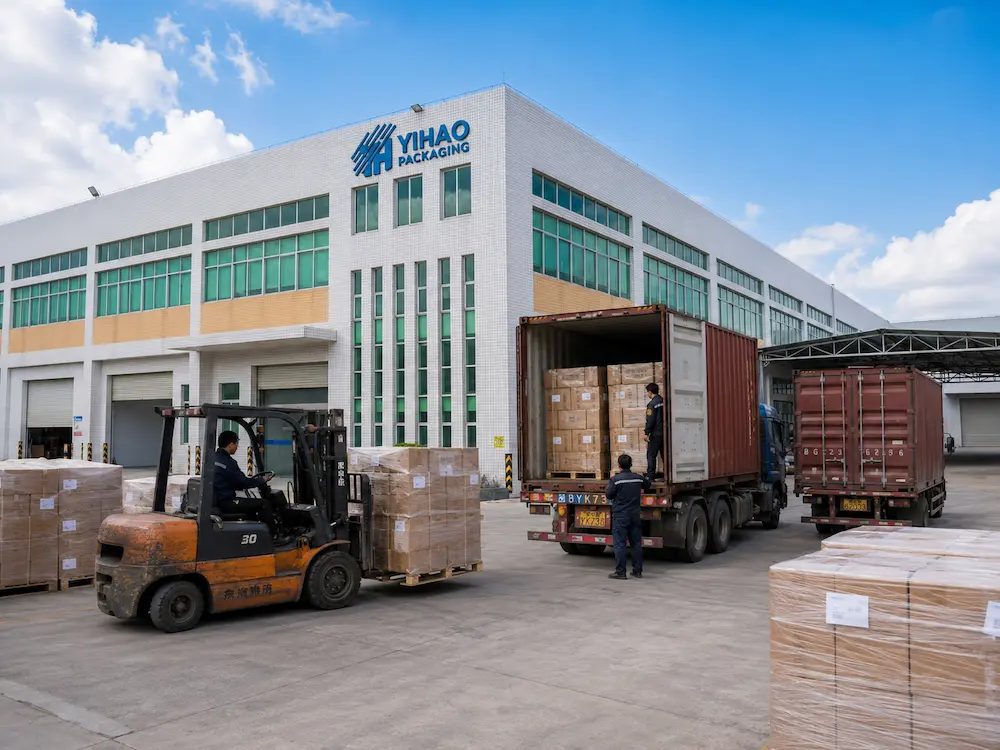
If you are sourcing PET round bowls for wholesale food packaging, work with a manufacturer that understands both product structure and real packing scenarios. YIHAO factory can help buyers evaluate bowl options, lid matching, application fit, carton packing, and sample testing before bulk purchasing.
FAQ
1. What are PET round bowls used for?
PET round bowls are used for chilled salads, fresh fruit, deli sides, pasta salad, grain bowls, snacks, desserts, and grab-and-go ready-to-eat foods. They are especially useful when clear food visibility and retail presentation are important.
2. Are PET round bowls suitable for hot food?
PET round bowls are generally selected for cold food, chilled display, and room-temperature presentation. For hot food or microwave-related applications, buyers should evaluate PP or other heat-suitable packaging options and confirm product data with the supplier.
3. What is the difference between PET round bowls and PP bowls?
PET round bowls are commonly chosen for clarity and cold food presentation. PP bowls are often chosen for applications that need higher heat resistance. Buyers should select the material based on food temperature, display method, and handling requirements.
4. How should buyers choose wholesale round deli containers?
Buyers should check material clarity, rim strength, lid fit, stacking stability, carton packing, food application, labeling compatibility, sample testing, and supplier reliability before placing wholesale orders.
5. What should I check before choosing a PET round bowls manufacturer?
Before choosing a PET round bowls manufacturer, check whether the supplier has real production capability, food packaging experience, quality control procedures, sample support, stable wholesale supply, and the ability to recommend suitable packaging based on your food application.
References
- U.S. Food and Drug Administration. Recycled Plastics in Food Packaging. FDA Food Contact Substances and Packaging Guidance.
- U.S. Food and Drug Administration. Guidance for Industry: Use of Recycled Plastics in Food Packaging: Chemistry Considerations. Human Foods Program.
- European Food Safety Authority. Recycled Plastic Materials and Plastic Recycling for Food Contact Applications. EFSA Food Contact Materials Topic Resources.
- European Food Safety Authority. Scientific Guidance on the Criteria for the Evaluation of Mechanical PET Recycling Processes for Food and Drink Packaging. EFSA Journal.
- Association of Plastic Recyclers. APR Design Guide for Plastics Recyclability. Packaging Recyclability Design Guidance.
- RecyClass. Design for Recycling Guidelines for Plastic Packaging. European Plastics Recycling Compatibility Guidance.
- Australian Packaging Covenant Organisation. Quickstart Guide: Designing for Recyclability — PET Packaging. Sustainable Packaging Design Resource.
- Food Packaging Forum. Scientific and Regulatory Updates on PET Recycling Processes and Food Contact Packaging. Packaging Safety and Circular Economy Research Resource.
Deep-Dive Insights
Final Note / Practical Takeaway
Copyright © YIHAO Packaging. All Rights Reserved.
All content, images, product descriptions, and packaging solutions on this website are protected and may not be copied, reproduced, or used without permission.