
Wholesale Compartment Containers for Supermarkets, Cafes, Bakeries, and Foodservice Brands
Wholesale compartment containers are practical packaging solutions for food businesses that need to keep multiple ingredients separated inside one package. They are used for fruit-and-nut snack packs, meal prep trays, fresh-cut fruit assortments, cheese-and-cracker packs, sushi platters, vegetable-and-dip trays, dessert samplers, bakery assortments, deli snack boxes, and chilled grab-and-go foods.
For supermarkets, cafes, bakeries, and foodservice brands, compartment packaging is not only about adding more sections. It is about controlling the food experience before the customer opens the pack. Wet fruit should not soften crackers. Dips should stay in their own area. Dessert pieces should not damage each other. Meal prep components should remain organized. A good divided package makes the product look cleaner, more valuable, and easier to understand on shelf.
YIHAO is a food packaging manufacturer and solution provider focused on practical PET/RPET packaging systems for fresh food, fruit, salad, deli, bakery, snack, takeaway, and retail display applications. This guide explains how buyers should choose wholesale compartment containers by food channel, compartment layout, material, lid structure, tamper-evident need, cold-chain display performance, sample testing, and supplier reliability.
What Are Wholesale Compartment Containers?
Wholesale compartment containers are bulk food packaging containers designed with two or more internal sections. These sections separate different food components in one package. Depending on the application, the structure may be a clear PET hinged clamshell, an RPET snack tray, a round multi-compartment platter with a dome lid, a paper dessert box with a clear PET lid, or a tamper-evident divided container for secure retail display.
The core function is separation. A buyer may need to separate fruit from nuts, cheese from crackers, sushi from garnish, vegetables from dip, mini desserts from each other, or meal prep components from sauces. Without compartment structure, these foods can mix, soften, stain, move, or lose visual value before purchase.
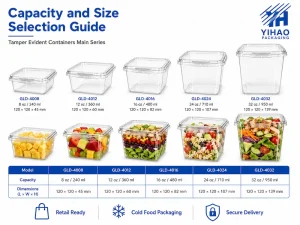
For secure retail and delivery-sensitive programs, multi-compartment tamper evident containers should be reviewed as a category because they combine food separation with visible first-opening confidence.
Why Compartment Packaging Works Across Different Food Channels
Compartment packaging works because many modern food products are sold as combinations. A single package may include fruit, nuts, cheese, crackers, vegetables, dip, dessert, protein, sauce, garnish, or small deli items. Customers want to see the full combination clearly before they buy. Retail teams want the pack to look organized. Packing teams want a structure that is easy to fill. Buyers want a container range that can be ordered repeatedly without constant SKU confusion.
For supermarkets, divided packaging improves chilled shelf presentation. For cafes, it supports grab-and-go snacks and breakfast packs. For bakeries, it protects delicate desserts and pastry samplers. For foodservice brands, it supports portion consistency, ingredient separation, and repeatable production.
The mistake is treating all divided packaging as the same. A two-compartment fruit pack, a four-compartment snack tray, a six-section party platter, and a nine-compartment dessert box all solve different problems. A strong wholesale strategy gives each structure a clear role.
Best Wholesale Compartment Containers for Supermarkets
Supermarkets need packaging that performs in refrigerated shelves, fresh produce sections, deli counters, bakery departments, and grab-and-go displays. The product must be easy to understand at a glance, because shoppers often compare several packs quickly before choosing one.
Wholesale compartment containers are especially useful for supermarket programs such as:
- Fresh-cut fruit and nut packs.
- Cheese, cracker, and fruit snack boxes.
- Vegetable and dip trays.
- Sushi, garnish, and chilled party platters.
- Meal prep packs with protein, vegetables, grains, and sauce.
- Dessert samplers and bakery sharing boxes.
- Private-label chilled grab-and-go food programs.
For produce departments, fresh-cut fruit containers should be matched with divided snack formats so buyers can cover both simple fruit portions and higher-value fruit-and-nut combinations. For everyday fruit combo packs, two-compartment PET clamshell containers support simple pairings such as fruit with dip, fruit with nuts, or grapes with cheese.
Best Wholesale Compartment Containers for Cafes
Cafes need packaging that supports fast packing, counter display, takeaway convenience, and small-batch menu flexibility. Many cafe food programs include breakfast fruit packs, yogurt toppings, cheese and cracker boxes, vegetable snack packs, dessert samplers, small salads, and protein snack sets.
For cafes, the best compartment food containers are usually compact, clear, easy to open, and simple for staff to fill. Hinged clamshells often work well because the lid and base stay connected, reducing lid-matching errors during busy service. Separate tray-and-lid systems may work better for premium display, but they require stronger inventory control.
For balanced cafe snack packs, three-compartment snack containers support fruit, nuts, cheese, crackers, and small protein combinations. For richer grab-and-go assortments, four-compartment fruit and nut containers help cafes create premium snack packs with better separation and stronger visual variety.
Best Wholesale Compartment Containers for Bakeries
Bakeries use compartment packaging for a different reason. The priority is not only separation but also product protection. Mini cakes, cookies, brownies, mochi, macarons, pastry bites, and dessert samplers can be damaged when they touch each other during transport or shelf handling. Divided packaging helps protect decoration, shape, and premium presentation.
For bakery programs, buyers should consider food height, frosting clearance, lid visibility, moisture behavior, and whether the package supports gifting or sharing. A clear lid is valuable because customers want to see dessert quality before purchase, but the lid must not touch frosting, cream, fruit toppings, or decorative surfaces.
For bakery-focused buyers, bakery containers should be reviewed as a broader packaging category. For small dessert assortments, four-compartment dessert boxes support pastry samplers and mini dessert packs. For larger dessert programs, nine-compartment dessert boxes help package party sweets, assorted pastries, and premium sharing desserts.
Best Wholesale Compartment Containers for Foodservice Brands
Foodservice brands need packaging that works repeatedly across production, storage, delivery, customer use, and reorder cycles. A container may look attractive, but if it slows packing, creates lid confusion, damages during carton shipment, or does not support repeat orders, it is not a strong wholesale solution.
Foodservice teams often use wholesale compartment containers for meal prep, office lunch programs, school meal components, catering trays, hotel breakfast packs, airline or travel snack packs, and distributor resale. In these programs, the package must support portion control, easy filling, stacking, carton efficiency, and consistent supplier support.
For shared foodservice and catering applications, round five-compartment trays work well for fruit, sushi, chilled snacks, vegetables, deli items, and party assortments. When a center section is useful for dip, garnish, sauce, or a featured item, round six-compartment trays provide a stronger shared display format.
Material Options for Wholesale Compartment Containers
Material choice should start with food temperature, sales channel, display needs, and handling route. PET and RPET are strong choices for clear chilled display because they show product color and portion clearly. Paper-based formats with clear PET lids may fit bakery and premium snack programs. PP or other heat-suitable materials may be needed when reheating or microwave performance is part of the application.
| Material Direction | Best Application | Main Advantage | Buyer Caution |
|---|---|---|---|
| PET | Fruit packs, snack trays, sushi, deli packs, chilled desserts | High clarity and strong retail display | Not the default choice for hot-fill or microwave use |
| RPET | Clear chilled packaging with recycled-content positioning | Supports sustainability-focused packaging direction | Documentation and local market requirements must be checked |
| Paper-based with clear PET lid | Bakery samplers, dessert boxes, premium snack packs | Branding surface plus food visibility | Moisture, grease, and lid fit need real product testing |
| PP or heat-suitable material | Meal prep programs requiring heat resistance | Better fit for selected heated applications | Usually less crystal-clear than PET for chilled display |
For most chilled snack, fruit, bakery, and deli programs, clear PET/RPET packaging offers the strongest retail display value. For heated meal prep, buyers should not choose material by appearance alone. Temperature suitability must come first.
Compartment Layout Planning: Two, Three, Four, Five, Six, or More Sections?
The number of sections should match the food concept. More compartments are not automatically better. Extra sections can reduce usable space, slow filling, and create higher SKU complexity. Too few sections can cause food mixing, weak portion control, and poor retail presentation.
| Layout | Best Use | Channel Fit | Buyer Caution |
|---|---|---|---|
| Two compartments | Fruit with dip, fruit with nuts, grapes with cheese | Cafes, supermarkets, produce departments | Not enough for complex snack packs |
| Three compartments | Fruit, nuts, cheese, crackers, vegetable snacks | Cafes, convenience stores, grab-and-go retail | Portion balance must be tested |
| Four compartments | Bento-style snacks, protein packs, deli snack boxes, dessert samplers | Premium retail, foodservice, bakery, deli | Can feel crowded if food pieces are large |
| Five compartments | Fruit platters, sushi, chilled party trays, snack assortments | Supermarkets, catering, party food retail | Needs loaded-weight and dome-lid testing |
| Six compartments | Fruit with center dip, sushi with garnish, mixed platter packs | Foodservice, catering, retail platters | Better for sharing than compact individual packs |
| Nine compartments | Dessert assortments, bakery sharing boxes, party sweets | Bakeries, dessert brands, supermarket bakery | Not ideal for large or wet food pieces |
For retail food teams, a focused layout range usually works better than too many overlapping trays. A practical set may include two-compartment packs for simple pairings, three- or four-compartment packs for everyday snacks, five- or six-compartment trays for shared platters, and specialty dessert boxes for bakery programs.
When to Choose Multi-Compartment Tamper Evident Containers
Not every divided package needs tamper-evident structure. But when food is ready to eat, self-service, delivery-sensitive, or handled by third parties, visible first-opening confidence becomes more important.
Multi-compartment tamper evident containers are strongest when buyers need three functions at the same time: ingredient separation, clear product display, and visible package-integrity signaling. This is especially useful for convenience store snack packs, meal prep programs, retail salad kits, fruit-and-nut packs, protein snack boxes, and grab-and-go chilled meals.
For a wider secure packaging strategy, tamper evident containers should be reviewed alongside divided formats. A single-compartment tamper-evident pack may be enough for one-component foods, while divided tamper-evident packaging fits multi-component products.
Wholesale Compartment Containers for Retail Display
Retail display is one of the main reasons buyers choose clear divided packaging. Customers can see each ingredient before purchase. The pack explains the product without requiring the customer to open it. This is important for fruit packs, cheese-and-cracker boxes, vegetable-and-dip trays, sushi platters, dessert samplers, and chilled meal prep packs.
A strong retail display package should have:
- Clear visibility from the top and sides.
- Compartments that look intentionally filled.
- Enough internal wall height to reduce food movement.
- A lid that does not crush food or hide presentation.
- Label placement that supports branding without covering the best food view.
- Stacking stability in refrigerated shelves and cartons.
- Cold-chain clarity after refrigeration, not only at room temperature.
For premium chilled snack display, four-compartment snack containers provide more space for apple slices, grapes, nuts, cheese, vegetables, and snack combinations. This type of format is useful when the buyer wants a larger individual snack pack with a stronger visual layout.
Wholesale Compartment Containers for Takeaway and Delivery
Takeaway and delivery packaging must handle movement. A tray may be filled, closed, stacked, placed in a bag, transported by the customer, stored in a refrigerator, and opened later. The compartment walls, lid, and closure must keep food organized through that route.
For takeaway and delivery, buyers should test:
- Whether food crosses compartments during normal movement.
- Whether the lid stays engaged in a bag or carton.
- Whether wet ingredients leak into dry areas.
- Whether customers can open the package without spilling food.
- Whether labels and tamper-evident features remain visible after handling.
Divided tamper evident containers are especially useful when takeaway foods pass through delivery or third-party pickup. The divided structure controls the food layout, while tamper evidence gives the customer a stronger first-opening signal.
Wholesale Compartment Containers for Bakery and Dessert Programs
Bakery and dessert programs need packaging that protects appearance. Mini cakes, pastry bites, cookies, brownies, macarons, mochi, cream desserts, and party sweets can lose value quickly if they touch, smear, shift, or become hidden behind poor packaging.
Compartment dessert boxes help protect each piece and create a more premium product view. Paper-based bases can provide a cleaner branded surface, while clear PET lids keep the food visible. Buyers should test frosting clearance, moisture, grease, lid fit, stacking, and customer opening.
For bakery buyers, divided dessert packaging should not be chosen only by the number of compartments. A four-section sampler may be better for premium small packs. A nine-section box may be better for party sharing. The food size, decoration height, and selling occasion should decide the structure.
Wholesale Compartment Containers for Meal Prep and Foodservice
Meal prep tamper evident containers and regular meal prep compartment containers serve different needs. A regular divided container organizes food. A tamper-evident divided container organizes food and adds visible opening confidence.
For foodservice buyers, meal prep applications may include protein with grains, vegetables with sauce, fruit with yogurt, pasta with salad, or snack meal combinations. The correct package must support fill weight, temperature needs, compartment depth, lid clearance, and stacking behavior.
When the food is sold through self-service retail, convenience stores, delivery, corporate meal programs, or school lunch distribution, tamper-evident options become more useful. When the product is handled directly by staff and consumed quickly, regular divided packaging may be enough.
How to Build a Wholesale Compartment Container Matrix
A strong product matrix helps buyers avoid SKU confusion. Instead of buying random divided trays, each package should have a defined role in the food program.
| Product Role | Recommended Structure | Best Channel | Procurement Logic |
|---|---|---|---|
| Simple fruit combo pack | Two compartments | Produce, cafes, convenience retail | Simple separation and fast filling |
| Balanced snack tray | Three compartments | Cafes, grab-and-go retail, foodservice | Fruit, nuts, cheese, crackers, or vegetables in one pack |
| Premium snack or deli box | Four compartments | Supermarkets, delis, premium takeaway | More variety and stronger presentation |
| Shared party tray | Five or six compartments with dome lid | Catering, supermarkets, party food programs | Large display impact and separated items |
| Dessert sampler | Four to nine compartments | Bakeries, dessert brands, supermarket bakery | Protects appearance and prevents contact damage |
| Secure meal prep pack | Divided tamper-evident structure | Self-service retail, delivery, convenience stores | Separation plus first-opening confidence |
This matrix gives purchasing teams, sales teams, and packing teams a shared language. Instead of saying “we need compartment containers,” teams can define the exact role: simple fruit combo pack, premium snack box, bakery sampler, party tray, or secure meal prep pack.
Supplier and Manufacturer Selection Checklist
When sourcing from a food packaging factory, buyers should evaluate the full supply system, not only product price. A strong supplier should understand food separation, material selection, lid matching, tamper-evident needs, carton packing, sample testing, and repeat-order consistency.
Use this checklist before choosing a manufacturer, wholesale supplier, or export partner:
- Does the supplier offer a practical range of wholesale compartment containers?
- Can the supplier support two-, three-, four-, five-, six-, and specialty divided layouts?
- Are PET, RPET, paper-based, or heat-suitable material options available where needed?
- Can the supplier explain which structures fit supermarkets, cafes, bakeries, and foodservice brands?
- Are tamper-evident divided options available for secure retail channels?
- Can samples be tested with real food before wholesale confirmation?
- How are trays and lids packed to reduce scratches, deformation, and mismatch?
- Can the supplier maintain sample-to-bulk consistency in clarity, rim shape, compartment structure, and lid fit?
- Can the supplier help reduce SKU overlap instead of selling too many similar trays?
A strong supplier asks about the food before recommending the container. A weak supplier sends only a price list and leaves the buyer to guess whether the tray will work.
Sample Testing Before Wholesale Orders
Wholesale buyers should test filled samples before approving bulk orders. Empty samples are only the first step. Real fruit, nuts, cheese, crackers, vegetables, dips, sushi, dessert pieces, and meal components reveal whether the package truly works.
| Test Area | What to Check | Why It Matters |
|---|---|---|
| Food fit | Each section holds the planned food portion without looking empty or crowded | Protects retail value and portion perception |
| Ingredient separation | Wet and dry foods remain separated during storage and handling | Protects texture and eating quality |
| Lid closure | Lid closes consistently at normal packing speed | Supports staff efficiency and product security |
| Display quality | Food remains visible, organized, and attractive after refrigeration | Improves shelf conversion |
| Stacking | Filled trays stack safely in cartons, shelves, and bags | Reduces crushing and damage complaints |
| Label position | Labels do not hide the food arrangement or tamper-evident feature | Protects branding, compliance, and product visibility |
| Customer opening | Pack opens cleanly without spilling or mixing ingredients | Protects final user experience |
| Bulk consistency | Bulk order matches approved sample in clarity, lid fit, and compartment structure | Reduces repeat-order quality risk |
Common Buying Mistakes to Avoid
Choosing by Compartment Count Alone
More sections are not always better. A two-section package may be perfect for fruit and dip. A six-section tray may be excellent for a party platter but unnecessary for a simple individual snack pack.
Ignoring Moisture Transfer
Compartment packaging is often used to separate wet and dry foods. If moisture still transfers during refrigeration or transport, the package is not doing its job.
Using the Wrong Material for the Temperature
PET/RPET works well for many chilled display applications, but heat-related meal prep may require PP or another heat-suitable material. Buyers should confirm temperature requirements before choosing packaging.
Approving Empty Samples Only
Empty samples do not show food movement, lid pressure, condensation, label blocking, or customer opening behavior. Real food testing is necessary.
Overloading the SKU Range
Too many similar trays create warehouse pressure and staff confusion. A focused range with clear roles usually performs better than a large list of overlapping products.
FAQ
1. What are wholesale compartment containers used for?
Wholesale compartment containers are used for fruit packs, snack trays, meal prep foods, salad kits, sushi platters, bakery samplers, dessert boxes, deli snack packs, and chilled grab-and-go foods that need ingredient separation and portion control.
2. What material is best for clear compartment containers?
PET and RPET are common choices for clear chilled compartment containers because they provide strong visibility, lightweight handling, and clean retail display. Heat-related applications should be evaluated separately.
3. When should buyers choose multi-compartment tamper evident containers?
Buyers should choose multi-compartment tamper evident containers when ready-to-eat products need ingredient separation and visible first-opening confidence in self-service retail, delivery, convenience stores, or third-party handling channels.
4. Which compartment containers are best for supermarkets?
Supermarkets usually need clear PET/RPET fruit packs, snack trays, sushi platters, bakery samplers, and tamper-evident divided containers for chilled self-service display and grab-and-go retail programs.
5. Which compartment containers are best for bakeries?
Bakeries usually need divided dessert boxes, clear-lid pastry samplers, mini cake boxes, and multi-compartment bakery containers that protect decoration and prevent product contact damage.
6. How should buyers choose a wholesale supplier?
Buyers should choose a supplier that understands food separation, material choice, compartment layout, lid matching, tamper-evident options, carton protection, sample testing, repeat-order consistency, and wholesale packaging applications.
References
- U.S. Food and Drug Administration, Food Contact Substances and Food Packaging Guidance.
- European Commission, Regulation (EC) No 1935/2004 on Materials and Articles Intended to Come into Contact with Food.
- European Commission, Regulation (EU) No 10/2011 on Plastic Materials and Articles Intended to Come into Contact with Food.
- European Food Safety Authority, Guidance on Plastic Recycling Processes for Food Contact Materials.
- Association of Plastic Recyclers, APR Design Guide for Plastics Recyclability.
- RecyClass, Design for Recycling Guidelines for PET Packaging.
- GS1, General Guidance on Retail Barcode and Label Placement.
- International Organization for Standardization, Packaging and Environmental Considerations for Packaging Systems.
Final Note / Practical Takeaway
© YIHAO Packaging. All rights reserved. All articles, product images, packaging designs, technical specifications, and website materials are protected by copyright. Unauthorized copying, reproduction, redistribution, modification, or commercial use is strictly prohibited without prior written permission.