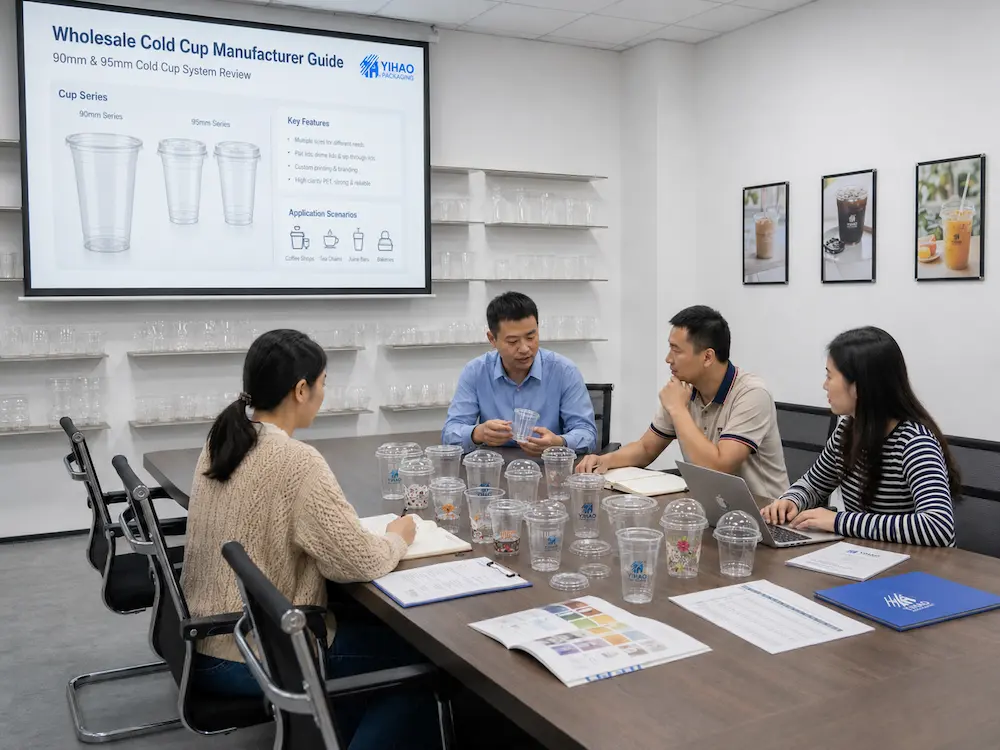
Choosing the right cold cup manufacturer is a supply-chain decision, not just a packaging purchase. Beverage chains need cups that look clear on the counter, match lids correctly during rush hours, support branded drink presentation, survive carton handling, and remain consistent across repeat orders. A cup that looks acceptable in a catalog may still fail in real store use if the rim is unstable, the lid fit is inconsistent, the cup wall feels weak, or the supplier cannot repeat the same quality in bulk production.
For iced coffee chains, bubble tea shops, juice bars, smoothie counters, convenience stores, QSR beverage programs, and foodservice distributors, cold cups directly affect customer experience. They display drink color, protect toppings, support takeaway service, simplify back-of-house storage, and carry brand identity when custom printing is required. That is why professional buyers evaluate more than price when sourcing wholesale cold cups.
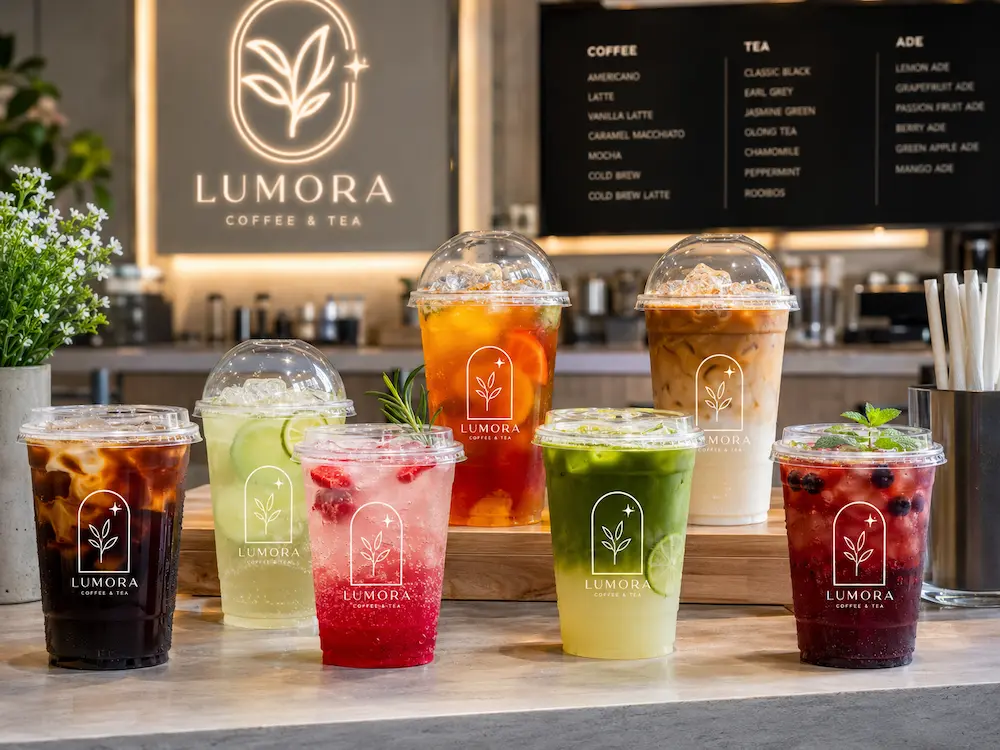
YIHAO is a food packaging manufacturer and solution provider focused on practical packaging formats for beverage, fresh food, bakery, deli, and foodservice brands. For cold drink programs, YIHAO supports clear PET/RPET cold cups, matching flat lids, dome lids, strawless sipper lids, bulk supply discussion, and custom packaging communication for chain-store and distributor needs.
This guide explains how beverage chains should evaluate a cold cup manufacturer, compare PET and PP materials, test cup-lid compatibility, plan OEM cold cups, approve custom printing, and prepare stronger RFQ information before placing bulk orders.
For a broader category view, start from Cold Cups & Lids or review Cold Drink Packaging to connect cups, lids, menu applications, and wholesale sourcing into one practical packaging system.
Why Beverage Chains Need a Reliable Cold Cup Manufacturer
A beverage chain does not use cold cups in isolation. The cup must work with lids, straws or strawless openings, drink textures, ice, toppings, carton packing, store storage, and brand presentation. When a chain operates multiple stores, small packaging differences become daily operational problems. A lid that takes extra force to press slows service. A cup that sticks during stacking delays staff. A printed logo that shifts between batches weakens brand consistency.
A reliable cold cup supplier helps buyers control these risks by keeping cup dimensions, material clarity, rim strength, lid compatibility, carton packing, and production communication stable. This is especially important for chains selling iced coffee, cold brew, matcha drinks, fruit tea, lemonade, milk tea, bubble tea, smoothies, refreshers, protein drinks, sparkling fruit drinks, and yogurt beverages.
Packaging Consistency Across Chain Stores
Chain-store packaging must be repeatable. Customers expect the same drinking experience whether they buy an iced latte in one store or a fruit tea in another. Procurement teams also need a consistent cup system so stores can train staff quickly, reduce wrong-lid use, and simplify inventory planning.
The best cold cup manufacturer does not only offer individual cup sizes. It helps buyers build a cup-lid system. For example, a shared-rim PET cup series allows several cup capacities to use the same matching lid diameter, reducing SKU confusion and improving packing speed.
Brand Presentation Starts with the Cup
Cold beverages are highly visual. Clear PET cups show ice clarity, coffee layers, fruit color, boba pearls, matcha gradients, whipped toppings, smoothie texture, and sparkling beverage bubbles. For drinks displayed in cafés, convenience stores, supermarket chillers, or social media posts, the cup becomes part of the selling image.
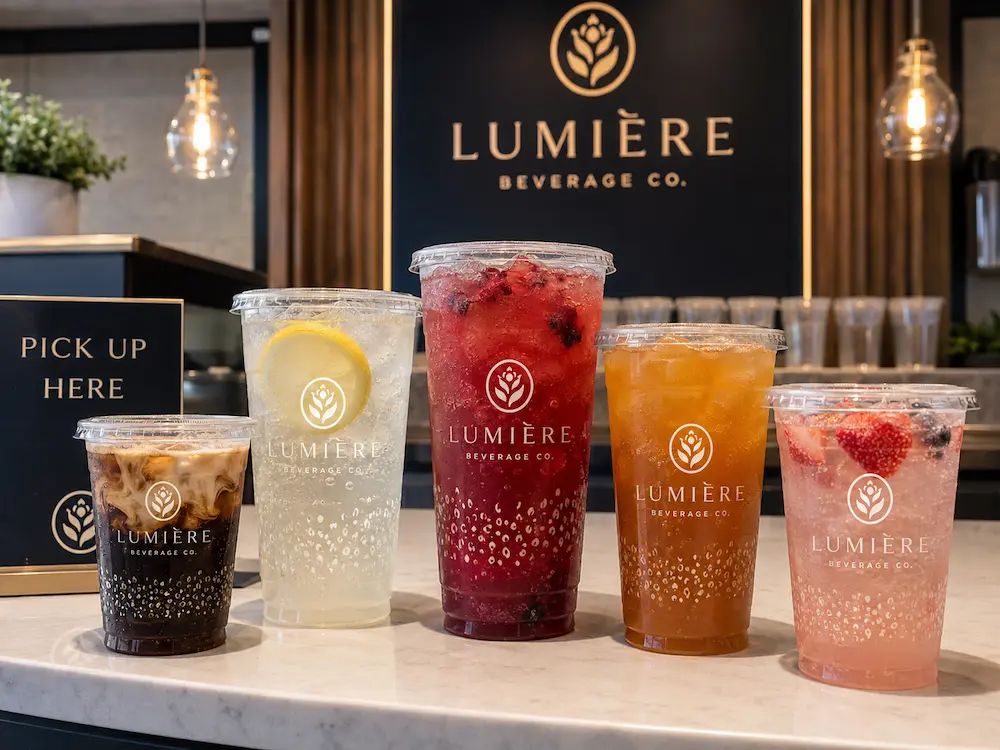
For this reason, many beverage chains choose clear PET cups for premium visibility. Buyers can explore PET Cold Cups when drink display, transparency, and menu presentation are major priorities.
Bulk Supply Stability During Peak Beverage Seasons
Cold drink demand often increases during warm seasons, holiday campaigns, menu launches, and regional promotions. A beverage chain may need repeat orders across several cup sizes and lid types within a short period. A weak supplier may handle the first order but fail when demand grows.
Before choosing a beverage packaging supplier, buyers should confirm whether the factory can support repeat production, carton packing consistency, mixed-size supply, cup-lid matching, custom printing communication, and export coordination without making unrealistic promises.
PET vs PP Cold Cups: How Buyers Should Compare Materials
PET and PP are both common materials for cold beverage cups, but they serve different buying priorities. A professional PET cup factory should explain where PET adds value, while a practical PP cup manufacturer should explain where PP makes sense. Beverage chains should choose based on menu needs, not only unit price.
PET Cold Cups for Clarity and Premium Drink Display
PET cold cups are widely used for drinks that need strong visibility. Their clear appearance supports iced coffee, iced tea, lemonade, juice, smoothies, milk tea, bubble tea, cold brew, fruit tea, matcha drinks, refreshers, sparkling fruit beverages, protein drinks, and layered yogurt drinks.
PET cups also provide a clean and structured hand feel for takeaway and retail display. When paired with flat lids, dome lids, or strawless sipper lids, they support different beverage textures and service methods. For chains that sell colorful or layered drinks, PET often delivers stronger shelf and counter presentation than PP.
PP Cold Cups for Flexible and Cost-Controlled Programs
PP cold cups can be suitable for selected high-volume programs where flexibility, practical handling, and cost control are more important than premium clarity. A PP cup manufacturer may be relevant for buyers serving general cold drinks, economy drink programs, or selected takeaway channels.
However, PP usually does not provide the same crystal-clear product visibility as PET. If the drink itself is a visual product, such as matcha refreshers, fruit tea, boba drinks, smoothies, or iced coffee layers, PET may provide stronger customer-facing value. Buyers comparing material options can also review PP Cold Cups and PLA Compostable Cold Cups if their sourcing program includes multiple material directions.
PET vs PP Cold Cup Comparison for Beverage Chains
| Decision Point | PET Cold Cups | PP Cold Cups | Best Buyer Use |
|---|---|---|---|
| Visual Clarity | High transparency for drink display | Lower clarity compared with PET | Choose PET for premium visual drinks |
| Hand Feel | Clean, rigid, display-focused feel | More flexible feel | Match the feel to the brand position |
| Drink Menu | Iced coffee, fruit tea, smoothies, milk tea, matcha, refreshers | General cold drinks and cost-sensitive menus | Test with real beverages before bulk orders |
| Lid Matching | Works well with flat, dome, and strawless lids when designed as a system | Depends on rim design and lid structure | Always test cup and lid together |
| Branding | Strong for printed logos and visible drinks | Possible depending on print method | Request physical print samples before production |
| Procurement Logic | Better for display-driven beverage chains | Useful for selected economical programs | Compare total value, not only cup price |
Why 95mm and 98mm Cup-Lid Systems Matter
One of the most important but often overlooked sourcing details is cup-lid compatibility. A beverage chain should not treat cups and lids as separate purchases. The rim diameter, lid structure, pressing force, drinking opening, and drink type must work together.
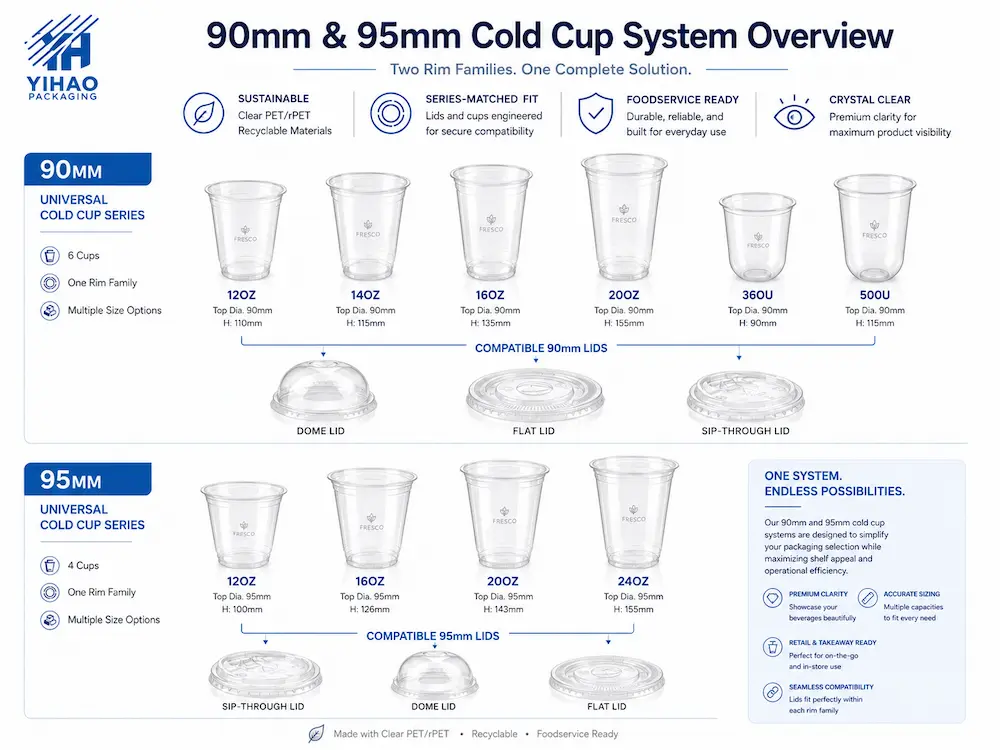
YIHAO offers PET/RPET cold cup and lid series built around 95mm and 98mm diameter systems. Each diameter system supports shared-lid compatibility within the same series, allowing different capacities to use matching flat lids, dome lids, or strawless sipper lids. This structure helps beverage chains reduce wrong-lid risk and simplify store-level inventory.
98mm PET/RPET Cold Cup System
The 98mm series supports multiple cold cup capacities with matching 98mm PET/RPET lids. This system is useful for buyers who need a wide range of drink sizes while keeping one lid family. It supports iced coffee, cold brew, milk tea, fruit tea, smoothies, lemonade, sparkling drinks, yogurt beverages, and high-visibility takeaway beverages.
Relevant product examples include 12 oz PET/RPET clear cold cup for iced coffee, cold brew, juice, and lemonade, 16 oz PET/RPET clear cold cup for iced coffee, iced tea, lemonade, and smoothies, and 20 oz PET/RPET clear cold cup for smoothies, iced coffee, lemonade, and milk tea.
95mm PET/RPET Cold Cup System
The 95mm series is another practical shared-lid system for beverage menus that need efficient cup-lid matching. It supports drink formats such as iced coffee, iced tea, lemonade, fruit tea, juice, bubble tea, smoothies, and direct-drink cold beverages.
Flat, Dome, and Strawless Lids Serve Different Drink Styles
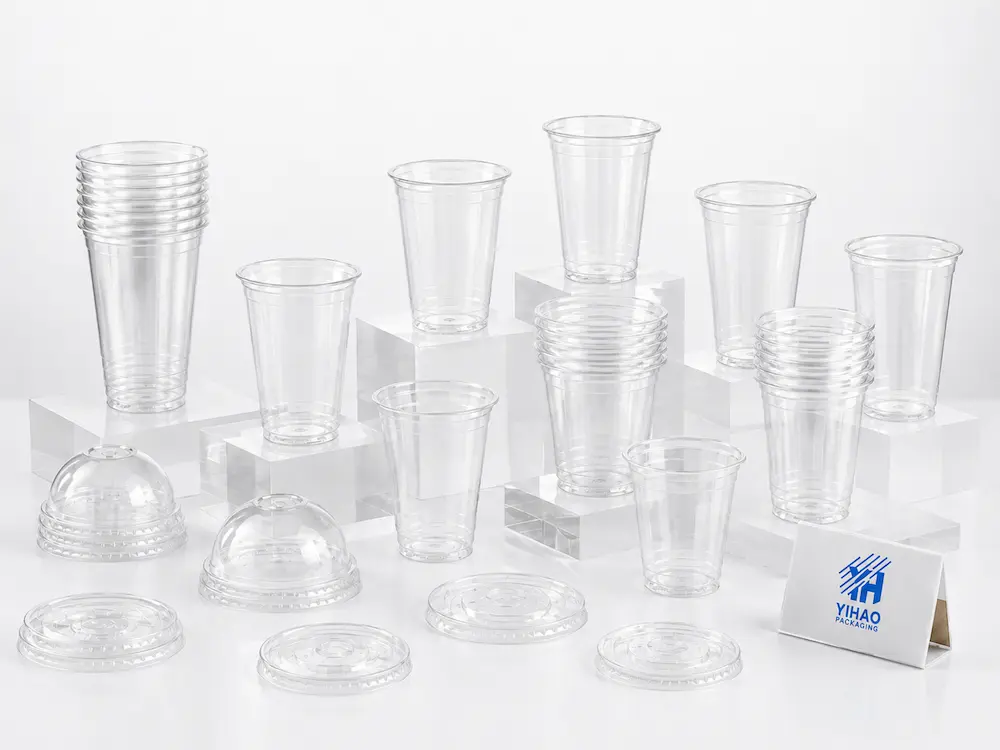
Flat lids with straw slots are practical for standard iced coffee, iced tea, lemonade, juice, soda, and fruit tea. Dome lids provide extra headspace for smoothies, milkshakes, whipped cream, fruit pieces, boba toppings, yogurt parfaits, and dessert-style beverages. Strawless sipper lids support direct drinking for iced coffee, iced tea, lemonade, refreshers, and on-the-go cold beverages.
Buyers comparing lid types should review Cold Cup Lids and Flat, Dome & Strawless Lids before confirming a cup program. The right lid selection reduces leakage complaints, wrong-lid use, service delays, and customer inconvenience.
What to Check Before Choosing a Cold Cup Supplier
A supplier should be evaluated through product samples, factory communication, material documentation, packaging tests, and repeat-order capability. A polished catalog image is not enough. Beverage chains need proof that the cup system works in real store conditions.
Factory Capacity and Repeat Production Stability
A capable cold cup manufacturer should explain available cup series, material options, matching lid types, carton packing, and repeat-order planning. Buyers should also ask whether the supplier can support mixed cup sizes and matching lids in one purchasing program.
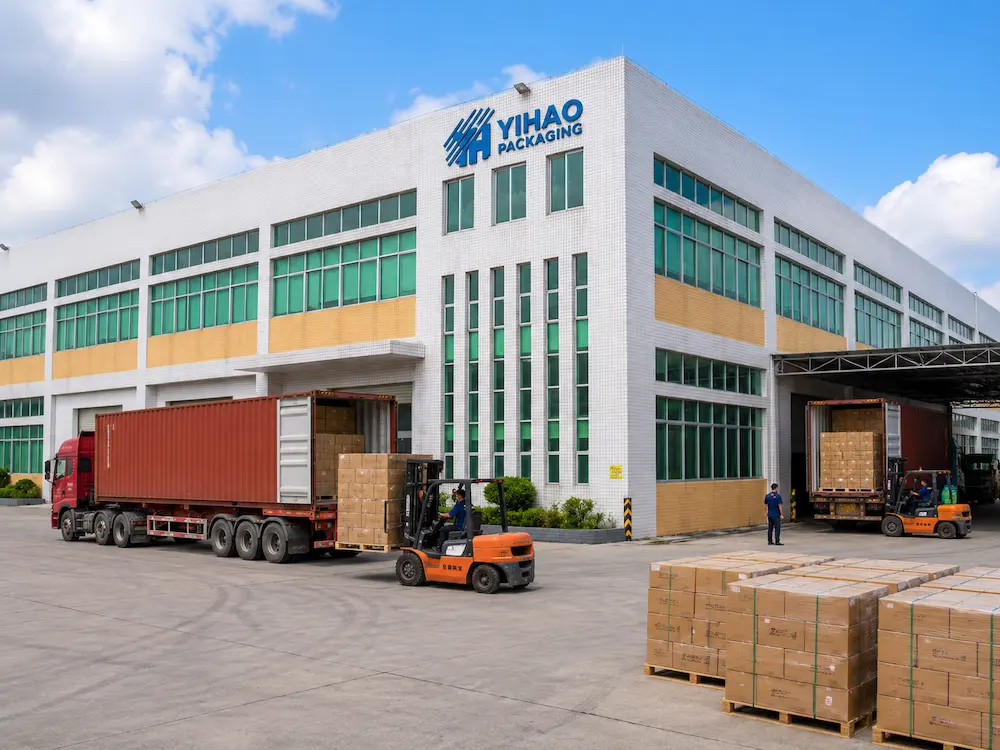
For larger sourcing projects, the YIHAO factory page is a useful internal destination because it helps buyers understand manufacturing support, packaging capability, and long-term cooperation direction.
Food-Contact Documentation
Cold cups are used for beverages and sometimes chilled ready-to-go foods such as fruit cups, berry cups, yogurt parfaits, pudding cups, salad cups, and dessert cups. Buyers should request food-contact documentation according to the target market and intended use. This may include material declarations, test reports where applicable, and supplier documentation related to food-contact use.
A responsible beverage packaging supplier should avoid vague claims such as “approved for every market” without documents. U.S., EU, and other regional markets may have different food-contact expectations. Buyers should confirm the destination market before approving bulk production.
Cup-Lid Fit Testing
Cup-lid fit is one of the most important quality checks for bulk cold cups. Buyers should test the cup and lid as one system, not as separate items. A lid that is too loose may leak during delivery. A lid that is too tight may slow service and frustrate store staff. A rim that deforms under pressure can create real operating problems.
Testing should include flat lids, dome lids, and strawless sipper lids when the menu requires them. Buyers should test with ice, liquid, toppings, delivery movement, hand pressure, and real store handling. A reliable cold cup supplier should provide cup-and-lid samples together.
Custom Printing Proofing
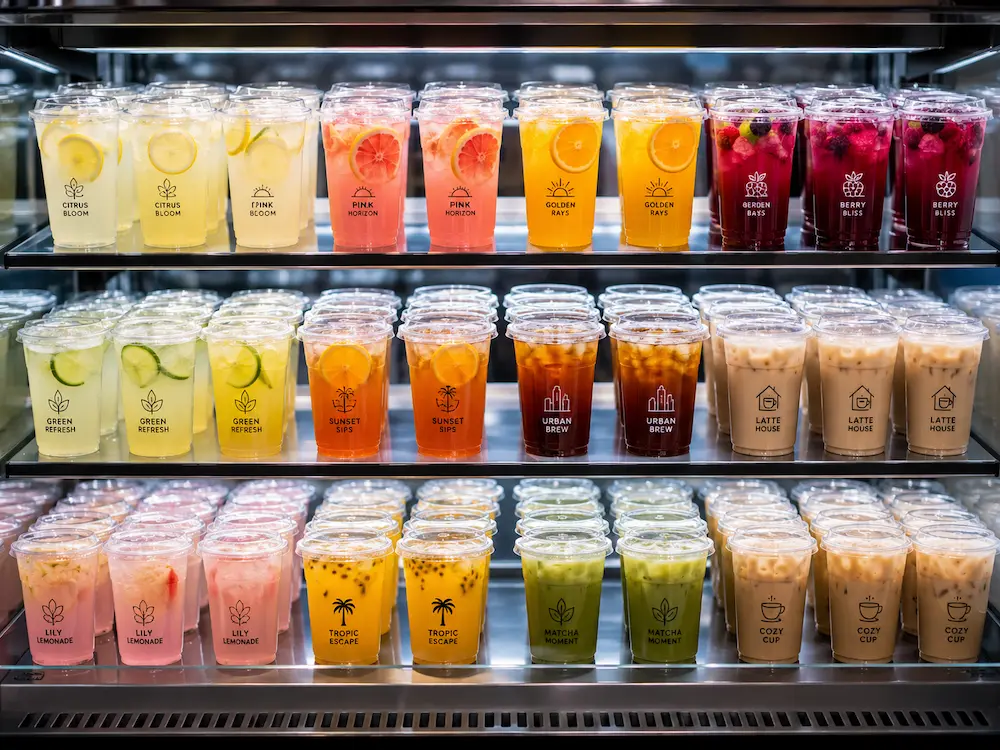
Custom printing should be approved with physical samples before mass production. Artwork may look good on a screen but appear different on a clear curved cup surface. Buyers should check logo size, print position, color appearance, line sharpness, ink adhesion, and how the printed design looks when the cup is filled with a real beverage.
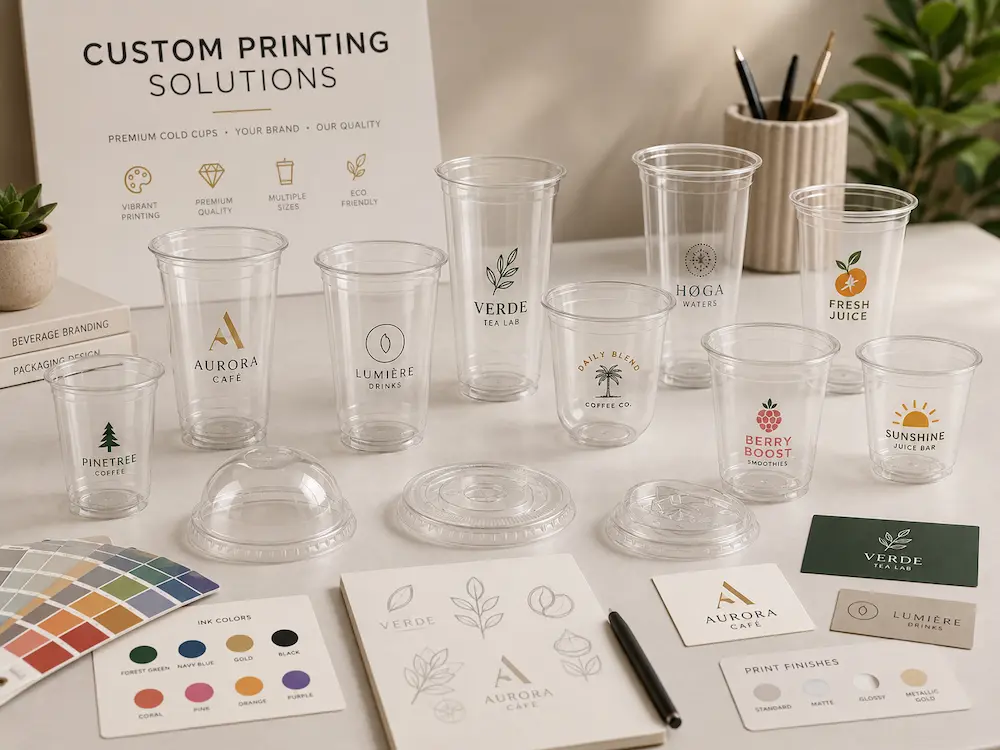
This step is especially important for beverage chains that use seasonal drinks, limited-time promotions, franchise store branding, or private-label packaging programs.
Buyer Approval Checklist Before Bulk Cold Cup Orders
| Approval Area | What to Check | Why It Matters |
|---|---|---|
| Material | PET, PP, rPET, PLA, or other material direction | Controls clarity, hand feel, cost, compliance review, and brand positioning |
| Cup Clarity | Transparency, haze level, drink visibility, retail display effect | Important for iced coffee, fruit tea, matcha, smoothies, and layered drinks |
| Rim Strength | Rim stability during lid pressing and normal handling | Prevents deformation, leakage, and slow service |
| Lid Fit | Flat lid, dome lid, strawless sipper lid, snap-on feel, leakage observation | Protects takeaway performance and customer experience |
| Stacking Release | Whether cups separate smoothly during store use | Improves service speed during busy hours |
| Print Quality | Logo position, color accuracy, artwork sharpness, ink adhesion | Protects brand consistency across stores |
| Carton Packing | Carton strength, inner packing, pallet arrangement, label clarity | Reduces transit damage and warehouse confusion |
| Food-Contact Documents | Material declarations and relevant documentation for the target market | Supports responsible procurement review |
| Repeat Supply | Reorder planning, mixed-size supply, cup-lid matching, communication stability | Protects long-term chain-store operations |
Custom Cup Manufacturer Services for Beverage Chains
Custom cold cups help beverage brands turn packaging into a visible part of the customer experience. A custom cup manufacturer should support branding without ignoring production reality. Logo printing, artwork placement, color control, packaging labels, and reorder consistency all need clear communication before production starts.
Logo Printing and Brand Color Matching
Custom printed cold cups can carry logos, brand colors, seasonal graphics, QR codes, social handles, campaign messages, or private-label designs. For beverage chains, print consistency is not optional. A logo that shifts between batches or appears too light on a filled cup can weaken store-level brand presentation.
Before approving custom production, buyers should confirm artwork format, printable area, color reference, sample proofing, cup surface limitations, and carton labeling requirements. A professional custom cup manufacturer will help buyers adjust artwork for real cup production instead of simply accepting a file and hoping the final output works.
OEM Cold Cups for Private Label Beverage Programs
OEM cold cups are useful for beverage chains, distributors, café groups, supermarket drink programs, and private-label foodservice brands. OEM support may include cup series selection, logo printing, matching lids, carton marks, barcode labels, package grouping, and repeat-order planning.
OEM should not be treated as only printing a logo. A complete OEM cold cup program should connect the cup material, lid system, cup size range, menu application, artwork approval, storage method, and future reorder plan. This is where a practical cold cup manufacturer provides more value than a simple trading supplier.
Custom Packaging for New Drink Launches
New drink launches need packaging that makes the beverage look intentional. Matcha drinks, refreshers, fruit tea, sparkling fruit beverages, flavored cold brew, smoothies, protein drinks, and bubble tea all benefit from clear visual presentation. PET cups support this by showing color, ice, layers, toppings, and texture.
For campaigns, buyers should plan cup artwork earlier than the launch date. Sample proofing, print approval, production scheduling, and shipping all affect the timeline. A practical cold cup supplier will ask about launch timing before confirming details.
How Beverage Chains Should Evaluate Wholesale Cold Cups
When sourcing wholesale cold cups, buyers should compare total packaging value. A lower unit price may not save money if the cup causes leakage, wrong-lid use, breakage, slow service, or brand inconsistency. Good sourcing looks at performance across the whole packaging system.
Match Cup Sizes to the Drink Menu
Different drink menus need different cup capacities and lid options. Smaller cups may support juice, tasting portions, iced espresso drinks, yogurt cups, or fruit snacks. Medium cups often support iced coffee, fruit tea, milk tea, lemonade, and refreshers. Larger cups support bubble tea, smoothies, cold brew, sparkling beverages, and high-capacity takeaway drinks.
The smartest approach is to map cup sizes to the menu before choosing products. A shared-lid system can reduce inventory complexity, but only when the cup capacities, drink types, and lid options fit the chain’s real use.
Check Storage and Store Workflow
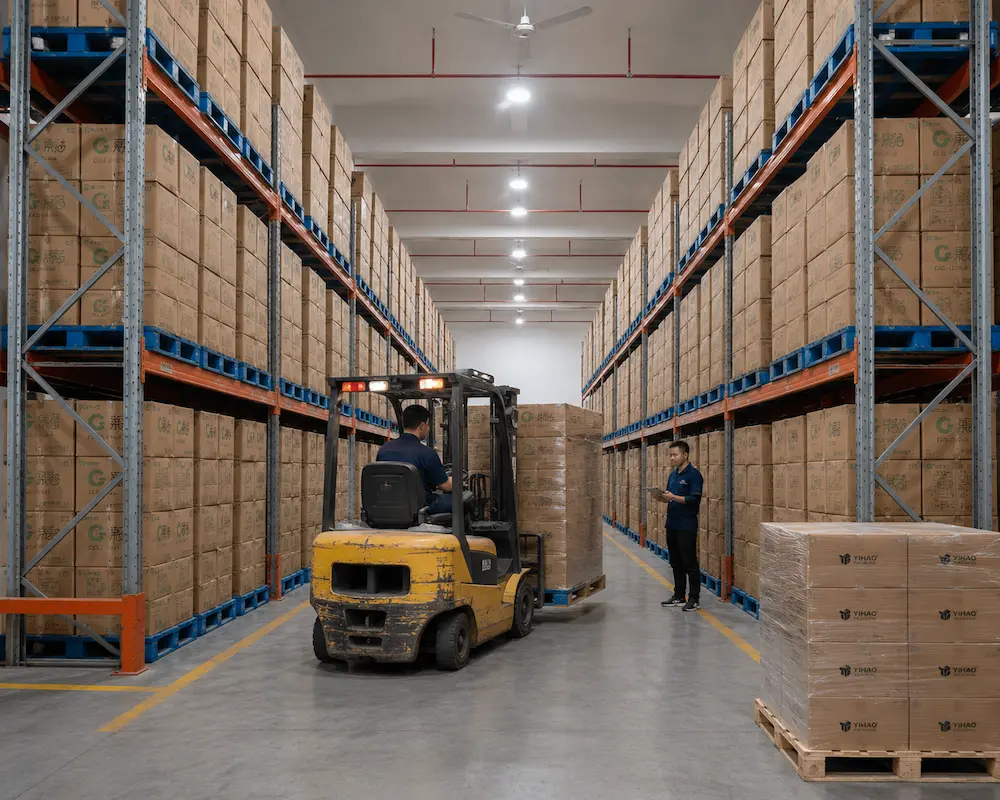
Cold cups must stack cleanly, release smoothly, and fit store storage areas. If cups stick together, staff lose time during rush periods. If lids are hard to identify, wrong-lid use increases. If cartons are poorly labeled, warehouse and store teams waste time sorting products.
A professional cold cup manufacturer should help buyers think through carton labels, cup-lid grouping, warehouse storage, and store-level handling. This is where factory-side communication becomes more valuable than a slightly lower price.
Compare Hidden Costs, Not Only Unit Price
Cheap cups can create expensive problems. Leakage, cracking, cloudy appearance, weak lids, inconsistent printing, and carton damage all increase hidden costs. Beverage chains should compare suppliers by sample performance, repeat quality, documentation support, and long-term cooperation stability.
For buyers planning a wider foodservice packaging mix, Food Packaging Solution & Catalog can help connect beverage cups with fresh food packaging, deli containers, bakery packaging, and retail food packaging categories.
Sustainability Questions Beverage Buyers Should Ask
Sustainability is important in beverage packaging, but it must be communicated accurately. Buyers should avoid broad claims such as “eco-friendly,” “recyclable everywhere,” or “food-grade recycled content” unless the statement is supported by material documentation, package design, food-contact requirements, and local recycling acceptance.
Recyclability Depends on Local Systems
PET cups may be recyclable where local PET collection, sorting, and recycling systems accept this package format. However, recyclability is not universal. Cup shape, labels, inks, sleeves, residues, colorants, and local infrastructure can all affect whether a cup is actually collected and processed.
Buyers should ask whether the cup design supports recycling compatibility in the target market. A responsible cold cup supplier should use cautious, market-specific wording instead of absolute claims.
rPET Requires Food-Contact Verification
Recycled PET can support sustainability goals in some packaging programs, but food-contact use requires proper verification. Buyers should request information about the recycled material source, intended application, food-contact suitability, and target market requirements before approving rPET cold cups for beverage service.
The fact that a cup contains recycled material does not automatically mean it is suitable for every food-contact application or every market. Buyers should verify documents before making marketing claims.
Decoration Can Affect Recycling Compatibility
Labels, sleeves, adhesives, inks, and large printed areas may affect sorting or recycling compatibility. Beverage brands should discuss decoration and recycling design together, especially when using full-wrap labels, heavy ink coverage, or promotional sleeves.
A practical beverage packaging supplier helps buyers balance brand visibility, print quality, material selection, and responsible packaging claims.
Questions to Ask Before Ordering Bulk Cold Cups
Before confirming bulk cold cups, beverage chains should ask direct questions. A supplier that answers clearly is usually safer than a supplier that only repeats low prices.
- Which materials are available: PET, PP, rPET, PLA, or other options?
- Which cup sizes and rim diameters are available?
- Do the cups match flat lids, dome lids, and strawless sipper lids?
- Can different cup capacities share the same lid within one diameter system?
- Can the supplier provide physical samples before bulk production?
- What documents are available for food-contact review in the target market?
- What custom printing methods are available for logos and seasonal artwork?
- How does the factory control cup clarity, weight, rim strength, and stacking?
- How are cups and lids packed for export, warehouse storage, and store distribution?
- Can the supplier support repeat orders for chain expansion?
RFQ Information Beverage Buyers Should Prepare
A clear RFQ helps the cold cup manufacturer recommend the right product faster. Instead of asking only for “cold cup price,” buyers should provide practical use information.
| RFQ Item | Buyer Should Provide | Supplier Can Recommend |
|---|---|---|
| Drink Type | Iced coffee, milk tea, smoothie, lemonade, fruit tea, matcha, refreshers, juice, soda | Suitable cup material, capacity, and lid type |
| Cup Size Range | Current menu sizes or target serving sizes | Matching PET/RPET cup series and lid system |
| Lid Style | Flat lid, dome lid, strawless sipper lid, or mixed lid system | Compatible lids and cup-lid testing samples |
| Branding Need | Plain cup, logo printing, seasonal artwork, OEM packaging | Custom printing and artwork proofing direction |
| Order Volume | Trial order, monthly usage, chain-store forecast, distributor demand | Wholesale packing and repeat-order planning |
| Market | Destination country or region | Relevant documentation discussion and packing requirements |
Why YIHAO Is a Practical Beverage Packaging Supplier for Cold Cup Programs
YIHAO supports beverage packaging buyers with clear PET/RPET cold cups, 95mm and 98mm cup-lid systems, matching flat lids, dome lids, strawless sipper lids, custom branding discussion, and wholesale supply communication. For beverage chains, the real value is not only receiving a product quotation. The value is building a cup-and-lid program that fits the menu, store workflow, customer experience, and reorder plan.
As a cold cup manufacturer and food packaging solution provider, YIHAO focuses on practical packaging performance: clear presentation, stackable storage, lid compatibility, sample confirmation, custom printing discussion, and reliable bulk supply planning. Buyers can start from the YIHAO home page, compare product categories through Cold Cups & Lids, and then move toward specific PET cold cup or lid pages based on actual menu needs.
For beverage chains planning private-label packaging, OEM cold cups, or a full drink packaging program, the best next step is to prepare drink type, cup size range, lid style, printing artwork, estimated quantity, and target market. This allows the supplier to recommend a practical packaging path instead of only sending a generic price list.
Common Mistakes When Choosing a Cold Cup Manufacturer
Only Comparing the Lowest Price
The cheapest cup is not always the lowest-cost packaging. Weak rims, poor lid fit, cloudy material, inconsistent print quality, and carton damage can create higher losses than the first price difference. Beverage chains should compare total performance and reorder stability.
Ordering Cups Without Testing Lids
Cups and lids must be tested together. A cup body may look fine, but the packaging fails if the lid is too loose, too tight, or unstable during takeaway use. Buyers should approve matched samples before bulk orders.
Approving Printing Without Physical Proofs
Custom printing needs physical sample approval. Curved cup surfaces, transparent material, drink color, and condensation can all affect how the final logo looks. Buyers should check real samples before mass production.
Making Sustainability Claims Too Broadly
Packaging claims must be accurate. PET, rPET, PP, recyclable, recycled content, compostable, and food-contact suitability are different topics. Buyers should avoid absolute claims unless they are supported by the material, market, documentation, and package design.
Conclusion
A strong cold cup manufacturer helps beverage chains reduce sourcing risk by connecting material selection, cup clarity, lid compatibility, custom branding, food-contact documentation, carton packing, sample approval, and repeat supply into one packaging system. This is especially important for brands selling iced coffee, fruit tea, milk tea, smoothies, lemonade, matcha drinks, refreshers, and other high-visibility cold beverages.
The best sourcing decision is not simply choosing the lowest unit price. It is choosing a cup-and-lid program that supports store efficiency, customer experience, brand consistency, and long-term supply stability. Buyers should test samples with real drinks, confirm matching lids, review documentation, approve custom printing carefully, and work with a supplier that understands beverage chain operations.
FAQ
1. What is a cold cup manufacturer?
A cold cup manufacturer produces cups designed for cold beverages such as iced coffee, fruit tea, smoothies, lemonade, juice, milk tea, bubble tea, soda, and other chilled drinks. A professional manufacturer may also provide matching lids, custom printing, OEM support, carton packing, and bulk supply services for beverage chains and distributors.
2. What is the difference between PET and PP cold cups?
PET cold cups usually offer higher transparency and a more structured display effect, making them suitable for iced coffee, fruit tea, smoothies, milk tea, matcha, refreshers, and premium beverage presentation. PP cold cups are often more flexible and may fit selected cost-sensitive drink programs. Buyers should compare clarity, lid fit, drink type, printing needs, and brand position before choosing.
3. Why do 95mm and 98mm cup-lid systems matter?
95mm and 98mm cup-lid systems help buyers match cups and lids more efficiently. When different cup capacities share the same lid diameter within one series, stores can reduce wrong-lid use, simplify inventory, and improve packing speed. Buyers should never mix 95mm lids with 98mm cups or 98mm lids with 95mm cups.
4. Can beverage chains order custom printed cold cups?
Yes. Beverage chains can order custom printed cold cups with logos, brand colors, seasonal graphics, QR codes, or promotional artwork. Before mass production, buyers should confirm artwork format, printing area, logo position, color matching, ink adhesion, and physical sample approval with the custom cup manufacturer.
5. What should buyers check before ordering wholesale cold cups?
Before ordering wholesale cold cups, buyers should check material, cup clarity, rim strength, lid compatibility, size range, carton packing, sample quality, food-contact documentation, custom printing capability, and repeat supply stability. Physical sample testing is strongly recommended before bulk orders.
6. Are PET cold cups recyclable?
PET cold cups may be recyclable where local PET collection, sorting, and recycling systems accept this package format. Recyclability depends on local infrastructure, cup design, labels, inks, sleeves, residues, and sorting conditions. Buyers should avoid absolute recycling claims unless they are supported by the target market and package design.
References
- U.S. Food and Drug Administration, Packaging & Food Contact Substances.
- U.S. Food and Drug Administration, Guidance for Industry: Use of Recycled Plastics in Food Packaging.
- European Commission / EUR-Lex, Commission Regulation (EU) No 10/2011 on plastic materials and articles intended to come into contact with food.
- Association of Plastic Recyclers, APR Design Guide for Plastics Recyclability.
- NAPCOR, PET packaging and recycling design resources.
- Foodservice packaging material supplier documentation and technical data sheets.
- Internal PET/RPET cold cup and lid series specifications for 95mm and 98mm cup-lid systems.
- Internal sample testing and buyer approval records for beverage packaging programs.
Deep-Dive Insights
How should a beverage chain start choosing cold cups?
Start with the drink menu. Identify which drinks need premium clarity, which need dome-lid headspace, which need straw access, which can use strawless sipper lids, and which sizes drive the highest daily volume. Then match cup material, rim diameter, lid type, and carton packing to those real operating needs.
Why is a shared-lid system useful for chain stores?
A shared-lid system allows different cup capacities within the same diameter series to use matching lids. This reduces wrong-lid use, simplifies purchasing, improves store training, and makes wholesale cup-lid matching easier for beverage chains and distributors.
What makes PET cold cups valuable for visual drinks?
PET cold cups support high product visibility. They help customers see iced coffee layers, fruit tea color, matcha gradients, smoothie texture, boba toppings, lemonade brightness, and sparkling beverage clarity. This makes PET especially useful for display-driven beverage menus.
What should buyers avoid when discussing sustainability?
Buyers should avoid absolute claims such as recyclable everywhere, fully eco-friendly, or food-grade recycled material without documentation. Sustainability claims depend on material, package design, local collection systems, recycling compatibility, and food-contact requirements.
What should be included in a professional cold cup RFQ?
A strong RFQ should include drink type, cup size range, lid style, target material, custom printing needs, monthly usage estimate, destination market, and sample testing expectations. This helps the supplier recommend a practical cup-lid system instead of sending a generic price list.
Final Note / Practical Takeaway
© YIHAO Packaging. All rights reserved.
Your trusted food packaging manufacturer and beverage packaging supplier.