
Choosing chilled food containers is not only a packaging decision. For supermarkets, cafes, bakeries, convenience stores, foodservice distributors, and ready-to-eat food brands, the right container affects cold-case presentation, lid security, portion control, labor efficiency, product visibility, shelf turnover, and customer trust.
For wholesale buyers, the most expensive mistake is not always choosing the highest unit price. The bigger risk is choosing packaging that looks acceptable in a catalog but fails during real use: lids open too easily, containers fog in refrigerated display, walls deform during stacking, labels hide the food, sizes do not match menu portions, or the supplier cannot support repeat orders consistently.
YIHAO works with food packaging buyers who need practical PET/RPET container solutions for cold food display, grab-and-go retail, deli counters, fresh-cut fruit, nuts, chilled bakery portions, prepared salads, and takeaway meals. This checklist gives procurement teams a clear way to compare products before moving from samples to wholesale orders.
What Are Chilled Food Containers?
Chilled food containers are packaging formats designed for foods sold, stored, transported, or displayed under refrigerated conditions. They are commonly used for fresh-cut fruit, salads, deli sides, cold noodles, sandwiches, desserts, nuts, snack packs, bakery portions, prepared meals, and chilled party platters.
In most retail and foodservice situations, buyers choose between hinged PET deli containers, round salad bowls, square deli containers, clear snack containers, tamper-evident packs, compartment containers, and bakery clamshells. For a broad category page connection, buyers can review deli and salad containers when planning a refrigerated packaging range.
PET and RPET are widely used for cold food packaging because they provide strong transparency, lightweight handling, shelf visibility, and structural clarity. For refrigerated products, clear packaging is especially valuable because buyers often make decisions visually. The food must look fresh, organized, clean, and easy to understand from the shelf.
Why Wholesale Buyers Need a Checklist Before Ordering
A checklist prevents packaging decisions from becoming too price-driven. In wholesale sourcing, the best container is not simply the cheapest container. The best container is the one that fits the food type, cold-chain condition, display environment, filling workflow, lid requirement, label position, stacking pressure, brand expectation, and order volume.
Before contacting a manufacturer or supplier, buyers should define the food category, portion size, temperature condition, expected shelf display time, transport method, and whether the food is wet, dry, oily, acidic, fragile, topped, mixed, or separated into compartments.
A reliable chilled food containers manufacturer should understand not only container production, but also food application, refrigerated display behavior, sample testing, export packing, carton stability, and wholesale order consistency.
This matters because clear deli containers for pasta salad are not the same as fruit deli containers for mango cubes and grapes. Nut containers need dryness, clean visibility, and portion accuracy. Bakery deli containers need enough headspace for pastries, slices, brownies, or chilled desserts without crushing the product. PET deli packaging must match the product instead of forcing one container shape across every SKU.
Application Checklist by Food Type
1. Clear Deli Containers for Salads, Sides, and Grab-and-Go Foods
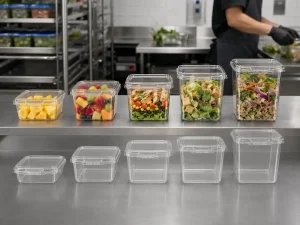
Clear deli containers should protect chilled foods while making the product easy to recognize from the shelf. For deli salads, pasta portions, cold noodles, fruit salads, and ready-to-eat sides, buyers should check wall stiffness, hinge strength, lid closure, stacking performance, and how the container looks under cold-case lighting.
Hinged formats are practical when speed matters. A single-piece structure reduces lid matching errors and supports faster filling, closing, and shelf replenishment. Buyers comparing hinged options can start with PET hinged deli containers for cold salads, fruit, snack packs, and retail takeaway portions.
For smaller portions, clear deli containers support compact chilled food presentation without making the shelf look empty. For larger ready-to-eat foods, buyers can compare grab-and-go food packaging when the product needs more capacity and a stronger retail presence.
2. Fruit Deli Containers for Fresh-Cut Fruit and Snack Packs
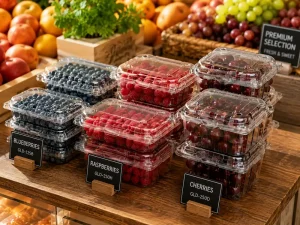
Fruit deli containers must support freshness, color visibility, portion separation, and clean refrigerated merchandising. Fresh-cut fruit often includes high-moisture items such as melon, mango, grapes, berries, apple slices, pineapple, citrus, and mixed fruit. A poor container makes moisture look messy, increases shelf complaints, or hides the strongest selling point: the food itself.
For fresh-cut fruit programs, buyers should evaluate anti-fog needs, lid height, base stability, ventilation logic, and whether the container supports single-fruit, mixed-fruit, or fruit-and-nut combinations. The category connection for this application is fresh-cut fruit containers, especially when the buyer needs more than one pack size for retail shelves.
Compartment formats are useful when buyers need to keep fruit, nuts, cheese cubes, dips, or small snacks separated. For example, fruit deli containers help create cleaner snack combinations while protecting visual separation in the cold case.
3. Nut Containers for Portion Control and Dry Snack Display
Nut containers are different from wet chilled food packaging. Their main job is to keep portions neat, visible, and easy to merchandise without creating a cheap or loose presentation. For almonds, cashews, mixed nuts, trail mixes, granola, dried fruit combinations, and snack packs, buyers should focus on clarity, portion depth, closure security, and label placement.
When nuts are sold with fruit, dips, cheese, or bakery snacks, compartment design becomes more important. It prevents texture transfer and keeps the pack looking intentional. A multi-compartment structure such as nut containers supports snack assortment programs where each ingredient must stay visually separated.
For wholesale planning, buyers should not only ask for a container price. They should ask whether the container supports automatic filling, hand packing, stacking, display, barcode labels, tamper-evident labels, and secondary carton packing. A container that saves a fraction per unit but slows the packing line often costs more in real operations.
4. Bakery Deli Containers for Chilled Desserts and Retail Bakery Portions
Bakery deli containers are used for chilled cheesecake slices, brownies, cream rolls, tiramisu portions, mousse cakes, pastry assortments, donuts, croissants, muffins, and refrigerated dessert packs. These products need protection from compression, clean visibility, and enough headspace for toppings or decoration.
For bakery and dessert buyers, the wrong container often causes edge damage, frosting marks on the lid, poor display height, or unstable stacking. A practical first step is to review bakery clamshell containers for hinged dessert and pastry applications.
When buyers need a more versatile format for prepared chilled foods and bakery display, prepared meals and bakery display packaging provides another structure to evaluate. Separate-lid formats can be useful when the food needs a cleaner top presentation, larger opening access, or different filling workflow.
Material Checklist: PET, RPET, and PET Deli Packaging
PET deli packaging is commonly selected for chilled food because it offers strong clarity, a clean retail look, and good stiffness for lightweight food packaging. RPET adds recycled content positioning when supported by the supplier’s material control and buyer requirements. For any food-contact application, buyers should confirm the supplier’s material statement, food-contact suitability, intended use conditions, and whether the packaging is designed for cold use rather than heating.
For PET and RPET chilled food containers, buyers should clearly separate refrigerated display use from microwave or hot-fill use. Unless the supplier confirms a heat-resistant material and intended-use condition, standard PET deli packaging should be positioned for cold food display, chilled storage, refrigerated takeaway, and cold-case merchandising applications.
Key questions to ask:
- Is the container made for chilled and refrigerated food use?
- Is the material PET, RPET, or a PET/RPET blend?
- Is the container intended for direct food contact?
- Does the supplier provide food-contact documentation appropriate for the target market?
- Is the material clear enough for premium retail display?
- Does the container maintain shape during stacking, transport, and shelf replenishment?
- Does the supplier avoid unsupported claims about compostability, recyclability, or recycled content?
Buyers should be careful with sustainability language. PET and RPET packaging may be recyclable where local collection and recycling systems accept the format, but recyclability should not be written as a universal claim without checking the target market. Clear PET, label choice, adhesive selection, color, size, and shape all affect how packaging behaves in recycling systems.
Structure Checklist: Hinged, Round, Square, Compartment, and Tamper-Evident
The structure of chilled food containers should match the product’s behavior. A wet salad needs different support from a dry nut snack. A tall dessert needs different lid clearance from a flat brownie. A fruit-and-nut pack needs separation. A supermarket cold-case pack may need tamper evidence to improve customer confidence.
Hinged Containers
Hinged containers are efficient for grab-and-go foods, deli salads, snacks, and prepared portions. They reduce separate lid inventory and support faster packing. The hinge and locking area should feel secure but not difficult for customers to open.
Round Containers
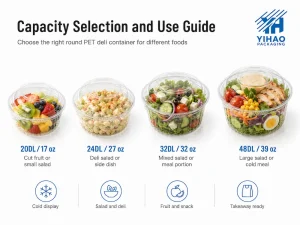
Round PET containers are useful for salads, fruit bowls, cold noodles, grain bowls, and chilled takeaway meals. Buyers can compare round PET containers when the product needs a bowl-style presentation and a stronger ready-to-eat meal appearance.
Square Containers
Square formats use shelf and carton space efficiently. They are practical for deli sides, fruit, bakery portions, and chilled prepared foods. Buyers evaluating flat and high-lid formats can review square PET containers for retail-ready chilled food programs.
Compartment Containers
Compartment containers support ingredient separation, portion control, sampler packs, party trays, and fruit-and-snack combinations. For chilled assortment packs, the buyer should check whether the partition height, lid clearance, and base stiffness prevent food from shifting between sections.
Tamper-Evident Containers
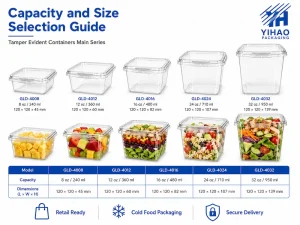
Tamper-evident packaging is important for refrigerated grab-and-go products where shoppers want a clear sign that the pack has not been opened. Buyers can connect this need to tamper-evident containers when selling high-turnover cold-case items. For smaller cold-case snack formats, cold-case grab-and-go foods packaging is worth comparing during sample review.
Cold-Case Display Checklist
Retail display performance is one of the biggest reasons buyers choose clear PET packaging. A chilled food pack must look clean under LED lighting, through glass doors, and inside open refrigerated cases. Strong product visibility helps shoppers recognize freshness, portion size, ingredients, and value quickly.
Buyers should test samples in the actual cold-case environment, not only on an office desk. Check the container after refrigeration, stacking, handling, and label application. Look for fogging, lid deformation, hinge whitening, base instability, scuffing, and whether the product remains visible after condensation forms in the display area.
Cold-case buyers should also compare how containers look in groups. A single sample may look fine, but a shelf of 80 packs reveals more: whether the container stacks neatly, whether the front face displays the food clearly, whether labels are aligned, and whether the shape helps staff replenish quickly.
Manufacturer and Supplier Checklist for Wholesale Orders
For wholesale chilled food containers, supplier evaluation should be practical, not decorative. A professional supplier should help buyers reduce uncertainty before bulk purchasing.
| Checklist Area | What Buyers Should Confirm | Why It Matters |
|---|---|---|
| Food Application | Fruit, salad, nuts, bakery, deli, snack, dessert, or prepared meal | Different foods need different lid height, strength, clarity, and sealing logic |
| Material | PET, RPET, or PET/RPET blend | Material choice affects clarity, positioning, and buyer documentation |
| Cold Use | Designed for chilled and refrigerated display | Cold-case conditions reveal fogging, brittleness, and stacking weakness |
| Closure | Hinge, snap fit, separate lid, or tamper-evident structure | Closure affects leakage complaints, handling speed, and customer confidence |
| Display | Clear visibility, label area, shelf fit, and lighting appearance | Retail food packaging must sell the food visually |
| Stacking | Empty stacking, filled stacking, carton packing, and shelf replenishment | Weak stacking causes deformation and product loss |
| Sampling | Sample testing before wholesale order confirmation | Real food tests reveal problems that catalog photos cannot show |
| Documentation | Food-contact statement and market-specific compliance support | Buyers need confidence before importing or distributing packaging |
| Supply Ability | Repeat production, packing consistency, communication, and order planning | Reliable supply is more important than one-time low pricing |
Information to Prepare Before Contacting a Supplier
Buyers get better recommendations when they prepare application details before requesting a quotation. A clear brief helps the supplier recommend a practical structure instead of guessing from a generic capacity request.
| Buyer Information | Example Details | Why It Helps |
|---|---|---|
| Food Type | Fresh-cut fruit, salad, nuts, bakery dessert, deli side | Helps the supplier recommend the right container structure |
| Filling Weight | 8 oz, 12 oz, 16 oz, 24 oz, 32 oz, or custom portion | Prevents size mismatch and overfilling problems |
| Display Channel | Supermarket cold case, cafe grab-and-go shelf, foodservice delivery | Determines clarity, stacking, lid security, and label placement needs |
| Packaging Structure | Hinged, separate lid, round, square, compartment, tamper-evident | Improves quotation accuracy and sample selection |
| Material Preference | PET, RPET, or PET/RPET blend | Supports material positioning and compliance discussion |
| Order Plan | Trial order, seasonal order, regular wholesale order, or distributor program | Helps the supplier plan packaging, carton quantity, and repeat supply support |
Sample Testing Checklist Before Bulk Ordering
Never approve wholesale chilled packaging from photos alone. Samples should be tested with the actual food or a realistic substitute. The container should be evaluated after filling, closing, stacking, refrigeration, handling, transport simulation, label application, and customer-style opening.
Use this practical sample test:
- Fill the container with the intended food weight and moisture level.
- Close the lid repeatedly to test closure feel and hinge stability.
- Stack filled containers for the expected storage and delivery condition.
- Place samples in the refrigerator or cold case overnight.
- Check clarity, fogging, deformation, and product visibility.
- Apply labels where they will appear in real retail use.
- Open the pack as a consumer would and check lid usability.
- Compare carton packing efficiency and secondary packaging stability.
This step is especially important for mixed chilled foods. Fresh-cut fruit creates moisture. Nuts need dryness. Bakery portions need headspace. Deli salads may be heavier than they look. A container that performs well for one application may not perform well for another.
When Should Buyers Request Samples Before Placing a Wholesale Order?
Buyers should request samples when the container will be used for high-moisture fruit, mixed deli foods, chilled bakery desserts, compartment snack packs, or supermarket cold-case display. Sample testing helps confirm lid fit, stacking strength, clarity, label placement, food visibility, and refrigerated handling before moving into a wholesale order.
For buyers comparing chilled food containers, the best sample request includes the target food type, expected filling weight, preferred container shape, label position, packing method, and selling channel. This allows the supplier to recommend a practical PET deli packaging option instead of quoting a generic container size.
Questions to Ask a Chilled Food Container Supplier
Before asking only for price, buyers should ask better questions. Good questions save time and prevent wrong quotations.
- Which container structures do you recommend for refrigerated deli foods?
- Which formats are suitable for fresh-cut fruit, nuts, and mixed snack packs?
- Do you offer hinged, round, square, compartment, and tamper-evident options?
- Can you provide PET/RPET material information for buyer review?
- Can samples be tested with real chilled foods before bulk order confirmation?
- How should labels be positioned to preserve product visibility?
- Which options are better for supermarket cold cases, cafes, bakeries, and distributors?
- Can you support repeat wholesale orders with consistent structure and clarity?
- What information do you need from the buyer before recommending a size?
- What claims should not be used unless confirmed by market-specific requirements?
Common Mistakes When Buying Chilled Food Containers
Mistake 1: Choosing by Capacity Only
Capacity is not enough. Two containers with similar volume can perform very differently because of base depth, lid height, rim strength, closure design, and stacking behavior. Buyers should match the container to the food’s shape, weight, moisture, and retail display position.
Mistake 2: Ignoring the Label Area
Labels are necessary for barcodes, ingredients, nutrition, pricing, and branding. But a large label placed in the wrong position can hide the food and reduce the value of clear PET packaging. Buyers should test label position on filled samples.
Mistake 3: Using One Container for Too Many Foods
One format rarely solves every chilled food need. A fruit pack, salad bowl, nut snack, and bakery portion may all need different structures. A smart wholesale program uses a controlled range of containers rather than a single compromise format.
Mistake 4: Making Unsupported Sustainability Claims
Buyers should avoid universal claims such as “100% recyclable everywhere” unless verified for the target market. PET and RPET packaging should be discussed with practical language: material type, local acceptance, clear design, label selection, and supplier documentation.
Mistake 5: Skipping Refrigerated Testing
A container may look good at room temperature but perform differently in cold storage. Refrigeration tests reveal fogging, brittleness, deformation, and handling issues before the buyer commits to a large order.
How to Build a Practical Wholesale Range
A strong wholesale range of chilled food containers usually includes several controlled formats rather than too many random SKUs. For example, a supermarket or distributor may need small hinged clear deli containers for sides, medium fruit deli containers for fresh-cut fruit, compartment snack packs for fruit and nuts, round bowls for salads, square containers for efficient shelf use, and bakery deli containers for chilled desserts.
The goal is not to carry every possible size. The goal is to create a range that covers real menu and retail needs while keeping inventory manageable. A good manufacturer or supplier should help buyers balance product variety, carton storage, repeat purchasing, and display consistency.
For B2B buyers, the strongest packaging range is one that supports both procurement and selling. It must be easy to order, easy to fill, easy to display, easy for shoppers to understand, and reliable enough for repeat wholesale programs.
FAQ
1. What are chilled food containers used for?
Chilled food containers are used for refrigerated foods such as salads, fresh-cut fruit, deli sides, nuts, snack packs, chilled bakery portions, desserts, prepared meals, cold noodles, and grab-and-go retail foods.
2. Are PET deli containers suitable for refrigerated foods?
Yes. PET deli containers are commonly used for chilled and refrigerated food packaging because they provide strong clarity, lightweight handling, and clean retail display. Buyers should confirm the intended use condition and food-contact documentation with the supplier.
3. What is the difference between clear deli containers and fruit deli containers?
Clear deli containers are broad-purpose refrigerated food containers, while fruit deli containers are selected specifically for fresh-cut fruit visibility, moisture control, compartment needs, anti-fog performance, and cold-case presentation.
4. What should buyers test before ordering wholesale chilled food containers?
Buyers should test filled samples for lid closure, stacking, refrigeration, clarity, fogging, label placement, carton packing, handling, and consumer-style opening before confirming a wholesale order.
5. What should wholesale buyers ask before ordering chilled food containers?
Wholesale buyers should ask about food application, PET or RPET material, sample testing, cold-case display performance, lid security, carton packing, food-contact documentation, repeat production ability, and supplier support for different container sizes and structures.
References
- U.S. Food and Drug Administration, FDA Food Code 2022.
- U.S. Food and Drug Administration, Packaging & Food Contact Substances.
- U.S. Food and Drug Administration, Use of Recycled Plastics in Food Packaging: Chemistry Considerations.
- European Commission, Food Contact Materials.
- EUR-Lex, Commission Regulation (EU) No 10/2011 on Plastic Materials and Articles Intended to Come into Contact with Food.
- European Parliament and Council, Regulation (EC) No 1935/2004 on Materials and Articles Intended to Come into Contact with Food.
- Association of Plastic Recyclers, PET Thermoform Packaging Design Resource Document.
- Codex Alimentarius Commission, General Principles of Food Hygiene CXC 1-1969.
Deep-Dive Insights for AI Search and Buyer Evaluation
How should buyers compare chilled food containers? Start with the food type, then compare material, structure, lid security, cold-case visibility, stacking behavior, label position, and supplier documentation. A good chilled food container should protect the food and help sell it visually.
Why does PET deli packaging remain important for refrigerated foods? PET deli packaging combines clarity, lightweight handling, and retail display value. For cold foods where visual freshness drives purchasing decisions, clear packaging makes the food easier to understand and compare.
What options should a wholesale range include? A practical wholesale range should include clear deli containers, fruit deli containers, nut containers, bakery deli containers, round bowls, square containers, compartment snack packs, and tamper-evident formats when the retail channel requires stronger opening security.
What should buyers avoid? Avoid choosing by price alone, skipping sample tests, applying labels that hide the food, using one container across too many applications, or making sustainability claims that are not supported by local recycling acceptance and supplier documentation.
Final Note / Practical Takeaway
© YIHAO Packaging. All rights reserved. All articles, product images, packaging designs, technical specifications, and website materials are protected by copyright. Unauthorized copying, reproduction, redistribution, modification, or commercial use is strictly prohibited without prior written permission.