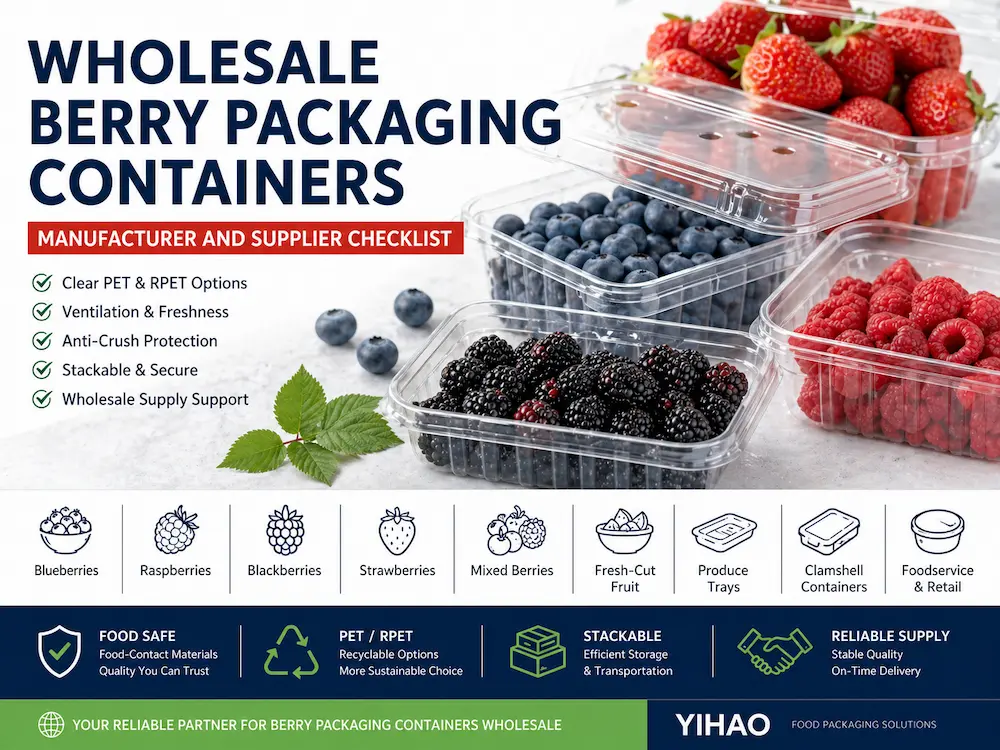
Micro Summary: Berry Packaging Containers for Wholesale Buyers
Berry packaging containers require a different buying checklist from general fresh produce packaging because blueberries, blackberries, raspberries, and strawberries are delicate, colorful, moisture-sensitive, and easy to damage during transport, stacking, and retail handling.
For wholesale buyers, the best packaging choice should balance clear PET produce packaging visibility, ventilation, base support, secure closure, stackability, label placement, and stable supply from a reliable manufacturer or supplier. This checklist helps fresh produce brands, supermarkets, distributors, and foodservice buyers compare berry containers, produce clamshell containers, fresh-cut fruit containers, and produce trays before placing bulk orders.
Wholesale Berry Packaging Containers: Manufacturer and Supplier Checklist
Berries are small, colorful, high-value, and highly sensitive fresh produce items. Blueberries, blackberries, raspberries, and strawberries need packaging that does more than simply hold the product. The right berry packaging containers must protect delicate fruit, support chilled display, allow customers to inspect quality, reduce crushing, and help wholesale buyers manage transport, stacking, labeling, and retail shelf presentation.
For fresh produce brands, berry farms, supermarkets, distributors, importers, and foodservice buyers, packaging selection should be treated as a risk-control decision. A low-cost package that looks acceptable when empty may fail once it is filled, stacked, chilled, transported, and handled by store staff or customers. For berries, that failure often shows up as bruising, leaking, poor shelf appearance, loose lids, crushed fruit, or customer rejection.
YIHAO is a food packaging manufacturer and solution provider focused on practical packaging formats for berries, fresh fruit, salads, snacks, bakery items, deli food, and chilled ready-to-eat meals. For buyers sourcing berry packaging containers wholesale, the goal is not to choose one generic plastic box. The goal is to match berry type, fruit sensitivity, ventilation, base support, closure strength, PET/RPET material choice, and supply stability with real retail and distribution needs.
This guide gives buyers a clear manufacturer and supplier checklist for evaluating berry packaging containers, fresh produce packaging containers, produce clamshell containers, fresh-cut fruit containers, produce trays, and clear PET produce packaging before placing wholesale orders.
Fresh-cut and ready-to-eat produce packaging should be considered part of a broader food safety and handling system. FDA guidance for fresh-cut fruits and vegetables focuses on minimizing microbial food safety hazards during processing and handling, which makes packaging, storage, and handling conditions important parts of fresh produce programs.
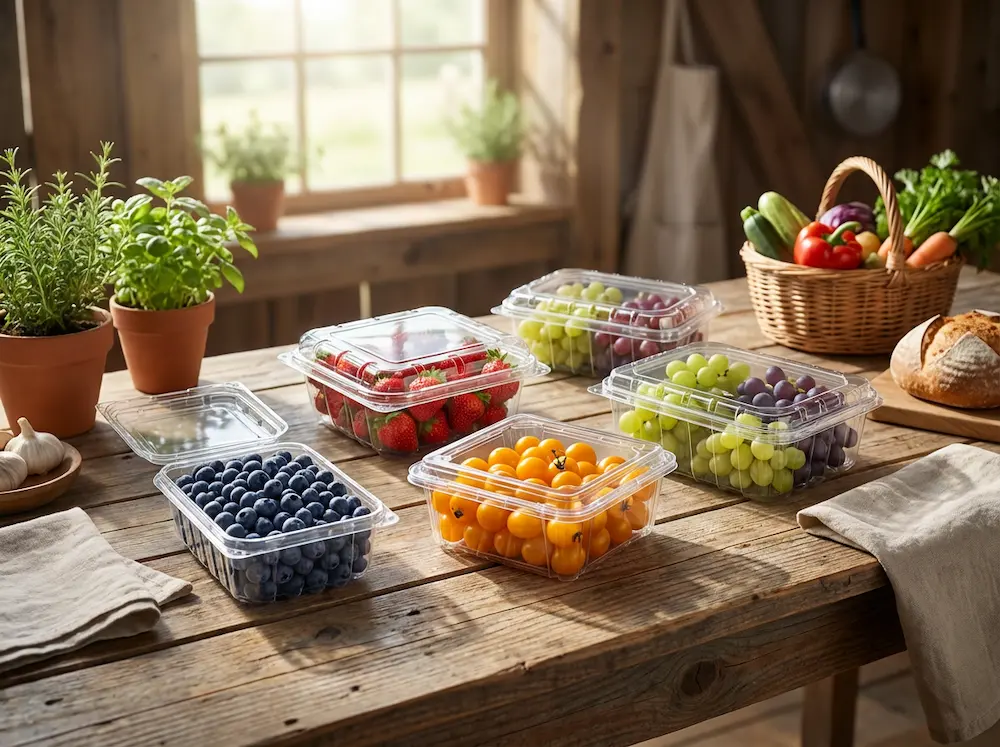
Why Berry Packaging Containers Need a Different Buying Checklist
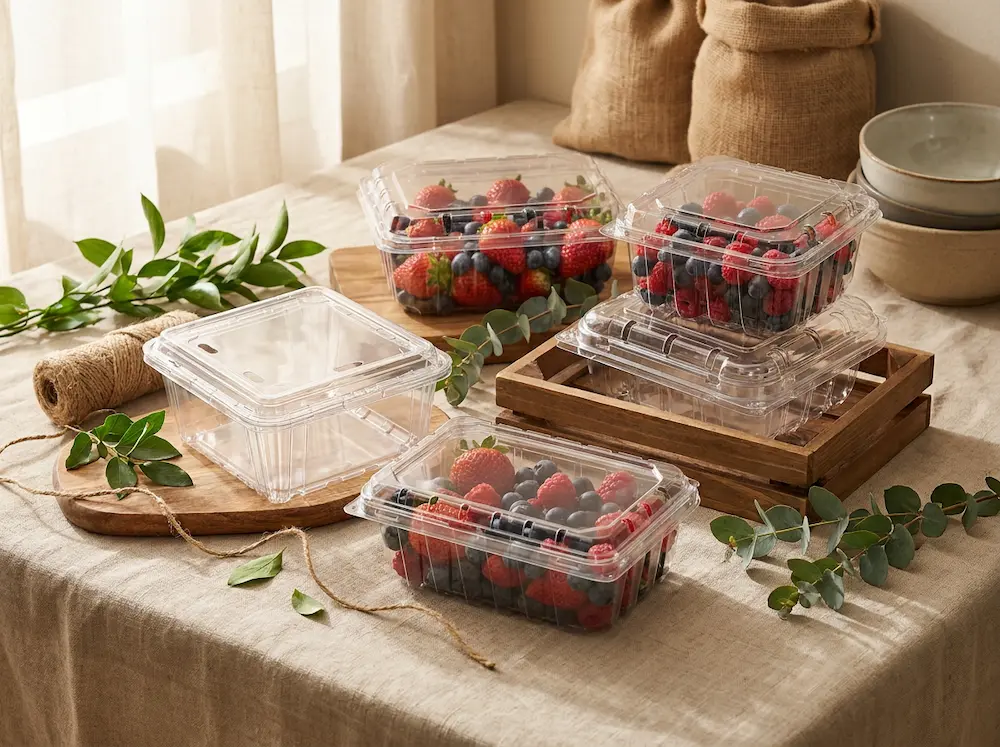
Berries are more delicate than many other fresh produce items. A tray or container that works well for apple slices, grapes, vegetable sticks, or salad portions may not provide enough protection for raspberries, blackberries, or strawberries. Berries can bruise, soften, leak, or lose visual appeal when they are packed too tightly, stacked too heavily, or moved too much during distribution.
This is why berry packaging containers need a different buying checklist. Buyers must evaluate more than container size and price. They need to check visibility, airflow, closure, base rigidity, stackability, carton fit, label placement, and whether the package performs well with the actual berry type.
Berries Are More Sensitive Than Many Fresh Produce Items
Blueberries are small and relatively firm, but they still need containment and stable stacking. Blackberries are larger and more fragile. Raspberries are soft, hollow, and easily damaged by pressure. Strawberries need space because of their size, shape, and surface sensitivity.
A packaging format that works for blueberries may not be ideal for raspberries. A container suitable for strawberries may be too large for smaller berry portions. Buyers should not assume that all berries can use the same structure.
Good berry packaging containers should reduce product movement, support gentle handling, and protect the fruit from unnecessary pressure. The package should help berries reach the shelf looking clean, fresh, and easy to inspect.
Good Berry Packaging Must Balance Visibility, Ventilation, and Protection
Berry packaging has to solve three problems at the same time.
First, customers need to see the berries clearly. Berry color, size, shape, and surface condition influence purchase decisions. This makes clear PET produce packaging useful for retail display.
Second, many berry applications benefit from ventilation. Airflow helps support handling and chilled display conditions. Vent design should be matched with berry type, cold shelf conditions, and market requirements.
Third, the package must protect the product. Weak bases, unstable stacking, and poor lid fit can create pressure points that damage berries before sale.
The best berry packaging containers are not simply clear. They are clear, protective, stackable, and practical for wholesale distribution.
Wholesale Buyers Should Evaluate More Than Price
Price matters, but berry packaging should not be selected by unit price alone. A cheaper package that causes bruising, loose lids, shelf mess, or poor customer experience can create higher hidden costs than a better-matched container.
Wholesale buyers should evaluate total performance: packing speed, transport stability, retail appearance, stacking safety, product protection, labeling, storage efficiency, and repeat supply reliability. A professional manufacturer or supplier should help buyers compare these factors clearly before bulk purchasing.
Berry-Specific Packaging Risks Buyers Should Not Ignore
Different berries require different packaging logic. Blueberries, raspberries, blackberries, and strawberries may all be sold in clear packs, but their pressure tolerance, movement risk, lid clearance needs, and ventilation requirements are not the same. Wholesale buyers should evaluate each berry type separately instead of using one universal container for every product.
Blueberries Need Containment, Ventilation, and Carton Stability
Blueberries are smaller and more mobile than many other berries. The main packaging risk is movement during transport and shelf handling. A good blueberry pack should provide reliable containment, clear visibility, suitable ventilation, and stable stacking inside cartons. For wholesale buyers, carton fit and filled-pack stacking tests are especially important.
Raspberries Need Low-Pressure Protection
Raspberries are soft, hollow, and highly pressure-sensitive. They are not ideal for deep containers with heavy vertical stacking. Buyers should look for shallow, supportive, low-pressure packaging structures that reduce compression while keeping the fruit visible. Lid clearance and base support should be tested carefully with real raspberries.
Blackberries Need Shallow Support and Reduced Compression
Blackberries are larger and softer than blueberries, so they need packaging that limits movement and reduces pressure points. A shallow protective berry container often works better than a deep generic pack. Buyers should check whether the fruit shifts during handling and whether the base structure supports the berries evenly.
Strawberries Need Space, Lid Clearance, and Strong Visual Display
Strawberries are larger and more irregular in shape, so they often need more internal space and better lid clearance. Produce clamshell containers are commonly used for strawberries because they provide clear visibility, closure, and retail handling convenience. Buyers should confirm that the lid does not press against the fruit and that the pack still stacks safely when filled.
What Are Berry Packaging Containers Used For?
Berry packaging containers are used for blueberries, blackberries, raspberries, strawberries, mixed berry portions, fresh-cut fruit with berries, retail grab-and-go packs, and chilled display applications. They are commonly used by berry farms, produce brands, supermarkets, distributors, foodservice buyers, and packaging importers.
Blueberry Packaging Containers
Blueberries need reliable containment, strong visibility, and stable stacking. They are usually smaller and firmer than raspberries or blackberries, but they still require packaging that prevents rolling, spilling, and excessive pressure.
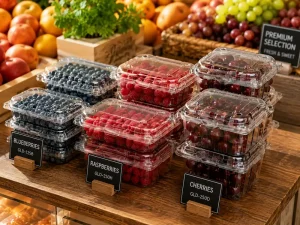
For blueberry packaging, buyers should check lid fit, ventilation pattern, base support, and carton stacking. The container should keep the berries visible from the top and sides while supporting efficient packing and retail handling.
Clear PET blueberry packaging helps customers inspect color and quality. For retail display, the pack should look clean and organized even after transport and shelf replenishment.
Blackberry and Raspberry Packaging Containers
Blackberries and raspberries require more careful packaging because they are softer and more pressure-sensitive. Raspberries, in particular, can deform easily if the package is too deep, too tight, or poorly stacked.
For these berries, shallow or lower-pressure packaging structures may be more suitable. Buyers should evaluate how the berries sit in the base, whether the lid creates pressure, and whether filled packs can stack safely without damaging fruit.
The main buyer focus should be anti-crush support, gentle containment, and limited movement. A package that looks attractive when empty is not enough. It must protect the fruit when filled.
Strawberry Clamshell Containers
Strawberries are often packed in produce clamshell containers because clamshell structures provide visibility, closure, and easy retail handling. Strawberries need more space than smaller berries, and the container should allow the fruit to sit naturally without excessive pressure.
For strawberry packaging, buyers should check height, lid clearance, hinge strength, closure reliability, and base stability. The package should show the strawberries clearly while protecting them from direct handling and shelf compression.
Strawberry clamshells are common in supermarkets, fruit stores, wholesale produce distribution, and export packaging programs.
Mixed Berry and Fresh-Cut Fruit Packaging
Mixed berries often need portion control and strong visual presentation. When berries are combined with cut fruit, yogurt, granola, salads, or chilled desserts, the packaging requirements change.
For mixed berry packs or fresh-cut fruit combinations, fresh-cut fruit containers may perform better than standard berry packs. These containers often provide more space, better closure, and improved takeaway handling.
The best choice depends on the product format. Loose berries need gentle containment and ventilation. Mixed fresh-cut fruit needs closure, moisture control, and portion stability. Catering berry trays need arranged display. Each application needs its own packaging logic.
Key Features Buyers Should Check Before Wholesale Orders
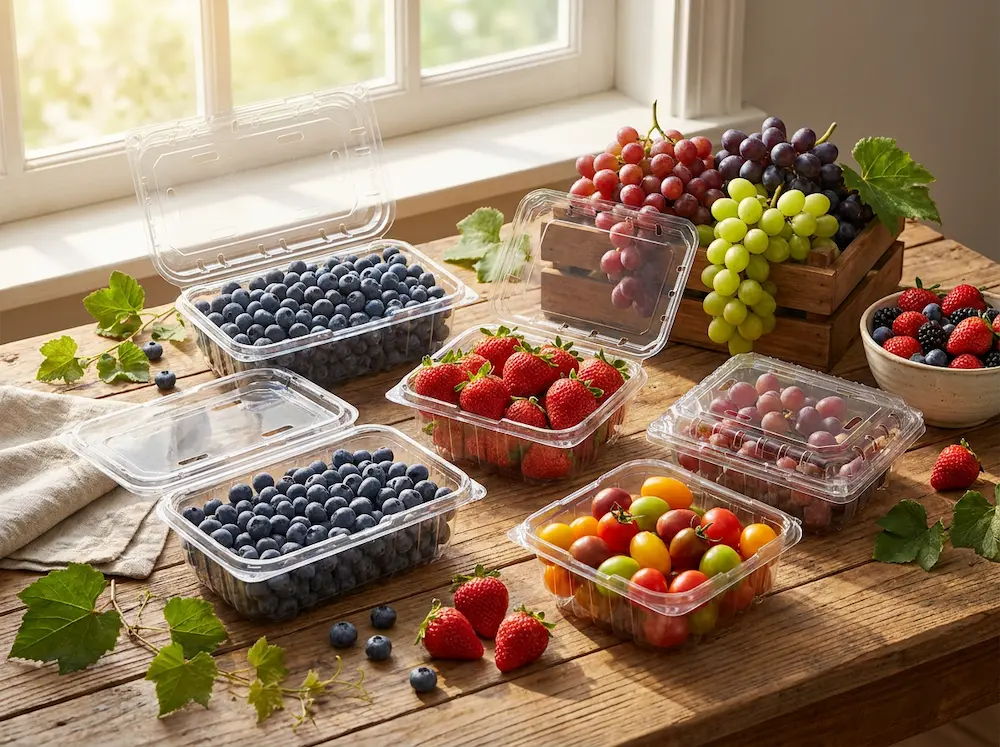
Before placing wholesale orders, buyers should test berry packaging containers with real berries, real filling weight, real labels, real cartons, and realistic cold shelf conditions. Empty samples are useful for first review, but they do not show how packaging performs under actual use.
Clear Visibility for Retail Display
Berry packaging must show the product clearly. Customers want to inspect berry color, size, freshness, and condition before purchase. Cloudy packaging weakens trust because it hides the product.
This is one of the key reasons buyers choose clear PET produce packaging. PET supports strong transparency and a clean retail appearance, making it suitable for berry packaging, clamshells, fresh-cut fruit packs, and chilled food display.
Buyers should evaluate clarity under store lighting, not only in office conditions. The lid, base, and sidewalls should keep the berries visible after stacking and handling.
Ventilation Design for Berry Freshness
Ventilation is especially important for many berry packaging applications. Vent holes, airflow channels, and lid/base design can affect how the package performs in chilled display and transport.
Ventilation should not be treated as decoration. The hole pattern, placement, and package structure should match the berry type and handling route. Too little airflow may not support the intended cold shelf conditions. Too much opening or poorly placed ventilation may weaken protection or cause handling issues.
Buyers should ask the manufacturer or supplier how the container is designed for berry applications and whether samples can be tested with actual products.
Secure Closure for Transport and Shelf Handling
A good berry package should stay closed during packing, carton loading, transport, shelf replenishment, and customer handling. A weak lid creates risk. If a container opens too easily, berries may spill, shift, or become damaged.
For produce clamshell containers, buyers should check hinge quality, lock fit, lid engagement, and ease of opening. The closure should feel reliable but not difficult for customers to use.
A secure closure is especially important for wholesale distribution because products may pass through several handling points before reaching the final shelf.
Stackable Structure for Cartons and Retail Shelves
Stackability matters in both logistics and retail display. Filled berry containers must stack safely inside cartons and on cold shelves. If the structure is too weak, berries can be compressed, packs can deform, and shelves can become messy.
Buyers should test stacking with filled containers, not empty samples. Real berry weight changes the performance of the base, lid, and sidewalls.
For wholesale buyers, stacking performance also affects carton efficiency, shipping stability, warehouse handling, and retail shelf organization.
Base Support and Anti-Crush Performance
Base support is one of the most important features of berry packaging containers. The bottom structure should support the weight of the fruit without creating pressure points or collapse.
Anti-crush performance is especially important for blackberries and raspberries. A shallow, supportive base may protect soft berries better than a deep container that allows too much vertical pressure.
Buyers should inspect the bottom design, sidewall strength, lid clearance, and stack contact points. The package should protect the berries without adding unnecessary material or bulk.
Berry Packaging Containers vs Produce Clamshell Containers
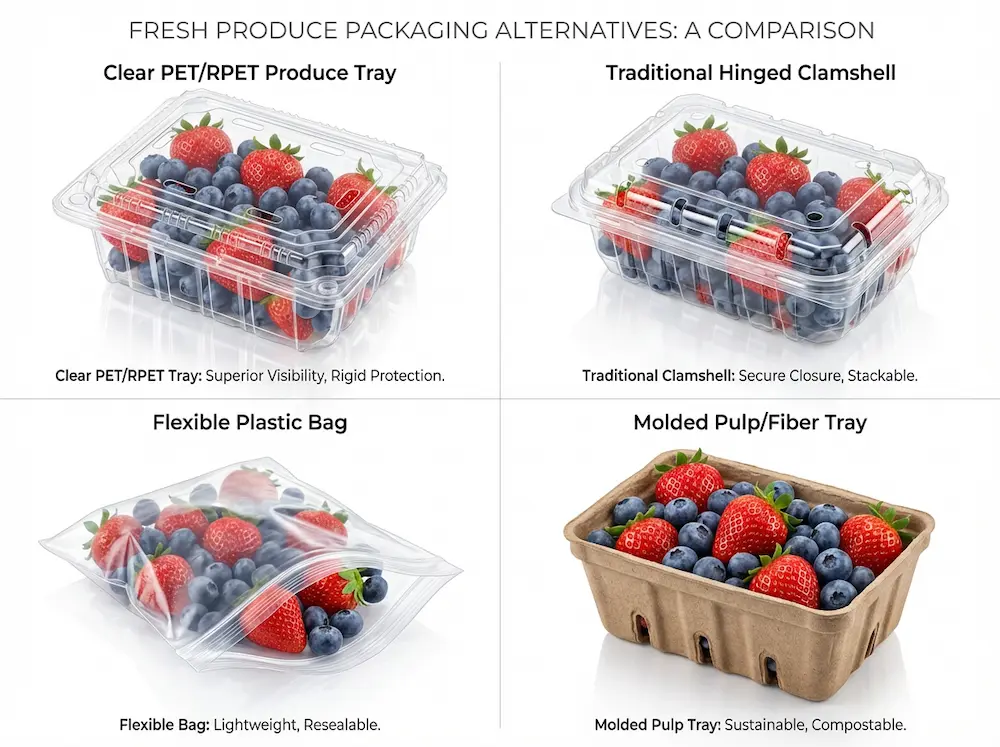
Berry packaging containers and produce clamshell containers overlap in many applications. In some markets, berry containers are designed as clamshells. In other cases, berry packs may have ventilation and structural details specifically intended for small fruit protection.
When Berry Containers Are the Better Choice
Dedicated berry containers are better when the fruit requires ventilation, gentle containment, and specific berry-focused structure. Blueberries, blackberries, raspberries, and small mixed berries often benefit from packaging designed around airflow, visibility, and pressure control.
For delicate berries, the container should reduce movement and avoid excessive compression. A dedicated berry pack can provide a better match than a general-purpose clamshell.
When Produce Clamshell Containers Work Better
Produce clamshell containers work well when buyers need an integrated hinged lid, fast packing, clear display, and secure retail handling. They are useful for strawberries, mixed fruit, salads, snacks, and some berry applications.
For strawberries, clamshells are often practical because the fruit is larger and needs more lid clearance. For mixed berries or retail grab-and-go packs, clamshell formats can also work well when the structure includes proper base support and ventilation.
Buyer Decision Logic for Different Berry Types
| Berry Type | Better Packaging Direction | Buyer Focus |
|---|---|---|
| Blueberries | Ventilated berry packaging containers | Visibility, containment, and stacking |
| Blackberries | Protective berry containers | Anti-crush support and limited pressure |
| Raspberries | Gentle low-pressure containers | Soft fruit protection and shallow packing |
| Strawberries | Produce clamshell containers | Space, lid clearance, and closure |
| Mixed berries | Clear PET berry containers or clamshells | Portion control and display |
| Berries with cut fruit | Fresh-cut fruit containers | Moisture control and secure closure |
The best packaging choice should be based on fruit sensitivity, pack weight, ventilation need, retail shelf layout, and transport route.
Berry Packaging Containers vs Produce Trays and Fresh-Cut Fruit Containers
Berries can be packaged in several formats, but not every format is suitable for every application. Buyers should understand the difference between berry containers, produce trays, and fresh-cut fruit containers.
Why Produce Trays Are Not Ideal for Loose Berries
Produce trays are strong for arranged display, sliced fruit, catering platters, deli-style food, and wide visual presentation. They are not usually the best choice for loose berries because loose berries can roll, shift, and experience uneven pressure.
Produce trays can work for arranged berry platters, dessert trays, or mixed fruit presentations. However, for retail packs of blueberries, blackberries, raspberries, or strawberries, dedicated berry packaging or clamshells usually provide better containment and handling stability.
When Fresh-Cut Fruit Containers Are Suitable
Fresh-cut fruit containers are suitable when berries are combined with cut fruit, yogurt, granola, salad, chilled desserts, or ready-to-eat portions. These containers usually provide stronger closure and better takeaway handling than open trays.
For example, a mixed pack of strawberries, grapes, melon, and blueberries may need a deeper clear PET container with secure closure. A small grab-and-go fruit bowl with berries may need portion control and lid stability more than ventilation.
How Buyers Should Choose by Product Sensitivity
Product sensitivity should guide packaging selection. Soft berries need low-pressure support. Loose berries need containment. Mixed fruit needs closure. Arranged fruit needs display surface. Takeaway food needs secure handling.
| Product Situation | Best Packaging Direction |
|---|---|
| Loose blueberries | Ventilated berry packaging containers |
| Loose raspberries | Shallow protective berry containers |
| Strawberries for retail | Produce clamshell containers |
| Mixed berries for grab-and-go | Clear PET berry containers |
| Fruit salad with berries | Fresh-cut fruit containers |
| Catering berry display | Produce trays with lid |
| Berry dessert portions | Clear PET containers with lid clearance |
This logic helps buyers avoid using one format for every product.
Manufacturer Checklist for Berry Packaging Containers
A reliable packaging manufacturer should understand the technical and practical requirements of berry packaging. Buyers should use the checklist below before confirming wholesale orders.
| Checklist Item | What Buyers Should Check | Why It Matters |
|---|---|---|
| Material clarity | PET/RPET transparency and surface appearance | Helps customers inspect berry quality |
| Ventilation | Hole pattern, airflow design, and vent placement | Supports berry handling and chilled display |
| Closure | Lid fit, lock strength, hinge performance | Reduces opening during transport and shelf handling |
| Stackability | Filled-pack stacking performance | Prevents crushing and shelf mess |
| Base rigidity | Bottom support under real berry weight | Protects soft fruit from pressure damage |
| Lid clearance | Space between berries and lid | Helps reduce compression |
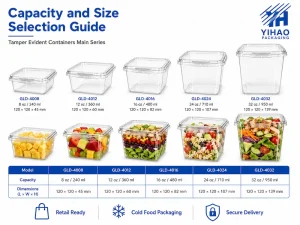
| Size range | Different capacities for berry types and retail programs | Supports blueberries, strawberries, raspberries, and mixed packs |
| Nesting efficiency | Empty container stacking and separation | Saves warehouse and packing line space |
| Label area | Barcode, brand label, and information placement | Keeps product visible while supporting retail needs |
| Sample testing | Testing with actual berries | Avoids packaging mismatch before bulk orders |
| Material documentation | PET/RPET options and food-contact information | Supports market-specific review |
| Carton fit | Inner carton arrangement and shipping stability | Improves wholesale distribution efficiency |
This table should be used as a practical evaluation tool. The best berry packaging containers should perform well across product display, fruit protection, packing efficiency, and supply stability.
Supplier Checklist for Wholesale Berry Packaging Containers
A packaging supplier should provide more than a catalog. For wholesale berry packaging, buyers need clear communication, sample support, structure comparison, material explanation, and repeat order reliability.
Does the Supplier Understand Berry Applications?
Not every packaging supplier understands berries. A supplier may offer clear containers, but that does not mean the structure is suitable for delicate fruit.
Buyers should ask whether the supplier has packaging options for blueberries, blackberries, raspberries, strawberries, mixed berries, and fresh-cut fruit combinations. The supplier should be able to explain differences in closure, ventilation, base support, and stacking.
Can the Supplier Provide Stable Wholesale Supply?
Wholesale buyers need consistent supply. A good supplier should support repeat orders, stable specifications, clear packing details, and reliable communication. For distributors and importers, this matters because packaging delays can affect fresh produce programs.
Buyers should review sample consistency, carton packing, lead-time communication, and product availability before committing to large orders.
Are PET/RPET Options Clearly Explained?
PET and RPET options should be explained clearly. PET is widely used for transparent food packaging because it supports clear visibility and practical rigidity. RPET may support recycled-content packaging strategies when confirmed by proper documentation and target-market requirements.
For buyers selling into the European Union, recycled plastic food-contact materials should be reviewed according to Regulation (EU) 2022/1616, which covers recycled plastic materials and articles intended to come into contact with food. Buyers should confirm compliance documentation with their supplier before making market-specific claims.
A responsible manufacturer or supplier should avoid vague claims and provide accurate material information for buyer review.
Can the Supplier Support Different Berry Packaging Formats?
Different berry programs need different formats. A supplier should be able to discuss blueberry containers, strawberry clamshells, mixed berry packs, ventilated berry containers, clear PET hinged containers, and related fresh produce packaging containers.
A one-format recommendation is often too limited. Good supplier support should be application-based.
Does the Supplier Help with Sample Confirmation?
Sample confirmation is essential for berry packaging. Buyers should test containers with actual berries, labels, cartons, cold shelf conditions, and handling procedures.
The supplier should help buyers review samples before wholesale purchasing. This reduces risk and helps avoid packaging mismatch.
Clear PET Produce Packaging for Berry Retail Display
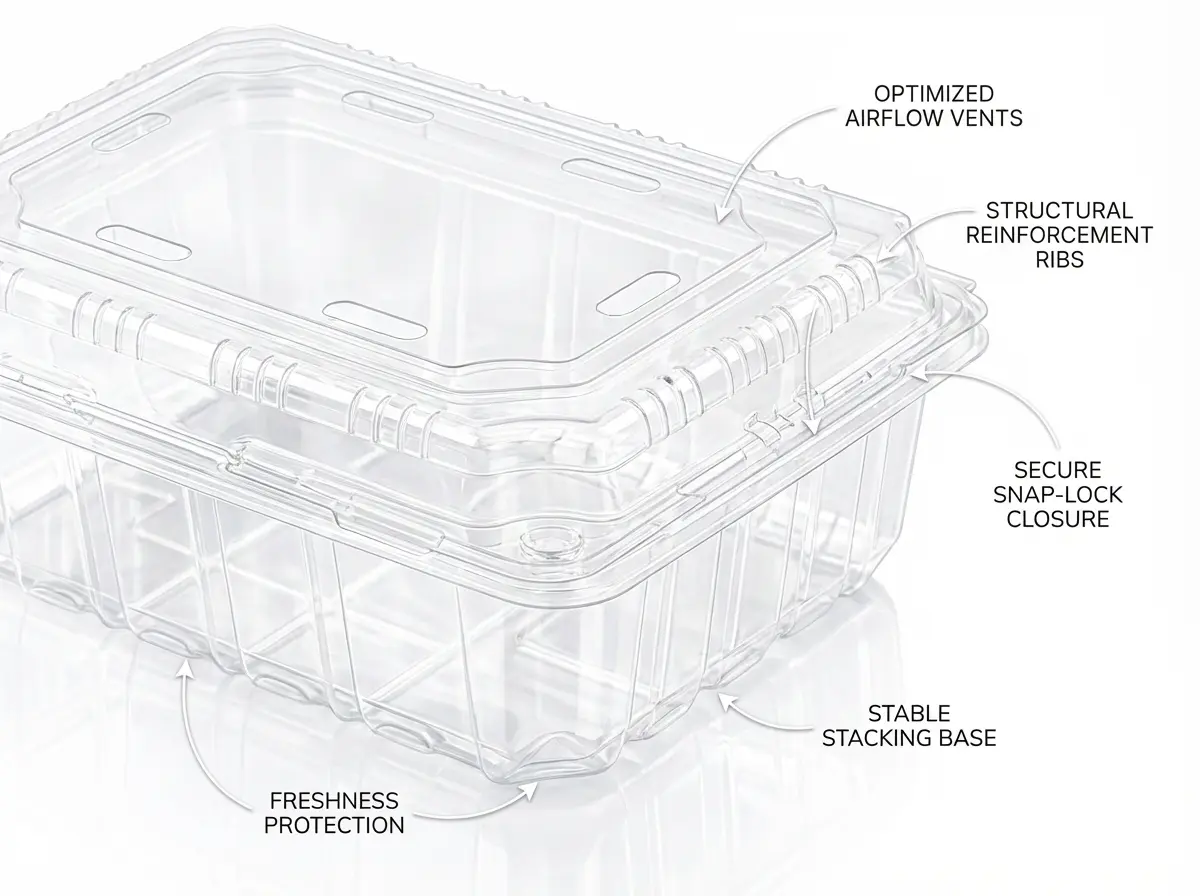
Clear PET produce packaging is widely used for berries because visibility is critical. Berries are purchased visually. Customers look at color, size, surface condition, and overall freshness before buying.
Why Visibility Matters for Berries
Berries are visually powerful products. Blueberries, raspberries, blackberries, and strawberries all rely on color and shape to communicate freshness. Packaging should not hide these qualities.
Clear packaging helps customers inspect the product without opening the container. It also helps retailers build trust in chilled displays.
Clear PET Packaging Supports Shelf Appeal
PET packaging supports high clarity and a clean retail look. For berry packaging containers, this allows the fruit to remain the main focus. Clear lids and sidewalls help customers see the product from multiple angles.
For supermarkets, convenience stores, and fruit retailers, strong product visibility can improve shelf appearance and customer confidence.
How Label Placement Affects Product Visibility
Labels are necessary for barcodes, branding, product names, country of origin, nutrition information, and retail pricing. However, labels should not block too much of the berries.
For clear PET berry packaging, label placement should protect visibility. Buyers should test label size, placement, adhesive choice, and scan position before final approval.
Packaging recyclability can be affected by labels, adhesives, colors, additives, and material combinations. The Association of Plastic Recyclers provides design guidance for evaluating plastic packaging compatibility with recycling systems, so buyers should consider packaging structure and label design together.
Application Matrix for Berry Packaging Containers
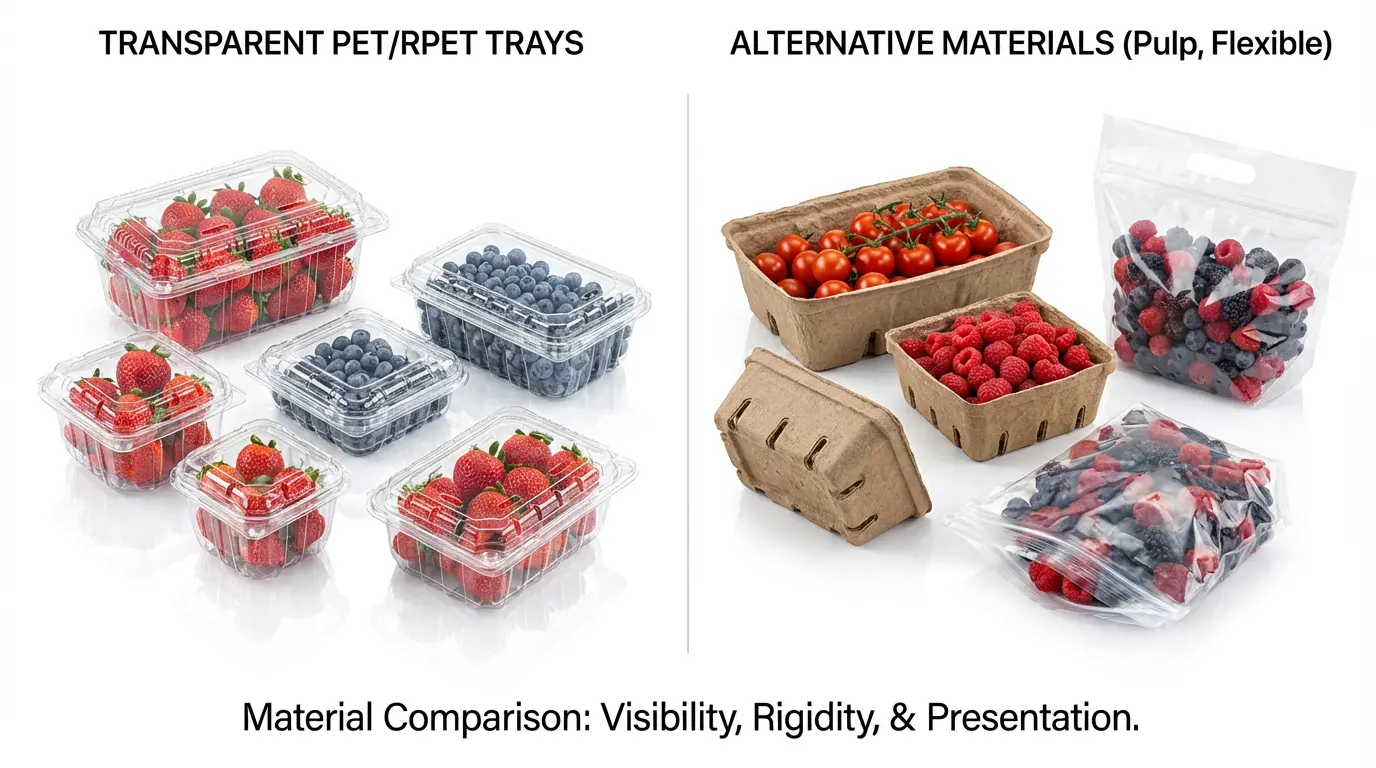
| Berry Type / Application | Recommended Packaging Direction | Buyer Focus |
|---|---|---|
| Blueberries | Ventilated berry packaging containers | Visibility, containment, and stacking |
| Blackberries | Shallow protective berry containers | Anti-crush support and limited pressure |
| Raspberries | Gentle low-pressure containers | Soft fruit protection |
| Strawberries | Produce clamshell containers | Space, visibility, and closure |
| Mixed berries | Clear PET berry containers | Portion control and retail display |
| Fresh-cut fruit with berries | Fresh-cut fruit containers | Moisture management and closure |
| Catering berry trays | Produce trays with lid | Arranged display |
| Berry dessert portions | Clear PET containers | Lid clearance and product visibility |
| Retail grab-and-go berries | Clear PET clamshell containers | Fast handling and shelf appeal |
| Wholesale berry distribution | Stackable berry packaging containers | Carton stability and fruit protection |
This matrix helps buyers choose packaging by application rather than by product name alone. Berry packaging containers should be selected according to berry type, handling route, display needs, and wholesale supply requirements.
Common Mistakes When Buying Berry Packaging Containers Wholesale
Wholesale berry packaging mistakes often happen because buyers review packaging too quickly or focus only on price. For delicate fruit, small packaging mistakes can create large product problems.
Choosing Only by Lowest Price
Low unit price is attractive, but it should not be the only decision factor. If a package causes damaged berries, messy shelves, loose lids, or poor customer experience, the hidden cost becomes higher.
Buyers should compare total value, including product protection, shelf appearance, stacking performance, transport stability, and supplier reliability.
Testing Empty Samples Instead of Filled Samples
Empty samples do not show true packaging performance. A container may look strong when empty but deform when filled and stacked. Berries change the way packaging behaves because they add weight, moisture, and pressure.
Buyers should fill samples with real berries and test them through handling, stacking, chilling, and labeling.
Ignoring Ventilation and Cold Shelf Conditions
Ventilation and cold shelf conditions affect berry packaging performance. Buyers should not evaluate berry packaging only by appearance. Vent design, airflow, carton loading, and retail cooling conditions should be part of the review.
Using One Packaging Format for Every Berry Type
Blueberries, blackberries, raspberries, and strawberries do not need exactly the same packaging. Using one format for every berry type may create unnecessary damage or poor display performance.
A professional buyer should match packaging structure with fruit sensitivity.
Overlooking Label Position and Branding Area
A label that blocks too much product visibility can reduce retail appeal. A label that does not scan well can slow store operations. A label that uses unsuitable materials can affect packaging design considerations.
Packaging and labeling should be tested together.
Packaging and Food Waste: Why Berry Protection Matters
Fresh produce waste remains a major issue across retail, foodservice, and consumer handling. The UNEP Food Waste Index Report 2024 highlights food waste as a global challenge and shows why prevention across packaging, distribution, retail display, and consumer handling remains important.
For berry buyers, packaging cannot solve every waste problem, but it can reduce avoidable damage. Weak packaging can increase bruising. Poor closure can cause spills. Bad stacking can crush fruit. Cloudy packaging can reduce customer confidence and slow product movement.
A better-matched berry container protects product value from packing line to retail shelf. This is why wholesale buyers should evaluate packaging as part of product protection, not only as a cost item.
Sustainability and Responsible Packaging Choices
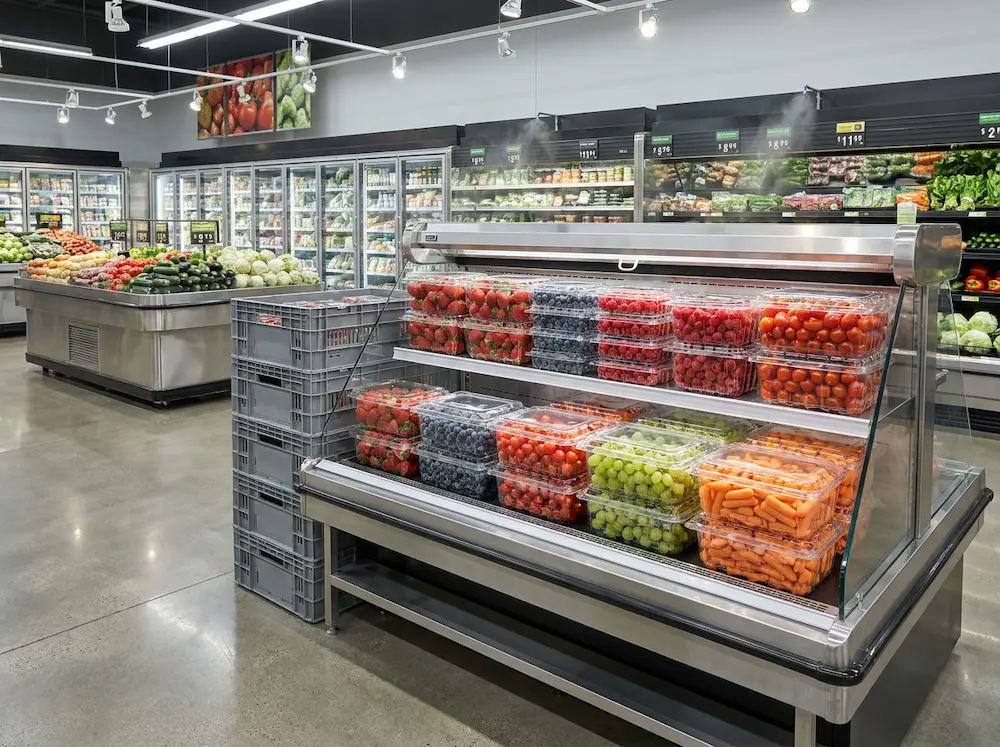
Sustainability is an important part of fresh produce packaging, but claims must be accurate. Buyers should focus on material efficiency, responsible design, recycled-content options where suitable, food-contact requirements, and local recycling expectations.
PET and RPET can both be relevant for clear PET produce packaging programs. PET supports clarity and practical forming performance. RPET may support recycled material goals when suitable for the target application and market.
However, buyers should avoid unsupported claims. Food-contact suitability, recycled content, recyclability, and market compliance should be confirmed with supplier documentation and local requirements.
For berry packaging containers, a responsible packaging approach should reduce unnecessary material while still protecting the fruit. If under-designed packaging causes berries to be damaged or wasted, the total impact may become worse.
Why Choose YIHAO as Your Berry Packaging Containers Manufacturer and Supplier?
Choosing the right packaging partner is as important as choosing the right container. A reliable partner should help buyers compare structures, confirm samples, and select packaging based on actual berry applications.
YIHAO provides food packaging solutions for berries, fresh fruit, salads, snacks, bakery items, deli food, and chilled ready-to-eat meals. For buyers sourcing berry packaging containers, fresh produce packaging containers, produce clamshell containers, fresh-cut fruit containers, or clear PET produce packaging, YIHAO focuses on practical structure, clean appearance, and application-based packaging selection.
Food Packaging Solutions for Berries, Fruit, Salads, and Chilled Food
Berry packaging often connects with wider fresh food packaging needs. A buyer may need blueberry containers, strawberry clamshells, mixed berry packs, fruit salad containers, and chilled dessert packaging within one product range.
YIHAO supports packaging solutions for these connected applications. This helps buyers build a more consistent packaging program across retail display, takeaway, and wholesale distribution.
Wholesale Supply Support for Fresh Produce Packaging Buyers
Wholesale buyers need repeatable quality and stable supply. Food brands, distributors, supermarkets, and importers need packaging that supports daily packing operations and regular purchasing cycles.
A strong packaging supplier should support clear specifications, sample confirmation, carton details, and practical communication.
Application-Based Packaging Selection for Different Berry Types
The best packaging recommendation should start with the berry type. Blueberries need containment and stacking. Raspberries need gentle protection. Blackberries need anti-crush support. Strawberries need space and lid clearance. Mixed berries need portion control and clean display.
YIHAO helps buyers compare packaging formats according to product behavior, not generic packaging names.
Final Buyer Checklist Before Ordering Berry Packaging Containers
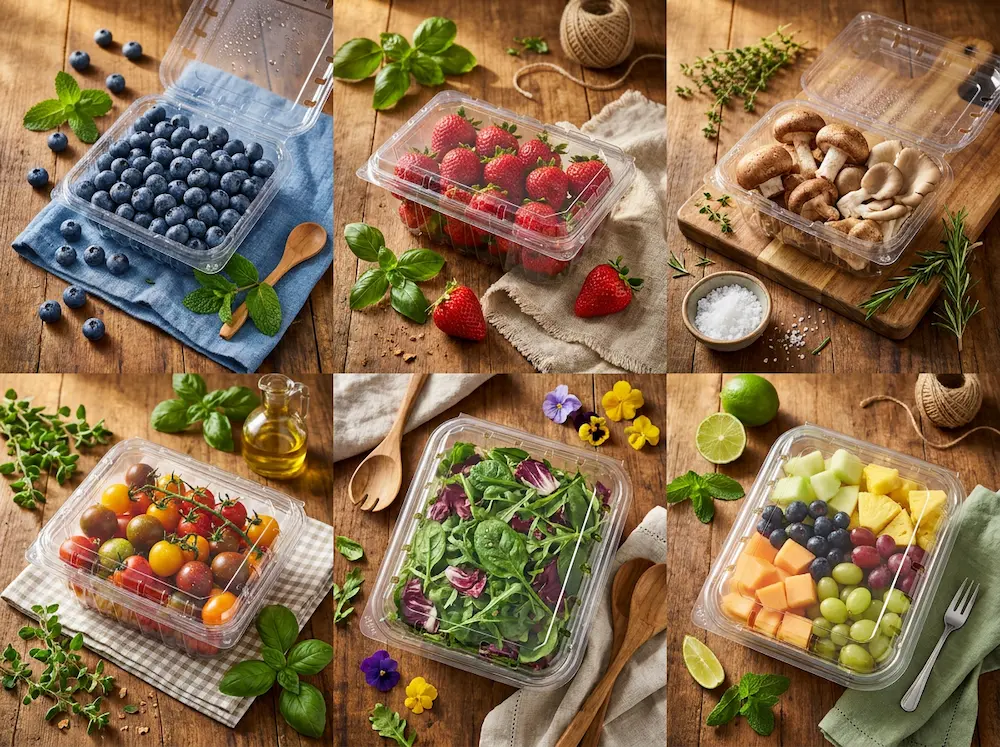
Before confirming a wholesale order, buyers should review the following checklist:
| Final Check | Buyer Question |
|---|---|
| Berry type | Is the package for blueberries, blackberries, raspberries, strawberries, or mixed berries? |
| Product sensitivity | Does the fruit need extra anti-crush protection? |
| Ventilation | Does the container support airflow for the intended use? |
| Closure | Does the lid stay secure during transport and shelf handling? |
| Stackability | Can filled packs stack safely in cartons and retail coolers? |
| Base support | Does the base protect soft berries from pressure damage? |
| Lid clearance | Is there enough space to avoid fruit compression? |
| Material | Is PET/RPET suitable for the target market and application? |
| Visibility | Does the package show berry color and quality clearly? |
| Labeling | Can labels be applied without blocking product visibility? |
| Sample testing | Has the package been tested with real berries? |
| Supplier support | Can the manufacturer provide samples and application guidance? |
The best berry packaging containers protect delicate fruit, support retail display, and help buyers reduce packaging risk before wholesale purchasing.
Conclusion
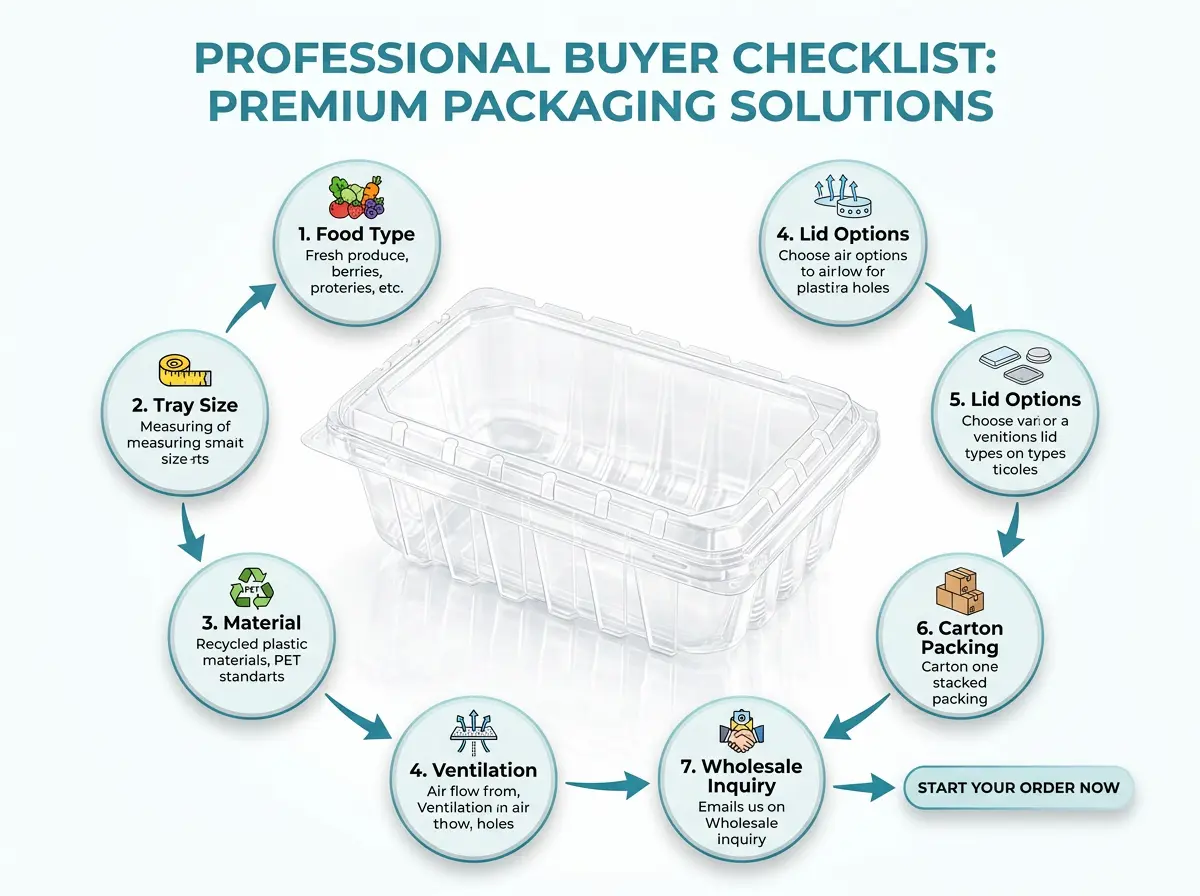
Berry packaging containers require a more careful buying checklist than general fresh produce packaging. Berries are delicate, colorful, moisture-sensitive, and easy to damage under pressure. Good packaging should balance visibility, ventilation, closure, stackability, base support, label placement, and wholesale supply reliability.
For blueberries, buyers should focus on visibility and stacking. For blackberries and raspberries, anti-crush support and gentle containment matter more. For strawberries, produce clamshell containers often provide useful space, closure, and retail display. For mixed berries and fruit combinations, fresh-cut fruit containers or clear hinged PET formats may provide better closure and portion control.
For berry farms, supermarkets, distributors, foodservice buyers, and packaging importers sourcing berry packaging containers wholesale, YIHAO provides practical PET/RPET packaging options for blueberries, raspberries, blackberries, strawberries, mixed berries, fresh-cut fruit, and chilled ready-to-eat applications. Contact YIHAO to compare clear PET/RPET clamshell structures, ventilation options, anti-crush packaging designs, sample choices, and supplier-ready wholesale packaging solutions for your market.
FAQ
1. What are berry packaging containers used for?
Berry packaging containers are used for blueberries, blackberries, raspberries, strawberries, mixed berries, fresh-cut fruit combinations, retail grab-and-go packs, and chilled produce display. They help protect delicate fruit while keeping berry color, size, and quality visible to customers.
2. What is the best packaging for blueberries?
The best packaging for blueberries usually provides clear visibility, ventilation, secure closure, and stable stacking. Ventilated clear PET berry packaging containers are commonly used because they help customers inspect the product while supporting retail handling and wholesale distribution.
3. Are produce clamshell containers suitable for berries?
Yes. Produce clamshell containers are suitable for many berry applications, especially strawberries, mixed berries, and retail grab-and-go packs. Buyers should check hinge strength, lid fit, ventilation, base support, and filled-pack stacking before confirming wholesale orders.
4. Why do berry packaging containers need ventilation?
Berry packaging containers often need ventilation to support airflow during handling, transport, and chilled display. Ventilation design should be matched with berry type, package structure, and retail conditions. Buyers should test vented packaging with actual berries before bulk purchasing.
5. How do I choose a wholesale berry packaging containers supplier?
Choose a wholesale supplier or manufacturer that understands different berry types, PET/RPET material options, ventilation design, closure strength, base support, stacking performance, labeling, and sample testing. A reliable supplier should help buyers evaluate packaging with real products before large-volume orders.
References
- U.S. Food and Drug Administration, Guide to Minimize Microbial Food Safety Hazards of Fresh-Cut Fruits and Vegetables.
- U.S. Food and Drug Administration, Guide to Minimize Microbial Hazards for Fresh Fruits and Vegetables.
- European Commission, Commission Regulation (EU) 2022/1616 on recycled plastic materials and articles intended to come into contact with foods.
- Association of Plastic Recyclers, APR Design Guide for Plastics Recyclability.
- United Nations Environment Programme, Food Waste Index Report 2024.
- Food and Agriculture Organization of the United Nations, Food Loss and Waste Resources.
- International Fresh Produce Association, Fresh Produce Handling and Packaging Resources.
- WRAP, Food Waste Reduction and Packaging Resource Efficiency Publications.
Deep-Dive Insights: How Buyers Should Think About Berry Packaging Containers
How do berry packaging containers protect delicate fruit?
Berry packaging containers protect delicate fruit by combining clear visibility, gentle containment, ventilation, base support, and secure closure. For blueberries, blackberries, raspberries, and strawberries, the package should reduce movement, avoid excessive pressure, and support stable stacking during wholesale distribution and retail display.
Why should buyers not use one packaging format for every berry type?
Different berries have different sensitivity levels. Blueberries need containment and stacking stability. Raspberries need low-pressure protection. Blackberries need anti-crush support. Strawberries need more space and lid clearance. A single packaging format may not protect every berry type equally well.
What should wholesale buyers compare before ordering?
Wholesale buyers should compare berry packaging containers, produce clamshell containers, fresh-cut fruit containers, produce trays, and clear PET produce packaging based on berry type, ventilation, closure strength, base rigidity, stackability, label placement, material options, and supplier reliability.
Which packaging option works best for retail berry display?
Clear PET berry packaging containers and produce clamshell containers are strong options for retail berry display because they show berry color and quality while supporting handling and shelf organization. Produce trays are better for arranged berry platters, not loose retail berry packs.
Why does supplier selection matter for berry packaging?
A reliable manufacturer or supplier helps buyers avoid packaging mismatch by connecting PET/RPET material options, ventilation design, closure structure, base support, sample testing, and wholesale supply stability with real berry applications.
© 2026 YIHAO packaging. Original content published on2026 and last updated on 2026. All information is provided for professional food packaging reference and may be updated as product lines and market requirements evolve.