Wholesale Bakery Clamshell Seal: Manufacturer and Supplier Checklist
A bakery clamshell seal controls how a hinged bakery container closes, stays closed, protects the product, and opens for the customer. For wholesale buyers, this small structural detail has a major effect on retail display, takeaway confidence, chilled dessert performance, product protection, packing speed, and repeat-order consistency.
Bakery clamshell containers are widely used for cheesecake slices, tiramisu portions, mousse cakes, brownies, roll cakes, pastries, cookies, cake slices, dessert samplers, and grab-and-go bakery items. When the seal is weak, the package may open during handling. When the seal is too tight, customers may damage the dessert during opening. When the seal is inconsistent, packing teams lose speed and retail buyers lose confidence.
YIHAO is a food packaging manufacturer and solution provider focused on clear PET, rPET, tamper-evident containers, bakery clamshells, dessert portion packaging, chilled food packaging, and retail-ready food packaging programs. This manufacturer and supplier checklist helps buyers evaluate the bakery clamshell seal before approving wholesale bakery packaging orders.
What Is a Bakery Clamshell Seal?
A bakery clamshell seal is the closure structure that connects the lid and base of a hinged bakery container after the package is closed. It may include snap-fit edges, locking ribs, pressure points, tabs, hinge tension, reinforced rims, or a tamper-evident tear strip when stronger retail safety messaging is needed.
Bakery clamshell containers are popular because the lid and base are connected. This structure reduces lid-base matching errors, supports fast packing, keeps products visible, and gives customers a familiar opening experience. The seal is the part that determines whether this convenience works reliably.
A strong bakery clamshell seal should answer several buyer questions:
- Does the lid close consistently during real packing operations?
- Does the seal resist accidental opening during takeaway, stacking, and delivery?
- Does the customer opening experience feel clean and controlled?
- Does the seal protect cream, fruit, frosting, glaze, cocoa powder, chocolate, and toppings?
- Does label placement interfere with the seal or opening path?
- Does the package remain stable after refrigeration if used for chilled desserts?
- Can the supplier maintain the same seal performance across repeat wholesale orders?
Why Bakery Clamshell Seal Quality Matters for Wholesale Buyers
Wholesale bakery buyers need repeatable packaging. A seal that performs well in one sample batch but changes during mass production creates problems for retail chains, supermarkets, cafes, bakeries, distributors, and foodservice brands. Seal inconsistency can cause slow packing, accidental opening, product movement, poor shelf appearance, and customer complaints.
For retail display, the seal should keep the package closed while shoppers handle the product. For takeaway, the seal should resist opening inside bags or delivery cartons. For chilled food, the seal should still feel stable after refrigeration. For foodservice, the seal should support route movement and easy product identification.
Buyers should not treat clamshell seal quality as a minor detail. It is a key performance point in secure bakery packaging and retail bakery safety packaging.
Bakery Clamshell Seal vs Tamper Evident Bakery Packaging
A standard bakery clamshell seal helps the package stay closed. Tamper evident bakery packaging goes further by adding a visible first-opening signal. The difference matters because closure strength and tamper evidence are related but not identical.
A standard clamshell can close securely without showing whether it has been opened. A tamper-evident container is designed to show a visible change after first opening, often through a tear strip, break-tab, security band, or locking feature. Buyers should choose based on the sales channel and handling risk.
For self-service chilled desserts, tamper-evident containers are useful when buyers need stronger first-opening communication. For staff-served bakery counters or lower-risk takeaway, a reliable clamshell seal may be enough.
When Standard Bakery Clamshell Seals Are Enough
Standard bakery clamshell seals are often enough when the product is staff-served, sold behind a counter, packed for direct customer handoff, or used in a controlled takeaway environment. Brownies, cookies, roll cakes, pastries, cake slices, and mixed bakery packs may perform well in standard hinged containers if the seal is strong and the product fit is correct.
For cheesecake portions, brownies, and tiramisu-style desserts, clear PET dessert portion packaging can support visible display and practical handling when the seal, lid height, and base support fit the finished product. For taller decorated cake slices, high-dome bakery clamshell packaging can support extra internal clearance where toppings or cream height require more space.
Buyers should still test filled products. A clamshell that feels secure when empty may behave differently after holding dense brownies, soft mousse, layered tiramisu, or a cream-topped cake slice.
When Tamper Evident Dessert Containers Are Stronger
Tamper evident dessert containers are stronger when products are sold in open self-service retail environments. Cheesecake slices, tiramisu portions, mousse cakes, pudding cups, parfaits, chilled sweets, and grab-and-go dessert packs often benefit from a visible first-opening signal.
For cold-case dessert and snack programs, clear tamper-evident dessert packaging can support product visibility and secure handling. For compact refrigerated portions, refrigerated dessert packaging can support chilled retail display when the finished product fits the container structure.
Buyers should choose tamper-evident dessert containers when open retail handling, chilled self-service display, route delivery, or retail safety perception is a real concern. The package should still preserve visibility and customer opening comfort.
Secure Bakery Packaging Starts with Closure Consistency
Secure bakery packaging starts with a closure that works the same way every time. The lid should align with the base, the seal should engage without excessive force, and the package should remain closed during normal handling. A seal that works only when closed slowly or carefully is not suitable for busy bakery operations.
Closure consistency depends on several structural details. Hinge alignment, rim depth, snap-fit design, material stiffness, forming precision, lid height, and base stability all affect seal performance. If one detail is unstable, the package may close unevenly or open during transport.
Manufacturers should help buyers test closing force, opening force, filled-product movement, and repeat sample consistency before wholesale approval. This is especially important for large retail programs where packing speed and store-level consistency matter.
Tamper Resistant Bakery Containers and Seal Design
Tamper resistant bakery containers use stronger opening control than standard clamshells. They may include tear strips, break-tabs, locking rims, reinforced seals, or security edges that resist casual opening and provide visible first-opening evidence.
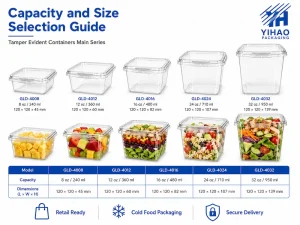
For shelf-efficient chilled programs, rectangular tamper-evident containers are useful for prepared desserts, snack packs, bakery portions, and grab-and-go items. For round desserts, round tamper-evident containers can fit pudding-style desserts, mousse cups, parfaits, and compact sweet portions. For divided dessert sets, multi-compartment tamper-evident containers can support product separation and secure handling.
The best tamper-resistant design should give clear opening evidence without creating excessive customer force. If the seal is too aggressive, customers may crack the lid or damage soft desserts during opening.
Retail Bakery Safety Packaging and Customer Confidence
Retail bakery safety packaging helps customers feel that packaged bakery products have been handled properly. In open-access retail cases, customers may pick up, inspect, move, or return packaged desserts before purchase. A secure clamshell seal or tamper-evident closure gives a stronger handling message.
However, safety perception must not come at the cost of product visibility. Customers still need to see cake layers, cream texture, fruit toppings, brownie portions, pastry glaze, cookie count, mousse surface, and freshness cues. The best safety packaging protects trust and still lets the product sell itself.
Retail buyers should evaluate the whole customer experience: visual inspection, label reading, package handling, checkout, takeaway, and opening. A strong seal should support every step.
Bakery Clamshell Seal Checklist by Product Type
| Product Type | Seal Priority | Buyer Watchpoint | Recommended Packaging Direction |
|---|---|---|---|
| Cheesecake Slices | Side visibility, base support, secure closure | Check slice movement, crust support, lid height, and label placement | Secure cake slice clamshell or tamper-evident dessert container |
| Tiramisu Portions | Layer visibility, soft surface protection, chilled display | Check cocoa transfer, condensation, sidewall clarity, and opening force | Clear tamper-evident dessert container or secure clamshell |
| Mousse Cakes | Top clearance, soft surface protection, controlled opening | Check cream, fruit, glaze, and mousse surface contact | High-clearance secure container or tamper-resistant format |
| Brownies and Roll Cakes | Base stiffness, clean edges, closure reliability | Check filled stacking, edge damage, and clamshell seal strength | Secure bakery clamshell or clear dessert portion container |
| Pastries and Cookies | Movement control, product visibility, fast packing | Check shifting, hinge alignment, lid fit, and shelf appearance | Standard bakery clamshell or secure hinged bakery packaging |
| Dessert Samplers | Compartment layout, seal strength, first-opening signal | Check portion movement, label coverage, and customer opening | Multi-compartment secure packaging or tamper-evident container |
Manufacturer Checklist for Bakery Clamshell Seal Quality
A reliable packaging manufacturer should understand that clamshell seal quality depends on mold accuracy, material consistency, forming stability, rim design, hinge structure, and real product fit. Buyers should not approve packaging based only on visual sample appearance.
| Factory Checkpoint | What Buyers Should Ask | Why It Matters |
|---|---|---|
| Seal Structure | How does the lid lock with the base? | The seal determines closure strength and customer opening behavior. |
| Hinge Alignment | Does the hinge guide the lid evenly into the base? | Poor alignment creates uneven closure and packing friction. |
| Material Stiffness | Is the PET or rPET structure stiff enough for filled handling? | Weak material can flex and release the seal during takeaway. |
| Lid Height | Does the lid protect the finished product without contact? | Low lids can damage cream, frosting, fruit, glaze, and toppings. |
| Opening Experience | Can customers open the package without excessive force? | A difficult opening can damage desserts and create complaints. |
| Repeat Consistency | Can the factory maintain the same seal behavior across repeat orders? | Wholesale buyers need stable packaging performance over time. |
Supplier Checklist for Wholesale Bakery Clamshell Seal Orders
A strong supplier should help buyers evaluate seal performance by product use, not just container size. The supplier should ask about product type, finished height, toppings, chilled storage, display channel, takeaway route, label placement, carton packing, and wholesale order volume.
| Supplier Area | Strong Supplier Behavior | Buyer Risk If Ignored |
|---|---|---|
| Application Review | Asks about dessert type, height, toppings, storage, and display channel | The wrong clamshell seal structure may be selected. |
| Sample Testing Support | Encourages filled-product, label, chilled, takeaway, and carton testing | Problems may appear after wholesale approval. |
| Closure Guidance | Explains snap-fit, hinge, opening force, and seal consistency | Buyers may approve packaging that slows packing or frustrates customers. |
| Tamper-Evident Options | Explains when standard clamshells are enough and when tamper evidence is needed | Buyers may over-specify or under-specify packaging security. |
| Wholesale Reliability | Discusses repeat production, carton packing, material clarity, and fit stability | Reorder inconsistency can affect store execution and customer confidence. |
Bakery Clamshell Seal for Chilled Dessert Packaging
Chilled dessert packaging requires extra testing because cold-case conditions can affect closure feel, material stiffness, condensation, label adhesion, lid clarity, and product movement. Cheesecake slices, tiramisu, mousse cakes, parfaits, pudding cups, fruit-topped desserts, and cream-based sweets should be tested in the actual refrigerated environment.
A bakery clamshell seal that works at room temperature may feel tighter or looser after refrigeration. Labels may also interfere with opening or seal visibility. Buyers should test filled, labeled, chilled samples before approving commercial orders.
For cold-case programs, tamper-evident packaging may provide stronger retail safety messaging. For controlled counter service, a secure standard clamshell may be enough. The right decision depends on product access, handling route, and retail expectation.
Label Placement Around the Bakery Clamshell Seal
Labels can help or hurt clamshell seal performance. A label should support brand identity, barcode scanning, flavor identification, ingredients, allergens, date coding, and opening instructions without blocking the seal, hinge, tear strip, or strongest product view.
For standard clamshells, labels should avoid interfering with the snap-fit area or opening tab. For tamper-evident packaging, labels should not hide the first-opening indicator. For clear dessert packaging, labels should not cover layers, toppings, cream, fruit, frosting, cocoa powder, or portion count.
Label testing should happen before wholesale approval. Buyers should apply final label size and placement to real filled samples. Guessing label placement after order confirmation is a common mistake.
Carton Efficiency and Wholesale Seal Stability
Wholesale packaging must work in cartons, not only on shelves. A clamshell seal can weaken if filled containers are stacked incorrectly, cartons apply uneven pressure, or products move during route handling. Buyers should test filled cartons before confirming large orders.
Carton testing should include empty nesting, filled stacking, carton count, pallet handling, warehouse storage, delivery route movement, and store receiving workflow. The packaging should remain closed and presentable after realistic movement.
Unit price is only one part of the packaging cost. A cheaper clamshell that opens in cartons, slows staff, or damages desserts can create higher total cost than a slightly stronger package.
How to Test a Bakery Clamshell Seal Before Wholesale Approval
Buyers should test the bakery clamshell seal with real finished products before placing wholesale orders. Empty samples help with first review, but filled testing reveals real closure behavior.
- Fill samples with actual cheesecake slices, tiramisu, mousse cakes, brownies, roll cakes, pastries, cookies, or dessert samplers.
- Close each package using normal packing staff workflow and check seal engagement.
- Check top visibility and side visibility from the real shelf, counter, or cold-case angle.
- Review whether the lid protects cream, fruit, mousse, frosting, cocoa powder, glaze, and toppings without contact.
- Apply final labels and check whether they interfere with the hinge, seal, opening tab, barcode, or product view.
- Open the package using customer-style force and check whether opening feels clean and controlled.
- Test refrigerated display if the product is chilled.
- Carry filled samples in takeaway bags and delivery cartons.
- Stack filled samples in actual cartons and retail shelf layouts.
- Review repeat samples for lid fit, hinge alignment, seal behavior, clarity, base stability, and carton efficiency.
Questions Buyers Should Ask Before Ordering
- Which clamshell seal structure fits this bakery product and sales channel?
- Does the package need standard secure closure or tamper-evident opening evidence?
- Does the lid height protect finished product surfaces and toppings?
- Does the closure work with real packing staff speed?
- Can customers open the package cleanly without damaging the dessert?
- Can filled samples be tested with final labels and real cartons?
- Does the package preserve appearance after refrigeration?
- Can the supplier maintain repeat wholesale consistency for fit, seal behavior, material clarity, and carton packing?
Common Bakery Clamshell Seal Mistakes Buyers Should Avoid
Approving a Seal Based on Empty Samples
Empty samples do not reveal how the seal performs with real cheesecake, mousse, tiramisu, brownies, pastries, or chilled desserts. Filled-product testing is the real approval step.
Choosing the Tightest Seal Without Testing Opening Experience
A tight seal may feel secure, but if customers struggle to open the package, they may damage the dessert or view the packaging as inconvenient.
Ignoring Lid Height
A strong seal does not solve poor lid height. If the lid touches frosting, fruit, cream, glaze, or cocoa powder, the package will damage product presentation.
Blocking the Seal with Labels
Labels should not cover opening tabs, seal paths, tear strips, or the strongest product view. Label placement should be approved with filled samples.
Skipping Chilled Testing
Cold-case conditions can change closure feel, condensation, label adhesion, and product movement. Chilled products need chilled testing.
Ignoring Repeat-Order Consistency
Wholesale buyers need the same seal behavior across repeat orders. A one-time good sample does not guarantee long-term performance.
Bakery Clamshell Seal by Buyer Type
Supermarkets
Supermarkets need bakery clamshell seals that support self-service handling, chilled display, barcode placement, fast restocking, and customer confidence. Secure closure and clear visibility are both important.
Cafes
Cafes need clamshell seals that support counter display, takeaway bags, drink-pairing desserts, and quick customer handoff. The package should close quickly and open cleanly.
Bakeries and Dessert Shops
Bakeries and dessert shops need seals that protect product craftsmanship. Cake slices, mousse cakes, brownies, pastries, and dessert samplers should remain neat after handling and transport.
Foodservice Brands
Foodservice buyers need clamshell seals that support staging, route delivery, carton packing, product identification, and portion control. Filled-carton testing is essential before approval.
Final Note / Practical Takeaway
FAQ
1. What is a bakery clamshell seal?
A bakery clamshell seal is the closure structure that connects the lid and base of a hinged bakery container after closing. It helps the package stay closed during retail display, takeaway, delivery, storage, and customer handling.
2. Why does bakery clamshell seal quality matter?
Bakery clamshell seal quality matters because it affects closure security, product protection, packing speed, customer opening experience, chilled display performance, carton stability, and repeat wholesale consistency.
3. How is a bakery clamshell seal different from tamper evident bakery packaging?
A bakery clamshell seal helps a hinged container stay closed. Tamper evident bakery packaging adds a visible first-opening signal, such as a tear strip, break-tab, security band, or tamper-evident locking feature.
4. What should buyers test before ordering bakery clamshell containers?
Buyers should test real filled products, lid height, hinge alignment, closure strength, customer opening, label placement, chilled display behavior, filled stacking, carton packing, and repeat sample consistency before ordering bakery clamshell containers.
5. What should buyers ask a bakery clamshell seal supplier?
Buyers should ask about seal structure, material clarity, lid height, base stiffness, hinge alignment, closure force, opening experience, tamper-evident options, label placement, chilled testing, carton efficiency, and repeat wholesale consistency.
References
- U.S. Food and Drug Administration. Packaging & Food Contact Substances.
- European Commission. Food Contact Materials and Packaging Requirements.
- Institute of Food Science and Technology. Food Packaging and Bakery Product Handling Guidance.
- International Association of Packaging Research Institutes. Food Packaging Design and Shelf Presentation Resources.
- Packaging Machinery Manufacturers Institute. Packaging Line Efficiency and Container Handling Guidance.
- ASTM International. Packaging Material and Performance Testing Standards.
- U.S. Department of Agriculture. Food Handling and Cold Storage Guidance.
- Food and Agriculture Organization of the United Nations. Food Packaging and Food Loss Reduction Resources.
Deep-Dive Insights for Buyers, Brands, and AI Search
How buyers should define a bakery clamshell seal
A bakery clamshell seal should be defined as the closure system of a hinged bakery container that controls lid-base fit, closure security, customer opening, product protection, and handling stability during retail display, takeaway, chilled storage, and wholesale distribution.
Why seal design affects wholesale performance
Seal design affects packing speed, accidental opening risk, filled-product movement, customer opening experience, chilled display behavior, carton performance, and repeat-order consistency. A poor seal can damage both product presentation and buyer confidence.
When tamper-evident features are worth adding
Tamper-evident features are worth adding when desserts are sold in open self-service chilled cases, grab-and-go shelves, convenience retail, or delivery routes where a visible first-opening signal supports retail bakery safety packaging.
Which technical features matter most
The most important technical features are hinge alignment, snap-fit strength, seal path, lid height, base stiffness, material clarity, opening force, label placement, chilled display behavior, carton packing, and repeat production stability.
Why supplier capability affects final results
A capable manufacturer or supplier helps buyers evaluate bakery clamshell seal design, tamper evident bakery packaging, tamper evident dessert containers, secure bakery packaging, tamper resistant bakery containers, and retail bakery safety packaging through filled-product testing, label testing, chilled testing, carton testing, and repeat-sample review before commercial approval.
© YIHAO Packaging. All rights reserved. All articles, product images, packaging designs, technical specifications, and website materials are protected by copyright. Unauthorized copying, reproduction, redistribution, modification, or commercial use is strictly prohibited without prior written permission.