Tamper Evident Packaging for Deli, Salad, and Grab-and-Go Meals Complete Guide
Tamper evident deli containers are designed for prepared foods that need clear presentation, reliable closure, practical handling, and visible first-opening confidence. They are widely used for deli salads, pasta salads, fruit bowls, cold noodles, grain bowls, snack packs, dips, sauces, sandwiches, chilled meals, and retail-ready prepared foods.
For supermarkets, cafes, delis, convenience stores, hotel counters, foodservice operators, and packaging distributors, tamper-evident packaging is not only a technical closure feature. It is part of how the package communicates trust. Customers can see the food, understand the portion, carry the package easily, and recognize whether the container has already been opened after sealing.
YIHAO is a food packaging manufacturer and solution provider focused on practical PET/RPET and PP packaging systems for deli, salad, fruit, bakery, takeaway, chilled display, and prepared food applications. This complete guide explains how buyers should choose tamper evident deli containers, compare salad and deli packaging formats, evaluate PET deli containers, and build a reliable wholesale food safety packaging strategy.
What Are Tamper Evident Deli Containers?
Tamper evident deli containers are food packaging containers designed with a visible first-opening feature. This feature may use a tear strip, breakaway tab, locking band, integrated closure, snap-security tab, or another structure that changes when the package is opened. The goal is to make the package opening status easier to recognize.
They are used for ready-to-eat and ready-to-serve foods that move through retail, takeaway, cold storage, delivery, or self-service handling. Common examples include pasta salad, potato salad, coleslaw, fruit salad, hummus, cold noodles, grain bowls, leafy salads, snack meals, and grab-and-go prepared foods.
For buyers comparing secure packaging across different food programs, tamper evident containers are the main category to review. For salad, deli, and chilled food programs, deli and salad containers should be compared together with tamper-evident options.
Why Tamper Evident Packaging Matters for Deli and Prepared Foods
Deli and prepared foods are often ready to eat. Customers usually do not cook them again before eating. That makes packaging confidence important, especially in self-service retail, convenience stores, delivery pickup shelves, hotel grab-and-go counters, and foodservice distribution.
Tamper-evident packaging provides a visible package-integrity signal. It does not replace food safety procedures, cold-chain control, sanitation, or proper handling. But it helps customers and food teams see whether a package has been opened after sealing.
This is why food safety packaging should be understood as a complete system: container material, lid fit, tamper-evident structure, cold-chain display, label placement, staff packing process, carton protection, and supplier consistency all work together.
Best Applications for Tamper Evident Deli Containers
Deli Salads and Cold Sides
Deli salads are one of the strongest applications for tamper evident deli containers. Pasta salad, potato salad, coleslaw, bean salad, quinoa salad, tabbouleh, cold noodles, hummus, dips, and prepared cold sides often contain oil, dressing, sauce, or moisture. These products need practical closure and clear retail display.
For dense deli foods, buyers should test lid engagement, fill height, spooning access, label placement, and stacking with real food. A container may close well when empty but behave differently after dense or moist food is added.
For daily deli and snack programs, PET hinged deli containers are useful where fast packing matters. Specific options such as clear PET hinged deli containers and grab-and-go hinged deli containers support deli, salad, snack, and prepared chilled food applications.
Retail Salad Packaging
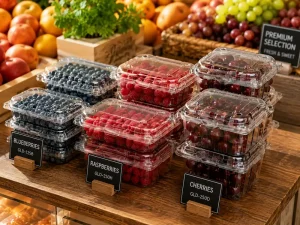
Tamper evident salad containers are important when ready-to-eat salads are sold through self-service shelves, delivery routes, convenience stores, or third-party handling channels. Salads are visually inspected before purchase, so packaging must show freshness while supporting closure confidence.
Leafy salads, grain bowls, cold noodle bowls, fruit salads, pasta salads, and protein bowls need different depths and lid structures. Leafy salads need height and topping protection. Dense deli salads need compact fill control. Fruit salads need clarity and moisture testing.
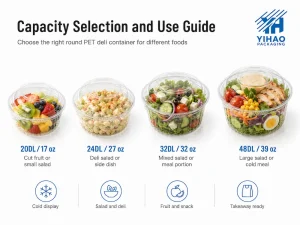
For salad-focused programs, round PET containers are practical because they create a bowl-like eating experience. grab-and-go salad bowls fit smaller salad and fruit portions, while premium meal salad bowls support fuller salads, cold noodles, toppings, and grain bowls.
Grab-and-Go Meal Packaging
Grab and go meal packaging must help customers understand the food quickly. The package should show the food, protect the portion, close reliably, stack safely, and support clean label placement. When the meal is self-service or delivery-sensitive, tamper-evident structure adds a stronger trust signal.
Grab-and-go foods may include salads, fruit bowls, sandwiches, wraps, snack packs, pasta salads, cold noodles, desserts, and prepared meals. The right package depends on food temperature, food height, moisture level, and whether the customer eats directly from the container.
For sandwich and takeaway programs, compact sandwich clamshells and grab-and-go fresh food clamshells support clear visibility and fast pack-out handling.
Prepared Food Containers for Chilled Retail
Prepared food containers cover a broader range of foods than deli salads alone. They include cold prepared meals, fruit portions, bakery items, sandwiches, protein bowls, side dishes, snack meals, and selected hot or reheatable foods.
For cold and chilled prepared foods, PET/RPET containers are valuable because customers can see the product before purchase. For hot or reheatable foods, PP or other heat-suitable materials may be more appropriate. Buyers should never use one container material for every prepared food line.
For heat-related prepared foods, microwave safe containers should be evaluated separately from clear PET chilled packaging. Options such as PP prepared meal containers and PP hot food containers are more relevant when temperature suitability matters more than crystal-clear chilled display.
PET Deli Containers: Why Clarity Matters
PET deli containers are widely used in deli and salad packaging because they provide clear product visibility, practical rigidity, and lightweight handling. For chilled foods, clear packaging helps customers inspect food color, freshness, portion size, ingredient quality, and product value before buying.
Clear packaging is especially important for salads, fruit bowls, deli sides, pasta salads, cold noodles, sandwiches, and prepared meals sold through retail display. If the packaging looks cloudy, scratched, fogged, or poorly labeled, the food may look lower quality even if the product itself is fresh.
| Packaging Format | Best Use | Main Advantage | Buyer Checkpoint |
|---|---|---|---|
| Hinged PET deli containers | Deli salads, snacks, fruit, sandwiches, fast pack-out foods | Lid and base stay connected for staff efficiency | Check hinge strength and closure feel |
| Round PET salad bowls | Leafy salads, grain bowls, cold noodles, fruit bowls | Bowl-like eating experience and strong top-view display | Check lid height and topping protection |
| Square PET deli containers | Deli sides, compact salads, fruit, chilled meals | Efficient shelf blocking and organized display | Check dense fill behavior and lid fit |
| Tamper-evident PET containers | Self-service retail, delivery, convenience stores, prepared meals | Visible first-opening confidence | Check opening clarity and real food performance |
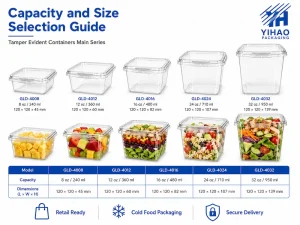
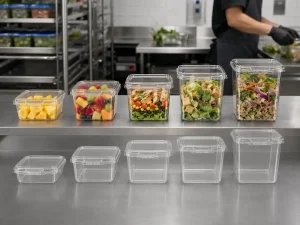
For compact shelf display, square PET deli containers are useful. Products such as square PET deli containers for salad and fruit and large square PET deli containers support salad, fruit, deli, and chilled meal programs where shelf blocking matters.
Material Selection: PET, RPET, PP, and Paper-Based Formats
Material choice should begin with food temperature and sales channel. PET and RPET are strong for cold and chilled food display. PP is more relevant for selected heat-related or microwave-oriented applications. Paper-based formats may work for certain cafe or bakery concepts, but they need stronger testing for moisture, grease, and food visibility.
| Material Direction | Best Application | Main Advantage | Buyer Caution |
|---|---|---|---|
| PET | Deli salads, fruit bowls, salad bowls, sandwiches, chilled meals | High clarity and strong retail display | Not the default choice for microwave or hot-fill use |
| RPET | Clear chilled packaging with recycled-content positioning | Supports sustainability-focused packaging direction | Documentation and market requirements must be checked |
| PP or heat-suitable material | Hot deli foods, selected reheatable prepared meals | Better fit for selected heat-related applications | Usually less crystal-clear than PET for cold retail display |
| Paper-based packaging | Some cafe, bakery, and branded takeaway concepts | Printable surface and different brand feel | Food visibility, grease, and moisture behavior need testing |
For cold deli and salad packaging, PET/RPET usually gives buyers stronger display value. For heated prepared foods, buyers should prioritize temperature suitability before clarity.
Tamper Evident Deli Containers vs Regular PET Deli Containers
Regular PET deli containers are useful when the main needs are clear display, practical handling, and reliable closure. They are suitable for staffed counters, direct handoff, and many chilled food programs where visible first-opening evidence is not required.
Tamper evident deli containers are stronger when the food is ready to eat, self-service, delivery-sensitive, or handled by multiple people before the customer opens it. They add a visible opening-status signal that regular PET deli containers may not provide.
| Packaging Type | Best Use | Main Advantage | Buyer Caution |
|---|---|---|---|
| Regular PET deli containers | Staffed counters, daily deli foods, fruit, snacks, cold sides | Clear display and practical chilled food handling | May not show visible first-opening evidence |
| Tamper evident deli containers | Self-service retail, delivery, convenience stores, prepared meals | Visible first-opening confidence | Tamper evidence does not automatically mean leak-proof |
| Tamper evident salad containers | Ready-to-eat salads, fruit salads, grain bowls, cold noodles | Fresh display plus opening-status signal | Lid clearance and topping protection must be tested |
| PP prepared food containers | Hot deli foods and reheatable meals | Better fit for selected heat-related foods | Usually weaker for crystal-clear chilled display |
Where Tamper Evident Packaging Adds the Most Value
Tamper-evident packaging should be used where it solves a real channel problem. It is most valuable when the food is ready to eat and the customer cannot directly see the handling history after packing.
Choose tamper-evident deli packaging when:
- The food is sold through a self-service refrigerated shelf.
- The product may be handled by delivery partners or third-party pickup staff.
- The package sits in convenience store coolers or hotel grab-and-go stations.
- The food is ready-to-eat and customer confidence matters.
- The brand wants a more controlled retail presentation.
- The package needs a visible first-opening signal.
- The buyer is building a private-label deli, salad, or prepared food line.
For cold-case secure food programs, anti-fog tamper-evident containers are useful where visibility and package confidence both matter. For larger chilled portions, clear PET tamper-evident containers support refrigerated foods where tear-strip style evidence is needed.
Retail Salad Packaging: What Buyers Should Test
Retail salad packaging must show freshness, protect toppings, support labeling, and survive cold display. A strong salad package should look full and organized without crushing greens, toppings, fruit, protein, or dressing cups.
Buyers should test:
- Top-view visibility: customers should see toppings, greens, fruit, grains, or protein clearly.
- Lid clearance: toppings should not be crushed after closure.
- Sidewall clarity: the container should show portion depth and ingredient layers.
- Condensation behavior: refrigerated display should not hide the food.
- Label placement: labels should not cover the best food view or tamper-evident feature.
- Stacking: filled packs should remain stable in cartons, shelves, and takeaway bags.
For ready-to-eat salad lines, ready-to-eat salad bowls support mainstream retail salad programs. For bigger chilled salads and fruit applications, large salad and fruit bowls can support family-size portions, fruit platters, and larger takeaway salads.
Food Safety Packaging: What Tamper Evidence Does and Does Not Do
Food safety packaging should be discussed carefully. Tamper-evident packaging gives a visible first-opening signal, but it does not replace food safety management. It does not automatically prove that the food has been handled correctly, stored at the right temperature, or protected from every possible risk.
What tamper-evident packaging does well:
- Shows visible evidence when a package has been opened.
- Improves customer confidence in self-service environments.
- Supports prepared food programs with more handling steps.
- Helps brands communicate controlled packaging integrity.
What buyers still need to manage separately:
- Food-contact material suitability.
- Cold-chain control and storage temperature.
- Sanitation and packing procedures.
- Leak-resistant behavior for sauces, oils, dressings, and fruit juice.
- Labeling, date coding, ingredient information, and local compliance requirements.
- Real food testing before wholesale orders.
The strongest result comes from using tamper-evident packaging as one part of a complete prepared food packaging system.
Lid Structure and Closure: The Critical Buying Point
For secure deli packaging, the lid is often the most important performance detail. A clear container with poor lid engagement creates risk in packing, stacking, takeaway handling, and customer opening. A strong lid should be easy for staff to close and clear for customers to open.
| Lid Direction | Best Use | Main Advantage | Buyer Test |
|---|---|---|---|
| Hinged lid | Fast pack-out deli foods, salads, snacks, sandwiches | Lid and base stay connected | Hinge strength, snap fit, customer opening |
| Flat clear lid | Compact deli sides, fruit portions, square containers | Clean stacking and efficient shelf display | Closure force, rim fit, label placement |
| Dome lid | Tall salads, toppings, fruit bowls, bakery-style foods | More height and product protection | Carton height, shelf space, lid stability |
| Tamper-evident closure | Self-service retail, delivery, convenience stores | Visible first-opening confidence | Tab clarity, opening force, food movement |
For salad bowl systems, matching PET salad bowl lids should be tested with the bowl body. For taller fresh food presentations, PET/RPET dome lids help protect toppings and provide more height where needed.
Wholesale Deli Containers: Building a Practical Packaging Matrix
Wholesale deli containers should be selected as a packaging matrix, not as random SKUs. A practical matrix helps buyers avoid warehouse confusion, lid mismatch, overstocking, and poor application fit.
| Product Role | Recommended Packaging | Best Channel | Procurement Logic |
|---|---|---|---|
| Small deli sides and snacks | Small PET/RPET containers or small hinged deli packs | Cafes, delis, convenience stores | Compact portions and fast handling |
| Daily deli salads | PET hinged deli containers or square PET containers | Supermarkets, delis, prepared food counters | Clear display and practical lid control |
| Retail salads and bowls | Round PET salad bowls | Supermarkets, cafes, grab-and-go shelves | Bowl-like eating experience and strong top-view display |
| Secure chilled foods | Tamper-evident deli containers | Self-service retail, delivery, convenience stores | Visible first-opening confidence |
| Hot or reheatable meals | PP or heat-suitable prepared food containers | Foodservice, hot deli, prepared meal counters | Temperature suitability comes before clarity |
For small side portions, small clear PET/RPET containers are useful. For medium chilled portions, medium clear food containers support fruit, deli sides, snacks, and compact prepared foods.
Sample Testing Before Wholesale Orders
Buyers should test tamper evident deli containers with actual food before approving bulk orders. Empty samples do not show enough. Real food changes closure, stacking, visibility, moisture behavior, and customer opening.
| Test Area | What to Check | Why It Matters |
|---|---|---|
| Food fit | Fill height, portion fullness, topping clearance, dense food behavior | Prevents crushed food, underfilled appearance, and poor usability |
| Lid closure | Closing force, lid engagement, hinge strength, tab behavior | Supports packing speed and handling reliability |
| Tamper evidence | Visible first-opening feature before and after opening | Supports customer confidence in self-service channels |
| Cold display | Clarity, condensation, shelf angle, label visibility | Improves retail appeal and product recognition |
| Moisture behavior | Dressing, fruit juice, sauce, oil, creamy deli foods | Confirms real food performance before wholesale ordering |
| Stacking | Filled packs in cartons, shelves, takeaway bags, and coolers | Reduces deformation and handling complaints |
| Bulk consistency | Sample-to-order clarity, rim shape, lid fit, and closure behavior | Reduces repeat-order quality risk |
Manufacturer and Supplier Checklist
When sourcing from a food packaging factory, buyers should evaluate the supplier’s full packaging logic. A reliable supplier should understand deli food behavior, salad packaging, PET/RPET clarity, tamper-evident closure, lid matching, carton protection, sample testing, and repeat-order consistency.
Ask these questions before choosing a manufacturer, wholesale supplier, or export partner:
- Does the supplier offer PET deli containers, round salad bowls, square PET deli containers, hinged clamshells, tamper-evident containers, and heat-suitable prepared food containers?
- Can the supplier recommend packaging by food type: deli salad, fruit bowl, salad bowl, sandwich, cold meal, or reheatable food?
- Which options provide visible first-opening evidence?
- Are matching lids tested with the selected containers?
- Can samples be tested with real food before bulk confirmation?
- How are containers packed to reduce scratches, deformation, and lid mismatch?
- Can the supplier maintain sample-to-bulk consistency in clarity, rim shape, lid fit, and closure feel?
- Can the supplier help reduce SKU overlap across a wholesale deli and prepared food packaging range?
Common Buying Mistakes to Avoid
Assuming Tamper Evidence Means Leak-Proof
Tamper evidence shows visible first-opening evidence. It does not automatically guarantee leak-proof performance for every dressing, sauce, fruit juice, oil, or creamy deli salad. Leak-resistant behavior must be tested separately.
Choosing by Price Before Testing Food Fit
A low-cost container that performs poorly with dense deli salad, sauce, fruit, or stacking pressure is not a safe purchasing decision. Buyers should test filled samples before finalizing wholesale orders.
Using PET/RPET for the Wrong Temperature
PET/RPET is strong for chilled display, but hot or reheatable prepared foods require separate material evaluation. Temperature suitability should come before visual clarity.
Ignoring Label Placement
Labels should support branding and required information without hiding the food or the tamper-evident feature. In retail deli packaging, the food is the selling image.
Using One Container for Every Prepared Food
Deli salads, leafy salads, fruit bowls, sandwiches, hot foods, and snack meals do not behave the same way. A focused packaging matrix works better than one universal container.
Buyer Decision Framework
Use this framework when choosing tamper evident deli containers and related secure food packaging:
- Define the food: deli salad, fruit bowl, leafy salad, cold noodles, sandwich, snack pack, prepared meal, or hot deli food.
- Confirm the temperature: cold, chilled, ambient, hot, or reheatable.
- Choose the material: PET/RPET for clear chilled display; PP or heat-suitable materials for selected hot or reheatable uses.
- Select the format: hinged deli container, round bowl, square PET container, tamper-evident container, sandwich clamshell, or PP prepared food container.
- Define the security level: standard closure, stronger snap fit, or visible tamper-evident structure.
- Test real conditions: filling, closing, labeling, refrigeration, stacking, transport, shelf display, and customer opening.
- Evaluate the supplier: sample support, carton protection, repeat consistency, and application guidance.
FAQ
1. What are tamper evident deli containers used for?
Tamper evident deli containers are used for deli salads, pasta salads, fruit bowls, cold noodles, dips, sauces, snack packs, prepared meals, and grab-and-go foods that need clear display and visible first-opening confidence.
2. Are tamper evident deli containers better than regular PET deli containers?
They are better when ready-to-eat foods are sold through self-service retail, delivery, convenience stores, or third-party handling channels where visible opening evidence matters. Regular PET deli containers may be enough for staffed counters or direct handoff.
3. What is the difference between tamper evident deli containers and tamper evident salad containers?
Tamper evident deli containers cover a broad range of deli sides, prepared foods, dips, fruit, snacks, and cold meals. Tamper evident salad containers are more specific to leafy salads, fruit salads, grain bowls, cold noodles, and ready-to-eat salad programs.
4. Are PET deli containers suitable for food safety packaging?
PET deli containers are suitable for many chilled food packaging applications when they meet the required food-contact and application needs. Tamper-evident structure adds visible first-opening confidence, but food safety also requires proper handling, cold-chain control, sanitation, and local compliance.
5. When should buyers choose PP prepared food containers instead?
Buyers should choose PP or other heat-suitable prepared food containers when the food requires heating, hot holding, or microwave-related performance. PET/RPET should not be treated as the default for heat-related applications.
6. What should buyers test before wholesale ordering?
Buyers should test real food fit, lid closure, tamper-evident function, cold display clarity, label placement, moisture behavior, stacking, customer opening, carton protection, and sample-to-bulk consistency before wholesale ordering.
References
- U.S. Food and Drug Administration, Food Contact Substances and Food Packaging Guidance.
- U.S. Food and Drug Administration, Food Tampering and Consumer Packaging Guidance.
- European Commission, Regulation (EC) No 1935/2004 on Materials and Articles Intended to Come into Contact with Food.
- European Commission, Regulation (EU) No 10/2011 on Plastic Materials and Articles Intended to Come into Contact with Food.
- European Food Safety Authority, Guidance on Plastic Recycling Processes for Food Contact Materials.
- Association of Plastic Recyclers, APR Design Guide for Plastics Recyclability.
- RecyClass, Design for Recycling Guidelines for PET Packaging.
- GS1, General Guidance on Retail Barcode and Label Placement.
Final Note / Practical Takeaway
© YIHAO Packaging. All rights reserved. All articles, product images, packaging designs, technical specifications, and website materials are protected by copyright. Unauthorized copying, reproduction, redistribution, modification, or commercial use is strictly prohibited without prior written permission.