Choosing takeout container lids looks simple from the outside, but it becomes a real purchasing decision when a buyer must balance food visibility, leak resistance, stackability, shelf display, delivery handling, material compliance, and wholesale cost. A lid that fits loosely creates operational problems. A lid that is too stiff slows packing work. A lid that fogs quickly affects product display. A lid that does not match the container rim creates complaints during takeaway, chilled display, retail handling, or delivery.
For food packaging teams, the best lid decision starts with the food type. Chilled salads, cut fruit, deli sides, bakery portions, sushi packs, prepared meals, hot takeaway foods, and cold display foods do not need the same lid structure. Some applications work better with hinged food containers, while others need bowl-and-lid systems, square bases with flat or high lids, or PP separate-lid containers for hot food and prepared meals.
YIHAO supports food packaging buyers with clear PET, rPET, and PP packaging formats for retail display, takeaway, chilled food, deli counters, supermarkets, bakeries, and foodservice supply. This FAQ answers the most common buyer questions before sampling, quoting, and placing a wholesale order.
What Are Takeout Container Lids?
Takeout container lids are the cover systems used to close food containers for takeaway, grab-and-go retail, chilled display, delivery, catering, and prepared food service. They may be integrated into a hinged clamshell structure or supplied as a separate lid that snaps onto a bowl, tray, or base.
The lid is not only a cover. It controls how the food is displayed, how the container stacks, how the pack opens, how labels are applied, how steam or moisture behaves, and how the product moves through packing, transport, and retail handling. For buyers, the lid affects customer experience as much as the container base.
In practical food packaging, lids usually fall into five major groups:
- Hinged lids attached to the base, often used for PET clamshell containers, deli packs, fruit packs, bakery containers, and grab-and-go foods.
- Separate flat lids used for salad bowls, square deli containers, prepared food trays, and cold display packs.
- Dome lids used when the food needs more headspace, such as leafy salads, fruit bowls, whipped desserts, sushi assortments, or decorated food presentations.
- High lids used for taller ingredients, layered salads, sandwiches, bakery portions, and fresh-cut foods.
- PP lids used with PP bases for hot food, deli meals, prepared food counters, and applications where PET is not the right material choice.
Which Materials Are Commonly Used for Takeout Container Lids?
The most common materials for takeout container lids are PET, rPET, PP, and sometimes paperboard-based systems with plastic windows or coatings. Each material has a different role. A buyer should never choose the lid material by price alone because material mismatch leads to poor performance, unclear display, weak sealing, or incorrect application use.
| Material | Common Lid Use | Best Application Fit | Buyer Note |
|---|---|---|---|
| PET | Clear hinged lids, flat lids, dome lids, clamshell lids | Cold food, salads, fruit, bakery, deli display, chilled takeaway | Strong visual clarity and good rigidity for retail presentation. |
| rPET | Clear lids and containers with recycled PET content | Brands seeking clearer sustainability communication for cold food packaging | Food-contact suitability and recycled content claims should be verified by target market requirements. |
| PP | Separate lids for hot food and prepared meals | Hot takeaway, deli meals, prepared meals, microwave-related foodservice needs | Suitable where the buyer needs better heat tolerance than PET systems. |
| Paperboard + PET Window or Lid | Bakery, dessert, deli presentation boxes | Premium bakery, chilled desserts, gift-style takeaway | Useful for presentation, but buyers should check recyclability by local systems. |
For cold and chilled food, PET remains a strong choice because it gives clear visibility, stable shape, and a clean retail look. PET lids are widely used for deli and salad containers, fruit cups, bakery containers, and PET clamshell containers. For hot foods, PP systems are usually more appropriate because the lid and base need better heat resistance and handling stability.
Are PET Takeout Container Lids Suitable for Hot Food?
PET takeout container lids are mainly used for cold, chilled, and room-temperature food applications. They are not the default choice for hot-fill meals, microwave use, or high-temperature food handling unless a supplier has clearly validated the material, structure, and use condition for that specific application.
For hot prepared meals, buyers should consider PP container systems such as microwave safe containers. PP separate-lid containers are commonly used for hot takeaway, deli meals, prepared food counters, and meal service applications where heat tolerance matters more than crystal-clear PET display.
A practical rule is simple: use PET lids when product visibility and chilled display performance are the priority; use PP lids when hot food handling and temperature resistance are the priority. Do not force one material to cover every food program.
How Should Buyers Compare Hinged Deli Containers vs Separate Lid Containers?
The question of hinged deli containers vs separate lid containers is one of the most important decisions in any deli container comparison. Both formats work well, but they solve different operational problems.
A practical deli container comparison should not only compare price. Buyers should also review packing speed, lid fit, SKU control, food height, stacking strength, delivery handling, and the type of food being sold.
| Comparison Point | Hinged Deli Containers | Separate Lid Containers |
|---|---|---|
| Packing Speed | Fast because the lid is attached to the base | Requires matching the correct lid to the correct base |
| Inventory Control | Simple SKU management | More flexible but needs lid/base inventory accuracy |
| Display Quality | Good for grab-and-go, deli, fruit, snacks, bakery | Excellent when flat, high, or dome lids are selected by food height |
| Food Height Flexibility | Limited by fixed lid depth | Better flexibility with flat lids, high lids, or dome lids |
| Delivery Handling | Good when closure strength is properly tested | Good when lid fit, rim lock, and stacking strength are confirmed |
| Best Use | Deli sides, salads, fruit, sandwiches, bakery packs | Salad bowls, square deli bases, prepared meals, high-fill foods |
Hinged formats are ideal when the buyer wants simple inventory and quick packing. For example, PET clamshell containers reduce the risk of missing lids because the lid and base are connected. This helps cafes, convenience stores, and deli counters keep packing work efficient.
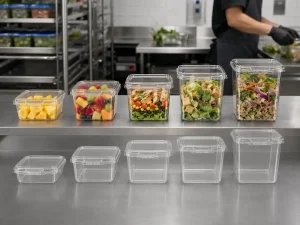
Separate lid systems work better when the same base may need multiple lid options. A square deli base may need a flat lid for low-profile salads, a high lid for layered foods, or a stronger lid for retail stacking. That is why square PET containers are useful for buyers who need more flexibility across salad, fruit, deli, and prepared food programs.
Quick Selection Table: Which Lid Format Fits Each Food Type?
Buyers can use the following table as a fast starting point before requesting samples. The final decision should still be confirmed by testing the exact food, filling weight, container base, lid fit, storage condition, and transport process.
| Food Type | Recommended Lid Format | Best Material Direction | Buyer Reason |
|---|---|---|---|
| Cold Salads | Flat lid or dome lid | PET / rPET | Clear display, stacking, and ingredient visibility. |
| Fruit Bowls | Dome lid or high lid | PET / rPET | More headspace and better visual freshness. |
| Deli Sides | Hinged lid or flat separate lid | PET / PP depending on temperature | Fast packing and secure closure. |
| Hot Meals | Separate lid system | PP | Better heat tolerance for takeaway meals. |
| Bakery Portions | Hinged clamshell or high lid | PET | Protects toppings and improves display. |
What Sizes Should Buyers Check Before Ordering Takeout Container Lids?
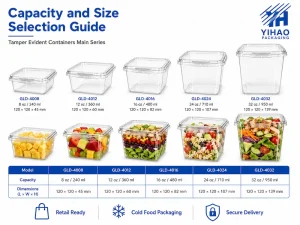
Size matching is the first technical checkpoint for takeout container lids. A lid must match the rim shape, rim diameter, opening length, opening width, wall angle, and closure design of the container base. Even a small mismatch affects sealing, stacking, and user experience.
Buyers should confirm the following before ordering:
- Top diameter or top opening size for round bowls and cups.
- Length and width for square, rectangular, and clamshell bases.
- Lid height when the food needs headspace.
- Rim structure because similar sizes from different suppliers may not lock correctly.
- Stack height for shipping cartons, warehouse storage, and retail shelves.
- Closure feel because a lid must close securely without slowing down staff.
- Label area if the pack needs branding, price labels, ingredient stickers, or tamper labels.
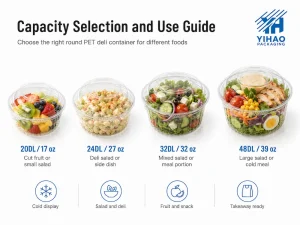
For round salad bowls, buyers often compare flat lids and dome lids. A flat lid supports stacking and compact display, while a dome lid gives more space for leafy salads, fruit mixes, toppings, and premium presentation. A dome lid is useful when the food needs more visible height without being compressed.
For square deli containers, buyers should confirm whether the lid is universal for several bases or dedicated to one size. A universal PET lid helps simplify procurement when one lid works across several compatible square bases.
When Should Buyers Choose Flat Lids, High Lids, or Dome Lids?
Flat lids, high lids, and dome lids are not interchangeable. They create different product presentation and stacking results.
Flat Lids
Flat lids are best for lower-profile food portions, efficient stacking, and compact refrigerated display. They work well for fruit slices, deli sides, grain salads, pasta salads, cold noodles, and low-height prepared foods. A flat lid supports cleaner shelf lines and usually saves space during transport.
For square salad packaging, flat lids give buyers a clean and simple display format for cold salad packaging.
High Lids
High lids are better for foods that sit above the rim or need more internal height. They are useful for fresh-cut fruit, layered salads, toppings, bakery portions, and foods that lose value when compressed. A high lid improves presentation when food height matters.
For buyers packing foods with more volume, a high lid food container supports better headspace and cleaner food presentation.
Dome Lids
Dome lids create a premium visual effect and protect taller food arrangements. They are common for salad bowls, fruit bowls, desserts, and display foods where visibility is part of the purchase decision. A dome lid is especially useful when the buyer wants the food to look full, fresh, and easy to inspect.
What Foods Work Best with Hinged Food Containers?
Hinged food containers are strong choices for fast-moving takeaway and grab-and-go programs. Because the lid and base are connected, packing is faster and lid mismatch is reduced. This format is useful for:
- Fresh salads and deli sides
- Cut fruit and snack packs
- Sandwiches and chilled wraps
- Bakery portions and desserts
- Cold noodles and light meals
- Supermarket grab-and-go counters
- Cafe takeaway display
Hinged PET packaging is especially useful when visual clarity matters. A buyer using clear containers wants the food to sell itself through the packaging. For salad and snack programs, hinged deli containers create a simple format for cold food display and takeaway service.
The main limitation is fixed lid depth. If the food height changes often, separate lid systems may give the buyer more flexibility.
When Are Separate Lid Salad Bowls a Better Choice?
Separate lid salad bowls are better when the buyer needs a bowl format, strong visual presentation, and multiple lid options. They work well for leafy salads, fruit bowls, grain bowls, cold noodles, yogurt bowls, poke-style meals, and chilled ready-to-eat foods.
Round bowls often look more premium than standard rectangular deli containers. They also present salads and fresh ingredients naturally because the food sits in a rounded shape. For supermarkets and cafes, round PET containers support chilled display while keeping the food visible from the top and side.
Buyers should compare bowl capacity, lid height, lid lock, stacking strength, label area, and carton packing quantity. A lid that looks good in a sample photo still needs to perform during real filling, cold storage, shelf stacking, and customer transport.
For large salad and chilled food programs, a PET salad bowl lid helps buyers build a consistent bowl-and-lid system for larger portions and shared food packs.
How Should Buyers Evaluate Lid Fit and Closure Strength?
Good lid fit is not only about whether the lid closes. Buyers should test the full packaging cycle: filling, closing, stacking, chilling, transport, opening, and customer handling. A lid that performs well in one step may fail in another.
Important tests include:
- Closing test: Staff should be able to close the lid quickly without excessive force.
- Opening test: Customers should be able to open the lid without cracking the rim or spilling food.
- Shake test: The pack should remain stable under normal takeaway movement.
- Stacking test: Filled containers should stack without lid collapse or base distortion.
- Cold storage test: The lid should keep its shape after refrigeration.
- Label test: Labels should fit without blocking important product visibility.
- Carton test: Packaging should arrive without deformation after shipping and warehouse handling.
For delivery programs, the buyer should test the exact food weight, sauce level, and transport angle. For retail display, the buyer should test visibility, fogging tendency, stacking, and shelf appearance. For wholesale purchasing, the buyer should also test carton strength and pallet stability.
Are Takeout Container Lids Leak-Proof?
Not every lid is leak-proof, and buyers should be careful with this claim. A lid may be secure for salads, fruit, and dry deli foods but not suitable for soups, sauces, oily foods, or heavy liquid movement. Leak resistance depends on rim design, lid lock, material flexibility, container shape, filling level, food temperature, and transport handling.
For chilled salads, fruit, bakery, and dry deli foods, PET lids often provide enough closure security when properly matched to the base. For saucy meals and hot takeaway, PP separate-lid systems may be a better direction. Buyers should test the real food, not only water, because sauces, oils, and food particles behave differently inside the package.
A strong supplier should avoid vague promises and instead help buyers match the container lid system to the actual food use. This is one reason why working with a packaging manufacturer is more reliable than choosing only from catalog photos.
How Do Takeout Container Lids Affect Retail Display?
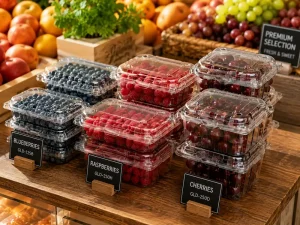
For supermarkets, cafes, bakeries, and convenience stores, the lid directly affects product display. Clear PET lids allow buyers to show color, texture, layering, toppings, freshness, and portion value. When the food is attractive, packaging clarity becomes a selling point.
Good display packaging should support:
- Clear top visibility
- Clean side visibility
- Stable stacking
- Enough headspace for food shape
- Label placement without blocking the product
- Consistent shelf appearance across different sizes
- Easy opening after purchase
For chilled foods, a clear lid helps shoppers inspect freshness before buying. For salads and fruit, the lid also protects product arrangement. For bakery and dessert packaging, lid height helps protect toppings, cream, decorations, and layers.
What Ordering Details Should Buyers Confirm Before a Wholesale Lid Order?
Before placing a wholesale order for takeout container lids, buyers should confirm more than the unit price. The real cost of a lid system includes fit accuracy, packaging speed, damage rate, carton efficiency, reorder stability, and whether the supplier can support repeat purchasing without changing dimensions or material performance.
Wholesale buyers should confirm the following details before approving a bulk order:
- Matching base: Confirm the exact container base that the lid is designed to fit.
- Material direction: Confirm whether the lid is PET, rPET, PP, or another material system.
- Food application: Confirm whether the lid is for chilled food, room-temperature food, hot food, or microwave-related use.
- MOQ and order quantity: Confirm minimum order quantity, carton quantity, and container loading plan.
- Sample testing: Test the lid with real food, real filling weight, and actual storage conditions.
- Carton packing: Confirm carton size, pieces per carton, pallet loading, and shipping protection.
- Lead time: Confirm production lead time, peak season capacity, and reorder schedule.
- Customization: Confirm whether the project needs private mold development, lid height adjustment, embossing, anti-fog treatment, ventilation, or label-area changes.
- Documentation: Confirm food-contact documents and recycled material documentation where applicable.
This ordering step is especially important for distributors, supermarket chains, restaurant supply companies, and food manufacturers that need stable repeat orders. A lid that works in a sample batch must also remain consistent across future production runs.
How to Choose a Takeout Container Lids Manufacturer or Supplier
A professional takeout container lids supplier should understand the complete packaging system, not only the lid itself. The supplier should be able to explain which lid matches which base, which material fits each food temperature, and which format supports the buyer’s packing process.
Buyers should choose a supplier that can support:
- Stable lid-base matching across repeat orders
- Clear PET, rPET, and PP material recommendations
- Samples for real food testing before bulk orders
- Carton and pallet packing information for wholesale purchasing
- Food-contact documentation for the target market
- Practical advice for retail display, takeaway, delivery, and chilled storage
- Customization support for lid height, closure design, ventilation, label area, or private mold projects
The best supplier does not push one lid format for every use. A reliable manufacturer helps buyers compare hinged deli containers, separate lid salad bowls, PP hot food containers, and PET clamshell containers based on real food use, not only catalog appearance.
What Should Buyers Ask a Takeout Container Lids Supplier?
Before placing a wholesale order, buyers should ask practical questions that reveal whether the supplier understands food packaging operations. The best takeout container lids supplier should answer more than price and MOQ.
Useful supplier questions include:
- Which lid matches this exact base?
- Is the lid designed for PET, rPET, PP, or another material system?
- Is the lid suitable for chilled food, room-temperature food, or hot food?
- Can the lid handle stacking after filling?
- What carton quantity and pallet loading are recommended?
- Can samples be tested before bulk orders?
- Does the lid support labels, sleeves, or tamper stickers?
- Can the supplier provide different lid heights for the same base?
- What customization options are available for wholesale or private-label projects?
- What compliance documents are available for the target market?
These questions help buyers separate basic traders from packaging partners. A professional supplier should understand food type, shelf display, filling method, closure performance, and export requirements.
How Should Wholesale Buyers Place an Order for Takeout Container Lids?
Wholesale ordering should follow a structured process. Buying lids without testing them with the matching base is risky, especially when the buyer operates across multiple food categories.
Step 1: Define the Food Application
Start with the food: salad, fruit, deli sides, bakery, hot meals, cold meals, prepared meals, or catering packs. The food determines the material, lid height, closure style, and container format.
Step 2: Choose the Container System
Decide whether the program needs hinged PET clamshell containers, separate lid salad bowls, square deli containers, PP hot food containers, or another format. A chilled salad brand may prefer clear PET bowls, while a hot meal counter may need PP separate-lid containers.
Step 3: Match Lid Size and Rim Design
Confirm the exact rim structure, not only the nominal size. Lids from different suppliers may not fit even when the listed size looks similar.
Step 4: Request Samples
Test samples with real food, real filling weight, real storage time, and real transport handling. Do not approve a lid only from photos.
Step 5: Confirm Compliance and Documentation
Ask for food-contact documentation relevant to the target market. If recycled content is involved, confirm whether the material claim and food-contact use are suitable for the buyer’s market.
Step 6: Confirm Carton, Pallet, and Delivery Details
Wholesale buyers should check carton quantity, carton dimensions, pallet loading, shipping protection, lead time, and reorder planning.
What Are Common Ordering Mistakes?
Most ordering mistakes happen because the lid is treated as a simple accessory instead of part of the full packaging system. Common mistakes include:
- Buying lids without testing them on the exact container base.
- Choosing PET lids for hot food applications without validation.
- Using flat lids when the food needs dome height.
- Ignoring stacking strength after filling.
- Choosing a lid based only on the cheapest quotation.
- Forgetting label placement and barcode scanning needs.
- Mixing bases and lids from different suppliers without fit testing.
- Ordering bulk quantities before sample approval.
- Ignoring carton compression and export shipping conditions.
A lid that costs slightly less can become more expensive if it increases breakage, slows packing, causes complaints, or forces the buyer to change packaging after launch.
Can Takeout Container Lids Be Customized?
Yes, many takeout container lids can be customized depending on tooling, material, size, order quantity, and project scope. Customization may include lid height, closure design, embossing, anti-fog treatment, ventilation design, label area, container shape, or private mold development.
For wholesale buyers, customization should be driven by food performance and brand use, not decoration alone. A custom lid is valuable when it improves fit, stacking, freshness presentation, shelf display, or operational efficiency.
Before requesting customization, buyers should prepare:
- Food type and serving weight
- Target container size
- Preferred material
- Target market
- Use temperature
- Storage and transport conditions
- Branding or label requirements
- Expected order volume
- Sample testing requirements
Clear information makes quoting faster and reduces unnecessary mold changes.
FAQ: Takeout Container Lids
1. What are the best materials for takeout container lids?
The best materials for takeout container lids depend on the food application. PET and rPET are strong choices for clear cold-food display, salads, fruit, bakery, and deli packaging, while PP is usually better for hot food and prepared meal applications that need higher heat tolerance.
2. How do I choose the right size lid for a takeout container?
To choose the right size lid for a takeout container, check the exact top diameter, length, width, rim shape, lid height, and closure design of the matching container base. Buyers should always test lid and base samples together before confirming a wholesale order.
3. Are hinged deli containers better than separate lid containers?
Hinged deli containers are better for fast packing and simple inventory control, while separate lid containers are better when buyers need different lid heights, bowl formats, square bases, or more flexibility across salads, deli foods, and prepared meals.
4. Can PET takeout container lids be used for hot food?
PET takeout container lids are mainly used for cold, chilled, and room-temperature foods. For hot food, buyers should consider PP container and lid systems unless the supplier has validated the PET structure for the exact use condition.
5. What should wholesale buyers ask a takeout container lids supplier?
Wholesale buyers should ask about material, matching base size, lid height, closure strength, stacking performance, food-contact documentation, carton packing, sample testing, customization options, MOQ, lead time, and reorder stability.
References
- U.S. Food and Drug Administration, Packaging & Food Contact Substances.
- U.S. Food and Drug Administration, Understanding How FDA Regulates Substances that Come into Contact with Food.
- European Commission, Commission Regulation (EU) No 10/2011 on plastic materials and articles intended to come into contact with food.
- European Commission, Commission Regulation (EU) 2022/1616 on recycled plastic materials and articles intended to come into contact with foods.
- Association of Plastic Recyclers, APR Design Guide for Plastics Recyclability.
- WRAP and RECOUP, Design Tips for Making Rigid Plastic Packaging More Recyclable.
- World Packaging Organisation and FH Campus Wien, Packaging Design for Recycling Guidance.
- Industry buyer practice for chilled food, deli packaging, salad bowls, and takeaway container sourcing.
Deep Dive Insights
How buyers should think about lid systems: The most reliable lid choice starts from the food, not the catalog. A chilled salad program needs clarity, stacking, and headspace. A hot meal program needs heat tolerance. A deli counter needs fast closure and simple SKU control. A retail display program needs product visibility and label placement.
Why hinged and separate-lid formats solve different problems: Hinged containers reduce lid mismatch and speed up packing, making them efficient for grab-and-go foods, deli sides, bakery portions, and chilled snacks. Separate-lid systems give buyers more flexibility when one base needs different lid heights, when foods vary in volume, or when a bowl format improves presentation.
What wholesale buyers should not ignore: Lid fit, rim structure, carton packing, stacking strength, sample testing, and repeat-order consistency matter as much as material choice. A low-cost lid becomes expensive when it causes leaking, cracking, slow packing, poor display, or mismatched inventory.
Option insight: PET and rPET lids are strong choices for clear cold-food display, while PP lids are more suitable for hot food and prepared meal applications. Buyers should not use one material strategy for every food category.
Practical consideration: Before placing a wholesale order, buyers should test the complete packaging system with real food, real filling weight, real storage conditions, and real transport handling. This is the most direct way to avoid lid fit problems before bulk production.
Final Note / Practical Takeaway
© YIHAO Packaging. All rights reserved. All articles, product images, packaging designs, technical specifications, and website materials are protected by copyright. Unauthorized copying, reproduction, redistribution, modification, or commercial use is strictly prohibited without prior written permission.