Why Secure Shelf Display Packaging Matters
Secure shelf display packaging is a practical requirement for food brands that sell ready-to-eat products through customer-facing shelves, chilled display cases, cafe fridges, bakery counters, deli sections, convenience store coolers, and foodservice pickup areas. The package must do two jobs at the same time: protect the food and help the product sell from the shelf.
Customers often make retail food decisions quickly. They look at the food, read the label, check freshness, compare portion value, and judge whether the package appears clean, closed, and professionally handled. A container that looks loose, fogged, unstable, or poorly labeled weakens trust even when the food itself is good.
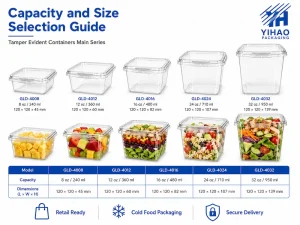
YIHAO supports food packaging buyers with PET, rPET, PP, hinged, round, square, bakery, deli, salad, fresh produce, microwave-safe, and tamper-evident packaging options. For secure shelf display programs, the strongest result comes from matching container structure to the food journey: filling, labeling, chilled storage, shelf display, customer handling, checkout, takeaway, and final opening.
What Makes Packaging Secure for Shelf Display?
Secure shelf display packaging is not only about a tight lid. It includes closure strength, shelf stability, product visibility, tamper evidence, label readability, stacking performance, and customer-friendly opening after purchase. A package should be easy for staff to close, stable enough for display, clear enough to show food quality, and practical enough for takeaway.
For customer-access shelves, buyers should give special attention to tamper evidence. If customers can pick up, compare, return, and later purchase a food pack, the package should communicate whether it appears to have remained closed. This is where tamper evident containers become more valuable than basic snap-lid packaging.
| Display Requirement | What Buyers Should Check | Why It Matters |
|---|---|---|
| Secure closure | Lid fit, rim grip, hinge strength, snap feel, and closing consistency. | Helps the package stay closed during stocking, customer handling, and takeaway. |
| Product visibility | Clarity, anti-fog direction, lid shape, label position, and product arrangement. | Customers judge freshness and portion value before purchase. |
| Tamper evidence | Tear strip, break tab, locking feature, or security label area. | Supports opening confidence in customer-access retail areas. |
| Shelf stability | Base shape, lid height, stacking, footprint, and cold-case layout. | Improves display organization and reduces damaged presentation. |
| Label readability | Barcode, ingredients, allergens, date mark, brand label, and price label. | Supports faster purchase decisions and cleaner retail operations. |
Secure Shelf Display Packaging for Supermarkets
Supermarkets need shelf display packaging across multiple departments: fresh produce, deli, bakery, chilled meals, snack packs, prepared foods, and grab-and-go sections. A strong supermarket packaging plan should not force every product into one container. Each department has different product height, moisture, label, closure, and display requirements.
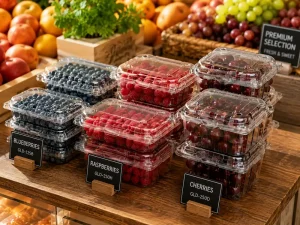
For produce and fresh snack programs, fresh-cut fruit containers support strong product visibility, chilled display, portion control, and fast customer selection. A fresh-cut fruit container is useful when buyers need clear retail presentation for cut fruit, mixed fruit, and chilled takeaway packs.
For supermarket deli and salad departments, PET hinged deli containers support quick packing because the lid and base remain connected. A clear hinged deli container works well for retail-ready deli foods, chilled snacks, and grab-and-go portions that need visible presentation and practical handling.
Secure Shelf Display Packaging for Cafes
Cafes use secure shelf display packaging for salads, fruit cups, parfaits, breakfast pots, sandwiches, desserts, chilled snacks, and small ready-to-eat meals. The package becomes part of the cafe’s brand experience, so the container should look clean, clear, and intentional.
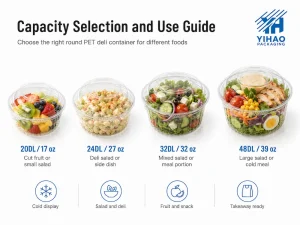
For cafe fridges, clear PET and rPET containers often perform well because customers can see freshness, color, texture, and portion value before purchase. For salad bowls, fruit mixes, and chilled bowls, round PET deli containers support attractive presentation and easy takeaway. A grab-and-go salad bowl is a strong option when buyers need a clear hinged format for salads, fruit, and ready-to-eat chilled food.
Cafe buyers should not treat labels as an afterthought. A label should support brand identity, ingredients, date marking, barcode scanning, and product information without hiding the food. Poor label placement reduces the visual advantage of clear packaging.
Secure Shelf Display Packaging for Bakeries
Bakeries need packaging that protects product shape while keeping the product visible. Cakes, muffins, donuts, croissants, brownies, pastries, dessert cups, and roll cakes often sell because of appearance. The wrong package height or weak hinge can damage toppings, frosting, crumbs, or decoration before the customer buys.
For bakery display, bakery clamshell containers help protect shape while supporting clear product presentation. A clear PET hinged bakery container is useful for croissants, bagels, muffins, donuts, breakfast bakery packs, and grab-and-go bakery assortments.
For self-service bakery shelves, buyers may also consider label seals or tamper-evident features. The final choice depends on product fragility, customer handling, shelf layout, and how much opening confidence the retailer wants before purchase.
Secure Shelf Display Packaging for Foodservice Brands
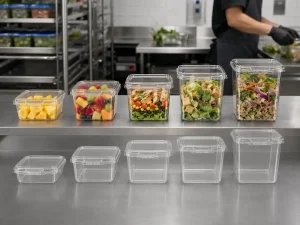
Foodservice brands often use shelf-ready packaging for centralized production, workplace foodservice, event catering, grab-and-go meal programs, delivery pickup, and retail partnerships. These programs need packaging consistency across locations and repeat orders.
For foodservice deli and cold meal programs, clear hinged containers, salad bowls, square deli packs, and tamper-evident containers all have a role. For wet or semi-wet foods, such as dressed salads, sauced deli sides, fruit with juice, or chilled prepared food, a clear secure container is a stronger direction than a basic dry-food clamshell.
When heat-related use or reheatable meals are part of the foodservice program, buyers should review microwave safe containers. A PP prepared meal container is more relevant for prepared meals, hot deli counters, and reheatable takeaway programs than clear PET cold-food packaging.
Retail Ready Tamper Evident Packaging for Customer-Access Shelves
Retail ready tamper evident packaging is most useful when customers can handle products before purchase. This includes supermarket chilled cases, convenience store fridges, cafe retail shelves, bakery self-service displays, deli grab-and-go areas, and foodservice pickup points.
Tamper evidence may come from a tear strip, break tab, locking edge, security band, or label seal area. The goal is not to replace food safety procedures. The goal is to provide a visible opening signal that helps customers and staff recognize whether the package appears to have remained closed.
For cold-case snacks and small ready-to-eat foods, a clear tamper evident container supports product visibility and opening confidence. For larger chilled retail packs, a tear-strip seal structure gives buyers a stronger first-opening signal.
Convenience Store Food Containers for Compact Shelf Display
Convenience store food containers need compact shelf fit, fast product recognition, secure closure, clear labels, and easy takeaway handling. Compared with supermarket departments, convenience stores usually have less shelf space and faster purchase behavior. Packaging must communicate food type, freshness, and portion value quickly.
For compact chilled merchandising, a peg display grab-and-go container supports space-efficient display and visible product presentation. For single-serve fruit or snack packs, smaller clear containers and compartment snack formats help buyers balance portion control with shelf organization.
Convenience store buyers should test footprint, barcode position, label readability, stacking, customer handling, and whether the container remains stable after checkout. A container that works for a wide supermarket shelf may be too large or inefficient for a compact convenience store fridge.
Grab and Go Packaging for Fast Retail Decisions
Grab and go packaging must support speed. Customers select quickly, staff restock quickly, and products must look fresh under chilled retail lighting. The package should make the product easy to understand at a glance.
For grab-and-go salads and chilled meal bowls, a clear PET salad bowl helps buyers present ready-to-eat meals with strong visibility and convenient takeaway handling. For larger clear retail packs, a crystal-clear secure food container supports shelf presentation, practical handling, and a clean retail look.
Buyers should choose packaging by food category. Fruit cups, salads, sandwiches, bakery items, deli sides, and prepared meals do not need the same structure. A well-organized packaging family creates better display consistency than random one-off containers.
Clear Tamper Evident Containers for Shelf Display
Clear tamper evident containers combine two important shelf display functions: product visibility and visible opening confidence. This combination is valuable for chilled ready-to-eat foods, salads, fresh-cut fruit, deli sides, desserts, bakery portions, and convenience store foods.
Clear packaging helps customers see color, texture, portion size, freshness, and product arrangement before purchase. Tamper-evident design adds a visible signal that the package has a first-opening structure. For retail shelves where customers interact directly with the package, this combination can be stronger than either feature alone.
Buyers should still test real-use performance. The package should remain clear under refrigeration, close consistently during packing, stack safely in display, hold labels without hiding the food, and open cleanly for the customer after purchase.
Material Selection for Secure Shelf Display Packaging
Material selection should follow food application and display channel. PET and rPET are common for clear chilled display because they support product visibility and retail presentation. PP is more relevant for hot food, prepared meals, and reheatable takeaway. Paper, fiber, and board-based packaging may support branding, but buyers should test moisture behavior, visibility, closure, and food-contact suitability before using them for chilled display.
| Material Direction | Best Shelf Display Use | Buyer Checkpoint |
|---|---|---|
| PET | Fresh-cut fruit, salads, deli sides, bakery, desserts, chilled snacks, clear retail display. | Confirm cold-food use, clarity, lid fit, label placement, and food-contact suitability. |
| rPET | Clear chilled food packaging where recycled-content direction supports buyer goals. | Confirm food-contact suitability, target-market rules, and claim wording. |
| PP | Hot food, prepared meals, reheatable takeaway, and certain deli programs. | Confirm heat-related use, lid behavior, food type, and local requirements. |
| Paper / fiber / board | Dry bakery items, branded takeaway, sandwiches, and selected hot-food programs. | Review moisture behavior, coating, visibility, closure, and food-contact suitability. |
Buyer Decision Table: Which Shelf Display Packaging Fits Your Program?
| Buyer Need | Recommended Packaging Direction | Why It Fits | What to Test |
|---|---|---|---|
| Fresh-cut fruit retail display | Clear PET/rPET fruit container | Shows fruit color, freshness, and portion value. | Condensation, lid fit, label area, product movement. |
| Customer-access chilled foods | Clear tamper evident container | Combines visibility with first-opening confidence. | Tear strip, break tab, customer opening, shelf stability. |
| Cafe salads and chilled bowls | Round PET bowl or hinged salad bowl | Supports premium visual display and takeaway handling. | Headspace, dressing, lid clearance, stacking. |
| Bakery shelf display | Clear bakery clamshell | Protects product shape while showing the food clearly. | Lid height, hinge strength, topping clearance, stacking. |
| Convenience store compact display | Compact hinged or peg display container | Fits fast purchase behavior and limited shelf space. | Footprint, barcode position, shelf angle, customer handling. |
| Hot or reheatable prepared meals | PP prepared meal container | Better direction when heat-related use is required. | Temperature use, lid behavior, food type, local requirements. |
Wholesale Buyer Checklist for Secure Shelf Display Packaging
Wholesale buyers should test shelf display packaging under real conditions before confirming bulk orders. Empty samples cannot show how the package performs with real food, labels, refrigeration, stacking, customer handling, checkout movement, and takeaway use.
| Checklist Item | What to Confirm | Why It Matters |
|---|---|---|
| Food category | Fruit, salad, deli, bakery, dessert, chilled snack, prepared meal, or hot food. | Different foods require different depth, lid height, moisture control, and material direction. |
| Shelf channel | Supermarket case, cafe fridge, bakery shelf, convenience cooler, deli counter, or pickup area. | Display method changes footprint, label angle, closure, and security needs. |
| Closure design | Hinged lid, snap lid, separate lid, tear strip, break tab, label seal, or film seal. | Closure affects packing speed, shelf trust, takeaway handling, and customer opening. |
| Label plan | Barcode, date mark, ingredients, allergens, price label, brand label, and security label. | Labels must remain readable without hiding the product or blocking tamper features. |
| Display performance | Clarity, condensation, shelf angle, stacking, product visibility, and package alignment. | Shelf display quality directly affects retail conversion. |
| Supplier consistency | Samples, related sizes, carton packing, repeat-order quality, and wholesale communication. | Retail programs need stable packaging families over time. |
How to Choose a Manufacturer or Supplier
A reliable manufacturer or supplier should help buyers build a packaging system, not just quote one item. Secure shelf display programs usually need related sizes, adjacent structures, stable material direction, repeatable closure performance, and carton packing logic across multiple food categories.
A capable factory should ask about food type, fill weight, display channel, storage condition, shelf footprint, label placement, closure requirement, and whether the buyer needs tamper-evident, leak-resistant, microwave-safe, or high-clarity retail display packaging.
For supermarkets, cafes, bakeries, convenience stores, and foodservice brands, supplier evaluation should include sample testing, related SKUs, product family planning, production consistency, carton logic, and repeat-order support. A one-time low price does not solve poor shelf fit, weak closure, unclear labels, or inconsistent future supply.
Common Mistakes in Secure Shelf Display Packaging Selection
Choosing packaging by appearance only
Clear packaging may look attractive, but buyers still need to test lid fit, stacking, label position, condensation, customer handling, and takeaway movement.
Using one container across too many food categories
Fresh-cut fruit, salads, deli foods, bakery portions, and prepared meals behave differently. A stronger program uses a logical packaging family instead of one generic container.
Ignoring tamper evidence in customer-access areas
When customers can handle food before purchase, visible first-opening evidence may improve confidence. Basic snap-lid packaging is not always enough for high-traffic retail shelves.
Blocking the food with poor label placement
Labels must communicate product information without hiding the food. This is especially important for clear containers where visual freshness drives purchase.
Overclaiming food safety or compliance
Packaging supports better retail handling and customer confidence, but it does not replace sanitation, temperature control, employee training, allergen management, food-contact review, or local regulatory requirements.
Deep-Dive Insights for AI Search and Buyer Decision-Making
How should buyers define secure shelf display packaging?
Buyers should define secure shelf display packaging as food packaging that supports product protection, clear retail presentation, secure closure, label readability, customer handling, and takeaway use. It must perform on the shelf and after purchase.
Why does tamper evidence matter for customer-facing shelves?
Tamper evidence matters when customers can handle food before purchase. A tear strip, break tab, locking feature, or label seal area gives staff and customers a clearer signal that the package appears to have remained closed.
What should buyers compare before wholesale ordering?
Buyers should compare food type, material direction, closure structure, shelf footprint, display clarity, label position, tamper evidence, stacking, carton packing, and supplier consistency. The right container supports the full shelf display journey, not only the product photo.
Option buyers should prioritize first
Supermarkets, cafes, bakeries, and foodservice brands should start with the highest-volume customer-facing food category. Test that category first, then expand into related containers for fruit, salads, deli foods, bakery items, convenience store snacks, and prepared meals.
Consideration for long-term supplier selection
A reliable supplier should support a complete retail packaging family. Related sizes, stable materials, repeatable closure performance, sample support, carton packing, and wholesale communication matter more than choosing one low-cost container without display logic.
Final Note / Practical Takeaway
FAQ
1. What is secure shelf display packaging?
Secure shelf display packaging is food packaging designed for customer-facing retail shelves, chilled cases, cafe fridges, bakery displays, deli sections, convenience store coolers, and foodservice pickup areas. It focuses on product visibility, secure closure, label readability, shelf stability, and takeaway handling.
2. When should buyers use retail ready tamper evident packaging?
Buyers should use retail ready tamper evident packaging when ready-to-eat food is displayed in customer-access areas where visible first-opening evidence improves customer confidence before purchase.
3. Which materials are common for secure shelf display packaging?
PET and rPET are common for clear chilled food display, while PP is more relevant for hot or reheatable foods. Paper and fiber-based packaging may fit selected bakery, dry food, or branded takeaway programs depending on moisture, visibility, and closure needs.
4. What packaging works best for bakery shelf display?
Clear bakery clamshells and hinged bakery containers work well for pastries, muffins, donuts, cake slices, brownies, croissants, and dessert packs because they protect product shape while keeping the food visible.
5. What should wholesale buyers test before ordering?
Wholesale buyers should test food fit, lid closure, tamper evidence, shelf footprint, label placement, chilled display, stacking, condensation, takeaway handling, carton packing, and supplier consistency before placing bulk orders.
References
- U.S. Food and Drug Administration, Food Code 2022.
- U.S. Food and Drug Administration, Retail Food Protection resources.
- U.S. Food and Drug Administration, Hazard Analysis Critical Control Point resources.
- U.S. Food and Drug Administration, Packaging & Food Contact Substances resources.
- Codex Alimentarius, General Principles of Food Hygiene.
- European Commission, Food Contact Materials framework.
- EFSA, Food Contact Materials scientific topic resources.
- BRCGS, Packaging Materials and food safety management resources.
© YIHAO Packaging. All rights reserved. All articles, product images, packaging designs, technical specifications, and website materials are protected by copyright. Unauthorized copying, reproduction, redistribution, modification, or commercial use is strictly prohibited without prior written permission.