Secure Round Packaging FAQ: Materials, Sizes, Uses, and Ordering Questions
Secure round packaging is a practical packaging direction for chilled food programs that need clear visibility, stable closure, bowl-like presentation, and stronger confidence during retail display, takeaway handling, or delivery movement. It is commonly used for salads, fruit bowls, dips, sauces, deli sides, cold noodles, grain bowls, desserts, and ready-to-eat chilled meals.
For food packaging teams, “secure” does not mean one single feature. It can refer to a reliable lid fit, a tamper-evident closure, a stable rim design, a strong PET/RPET structure, a matching lid system, anti-fog display performance, or a packaging range that keeps the food protected through filling, sealing, cold storage, shelf display, takeaway handling, and customer opening.
YIHAO is a food packaging manufacturer and solution provider focused on practical PET/RPET packaging systems for fresh food, salad, fruit, deli, bakery, beverage, takeaway, and retail display applications. This FAQ guide answers the most common buyer questions about secure round packaging, including materials, sizes, uses, tamper-evident options, supplier selection, sample testing, and wholesale ordering.
What Is Secure Round Packaging?
1. What does secure round packaging mean?
Secure round packaging refers to round food packaging designed to hold, display, close, and protect food more reliably than a loose or basic food container. In practical B2B buying, it usually means the package has a stable lid fit, consistent rim structure, reliable closure feel, clear material, suitable stacking performance, and, when required, tamper-evident opening control.
For chilled foods, security is not only about preventing the lid from opening. It is also about helping the customer feel that the food is clean, protected, and ready to eat. A secure round container should make the product look fresh, stay stable during handling, and support a better customer experience at the point of purchase.
2. Is secure round packaging the same as tamper-evident packaging?
No. Secure packaging and tamper-evident packaging are related, but they are not always the same. Secure packaging can mean a strong lid fit, stable closure, good stacking, or practical leak-resistant performance after proper closure. Tamper-evident packaging specifically means the package includes a visible first-opening feature.
For example, a round PET bowl with a well-fitting lid may be secure for takeaway salads. A round tamper evident container adds a stronger visible opening signal for self-service retail, delivery, or third-party handling. Buyers should choose the level of security based on the actual sales channel and food risk.
3. When do buyers need tamper-evident round containers?
Buyers should consider tamper evident containers when the food is sold through supermarket shelves, convenience store coolers, self-service displays, delivery routes, hotel grab-and-go counters, or any channel where the customer wants visible confirmation that the package has not been opened after sealing.
Round tamper evident containers are especially useful for salads, dips, sauces, fruit bowls, deli sides, chilled desserts, and ready-to-eat meals. These foods are visually inspected by customers, so the package needs to show both freshness and opening confidence.
Materials: PET, RPET, PP, and Food Contact Questions
4. What material is commonly used for secure round packaging?
PET and RPET are common materials for clear chilled food packaging. They provide strong transparency, clean shelf presentation, and practical rigidity for salads, fruit bowls, dips, deli foods, chilled meals, and desserts. For buyers who need clear product visibility, round PET containers are often the first material direction to review.
For broader salad and deli programs, round PET containers give buyers a clear category path for evaluating round bowls, chilled food containers, and related lid systems.
5. Is PET suitable for hot food or microwave use?
PET and RPET are mainly used for cold and chilled food display. They are not the default choice for hot-fill, microwave heating, or heated meal applications. Buyers should separate chilled packaging from heat-related packaging and evaluate PP or other heat-suitable materials when microwave or hot food performance is required.
For secure round packaging, PET/RPET works best when the application is chilled salad, fresh-cut fruit, cold deli food, dessert, snack bowl, dip, or grab-and-go cold meal. The material decision should always start with food temperature.
6. What is the difference between PET and RPET in round food containers?
PET is commonly chosen for clear presentation and stable chilled food packaging. RPET uses recycled PET content and may support recycled-content positioning when the supplier can provide suitable documentation and when the target market accepts that packaging direction.
Buyers should avoid vague sustainability claims. Instead, they should confirm food-contact suitability, recycled-content documentation, local recycling acceptance, and supplier consistency. In wholesale sourcing, material claims should be supported by documentation, not only by product descriptions.
7. Why does clarity matter in secure round packaging?
Clarity matters because chilled foods are often purchased by sight. A customer wants to see salad color, fruit freshness, dressing condition, deli texture, dessert layers, and portion size before buying. Clear PET/RPET packaging supports faster product recognition and stronger shelf appeal.
For small portions such as dips, toppings, nuts, fruit snacks, and chilled sides, small clear PET/RPET containers help keep food visible while supporting compact portion control.
Uses: Foods and Sales Channels
8. What foods are best suited for secure round packaging?
Secure round packaging is best suited for foods that benefit from a bowl-like shape, clear display, and reliable closure. Common applications include:
- Leafy salads and meal salads.
- Fruit bowls and fresh-cut fruit mixes.
- Dips, hummus, salsa, sauces, and spreads.
- Cold noodles, pasta salad, quinoa bowls, and grain bowls.
- Deli sides such as coleslaw, potato salad, and prepared chilled foods.
- Yogurt parfaits, mousse, pudding, tiramisu-style desserts, and chilled bakery portions.
- Family salads, fruit platters, catering foods, and shared chilled packs.
For a broader chilled food packaging line, deli and salad containers should be reviewed alongside round secure packaging. This helps buyers compare round bowls, hinged deli packs, standard clear containers, and tamper-evident structures with one practical product matrix.
9. Are round food containers good for salads?
Yes. Round food containers work well for salads because the bowl shape supports leafy volume, toppings, grains, proteins, fruit, nuts, cheese, and dressing cups. A round bowl also creates a ready-to-eat impression that feels more natural than a flat storage box.
For grab-and-go salad programs, grab-and-go salad bowls support smaller fresh salads, fruit portions, and chilled takeaway meals. For fuller meal-size salads, premium meal salad bowls give more room for toppings, leafy height, and ready-to-eat presentation.
10. Is secure round packaging suitable for fresh-cut fruit?
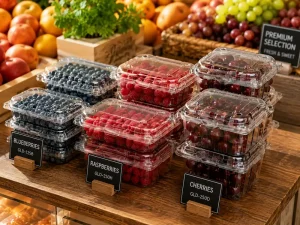
Yes. Fresh-cut fruit needs clear visibility, moisture consideration, and stable handling. Round containers can make fruit bowls look abundant from the top view, especially for melon cubes, pineapple, grapes, mango, berries, kiwi, citrus, and mixed fruit portions.
For fruit-heavy programs, buyers should compare round bowls with fresh-cut fruit containers. Some fruit items work better in round bowls, while family packs, snack combinations, or divided fruit-and-nut packs may need different structures.
11. Can secure round packaging be used for dips and sauces?
Yes, but buyers must test real food performance. Dips, salsa, hummus, cheese dips, dressings, creamy sides, and sauces need stable lid fit and practical leak-resistant performance after proper closure. A container that works for dry snacks may not perform the same way with oil, sauce, or moisture.
For compact chilled foods and deli sides, medium clear food containers help buyers cover fruit portions, dips, small deli sides, desserts, and prepared chilled foods.
12. What sales channels need secure round packaging most?
Secure round packaging is especially useful in channels where food passes through more handling steps before the customer opens it. These include:
- Supermarket chilled shelves.
- Convenience store grab-and-go displays.
- Cafe takeaway counters.
- Hotel breakfast and chilled food counters.
- Delivery and third-party pickup channels.
- Foodservice distributors and wholesale resale.
- Retail private label chilled food programs.
When the food is self-service, ready-to-eat, and visually inspected before purchase, packaging security becomes more important. That is where secure round packaging gives buyers stronger customer confidence.
Sizes: How Buyers Should Choose Capacity
13. What sizes are common for round salad containers?
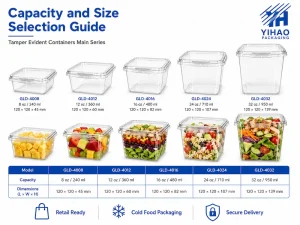
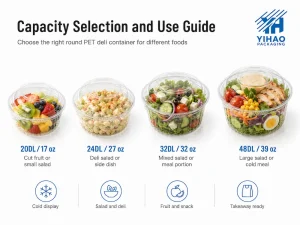
Common round salad container sizes vary by product line, but buyers often organize them into small portions, medium portions, meal-size bowls, and larger shared formats. In a practical salad bowl range, 24oz, 32oz, and 48oz formats can cover medium-small chilled foods, mainstream meal salads, and larger salad or fruit platter applications.
For buyers building a clear size ladder, larger clear PET/RPET containers work for prepared chilled foods, pasta salads, fruit mixes, and deli sides, while large salad and fruit bowls support bigger retail portions, fruit platters, and chilled takeaway meals.
14. How should buyers choose the right size?
Buyers should choose size by food behavior, not by capacity number alone. A leafy salad needs height and topping room. A fruit bowl needs visible fullness and moisture control. A dip needs compact volume and lid reliability. A cold noodle bowl needs depth for mixing. A family salad needs stronger stacking and carton protection.
| Food Type | Preferred Size Logic | Key Test |
|---|---|---|
| Dips and sauces | Small to medium secure round containers | Lid fit and leak behavior after filling |
| Fruit bowls | Small to medium clear PET/RPET bowls | Moisture, clarity, and fill appearance |
| Meal salads | Medium to large round salad containers | Lid clearance and topping protection |
| Cold noodles and grain bowls | Deeper meal-size round bowls | Mixing space and customer eating comfort |
| Shared chilled foods | Large bowls or round trays | Loaded weight, stacking, and transport movement |
15. Should buyers use one container size for many foods?
One size may simplify purchasing, but it often creates poor food presentation. If a container is too large, the portion looks empty. If it is too small, toppings are crushed and the lid may not close properly. A better approach is to create a focused size range with clear roles.
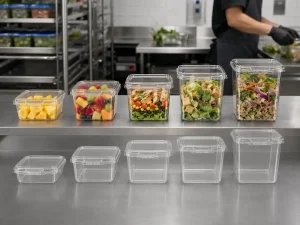
For example, buyers can use small containers for dips and snacks, medium containers for fruit bowls and deli sides, meal-size bowls for salads and cold noodles, and large bowls for shared chilled foods. This range reduces SKU confusion while still matching real food needs.
16. Are shared lids useful for round salad container programs?
Yes. A shared-lid system can reduce inventory complexity and make wholesale purchasing easier. When several bowl sizes use the same top diameter and the same lid, buyers can simplify lid management, reduce matching errors, and improve product-line consistency.
For larger bowl systems, matching PET salad bowl lids should be tested together with the bowl body. Lid compatibility matters as much as container clarity.
Closure, Leak Resistance, and Tamper Evidence
17. Does secure round packaging mean leak-proof?
No. “Secure” and “leak-proof” are not always the same. A container may have good lid engagement and good leak-resistant performance after proper closure, but buyers still need to test actual foods. Dressing, sauce, fruit juice, oil, cream, and transport movement can affect real performance.
Buyers should test filled samples in the actual route: packing, closing, labeling, refrigeration, carton stacking, takeaway handling, and customer opening. Do not approve a container only by checking an empty sample.
18. What should buyers test for leak-resistant performance?
Buyers should test the food most likely to create problems, not the easiest food. Test fruit with juice release, salad dressing, hummus, salsa, pasta salad, creamy deli sides, cold noodles, and sauces. Then check lid engagement, rim condition, sidewall deformation, stacking pressure, and movement during transport.
For tamper-evident chilled food programs, anti-fog tamper-evident containers can support cold-case grab-and-go applications where visibility and closure confidence both matter.
19. How does tamper-evident closure improve customer confidence?
A tamper-evident closure gives customers a visible signal that the package has not been opened after sealing. This matters for ready-to-eat chilled foods because customers cannot always know how the package was handled before purchase.
For supermarkets, cafes, convenience stores, and delivery channels, tamper evident round deli containers help connect product visibility with package integrity. This is especially useful for salads, dips, fruit bowls, deli sides, cold noodles, and chilled meals.
20. What is a tear-strip tamper-evident container?
A tear-strip tamper-evident container uses a strip or tab that must be removed or broken before opening. Once the strip is broken, the customer can see that the package has been opened. This type of structure is common in secure food packaging because it makes first-opening status easier to understand.
For buyers comparing secure closure formats, clear PET tamper-evident containers with tear-strip style closure are useful to review for refrigerated food packaging and secure chilled display.
Retail Display, Labeling, and Customer Experience
21. Why is round packaging good for retail display?
Round packaging creates a centered, bowl-like food presentation. Salads look fuller, fruit bowls look more abundant, dips look easier to serve, and desserts look more premium when customers can view the product through a clear lid and sidewall.
Clear round PET containers also help shoppers evaluate freshness quickly. In retail, customers often decide within seconds, so product visibility, label placement, and package cleanliness all influence conversion.
22. Where should labels be placed on secure round packaging?
Labels should support branding and compliance information without hiding the food or blocking the tamper-evident feature. If the label covers the most attractive product view, the package loses retail value. If the label hides the tear strip or tab, the security feature becomes less clear.
Buyers should test top labels, side labels, barcode labels, ingredient labels, and tamper-evident sticker positions before approving bulk orders.
23. Does anti-fog performance matter?
Anti-fog performance matters when the product is sold through refrigerated shelves or cold-chain display. Fogged lids and sidewalls reduce visibility and make fresh food look less appealing. For salads, fruit, cold noodles, chilled desserts, and deli foods, clearer cold display improves product presentation.
Anti-fog features should be tested under real storage conditions. A package that looks clear at room temperature may behave differently after refrigeration.
24. What creates a good customer opening experience?
A good customer opening experience is secure but not frustrating. The lid should not pop open too easily during handling, but the customer should still understand how to open it. Tamper-evident tabs should be visible, logical, and strong enough to survive packing while still breaking properly during first opening.
This detail matters because customers remember packaging problems. If a package is difficult to open, spills during opening, or damages the food, the product experience suffers even if the food quality is good.
Ordering, Wholesale, and Supplier Questions
25. What should buyers ask before ordering secure round packaging wholesale?
Before placing a wholesale order, buyers should ask:
- Which material is used: PET, RPET, PP, or another material?
- Is the package intended for chilled food, hot food, or microwave use?
- Which lid options match the container?
- Does the container need tamper-evident closure?
- Can the supplier provide samples for real food testing?
- How are containers and lids packed in cartons?
- Can the supplier support repeat orders with consistent clarity and lid fit?
- Does the supplier understand salads, fruit bowls, deli sides, and chilled takeaway applications?
When sourcing from a food packaging factory, buyers should evaluate production consistency, lid compatibility, carton protection, application knowledge, and sample support, not only unit price.
26. How should buyers evaluate a manufacturer or supplier?
A strong manufacturer or supplier should help buyers choose the right packaging structure for the actual food program. The supplier should ask about food type, fill weight, lid needs, sales channel, cold storage, labeling, and ordering volume before recommending a product.
| Evaluation Area | Strong Supplier Behavior | Warning Sign |
|---|---|---|
| Material guidance | Explains PET/RPET fit for chilled food | Uses one material for every application without checking temperature |
| Lid matching | Confirms lid compatibility before quotation | Provides unclear lid recommendations |
| Sample support | Encourages real food testing | Pushes bulk orders before sample evaluation |
| Product range | Offers logical sizes for dips, salads, fruit, and shared foods | Only lists random SKUs without application logic |
| Wholesale packing | Explains carton protection and nesting | Cannot explain shipment damage control |
27. What sample tests should be done before bulk orders?
Buyers should test real food in real conditions. The test should include filling, closing, labeling, stacking, refrigeration, carton movement, takeaway handling, customer opening, and shelf display. The sample should also be compared with bulk production later to confirm consistency.
For larger chilled food and display programs, shared chilled food bowls help buyers evaluate bigger portions, family salads, fruit mixes, and shared retail packs. For multi-item assortments, round compartment catering trays are useful when food separation matters more than one mixed bowl.
28. How can buyers avoid overcomplicating SKUs?
Buyers should build a simple range instead of adding too many similar containers. A practical range may include one small container for dips and snacks, one or two medium containers for fruit and deli sides, one meal-size bowl for salads, one large format for shared foods, and one tamper-evident option for retail or delivery-sensitive channels.
This structure helps procurement, packing teams, and sales teams work from the same logic. It also reduces warehouse pressure and prevents lid-matching mistakes.
29. What information should buyers send to a supplier?
Buyers should send clear application information before requesting a quotation. Useful details include food type, expected portion weight, chilled or ambient use, lid preference, tamper-evident need, label position, carton requirement, target sales channel, and expected order direction.
The more specific the application, the better the supplier can recommend the right secure round packaging. Vague requests often lead to mismatched samples and wasted testing time.
30. What is the biggest mistake buyers make with secure round packaging?
The biggest mistake is choosing by appearance or unit price before testing performance. A clear round container may look attractive, but the real questions are: does it fit the food, close properly, stack safely, display clearly, survive handling, support labeling, and remain consistent in repeat wholesale orders?
For buyers, the best decision is not the cheapest container. It is the packaging system that reduces risk from filling table to customer hand.
Buyer Checklist for Secure Round Packaging
| Checklist Area | What to Confirm | Why It Matters |
|---|---|---|
| Food application | Salad, fruit, dip, deli side, dessert, cold meal, or shared pack | Prevents wrong-size and wrong-structure decisions |
| Material | PET, RPET, PP, or other application-specific material | Matches the package to food temperature and display needs |
| Lid fit | Flat lid, dome lid, hinged lid, separate lid, or tamper-evident closure | Controls closure, stacking, and opening experience |
| Security level | Standard secure lid or visible tamper-evident feature | Matches channel risk and customer trust expectations |
| Display | Clarity, anti-fog behavior, label position, and shelf view | Improves retail appeal and purchase confidence |
| Testing | Real food, real cold storage, real labels, and real handling | Confirms performance before wholesale orders |
| Supplier | Sample support, carton protection, repeat-order consistency | Reduces procurement and quality risk |
FAQ
1. What is secure round packaging used for?
Secure round packaging is used for salads, fruit bowls, dips, sauces, deli sides, cold noodles, grain bowls, chilled desserts, and grab-and-go meals that need clear display, stable closure, and better handling confidence.
2. Are round PET containers suitable for chilled food?
Yes. Round PET containers are suitable for many chilled food applications because PET provides clear visibility, clean presentation, and practical rigidity for salads, fruit, deli foods, and desserts.
3. When should buyers choose round tamper evident containers?
Buyers should choose round tamper evident containers when food is sold through self-service retail, convenience stores, delivery routes, or third-party handling channels where visible first-opening evidence improves customer confidence.
4. What sizes are best for round salad containers?
The best size depends on the food. Small containers fit dips and toppings, medium containers fit fruit and deli sides, meal-size bowls fit salads and cold noodles, and larger bowls fit shared chilled foods or fruit platters.
5. Does secure round packaging mean leak-proof?
No. Secure closure and leak-proof performance are not the same. Buyers should test real foods such as dressing, fruit juice, sauces, dips, and moist deli sides before approving wholesale orders.
6. What should buyers check before ordering wholesale?
Buyers should check material, lid fit, tamper-evident function, food fit, stacking, label placement, anti-fog performance, carton protection, sample quality, and supplier consistency before ordering wholesale secure round packaging.
References
- U.S. Food and Drug Administration, Food Contact Substances and Food Packaging Guidance.
- U.S. Food and Drug Administration, Food Tampering and Consumer Packaging Guidance.
- European Commission, Regulation (EC) No 1935/2004 on Materials and Articles Intended to Come into Contact with Food.
- European Commission, Regulation (EU) No 10/2011 on Plastic Materials and Articles Intended to Come into Contact with Food.
- European Food Safety Authority, Guidance on Plastic Recycling Processes for Food Contact Materials.
- Association of Plastic Recyclers, APR Design Guide for Plastics Recyclability.
- RecyClass, Design for Recycling Guidelines for PET Packaging.
- GS1, General Guidance on Retail Barcode and Label Placement.
Final Note / Practical Takeaway
© YIHAO Packaging. All rights reserved. All articles, product images, packaging designs, technical specifications, and website materials are protected by copyright. Unauthorized copying, reproduction, redistribution, modification, or commercial use is strictly prohibited without prior written permission.