
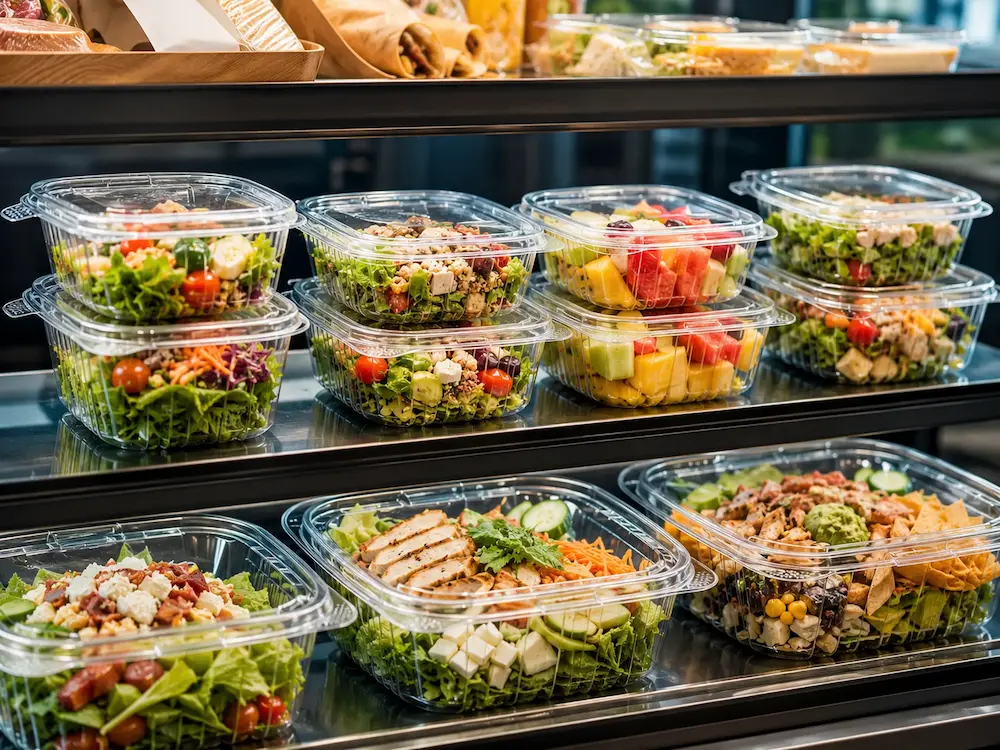
Salad packaging containers are a practical purchasing priority for food packaging teams that manage chilled ready-to-eat salads, supermarket salad programs, cafe takeaway meals, convenience-store lunch items, deli counters, and fresh food retail displays. A salad container is not just a bowl, tray, or hinged pack. It influences product visibility, lid security, shelf organization, chilled handling, label placement, customer trust, and repeat wholesale purchasing.
For B2B buyers, the right packaging choice starts with the product itself. Leafy green salads, grain bowls, pasta salads, fruit salads, protein salads, deli salads, and meal-prep salads do not behave the same way inside a container. Leafy greens need headspace. Pasta salads create weight. Fruit salads release moisture. Meal salads often need topping visibility and secure lids. That is why packaging teams compare salad packaging containers, clear salad bowls, PET hinged deli containers, square PET deli containers, tamper-evident packs, and compartment formats before confirming a wholesale order.
YIHAO food packaging solution provider focuses on clear PET and rPET packaging for chilled fresh food, salad, deli, bakery, produce, and grab-and-go retail applications. For food packaging teams, the goal is clear: choose containers that make fresh food look attractive, stay protected, and move efficiently through filling, closing, labeling, chilled storage, transport, display, and final sale.
What Are Salad Packaging Containers?
Salad packaging containers are food-contact packaging formats designed for chilled salads, ready-to-eat salad meals, deli salads, fruit salads, grain bowls, pasta salads, and grab-and-go fresh food. They are used by supermarkets, cafes, central kitchens, convenience stores, foodservice operators, fresh food distributors, salad brands, and wholesale packaging buyers.
Most retail salad packaging relies on clear PET or rPET because visibility matters in chilled display. Buyers want customers to see lettuce color, topping quality, ingredient layers, portion value, and product freshness before purchase. A transparent container also helps store staff inspect the product quickly during packing, shelf rotation, and cold-case restocking.
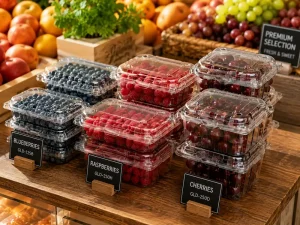
In practice, salad packaging usually falls into several formats: round clear salad bowls, hinged deli containers, square PET containers, tamper-evident containers, compartment containers, and fresh-cut fruit or snack containers that also support toppings, side salads, and ingredient combinations.
Why Salad Packaging Containers Matter for Fresh Food Sales
Fresh food packaging directly affects how a salad sells. A well-prepared salad can lose value if the lid fogs heavily, the base bends, the container leaks dressing, or the product looks compressed. A well-matched container improves shelf appeal, protects the food presentation, and supports a more confident buying decision.
For supermarkets, supermarket salad containers must support cold-case visibility, stable stacking, label placement, fast replenishment, and safe customer handling. For cafes and convenience stores, grab-and-go salad containers must look clean, close securely, and fit compact refrigerated displays. For meal-prep and ready-to-eat brands, ready-to-eat salad containers must balance portion control, lid fit, transport stability, and brand presentation.
This is why many food packaging teams start by comparing clear salad bowls and PET hinged deli containers. These two formats cover many chilled salad programs because they combine product visibility, practical handling, and strong retail compatibility.
Main Types of Salad Packaging Containers
Clear Salad Bowls
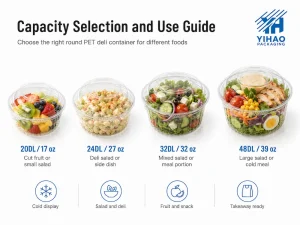
Clear salad bowls are widely used for leafy salads, protein bowls, fruit salads, grain bowls, noodle salads, and premium chilled meal salads. Their round shape gives a strong top-view presentation, which is useful when the product relies on color, layering, and ingredient freshness.
A clear PET salad bowl with hinged lid is a strong choice for grab-and-go salads and fresh fruit portions because the attached lid simplifies packing and reduces lid mismatch. For ready-to-eat salad programs, a ready-to-eat salad bowl supports chilled display while keeping the meal visible and easy to merchandise.
Hinged Salad Containers
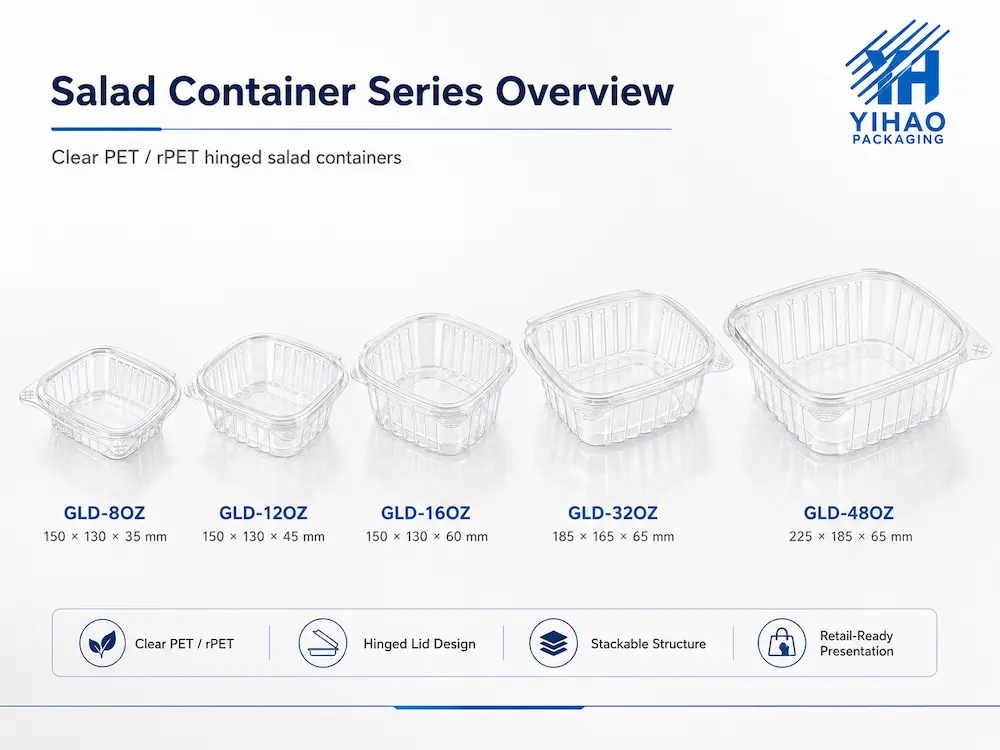
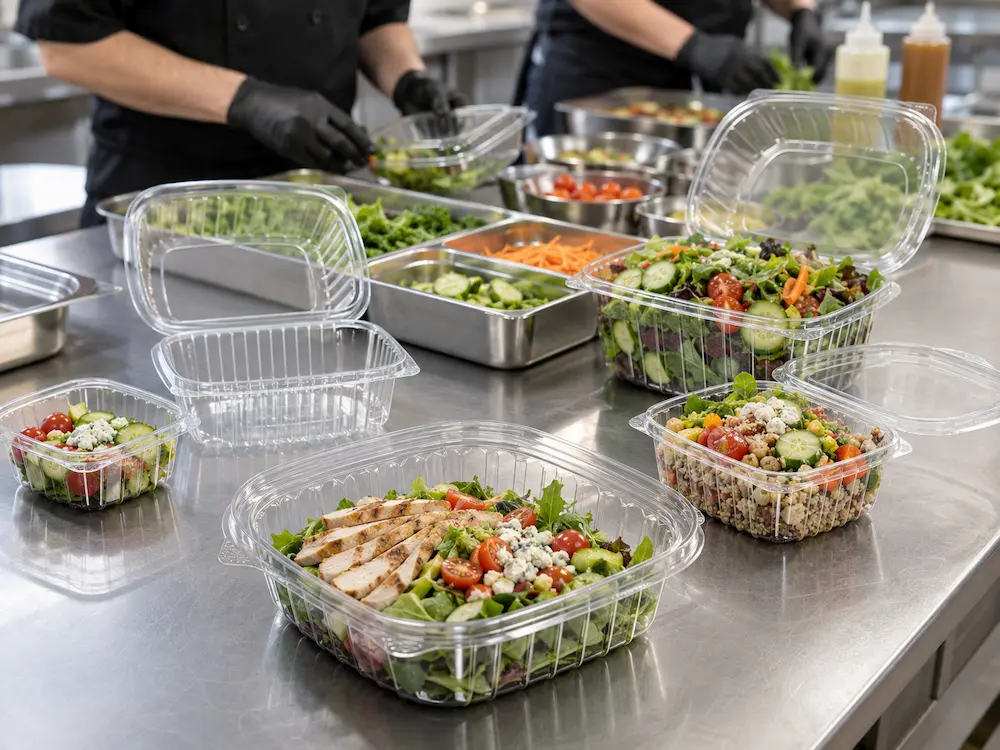
Hinged salad containers are useful for fast-paced packing operations. Because the lid and base are connected, staff do not need to match separate lids during filling. This improves packing speed, simplifies inventory, and reduces operational errors in cafes, delis, salad bars, and central kitchens.
For deli salads, fruit salads, snacks, and chilled grab-and-go foods, a clear recycled PET hinged deli container gives buyers a transparent and practical format for fresh food display. For broader grab-and-go food programs, a clear recycled PET grab-and-go food container supports chilled salads, fruit portions, snacks, and deli-style meals without forcing the buyer into a single product concept.
Square PET Salad Containers
Square PET containers are useful when shelf efficiency, carton planning, label placement, and portion control matter. Compared with round bowls, square packs often support tighter cold-case organization and more structured stacking in refrigerated displays.
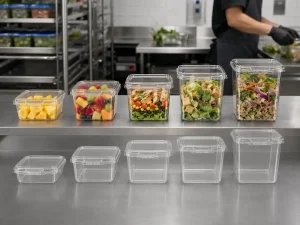
Food packaging teams can review square PET deli containers when they need a clean retail format for salads, fruit, deli meals, and chilled sides. A clear square high-lid food container works well for salads with toppings, layered ingredients, or added headspace. A clear square flat-lid food container is better for flatter salad presentations, compact fresh food portions, and organized supermarket merchandising.
Tamper-Evident Salad Containers
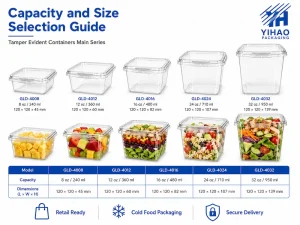
Tamper-evident containers are valuable when salads are sold in supermarkets, convenience stores, cold cases, vending-style displays, and unattended retail environments. A visible security feature helps customers recognize whether the pack has been opened before purchase. This matters for ready-to-eat salad containers because the product is consumed directly after purchase or with minimal preparation.
Buyers developing retail salad programs often compare tamper evident containers for chilled food safety perception, shelf trust, and sealed display. An anti-fog clear PET tamper-evident container is suitable for cold-case grab-and-go foods where product visibility and security both matter. For stronger retail security, a clear PET tamper-evident container with tear-strip seal gives packaging teams a more protective option for chilled retail handling.
Compartment and Side-Pack Containers
Some salad programs need ingredient separation. Nuts, fruit, cheese, croutons, proteins, and dressing should not always touch leafy greens before sale. Compartment containers help preserve texture and allow buyers to create higher-value combinations for retail, convenience, and foodservice channels.
For snack salads, fruit-and-nut sides, and topping combinations, food teams can also consider fresh-cut fruit containers. A clear PET two-compartment fruit and nut container is relevant when the product concept includes divided ingredients, snack pairings, or salad toppings that need visual separation.
Material Selection: PET, rPET, PP, or Paper-Based Salad Packaging?
Material choice affects clarity, rigidity, chilled display, sustainability messaging, price positioning, and supplier selection. PET and rPET are common choices for chilled salad packaging because they provide high clarity and strong retail presentation. PP is used in some food container categories where heat tolerance is required, but it usually does not deliver the same crystal-clear appearance as PET. Paper-based formats may support a natural look, but they require careful review for moisture resistance, window visibility, and chilled display performance.
| Material | Best Use | Main Advantage | Buyer Check |
|---|---|---|---|
| PET | Clear salad bowls, chilled salad packaging, grab-and-go salad containers | High clarity, strong shelf visibility, clean retail appearance | Confirm lid fit, wall strength, stacking performance, and cold-case display behavior. |
| rPET | Retail salad packaging with recycled-content positioning | Supports sustainability-focused packaging discussion | Confirm food-contact suitability, material consistency, and recycled-content documentation. |
| PP | Selected food containers where heat tolerance is required | Better heat resistance than PET in many foodservice applications | Check whether transparency and rigidity meet chilled retail display needs. |
| Paper-Based | Natural-style presentation and selected dry salad concepts | Warm kraft-style identity and natural visual positioning | Review moisture resistance, grease resistance, window visibility, and lid compatibility. |
Food-Contact and Compliance Questions Buyers Should Ask
Food packaging teams should treat food-contact suitability as a buying requirement, not an afterthought. A salad container comes into direct contact with chilled ready-to-eat food, so buyers should confirm that the selected material and production process are appropriate for the intended market and application.
For PET and rPET salad packaging, buyers should ask whether the supplier can provide relevant food-contact documentation, material information, and sample support. When recycled plastic is used in food packaging, buyers should be especially careful to confirm that the recycled material stream and process are suitable for food-contact applications in the target market. Compliance expectations may vary by country or region, so buyers should verify requirements for the market where the salads will be sold.
For chilled salads, packaging should also be tested under the actual cold-chain environment. Retail refrigerators and cold rooms can affect label adhesion, lid fit, condensation, rigidity, and shelf appearance. A container that performs well at room temperature should still be reviewed after refrigeration, transport simulation, and stacked storage.
How to Choose Salad Packaging Containers by Sales Channel
| Sales Channel | Packaging Priority | Recommended Direction |
|---|---|---|
| Supermarkets | Cold-case visibility, stacking, label space, tamper evidence, repeat SKU consistency | Clear bowls, square PET containers, tamper-evident salad containers |
| Cafes | Fast packing, attractive display, secure closure, easy customer handling | Hinged deli containers, clear salad bowls, compact square containers |
| Convenience Stores | Grab-and-go appeal, compact shelf fit, clean labeling, lid security | Grab-and-go salad containers, tamper-evident containers, square PET packs |
| Central Kitchens | Packing speed, carton efficiency, repeat supply, consistent quality | Hinged PET containers, round salad bowls, standardized packaging families |
| Foodservice and Catering | Larger portions, divided presentation, transport stability, serving convenience | Large salad bowls, compartment trays, catering trays with clear lids |
Supermarket Salad Containers
Supermarket salad containers must perform under refrigerated lighting, repeated customer handling, and shelf stacking. The pack should show the product clearly from the front and top. It should also leave enough space for branding labels, nutrition labels, barcode labels, price stickers, and use-by information.
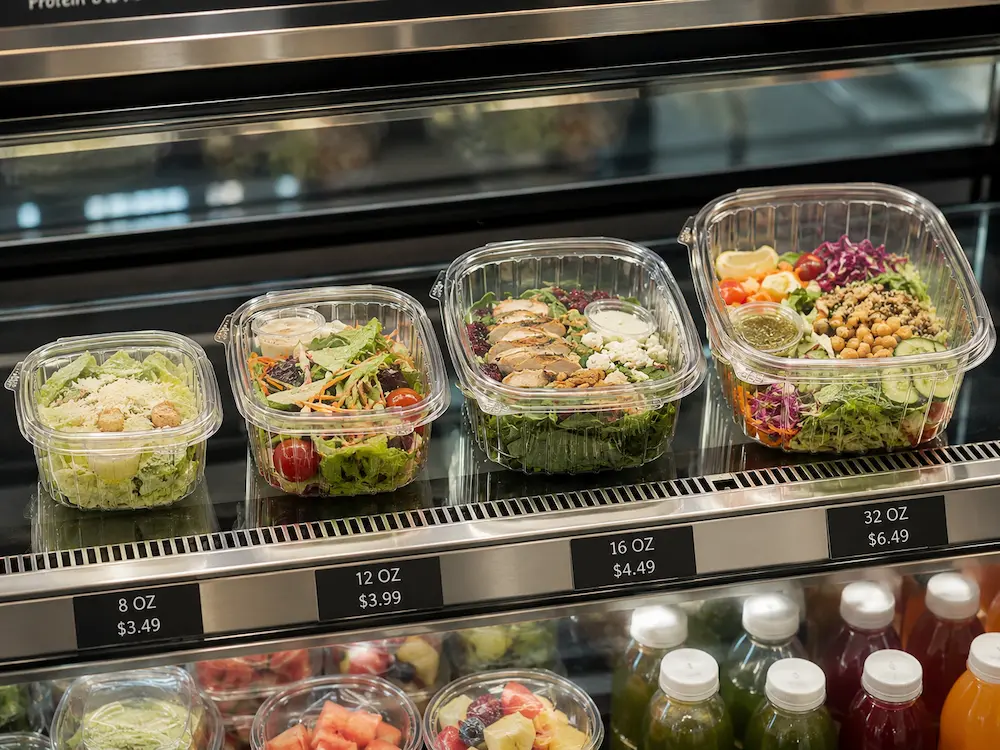
For supermarkets, packaging teams should test whether containers stack evenly after filling. A container that looks strong when empty may behave differently when filled with leafy greens, tomatoes, proteins, pasta, dressing cups, or heavier toppings. Buyers should also review carton packing efficiency because supermarket programs often require repeat wholesale orders, stable SKUs, and reliable replenishment.
Grab-and-Go Salad Containers
Grab-and-go salad containers need instant shelf appeal. Customers often choose quickly, so the packaging must communicate freshness before they read the label. Clear PET, stable lids, clean edges, and a neat product shape help increase confidence in the meal.
For cafe counters, office lunch displays, airports, schools, and convenience-store coolers, the container should be easy to hold, quick to open, and secure enough for short-distance transport. A premium grab-and-go salad container should not collapse under normal handling, should not make the salad look compressed, and should fit the brand’s price position.
Ready-to-Eat Salad Containers
Ready-to-eat salad containers must protect food that customers may consume directly after purchase. The container should support clean display, secure closure, practical labeling, and a format that feels trustworthy. If the salad includes dressing, packaging teams should decide whether the dressing is packed separately, placed in an insert cup, or sold as part of a divided layout.
Clear bowls and hinged PET containers are popular for ready-to-eat salads because they make ingredient quality visible. For more sensitive retail environments, tamper-evident packaging can add another layer of confidence.
Foodservice and Catering Salad Containers
Foodservice and catering buyers often need consistency across multiple portion sizes. The best container system should cover individual salads, side salads, fruit salads, sharing bowls, and chilled party trays. Packaging teams should check whether the same supplier can support a full range instead of only one size or shape.
For chilled platters and larger party-style displays, a clear PET multi-compartment catering tray is useful when buyers need divided presentation for salad toppings, fruit, snacks, sushi assortments, or retail sharing packs.
Buyer Checklist Before Wholesale Ordering
Before placing a wholesale order, packaging teams should test salad packaging containers under real operating conditions. Do not judge only by catalog photos. A sample should be filled, closed, stacked, chilled, transported, labeled, opened, and reviewed from the customer’s point of view.
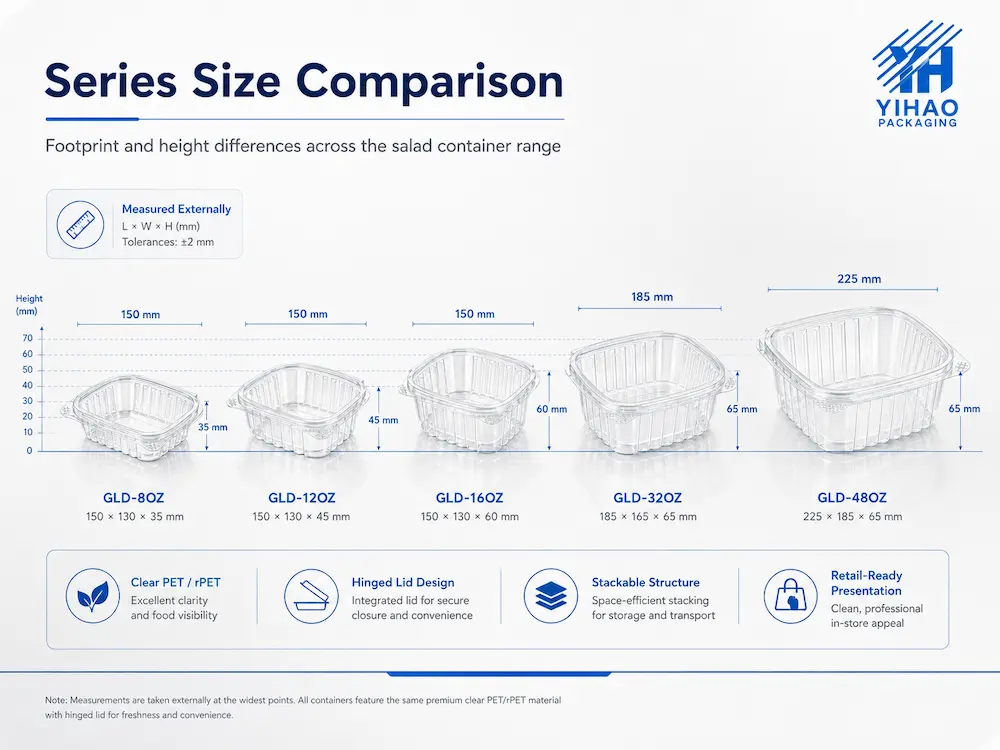
| Buyer Question | Why It Matters | What to Test |
|---|---|---|
| What salad type will be packed? | Leafy salads, grain bowls, fruit salads, and deli salads need different depths and lid shapes. | Fill height, ingredient movement, lid clearance, and top visibility. |
| Will the product be sold chilled? | Cold-case conditions affect clarity, condensation, stiffness, and label adhesion. | Display appearance after refrigeration and transport simulation. |
| Is tamper evidence required? | Supermarkets and ready-to-eat channels often need visible security features. | Seal visibility, tear-strip function, and customer opening experience. |
| Will dressing or toppings be packed separately? | Dry and wet ingredients may need separation to protect texture. | Compartment layout, insert cup space, and leak risk. |
| How will the container be labeled? | Labels must fit without blocking too much product visibility. | Top label area, side label area, barcode placement, and branding visibility. |
| Can the supplier support repeat wholesale orders? | Salad packaging requires stable supply, consistent quality, and practical communication. | Sample quality, carton packing, lead-time planning, and production support. |
Key Performance Factors Food Packaging Teams Should Compare
Clarity and Shelf Visibility
For chilled salad packaging, clarity is one of the strongest selling factors. Customers want to see freshness before purchase. A transparent container helps display lettuce color, fruit brightness, protein quality, dressing separation, topping variety, and portion value. In many retail environments, the package becomes the display case.
Lid Fit and Closure Strength
A lid should close consistently without excessive pressure. If staff struggle to close the container during rush periods, packing speed drops. If the closure feels weak, customers may worry about spills. Buyers should test lid fit after filling because ingredients create upward pressure, especially in salads with bulky toppings.
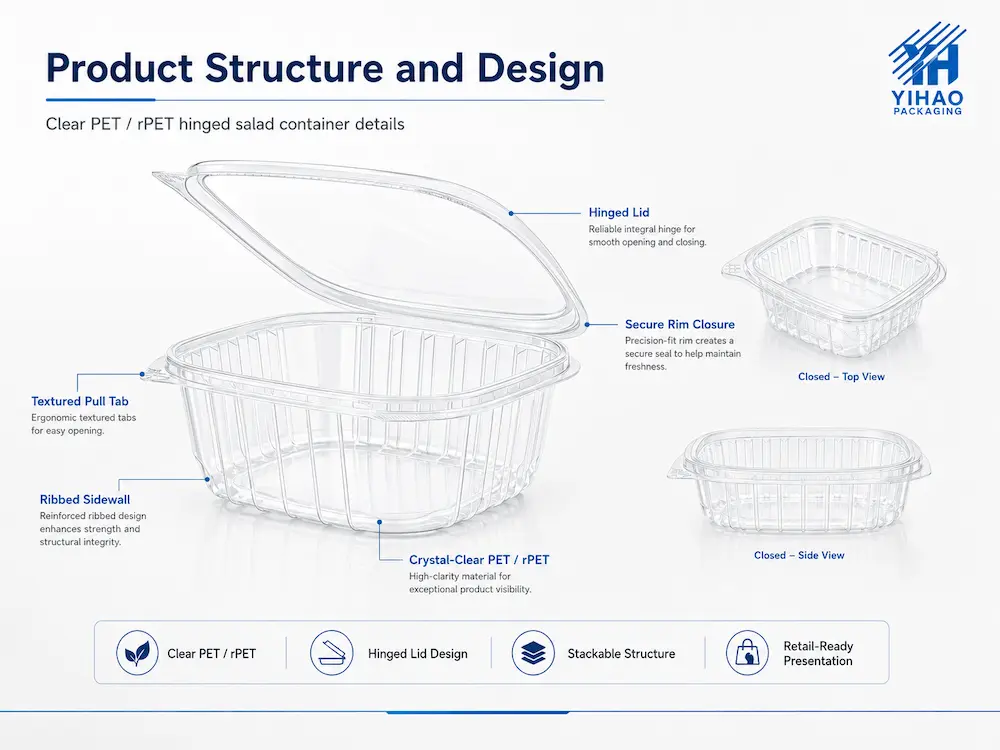
Stacking and Transport Stability
Stacking performance matters for supermarkets, central kitchens, distributors, and wholesale buyers. Containers should stack securely when empty and remain stable after filling. Poor stacking increases labor costs, storage problems, product damage, and shelf disorder.
Label and Branding Area
Packaging teams should decide where labels will sit before confirming a container. A label that covers too much of the lid may reduce product visibility. A label that does not adhere well in cold conditions may create operational issues. The ideal container supports branding while still showing the salad clearly.
Material Consistency
Wholesale buyers should review material consistency across batches. A container should maintain similar clarity, thickness feel, closure performance, and carton condition from one order to the next. This is one reason to work with a reliable food packaging manufacturer rather than choosing only by the lowest unit price.
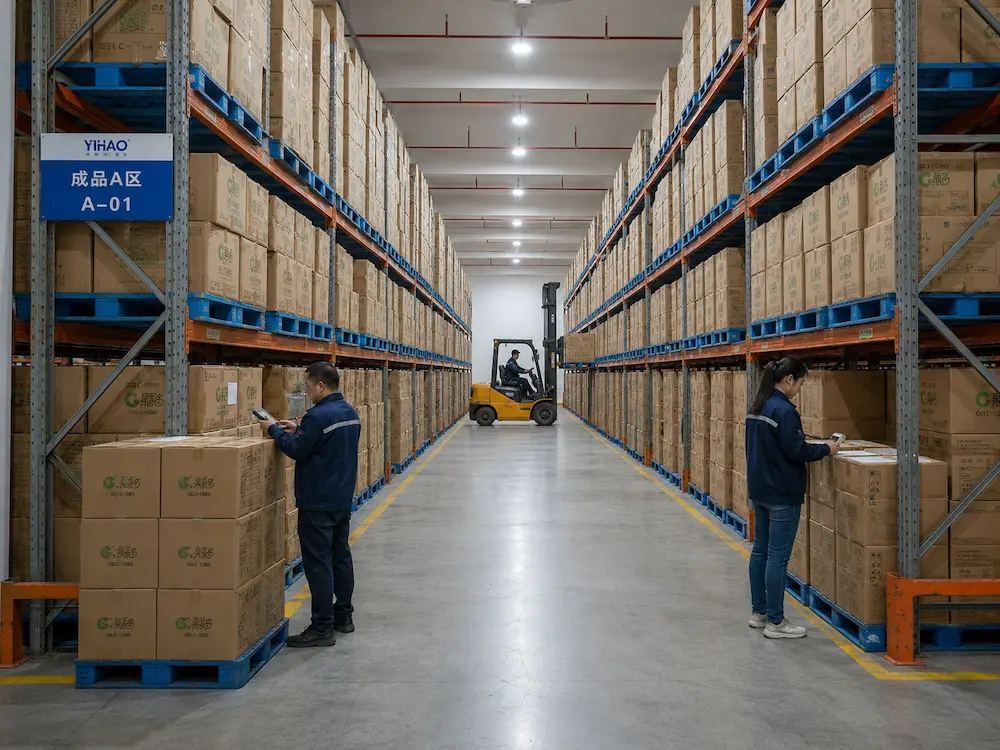
Wholesale Supplier Selection: What Buyers Should Ask
Choosing a salad packaging supplier is not just a price comparison. A low price loses value if the container creates complaints, slows packing, arrives with inconsistent quality, or cannot support repeat orders. Food packaging teams should evaluate the supplier’s product range, communication, sample support, material options, production stability, documentation, carton packing, and ability to match the intended sales channel.
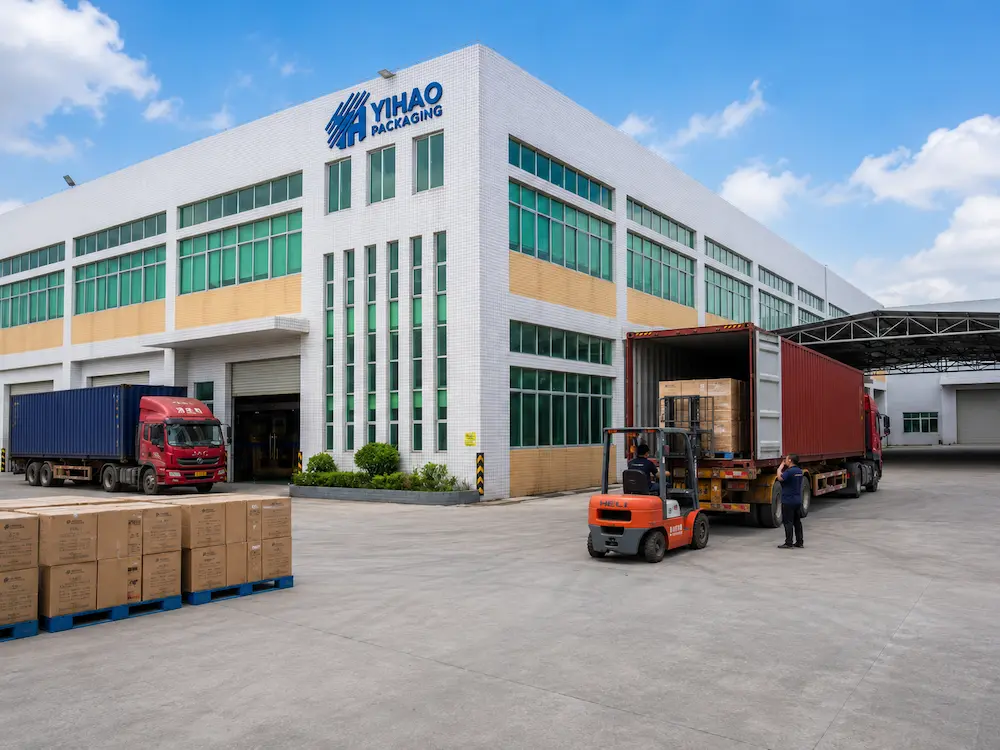
| Supplier Factor | Why Buyers Should Care | Preferred Direction |
|---|---|---|
| Product Range | A broader range helps buyers match bowls, hinged packs, square containers, and tamper-evident formats. | Choose a supplier with multiple salad and deli packaging options. |
| Sample Support | Samples reduce the risk of poor lid fit, weak stacking, or unsuitable portion size. | Request samples before confirming bulk orders. |
| Wholesale Reliability | Repeat programs need stable supply and consistent carton quality. | Review production capacity, packing method, and order planning. |
| Customization Ability | Private-label salad brands may need label guidance, logo printing, or custom packaging direction. | Discuss branding requirements early. |
| Material Options | PET and rPET positioning may affect brand image and buyer preference. | Confirm available material choices and food-contact suitability. |
| Documentation | Food packaging teams need confidence before selling into regulated retail markets. | Ask for material information, sample reports, and market-specific compliance support. |
Common Mistakes When Buying Salad Packaging Containers
The first mistake is choosing a container only by capacity. Capacity matters, but salad volume is not always the same as liquid volume. Leafy greens create height. Protein toppings create weight. Fruit salad creates moisture. Pasta salad creates density. Buyers should test real product fill instead of assuming that a catalog capacity will match the finished meal.
The second mistake is ignoring the lid. A clear base with a weak lid will not perform well in retail or takeaway. Lid height, hinge strength, snap closure, anti-fog performance, and stacking shape all affect the final customer experience.
The third mistake is overloading the label area. Strong branding is important, but chilled salad packaging sells through visibility. A label should communicate brand and product information without hiding the fresh ingredients customers want to see.
The fourth mistake is selecting a container that fits only one product. A smarter approach is to build a packaging family. For example, a buyer may use clear salad bowls for premium meal salads, square PET containers for compact chilled meals, hinged deli containers for fruit salad and deli sides, and tamper-evident containers for supermarket ready-to-eat items.
Why Work With YIHAO for Salad Packaging Containers?
YIHAO supports food packaging buyers with clear PET and rPET packaging solutions for chilled salads, deli foods, fresh-cut fruit, bakery items, produce, and grab-and-go meals. For salad packaging containers, the value is not only the container itself. The value is a more complete packaging decision: product fit, shelf visibility, lid security, carton planning, wholesale supply, and practical sample testing.
Food packaging teams working with supermarkets, cafes, convenience stores, distributors, and ready-to-eat salad brands need packaging that supports repeat sales. A good supplier should help buyers compare salad bowls, hinged containers, square containers, tamper-evident containers, and compartment options based on the actual product and sales channel.
When a buyer needs chilled display clarity, retail-ready presentation, and wholesale supply support, YIHAO helps connect packaging format with product use. That makes the selection process more efficient and gives food teams a stronger foundation before placing bulk orders.
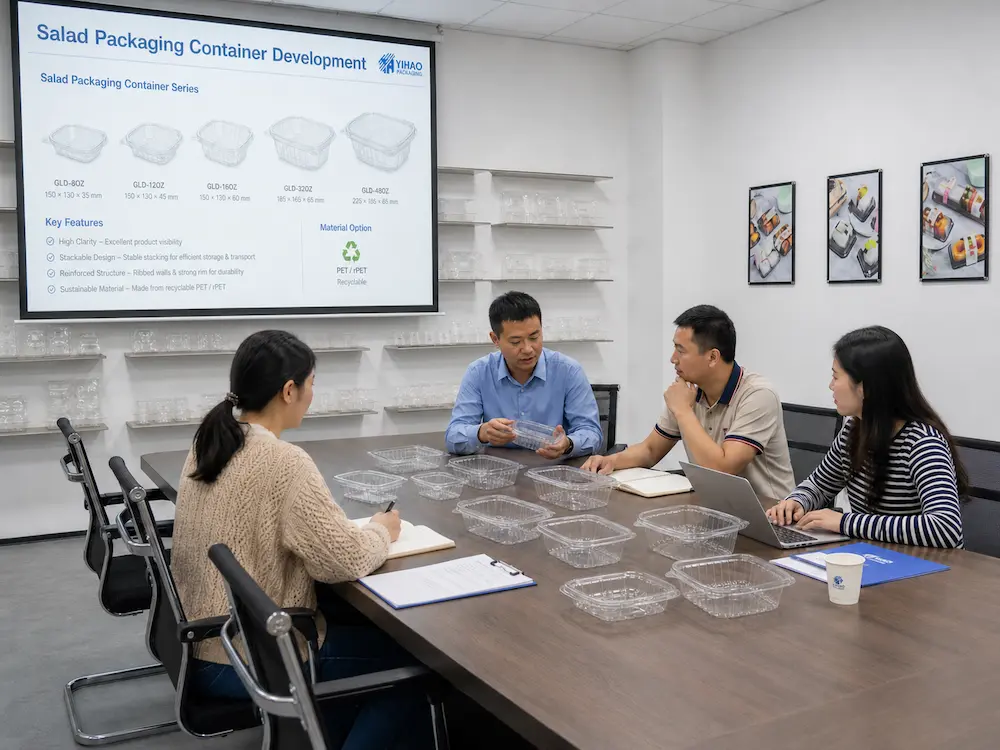
Deep-Dive Insights for Food Packaging Teams
Final Note / Practical Takeaway
FAQ: Salad Packaging Containers
1. What are salad packaging containers used for?
Salad packaging containers are used for chilled salads, ready-to-eat salads, grab-and-go salad meals, deli salads, fruit salads, grain bowls, pasta salads, and supermarket salad displays. They help protect the product, improve visibility, and support practical retail handling.
2. What material is best for clear salad bowls?
PET and rPET are common choices for clear salad bowls because they provide strong transparency and chilled shelf appeal. Buyers should confirm food-contact suitability, lid fit, carton packing, and cold-case performance before placing wholesale orders.
3. Are PET salad packaging containers suitable for chilled display?
Yes, PET salad packaging containers are widely used for chilled display because they offer high clarity and stable presentation for fresh food. Buyers should still test the actual filled product under refrigerated conditions to review condensation, stacking, and label performance.
4. How should buyers choose supermarket salad containers?
Buyers should choose supermarket salad containers by checking product visibility, lid security, stacking stability, label area, portion fit, material clarity, and supplier reliability. Tamper-evident options may be useful for ready-to-eat salad programs in retail cold cases.
5. What should food packaging teams check before wholesale salad container orders?
Food packaging teams should request samples, test real fill volume, review lid closure, check chilled shelf appearance, compare label placement, test stacking, and confirm that the supplier can support repeat wholesale orders with consistent quality.
References
- U.S. Food and Drug Administration, Packaging & Food Contact Substances, FDA.
- U.S. Food and Drug Administration, Recycled Plastics in Food Packaging, FDA.
- U.S. Food and Drug Administration, Guidance for Industry: Use of Recycled Plastics in Food Packaging: Chemistry Considerations, FDA.
- European Commission, Commission Regulation (EU) No 10/2011 on Plastic Materials and Articles Intended to Come into Contact with Food.
- European Parliament and Council, Regulation (EC) No 1935/2004 on Materials and Articles Intended to Come into Contact with Food.
- Association of Plastic Recyclers, APR Design Guide for PET Rigid Packaging.
- U.S. Food and Drug Administration, Refrigerator Thermometers: Cold Facts about Food Safety.
- FoodSafety.gov, Cold Food Storage Chart.
© YIHAO Packaging. All rights reserved.
Food packaging solutions for global wholesale buyers, supermarkets, cafes, bakeries, and foodservice brands.