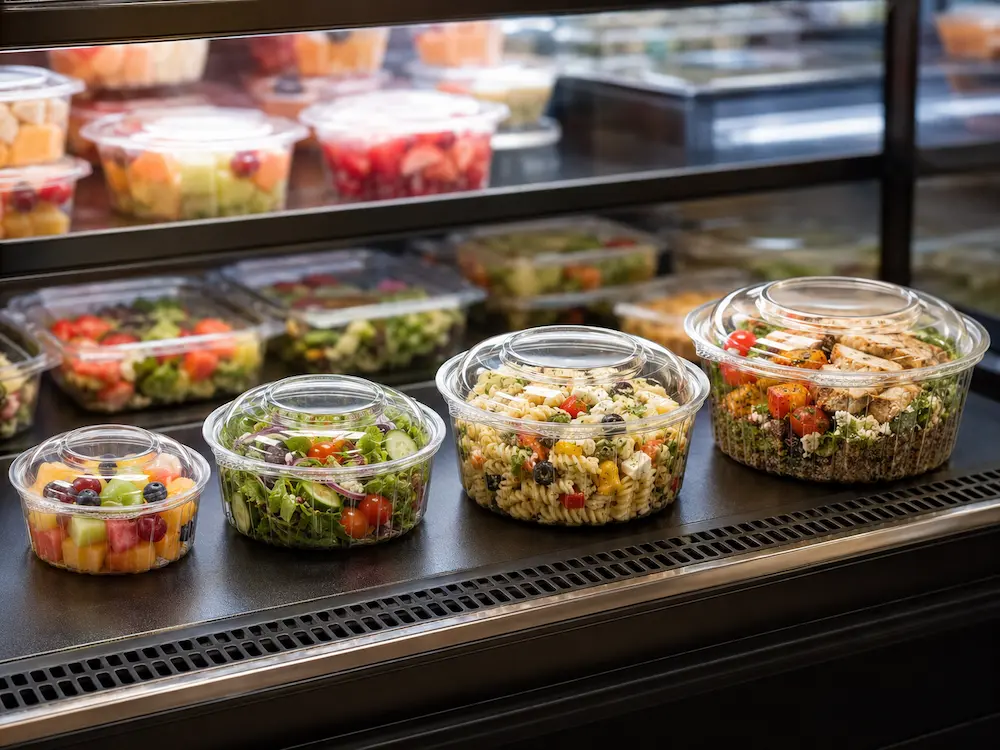
Choosing between salad clamshell containers and alternative packaging is not only a shape decision. It affects food visibility, staff packing speed, cold-case display, customer handling, carton efficiency, and wholesale reorder consistency. A clear hinged clamshell may be the best option for grab-and-go salad, while a round PET bowl, square deli container, film-sealed tray, paper bowl, or PP container may be better for a different food program.
For food packaging buyers, the real question is direct: should this product be packed in a clamshell, a bowl, a tray, or another deli packaging format? The answer depends on the food type, portion size, temperature requirement, moisture level, display style, and packing operation.
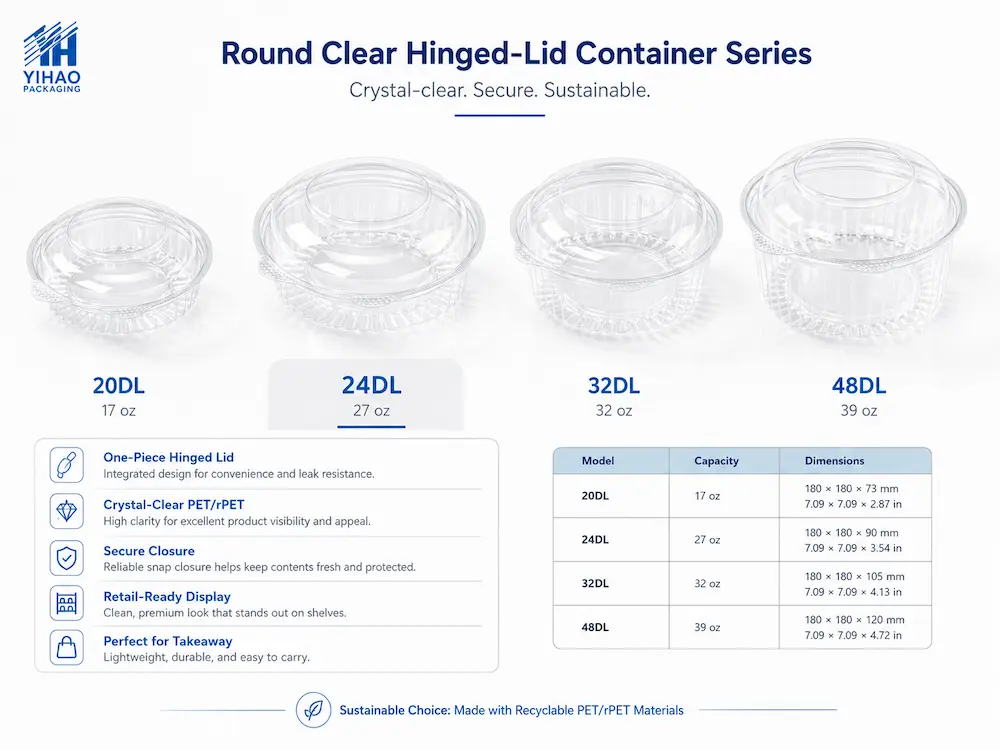
As a packaging manufacturer and solution provider, YIHAO supports clear plastic food packaging for supermarkets, cafes, bakeries, distributors, foodservice brands, and chilled retail programs. This guide compares salad clamshell containers with common alternatives so buyers can choose a structure that fits real production, retail display, and wholesale supply needs.
Quick Decision Table: Which Salad Packaging Format Should Buyers Choose?
| Buyer Need | Better Packaging Choice | Reason |
|---|---|---|
| Fast manual packing | Salad clamshell containers | One-piece hinged structure reduces lid matching and speeds up packing |
| Clear retail display | Clear PET deli containers or salad clamshells | Transparent structure shows freshness, color, and portion size |
| Premium meal salad presentation | Round PET salad bowls | Bowl shape creates better depth for full meal salads and grain bowls |
| Compact shelf organization | Square PET deli containers | Square structure supports neat shelf layout and efficient case arrangement |
| Heat or microwave use | PP containers | PP is usually more suitable for heat-related food applications than PET |
| Automated sealed packing | Film-sealed trays | Tray sealing works better when the operation has sealing equipment and film control |
| Brand printing and natural look | Paper or fiber bowls | Paper-based formats provide more printable surface but reduce full product visibility |
What Are Salad Clamshell Containers?
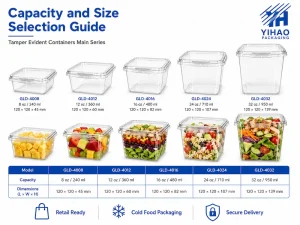
Salad clamshell containers are clear hinged packaging formats used for ready-to-eat salads, deli salads, fruit salad, cold pasta, chilled noodles, snack packs, bakery sides, and grab-and-go fresh meals. The lid and base are connected by a hinge, so the container opens and closes as one piece.
This one-piece design is the main advantage. Staff do not need to match separate lids during packing, which reduces operation complexity in busy supermarket commissaries, cafe prep areas, convenience stores, airport food counters, and foodservice packing lines.
Most salad clamshells for chilled food are made from PET or rPET because the material offers strong transparency and a clean retail look. Clear packaging allows customers to see lettuce color, toppings, fruit freshness, portion size, and ingredient separation before purchase. For chilled retail programs, this visibility often supports purchase confidence more directly than opaque packaging.
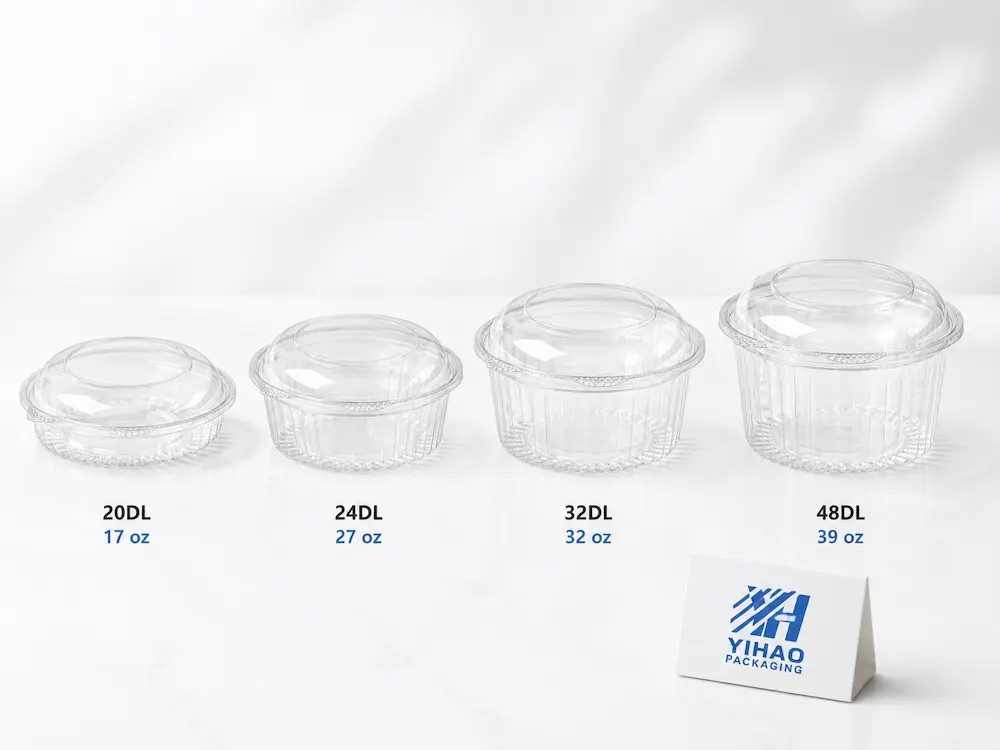
Buyers comparing deli and salad containers should treat clamshells as one part of a broader salad packaging system. They are excellent for many cold food programs, but they are not always the best structure for meal bowls, hot foods, high-liquid products, or equipment-sealed operations.
Salad Clamshell Containers vs Alternative Packaging: Main Comparison
| Packaging Format | Best For | Main Strength | Main Limitation | Buyer Recommendation |
|---|---|---|---|---|
| Salad clamshell containers | Grab-and-go salads, chilled deli food, fruit salad, snack packs | Clear display, hinged convenience, fast closing | Not ideal for hot food or very liquid-heavy meals | Choose when visibility, speed, and retail presentation are priorities |
| Round salad bowls | Meal salads, grain bowls, fruit bowls, chilled noodles | Premium eating experience and strong visual depth | Separate lid matching may increase packing steps | Choose when the product is sold as a full meal bowl |
| Square deli containers | Deli sides, compact salads, fruit portions, chilled meals | Shelf efficiency and neat cold-case organization | Less natural bowl-style eating experience | Choose when shelf order and compact display matter |
| Film-sealed trays | Automated packing, sealed retail programs, high-volume production | Stronger seal control when equipment and film are matched | Requires sealing equipment and process control | Choose only when the operation is built for tray sealing |
| Paper or fiber bowls | Brand-led takeaway salads and selected sustainability programs | Printable exterior and natural visual style | Lower side visibility and coating considerations | Choose when brand image matters more than full product visibility |
| PP deli containers | Prepared foods, hot deli food, reheatable meal programs | Better fit for heat-related food applications | Usually less crystal-clear than PET | Choose when heat resistance is more important than premium clarity |
When Salad Clamshell Containers Are the Better Choice
Salad clamshell containers are the better choice when the product is chilled, visually attractive, portioned for retail display, and packed for ready-to-eat sale. This includes green salads, deli salads, fruit salad, pasta salad, cold noodles, snack packs, bakery sides, and light takeaway meals.
The hinged structure supports fast operation because the lid and base stay connected. This helps packing teams reduce lid mismatch, simplify inventory handling, and improve speed during daily preparation. For wholesale buyers, this matters because labor efficiency is part of the real packaging cost.
Clear hinged packs also support visual merchandising. A good salad package should show freshness clearly without forcing customers to open the lid. For this reason, buyers often compare PET hinged deli containers when building chilled salad and deli programs.
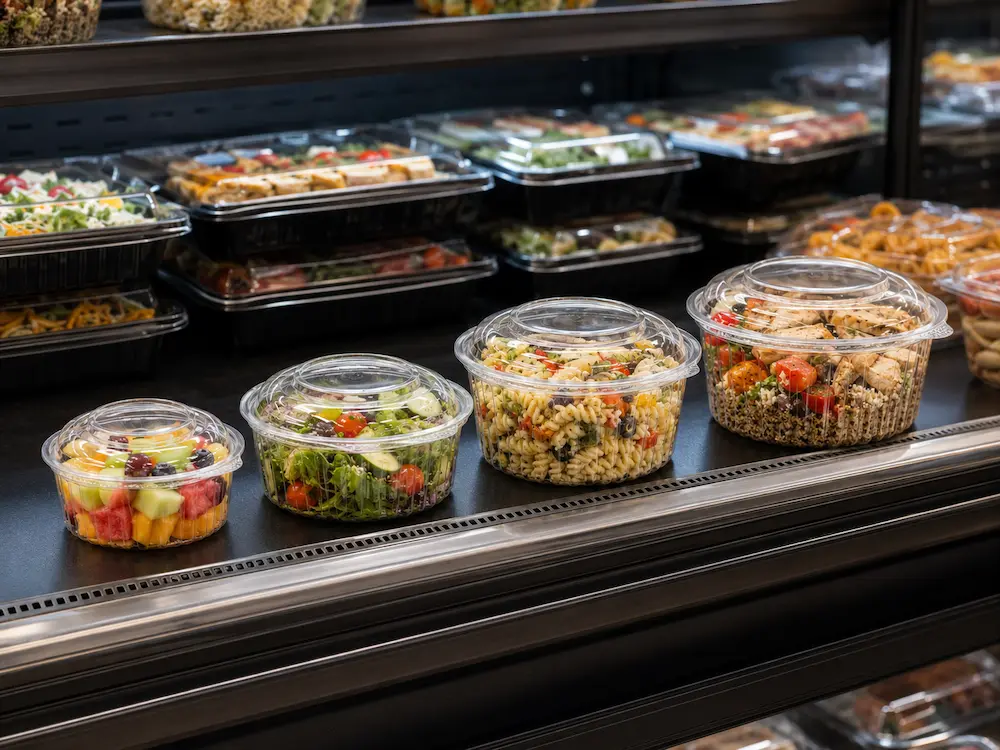
Do not choose salad clamshells only because they are familiar. Choose them when the product benefits from a hinged structure, clear display, and quick manual closure. For compact portions, a format such as deli salad and snack packaging can support smaller chilled food applications. For larger grab-and-go portions, buyers may compare bigger hinged formats such as grab-and-go food packaging.
When Round Salad Bowls Are Better Than Salad Clamshell Containers
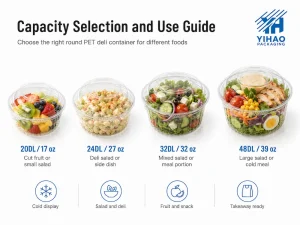
Round salad bowls are better when the product is positioned as a full meal rather than a flat deli portion. Meal salads, grain bowls, poke-style meals, chilled noodles, and fruit bowls often look more premium in a round structure because ingredients build upward and create visual depth.
A bowl also gives customers more room to mix dressing, toppings, grains, and proteins. This makes round bowls more suitable for eat-from-the-pack meals. If the salad is designed as a lunch bowl, round PET packaging may create a better customer experience than a shallow clamshell.
Buyers should compare round PET containers when the product needs a stronger bowl-style presentation. For example, salad fruit mix chilled noodles and takeaway meals are more naturally served in bowl formats than in many flat clamshell designs.
Do not choose round bowls if the main goal is the fastest possible manual closure with a one-piece format. Separate lids can add storage and matching steps. For high-speed side salad programs, hinged clamshells often remain more efficient.
When Square PET Deli Containers Are Better Than Salad Clamshells
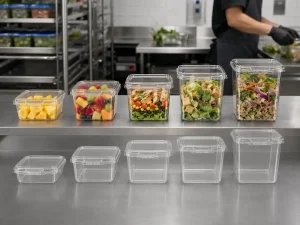
Square PET deli containers are useful when buyers need compact shelf organization, efficient carton packing, and clean cold-case presentation. They fit deli sides, fruit portions, compact salads, toppings, chilled snacks, and small prepared foods.
The square structure helps retailers organize shelves neatly. Compared with round bowls, square formats often use space more efficiently. Compared with hinged clamshells, they may provide a more structured base for dense foods or compact deli portions.
Buyers should review square PET containers when the product is dense, compact, or designed for shelf efficiency rather than fast hinged packing. A product format such as salad fruit deli meals may be more suitable when cold-case order, stackability, and compact presentation matter more than one-piece hinged convenience.
Do not choose square containers only for appearance. Confirm lid fit, label position, stacking strength, and customer opening experience before placing wholesale orders.
When Film-Sealed Trays Are Better Than Clamshell Packaging
Film-sealed trays are better when the packing operation has the correct sealing equipment, film specification, tray compatibility, and production control. They can support high-volume retail programs where consistent sealing, tamper control, and process standardization matter.
However, film-sealed trays are not a simple replacement for salad clamshell containers. They require sealing machinery, trained staff, film control, sealing temperature management, and production validation. For smaller cafes, seasonal salad programs, and low-to-medium volume grab-and-go lines, hinged clamshells are often easier to implement.
Do not choose film-sealed trays unless the operation is built for sealing. If the buyer does not have stable volume, equipment, and process control, clamshell packaging is usually more practical for manual packing.
When Paper or Fiber Bowls Are Better Than Clear PET Clamshells
Paper and fiber bowls can be a better choice when brand image, print surface, and natural visual style matter more than full product visibility. They are useful for cafes, takeaway salad brands, and selected foodservice programs where exterior branding is part of the customer experience.
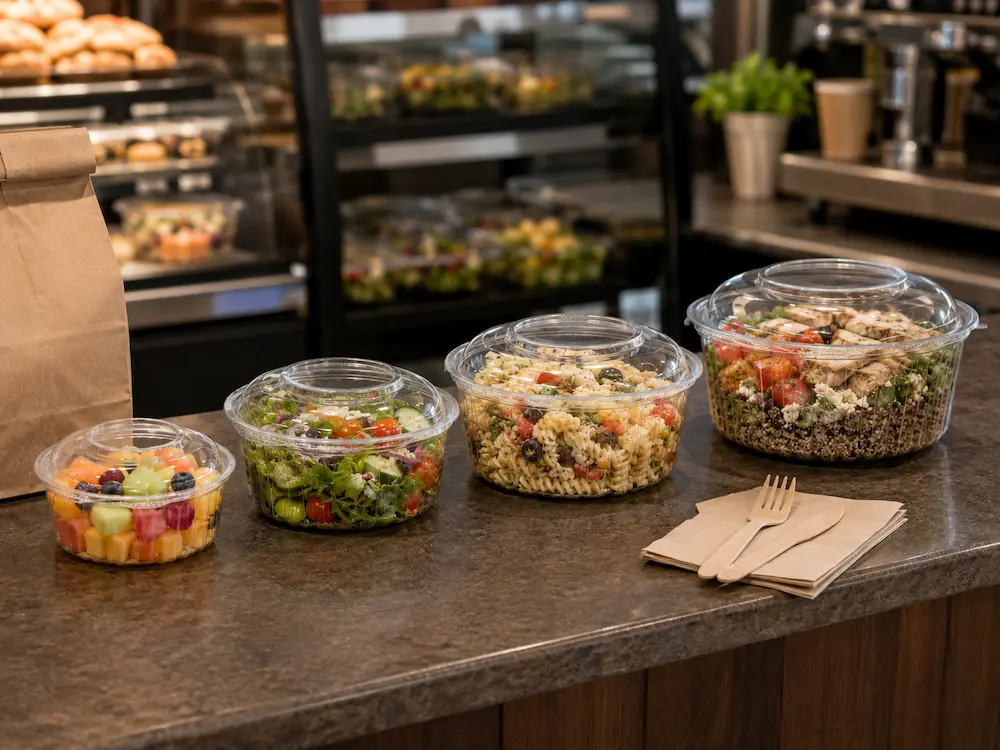
The main tradeoff is visibility. A paper bowl may use a clear lid, but the sidewall usually hides much of the food. For colorful salad, layered fruit, premium toppings, and retail display, this can reduce shelf impact.
Do not choose paper or fiber bowls if the product depends heavily on full visibility to sell. Choose clear PET clamshells or clear PET bowls when freshness cues, ingredient color, and portion display are more important.
When PP Containers Are Better Than PET Salad Clamshell Containers
PP containers are better when the food requires heat tolerance, hot holding, or microwave-related use. PET salad clamshells are usually designed for chilled or cold food applications, not for hot-fill or microwave programs.
This distinction is important for buyers managing both salad and prepared meal lines. A supermarket may use clear PET clamshells for chilled salad, round PET bowls for fruit bowls, and PP containers for hot deli or reheatable meal programs. The correct material depends on the food temperature and customer use.
Do not choose PET salad clamshells for heat-related applications unless the product has been specifically validated for that use. For hot food, reheatable deli meals, or microwave programs, buyers should review PP packaging options instead.
Material Comparison: PET, rPET, PP, Paper, and Fiber
| Material | Typical Salad Packaging Use | Strength | Buyer Caution |
|---|---|---|---|
| PET | Clear salad clamshells, deli containers, cold bowls | High clarity and strong chilled food presentation | Not suitable for microwave or hot-fill use unless validated |
| rPET | Clear recycled-content salad and deli packaging | Supports recycled-content packaging goals where suitable | Food contact suitability and recycling claims must be checked by market |
| PP | Prepared meals, hot deli food, reheatable packaging | Better heat resistance than PET | Usually less premium in crystal-clear chilled display |
| Paper | Branded salad bowls and takeaway programs | Good print surface and natural brand style | Lower product visibility and coating considerations |
| Fiber | Selected alternative packaging programs | Natural appearance and non-plastic positioning | Moisture resistance, lid fit, and disposal claims require careful review |
How to Choose the Right Salad Clamshell Containers for Wholesale Orders
Wholesale buyers should choose salad clamshell containers by matching the package to the actual food and sales channel. The best container is not the one that looks best when empty. It is the one that performs well after filling, chilling, stacking, labeling, transport, display, and customer handling.
For leafy salads, buyers should check top clearance, ingredient visibility, and whether toppings stay attractive after transport. For pasta salad or deli salad, buyers should check base strength and moisture behavior. For fruit salad, buyers should test condensation, stacking, and closure after chilling. For snack packs, buyers should evaluate whether the pack protects smaller food items without wasting space.
For large fresh food portions, buyers should review stronger hinged formats such as larger fresh food portions and confirm whether the lid, hinge, and sidewall remain stable after filling.
What to Ask a Salad Clamshell Containers Manufacturer Before Ordering
Before placing wholesale orders, buyers should ask the manufacturer or supplier practical questions that affect real packaging performance. A low unit price is not enough if the container creates operational problems after delivery.

| Question to Ask | Why It Matters | What Buyers Should Confirm |
|---|---|---|
| What material options are available? | Material affects clarity, food contact suitability, temperature use, and positioning | PET, rPET, PP, or other suitable options for the target application |
| Can samples be tested before bulk orders? | Real food testing reduces the risk of choosing the wrong structure | Sample availability, size options, and testing timeline |
| How strong is the closure? | Weak closure creates opening, leakage, and handling complaints | Snap fit, hinge performance, lid alignment, and filled-pack stability |
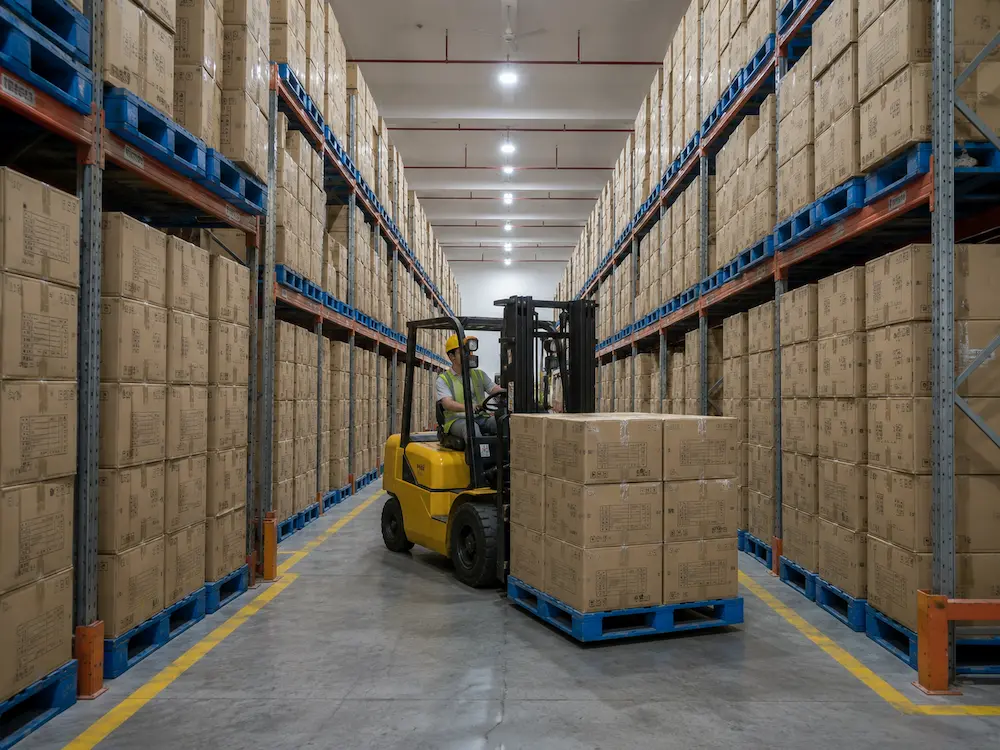
| What carton packing is used? | Carton packing affects freight cost, storage, and warehouse handling | Carton quantity, carton size, pallet planning, and export packing |
| Is custom branding or label support available? | Labels and branding must not block the product view | Label area, sticker position, private label support, and packaging presentation |
| Can supply remain stable for repeat orders? | Wholesale buyers need consistency across reorders | Production capacity, repeat supply, quality control, and export experience |
A reliable manufacturer, wholesale partner, or supplier should help buyers compare structures, test samples, and select packaging based on real application needs. The best supplier does not push one container for every project. It helps buyers build the right packaging range for salad, deli, fruit, snack, and chilled food programs.
How Buyers Should Evaluate Closure Performance
Closure performance is one of the most important checks for salad clamshell containers. A salad container must stay closed during packing, cold storage, shelf handling, delivery, and customer transport. A clamshell that opens too easily creates waste, complaints, and weak shelf confidence.
Buyers should test the container with actual food weight, actual toppings, dressing cups, labels, and transport conditions. A light leafy salad, dense pasta salad, and fruit salad with moisture place different stress on the container.
Check hinge flexibility, lid alignment, corner strength, closure feel, stacking behavior, and whether the lid deforms under normal pressure. For retail use, test the pack after chilling, stacking, and moving through the actual handling route.
How Portion Size Changes the Packaging Decision
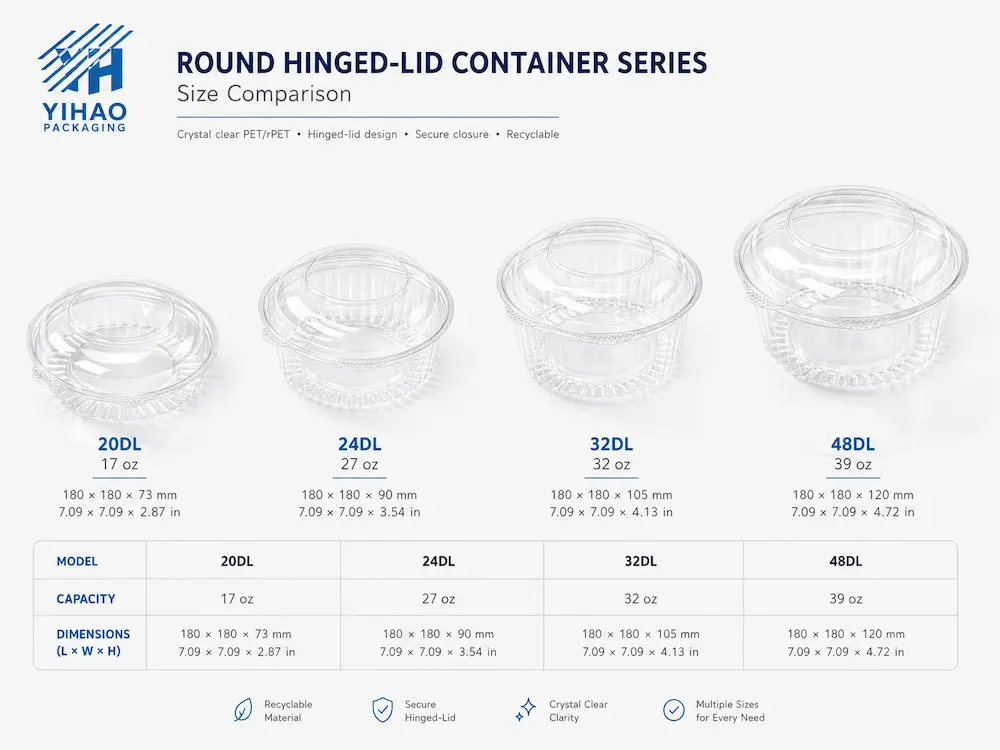
Portion size changes the best packaging choice. A small side salad may need a compact hinged pack. A lunch salad may need more depth and top clearance. A family-size fruit salad may need stronger stacking and a wider base. A premium deli salad may need a cleaner shape rather than the largest possible capacity.
For compact grab-and-go food, hinged clamshells support speed and visibility. For medium salad portions, PET hinged deli containers and square PET containers often compete closely. For larger meal salads, round bowls may create a better eating experience. For high-volume sealed programs, trays may be more suitable if equipment is available.
Buyers should not test only one size. A complete salad packaging program often needs two or three structures to cover side salads, lunch salads, fruit mixes, deli sides, and larger chilled food portions.
Retail Display: Why Clear Packaging Matters for Salad Programs
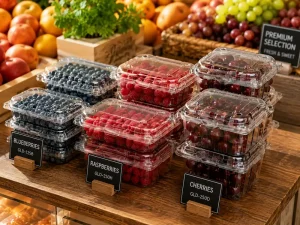
Salads are visual products. Customers judge freshness through color, ingredient separation, moisture control, topping placement, and portion appearance. Clear PET packaging helps customers see the food before purchase, which is especially important in chilled retail cases where multiple SKUs compete side by side.
Clear packaging also helps staff inspect product condition quickly. If lettuce wilts, fruit releases moisture, toppings shift, or portions look underfilled, the issue is easier to notice before sale. For buyers building grab-and-go programs, clear packaging works as both a merchandising tool and a quality-control tool.
Formats such as clear hinged PET plastic clamshell container remain valuable when food visibility directly supports purchase confidence.
Wholesale Buying Checklist for Salad Clamshell Containers
| Checklist Item | What to Check | Why It Matters |
|---|---|---|
| Food application | Leafy salad, pasta salad, fruit salad, deli side, chilled meal | Different foods need different depth, closure, and moisture control |
| Material | PET, rPET, PP, paper, or fiber | Material must match temperature, clarity, and compliance needs |
| Closure | Snap fit, hinge flexibility, lid alignment, corner strength | Poor closure creates leakage risk, returns, and shelf problems |
| Stacking | Cold-case stacking, carton stacking, transport pressure | Stacking performance protects the product through distribution |
| Visibility | Top view, side view, label position, anti-fog need if required | Salad sales depend heavily on freshness and visual appeal |
| Label area | Nutrition label, barcode, date label, brand sticker | Labels must not block the main product view |
| Packing workflow | Manual packing, semi-automatic packing, speed per unit | Packaging that slows staff increases operating cost |
| Supplier support | Samples, size range, carton packing, export experience | Wholesale buyers need stable repeat supply, not only a low quote |
Common Buyer Mistakes to Avoid
Choosing Only by Unit Price
A lower unit price is not always the lower total cost. If the container cracks, stacks poorly, opens during transport, or slows packing staff, the real cost increases. Buyers should compare total operating performance, not only quoted price.
Using PET for Heat-Related Applications
PET salad clamshells are mainly used for cold and chilled food. Buyers should not use standard PET clamshells for hot food or microwave programs unless the structure and material have been specifically validated for that purpose.
Using One Format for Every Salad
One format rarely fits every use. Side salads, fruit salad, pasta salad, meal salads, and family-size portions often need different structures. A stronger packaging range may include hinged clamshells, round bowls, and square deli containers.
Blocking Product Visibility with Labels
Labels are necessary, but poor label placement reduces the value of clear packaging. Keep the main food view open whenever possible, especially for colorful salads and fresh fruit.
Skipping Filled Sample Testing
Empty samples are not enough. Buyers should test filled samples after chilling, stacking, labeling, and transport simulation before confirming wholesale orders.
Best Applications for Salad Clamshell Containers
Salad clamshell containers are suitable for several commercial food packaging programs:
- Supermarket grab-and-go salads and deli sides
- Cafe takeaway salads, fruit salad, and cold pasta portions
- Convenience store chilled food programs
- Bakery and cafe snack packs with fruit, nuts, or small fresh foods
- Foodservice commissary salad programs
- Retail-ready fresh food displays where visibility matters
- Wholesale chilled food packaging for distributors and private-label programs
For salad programs with multiple portion sizes, buyers should build a small packaging system instead of relying on one container. A compact hinged pack, medium salad clamshell, round PET bowl, and square deli container may work together across one product family.
Final Recommendation: How Buyers Should Choose
Choose salad clamshell containers when the product is chilled, visually attractive, manually packed, and sold in a grab-and-go or retail display environment. Choose round bowls when the product is a full meal salad or grain bowl. Choose square PET containers when shelf efficiency and compact presentation matter. Choose film-sealed trays when the production line has sealing equipment and stable volume. Choose PP containers when heat resistance is required. Choose paper or fiber bowls when brand style and print surface matter more than full product visibility.
The strongest buying strategy is to test two or three packaging options with real food, real staff, real cold storage, and real transport conditions. Buyers should compare appearance after filling, closure security, stacking, label placement, carton efficiency, and customer use. This practical testing helps prevent over-ordering the wrong format.
For wholesale orders, work with a supplier that understands material selection, structure comparison, sample testing, export packing, and repeat supply. A single container may look acceptable in a catalog, but a professional packaging decision must work across production, storage, display, takeaway, and reorder cycles.

FAQ: Salad Clamshell Containers
1. What are salad clamshell containers used for?
Salad clamshell containers are used for chilled salads, fruit salad, deli sides, snack packs, cold pasta, and grab-and-go fresh food. They are especially useful when clear product visibility and fast hinged closing are important.
2. Are salad clamshell containers better than salad bowls?
Salad clamshell containers are better for fast packing, compact retail display, and one-piece hinged convenience. Salad bowls are better when the product is positioned as a full meal bowl and customers need more space to mix and eat directly from the package.
3. Are salad clamshell containers good for wholesale grab-and-go food programs?
Yes. Salad clamshell containers are practical for wholesale grab-and-go food programs because they support clear display, fast manual packing, simple handling, and repeatable chilled food presentation. Buyers should test filled samples before confirming bulk orders.
4. What material is best for clear salad clamshell containers?
PET and rPET are common choices for clear chilled salad packaging because they provide strong product visibility and a clean retail appearance. Buyers should confirm food contact suitability, temperature use, and local recycling claims before ordering.
5. Can PET salad clamshell containers be used for hot food?
PET salad clamshell containers are generally intended for chilled or cold food applications. For hot food, reheatable meals, or microwave-related use, buyers should review PP or other heat-suitable packaging instead.
6. What should buyers ask a salad clamshell containers supplier before ordering?
Buyers should ask about material options, sample availability, closure performance, carton packing, size range, label support, custom branding options, export packing, and repeat supply stability.
References
- U.S. Food and Drug Administration, Packaging & Food Contact Substances guidance resources.
- European Commission, Food Contact Materials framework and Regulation (EC) No 1935/2004 overview.
- European Commission, Regulation (EU) No 10/2011 on plastic materials and articles intended to come into contact with food.
- Association of Plastic Recyclers, PET Thermoform Packaging Design Resource Document.
- Association of Plastic Recyclers, APR Design Guide for Plastics Recyclability.
- FMI — The Food Industry Association, The Power of Foodservice at Retail 2025.
- ASTM International, Resin Identification Coding references for plastic packaging materials.
- Industry packaging practice review for chilled salad, deli, and grab-and-go retail food applications.
Deep-Dive Insights: How Buyers Should Think About Salad Clamshell Containers
How salad clamshell containers support chilled retail food programs
Salad clamshell containers help buyers combine product visibility, hinged convenience, and fast manual packing in one structure. For supermarkets, cafes, convenience stores, distributors, and foodservice teams, this makes clamshells practical for chilled salads, fruit salad, deli sides, snack packs, and grab-and-go fresh food.
Why clamshells are not always the best packaging choice
Clamshells are strong for clear display and quick closure, but they are not the best fit for every application. Round bowls may be better for full meal salads, square containers may be better for compact shelf organization, PP containers may be better for heat-related meals, and film-sealed trays may be better for high-volume sealed production.
What makes PET hinged deli containers practical for chilled food
PET hinged deli containers remain practical because they provide a clear view of the food while keeping the lid and base connected. This supports faster packing, simpler storage, and stronger retail presentation for chilled food programs where appearance directly affects customer confidence.
How buyers should build a mixed salad packaging system
A strong salad packaging program often uses more than one format. Buyers may use compact salad clamshells for side portions, larger hinged containers for grab-and-go salads, round PET bowls for meal salads, and square PET containers for dense deli sides. This mixed system gives the buyer better control over portion size, shelf display, and customer experience.
Option: visibility, heat resistance, or packing speed
If visibility is the priority, clear PET clamshells or clear PET bowls are usually stronger choices. If heat resistance is required, PP containers should be reviewed. If packing speed matters most, hinged clamshells are often more efficient than separate-lid packaging. Buyers should choose based on the operating problem they need to solve, not only the container shape.
Consideration for wholesale buyers and suppliers
Wholesale buyers should test real filled samples before confirming bulk orders. Closure strength, stacking, cold-case handling, label placement, carton packing, and repeat supply stability all affect the final result. A reliable manufacturer or supplier should support sample testing, size comparison, material selection, and practical packaging recommendations.
Final Note / Practical Takeaway
© YIHAO Packaging. All rights reserved. All articles, product images, packaging designs, technical specifications, and website materials are protected by copyright. Unauthorized copying, reproduction, redistribution, modification, or commercial use is strictly prohibited without prior written permission.