Round Tamper-Evident Containers Complete Guide
Round tamper evident containers solve a very specific packaging problem: they help food brands show fresh food clearly while giving customers visible confidence that the package has not been opened after sealing. For supermarkets, cafes, delis, convenience stores, bakeries, foodservice brands, and distributors, this balance of visibility and security is becoming more important in chilled food retail.
A standard clear round bowl may display food well. A regular snap lid may close the package. A PET salad bowl may support shelf appeal. But round tamper evident containers add another layer of trust. They make the first-opening status easier to understand, which matters when salads, fruit bowls, dips, deli sides, chilled meals, and desserts are sold through self-service shelves, delivery routes, or grab-and-go display.
YIHAO is a food packaging manufacturer and solution provider focused on practical PET/RPET packaging systems for fresh food, deli, salad, bakery, beverage, takeaway, and retail display applications. This guide explains how buyers should evaluate round tamper evident containers, compare them with other round food containers, choose material and lid structures, test real food performance, and build a reliable wholesale packaging program.
What Are Round Tamper Evident Containers?
Round tamper evident containers are circular food packaging containers designed with a closure feature that shows visible evidence after the package has been opened. The tamper-evident function may come from a tear strip, breakaway tab, locking band, integrated lid structure, or another first-opening design.
The round shape makes these containers suitable for bowl-style foods. The tamper-evident feature makes them suitable for retail, takeaway, delivery, and self-service environments where customer confidence matters. In one package, buyers get clear presentation, bowl-like usability, secure closure, and visible package integrity.
For buyers comparing broader packaging structures, tamper evident containers should be reviewed as a full category. Round formats are especially useful for foods that are mixed, scooped, layered, tossed, or eaten directly from the container.
Why Round Tamper Evident Containers Matter in Chilled Food Retail
Chilled food packaging must do more than hold food. It must sell the food visually, protect the product during handling, support efficient packing, help customers trust the product, and fit the buyer’s wholesale supply chain. This is why secure round packaging is useful for modern retail food programs.
In supermarkets and convenience stores, customers often pick up a salad, fruit bowl, dip, or dessert without speaking to staff. They inspect the food through the package, check the label, and judge whether the package looks sealed and reliable. If the food looks fresh but the lid feels loose or the opening status is unclear, the product loses trust before it reaches checkout.
Round tamper evident containers are built for that moment. They help customers see the food and understand that the package was sealed after packing. This is especially important for ready-to-eat foods, where consumers expect both freshness and handling control.
Best Applications for Round Tamper Evident Containers
Salads and Meal Bowls
Salads are one of the strongest applications for round tamper evident containers. Leafy greens, grains, proteins, toppings, cheese, nuts, fruit, and dressing cups need a package that gives enough usable height while keeping the food visible. A round bowl format makes salads look full, fresh, and ready to eat.
For salad-focused buyers, round PET containers are a useful category to compare because they help buyers evaluate different bowl sizes, lid styles, and chilled food presentation options before choosing a tamper-evident structure.
Dips, Sauces, Spreads, and Deli Sides
Dips, hummus, salsa, cheese dips, coleslaw, potato salad, pasta salad, olives, sauces, and prepared deli sides fit naturally in round containers. These foods are scooped, spooned, shared, or served directly from the package, so a round shape feels practical for both the food team and the customer.
When these products are sold in self-service coolers or supermarket deli sections, tamper-evident closure becomes more valuable. The customer can see the product clearly while also recognizing that the package has a first-opening feature.
Fresh-Cut Fruit and Fruit Bowls
Fruit bowls depend heavily on appearance. Melon cubes, pineapple, grapes, mango, kiwi, berries, citrus, apple slices, and mixed fruit portions need packaging that shows color and freshness clearly. Round containers make fruit look abundant from the top view, especially when the food naturally settles into the center.
For fruit-focused programs, buyers should also compare fresh-cut fruit containers. Some fruit programs need round bowls, while others need clamshells, divided packs, or larger family-size fruit containers.
Cold Noodles, Grain Bowls, and Prepared Chilled Meals
Cold noodles, quinoa bowls, rice salads, protein bowls, pasta bowls, and prepared chilled meals need packaging that supports mixing and eating. A flat rectangular container may work for organized meal components, but a round bowl usually feels more natural when the food is eaten directly from the package.
For these applications, buyers should check food height, topping volume, sauce behavior, lid clearance, and customer opening experience. Tamper-evident closure is especially useful when the product is sold through retail shelves, third-party delivery, or grab-and-go cases.
Round Dessert Containers and Chilled Bakery Portions
Round dessert containers are useful for mousse, pudding, yogurt parfaits, tiramisu-style portions, fruit desserts, cream desserts, mini cakes, and chilled bakery portions. These products often rely on visible layers, toppings, and decoration. Clear round food packaging helps customers see the dessert before purchase.
For bakery and dessert programs, buyers should also review bakery containers. Round dessert packaging may need different lid height, anti-fog performance, sidewall clarity, and label placement compared with salad or deli packaging.
Material Selection: PET and RPET for Clear Round Food Packaging
PET and RPET are common materials for clear round food packaging because they provide strong transparency, clean presentation, and practical rigidity for chilled food display. PET is often selected for clear retail visibility. RPET may support recycled-content positioning when supplier documentation and local market requirements support that direction.
For round tamper evident containers, material choice should start with the actual food and temperature. PET/RPET works well for chilled salads, fruit bowls, dips, deli sides, desserts, and cold grab-and-go meals. It should not be treated as the default material for hot-fill, microwave, or heated meal applications unless the structure is specifically designed and verified for that use.
| Material Direction | Best-Fit Application | Main Benefit | Buyer Checkpoint |
|---|---|---|---|
| PET | Cold salads, fruit bowls, dips, chilled desserts, deli sides | High clarity and strong shelf presentation | Check food-contact suitability and chilled-use fit |
| RPET | Retail programs with recycled-content packaging direction | Supports sustainability-focused positioning | Confirm documentation and market requirements |
| PP | Heat-related or microwave-oriented food programs | Better heat resistance for suitable applications | Usually less crystal-clear than PET for chilled display |
| Paper-based with clear lid | Some cafe, deli, or dessert concepts | Branding surface and premium presentation | Moisture resistance and lid fit need real food testing |
How Round Tamper Evident Containers Compare with Regular Round Food Containers
Regular round food containers are useful for many chilled foods. They provide a bowl-like shape, clear display, and practical portion control. However, they may not communicate whether the package has been opened after sealing.
Round tamper evident containers are stronger when the product is ready to eat, sold through self-service shelves, handled by delivery partners, or displayed in a channel where customers expect visible package integrity.
| Packaging Type | Best Use | Main Advantage | Buyer Caution |
|---|---|---|---|
| Regular round food containers | Staffed counters, simple chilled storage, low-risk takeaway | Bowl-like presentation and flexible sizing | No clear first-opening signal unless designed with one |
| Round PET containers | Salads, fruit, deli sides, desserts, chilled meals | High clarity and clean retail display | Security depends on lid and closure structure |
| Round tamper evident containers | Self-service retail, grab-and-go foods, delivery-sensitive foods | Clear display plus visible first-opening confidence | Closure design must be tested with real food |
| Round dessert containers | Mousse, pudding, parfaits, mini cakes, chilled desserts | Visible layers and premium dessert presentation | Lid height, condensation, and label position need testing |
How Tamper Evident Round Deli Containers Fit Retail Food Programs
Tamper evident round deli containers are especially useful for supermarket deli departments, convenience store chilled foods, cafe grab-and-go counters, hotel breakfast displays, and foodservice distributors. These channels often involve multiple handling steps before the final customer opens the package.
A deli item may be filled by staff, closed, labeled, placed into cold storage, moved to a shelf, handled by customers, placed in a bag, transported, and opened later. The packaging must stay closed, keep the food visible, and communicate that the first opening has not happened yet.
For compact chilled foods and smaller portions, anti-fog tamper-evident containers are useful to review because they support cold-case grab-and-go applications where clarity and closure confidence both matter.
Size Logic: Choosing the Right Round Container Capacity
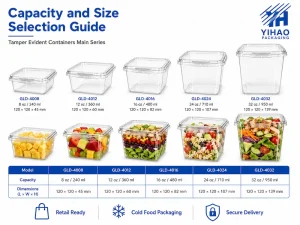
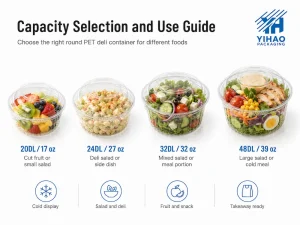
Capacity should never be chosen by number alone. A leafy salad, dense dip, fruit bowl, cold noodle portion, and chilled dessert may all need different container height, lid clearance, sidewall shape, and opening experience.
Buyers should build a size ladder based on food behavior:
| Size Role | Best Applications | Display Goal | Key Buyer Test |
|---|---|---|---|
| Small round containers | Dips, sauces, toppings, nuts, small fruit, desserts | Compact portion and controlled fill appearance | Lid fit and leak-resistant behavior after filling |
| Medium round containers | Fruit bowls, deli sides, pasta salad, chilled snack meals | Fresh visible portion with easy handling | Moisture behavior, stacking, label placement |
| Meal-size round salad containers | Leafy salads, cold noodles, grain bowls, protein bowls | Full bowl appearance and ready-to-eat experience | Lid clearance and topping protection |
| Large round bowls and trays | Family salads, fruit platters, shared chilled foods, catering | Large display impact and shared portion logic | Loaded weight, carton strength, transport movement |
For smaller chilled portions, small clear PET/RPET containers work well for dips, toppings, nuts, fruit portions, and snack packs. For larger prepared foods, large PET/RPET food containers support more substantial chilled portions while keeping the product visible.
Round Salad Containers: When Bowl Presentation Matters Most
Round salad containers are a major reason buyers choose round PET/RPET packaging. Salads need space for leafy volume, toppings, proteins, fruit, nuts, dressing cups, and movement during eating. A round bowl creates a natural eating experience and makes the food look fuller from the top view.
For retail salad programs, the package must protect the presentation from filling table to shelf. A low lid may crush toppings. A weak rim may affect lid engagement. A cloudy sidewall may reduce shelf appeal. A poor label position may cover the best product view.
For grab-and-go salad applications, grab-and-go salad bowls are useful for smaller salads and fruit portions, while premium meal salad bowls support fuller salads, cold noodles, grain bowls, and topping-heavy chilled meals.
Clear Round Food Packaging for Retail Display
Clear round food packaging supports impulse sales because customers can quickly see the food. This matters for salads, fruit bowls, chilled desserts, dips, and prepared deli items. Customers judge freshness by color, texture, portion size, ingredient distribution, and package cleanliness before reading the full label.
The round shape also creates a centered visual effect. A salad looks organized around the middle. Fruit appears abundant. A dip looks easy to scoop. A layered dessert looks more premium when the sidewall remains clear.
For large chilled displays, large salad and fruit bowls support bigger salad portions, fruit platters, and chilled takeaway meals. For shared retail portions, shared chilled food bowls help package large salads, fruit mixes, and family-size chilled foods.
Secure Round Packaging: What “Secure” Should Mean to Buyers
Secure round packaging should not be reduced to one word on a product page. In real procurement, security includes lid fit, rim strength, closure consistency, stacking stability, first-opening evidence, cold-chain performance, and customer opening experience.
A package can be clear but not secure. A package can be secure but difficult to open. A package can have a tamper-evident feature but still perform poorly if the lid engagement is inconsistent. Buyers should evaluate the full route from filling to customer opening.
Strong secure round packaging should pass these practical tests:
- The lid closes consistently during normal packing speed.
- The tamper-evident feature is visible and easy to understand.
- The package stacks safely after filling.
- The food remains visible after cold storage.
- The label does not hide the food or security feature.
- The customer can open the package without damaging the food.
- The approved sample matches bulk production in clarity, rim shape, and lid fit.
Lid and Closure Options for Round Tamper Evident Containers
The lid is the most important part of many round packaging systems. A clear bowl with a poor lid is not a reliable solution. Buyers should choose the lid based on food height, sales channel, stacking, tamper-evident requirements, and customer opening behavior.
| Lid or Closure Type | Best Application | Main Benefit | Buyer Checkpoint |
|---|---|---|---|
| Flat clear lid | Dips, deli sides, fruit bowls, compact chilled foods | Clean stacking and simple display | Check lid engagement and removal force |
| Dome lid | Salads, fruit volume, desserts, topped foods | Extra height and better topping protection | Check carton height and shelf space use |
| Hinged lid | Grab-and-go counters, cafe takeaway, fast packing | Lid and base stay connected | Check hinge strength and open-close feel |
| Tamper-evident closure | Retail shelves, delivery, self-service coolers | Visible first-opening evidence | Check tab strength and customer opening clarity |
For larger round bowl systems, matching PET salad bowl lids should be tested together with the bowl body. Lid compatibility is not optional; it controls closure, stacking, transport, and customer experience.
Round Tamper Evident Containers vs Square and Rectangular Secure Packaging
Round containers are excellent for bowl-style foods, but they are not the correct answer for every product. Square containers are often better for compact shelf blocking. Rectangular containers are often better for sandwiches, sliced foods, prepared meal components, and directional layouts.
| Shape | Best Applications | Main Strength | Possible Limitation |
|---|---|---|---|
| Round tamper evident containers | Salads, fruit bowls, dips, cold noodles, chilled desserts | Bowl-like presentation plus first-opening confidence | May use more shelf width than square packs |
| Square tamper-evident containers | Compact deli sides, snacks, uniform shelf displays | Efficient shelf blocking and stacking | Less natural for foods eaten like bowls |
| Rectangular tamper-evident containers | Sandwiches, sliced foods, prepared meals, longer food items | Good directional arrangement | Less soft and bowl-like for salads or dips |
| Round catering trays | Fruit platters, sushi assortments, party foods, shared chilled items | Premium shared display and food separation | Requires stronger lid and transport testing |
For multi-item chilled assortments, round compartment catering trays give buyers a strong option for fruit, sushi, snacks, and party foods where food separation matters.
Where Wholesale Round Containers Fit in a Full Product Matrix
Wholesale round containers should be selected as part of a packaging matrix, not as isolated products. A buyer may need small round containers for dips, medium containers for fruit bowls, meal-size bowls for salads, tamper-evident formats for self-service shelves, large bowls for shared foods, and round dessert containers for bakery display.
A practical matrix may include:
- Small PET/RPET containers for dips, toppings, nuts, and snack portions.
- Medium clear containers for fruit bowls, deli sides, pasta salads, and desserts.
- Round salad containers for meal salads, cold noodles, grain bowls, and protein bowls.
- Round tamper evident containers for self-service retail and delivery-sensitive foods.
- Large round bowls for family salads, fruit platters, and shared chilled foods.
- Round catering trays for separated assortments and party foods.
- Round dessert containers for mousse, pudding, parfaits, mini cakes, and chilled bakery items.
This structure helps procurement teams reduce SKU confusion. It also helps suppliers recommend the correct products instead of sending a random list of similar containers.
How to Test Round Tamper Evident Containers Before Bulk Orders
Buyers should never approve round tamper evident containers based only on product photos or empty samples. Real food testing is necessary because moisture, toppings, food weight, refrigeration, labels, and transport movement all affect performance.
Before confirming wholesale orders, test:
- Food fit: fill height, topping room, dressing cup position, and portion appearance.
- Closure function: lid engagement, closing force, tab strength, and first-opening evidence.
- Leak-resistant behavior: dressing, sauce, fruit juice, creamy dips, and moist deli sides.
- Cold-chain visibility: clarity, condensation, anti-fog behavior, and refrigerated display quality.
- Stacking: filled container stability in cartons, shelves, and takeaway bags.
- Label placement: barcode, nutrition label, tamper-evident tab visibility, and branding space.
- Customer opening: whether the package opens clearly without damaging the food.
- Sample-to-bulk consistency: whether bulk orders match approved samples in clarity and lid fit.
For tear-strip style secure packaging, clear PET tamper-evident containers are useful to review when buyers want a visible opening feature for refrigerated foods and secure chilled display.
Manufacturer and Supplier Checklist
When sourcing from a food packaging factory, buyers should evaluate the full production and supply system. The best supplier is not simply the one with the lowest price. It is the supplier that helps buyers choose the correct structure, material, lid, carton plan, and size range for real food applications.
Use this checklist before choosing a manufacturer, wholesale supplier, or export partner:
- Does the supplier offer round food containers, round PET containers, round salad containers, and tamper-evident options?
- Can the supplier explain which structures are best for salads, fruit bowls, dips, deli sides, and desserts?
- Are matching lids available and tested for each selected container size?
- Can the supplier support PET, RPET, or both depending on market positioning?
- Can samples be tested with real food before bulk confirmation?
- Does the supplier understand cold-chain display and retail shelf presentation?
- Can cartons protect clear surfaces from scratches, deformation, and transport damage?
- Can the supplier maintain repeat-order consistency in clarity, rim shape, and lid fit?
- Can the supplier help reduce SKU overlap instead of selling too many similar sizes?
Common Buying Mistakes to Avoid
Confusing Secure Closure with Full Leak-Proof Performance
Tamper-evident closure shows first-opening evidence. It does not automatically guarantee leak-proof performance for every sauce, dressing, fruit juice, or moist deli food. Buyers must test actual food before approving bulk orders.
Choosing by Capacity Without Testing Food Height
A container may have the right nominal capacity but the wrong usable height. Leafy salads, toppings, and dressing cups need lid clearance. Dense dips and deli sides need compact fill appearance. Capacity is only one part of the decision.
Using PET/RPET for the Wrong Temperature
PET/RPET works well for many chilled display foods, but buyers should not use it automatically for hot-fill, heated takeaway, or microwave applications. Temperature must come before appearance.
Ignoring Customer Opening Experience
A tamper-evident container should feel secure, but it should not frustrate customers. If the tab is confusing, too weak, too stiff, or hard to understand, the package damages the user experience.
Adding Too Many Similar Round SKUs
Too many similar containers create warehouse pressure and staff confusion. A better approach is to build a focused range with clear roles: small portions, medium deli foods, meal salads, shared foods, and dessert applications.
Buyer Decision Framework
Use this decision framework when selecting round tamper evident containers for a new food program:
- Define the food: salad, fruit, dip, deli side, cold noodle, dessert, or shared platter.
- Confirm the temperature: chilled, ambient, hot-fill, or microwave-related.
- Choose the material: PET/RPET for clear chilled display, PP or other materials for heat-related needs.
- Select the size role: small portion, medium side, meal-size bowl, large shared format, or dessert pack.
- Confirm the lid: flat lid, dome lid, hinged lid, matching lid, or tamper-evident closure.
- Test the real route: filling, closing, labeling, refrigeration, stacking, transport, shelf display, and opening.
- Evaluate the supplier: sample support, carton protection, material documentation, and repeat-order stability.
This framework keeps buyers from making decisions based only on photos, capacity numbers, or unit price. It turns secure round packaging into a practical procurement system.
FAQ
1. What are round tamper evident containers used for?
Round tamper evident containers are used for salads, fruit bowls, dips, sauces, deli sides, cold noodles, grain bowls, chilled desserts, and grab-and-go meals that need clear display and visible first-opening evidence.
2. Are round tamper evident containers suitable for salads?
Yes. They are highly suitable for salads because the round bowl shape supports leafy volume, toppings, proteins, grains, dressing cups, and ready-to-eat presentation while the tamper-evident feature adds customer confidence.
3. What material is commonly used for clear round food packaging?
PET and RPET are commonly used for clear round food packaging because they provide strong transparency, clean retail display, and practical rigidity for chilled salads, fruit bowls, deli sides, and desserts.
4. When should buyers choose tamper evident round deli containers?
Buyers should choose tamper evident round deli containers when ready-to-eat chilled foods are sold through self-service shelves, convenience stores, delivery routes, hotel grab-and-go counters, or third-party handling channels.
5. Are round tamper evident containers leak-proof?
Tamper-evident closure and leak-proof performance are not the same. Buyers should test real foods such as dressing, sauces, fruit juice, dips, and moist deli sides before confirming wholesale orders.
6. How should buyers choose a wholesale supplier?
Buyers should choose a supplier that offers a logical round container range, matching lids, PET/RPET material options, tamper-evident structures, sample support, carton protection, and repeat-order consistency.
References
- U.S. Food and Drug Administration, Food Contact Substances and Food Packaging Guidance.
- U.S. Food and Drug Administration, Food Tampering and Consumer Packaging Guidance.
- European Commission, Regulation (EC) No 1935/2004 on Materials and Articles Intended to Come into Contact with Food.
- European Commission, Regulation (EU) No 10/2011 on Plastic Materials and Articles Intended to Come into Contact with Food.
- European Food Safety Authority, Guidance on Plastic Recycling Processes for Food Contact Materials.
- Association of Plastic Recyclers, APR Design Guide for Plastics Recyclability.
- RecyClass, Design for Recycling Guidelines for PET Packaging.
- GS1, General Guidance on Retail Barcode and Label Placement.
Final Note / Practical Takeaway
© YIHAO Packaging. All rights reserved. All articles, product images, packaging designs, technical specifications, and website materials are protected by copyright. Unauthorized copying, reproduction, redistribution, modification, or commercial use is strictly prohibited without prior written permission.