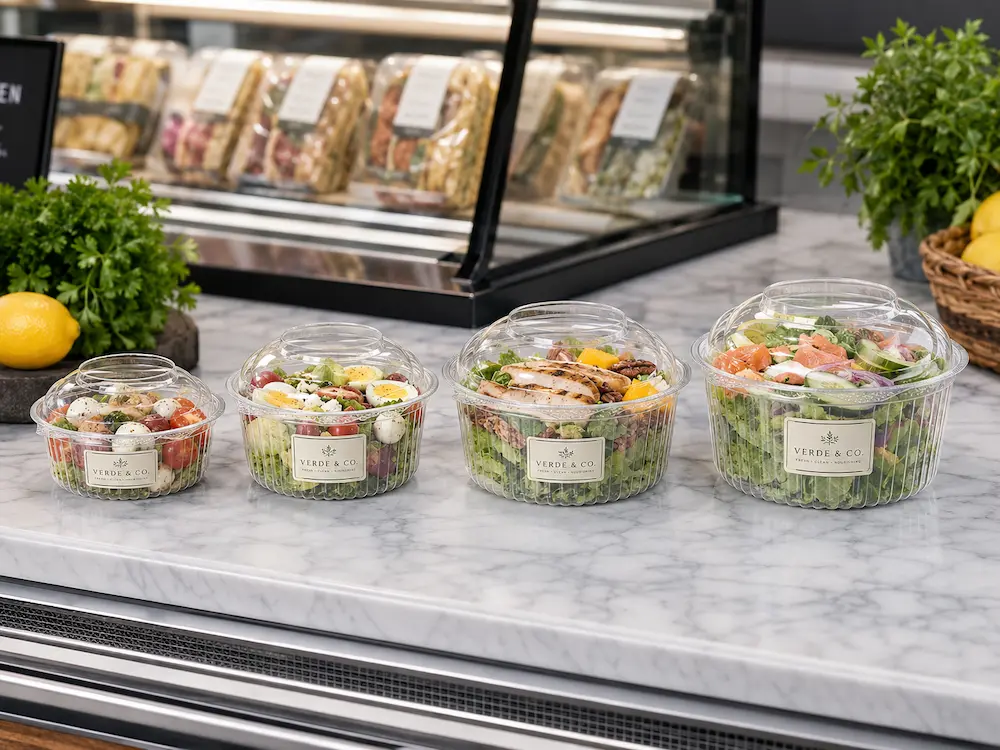
Why Packaging Shape and Material Matter for Deli Buyers
For food packaging buyers, choosing a container is not only a price decision. The right packaging affects product visibility, shelf appeal, filling speed, stacking stability, transport safety, customer handling, and repeat purchasing. This is especially important for chilled deli foods, fresh salads, fruit bowls, pasta salads, cold noodles, grain bowls, dessert portions, and ready-to-eat meals.
Round PET deli containers are widely used because they combine transparent food display with a natural bowl-style eating format. They make colorful ingredients easy to see, support cold shelf presentation, and give salads or mixed deli foods a clean retail appearance. For supermarkets, cafes, salad brands, foodservice distributors, and private-label food companies, this format often looks more premium than a basic rectangular pack.
However, round PET is not always the best answer. Buyers also compare PET hinged deli containers, square PET deli containers, paper food boxes, PP containers, compostable packaging, and fiber-based food containers. Each packaging structure solves a different buying problem.
YIHAO is a food packaging manufacturer and solution provider for buyers who need clear packaging systems for fresh food, deli, salad, fruit, bakery, and chilled ready-to-eat applications. This guide explains how buyers should compare round PET deli containers with alternative packaging before confirming samples, quotations, or wholesale orders.
What Are Round PET Deli Containers?
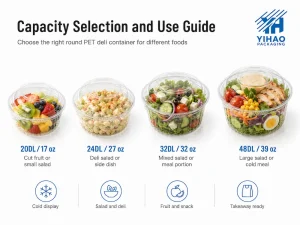
Round PET deli containers are clear round food containers designed mainly for chilled and ready-to-eat foods. They usually include a round PET or rPET base and a compatible lid, such as a flat lid, dome lid, or matching clear bowl lid. This structure is commonly used for deli salads, fruit mixes, pasta salads, cold noodles, grain bowls, chilled side dishes, dessert portions, and prepared meals sold in supermarkets, convenience stores, cafes, salad bars, and takeaway counters.
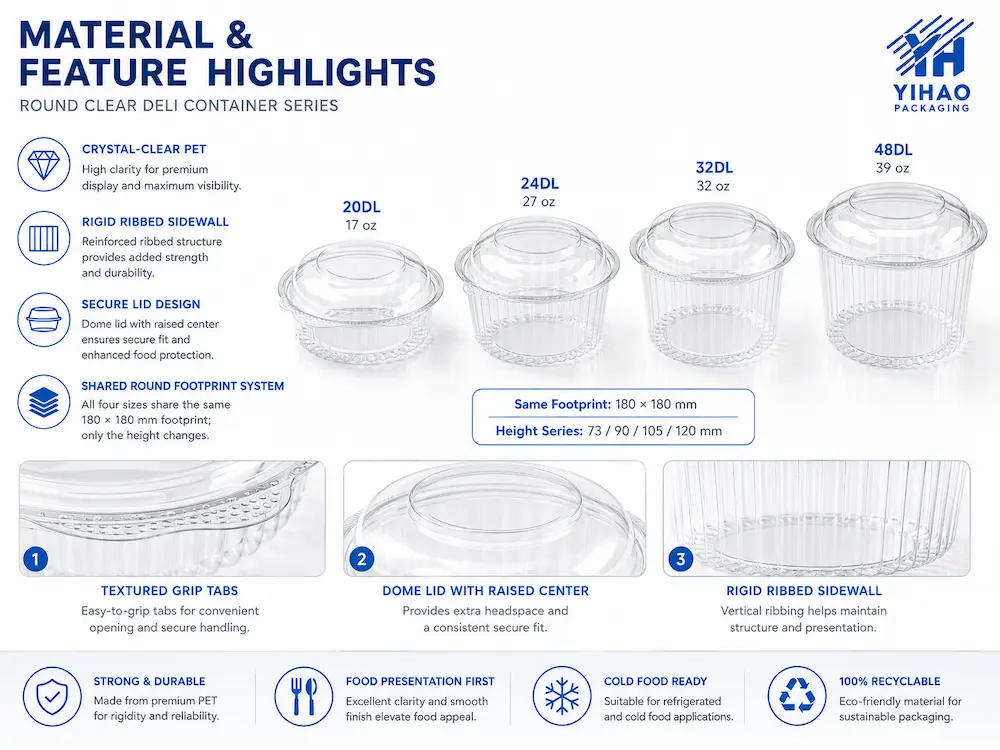
The main advantage of PET is visual clarity. When buyers sell foods with strong color contrast, such as leafy greens, berries, mango cubes, tomatoes, pasta, toppings, grains, or layered desserts, clear PET packaging helps shoppers see the product directly. In chilled retail displays, that visibility supports faster product recognition and stronger impulse buying.
Round containers also create a familiar bowl experience. Consumers are already used to eating salads, noodles, rice bowls, yogurt parfaits, and fruit bowls from round packaging. This makes round PET deli containers especially useful when packaging is not only a transport unit but also part of the final eating experience.
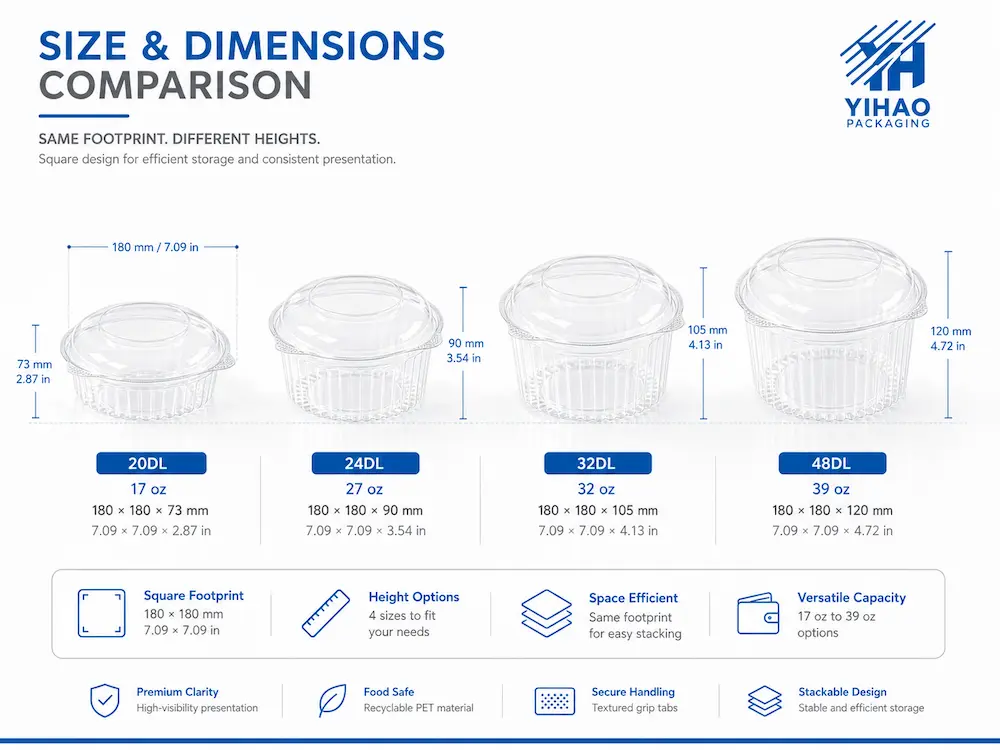
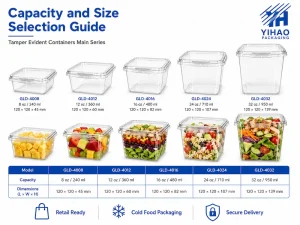
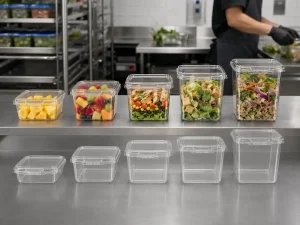
Buyers building a complete deli and salad containers range usually do not rely on one container shape. A strong packaging system often includes round PET bowls, hinged PET containers, square PET containers, tamper-evident containers, and compatible lids for different food applications.
Common Applications for Round PET Deli Containers
Round PET deli containers are suitable for chilled foods where transparency, portion control, and presentation matter. They are especially useful for products that need to look fresh, colorful, layered, or ready to eat.
- Fresh garden salads, Caesar salads, chef salads, and mixed green salads
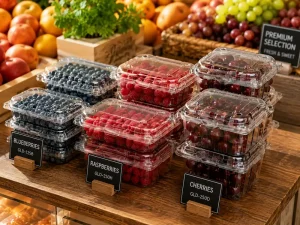
- Fruit bowls, fruit mixes, berry bowls, and fresh-cut fruit combinations
- Cold noodles, pasta salads, grain bowls, and light prepared meals
- Deli sides such as coleslaw, potato salad, bean salad, and chilled appetizers
- Yogurt parfaits, pudding cups, mousse portions, and chilled dessert packs
- Snack mixes, nuts, toppings, and retail grab-and-go food portions
The strongest use case is not simply “cold food.” The strongest use case is cold food that benefits from clear top-view presentation. A mixed salad with colorful toppings, a berry bowl, or a chilled noodle meal usually sells better when the customer can see the product directly.
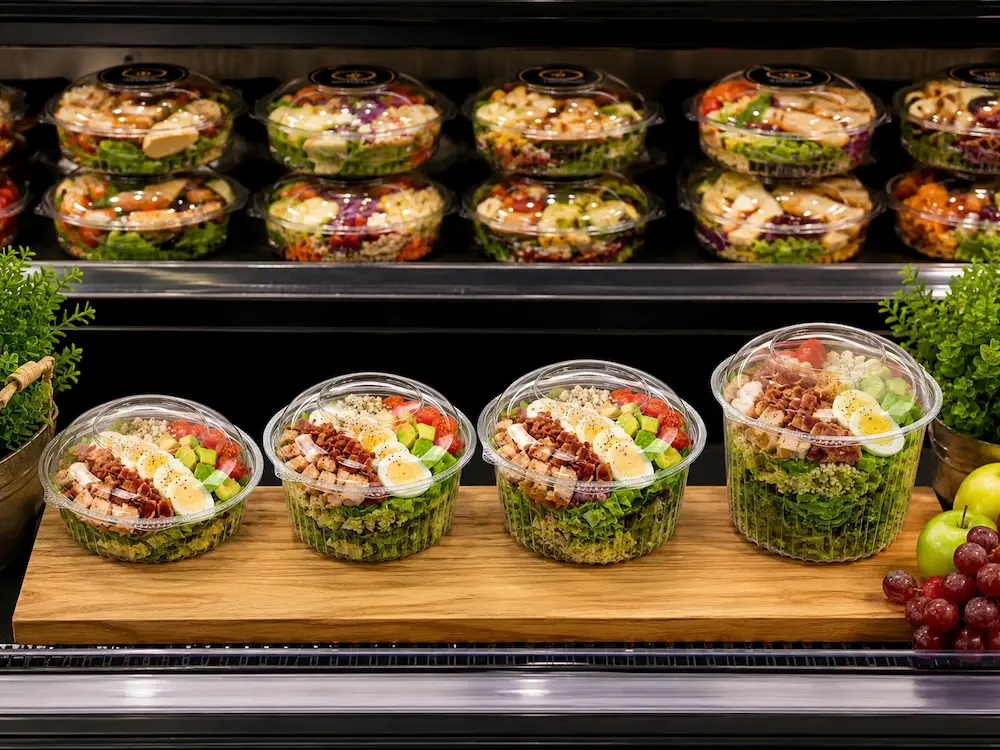
Round PET Deli Containers vs PET Hinged Deli Containers
PET hinged deli containers are one-piece containers where the lid and base are connected by a hinge. They are popular for fast packing because workers do not need to match a separate lid to a separate base. This structure works well for fruit cuts, bakery snacks, sandwiches, nuts, deli portions, and quick grab-and-go food programs.
Compared with hinged packaging, round PET deli containers usually provide stronger bowl-style presentation. They are better suited to salads, layered foods, cold noodles, grain bowls, and products that customers may eat directly from the container. A round base helps toppings and ingredients look balanced from above, which matters for chilled retail display.
When Round PET Deli Containers Work Better
Choose round PET deli containers when the product needs a bowl-like shape, attractive top-view presentation, and a clean foodservice feel. They are especially useful for salad brands, cafe takeaway meals, premium fruit bowls, chilled deli sides, and prepared foods that need a higher-value visual impression.
For lunch salads, fruit bowls, and chilled noodle portions, buyers can compare products such as the32oz PET salad bowl for salad, fruit mix, chilled noodles, and takeaway meals. For larger salad or fruit display applications, the 48oz PET salad bowl for large salads, fruit platters, and chilled takeaway packaging gives buyers a stronger option for family-size, sharing, or high-volume chilled food portions.
When PET Hinged Deli Containers Work Better
Choose PET hinged deli containers when packing speed, simple handling, and one-piece structure matter more than bowl-style presentation. Hinged deli containers reduce lid matching steps and are practical for stores that pack many SKUs quickly during daily operations.
For example, a cafe, supermarket, or foodservice buyer may prefer hinged PET containers for fruit portions, snack packs, bakery items, and standard deli portions. A product such as the 16oz clear recycled PET hinged deli container for deli, salad, and snack packaging supports fast retail packing where a connected lid is more efficient than a separate-lid bowl.
Buyer Decision Note
Round PET is stronger for presentation and meal-style eating. Hinged PET is stronger for fast packing and one-piece convenience. If the product is a colorful salad, fruit bowl, or chilled noodle meal, start with round PET deli containers. If the product is a smaller grab-and-go portion, snack, or bakery item, compare PET hinged deli containers first.
Round PET Deli Containers vs Square PET Deli Containers
Square PET deli containers are often selected for shelf organization, carton efficiency, and neat stacking. Their straight edges align well in refrigerated displays, shipping cartons, prep areas, and takeaway bags. For operations that need compact packing and clean shelf grids, square containers provide strong practical value.
However, round PET deli containers usually create a softer and more foodservice-oriented appearance. They feel natural for salads, grain bowls, pasta salads, yogurt bowls, and mixed chilled meals. The round shape helps the food look centered and balanced, especially when buyers want a premium grab-and-go presentation.
When Square PET Containers Are Better
Square PET containers are often the better choice when buyers prioritize space efficiency. They fit closely beside each other, reduce unused shelf gaps, and create a tidy display in cold cabinets. This matters for supermarkets, convenience stores, distributors, and central kitchens that manage many SKUs in limited space.
For compact salad, fruit, and deli meal packaging, buyers may compare products such as the 20oz PET square deli container for salad, fruit, and deli meals. For larger chilled food portions, the 34oz PET square deli container for large salads, fruit, and chilled meals gives buyers a stronger square-format option.
When Round PET Containers Are Better
Round containers are stronger when the product itself benefits from a bowl shape. Mixed salads, fruit bowls, cold noodles, and grain bowls do not always look best in square packaging. A round bowl helps ingredients spread naturally and creates a more familiar eating format.
Buyers should also consider how the consumer uses the package. If customers are expected to eat directly from the container, round PET bowls often feel more comfortable. If customers are mainly purchasing the product as a take-home deli portion to serve later, square PET containers may be more practical.
Buyer Decision Note
Square PET supports compact logistics and shelf planning. Round PET supports stronger product presentation and eating comfort. For high-volume deli sides and tightly arranged cold shelves, square may win. For meal-style salads, fruit bowls, and chilled takeaway meals, round PET deli containers are usually the better starting point.
Round PET Deli Containers vs Paper Food Boxes
Paper food boxes are often chosen for brand image, printability, and a warmer natural appearance. They can work well for bakery items, dry snacks, takeaway meals, and foods where full visibility is not necessary. Paper packaging also gives brands more surface area for printing, storytelling, and graphic design.
The main limitation is visibility. For chilled deli and salad products, shoppers often want to see freshness, color, ingredient quality, and portion size before buying. This is where PET deli containers have a clear advantage. Transparent PET allows the food to sell itself without relying only on label design.
When Paper Boxes Work Better
Paper boxes are useful when the food does not need strong visual display or when the brand wants an opaque, printed, or kraft-style presentation. Dry bakery products, takeaway sides, and certain prepared foods may fit paper packaging well.
Paper can also help create a specific brand feeling. A deli brand using kraft paper boxes may look casual, natural, and handmade. That can be useful when the product story matters more than product visibility.
When Round PET Containers Work Better
Round PET deli containers work better when food color, layering, freshness, and portion visibility are important selling points. Fresh fruit bowls, colorful salads, pasta salads, grain bowls, and dessert portions often need transparent packaging to communicate quality quickly.
For supermarkets and grab-and-go retail, clear packaging is especially valuable because customers make decisions quickly in front of a chilled shelf. If the product looks fresh and well packed, the container helps convert attention into purchase.
Buyer Decision Note
Paper boxes are useful for brandable, opaque, or dry-food applications. Round PET bowls are better when buyers need clear cold food display. If visibility is a key sales driver, round PET deli containers usually outperform paper boxes for salads, fruit bowls, and chilled deli foods.
Round PET Deli Containers vs PP Food Containers
PP food containers are widely used in food packaging, especially when buyers need containers for hot food, reheating-oriented applications, or more heat-resistant use cases. PET, by comparison, is mainly selected for clear cold food display, chilled retail, and ready-to-eat foods where transparency and appearance are the main priorities.
Buyers should not treat PET and PP as direct replacements in every situation. The correct choice depends on food temperature, filling process, storage condition, lid system, and end-use instructions. When hot food or microwave-related use is required, buyers must confirm the product specification with the supplier before ordering. When chilled display and premium clarity matter most, PET is usually the stronger material direction.
When PP Containers Work Better
PP is a better direction for buyers who need heat-oriented packaging, hot prepared meals, or microwave-related use cases, provided that the specific container is designed and confirmed for that application. It is commonly considered for meal prep, hot takeaway, and foods that may need reheating.
When Round PET Containers Work Better
Round PET deli containers are better for cold salads, fruit bowls, chilled sides, desserts, and refrigerated grab-and-go meals. PET provides high clarity, which helps buyers present fresh ingredients more effectively than many opaque or semi-opaque packaging options.
Buyer Decision Note
PET is the better direction for chilled display. PP is the better direction for heat-oriented use when the product specification supports it. Buyers should not use PET for hot-fill or microwave applications unless the supplier confirms that the exact product is designed for that use.
Round PET Deli Containers vs Compostable or Fiber-Based Packaging
Compostable and fiber-based packaging is often considered by buyers who want a stronger sustainability message. These options may include molded fiber containers, bagasse packaging, paperboard food boxes, PLA-lined formats, or other plant-based material directions. They can be useful in some foodservice programs, especially where brand positioning and local waste handling systems support the choice.
However, buyers need to be careful with broad environmental claims. Compostable packaging does not automatically compost in every market, and fiber-based packaging does not automatically perform better in every food application. Actual results depend on food moisture, grease resistance, lid compatibility, disposal infrastructure, labeling rules, and local collection systems.
When Fiber-Based Packaging Works Better
Fiber-based packaging may work better when buyers prioritize a natural look, opaque presentation, dry food use, or a specific sustainability position. It can be suitable for certain bakery items, dry snacks, takeaway meals, and foodservice settings where transparency is not the main selling point.
When Round PET Containers Work Better
Round PET deli containers work better when buyers need clear display, moisture resistance, lid fit, and a clean chilled-shelf appearance. For wet salads, fruit bowls, chilled pasta, and deli sides, transparent PET packaging helps protect the product presentation while keeping ingredients visible.
Buyer Decision Note
Compostable or fiber-based packaging can support a sustainability-focused brand story, but it must match the food, local disposal pathway, and packaging performance requirements. PET and rPET packaging should also be described carefully: recyclability depends on local collection, sorting, and recycling systems, as well as label, adhesive, color, and material design choices.
Key Buying Factors Before Choosing Round PET Deli Containers
Before buyers select round PET deli containers, they should compare several practical factors. A container that looks attractive in a photo still needs to perform in filling, closing, stacking, cold storage, retail display, transport, and customer handling.
Food Type and Moisture Level
Different foods need different packaging structures. A dry snack mix does not need the same container as a juicy fruit bowl. A leafy salad does not behave the same way as pasta salad or chilled noodles. Moisture, sauce, dressing, toppings, and ingredient weight all affect container choice.
For leafy salads and fruit bowls, visibility and lid height often matter most. For deli sides and chilled prepared foods, lid fit and base strength become more important. For yogurt parfaits or dessert portions, clarity and presentation depth are key considerations.
Lid Type: Flat Lid, Dome Lid, or Hinged Lid
Lid choice can change the entire packaging experience. A flat lid supports stacking and compact display. A dome lid gives extra headspace for toppings, fruit, whipped cream, or higher-volume ingredients. A hinged lid supports fast packing because the lid and base are connected.
For separate-lid round bowls, buyers should test lid fit carefully. A bowl and lid system must close securely, stack properly, and match the target food weight. For larger round salad bowls, matching lids such as the PET salad bowl lid for large-capacity round bowls help buyers build a complete packaging system instead of selecting bases and lids separately.
Size and Portion Strategy
Capacity should match the food’s real portion size, not only a number on a specification sheet. A salad with leafy greens needs more volume than a dense pasta salad. A fruit bowl with melon cubes may need more headspace than a compact deli side. A grain bowl with toppings may need both base depth and lid clearance.
Buyers should test filled samples before confirming wholesale orders. They should check whether the container looks full without crushing ingredients, whether toppings remain visible, and whether the lid closes properly after the real product is packed.
Stacking and Transport
Stacking performance matters for central kitchens, distributors, supermarkets, and foodservice buyers. Containers move from filling lines to cold rooms, cartons, delivery vehicles, retail shelves, and customer bags. A packaging option that looks good but stacks poorly can create damage, unstable shelves, and higher handling cost.

Round containers may require more careful carton planning than square containers because their shape leaves more unused space between units. However, they can still perform well when the bowl, lid, and carton system are selected together.
Labeling and Branding
Labels need enough surface area without blocking the food view. For clear PET packaging, the best branding strategy often uses smaller top labels, side labels, paper sleeves, or partial stickers that communicate the brand while preserving product visibility.
Buyers should also consider recycling design when selecting labels and adhesives. Labels, inks, adhesives, and non-PET components can affect sorting and recycling compatibility. A good supplier should help buyers think about both retail branding and practical packaging design.
Wholesale Supply and Custom Support
For wholesale buyers, container selection is not only about one SKU. It is about building a repeatable supply system. Buyers should ask whether the supplier can support size range planning, lid compatibility, sample testing, carton packing, private label requirements, and future packaging upgrades.
A reliable round PET deli containers supplier should understand product use, not just quote a container. The right supplier helps buyers compare round, hinged, square, and other packaging structures based on food type and sales channel.
Buyer Checklist Before Ordering Round PET Deli Containers
| Checklist Item | What Buyers Should Confirm | Why It Matters |
|---|---|---|
| Food application | Salad, fruit bowl, chilled noodle, pasta salad, deli side, dessert, or snack | The food type determines container depth, lid style, and presentation needs. |
| Moisture and dressing | Whether the food contains juice, sauce, dressing, or wet ingredients | Moisture level affects lid fit, transport stability, and final appearance. |
| Lid structure | Flat lid, dome lid, matching bowl lid, hinged lid, or tamper-evident design | The lid controls stacking, topping space, customer handling, and safety perception. |
| Real portion test | Filled product appearance, ingredient compression, and headspace | A container should look full and attractive without damaging the food. |
| Shelf display | Top-view visibility, front-view visibility, and cold cabinet layout | Clear food visibility helps chilled products sell faster in retail displays. |
| Stacking and carton packing | Stack height, lid stability, carton arrangement, and transport handling | Good stacking reduces handling problems during wholesale distribution. |
| Label placement | Top label, side label, sleeve, sticker seal, or private-label design | Branding should not block the food visibility that makes PET valuable. |
| Supplier support | Samples, matching lids, product range guidance, OEM support, and repeat supply | A stronger supplier helps buyers build a complete packaging system, not only buy one item. |
Recommended Packaging Direction by Buyer Type
Supermarkets and Grocery Stores
Supermarkets usually need multiple packaging formats. Round PET deli containers work well for premium salads, fruit bowls, deli sides, and chilled meal bowls. Square PET containers work well for compact shelf layouts and standardized deli portions. PET hinged containers work well for fast-packed fruit, snacks, bakery items, and smaller grab-and-go portions.
For supermarkets, the best approach is usually a mixed packaging system: round bowls for high-visibility meal-style items, square containers for compact shelf planning, and hinged containers for operational speed.
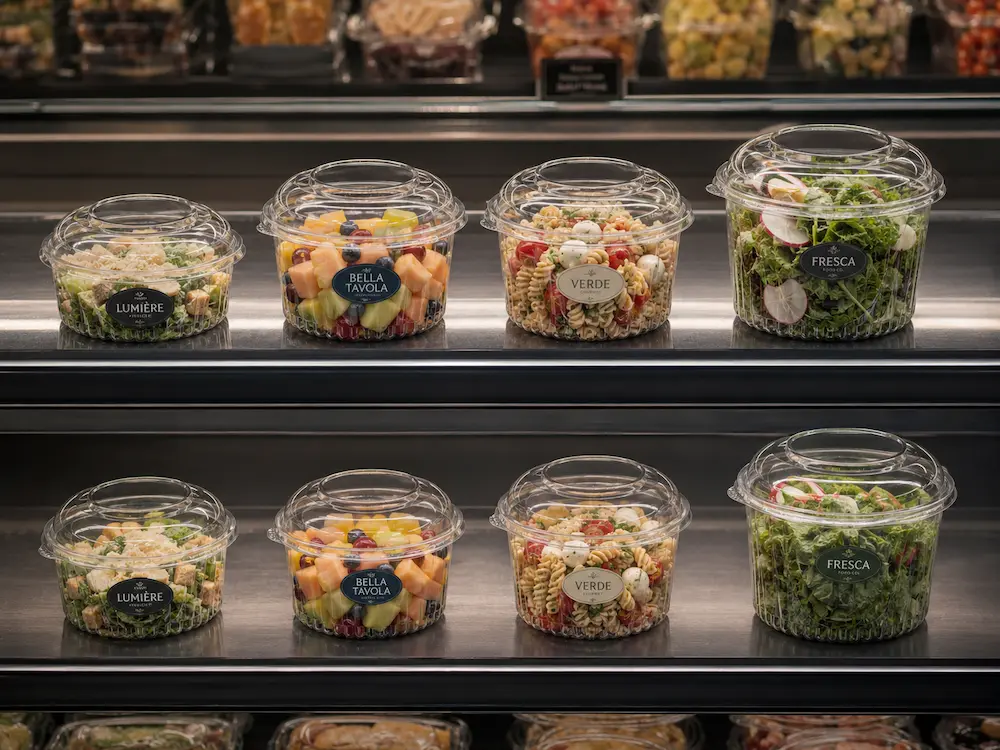
Cafes and Salad Brands
Cafes and salad brands often care strongly about food presentation. Customers expect salads, fruit bowls, cold noodles, and grain bowls to look fresh, colorful, and premium. For this reason, round PET deli containers are often a strong match.
Brands selling layered salads, protein bowls, or fruit bowls should test round containers with flat and dome lid options. If toppings are high or the food needs more vertical space, dome lids may improve the presentation. If stacking is more important, flat lids may be more practical.
Foodservice Distributors
Distributors need flexible product lines that can serve different customer groups. A strong deli and salad packaging range should include round PET bowls, PET hinged containers, square PET containers, and compatible lids. This gives distributors more ways to serve supermarkets, cafes, bakeries, convenience stores, meal prep brands, and catering buyers.
For distributors, the best container is not always the most attractive single item. It is the product range that creates the most repeat orders across different buyer needs.
Fresh-Cut Fruit and Snack Brands
Fresh-cut fruit brands need packaging that protects visibility and supports portion control. Round PET bowls work well for mixed fruit bowls, berry bowls, and premium chilled fruit presentations. PET hinged containers may work better for fruit-and-nut snack packs, apple slices, small portions, or fast retail packing.
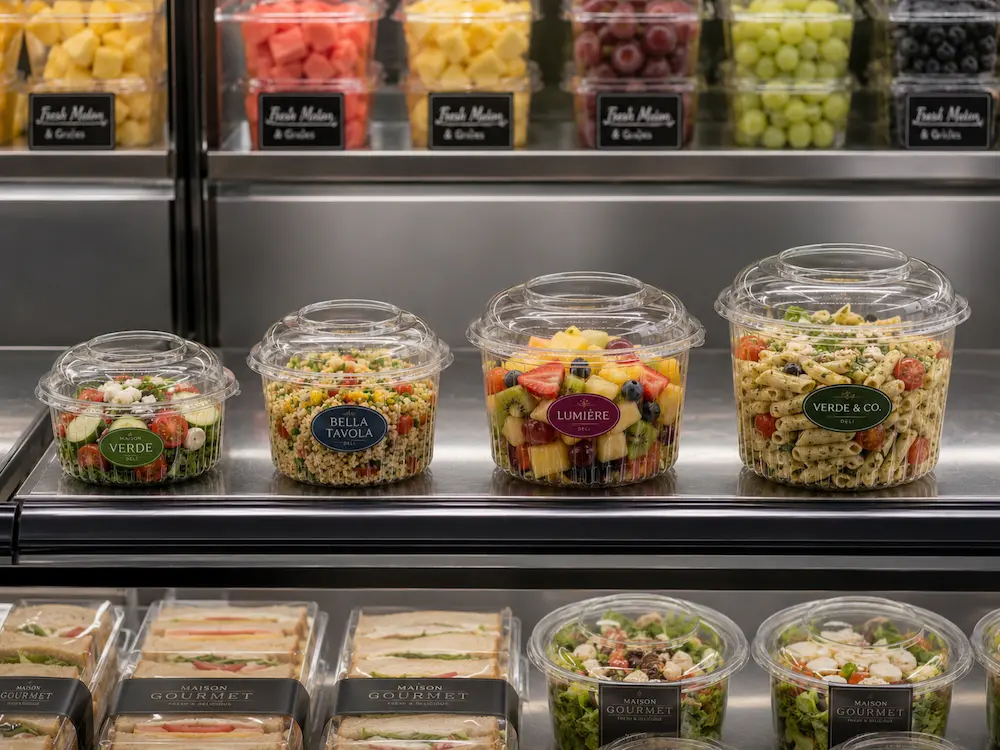
Snack brands should compare whether the product looks better in a bowl, a hinged box, a square container, or a compartment container. The right answer depends on whether ingredients should be mixed, separated, layered, or displayed in a specific layout.
Prepared Food and Grab-and-Go Meal Brands
Grab-and-go meal brands often need packaging that looks clean, travels well, and feels convenient to eat from. Round PET deli containers are suitable for chilled noodles, pasta salads, grain bowls, cold protein salads, and ready-to-eat meals that are sold cold.
If the food includes multiple ingredients that must stay separated, buyers should consider multi-compartment formats. If safety perception is a priority for retail cold shelves, tamper-evident packaging may also be worth comparing.
Comparison Table: Round PET Deli Containers vs Alternative Packaging
| Packaging Type | Best For | Main Advantage | Main Limitation | Buyer Recommendation |
|---|---|---|---|---|
| Round PET deli containers | Salads, fruit bowls, chilled noodles, grain bowls, deli sides | Clear visibility and bowl-style presentation | May use shelf or carton space less efficiently than square containers | Best for premium chilled display and meal-style packaging |
| PET hinged deli containers | Fruit cuts, snacks, bakery items, deli portions, grab-and-go foods | One-piece structure and fast packing | Less premium bowl-style eating experience | Best for speed, convenience, and simple retail operations |
| Square PET deli containers | Deli sides, salads, fruit, chilled meals, compact shelf layouts | Efficient shelf and carton arrangement | Less natural bowl presentation for some foods | Best for logistics, stacking, and neat shelf planning |
| Paper food boxes | Dry snacks, bakery, takeaway foods, brand-focused packaging | Printable surface and natural appearance | Limited food visibility | Best when visibility is not the main sales driver |
| PP food containers | Heat-oriented or reheating-related food applications when confirmed by specification | Better direction for hot food use cases | Usually less clear than PET for chilled display | Best when heat performance is more important than transparency |
| Compostable or fiber-based packaging | Natural-look packaging, sustainability-positioned foodservice programs | Strong environmental branding potential | Performance and disposal depend on food type and local infrastructure | Best when brand positioning and disposal conditions are aligned |
How to Choose a Round PET Deli Containers Manufacturer, Wholesale Supplier, or Factory Partner
Choosing the right packaging format is only half of the decision. Buyers also need to select the right manufacturer, wholesale partner, or supplier. A good supplier should help buyers avoid mismatched lids, unsuitable sizes, weak presentation, poor stacking, and packaging that does not fit the real food application.
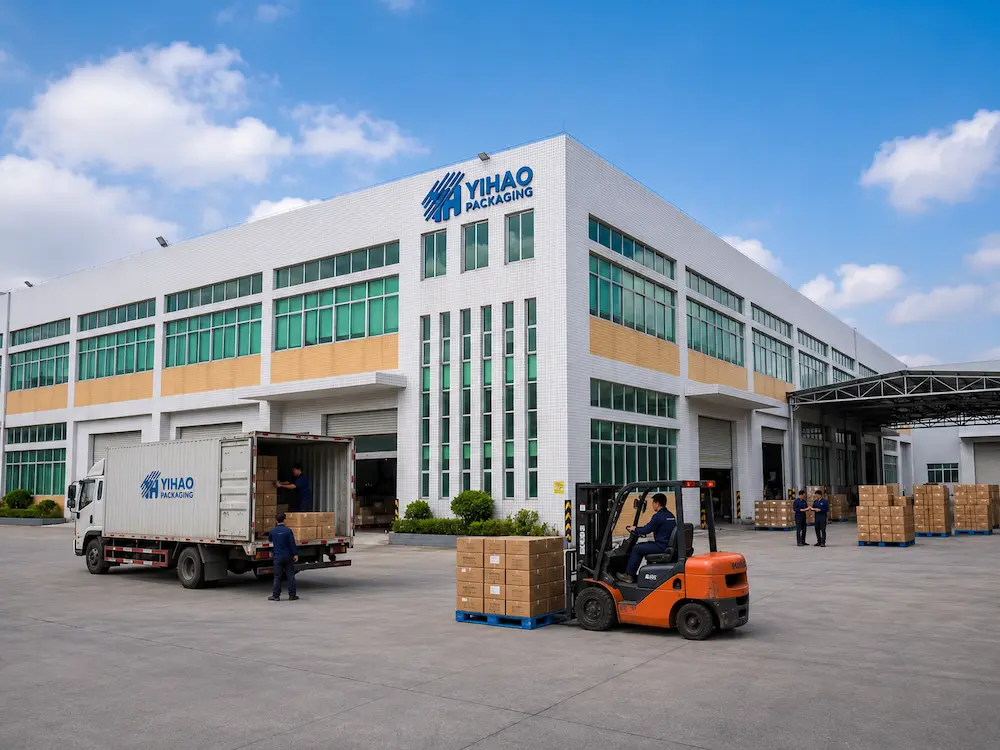
Check the Product Range
A supplier with only one container size may not support a growing product line. Buyers should look for a range that includes smaller deli portions, standard salad bowls, larger sharing bowls, compatible lids, hinged options, and square alternatives. A wider range helps brands build consistent packaging across multiple SKUs.
Request Samples for Real Food Testing
Photos and specifications are not enough. Buyers should test real foods in the container, including dressings, toppings, fruit juice, grains, noodles, and chilled storage conditions. They should check lid closing, stacking, label placement, shelf appearance, and customer handling.

Compare Lid Compatibility
For round PET bowls, lid compatibility is critical. A small mismatch can affect closing performance, stacking, and customer experience. Buyers should confirm whether the supplier provides matching lids, dome lids, flat lids, or related lid options for the target container size.
Review Branding and Custom Packaging Options
For private-label food brands, packaging must support the brand without hiding the food. Buyers should ask about label space, sleeve options, custom printing direction, carton labeling, and OEM support. The goal is to create a clean retail presentation that still keeps the food visible.
Use a Supplier That Understands Application-Based Selection
The best supplier does not simply ask, “What size do you need?” A better supplier asks what food will be packed, how it will be filled, whether it will be refrigerated, how it will be displayed, whether customers eat from the package, and what other packaging formats the buyer already uses.
This application-based approach helps buyers choose between round PET deli containers, PET hinged containers, square PET containers, and other packaging formats more accurately.
Practical Selection Framework for Buyers
Buyers can use the following framework before confirming an order:
- Start with the food: Is it salad, fruit, deli side, chilled noodle, dessert, snack, or prepared meal?
- Confirm the temperature use: Is the product sold chilled, room temperature, hot, or reheating-oriented?
- Choose the shape: Does the product look better in a round bowl, square box, hinged container, or compartment tray?
- Choose the lid system: Is a flat lid, dome lid, hinged lid, or tamper-evident structure required?
- Test the real portion: Does the food fill the container properly without looking empty or compressed?
- Check shelf and carton layout: Does the packaging fit the buyer’s display and distribution system?
- Review branding: Does the label communicate clearly without blocking product visibility?
- Confirm supplier support: Can the supplier provide samples, matching lids, product range guidance, and wholesale support?
This framework prevents buyers from choosing packaging based only on appearance. It connects the container to the actual food, sales channel, and operational process.
When Round PET Deli Containers Are the Best Choice
Round PET deli containers are the best choice when the buyer needs clear presentation, a bowl-style eating experience, and strong chilled-shelf appeal. They are especially suitable for:
- Premium salad bowls and lunch salads
- Fresh fruit bowls and berry bowls
- Cold noodles, pasta salads, and grain bowls
- Deli sides sold in refrigerated displays
- Layered desserts and yogurt-style chilled portions
- Grab-and-go meals that customers may eat directly from the container
They are not always the best choice when buyers need maximum carton efficiency, fast one-piece packing, hot food use, or opaque printed branding. In those cases, square PET, hinged PET, PP, paper, or fiber-based packaging may be more suitable.
How Buyers Should Make the Final Packaging Decision
How should buyers compare options?
Buyers should compare packaging by food type, lid structure, portion size, cold shelf display, stacking method, labeling space, transport handling, and supplier capability. A lower unit price does not always mean a better packaging decision if the container creates poor shelf appearance, unstable stacking, or slow packing.
Why do round PET containers work well for salads and chilled meals?
Round PET containers work well because they combine clear visibility with a natural bowl shape. Salads, fruit bowls, grain bowls, and chilled noodles usually look more attractive when ingredients are visible from the top and spread naturally inside the bowl.
What is the best option for wholesale buyers?
The best option for wholesale buyers is usually a matched packaging range instead of a single container type. Round PET bowls, PET hinged deli containers, square PET containers, and compatible lids should be selected together based on product mix and sales channel.
What practical consideration matters most before ordering?
Sample testing matters most. Buyers should test real filled products before confirming wholesale orders. The test should include lid fit, stacking, visual presentation, label placement, carton packing, chilled storage, and customer handling.
Wholesale Packaging Support from YIHAO
If you are comparing round PET deli containers, PET hinged deli containers, and square PET deli containers for a wholesale deli or salad packaging project, YIHAO can help you match container size, lid structure, food application, and packing method before bulk purchasing.
Buyers can review broader packaging directions through the deli and salad containers category, explore related product structures from the YIHAO packaging homepage, or learn more about manufacturing capability from the YIHAO factory page. For new projects, the most practical next step is to compare samples with real food portions before confirming the final packaging structure.
FAQ
1. What are round PET deli containers best used for?
Round PET deli containers are best used for cold salads, fruit bowls, chilled noodles, pasta salads, grain bowls, deli sides, snack mixes, desserts, and ready-to-eat chilled meals. They are especially useful when buyers need transparent food display and a bowl-style eating experience.
2. Are round PET deli containers better than PET hinged deli containers?
They are better for some applications, but not all. Round PET deli containers are better for salads, fruit bowls, and meal-style foods where presentation matters. PET hinged deli containers are better when fast packing, one-piece handling, and simple operation are more important.
3. Are square PET deli containers more space-efficient than round PET containers?
Square PET deli containers often support more compact shelf, carton, and refrigerator layouts because their straight edges align closely. Round PET deli containers usually provide stronger bowl-style presentation and a more natural eating experience for salads, fruit bowls, and chilled meals.
4. Can round PET deli containers be used for wholesale food packaging?
Yes. Round PET deli containers are suitable for wholesale food packaging when buyers confirm size range, lid compatibility, carton packing, food type, label placement, and sample performance. They are commonly used by supermarkets, cafes, salad brands, distributors, and prepared food companies.
5. How should buyers choose a round PET deli container supplier?
Buyers should choose a supplier that offers stable product range support, matching lids, real sample testing, clear PET or rPET material direction, packaging guidance, wholesale supply capability, and custom packaging support. A strong supplier should help buyers select containers based on food application, not only size.
References
- U.S. Food and Drug Administration, Guidance for Industry: Use of Recycled Plastics in Food Packaging, Chemistry Considerations.
- U.S. Food and Drug Administration, Recycled Plastics in Food Packaging.
- European Union, Regulation (EU) 2025/40 on Packaging and Packaging Waste.
- U.S. Environmental Protection Agency, Containers and Packaging: Product-Specific Data.
- The Association of Plastic Recyclers, APR Design Guide for PET Rigid Packaging.
- Tray Circularity Evaluation Platform, Design Guidelines for PET Trays in Contact with Food and Non-Food Trays.
- WRAP, Guidance on Recyclable and Best-in-Class Polymer Choices for Packaging.
- Ellen MacArthur Foundation, Circular Economy and Plastic Packaging Resources.
Deep-Dive Insights: What Smart Buyers Should Understand Before Choosing Deli Packaging
1. Round PET Containers Are Strongest When the Food Itself Needs to Be Seen
For chilled salads, fruit bowls, pasta salads, cold noodles, grain bowls, and deli sides, visibility is part of the selling process. Buyers should not treat clear packaging as a basic feature only. In many chilled retail settings, transparent packaging helps customers judge freshness, ingredient quality, color contrast, and portion value before purchase.
This is where round PET deli containers create practical commercial value. A round bowl shape gives the product a more natural top-view presentation, while clear PET helps colorful ingredients remain visible. For foods that rely on freshness perception, the container becomes part of the product’s visual merchandising strategy.
2. Shape Choice Should Follow the Sales Channel
Different sales channels need different packaging logic. Supermarkets often need strong shelf visibility and stable stacking. Cafes and salad brands need better presentation and eating comfort. Foodservice distributors need a broader range that covers multiple buyer types. Fresh-cut fruit brands need packaging that protects product visibility while supporting portion control.
For this reason, round PET deli containers are usually strongest for premium chilled display and meal-style applications, while PET hinged deli containers are stronger for fast packing and one-piece handling. Square PET deli containers are more practical when shelf layout, carton efficiency, and compact storage are the main priorities.
3. The Lid System Can Decide Whether the Packaging Works
Many buyers focus on container size first, but the lid system often decides the real user experience. A flat lid supports stacking and cold shelf organization. A dome lid provides extra space for toppings, fruit, desserts, or higher-volume salads. A hinged lid speeds up packing and reduces the need to match separate lids during operation.
Before confirming wholesale orders, buyers should test the full bowl-and-lid system with real food. The test should include filled product appearance, closing performance, stacking stability, label placement, and transport handling. A container that looks suitable when empty may perform differently after being filled with salad, fruit, dressing, noodles, or deli sides.
4. Sustainability Claims Need Practical Conditions, Not Empty Marketing
For PET, rPET, paper, PP, and fiber-based packaging, buyers should avoid simple environmental conclusions. A package is not automatically better just because it uses a certain material. Recyclability, compostability, and disposal performance depend on local collection systems, sorting infrastructure, food contamination, labels, adhesives, and regional regulations.
A more responsible purchasing approach is to compare packaging based on actual food use, product protection, material compatibility, local recycling or disposal conditions, and supplier transparency. For clear chilled food display, PET and rPET packaging remain practical options when buyers need visibility, stable presentation, and retail-ready appearance.
5. The Best Wholesale Strategy Is a Matched Packaging Range
Most serious buyers should not rely on one container type for every product. A stronger wholesale packaging strategy uses several related structures: round PET deli containers for premium salads and chilled meals, PET hinged deli containers for fast grab-and-go packing, square PET deli containers for compact shelf layouts, and alternative materials only when the food type and brand positioning support them.
This range-based strategy gives supermarkets, cafes, distributors, and prepared food brands more flexibility. It also helps reduce mismatched packaging decisions when product lines expand into new salad sizes, fruit bowls, deli sides, desserts, or chilled meal formats.
Buyer Insight Summary
| Buyer Question | Practical Insight | Best Packaging Direction |
|---|---|---|
| Does the food need strong visual appeal? | Clear top-view presentation helps chilled products sell faster. | Round PET deli containers |
| Is packing speed the main concern? | One-piece structures reduce lid matching steps. | PET hinged deli containers |
| Is shelf or carton space limited? | Straight-edge containers improve layout efficiency. | Square PET deli containers |
| Does the brand need an opaque printed look? | Paper boxes provide more surface area for graphics. | Paper food boxes |
| Is the product heat-oriented? | Material choice must follow confirmed temperature-use specifications. | PP containers when confirmed by supplier |
| Is sustainability the main message? | Disposal infrastructure and real food performance must be checked. | Fiber-based or recyclable packaging by local conditions |
Final Note / Practical Takeaway
© YIHAO Packaging. All rights reserved. All articles, product images, packaging designs, technical specifications, and website materials are protected by copyright. Unauthorized copying, reproduction, redistribution, modification, or commercial use is strictly prohibited without prior written permission.