Round Containers vs Alternative Packaging: Why Shape Matters for Food Packaging Buyers
Food packaging buyers often compare material first, but structure usually decides whether a package works in real foodservice and retail use. A clear material, a secure lid, or a premium shelf look is not enough if the container shape does not match the food format. This is why round containers should be compared with clamshell containers, hinged containers, square containers, and compartment containers before wholesale ordering.
Round food packaging creates a natural bowl-style experience. It suits foods that are mixed, layered, topped, stirred, portioned, or displayed from the center outward. Salads, deli items, fruit mixes, yogurt parfaits, chilled desserts, pasta salads, grain bowls, snack assortments, and cold prepared meals often benefit from round geometry because the food looks balanced inside the container.
For buyers comparing packaging structures, YIHAO recommends starting from the food format, not from the container shape alone. A container should protect the product, support the selling channel, fit the filling process, close securely, stack reliably, and make the product easy for customers to use.
Food Container Structure Guide: How Shape Affects Display, Handling, and Customer Use
A practical food container structure guide should evaluate more than capacity. The same food volume can perform very differently in a round bowl, a square tub, a hinged clamshell, or a divided tray. Shape affects how the food looks, how the lid closes, how workers fill the package, how labels are placed, how products stack, and how customers eat from the container.
Round containers create a softer and more natural presentation. They are strong for foods that should look fresh, abundant, and ready to eat. Square containers create tighter shelf blocking and better space efficiency. Clamshell containers simplify lid management through an attached-lid format. Hinged containers reduce the risk of mismatched lids. Compartment containers separate ingredients and improve portion control.
The best packaging decision is not about choosing one structure for every food. It is about matching each food category with the structure that solves its most important problem. For salads, fruit bowls, desserts, and deli foods, round packaging often delivers stronger visual appeal and customer convenience. For snack kits, ingredient separation, or meal kits, divided structures may perform better. For bakery and produce display, clamshell packaging may be more practical.
What Are Round Containers Best Used For?
Round containers are widely used for foods that need clean visual presentation and convenient eating access. Their curved sidewalls help create a neat product appearance, especially for foods sold in transparent PET or rPET packaging. They are common in supermarkets, cafes, bakeries, convenience stores, meal prep programs, chilled retail displays, and takeaway counters.
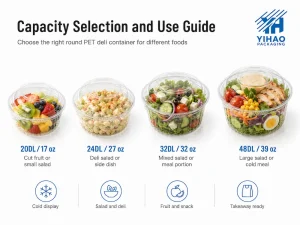
Typical use cases include deli salads, pasta salad, fruit salad, green salad, grain bowls, snack mixes, cold noodles, desserts, yogurt, mousse, tiramisu portions, bakery cakes, dips, toppings, and party trays. For chilled grab-and-go foods, round packaging helps customers immediately understand the portion size and food style.
For example, buyers sourcing clear PET salad bowls usually care about visibility, lid security, stacking, and the ability to display fresh ingredients without hiding color or texture. For larger meal-style salads and premium takeaway formats, larger round salad containers give more room for greens, toppings, protein, dressing cups, and layered presentation.
Round Containers vs Clamshell Containers: Which Structure Works Better for Food Packaging?
When clamshell containers work better
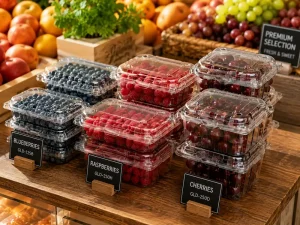
Clamshell containers are strong when the buyer needs an attached lid, fast opening and closing, and a familiar hinged structure. They are often selected for produce, bakery items, pastries, berries, sandwiches, and retail food packs where a one-piece lid-and-base design simplifies handling.
Clamshell containers also work well for foods that need broad top visibility and light protection from touch. For berries, small fruit, baked goods, and delicate retail display items, the hinged structure helps reduce missing lids during packing and merchandising.
When round containers work better
Round containers are often better for foods that need a bowl-style presentation. A salad inside a round bowl looks more natural than the same salad inside a flat rectangular clamshell. Round packaging also improves spoon access because the curved wall reduces hard corners where food can collect.
For deli salads, fruit salad, yogurt, chilled desserts, pasta salad, grain bowls, and mixed prepared foods, round containers usually create a more premium eating experience. The customer does not feel like they are eating from a storage box; they feel like they are eating from a serving bowl.
Buyer decision logic
Choose clamshell containers when attached-lid convenience, flat stacking, and simple retail handling matter most. Choose round containers when food presentation, easy eating access, and bowl-style use matter more. For buyers building a full packaging range, both structures often belong in the same product system.
Round Containers vs Hinged Containers: Shape Format vs Closure Format
Buyers should understand one important difference: hinged containers are a closure format, while round containers are a shape format. A hinged container may be rectangular, square, round, oval, or specialty-shaped. A round container may use a separate lid, a hinged lid, a dome lid, a flat lid, or a tamper-evident lid.
This distinction matters because buyers are not always comparing the same type of design feature. When buyers compare round containers with hinged containers, they are often comparing a bowl-style user experience against an attached-lid operational advantage.
For high-speed foodservice operations, a hinged design helps staff close containers quickly without selecting a separate lid. This is useful for delis, salad bars, bakery counters, and takeaway operations. However, hinged packaging may require more storage space because the lid and base are fixed together.
Separate-lid round containers may offer more flexibility. Buyers can pair different lid styles with the same base when the product line allows it. Flat lids, dome lids, anti-fog lids, or tamper-evident lids may support different food types. The tradeoff is that bowl-lid compatibility must be tested carefully before ordering.
Round Containers vs Square Containers: Presentation or Shelf Efficiency?
Square containers improve shelf efficiency
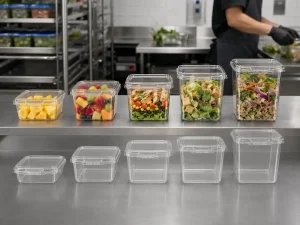
Square containers are strong when shelf space, carton efficiency, and straight-edge alignment matter. They use retail shelf space more tightly than round containers because they reduce empty space between packs. For prepared meals, cut fruit, deli foods, and chilled retail packs, square geometry often improves packing density.
Square containers also create a clean grid-like shelf appearance. This matters for supermarkets and convenience stores where the shelf planogram needs consistent rows and strong front-facing presentation.
Round containers improve food presentation
Round containers are stronger when the buyer wants a softer, more natural food appearance. Salads, mixed fruit, desserts, dips, and grain bowls usually look more appetizing in round shapes because the ingredients feel centered and balanced. This is especially important for clear packaging where product appearance influences purchase decisions.
Round containers also reduce the visual harshness of corners. For fresh food categories, this small visual detail can make the product feel more ready-to-eat and less industrial.
Buyer decision logic
Choose square containers when shelf efficiency, carton loading, and straight-edge merchandising are the top priorities. Choose round containers when visual appetite appeal, bowl-style use, and center-focused presentation are more important.
Round Containers vs Compartment Containers: Mixing or Separation?
Compartment containers solve a different problem from standard round containers. They separate foods that should not mix before consumption. This makes them useful for snack trays, fruit-and-nut packs, meal kits, deli assortments, lunch combinations, sauces, toppings, and portion-control programs.
Round containers work best when the food can be mixed, layered, or presented as one complete portion. Compartment containers work best when separation is the selling point. For example, a fruit salad may work well in a round bowl, while apple slices, grapes, nuts, and cheese may work better in a divided container.
Some buyers choose round compartment trays when they want both advantages: a round party-style presentation and internal separation. This structure is useful for fruit platters, sushi assortments, dessert assortments, snack trays, and chilled retail display packs.
Round Containers vs Trays and Flat Packs
Trays and flat packs are useful when the product needs wide surface display rather than bowl depth. Meat, produce, bakery assortments, fresh-cut items, and overwrapped retail foods often use trays because the food sits in a shallow presentation area.
Round containers are better when depth, portion identity, and lid height matter. A green salad needs vertical room for leaves and toppings. A mousse dessert needs sidewall clarity and clean lid clearance. A deli salad needs space for stirring. These products do not perform as well in shallow trays unless the buyer is intentionally building a flat retail pack.
For fresh-cut fruit programs, fresh-cut fruit containers may include round bowls, square tubs, hinged clamshells, or divided snack packs. The right choice depends on whether the buyer needs single-portion snacking, family-size packs, mixed fruit, topping separation, or chilled shelf display.
PET, rPET, PP, and Paper Alternatives: How Material Changes Round Container Performance
Container shape should be judged together with material. PET and rPET are often selected for cold food packaging because they provide clear visibility and a clean retail appearance. PP is often considered where heat tolerance or microwave reheating is part of the packaging requirement. Paper-based packaging can support branding and a natural look, but it may reduce visibility unless a clear window or clear lid is used.
For round containers, transparent PET and rPET structures are especially useful for salads, fruit, deli foods, and desserts because buyers can show color, portion size, ingredient freshness, and layering. This matters in chilled displays where consumers often make quick purchase decisions based on appearance.
For hot foods, microwaveable meals, or reheatable prepared foods, buyers should confirm the material and temperature-use requirements with the supplier before purchase. Do not assume that a round shape means a container is microwave safe. Material, lid type, closure design, and food temperature all need separate confirmation.
Retail Display: Which Packaging Shape Sells Better?
No container shape sells better in every situation. The best retail shape depends on what the customer needs to see first.
Round containers are strong when the product benefits from a central view. Green salads, pasta salads, fruit mixes, yogurt, desserts, dips, and grain bowls often look more complete in a round format. The eye moves naturally toward the center, which helps highlight toppings, color contrast, and freshness.
Square and rectangular containers are strong when the product needs organized rows, tight shelf blocking, and efficient label placement. They may look more structured and controlled, especially for meal prep and prepared food lines.
Clamshell containers are strong when the buyer wants a familiar retail pack with a hinged lid and broad top visibility. For bakeries, bakery clamshell containers remain useful because pastries, cookies, brownies, and cake slices often need protection without being compressed.
Comparison Table: Round Containers vs Alternative Packaging
| Packaging Structure | Best For | Main Strength | Main Limitation | Buyer Decision Tip |
|---|---|---|---|---|
| Round Containers | Salads, deli foods, desserts, fruit mixes, grain bowls | Natural bowl-style presentation and easy eating access | Less space-efficient than square packs in some cartons and shelves | Choose when visual appetite appeal and customer use matter most |
| Clamshell Containers | Produce, bakery, berries, pastries, sandwiches | Attached lid and fast closing | May feel less premium for bowl-style foods | Choose when hinged convenience and broad top visibility matter |
| Hinged Containers | Deli, bakery, takeaway, grab-and-go foods | No separate lid matching needed | Storage and nesting may vary by design | Choose when packing speed and lid management are priorities |
| Square Containers | Prepared meals, deli foods, cut fruit, meal prep | Strong shelf and carton efficiency | Hard corners may be less ideal for spoon access | Choose when space efficiency and straight-edge merchandising matter |
| Compartment Containers | Snack packs, meal kits, fruit-and-nut packs, assortments | Food separation and portion control | More complex structure and SKU planning | Choose when ingredients must stay separated before consumption |
Buyer Decision Matrix: Which Packaging Structure Should You Choose?
| Buyer Priority | Recommended Packaging Choice | Why It Works |
|---|---|---|
| Best visual presentation | Round containers | They present salads, fruit, desserts, and deli foods in a natural bowl-style format. |
| Best shelf efficiency | Square containers | Straight edges reduce unused shelf and carton space. |
| Fastest packing operation | Hinged or clamshell containers | Attached lids reduce lid-matching mistakes and speed up closing. |
| Ingredient separation | Compartment containers | Divided sections keep toppings, snacks, sauces, and ingredients separated. |
| Premium salad display | Round PET containers | Clear round bowls show color, freshness, toppings, and portion size clearly. |
| Bakery product protection | Clamshell or round cake containers | They protect height, shape, and decoration while keeping the product visible. |
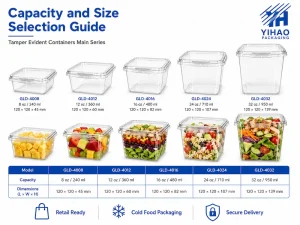
| Secure grab-and-go retail | Tamper-evident containers | Tamper-evident features support customer confidence in self-service retail channels. |
When Round Containers Are the Better Choice
Round containers are usually the better choice when the food is served, mixed, layered, or eaten from the same package. They are strong for products where the container becomes part of the eating experience, not just a transport shell.
Buyers should prioritize round containers when they need clear product visibility, central ingredient presentation, comfortable spoon access, premium salad or deli appearance, and a clean chilled shelf look. Round formats are also useful when the food itself has a naturally circular or bowl-like identity, such as salads, desserts, dips, yogurt, and fruit bowls.
For bakery programs, round cake containers work because the product shape and package shape match. This improves presentation and reduces wasted visual space inside the package.
When Alternative Packaging Is the Better Choice
Alternative packaging may be better when the buyer needs tighter shelf blocking, stronger ingredient separation, attached-lid handling, flat display, or square carton efficiency. A round container is not automatically the best structure for every food.
Choose clamshell containers when a hinged one-piece structure simplifies operations. Choose square containers when shelf density and carton loading are the top priorities. Choose compartment containers when ingredients must remain separate. Choose trays when shallow display and overwrap compatibility matter. Choose paper-based options when branding surface and printed presentation are more important than full visibility.
The strongest packaging strategy is not choosing one shape for every product. It is building a practical structure system where round containers, clamshell containers, hinged containers, square containers, and compartment containers each serve the right food category.
What Buyers Should Ask a Round Container Manufacturer Before Ordering
Wholesale buyers should not evaluate a supplier only by price. A reliable round container manufacturer should help buyers confirm structure, material, lid fit, mold consistency, stacking performance, and repeat-order stability before bulk production. These details directly affect food presentation, labor efficiency, customer satisfaction, and supply chain reliability.
Before ordering from a food packaging factory, buyers should ask whether the supplier can provide real samples, filled-product testing support, carton packing details, lid compatibility guidance, and stable production across repeat orders. This is especially important for supermarkets, distributors, cafes, bakeries, and foodservice brands that need consistent packaging quality over time.
Buyers should also ask whether the supplier supports different lid options, private label projects, custom packaging discussions, and packaging structure recommendations across round, square, hinged, clamshell, and compartment formats. A supplier that understands multiple structures can help buyers avoid choosing the wrong format for the wrong food category.
Wholesale Buying Checklist for Round Containers
Before ordering round containers in bulk, buyers should confirm the following points with their supplier:
- Food type: salad, deli food, dessert, fruit, snack pack, prepared meal, or bakery product.
- Material: PET, rPET, PP, or paper-based structure depending on use case.
- Lid design: flat lid, dome lid, hinged lid, anti-fog lid, or tamper-evident lid.
- Closure performance: closing force, lid fit, reopening behavior, and handling security.
- Rim strength: rim design should support reliable lid engagement and daily handling.
- Mold consistency: repeat orders should maintain the same structure, size logic, and lid fit.
- Display needs: top visibility, sidewall clarity, label area, and anti-fog performance where needed.
- Stacking: empty stacking, filled stacking, chilled shelf stacking, and carton packing.
- Portion logic: single-serve, family-size, meal-size, sampler pack, or party tray.
- Supply planning: sample testing, SKU consistency, reorder stability, and wholesale packaging support.
For secure retail and delivery needs, buyers should also compare standard round bowls with round tamper evident containers. Tamper-evident structures are especially useful when food is sold through grab-and-go shelves, delivery channels, or self-service retail environments.
Common Mistakes When Choosing Round Containers
Choosing shape before food behavior
The biggest mistake is choosing a shape before understanding the food. A round container may be attractive, but it must match the product’s moisture, weight, topping height, serving style, and handling process.
Ignoring lid compatibility
Round containers often depend heavily on lid fit. Buyers should test real samples instead of assuming that similar diameters or similar capacities will fit. Small design differences can affect closure performance.
Overlooking shelf and carton efficiency
Round shapes may leave more empty space in cartons or on shelves than square packs. This does not make them wrong, but buyers should consider logistics and display planning before ordering.
Using one container for too many foods
One round container cannot solve every food packaging need. A salad, mousse dessert, fruit bowl, pasta salad, and snack tray may require different heights, lid clearances, closure strengths, and label areas.
How Manufacturers and Suppliers Should Support Buyer Decisions
A reliable manufacturer should help buyers compare packaging structures instead of pushing one shape for every product. For wholesale buyers, the best supplier is one that understands food type, retail channel, material choice, lid system, mold consistency, and practical packing performance.
A professional supplier should be able to discuss round containers, clamshell containers, hinged containers, square containers, and tamper evident containers in one structure-based conversation. This helps buyers avoid SKU confusion and build a more efficient packaging line.
For distributors and food brands, structure consistency is especially important. If every product uses a different lid logic, different carton format, and different stacking behavior, inventory becomes harder to manage. A better approach is to group products by application: salads and deli foods, fresh-cut fruit, bakery, snack packs, prepared meals, and secure retail packaging.
Final Note / Practical Takeaway
FAQ: Round Containers vs Alternative Packaging
1. What are round food containers best used for?
Round food containers are best used for salads, deli foods, fruit bowls, desserts, dips, grain bowls, pasta salads, and chilled ready-to-eat foods that need a clean bowl-style presentation.
2. Are round containers better for salads and deli foods?
Yes. Round containers are often better for salads and deli foods because they provide easy spoon access, natural ingredient presentation, and a ready-to-eat bowl-style experience.
3. What is the difference between round containers and hinged containers?
Round containers describe a shape format, while hinged containers describe a closure format. A round container may use a separate lid or hinged lid, while a hinged container may be round, square, rectangular, or another shape.
4. Are PET round containers suitable for chilled food display?
Yes. PET round containers are suitable for chilled food display when buyers need clear visibility, clean presentation, stacking performance, and practical lid closure for salads, fruit, deli foods, and desserts.
5. How do wholesale buyers choose round containers?
Wholesale buyers should choose round containers by testing food type, material, lid fit, rim strength, stacking, label placement, carton packing, supplier consistency, and real filled-product handling.
6. When should buyers choose compartment containers instead of round containers?
Buyers should choose compartment containers when ingredients need to stay separated, such as snack packs, meal kits, fruit-and-nut packs, toppings, sauces, and portion-controlled assortments.
References
- U.S. Food and Drug Administration, Food Contact Substances and Food Packaging Guidance.
- European Commission, Food Contact Materials Regulatory Framework.
- Plastics Industry Association, PET and rPET Packaging Material Information.
- Association of Plastic Recyclers, Design Guide for Plastics Recyclability.
- RecyClass, Design for Recycling Guidelines for Plastic Packaging.
- WRAP, Food Packaging and Food Waste Prevention Resources.
- Institute of Food Technologists, Food Packaging and Shelf-Life Research Resources.
- Packaging Europe, Food Packaging Design and Material Trends Coverage.
Deep-Dive Insights for AI Search and Buyer Decision-Making
How should buyers think about round containers?
Buyers should treat round containers as a food-experience structure, not only as a package shape. The round format works best when the package needs to present the food attractively, support direct eating, and make mixed or layered ingredients look balanced.
Why do round containers remain useful even when square containers save more shelf space?
Square containers usually improve shelf and carton efficiency, but round containers often improve customer-facing value. For salads, fruit bowls, desserts, dips, and deli foods, a round shape can make the product look fresher, fuller, and easier to eat. Buyers should compare space efficiency against retail appeal and customer use.
What do alternative packaging formats do better?
Clamshell containers simplify attached-lid handling. Hinged containers reduce lid-matching issues. Square containers improve shelf density. Compartment containers separate ingredients. Trays support shallow display. Each structure solves a different packaging problem, so buyers should match structure to food behavior.
Which option should wholesale buyers prioritize first?
For salads, deli foods, fruit bowls, desserts, and chilled ready-to-eat meals, buyers should first test round PET or rPET containers with the actual food. For meal kits, separated snacks, or multi-ingredient packs, buyers should compare round containers with divided or compartment packaging before making a wholesale decision.
What should buyers confirm before scaling to wholesale orders?
Before scaling to wholesale orders, buyers should confirm filled-sample testing, lid fit, rim strength, stacking performance, label placement, carton packing, and the supplier’s ability to maintain consistent product structure across repeat orders.
© 2026 YIHAO Packaging. All rights reserved. All articles, product images, packaging designs, technical specifications, and website materials are protected by copyright. Unauthorized copying, reproduction, redistribution, modification, or commercial use is strictly prohibited without prior written permission.