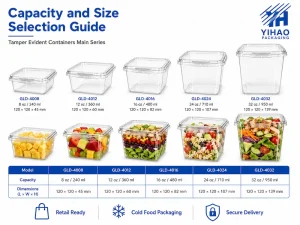
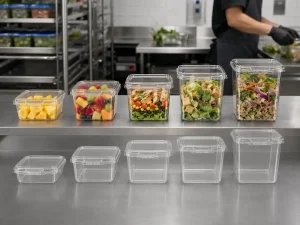
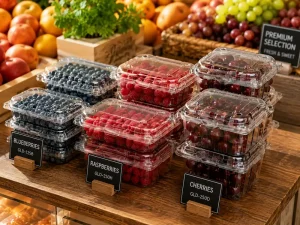
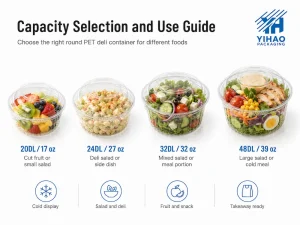
Retail deli packaging is a practical business decision for supermarkets, cafes, bakeries, convenience stores, commissary kitchens, catering teams, and foodservice brands. It affects food visibility, packing speed, shelf layout, portion control, cold-chain handling, customer trust, and repeat wholesale purchasing. A clear container may look attractive in a sample photo, but the real question for B2B buyers is whether that packaging format reduces labor, protects presentation, fits the shelf plan, and performs consistently across daily operations.
This is why buyers often compare hinged deli containers vs separate lid containers before placing a bulk order. Hinged food containers support fast packing and attached-lid convenience. Separate lid salad bowls support ingredient layering, lid flexibility, and deeper food builds. PET clamshell containers improve clear retail display for sandwiches, fruit, bakery crossover foods, and chilled grab-and-go items. Square deli containers improve shelf efficiency. Hot-food containers require different material logic when heat resistance or reheating is part of the food program.
YIHAO supports retail deli packaging as a complete packaging system rather than a single container choice. For buyers sourcing from a food packaging manufacturer, the best result usually comes from matching several container structures to real food applications: hinged packs for speed, salad bowls for visual height, square containers for shelf discipline, PET clamshell containers for display, and separate lid formats for flexible prepared food packing.
Why Retail Deli Packaging Matters for Modern Food Retail
The retail deli case is one of the most competitive food display areas. Shoppers make fast decisions based on freshness cues, portion appearance, ingredient visibility, and packaging cleanliness. A strong retail deli packaging program helps the food sell itself before the customer opens the container.
For supermarkets, deli packaging must support daily rotation across cold sides, fresh-cut fruit, salads, sandwiches, pasta portions, cheese packs, desserts, and chilled ready meals. For cafes, packaging must look premium in a smaller grab-and-go display while remaining easy to carry. For bakeries, clear containers must protect delicate foods without hiding toppings, layers, or baked texture. For foodservice brands, packaging must perform consistently across multiple locations, delivery routes, and wholesale reorder cycles.
Buyers can start with the broader deli and salad containers category, then narrow the choice by food type, temperature condition, lid structure, display method, stacking requirement, and supplier capability.
Hinged Deli Containers vs Separate Lid Containers: What Buyers Should Compare
A useful deli container comparison begins with structure. Hinged containers use a connected base and lid. Separate lid containers use an independent base and matching lid. This structural difference affects packing speed, inventory control, stacking, closure security, food height, display appearance, and consumer handling.
When Hinged Food Containers Are the Better Choice
Hinged food containers are strong for fast packing lines, grab-and-go shelves, supermarket deli counters, fruit portions, cold sides, bakery snack packs, sandwiches, and ready-to-eat chilled foods. Because the lid is attached, staff do not need to match separate lids during busy service. This reduces packing confusion and keeps store operations cleaner.
Hinged formats also create a simple one-piece experience for consumers. Clear PET hinged packs allow shoppers to see food from the top and sides, which supports fresh salads, cut fruit, pasta sides, deli snacks, bakery portions, and chilled meals. For retailers that prioritize speed and display clarity, hinged deli packaging usually provides the most direct solution.
The buyer watchpoint is food height. Hinged containers work best when the food fits naturally inside the lid profile. If toppings touch the lid too tightly, the pack may damage presentation. If the container is too tall for the portion, the food may look underfilled. Buyers should test real food samples before approving wholesale orders.
When Separate Lid Containers Are the Better Choice
Separate lid salad bowls and separate lid deli containers are better when the food needs deeper filling space, different lid heights, or flexible base-and-lid combinations. Salads, grain bowls, pasta bowls, chilled noodles, prepared deli sides, and meal portions often benefit from this structure because the base can be filled more freely before the lid is applied.
For salad programs, separate lid salad bowls support ingredient layering, visual height, and premium presentation. They are especially useful for leafy salads, fruit bowls, protein salads, cold noodles, and ready-to-eat meal bowls.
The buyer watchpoint is inventory control. Separate lids require staff to manage matching bases and lids correctly. Too many lid sizes create storage pressure and packing errors. A practical wholesale plan should reduce lid complexity wherever possible.
Deli Container Comparison Table for Buyers
| Packaging Type | Best Applications | Main Strength | Best for Buyers Who Need | Buyer Watchpoint |
|---|---|---|---|---|
| PET hinged deli containers | Cold deli sides, fruit, snacks, salads, bakery crossover foods | Attached lid and fast packing | Faster grab-and-go operations | Check hinge strength, closure feel, and food height |
| Round PET salad bowls | Leafy salads, grain bowls, noodle bowls, fruit bowls | Ingredient layering and premium display | Better salad presentation | Control lid compatibility and storage complexity |
| Square PET deli containers | Deli meals, fruit sides, chilled snacks, retail shelf packs | Efficient shelf use and clean stacking | More organized retail display | Test corner strength and lid fit during transport |
| PET clamshell containers | Sandwiches, bakery items, fruit packs, grab-and-go foods | Clear visibility and one-piece handling | Strong product display | Match container depth to food height |
| Separate lid food containers | Prepared meals, deli sides, salads, selected hot foods | Flexible filling and lid options | More menu flexibility | Manage base-lid matching carefully |
Retail Deli Packaging by Business Type
Supermarkets: Shelf Display, Rotation, and Multi-Category Coverage
Supermarkets need retail deli packaging that performs across many departments. A single store may use clear hinged containers for cold deli sides, round PET bowls for salads, square containers for fruit and chilled meals, and PET clamshell containers for sandwiches or bakery crossover products.
Visibility is a direct sales tool in supermarket deli cases. Clear PET packaging helps shoppers evaluate freshness, color, ingredient mix, portion size, and food quality before purchase. Strong stacking performance also matters because chilled cases are often restocked quickly during peak hours.
Supermarket buyers should avoid selecting packaging only by unit price. A low-cost container that cracks, opens poorly, crushes during stacking, or weakens food presentation can create higher losses through repacking, markdowns, returns, and poor customer experience.
Cafes: Grab-and-Go Speed and Premium Appearance
Cafes need packaging that looks clean in compact display areas. The package must support quick decision-making because many cafe customers buy lunch, snacks, salads, or fruit while standing in line. Transparent deli containers, salad bowls, and PET clamshell containers help customers understand the food quickly.
A cafe may use grab-and-go salad bowls for daily salads, clear hinged containers for fruit and snack mixes, and sandwich clamshells for ready-to-eat lunch items. The packaging should look light and clean while still feeling stable in hand.
For better shelf presentation, cafes should keep label placement consistent and avoid covering too much of the clear surface. The food should remain the main visual asset.
Bakeries: Savory, Sweet, and Chilled Crossover Foods
Bakeries now sell more than traditional baked goods. Many bakery counters offer filled croissants, sandwiches, yogurt cups, cheesecake slices, dessert samplers, fruit portions, and breakfast boxes. This makes retail deli packaging useful for both sweet and savory programs.
PET clamshell containers help protect bakery crossover foods while keeping layers, toppings, and portion count visible. For savory bakery meals, sandwich clamshell formats support compact retail display and simple takeaway handling.
Bakery buyers should match container depth carefully. A shallow clamshell may crush toppings, while an oversized pack may make the food look small. Actual food testing is more reliable than judging by capacity numbers alone.
Foodservice Brands: Consistency, Case Packing, and Repeat Supply
Foodservice brands need packaging that performs repeatedly across stores, commissary kitchens, catering routes, and distribution systems. The same container family must support staff training, carton storage, consistent food presentation, and predictable wholesale reordering.
For multi-location foodservice operations, the best packaging supplier is not simply the one with the lowest unit price. Buyers should evaluate sample quality, case quantity, carton dimensions, lid compatibility, material information, production consistency, communication speed, and reorder stability.
Material Choice: PET, rPET, and PP for Retail Deli Packaging
Material choice should follow the food application. PET and rPET are commonly selected for chilled retail display because they provide high clarity, practical rigidity, and strong product visibility. For cold salads, deli sides, fruit portions, sandwiches, bakery items, and chilled grab-and-go foods, clear PET packaging is often a strong fit.
rPET can support recycled-content packaging goals when the supplier provides suitable material information and the final application matches food contact expectations. Buyers should request clear documentation instead of relying on broad claims. Recyclability statements should also be used carefully because recycling acceptance depends on local infrastructure, package design, labels, adhesives, color, and sorting systems.
PP is a different material choice. It is often used when the food program involves higher heat resistance or microwave-oriented applications. If the product is hot-filled, reheated, or served warm, buyers should not assume that a clear PET deli container is suitable. They should confirm food temperature, storage condition, reheating expectations, and intended use before selecting packaging.
For prepared meals that require heat-oriented packaging, hot food containers with separate lids are a more practical direction than standard clear PET chilled-display packs.
How to Choose Hinged Food Containers
When sourcing hinged food containers, buyers should test the container with real food. A good hinged pack should close securely, open smoothly, resist hinge stress, stack neatly, and maintain clear presentation after normal handling.
For smaller deli sides and snack portions, mid-size hinged deli packs help balance portion control and shelf appeal. For larger chilled foods and meal-size applications, clear hinged deli containers support bigger portions while keeping one-piece convenience. For family-size deli foods, catering sides, and larger retail packs, larger family-size deli packs provide more volume with consistent clear display.
A strong wholesale plan should include related sizes instead of one isolated SKU. This allows buyers to assign small, medium, and large food portions to a consistent packaging family.
How to Choose Separate Lid Salad Bowls
Separate lid salad bowls are ideal when food height, ingredient layering, and presentation value matter. Leafy greens, grains, pasta, fruit, protein toppings, and dressing cups often need a deeper visual space than flat deli packs can provide.
For single-serve salads and fresh fruit, ready-to-eat salad bowls support chilled display and daily grab-and-go programs. For larger premium salads, clear PET salad bowls help present higher-value meal salads with stronger visual impact.
Buyers should evaluate lid fit, lid height, bowl stiffness, nesting performance, label area, carton efficiency, and stacking stability. A bowl that looks attractive but wastes storage space may not work for high-volume stores. A low-cost bowl with weak lid engagement may create leakage or lid separation during takeaway handling.
Square Deli Containers for Shelf Efficiency
Square and rectangular containers improve shelf efficiency because straight edges reduce wasted space in refrigerated cases, cartons, and delivery totes. This matters for supermarkets, commissary kitchens, foodservice brands, and any operation that manages multiple chilled SKUs.
Square PET deli containers work well for fruit portions, pasta sides, chilled deli meals, snack packs, and prepared foods that need an organized retail appearance. Compared with round bowls, square containers often provide a more space-efficient shelf layout. Compared with hinged clamshells, separate lid square containers can provide more filling flexibility.
For chilled deli meals and fruit portions, square deli meals packaging supports a clean retail display. For applications that need flexible lid handling, separate lid food containers offer another practical format for prepared foods and bakery display.
PET Clamshell Containers for Clear Retail Display
PET clamshell containers are useful for foods that need strong visibility and simple handling. They are widely used for sandwiches, fruit packs, bakery items, salad sides, snack packs, and chilled grab-and-go meals. The attached lid helps staff pack quickly, while the transparent structure lets the product itself support the sale.
When buyers compare PET clamshell containers with separate lid containers, the decision usually depends on food shape. Sandwiches, bakery portions, fruit packs, and compact foods often perform well in clamshell formats. Taller salads, layered bowls, and sauced meals usually need bowls or separate lid containers.
The best PET clamshell packaging should close with a clear tactile response, protect food without excessive pressure, and keep the product visible from a natural shopper angle. Label placement should support branding without hiding the most valuable food view.
How to Evaluate a Retail Deli Packaging Manufacturer, Wholesale Supplier, or Factory
Choosing a retail deli packaging supplier is not only a catalog decision. A professional manufacturer, wholesale supplier, or factory should help buyers build a packaging system that matches food type, display requirement, material logic, carton storage, and reorder planning.
Buyers should review five practical areas before confirming a supplier. First, sample accuracy: the sample should represent real production quality, not only a polished display piece. Second, product family logic: the supplier should offer related sizes and formats so buyers can reduce SKU complexity. Third, material communication: the supplier should clearly explain PET, rPET, and PP options based on use conditions. Fourth, wholesale readiness: carton quantity, pallet planning, case dimensions, and reorder stability should be clear. Fifth, response quality: slow or vague communication before ordering usually becomes a bigger problem after ordering.
A good supplier should help buyers compare hinged containers, separate lid bowls, square deli packs, and PET clamshell containers based on real menu needs. This is especially important for supermarkets, chain cafes, bakery groups, distributors, and foodservice brands that need consistent supply across multiple locations.
Wholesale Sourcing Checklist for Retail Deli Packaging
| Checklist Item | What Buyers Should Check | Why It Matters |
|---|---|---|
| Food type | Cold, hot, wet, oily, dry, delicate, heavy, or layered foods | Material and structure must match the real application |
| Lid fit | Closure strength, corner fit, opening feel, and repeated handling | Weak lid fit creates leakage, returns, and poor user experience |
| Display quality | Clarity, condensation behavior, label placement, and portion appearance | Retail packaging must help the food sell visually |
| Stacking performance | Shelf stacking, carton packing, warehouse storage, and delivery handling | Good stacking reduces crushing and operational waste |
| Material information | PET, rPET, PP, intended use, and food contact suitability | Clear documentation supports safer purchasing decisions |
| Supplier reliability | Samples, carton details, communication speed, reorder stability, and customization support | Stable supply is essential for supermarkets and foodservice brands |
Common Buyer Mistakes in Deli Container Comparison
The first mistake is choosing only by capacity. Capacity numbers do not show how the food actually looks inside the pack. Two containers with similar capacity may create very different shelf impressions because of shape, depth, lid height, and base footprint.
The second mistake is forcing one container style across too many foods. A hinged container may be excellent for fruit and deli sides but less suitable for tall salads. A round bowl may be excellent for premium salads but inefficient for flat sandwich displays. A separate lid container may offer flexibility but slow down high-speed packing if too many lid sizes are used.
The third mistake is ignoring labor. Packaging that requires staff to search for matching lids, force closures, or adjust labels manually creates hidden cost. A slightly stronger container family with better lid logic may reduce daily friction.
The fourth mistake is making broad sustainability claims without checking the actual packaging design and local recycling system. PET and rPET can support clear display and recyclable design goals where local systems accept the package, but claims should match the material, label, adhesive, color, and regional recycling infrastructure.
Practical Packaging Strategy by Menu Type
| Menu Type | Recommended Packaging Direction | Reason |
|---|---|---|
| Cold deli sides | Clear hinged deli containers or square PET containers | Fast packing, clear visibility, and portion control |
| Leafy salads | Round PET salad bowls | Better height, ingredient display, and premium presentation |
| Fruit cups and snack packs | Hinged PET containers or clear square containers | Clear display and easy grab-and-go handling |
| Sandwiches and bakery lunch items | PET clamshell containers | One-piece structure and strong product visibility |
| Prepared meals | Separate lid containers; PP when heat use is required | More filling flexibility and better material matching |
| Catering sides and family packs | Larger hinged or separate lid containers | Higher volume and stronger bulk handling |
Retail Deli Packaging FAQ
1. What is retail deli packaging?
Retail deli packaging refers to food containers used for chilled deli foods, salads, fruit portions, sandwiches, bakery crossover items, prepared meals, and grab-and-go foods sold through supermarkets, cafes, bakeries, convenience stores, and foodservice channels.
2. Which is better: hinged deli containers or separate lid containers?
Neither format is universally better. Hinged deli containers are better for fast packing, attached-lid convenience, and clear grab-and-go display. Separate lid containers are better when the food needs deeper bases, flexible lid options, ingredient layering, or prepared meal applications.
3. Are PET clamshell containers good for retail deli display?
Yes. PET clamshell containers are useful for chilled retail display because they provide clear visibility, one-piece handling, and convenient opening. They work well for sandwiches, fruit packs, bakery items, snack packs, and compact deli foods.
4. How do I choose a wholesale retail deli packaging supplier?
Choose a wholesale retail deli packaging supplier by reviewing sample quality, material information, lid fit, carton efficiency, product family coverage, customization support, communication speed, and reorder stability. A reliable supplier should help match container structure to actual food applications instead of pushing one format for every menu item.
5. What should buyers test before ordering deli containers in bulk?
Buyers should test real food fit, lid security, stacking strength, clarity, label placement, carton storage, material suitability, and handling performance before placing a bulk order. Actual food testing is more reliable than choosing by catalog capacity alone.
6. Can one packaging manufacturer support supermarkets, cafes, bakeries, and foodservice brands?
Yes, if the manufacturer offers coordinated packaging families across hinged food containers, salad bowls, square deli containers, PET clamshell containers, and separate lid food containers. The supplier should also support samples, material guidance, wholesale planning, and consistent repeat supply.
References
- U.S. Food and Drug Administration, Packaging & Food Contact Substances.
- Electronic Code of Federal Regulations, 21 CFR Part 170, Food Additives and Food Contact Substance Definitions.
- European Parliament and Council, Regulation (EC) No 1935/2004 on Materials and Articles Intended to Come into Contact with Food.
- European Commission, Regulation (EU) No 10/2011 on Plastic Materials and Articles Intended to Come into Contact with Food.
- Association of Plastic Recyclers, APR Design Guide for Plastics Recyclability.
- Association of Plastic Recyclers, PET Thermoform Packaging Design Resource Document.
- U.S. Environmental Protection Agency, Sustainable Management of Food.
- U.S. Environmental Protection Agency and U.S. Department of Agriculture, National Strategy for Reducing Food Loss and Waste and Recycling Organics.
Deep Dive Insights
How should buyers think about retail deli packaging as a system?
Buyers should treat retail deli packaging as a connected operating system, not a single container purchase. The strongest system combines visual clarity, food protection, staff efficiency, carton storage, shelf layout, and repeat supply. A supermarket may need hinged PET packs for cold sides, round bowls for salads, square containers for shelf discipline, and PET clamshell containers for sandwiches or bakery crossover foods.
Why does container structure affect commercial performance?
Container structure influences how quickly staff pack food, how clearly customers see ingredients, how well products stack in chilled cases, and how reliably the package travels after purchase. Hinged containers reduce lid-matching work. Separate lid bowls improve food height and ingredient layering. Square containers improve shelf efficiency. PET clamshell containers strengthen display visibility for compact foods.
What should buyers prioritize before placing wholesale orders?
Buyers should prioritize actual food testing, lid security, material suitability, label placement, case packing, supplier communication, and reorder stability. Capacity numbers alone are not enough. A container that performs well with real food under real display and handling conditions is more valuable than a cheaper pack that creates daily operational issues.
Option insight: when should PET, rPET, or PP be selected?
PET and rPET are strong choices for chilled display where clarity and product visibility matter. PP is more suitable when the food program involves higher heat resistance or microwave-oriented use. Buyers should separate chilled-display packaging decisions from hot-food packaging decisions instead of forcing one material across all applications.
Consideration for manufacturers, wholesalers, and suppliers
A reliable supplier should help buyers reduce packaging complexity while still covering different menu needs. The goal is not to carry too many unrelated SKUs, but to build a coordinated container family that supports salads, deli sides, fruit, sandwiches, bakery items, prepared meals, and foodservice operations with consistent quality and practical reorder planning.
Final Note / Practical Takeaway
© YIHAO Packaging. All rights reserved. All articles, product images, packaging designs, technical specifications, and website materials are protected by copyright. Unauthorized copying, reproduction, redistribution, modification, or commercial use is strictly prohibited without prior written permission.