For food brands, supermarkets, cafes, distributors, meal prep programs, beverage chains, and chilled food retailers, packaging is no longer only a protective container. It is part of product identity, shelf presentation, food safety perception, customer trust, and repeat purchase behavior. This is why private label food packaging has become a serious sourcing option for buyers who want stronger control over how their food products look, feel, and perform in the market.
However, private label packaging is not always the best first step. Some buyers need fast stock packaging for trial orders. Some need custom OEM food packaging to solve structure, size, lid fit, or material requirements. Others need branded food packaging or custom printed cups to improve visible brand exposure without building a complete private label system.
YIHAO helps packaging buyers compare material selection, container structure, branding method, wholesale supply logic, and manufacturing feasibility before production. This guide explains when private label packaging makes sense, when alternative packaging is more practical, and how buyers should choose the right route with fewer sourcing mistakes.
What Private Label Food Packaging Means
Private label food packaging refers to packaging that is selected, customized, printed, labeled, or specified for a buyer’s own brand, supermarket line, distributor program, cafe chain, prepared food business, or retail food identity. It may include custom logos, printed sleeves, brand labels, private label artwork, printed cups, custom carton marks, specific color systems, or a coordinated packaging family across different food categories.
Private label packaging does not always require a completely new mold. In many wholesale food packaging projects, buyers start with existing proven container structures and then customize the visible brand elements, label placement, packaging family rules, carton markings, and order documentation. This is often more efficient than creating a new structure before confirming product demand.
For example, a supermarket may use clear PET containers for salads, cut fruit, bakery items, deli snacks, and chilled desserts under one private label food line. The value does not come from the logo alone. It comes from consistent structure, clear visibility, reliable lid fit, repeatable shelf presentation, and stable wholesale supply.
Private Label Food Packaging vs Alternative Packaging
The most important decision is not whether private label packaging is “better.” The real question is whether it matches the buyer’s current business stage, food category, order volume, branding goal, and supply chain capability.
| Packaging Route | Best For | Main Strength | Main Limitation | Best Buyer Fit |
|---|---|---|---|---|
| Private label food packaging | Retail food brands, supermarkets, distributors, foodservice chains | Strong brand control, shelf consistency, repeatable packaging family | Requires clearer artwork, planning, volume, and reorder management | Buyers building a long-term branded food program |
| Stock food containers | Trial orders, urgent sourcing, seasonal food programs | Fast sourcing and simple purchasing | Limited brand differentiation and weaker shelf identity | Buyers testing demand before private label investment |
| Custom OEM food packaging | Products needing adjusted size, structure, compartment, lid, or material | Better product-to-packaging fit | Requires technical communication and sample validation | Buyers solving packaging performance problems |
| OEM plastic packaging | Foodservice, takeaway, retail display, chilled food, prepared meals | Flexible material and structure options | Branding may be limited if not planned early | Buyers prioritizing function before full brand control |
| Branded food packaging | Cafes, bakeries, dessert shops, grab-and-go food brands | Improves visible brand recognition | May not include full private label specification control | Buyers needing brand exposure without high complexity |
| Custom printed cups | Iced coffee, milk tea, juice, smoothies, refreshers, cold drinks | Strong takeaway visibility and drink brand impact | Needs cup, lid, print area, and drink application checks | Beverage brands, cafes, and chain drink programs |
Private Label vs Stock Packaging
Stock packaging is the simplest route. Buyers choose available containers, cups, lids, trays, or bowls from existing supplier inventory. It works well for urgent needs, trial launches, small seasonal programs, and early-stage food concepts.
Private label food packaging becomes stronger when the buyer needs brand consistency, packaging family planning, and repeatable supply. A supermarket fresh food line, for example, should not look like it was built from random containers across different suppliers. A private label system helps salads, fruit cups, bakery packs, and ready-to-eat meals look more coordinated on the shelf.
Stock packaging answers the question: “What can we use now?” Private label packaging answers the question: “How should our food brand look and scale over time?”
Private Label vs Custom OEM Food Packaging
Custom OEM food packaging focuses on product fit and packaging performance. It may involve adjusted dimensions, stronger lid engagement, better stacking, compartment design, anti-fog requirements, tamper-evident features, or material changes. The main goal is to make the packaging work better for the food product and filling process.
Private label packaging focuses more on brand ownership and packaging identity. It may use existing structures, but the buyer controls the visible brand system, artwork direction, label position, carton marking, and product family logic.
In many real projects, the best route is not one or the other. Buyers often combine both. A food brand may select an OEM container structure first, approve samples, confirm material performance, and then apply private label artwork after the packaging format is stable.
Private Label vs Branded Food Packaging
Branded food packaging usually means adding visible brand elements to packaging. This may include logo stickers, printed labels, sleeves, simple cup printing, or branded cartons. It improves customer recognition, but it does not always mean the buyer controls the full packaging system.
Private label packaging goes deeper. It connects packaging structure, material, label area, artwork rules, retail shelf presentation, carton specifications, and repeat order supply into one system. For buyers with multiple food categories, this deeper control matters.
A bakery may start with branded labels on clear containers. A supermarket private label line may need a complete packaging family for salads, fruit, bakery, deli, and chilled meals. These two buyers need different sourcing strategies.
Private Label vs Custom Printed Cups
Custom printed cups are one of the most common private label or branded packaging formats for beverage programs. They are highly visible because customers carry the cup in public, share drink photos, and associate the cup appearance with the drink brand.
For iced coffee, matcha, refreshers, fruit tea, smoothies, juice, lemonade, milk tea, and flavored cold brew, printed cups can create strong takeaway exposure. However, buyers should not treat printing as the only decision. Cup clarity, rim size, matching lid, cup strength, print area, stacking, and drink temperature must all be confirmed before production.
A beverage brand may use a 20 oz PET/RPET clear cold cup as part of a private label drink program when visibility, lid compatibility, and printed brand presentation are all important.
Buyer Stage: Which Packaging Route Fits Your Business?
| Buyer Stage | Best Packaging Route | Why It Fits | Key Sourcing Priority |
|---|---|---|---|
| Testing a new food product | Stock food containers | Fast, flexible, and lower startup complexity | Confirm size, food fit, and shelf response |
| Improving product fit | Custom OEM food packaging | Solves structure, lid, compartment, or material issues | Request samples and validate performance |
| Building a visible retail food line | Private label food packaging | Creates consistent shelf identity across multiple SKUs | Plan packaging family and artwork rules |
| Launching a beverage brand | Custom printed cups | Improves takeaway visibility and brand recall | Confirm cup-lid fit and print area |
| Scaling wholesale supply | Private label + manufacturer support | Connects brand control with stable repeat production | Choose a reliable manufacturer and supplier |
When Private Label Food Packaging Is the Better Choice
When the buyer needs a repeatable retail packaging family
Private label packaging works best when the buyer needs more than one container. It becomes valuable when a brand wants a consistent packaging family across salads, deli foods, cut fruit, bakery products, desserts, cold drinks, and grab-and-go meals.
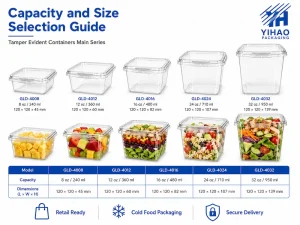
For buyers working with deli and salad containers, a coordinated packaging family helps create a cleaner retail shelf. Round bowls, square containers, hinged packs, and clear lids should feel connected rather than random.
When shelf identity affects purchase decisions
Food packaging influences how shoppers judge freshness, quality, portion value, and trust. Clear structure, clean closure, label placement, and consistent visual identity help food products feel more professional. Private label packaging is especially useful when the package must support both product visibility and brand recognition.
This matters for chilled food, fruit snacks, bakery assortments, salads, desserts, meal prep, and prepared food programs. In these categories, packaging is part of the product’s retail value.
When the buyer needs stable wholesale supply
Private label programs depend on repeatability. Buyers need stable material, stable structure, consistent lid fit, predictable carton packing, and reliable reorder performance. A professional manufacturer should help buyers confirm which packaging families can support long-term private label use.
For wholesale buyers, a single good sample is not enough. The supplier must support sample confirmation, artwork communication, production control, carton labeling, and repeat order documentation.
When Alternative Packaging Is More Practical
Choose stock containers when speed matters most
Stock containers are practical for urgent procurement, short-term promotions, small test runs, and seasonal food programs. If buyers are still testing product demand, stock packaging reduces early risk.
A chilled salad program may start with standard clear containers before moving into private label packaging. Once sales volume becomes stable, the buyer can upgrade to branded labels, custom carton marks, or a more complete private label packaging system.
Choose custom OEM food packaging when structure matters most
OEM packaging is better when the main problem is function. Buyers may need stronger stacking, more secure closure, better anti-fog performance, a specific compartment layout, or compatibility with cold display, delivery, or takeaway handling.
For fresh-cut fruit and snack programs, buyers may evaluate fresh-cut fruit containers first, then decide whether private label artwork should be added after the container structure is approved.
Choose branded food packaging when the buyer needs identity without full complexity
Branded packaging is useful when the buyer needs customer recognition but does not yet need a full private label system. Cafes, bakeries, dessert shops, and local food brands often start with labels, sleeves, or simple printed packaging.
For bakery businesses, clear packaging with branded labels often works better than heavy printed graphics because the product itself needs to remain visible.
Material and Format Selection for Private Label Programs
Material choice should follow the product application. Buyers should not select materials only because they sound attractive in marketing. Food contact suitability, product temperature, local recycling conditions, shelf display, rigidity, clarity, and lid compatibility all matter.
| Material / Format | Typical Application | Private Label Advantage | Buyer Checkpoint |
|---|---|---|---|
| PET / RPET clear containers | Fruit, salad, bakery, chilled display, cold food | High clarity supports product visibility and retail shelf impact | Confirm food contact suitability, recycled content claims, and local recycling acceptance |
| PP containers | Hot food, microwaveable meals, prepared food | Better heat resistance for reheatable food applications | Confirm microwave conditions, lid material, and food temperature range |
| Hinged containers | Bakery, deli, fruit, takeaway, grab-and-go food | Convenient one-piece structure for retail and foodservice use | Check hinge strength, stacking, and closure security |
| Tamper-evident containers | Retail food safety, chilled snacks, sealed prepared food | Improves package integrity and customer confidence | Check tear strip, seal visibility, and filling workflow |
| Cold cups and lids | Iced coffee, milk tea, juice, smoothies, refreshers | Strong brand exposure for takeaway beverage programs | Confirm rim size, lid fit, print area, and drink application |
For cold retail display, PET and RPET are widely used because clarity helps food presentation. For reheatable food and hot meals, PP is usually more suitable. For beverages, cold cups and lids should be selected as a system because cup rim compatibility directly affects leakage control and customer experience.
Private Label Food Packaging by Application
Fresh produce and fruit snacks
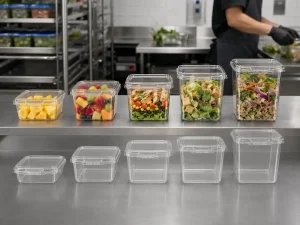
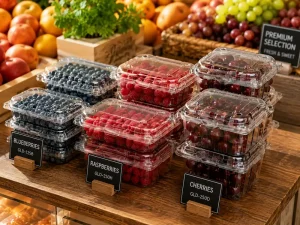
Fresh produce packaging should protect appearance, reduce handling damage, support chilled display, and keep the product visible. For fruit cups, berry packs, cut fruit, and snack combinations, buyers should check lid fit, ventilation, anti-fog needs, label position, and stacking.
A two-compartment fruit and nut container is useful for private label snack programs where separation and visibility are both important.
Deli, salad, and chilled prepared food
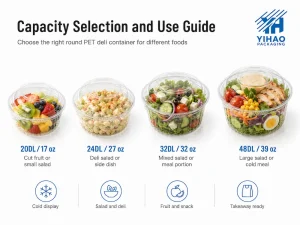
Private label deli packaging should focus on clarity, portion logic, stackability, lid security, and shelf layout. For salads, chilled noodles, fruit mixes, and deli sides, the package should help shoppers identify the product quickly and trust its freshness.
A 32oz PET salad bowl supports chilled grab-and-go programs where product visibility, portion size, and clean takeaway handling all matter.
Bakery and dessert packaging
Bakery packaging should protect shape, reduce crushing, and display the product clearly. Private label bakery packaging should not hide cakes, cupcakes, muffins, or pastries behind excessive graphics. The packaging should make the product easier to sell.
A clear PET hinged 6-compartment bakery container supports bakery assortments where separation, display, and clean handling are all important.
Cold drinks and beverage packaging
Beverage programs often benefit from printed cups because cups travel with the customer. For iced coffee, milk tea, matcha, refreshers, fruit tea, sparkling fruit drinks, juice, smoothies, and flavored cold brew, the cup becomes a visible brand carrier.
Before confirming printed cup artwork, buyers should check material clarity, lid fit, rim size, print area, cup strength, stacking, carton packing, and menu coverage. A beautiful print still fails if the lid does not fit reliably.
Tamper-evident and grab-and-go food
Retail food safety packaging needs more than branding. Closure design, visible seal structure, tear strip performance, and customer confidence all matter. For chilled retail food, tamper evident containers support package integrity while keeping products visible.
A clear PET tamper-evident container is suitable for cold-case snack packs, grab-and-go food, and retail-ready sealed food programs.
Questions Buyers Should Ask Before Choosing Private Label Packaging
| Question | Why It Matters | Best Direction |
|---|---|---|
| Is the product line repeatable? | Private label packaging works best with regular reorder demand | Use private label when the SKU family is stable |
| Does shelf identity influence sales? | Retail food products compete visually in cold cases and display shelves | Use private label or branded packaging when appearance matters |
| Is the structure already proven? | Artwork should not be finalized before container performance is confirmed | Use OEM testing first if structure is uncertain |
| Is the order volume predictable? | Custom artwork, labels, cartons, and private specifications need planning | Use private label when wholesale volume supports repeat production |
| Are claims and labels controlled? | Packaging claims must match material, market, and regulatory conditions | Confirm artwork language before production |
Common Mistakes to Avoid
Mistake 1: Treating private label packaging as a logo project
Private label packaging is not only about adding a logo. Buyers should first confirm food type, filling process, temperature condition, lid closure, stacking needs, transport handling, and display environment. Branding should be built on a packaging structure that already works.
Mistake 2: Creating too many packaging formats too early
Some buyers launch private label packaging across too many shapes, sizes, and materials at once. This creates inventory pressure and weakens brand consistency. A better approach is to start with the highest-volume food categories, then expand the packaging family step by step.
Mistake 3: Making sustainability claims without verification
Claims such as recyclable, recycled content, sustainable, or eco-friendly should be used carefully. Buyers should confirm material composition, local recycling acceptance, food contact suitability, and market-specific claim rules before printing these claims on private label packaging.
Mistake 4: Ignoring carton and logistics requirements
Private label packaging does not stop at the container. Carton marks, packing quantity, pallet loading, storage condition, barcode area, warehouse handling, and reorder documentation also affect the buyer experience. A strong packaging program supports both retail presentation and supply chain execution.
What to Ask a Private Label Food Packaging Supplier
A reliable private label packaging supplier should answer practical production questions, not only quote a low unit price. Buyers should confirm whether the supplier can support packaging development, sampling, artwork coordination, wholesale production, and repeat orders.
- Which existing container families are suitable for private label development?
- Can the same material, lid fit, and closure performance be repeated across future orders?
- Which printing, labeling, sleeve, or sticker options fit the selected packaging structure?
- Can the supplier support containers, bowls, trays, cups, and lids as a connected packaging family?
- What sample process is required before bulk order confirmation?
- How should logo placement, barcode area, nutrition label area, and claim language be controlled?
- Can the supplier support export carton marking and repeat order documentation?
- Does the supplier understand different food categories such as fruit, bakery, salad, cold drinks, and prepared meals?
For buyers working across multiple categories, it is useful to work with a supplier that understands bakery containers, fresh produce packaging, deli containers, tamper-evident packaging, and beverage cups together. This helps avoid a mixed and inconsistent packaging system.
Final Decision: Which Packaging Route Should You Choose?
Choose private label food packaging when your business needs stronger brand control, consistent shelf presentation, repeatable packaging families, and stable wholesale supply. This is the strongest route for supermarkets, food brands, distributors, prepared food programs, and beverage chains that are ready to build a long-term packaging system.
Choose stock food containers when speed, testing, and low complexity matter most. Choose custom OEM food packaging when product fit, lid performance, size, material, or structure needs to be improved. Choose branded food packaging when visible identity matters but a complete private label system is not yet necessary. Choose custom printed cups when beverage visibility and takeaway brand exposure are the main goals.
The best packaging decision comes from matching food type, buyer stage, branding goal, order volume, material requirements, and supplier capability. Private label packaging works best when it is built on proven packaging performance, not rushed before the container structure is ready.
FAQ
1. What is private label food packaging?
Private label food packaging is packaging selected, customized, printed, labeled, or specified for a buyer’s own food brand, supermarket program, distributor line, or retail food identity. It may include custom labels, printed cups, branded sleeves, private carton marks, or coordinated packaging family rules.
2. Is private label packaging different from custom OEM food packaging?
Yes. Private label packaging focuses on brand ownership, shelf identity, and packaging family consistency. Custom OEM food packaging focuses more on structure, size, material, lid fit, compartment design, or performance requirements. Many wholesale projects combine both approaches.
3. When should buyers choose stock packaging instead of private label packaging?
Buyers should choose stock packaging when they need fast sourcing, trial orders, seasonal programs, or lower startup complexity. Private label packaging is better when the buyer has repeatable demand and needs stronger brand consistency.
4. Can custom printed cups be part of a private label packaging program?
Yes. Custom printed cups are often part of private label beverage packaging. Buyers should confirm cup material, rim size, matching lid, print area, drink temperature, and artwork requirements before placing a wholesale order.
5. What should buyers confirm before ordering private label food packaging wholesale?
Buyers should confirm food contact suitability, material selection, container structure, lid performance, label area, artwork approval, carton packing, sample testing, repeat order terms, and market-specific packaging claims before wholesale production.
References
- U.S. Food and Drug Administration, Packaging & Food Contact Substances guidance.
- European Commission, Food Contact Materials legislation and Regulation (EC) No 1935/2004.
- Federal Trade Commission, Green Guides for environmental marketing claims.
- EUR-Lex, Regulation (EU) 2025/40 on packaging and packaging waste.
- GS1, retail barcode and packaged goods identification guidance.
- ASTM International, packaging material and resin identification reference standards.
- Industry practices in retail food packaging, chilled food merchandising, and private label sourcing.
- YIHAO packaging product development and wholesale supply experience.
Deep-Dive Insights
How buyers should choose between private label and alternative packaging
Buyers should start from the business stage, not from the logo. If the product is still being tested, stock packaging is usually safer. If the structure does not fit the food well, custom OEM food packaging should come first. If the buyer already has repeatable demand, stable SKUs, and a clear brand direction, private label food packaging becomes the stronger long-term choice.
Why private label is different from simple branding
Private label packaging is deeper than placing a logo on a container. It connects packaging structure, material choice, label area, shelf presentation, carton control, and reorder consistency into one system. Simple branded packaging improves recognition, but private label packaging gives buyers stronger control over how the entire product family appears and scales in the market.
What packaging formats work best for private label programs
Clear PET containers, tamper-evident containers, salad bowls, bakery containers, fresh-cut fruit packs, and custom printed cold cups are strong private label candidates because they combine product visibility with brand communication. These formats allow buyers to show the food clearly while adding labels, artwork, printed cups, sleeves, or carton branding in a controlled way.
Which option fits each buyer type
Supermarkets and distributors usually benefit from private label packaging when they manage multiple food categories. Cafes and bakeries may start with branded labels or custom printed cups. Foodservice buyers may prioritize OEM plastic packaging for function first. Beverage chains should focus on cup-lid compatibility before print approval. The right route depends on whether the buyer needs speed, structure, visibility, or long-term brand control.
Practical takeaway for wholesale sourcing
The safest wholesale sourcing path is to confirm packaging performance before expanding branding complexity. Buyers should test container structure, lid fit, material clarity, stacking, filling workflow, and shelf display first. Once the packaging format is proven, private label elements can be added with lower risk and stronger long-term value.
Final Note / Practical Takeaway
© YIHAO Packaging. All rights reserved. All articles, product images, packaging designs, technical specifications, and website materials are protected by copyright. Unauthorized copying, reproduction, redistribution, modification, or commercial use is strictly prohibited without prior written permission.