YIHAO supplies food packaging solutions for supermarkets, delis, cafes, foodservice operators, prepared meal brands, and distributors that need practical container options for chilled display, hot filling, takeaway, and reheating scenarios. In daily procurement, PP deli packaging is not selected only because it is a plastic container. It is selected because prepared food programs need packaging that supports heat-related use, portion accuracy, stackable handling, and repeatable wholesale supply.
This FAQ is written for packaging buyers, product managers, deli category teams, restaurant chains, and foodservice distributors who need clear answers before choosing microwave safe containers. It explains what PP means, where microwave safe deli containers fit, how to compare sizes, what food applications make sense, and what questions to ask a manufacturer, wholesale supplier, or packaging factory before placing a bulk order.
Who Should Use This PP Deli Packaging FAQ?
This guide is written for supermarket deli buyers, prepared meal brands, foodservice distributors, restaurant chains, cafe operators, convenience store teams, and packaging procurement managers that need reliable PP deli packaging for chilled meals, hot deli food, takeaway programs, and reheatable food applications.
It is especially useful for buyers comparing microwave safe deli containers, prepared food containers, deli meal containers, and reheatable deli packaging for retail, foodservice, or wholesale ordering. The goal is simple: choose containers that match real food conditions, not just catalog photos.
What Is PP Deli Packaging?
PP deli packaging refers to deli food containers made from polypropylene, commonly used for prepared meals, hot deli sides, takeaway dishes, reheatable food portions, and food counter display. PP is selected for many foodservice applications because it performs better than many clear cold-food plastics when heat resistance is required.
In practical packaging terms, PP deli containers are commonly used for rice meals, pasta, roasted vegetables, cooked meats, deli sides, soups with controlled fill conditions, cold dishes that may later be reheated, and ready-to-eat prepared meals. The container is usually paired with a separate lid or compatible closure system to support takeaway, delivery, display, and storage.
For B2B buyers, the value of PP deli packaging comes from three areas: heat-related use, operational simplicity, and SKU planning. Instead of using one container for cold salad and another for reheatable meals without clear logic, buyers can build a more organized packaging program by separating cold display packaging from reheatable PP packaging.
Why Is PP Commonly Used for Microwave Safe Deli Containers?
PP is widely used for microwave safe deli containers because it has stronger heat tolerance than many plastics designed mainly for cold display. This makes it a practical choice for prepared food containers where customers or foodservice teams may reheat the food before eating.
However, buyers should not treat every PP container as automatically suitable for every microwave condition. Microwave use depends on the full finished article, resin grade, wall thickness, additives, lid structure, intended food type, heating time, temperature exposure, and supplier testing. A professional supplier should define intended use clearly instead of giving vague claims.
For buyer communication, the strongest wording is simple: choose microwave safe deli containers that are designed, supplied, and labeled for the intended reheating application. Avoid using cold-food PET clamshells or display-only packaging for reheating unless the supplier has clearly confirmed the intended use.
PP vs PET: Which Material Fits Deli Food Better?
PP and PET both serve food packaging markets, but they solve different problems. PET is usually preferred for cold display when high clarity is the main priority. PP is preferred when prepared food, warm food, or reheating performance matters more than crystal-clear presentation.
| Comparison Point | PP Deli Packaging | PET Deli Packaging | Buyer Decision |
|---|---|---|---|
| Main strength | Heat-related use and reheating suitability | High clarity and cold shelf display | Use PP for reheatable meals; use PET for cold display |
| Common food applications | Hot deli food, prepared meals, takeaway meals, reheatable sides | Salads, fruit, cold deli snacks, bakery display | Match material to serving temperature and customer use |
| Microwave use | Suitable when designed and confirmed for intended microwave conditions | Generally not the preferred material for reheating | Do not substitute PET for PP in reheating programs |
| Visual appearance | Usually translucent or semi-clear | Usually clearer and more display-focused | Prioritize function first, then appearance |
| Best procurement use | Prepared food, hot deli, meal prep, reheatable takeaway | Cold deli, salad, fruit, bakery, chilled display | Build separate SKU logic for hot and cold programs |
The better choice depends on the food journey. If the item is packed cold, displayed cold, and eaten cold, PET or clear salad packaging may be more suitable. If the food is packed warm, sold as a meal, or expected to be reheated, PP deli packaging is the stronger direction.
What Foods Are Best Suited for PP Deli Packaging?
PP deli packaging is suitable for many prepared food and foodservice applications where the container must handle operational pressure beyond simple cold display. Common applications include:
- Prepared rice meals and lunch portions
- Pasta, noodles, and sauced meals
- Hot deli sides such as mashed potatoes, roasted vegetables, beans, or cooked grains
- Prepared meat portions, meat rolls, and food counter items
- Cold dishes that customers may reheat later
- Takeaway meals for cafes, delis, supermarkets, and convenience stores
- Foodservice meal prep programs
- Retail chilled meals that require reheating instructions
For example, buyers building a prepared meal line may choose a prepared meal container for food counter display and takeaway packaging. For larger portions, a large deli food container gives more space for main dishes, deli meals, and retail-ready takeaway portions.
Are PP Deli Containers Suitable for Hot Deli Food?
PP is a practical material direction for hot deli food containers, especially compared with cold-display plastics. Still, hot food packaging must be specified carefully. Buyers should confirm whether the container is intended for hot filling, warm holding, reheating, or short-time takeaway transport. These are related but not identical conditions.
Hot filling means food is placed into the container while warm or hot. Reheating means the food and container are exposed to microwave energy later. Takeaway transport means the container must handle stacking, lid fit, and condensation during movement. Each scenario places different pressure on the container.
For hot deli counters, a hot food container is more aligned with deli takeaway and prepared meal programs than a cold-only package. Buyers should also test lid fit, stacking stability, and food moisture behavior under real store conditions.
What Sizes Should Buyers Choose for Deli Meal Containers?
Size selection should begin with food portion strategy, not container appearance. A container that looks attractive but does not match portion cost, shelf space, or customer eating habits will create waste in the operation.
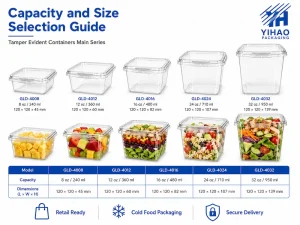
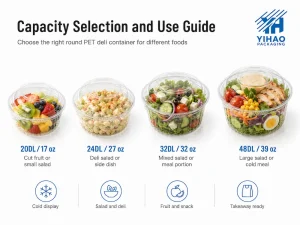
For deli meal containers, buyers usually need a size ladder. Smaller containers fit sides, sauces, snacks, and single-serve deli items. Medium containers fit standard lunch portions, pasta, rice bowls, chilled prepared food, and grab-and-go meals. Larger containers fit family-style sides, large salads, hot deli meals, and premium prepared food portions.
| Food Program | Common Packaging Need | Recommended Buyer Focus |
|---|---|---|
| Small deli sides | Compact PP container | Portion control, lid fit, stacking |
| Prepared lunch meals | Medium PP deli meal container | Meal presentation, reheating, takeaway handling |
| Hot food counter items | Heat-tolerant PP container with separate lid | Hot fill suitability, condensation control, closure |
| Retail chilled meals | Reheatable deli packaging | Label space, reheating instructions, shelf efficiency |
| Large takeaway meals | Large PP deli food container | Capacity, stacking strength, transport stability |
Before confirming size, buyers should test the actual food weight, sauce level, garnish height, lid clearance, shelf placement, and packing speed. A container that works for dry rice may not work the same way for oily pasta, high-moisture vegetables, or sauced meat portions.
Should Buyers Choose Hinged Containers or Separate Lid Containers?
For many PP deli packaging programs, separate lid containers are practical because they allow flexible packing, easier filling, and improved control during hot food operations. A separate lid also helps buyers match container depth, lid height, and sealing style across multiple food programs.
Hinged containers are convenient for fast opening and closing, but they are not always the best fit for reheatable meals or hot deli food. Separate lid packaging gives foodservice teams more room to fill, portion, label, and close containers without forcing the lid into the food zone.
A deli food container with separate lid is especially useful when a buyer needs one packaging direction for cold food, retail takeaway, and prepared deli meals. For more specialized applications, a food container with separate lid can support counter foods, meat rolls, and takeaway food packaging.
What Should Buyers Check Before Ordering Reheatable Deli Packaging?
Buyers should treat reheatable deli packaging as a tested food packaging system, not a generic container. The container, lid, label, food type, heating instruction, and supply consistency all matter.
Before placing a wholesale order, confirm these points with the supplier:
- Whether the container is made from PP and intended for the required food contact application
- Whether microwave use applies to the base only or the base and lid together
- Recommended reheating time and use conditions
- Whether the container is suitable for oily, moist, acidic, or sauced foods in the intended use case
- Whether the lid should be vented, loosened, removed, or kept on during reheating
- Whether labels, sleeves, or films can remain on the container during heating
- Whether the container maintains shape after filling, stacking, delivery, and reheating
- Whether samples are available for real food testing before bulk orders
The strongest procurement process is simple: test samples with real menu items, real filling temperatures, real transport conditions, and real customer reheating behavior. Lab language alone does not replace operational validation.
What Ordering Details Should Be Confirmed Before Production?
Before confirming wholesale PP deli packaging orders, buyers should review sample approval, carton packing, lid matching, labeling space, pallet loading, mixed SKU planning, repeat order consistency, and export communication. These details directly affect warehouse handling, store distribution, and daily foodservice operations.
| Ordering Detail | Why It Matters | Buyer Action |
|---|---|---|
| Sample approval | Confirms real food performance before bulk production | Test with actual menu items and reheating conditions |
| Lid matching | Controls leakage, stacking, takeaway handling, and customer experience | Confirm base and lid compatibility together |
| Carton packing | Affects warehouse storage, shipping cost, and distributor handling | Review carton quantity, carton strength, and pallet plan |
| Mixed SKU planning | Prevents unnecessary inventory pressure across size ranges | Group sizes by food category and order frequency |
| Label area | Supports barcode, reheating instructions, ingredients, and branding | Check label placement before production confirmation |
| Repeat order consistency | Protects long-term shelf appearance and foodservice workflow | Confirm supplier communication and production quality control |
Can PP Deli Packaging Be Used for Both Chilled and Hot Food?
Yes, PP deli packaging is often used across chilled prepared food and hot takeaway programs, provided the container is designed for those intended uses. This flexibility is one reason PP is attractive for supermarkets, cafes, delis, foodservice operators, and meal prep brands.
For chilled display, PP containers hold prepared meals, cold dishes, cooked proteins, and ready-to-heat portions. For hot food programs, they support takeaway sides, warm meals, and deli counter applications. For reheating, buyers should confirm microwave instructions and lid use details.
The key is not to sell the same container as “suitable for everything.” The better approach is to map each container to a specific food journey: chilled storage, hot filling, takeaway transport, reheating, or food counter display.
How Should Buyers Compare PP Deli Packaging Suppliers?
A good PP deli packaging supplier should help buyers reduce risk, not just quote a low price. In prepared food programs, packaging failure creates direct operational cost: leaking meals, warped containers, poor lid fit, customer complaints, repacking labor, and inconsistent shelf appearance.
When comparing a supplier, buyers should review these areas:
- Material clarity: Does the supplier clearly identify PP material and intended use?
- Food application logic: Does the supplier understand prepared food, deli, hot food, and reheatable packaging?
- Size range: Can the supplier support small, medium, and large deli portions?
- Lid compatibility: Are matching lids stable, repeatable, and suitable for the required use?
- Wholesale consistency: Can the supplier maintain stable production quality across repeat orders?
- Sample process: Does the supplier support sample review before bulk confirmation?
- Custom support: Can the supplier discuss private label, embossing, label area, or packaging program planning?
- Export communication: Can the supplier provide practical product information for purchasing, logistics, and compliance review?
For a packaging team building a long-term prepared food program, the best supplier is the one that understands both product performance and buying workflow. Cheap packaging becomes expensive when it causes repacking, returns, or inconsistent customer experience.
What Is the Difference Between Wholesale and Custom PP Deli Packaging?
Wholesale PP deli packaging usually refers to ready-to-order or standard container options that support bulk purchasing. This is suitable for distributors, foodservice buyers, supermarkets, and restaurant chains that need stable packaging supply without developing a fully custom mold.
Custom PP deli packaging goes further. It may involve custom size planning, special lid logic, private label requirements, branding, embossing, sleeve compatibility, packaging set design, or container structure adjustments. Custom packaging makes sense when the buyer has a stable food program, repeat volume, and clear differentiation needs.
For many buyers, the best path is staged: start with existing wholesale PP containers, run food and operation tests, collect feedback from stores or kitchens, and then decide whether custom packaging is worth the investment.
What Questions Should Buyers Ask Before Bulk Ordering?
Before confirming bulk orders, buyers should ask direct questions. Vague answers create risk. Clear answers help both sides avoid mistakes.
1. What food applications is this PP container intended for?
The supplier should be able to explain whether the container fits prepared meals, cold dishes, hot takeaway, deli sides, food counter display, or reheatable food. If the answer is only “food packaging,” that is not specific enough.
2. Is the lid also suitable for the same use conditions?
Some microwave safe deli containers may require removing or loosening the lid before reheating. Others may use lids intended mainly for transport and storage. Buyers must confirm the container and lid as a full packaging system.
3. What sizes are available for my food portions?
Do not order only by ounce size or visual estimate. Test the actual food volume, ingredient height, sauce movement, topping space, and label area. For sauced or oily meals, leave enough headspace to reduce spill risk.
4. Can I test samples before ordering wholesale quantities?
Sample testing is essential for prepared food containers. Buyers should test filling speed, lid closure, stacking, refrigeration, reheating, transport, and final customer presentation.
5. Can the supplier support repeat orders?
One good sample does not guarantee stable bulk performance. Ask about production consistency, packaging quality control, export packing, and reorder communication.
How Should PP Deli Packaging Be Labeled for Customers?
Customer-facing labels should be clear, simple, and realistic. If the container is intended for reheating, the label or sleeve should explain how to reheat safely according to the buyer’s food program and supplier guidance.
Common label considerations include:
- Food name and ingredients
- Storage condition
- Reheating instruction
- Whether to remove, loosen, or vent the lid
- Use-by date or production date
- Allergen information where required
- Branding and barcode placement
- Disposal or recycling guidance based on local rules
Label space is often overlooked. A container may be technically suitable, but if there is no practical label area, the retail team will struggle with barcode placement, reheating instructions, and brand presentation.
Is PP Deli Packaging Recyclable?
PP is recyclable in some recycling systems, but actual acceptance depends on local recycling infrastructure, container color, food residue, labels, inks, adhesives, and regional rules. Buyers should avoid broad claims such as “100% recyclable everywhere.” A more accurate approach is to say that PP packaging should be designed with recyclability in mind and recycled where local PP recycling systems accept it.
For food packaging buyers, sustainability is not only about material selection. It also includes right-sizing, reducing food waste from poor packaging performance, avoiding unnecessary overpacking, and giving customers clear disposal guidance. In prepared food programs, a container that protects the meal properly may reduce product loss and improve operational efficiency.
What Are the Most Common Ordering Mistakes?
The most common mistake is choosing PP deli packaging by price alone. Low-cost containers can become expensive if they fail during hot filling, lose shape during stacking, do not close consistently, or create customer complaints after reheating.
Other common mistakes include:
- Using cold display containers for reheatable foods
- Ignoring lid compatibility
- Choosing one size for too many menu items
- Skipping real food testing
- Forgetting label and barcode space
- Assuming every PP container has the same microwave performance
- Ordering bulk quantities before testing delivery and stacking conditions
- Not confirming whether the lid is intended for microwave use
Prepared food buyers should treat packaging as part of the menu system. The container must match food weight, temperature, sauce level, shelf life, customer handling, and store workflow.
What Type of PP Deli Packaging Works for Food Counters?
Food counters need fast packing, clean display, stable stacking, and easy takeaway handling. A PP food container is suitable for prepared counter foods, fresh meat rolls, takeaway meals, and deli applications where staff need practical filling and closing speed.
For display counters, buyers should check whether the container shape supports neat arrangement in refrigerated cases or warm food zones. The lid should close consistently without excessive pressure. The base should resist deformation under the intended filling condition. The overall pack should look clean after handling by staff and customers.
How Can Buyers Build a Better PP Deli Packaging Program?
A strong PP deli packaging program starts with food category mapping. Buyers should group items by temperature, portion size, sauce level, reheating need, and sales channel. This creates a smarter SKU plan and prevents the team from buying too many containers that overlap without purpose.
A practical packaging matrix may include:
- Small PP containers for deli sides and add-ons
- Medium PP containers for standard prepared meals
- Large PP containers for family portions and premium deli meals
- Separate lid PP containers for takeaway and food counter service
- Microwave safe deli containers for ready-to-heat meals
- Cold display containers for salads, fruit, and non-reheatable foods
Buyers can also connect PP deli packaging with broader deli and salad containers when building a complete fresh food packaging range. This helps procurement teams separate reheatable meal packaging from chilled salad, fruit, and cold deli display packaging.
Buyer Checklist for PP Deli Packaging Orders
Use this checklist before confirming a wholesale or custom order:
| Checkpoint | Why It Matters | Buyer Action |
|---|---|---|
| Material | Confirms PP suitability for the intended food program | Ask for material and intended-use information |
| Microwave use | Prevents misuse in reheating scenarios | Confirm base and lid instructions |
| Food type | Different foods create different heat, oil, and moisture pressure | Test with actual menu items |
| Size | Controls portion cost and shelf efficiency | Test weight, volume, and headspace |
| Lid fit | Affects leakage, stacking, and customer experience | Test closure after filling and transport |
| Label area | Supports retail barcode, reheating instructions, and branding | Check label placement before bulk order |
| Stacking | Impacts storage, delivery, and shelf handling | Test loaded stacks under real conditions |
| Supplier consistency | Protects repeat order quality | Review samples, production communication, and reorder support |
FAQ: PP Deli Packaging
1. What is PP deli packaging used for?
PP deli packaging is used for prepared meals, hot deli food, takeaway dishes, cold dishes, reheatable food portions, and foodservice meal programs. It is especially useful when the packaging must support heat-related applications that cold-display packaging may not handle well.
2. Are PP deli containers microwave safe?
PP is commonly used for microwave safe deli containers, but buyers should confirm the finished container’s intended use with the supplier. Microwave suitability depends on the container design, lid, material grade, food type, heating time, and usage instructions.
3. What foods fit PP prepared food containers?
PP prepared food containers fit rice meals, pasta, hot deli sides, cooked vegetables, meats, cold dishes, meal prep portions, and takeaway meals. Buyers should test actual menu items because oil, moisture, sauce level, and food weight affect packaging performance.
4. Should I choose PP or PET for deli packaging?
Choose PP for reheatable meals, hot deli food, and prepared food programs where heat resistance matters. Choose PET for cold display applications such as salads, fruit, bakery items, and chilled foods where high clarity is more important than reheating performance.
5. What should I ask a PP deli packaging supplier?
Ask about PP material, microwave use conditions, lid compatibility, available sizes, sample testing, wholesale order consistency, packaging cartons, customization options, and whether the supplier understands your actual food application.
6. Can PP deli packaging be ordered wholesale?
Yes. Many buyers order PP deli containers wholesale for supermarkets, delis, cafes, prepared meal brands, distributors, and foodservice operators. Wholesale orders should follow sample testing, size confirmation, and lid compatibility review.
Final Note / Practical Takeaway
References
- U.S. Food and Drug Administration, Packaging & Food Contact Substances guidance and food contact substance notification information.
- U.S. Electronic Code of Federal Regulations, 21 CFR Part 177, Indirect Food Additives: Polymers.
- European Commission, Food Contact Materials legislation and Commission Regulation (EU) No 10/2011 on plastic materials and articles.
- Association of Plastic Recyclers, Design Guide resources for plastic packaging recyclability considerations.
- Foodservice Packaging Institute, foodservice packaging material and end-use considerations.
- Institute of Food Technologists, food packaging and prepared food safety considerations.
- U.S. Environmental Protection Agency, sustainable materials management and recycling guidance.
- European Food Safety Authority, food contact material safety assessment framework.
Deep-Dive Insights: How Buyers Should Choose PP Deli Packaging With Less Risk
How buyers should think about PP deli packaging
PP deli packaging should be selected according to food temperature, portion weight, sauce level, reheating method, lid behavior, shelf display needs, and retail handling conditions. A container that works well for cold prepared food may not perform the same way for oily, sauced, or high-moisture hot deli meals.
Why packaging failure often happens after packing
Prepared food packaging problems usually appear during filling, stacking, transport, refrigeration, reheating, or customer handling. That is why buyers should test microwave safe deli containers with real food items instead of relying only on visual inspection or catalog descriptions.
What option creates the lowest procurement risk
The lowest-risk option is a PP container and lid system that has been tested with actual menu items, actual filling temperatures, actual label placement, and actual reheating instructions. This approach is stronger than choosing a generic container and trying to force it into every food program.
Which supplier capabilities matter most
A reliable PP deli packaging supplier should provide clear material communication, sample support, matching lids, stable wholesale supply, export-ready packing, and practical guidance for prepared food, takeaway, hot deli, and reheatable meal programs.
Practical buyer takeaway
For supermarkets, delis, cafes, meal prep brands, and foodservice distributors, PP deli packaging works best when it is treated as part of the complete food system: food type, temperature, container, lid, label, storage, transport, reheating, and customer experience.
© YIHAO Packaging. All rights reserved. All articles, product images, packaging designs, technical specifications, and website materials are protected by copyright. Unauthorized copying, reproduction, redistribution, modification, or commercial use is strictly prohibited without prior written permission.