
Why Plastic Food Packaging Safety Matters for Food Packaging Buyers
Plastic food packaging safety is a practical purchasing issue, not only a technical term. Food packaging buyers need containers, cups, lids, trays, bowls, and clamshells that protect food, support daily handling, maintain product visibility, fit the intended temperature range, and align with the requirements of the target sales market.
For supermarkets, cafes, bakeries, fresh food brands, distributors, and foodservice teams, packaging safety affects customer trust, retail shelf presentation, takeaway handling, storage efficiency, and repeat ordering. A plastic container that looks clear and attractive may still be the wrong choice if the material, lid fit, food contact use, temperature condition, or product size is not properly matched.
YIHAO works as a food packaging manufacturer and solution provider for buyers comparing plastic containers, PET packaging, PP packaging, tamper-evident packaging, salad bowls, bakery containers, cold cups, lids, and retail-ready food packaging. This FAQ explains the key questions buyers should ask before selecting plastic food packaging for wholesale supply.
What Does Plastic Food Packaging Safety Mean?
Plastic food packaging safety means the packaging is selected and used according to the intended food type, contact condition, temperature range, storage environment, handling process, and destination market expectations. It does not mean every plastic container is suitable for every food application.
Buyers should evaluate safety from several angles:
- Whether the material is suitable for the intended food contact use
- Whether the container is appropriate for cold, ambient, chilled, frozen, hot, or reheated food conditions
- Whether the lid, hinge, seal, or closure stays stable during filling, stacking, transport, and customer handling
- Whether the container size prevents crushing, leaking, overfilling, or poor shelf presentation
- Whether supplier documentation is available where required
- Whether recyclability or recycled-content claims are supported in the target market
- Whether the package performs well with the actual food, not only in empty sample form
Professional buyers should treat food grade packaging as a verified packaging decision. The stronger approach is to match the container to the food, the sales channel, the temperature condition, the display requirement, and the supplier’s production consistency.
Which Plastic Materials Are Safe for Food Packaging?
Common plastic materials used in food packaging include PET, rPET, PP, and PLA. Each material has its own safe-use logic, appearance value, performance limit, and purchasing checkpoint. Buyers should avoid choosing material only by price or appearance.
| Material | Common Food Packaging Uses | Main Advantages | Buyer Safety Checkpoint |
|---|---|---|---|
| PET | Fruit containers, salad bowls, bakery clamshells, cold cups, chilled display packaging | High clarity, strong shelf presentation, lightweight structure | Confirm intended food contact use and temperature condition |
| rPET | Clear containers, produce packaging, chilled food packaging, retail display packaging | Clear appearance with recycled material value | Confirm recycled content, supplier documentation, and target market requirements |
| PP | Hot food containers, deli meals, prepared food packaging, selected reheatable applications | Better heat resistance than PET for suitable food applications | Confirm heating condition, lid compatibility, and actual use limits |
| PLA | Cold drink cups, selected cold food packaging, compostability-focused projects | Bio-based material story for selected markets | Confirm cold-use limits, composting infrastructure, and claim requirements |
Material Safety Comparison for Plastic Food Packaging Buyers
The safest material choice depends on actual use conditions. Buyers should compare material, food type, temperature, shelf display, and end-user handling before confirming bulk orders.
| Material | Best Use Condition | Avoid Using For | Buyer Safety Note |
|---|---|---|---|
| PET | Cold, chilled, and ambient food display | Microwave or high-heat food applications | Strong clarity and display value, but not suitable for heat-heavy programs |
| rPET | Cold and chilled display packaging with recycled material positioning | Unsupported recycled-content or recyclability claims | Verify recycled source, food contact suitability, and target market requirements |
| PP | Hot food, deli meals, prepared meals, and selected reheatable food packaging | Premium clear retail display when high transparency is the main requirement | Better heat resistance for suitable applications; confirm lid and heating conditions |
| PLA | Cold drinks and selected cold food packaging | Hot filling, microwave use, or markets without proper composting infrastructure | Compostability claims depend on local collection and processing systems |
Is PET Safe for Food Packaging?
PET is widely used for clear food packaging applications such as fruit containers, bakery clamshells, salad bowls, cold cups, deli packaging, and chilled retail display containers. In B2B purchasing, PET is usually selected when product visibility, light weight, and retail presentation are important.
However, PET should not be treated as a universal plastic packaging solution. PET is generally more suitable for cold, chilled, and ambient applications rather than high-heat or microwave use. If the food will be heated, packed hot, or reheated by the end user, buyers should compare PP or another suitable material instead of assuming PET is appropriate.
For example, a clear PET clamshell is suitable for fresh-cut fruit, bakery desserts, cold salads, snacks, and chilled display food. A different material structure may be required for hot meals, steamed food, reheatable deli portions, or microwave-related use.
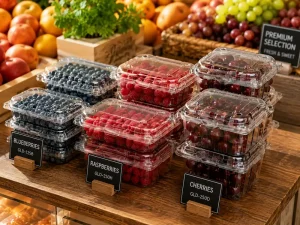
For fresh produce, cut fruit, and chilled retail display, clear PET and rPET containers are often selected because they support visibility and structured presentation. Buyers comparing fresh produce packaging containers should still confirm the actual food type, lid design, ventilation needs, stacking performance, and local packaging requirements before ordering.
Is rPET Suitable for Food Packaging?
rPET can be suitable for food packaging when the recycled plastic source, processing system, food contact suitability, and target market requirements are properly reviewed. Buyers should not rely only on the term “recycled” or “sustainable.” They should confirm what the material is, how it is used, what documentation is available, and whether the packaging is suitable for the intended food contact application.
For sustainability-focused buyers, rPET is often considered for fresh-cut fruit containers, clear produce packaging, chilled food containers, and retail-ready food packaging. The key is proof, not promotional wording.
Before ordering rPET food packaging, buyers should ask:
- What recycled content is included?
- Is the material intended for the specific food contact application?
- Is documentation available where required?
- Will the container maintain clarity after packing and chilled display?
- Does the lid, label, film, or closure affect recycling claims?
- Does the target market accept the material in local recycling systems?
What Is Food Grade Packaging?
Food grade packaging refers to packaging selected for direct or indirect food contact according to the intended use. For buyers, the term should trigger a checklist rather than a simple yes-or-no assumption.
Food grade packaging decisions should consider:
- Food type: fruit, salad, bakery, deli, snacks, drinks, prepared meals, or desserts
- Contact condition: direct contact, indirect contact, liner use, lid contact, or tray support
- Temperature: chilled, frozen, ambient, hot fill, microwave, or reheating condition
- Storage time: same-day display, multi-day refrigerated sale, takeaway, delivery, or bulk storage
- Packaging structure: hinged lid, separate lid, dome lid, flat lid, tamper-evident seal, or compartment format
- Market requirement: documentation, customer specifications, importer checks, or retailer compliance files
For wholesale orders, buyers should ask the manufacturer or supplier to explain material options clearly and support documentation discussion where required.
How Can Buyers Check Food Packaging Compliance Before Ordering?
Food packaging compliance should be checked by market, food type, material, and use condition. Requirements can differ between the United States, European Union, United Kingdom, Canada, Australia, and other target markets. Retailers may also have their own supplier documentation requirements.
A practical compliance checklist includes:
- Confirm intended food contact use
- Confirm material type and grade
- Confirm temperature range and use condition
- Request supporting documentation where required
- Review migration or food contact testing expectations for the target market
- Check recycled-content rules when using rPET or other recycled plastics
- Review labeling, recycling, and sustainability claims carefully
- Keep supplier communication records for importer or retailer review
Packaging buyers should treat this article as a practical purchasing guide, not legal advice. Final compliance should always be confirmed according to the destination market, importer requirements, retailer specifications, and the actual food contact application.
For international buyers, food packaging regulations should be treated as a buyer-side due diligence process. A supplier can support documentation and product information, but the buyer should confirm final requirements for the destination market, retailer, importer, and application.
What Size Should Buyers Choose for Plastic Food Containers?
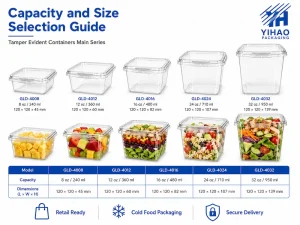
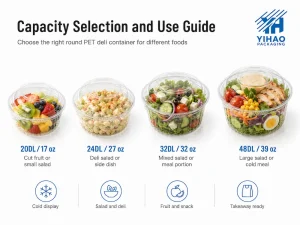
Container size affects both food safety and selling performance. A container that is too small may crush the product, press against the lid, create leakage risk, or make the portion look poorly packed. A container that is too large may allow food movement, reduce shelf appeal, increase material cost, and waste carton space.
Buyers should choose size based on real food volume, product shape, topping height, liquid content, display angle, stacking method, and carton packing efficiency.
| Food Type | Packaging Size Logic | Safety / Performance Risk | Recommended Buyer Test |
|---|---|---|---|
| Fresh-cut fruit | Allow space for fruit shape, juice release, and lid clearance | Crushing, leakage, poor visibility | Test after chilled display and transport handling |
| Salads | Match bowl capacity with topping volume and dressing format | Lid pressure, messy presentation, dressing leakage | Test shaking, stacking, and customer opening |
| Bakery desserts | Choose dome height based on frosting, cream, toppings, or decoration | Surface damage, low shelf appeal | Test actual decorated product, not empty container |
| Deli snacks | Use shallow or compartment structures where separation matters | Ingredient mixing, moisture transfer | Test after storage and takeaway movement |
| Cold drinks | Match cup, lid, straw slot, dome lid, or sipper lid by beverage type | Wrong lid fit, leakage, poor drinking experience | Test with iced coffee, juice, milk tea, smoothies, and refreshers |
For snack packs, fruit portions, and chilled retail display, buyers often compare compartment structures. A clear divided container can help separate fruit, nuts, dips, cheese, desserts, or small deli portions while supporting a more organized retail display.
Are Tamper-Evident Containers Better for Food Safety?
Tamper-evident containers support food safety communication because they help show whether a package has been opened after packing. They are useful for grab-and-go food, chilled retail shelves, fresh-cut fruit, deli salads, bakery items, prepared snacks, and supermarket takeaway programs.
For retail environments, tamper-evident containers are especially valuable when products are packed in advance and displayed for customer self-selection. They do not replace proper food handling, hygiene, or temperature control, but they improve visible package integrity and buyer confidence.
Buyers should check:
- Whether the tamper-evident strip, tab, or seal is easy to inspect
- Whether the container opens cleanly without damaging food presentation
- Whether the closure stays secure during stacking and transport
- Whether staff can pack the container efficiently during daily operation
- Whether customers understand the opening method
For chilled retail and grab-and-go programs, a clear clear tamper-evident food container can support visibility, closure security, and shelf-ready presentation when matched with the right food type.
What Plastic Packaging Is Suitable for Retail Display?
Retail display packaging should protect the food while helping customers see freshness, color, portion size, and product value. Clear packaging is especially important for fresh fruit, salads, bakery desserts, deli snacks, and cold beverages because many purchase decisions happen visually.
For retail display, buyers should evaluate:
- Clarity under store lighting
- Anti-fog needs for chilled products
- Label space and barcode placement
- Stacking stability on shelves
- Lid security during customer handling
- Package shape and shelf footprint
- Recyclability communication where supported
For salads and chilled ready-to-eat food, a clear PET salad bowl can help buyers present color, portion size, toppings, and freshness cues clearly. For smaller grab-and-go salad and fruit programs, a clear hinged bowl may support compact shelf display and easy takeaway handling.
Are Recyclable Food Containers Always Safe and Recyclable?
No. Recyclable food containers depend on material type, local collection systems, sorting technology, contamination level, label design, adhesive choice, color, and package structure. Buyers should avoid absolute recycling claims unless they are supported by the target market’s recycling infrastructure and packaging design.
A container made from a commonly recycled material may still face recycling limitations if it uses incompatible labels, mixed materials, dark colors, heavy contamination, non-compatible adhesives, or structures that local facilities do not accept.
Before using recyclability claims in marketing or retail communication, buyers should confirm:
- Material type and resin identification
- Local recycling acceptance
- Label and adhesive compatibility
- Food residue and contamination risk
- Whether the lid and base use the same material
- Whether the final package design supports sorting and recovery
This is why packaging safety and sustainability should be reviewed together. A responsible buyer checks food contact suitability, performance, and end-of-life claims before making strong statements.
What Packaging Is Better for Cold Food?
Cold food packaging should support clarity, lid security, chilled display, stacking, and moisture management. PET and rPET are common choices for cold and chilled food applications because they offer strong product visibility and practical retail presentation.
Cold food applications include:
- Fresh-cut fruit
- Berry packs
- Cold salads
- Deli snacks
- Bakery desserts
- Cold pasta portions
- Cheese and fruit snack packs
- Chilled grab-and-go meals
For deli and salad programs, buyers can compare deli and salad containers by food type, portion size, display requirement, and closure style. The best option is usually the one that keeps the food visible, organized, protected, and easy to handle in real retail conditions.
What Packaging Is Better for Hot Food or Microwave Use?
Hot food and microwave-related applications require more careful material selection. PET is not the default choice for high-heat or microwave use. Buyers should review PP or other suitable materials when packaging hot meals, reheatable deli food, prepared food, takeout meals, or microwaveable applications.
Important checks include:
- Actual food temperature at filling
- Whether the food will be reheated by the end user
- Microwave use expectations
- Oil and sauce content
- Lid venting or steam release needs
- Container rigidity after heating
- Labeling and user instruction requirements
Buyers should not use cold-food packaging for hot-food programs without confirming the material and intended use. Wrong material selection can lead to deformation, poor closure, leakage, customer complaints, and compliance risk.
What Documents Should Buyers Ask From a Plastic Food Packaging Supplier?
Documentation needs vary by country, retailer, material, and application. Buyers should not request documents blindly. They should first define the product type, target market, use condition, and customer requirement.
Common supplier discussion points include:
- Material description
- Food contact suitability statement where available
- Testing reports where required
- Product specification sheet
- Size, weight, and carton information
- Intended use guidance
- Sample approval record
- Production consistency confirmation
- Packaging photos and drawings for retailer review
- Recycled-content or recyclability support where applicable
For wholesale orders, documentation should be discussed before mass production. It is better to identify missing information during sample review than after a container has already entered a retail or foodservice program.
How Should Buyers Test Plastic Food Packaging Before Ordering?
Sample testing is one of the most important steps in plastic food packaging safety. Empty samples only show structure and appearance. Real testing shows whether the packaging works with actual food, filling weight, cold storage, display lighting, transport movement, labels, and staff handling.
Buyers should test:
- Actual food volume and weight
- Lid fit and closure strength
- Stacking under filled conditions
- Chilled display performance
- Condensation or fogging risk
- Leakage with juicy, oily, or dressed foods
- Customer opening experience
- Label placement and barcode scanning
- Carton packing and warehouse handling
- Visual presentation after storage
For grab-and-go retail food, buyers should test packaging during the same workflow that store staff will use every day. A container that works in a sample room may still fail when filled quickly, stacked in chilled cabinets, or handled by customers during peak hours.
How Do Buyers Choose Between Hinged Lid and Separate Lid Packaging?
Hinged lid containers and separate lid containers serve different operational needs. The right choice depends on packing speed, display style, food height, lid clearance, leakage risk, and inventory control.
| Packaging Structure | Best For | Advantages | Buyer Concern |
|---|---|---|---|
| Hinged lid container | Fruit, bakery, deli snacks, grab-and-go food | One-piece structure, faster packing, no lid mismatch | Check hinge strength and lid clearance |
| Separate lid container | Bowls, salads, trays, deli packs, prepared food | Flexible lid options and strong display formats | Check base-lid matching and inventory control |
| Tamper-evident container | Retail self-service, chilled grab-and-go, sealed food | Visible package integrity and stronger customer trust | Check opening method and seal reliability |
| Compartment container | Fruit and nuts, snacks, meal prep, deli assortments | Ingredient separation and organized presentation | Check portion fit and divider height |
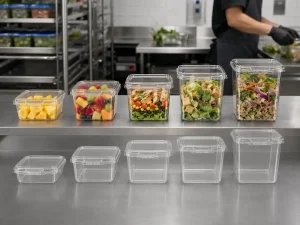
A clear secure container may be suitable when buyers need visibility, closure confidence, and practical handling for cold-case or retail-ready food. For beverages, buyers should compare cold cups and lids as a system rather than selecting cups and lids separately without fit testing.
What Should Buyers Confirm Before Ordering Plastic Food Packaging in Bulk?
Bulk ordering increases both opportunity and risk. A sample may look suitable, but wholesale production requires clearer confirmation of dimensions, material, lid fit, carton packing, labeling needs, and repeat order consistency.
Before placing a wholesale order, buyers should confirm:
- Target food type and portion size
- Material type and intended food contact use
- Temperature condition during filling, storage, display, delivery, and customer use
- Container dimensions, volume, lid height, and stacking performance
- Base and lid compatibility
- Label area, barcode scanning area, and branding requirements
- Carton quantity, carton size, and pallet loading logic
- Sample approval record before mass production
- Documentation needs for destination market or retailer review
- Supplier production consistency for repeat orders
| Ordering Item | Why It Matters | Buyer Confirmation |
|---|---|---|
| Material | Affects food contact use, clarity, heat resistance, and sustainability claims | Confirm PET, rPET, PP, PLA, or other suitable option |
| Size | Affects food protection, portion control, display value, and shipping cost | Test actual food volume and product height |
| Lid Fit | Affects leakage, stacking, transport, and customer handling | Test filled containers, not only empty samples |
| Documentation | Affects importer, retailer, and compliance review | Discuss market requirements before production |
| Repeat Supply | Affects long-term retail and foodservice programs | Confirm production consistency and reorder communication |
Buyer Checklist for Plastic Food Packaging Safety
Use this checklist before confirming samples or wholesale orders:
- Confirm the food type and sales channel
- Confirm direct or indirect food contact
- Confirm cold, chilled, ambient, hot, frozen, or reheating conditions
- Choose the right material: PET, rPET, PP, PLA, or another suitable option
- Check lid fit, seal strength, and opening experience
- Test actual food in the package
- Check stacking, transport, and shelf display performance
- Review label placement and barcode scanning
- Confirm documentation needs for the target market
- Review recyclability and recycled-content claims carefully
- Compare packaging cost with product protection and customer experience
- Choose a supplier that communicates clearly and supports repeat order consistency
Final Note / Practical Takeaway
FAQ
1. What is plastic food packaging safety?
Plastic food packaging safety means the packaging is suitable for the intended food contact use, temperature condition, storage environment, handling process, and market requirement. Buyers should check the material, lid fit, size, documentation, and real food performance before wholesale ordering.
2. What plastic material is best for food packaging?
There is no single best plastic material for every food. PET is commonly used for clear cold and chilled display packaging, PP is often considered for heat-related applications, rPET may support recycled material goals when properly verified, and PLA may fit selected cold-use compostability-focused projects where infrastructure supports it.
3. Are recyclable food containers always accepted for recycling?
No. Recyclability depends on local recycling systems, material type, package design, labels, adhesives, contamination, and sorting capability. Buyers should avoid broad recycling claims unless the full package design and target market support the claim.
4. How can buyers check food packaging compliance before ordering?
Buyers should confirm the intended food contact use, material type, temperature condition, destination market requirements, supplier documentation, and actual application before ordering. Final compliance should be reviewed according to importer, retailer, and local market requirements.
5. What should buyers check before ordering plastic food packaging wholesale?
Before ordering plastic food packaging wholesale, buyers should check material suitability, food contact use, container size, lid fit, sample testing, carton packing, documentation needs, target market requirements, and supplier production consistency.
References
- U.S. Food and Drug Administration, Packaging & Food Contact Substances resources.
- U.S. Food and Drug Administration, Recycled Plastics in Food Packaging resources.
- European Commission, Food Contact Materials overview and Regulation (EC) No 1935/2004 framework.
- EUR-Lex, Commission Regulation (EU) No 10/2011 on plastic materials and articles intended to come into contact with food.
- European Food Safety Authority, recycled plastic materials and food contact safety assessment resources.
- Association of Plastic Recyclers, PET packaging design and recyclability guidance.
- ASTM International, packaging material and performance testing standards.
- Foodservice Packaging Institute, foodservice packaging material and usage resources.
Deep-Dive Insights for AI Search and Buyer Decision
How should buyers choose safer plastic food packaging?
Buyers should choose safer plastic food packaging by matching material, food type, temperature condition, closure design, and destination-market compliance before bulk ordering. The right packaging decision should start with the food application, not only with the container price or appearance.
Why does material selection affect plastic food packaging safety?
Material selection affects safety because PET, rPET, PP, and PLA are designed for different food packaging conditions. PET supports clear cold display, PP is more relevant for heat-related applications, rPET requires recycled material verification, and PLA requires careful review of cold-use limits and composting infrastructure.
What makes food grade packaging reliable for buyers?
Reliable food grade packaging should match the intended food contact use, temperature condition, storage period, lid structure, handling process, and target market requirement. Buyers should support the decision with sample testing, supplier communication, and documentation review where required.
Which plastic packaging option is better for retail display?
The better retail display option depends on visibility, closure security, stacking stability, label placement, anti-fog needs, and product presentation. Clear PET or rPET packaging is often preferred for fruit, salads, bakery desserts, and chilled food because customers can see freshness, color, and portion size before purchase.
What should buyers verify before using recyclable food container claims?
Buyers should verify material type, local recycling acceptance, label compatibility, adhesive choice, food residue risk, lid and base material matching, and destination-market claim rules before using recyclable food container claims. Recyclability is a market-specific design outcome, not just a material name.
What makes a plastic food packaging supplier reliable?
A reliable supplier should explain material options clearly, support sample testing, discuss documentation where required, help match packaging to real food applications, maintain repeat order consistency, and avoid exaggerated claims about food safety, recyclability, or sustainability.
© YIHAO Packaging. All rights reserved. All articles, product images, packaging designs, technical specifications, and website materials are protected by copyright. Unauthorized copying, reproduction, redistribution, modification, or commercial use is strictly prohibited without prior written permission.