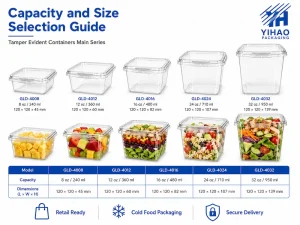
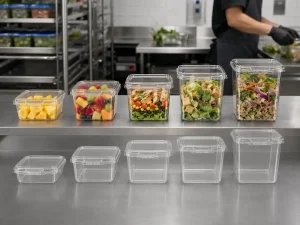
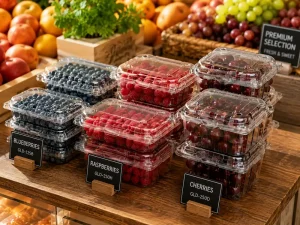
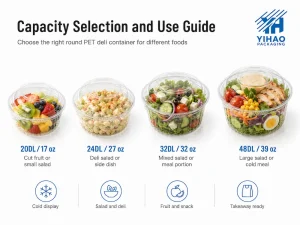
For food brands, supermarkets, distributors, cafes, bakeries, and foodservice buyers, the right plastic food packaging manufacturer directly affects shelf presentation, packing speed, product protection, customer trust, and repeat-order efficiency. The wrong container does not only create a packaging problem. It creates product damage, poor display, filling delays, customer complaints, inventory waste, and repeat-order risk.
YIHAO works with buyers who need clear, practical, and scalable food packaging solutions across fresh produce, bakery, salad, deli, cold drink, and tamper-evident packaging categories. For procurement teams, the goal is not simply to find any food packaging supplier. The real goal is to find a manufacturer that understands food type, retail channel, packaging structure, custom requirements, documentation needs, and bulk supply logic.
This buyer guide explains how to select a plastic food packaging manufacturer from a B2B purchasing perspective. It focuses on practical supplier evaluation: what to ask, what to test, which product categories to compare, and how to avoid sourcing mistakes before moving from samples to wholesale orders.
Why Food Packaging Teams Need a Manufacturer-Level Evaluation
Many buyers start by searching for a food packaging supplier, but serious procurement teams eventually need to evaluate the manufacturer behind the offer. A trading-style supplier may provide quotations quickly, but a real disposable food container factory gives buyers stronger control over product structure, mold options, quality consistency, packing details, and long-term category planning.
A manufacturer-level evaluation matters because food packaging is application-specific. A container for blueberries does not follow the same design logic as a salad bowl, bakery clamshell, tamper-evident deli pack, or cold drink cup. Each product type requires a different balance of clarity, stiffness, lid security, venting, anti-fog performance, stackability, food-contact suitability, and display effect.
For example, fresh produce buyers usually need high-clarity PET or rPET containers with stable hinges, ventilation details, and strong shelf visibility. Bakery buyers need dome height, anti-crush protection, and attractive dessert display. Salad and deli buyers need closure security, proper portion depth, and fast packing. Beverage buyers need cup-lid compatibility across iced coffee, matcha, refreshers, lemonade, smoothies, and milk tea menus.
That is why a reliable plastic food packaging manufacturer should not only quote products. It should help food packaging teams build a practical product matrix by application, food type, sales channel, and order stage.
Quick Manufacturer Checklist for Food Packaging Buyers
Before comparing prices, food packaging teams should use a simple manufacturer checklist. This helps buyers separate a real manufacturing partner from a basic quotation provider.
| Buyer Check | What to Confirm | Why It Matters |
|---|---|---|
| Product Range | Fresh produce, bakery, deli, salad, cold cups, and tamper-evident containers | Supports cross-category sourcing and reduces supplier fragmentation |
| Material Capability | PET, rPET, PP, and application-specific material guidance | Prevents wrong material selection for cold food, hot food, display, or delivery use |
| Custom Support | Existing mold options, logo, label space, carton marks, and private label support | Helps brands develop practical custom food packaging without overcomplication |
| Quality Checks | Lid fit, clarity, stacking, hinge strength, rim strength, and carton packing | Reduces damage, loose lids, poor display, and repeat-order complaints |
| Documentation | Food-contact support for target market and intended application | Supports safer purchasing decisions for importers, distributors, and food brands |
| Wholesale Supply | Repeat order stability, packing method, sample approval, and category planning | Protects long-term purchasing programs from supply inconsistency |
What a Plastic Food Packaging Manufacturer Should Offer
A strong plastic food packaging manufacturer should provide more than a few standard containers. Buyers should look for a clear product system, stable production capability, material guidance, sample support, and custom packaging options.
1. A Cross-Category Food Packaging Range
Food packaging teams rarely purchase only one container forever. A distributor may begin with deli containers and later add bakery clamshells, cold cups, produce containers, and tamper-evident packaging. A supermarket may need fruit packs, salad bowls, bakery trays, cold drink cups, and secure ready-to-eat food containers in one supply plan.
A qualified manufacturer should support category-level sourcing across fresh produce packaging containers, bakery containers, deli and salad containers, cold cups and lids, and tamper evident containers. This wider product range helps buyers simplify supplier management and build a more consistent packaging program.
2. Material Knowledge for PET, rPET, and PP Applications
Plastic food packaging is not one single material decision. PET and rPET are widely used for clear cold food packaging because they provide strong transparency and good retail display value. PP is usually selected when heat tolerance or microwave-related applications are required. Buyers should not ask only, “Is this plastic?” They should ask, “Which material fits this food, temperature, handling route, and sales channel?”
A PET container manufacturer should explain where PET or rPET performs well: fruit clamshells, salad bowls, bakery containers, cold deli packs, snack containers, and cold drink cups. For hot food, reheating, or microwave programs, buyers should confirm whether PP or another suitable material is required instead of assuming all plastic containers behave the same way.
Material Comparison for Plastic Food Packaging Buyers
Material selection should match the food, temperature, sales channel, shelf display requirement, and disposal or recycling expectations in the target market. The table below gives buyers a practical comparison for early-stage sourcing discussions.
| Material | Best-Fit Applications | Buyer Notes |
|---|---|---|
| PET | Clear cold food, fruit, bakery, salad, deli, cold cups | Strong clarity and display value for retail-ready food packaging |
| rPET | Recycled-content clear packaging for cold food and retail display | Useful for buyers with sustainability goals, depending on local recycling systems and claim requirements |
| PP | Microwave-related or higher-heat food applications | Often selected when better heat tolerance is required than standard PET cold-food packaging |
| PLA | Selected cold food or compostability-focused projects | Requires proper composting infrastructure and careful claim control |
| Paper/Fiber | Dry bakery, takeaway, selected foodservice use | Less transparent than PET; moisture resistance and grease resistance must be checked |
3. Stable Mold and Product Structure Capability
Food packaging structure affects buyer experience after the container leaves the factory. A small hinge weakness, thin rim, unstable base, or loose lid creates problems during packing, stacking, transport, shelf display, and customer handling. When comparing manufacturers, buyers should request samples and check the real container structure before confirming bulk orders.
For fresh-cut fruit and retail produce programs, a clear hinged option such as a clear PET hinged clamshell container helps buyers evaluate visibility, hinge strength, lid closure, and stacking performance. For chilled grab-and-go food, a clear recycled PET hinged deli container gives teams a practical reference for salads, snacks, fruit, and cold prepared foods.
4. OEM and Custom Food Packaging Support
Custom food packaging is important for food brands, retail chains, and distributors building private label programs. Customization may include product size, lid structure, logo embossing, printed cups, label space, color base, anti-fog features, packaging sleeve compatibility, carton marks, and private-label-ready packaging sets.
A capable plastic food packaging manufacturer should explain which custom options are realistic for existing molds and which require new mold development. This prevents buyers from wasting time on vague custom ideas that do not match production reality. For many projects, the best first step is not full custom mold development. It is often better to validate an existing container shape, confirm market acceptance, and then upgrade to custom packaging after demand becomes stable.
Manufacturer vs Supplier vs Factory: What Buyers Should Understand
The terms manufacturer, supplier, and factory are often used together, but they do not always mean the same thing in sourcing conversations.
| Term | What It Usually Means | Buyer Value | Key Risk to Check |
|---|---|---|---|
| Plastic food packaging manufacturer | Produces packaging through factory production and mold systems | Better control over quality, structure, customization, and supply consistency | Confirm real product range, documentation, and production capability |
| Food packaging supplier | May be a manufacturer, distributor, trading company, or sourcing partner | Useful for fast quotes and multi-category sourcing | Confirm whether the supplier controls production or only resells products |
| Disposable food container factory | Factory focused on producing single-use or reusable-style food containers | Useful for bulk orders, OEM planning, and direct production communication | Check whether the factory understands export packaging and buyer documentation |
| PET container manufacturer | Manufacturer focused on PET/rPET clear packaging products | Strong fit for clear display, cold food, fruit, bakery, salad, and beverage packaging | Confirm material grade, clarity, thickness, lid fit, and food-contact support |
For serious purchasing, the safest approach is to evaluate the company as a manufacturer-level partner even when it also acts as a food packaging supplier. This means asking about production, samples, materials, inspection, packaging cartons, order consistency, and category planning.
Key Product Categories to Review Before Choosing a Manufacturer
A good plastic food packaging manufacturer should help buyers match product categories to real food applications. The right product mix depends on what the buyer sells, how the food is displayed, how it is transported, and whether the end user values visibility, security, portion control, or heat resistance.
Fresh Produce and Fruit Packaging
Fresh produce packaging needs clear visibility, correct ventilation, stable stacking, and enough protection for delicate food. Blueberries, blackberries, raspberries, grapes, strawberries, apple slices, mango cubes, and mixed fruit packs all need packaging that protects appearance while supporting fast retail display.
For fruit brands and distributors, the most useful manufacturer is one that offers both clamshell-style produce containers and fresh-cut fruit packs. This allows buyers to cover whole berries, portioned fruit, fruit-and-nut snacks, and chilled ready-to-eat fruit cups without building a scattered supplier base.
Bakery and Dessert Packaging
Bakery packaging needs visual appeal and shape protection. Cake slices, croissants, muffins, donuts, brownies, tiramisu, cheesecake portions, and pastries depend on clear presentation. A crushed dessert is not only a product loss; it damages brand perception at the shelf.
Buyers should compare lid height, hinge strength, anti-crush structure, base stability, and display clarity. For bakery programs, a product such as a clear PET hinged bakery container helps food teams evaluate bakery shelf display, takeaway handling, and multipack presentation in one format.
Deli, Salad, and Ready-to-Eat Food Packaging
Deli and salad packaging must balance closure security, clear display, portion logic, and stacking. Salad bowls, hinged deli containers, round containers, and snack packs support chilled food programs for supermarkets, cafes, convenience stores, and foodservice distributors.
For large salad, fruit platter, and chilled takeaway programs, a PET salad bowl gives buyers a practical product reference for visibility, bowl depth, lid fit, and shelf presentation. For smaller and mid-size cold food, hinged deli containers provide fast packing and simple handling.
Cold Cups and Lid Systems
Cold drink packaging requires cup and lid compatibility. Iced coffee, cold brew, matcha, refreshers, lemonade, fruit tea, smoothies, milk tea, protein drinks, and sparkling fruit drinks each place different demands on cup shape, rim fit, dome space, straw slot, sip-through design, and strawless drinking experience.
Food packaging teams should not source cups and lids separately without checking compatibility. A reliable manufacturer should support cup-lid matching and provide suitable lid options such as a clear PET flat lid with straw slot for iced coffee, lemonade, juice, and cold brew programs. For beverage buyers, product system logic is more important than isolated cup pricing.
Tamper-Evident Food Packaging
Tamper-evident packaging is valuable for grab-and-go retail, delivery, prepared food, chilled deli, fresh snack packs, and supermarket ready-to-eat programs. The container should show whether it has been opened, while still supporting product clarity and clean presentation.
Buyers should check the tear strip, tab structure, first-opening experience, closure feel, and whether staff can pack the container quickly during busy operations. A clear PET tamper evident container gives procurement teams a direct reference for secure retail food packaging where customer trust matters.
How to Evaluate a Food Packaging Container Manufacturer
After confirming product categories, buyers should evaluate the manufacturer with a structured checklist. This prevents the sourcing process from becoming a simple price comparison.
Check Material Suitability
Ask which materials are used for each packaging type and why. PET/rPET clear containers fit many cold food and display applications. PP containers are usually selected for higher heat or microwave-related use. PLA, paper, or fiber-based options may fit some sustainability-focused programs, but they require careful evaluation of food type, moisture, shelf life, and local disposal infrastructure.
A trustworthy food packaging container manufacturer should not force one material into every application. It should recommend packaging based on food type, storage temperature, handling route, shelf display, and buyer channel.
Review Product Dimensions and Portion Logic
Buyers should confirm that container size matches the actual food portion. A container that is too large makes the food look insufficient. A container that is too tight crushes toppings, sauces, bakery decoration, fruit shape, or salad volume. A good manufacturer should help buyers compare capacity, height, base area, lid clearance, and stacking height.
Test Lid Fit and Closure Performance
Lid fit is one of the most important quality checks in plastic food packaging. A lid that feels secure during a factory sample review may still fail during fast packing, cold storage, or transport. Buyers should test closure after repeated opening, stacking, refrigeration, and actual food filling.
For hinged containers, check hinge memory, lock position, rim strength, and whether the container closes evenly. For separate-lid bowls and cups, confirm rim compatibility and lid pressure. For tamper-evident containers, confirm that the first-opening feature is clear and practical.
Inspect Clarity, Surface Finish, and Shelf Display
Clear food packaging must look clean, transparent, and consistent. Cloudy plastic, weak gloss, visible flow marks, scratches, or uneven forming reduce shelf appeal. For PET and rPET containers, clarity matters because buyers use the packaging to show fruit freshness, salad color, bakery decoration, and chilled food quality.
A strong PET container manufacturer should understand that visual quality is part of the product value, not just a cosmetic detail.
Confirm Stacking and Carton Packing
Wholesale buyers should check how containers stack before filling and after packing. Poor nesting creates storage waste. Weak stacking causes transport pressure and shelf deformation. Carton packing also matters because the same container may be damaged if carton strength, bagging method, or pallet planning is weak.
Ask the manufacturer how products are packed, how cartons are labeled, and how samples compare with bulk shipment packing. This matters for importers, distributors, and retail buyers managing repeated container orders.
Compliance and Documentation Questions Buyers Should Ask
Food packaging buyers should treat compliance documentation as a standard part of supplier evaluation. Requirements vary by market, material, food type, and intended use, so buyers should ask for documents that match their destination market and application.
Useful documentation questions include:
- What material is used for this container, lid, tray, or cup?
- Is the product intended for cold food, hot food, microwave use, chilled display, or dry bakery applications?
- What food-contact documentation is available for the target market?
- Can the manufacturer provide material declarations or test reports when needed?
- Are recycled-content claims, recyclable claims, or eco-related claims supported by actual material and market conditions?
- Are printing, adhesives, inks, labels, or sleeves part of the food-contact or packaging compliance review?
The best plastic food packaging manufacturer will answer these questions carefully instead of using vague claims such as “eco-friendly,” “food grade,” or “safe” without context. For international buyers, practical documentation support is often as important as product pricing.
How to Compare Samples Before Wholesale Orders
Samples are not only for checking appearance. They are a risk-control tool. Before placing a wholesale order, food packaging teams should test samples with real food, real staff, real storage conditions, and real display scenarios.
Sample Testing Checklist
| Test Area | What to Check | Why It Matters |
|---|---|---|
| Food Fit | Portion volume, lid clearance, food movement | Prevents crushed food, poor presentation, and wrong size selection |
| Lid Closure | Snap fit, hinge strength, rim pressure, opening feel | Reduces leakage, loose lids, and customer complaints |
| Clarity | Transparency, gloss, surface finish, anti-fog need | Supports shelf appeal and product visibility |
| Stacking | Empty nesting, filled stacking, carton packing | Improves storage, transport, and retail handling |
| Channel Fit | Retail shelf, delivery, takeaway, grab-and-go, catering | Confirms the container matches the real sales route |
| Label Area | Sticker position, barcode space, branding visibility | Helps private label and retail teams avoid label placement issues |
Food teams should take sample photos, collect staff feedback, compare filled weights, and document any lid or stacking issues. This makes the next discussion with the manufacturer more precise and avoids subjective decision-making.
Wholesale Buying Logic: How to Build a Practical Product Mix
For distributors and retail chains, a strong packaging program usually starts with a practical product mix instead of too many random SKUs. A plastic food packaging manufacturer should help buyers build a balanced range based on fast-moving applications.
A simple wholesale product mix may include:
- Fresh produce clamshells for berries, grapes, and small fruit
- Fresh-cut fruit containers for chilled ready-to-eat packs
- Bakery clamshells for muffins, pastries, donuts, and dessert portions
- PET hinged deli containers for salads, fruit, snacks, and cold food
- Round PET bowls for larger salads, fruit platters, and chilled takeaway meals
- PET cold cups and matching lids for coffee shops, juice bars, and beverage chains
- Tamper-evident containers for retail trust and prepared food programs
This product mix helps distributors serve multiple channels without overcomplicating inventory. It also gives food brands a clear pathway from sample testing to trial order and then to wholesale supply.
Custom Food Packaging: When It Makes Sense
Custom food packaging makes sense when the buyer has stable demand, strong brand requirements, or a specific application that standard packaging cannot solve. However, custom packaging should be planned carefully. Not every project needs a new mold at the beginning.
For early-stage brands, custom labels, printed sleeves, carton marks, or selected existing molds may be enough. For mature brands, custom embossing, private-label packaging systems, printed cold cups, custom lids, or exclusive structures may create stronger differentiation.
Buyers should ask the manufacturer:
- Which existing molds are closest to the target application?
- What customization options are available without new mold development?
- Which design changes require a new mold?
- How should samples be approved before bulk production?
- What information is needed for artwork, logo, label area, or carton marks?
- How does the manufacturer control consistency across repeat orders?
A capable food packaging container manufacturer will guide buyers through custom decisions step by step. The manufacturer should protect the buyer from over-customizing too early and under-customizing when the brand program is ready for scale.
Factory Capability: What to Look for During Supplier Review
A serious buyer should review the factory behind the offer. A reliable food packaging factory should have organized production, clear sample management, practical quality checks, and export-ready packing methods. Factory capability is not only about machine count. It is about whether the team can deliver stable products repeatedly.
Key factory review points include:
- Product category focus and real production experience
- Material handling and forming consistency
- Mold maintenance and product structure stability
- Sample approval process before mass production
- Inspection points for lid fit, clarity, thickness, stacking, and carton packing
- Ability to support wholesale, OEM, and repeat orders
- Communication speed and ability to answer technical questions clearly
Buyers should be cautious when a supplier promises every material, every certification, every custom feature, and every deadline without asking detailed questions. Good manufacturers ask about food type, packaging route, storage conditions, target market, order stage, and required documents before confirming the best solution.
Common Mistakes When Choosing a Plastic Food Packaging Manufacturer
Mistake 1: Comparing Only Unit Price
Unit price matters, but it is only one part of total packaging cost. Poor closure, wrong size, weak stacking, and low clarity create losses in labor, product damage, complaints, and reorder delays. A slightly cheaper container becomes expensive when it does not perform in real food operations.
Mistake 2: Treating All Plastic Materials as the Same
PET, rPET, PP, PLA, and other materials have different performance profiles. Buyers should never assume that one plastic material fits every application. Cold food display, microwave use, chilled retail, beverage cups, and bakery presentation require different material decisions.
Mistake 3: Ordering Bulk Before Sample Testing
Sample testing protects both the buyer and the manufacturer. Food teams should test container size, lid fit, food presentation, stacking, and label placement before confirming a wholesale order. Skipping this step increases the risk of wrong SKU selection.
Mistake 4: Ignoring Lid and Accessory Compatibility
Cups, lids, bowls, trays, and deli containers need system-level compatibility. A cup without the right lid is not a beverage packaging solution. A bowl without a matching lid is not a retail-ready salad package. Buyers should confirm complete packaging systems, not isolated items.
Mistake 5: Accepting Unsupported Sustainability Claims
Recyclable and recycled-content claims should be handled carefully. Packaging recyclability depends on material, design, local collection, sorting infrastructure, labels, color, adhesives, and end-market conditions. A responsible manufacturer should communicate sustainability claims with practical limits rather than using generic green language.
Questions to Ask Before Choosing a Food Packaging Supplier
Before selecting a food packaging supplier, buyers should prepare clear questions. This helps separate a real manufacturing partner from a basic quotation provider.
- Which product categories do you manufacture directly?
- Which materials do you recommend for my food type and temperature condition?
- Can you provide samples for real food testing?
- How do you check lid fit, clarity, stacking, and carton packing?
- Do you support PET, rPET, PP, or other material options?
- What food-contact documentation is available for my target market?
- Which products are best for wholesale orders?
- Which custom options are available through existing molds?
- Can you support private label or OEM packaging programs?
- How do you manage repeat-order consistency?
- What information do you need from our team before recommending products?
- Can you help us build a product matrix by application?
A reliable plastic food packaging manufacturer should answer these questions clearly and connect each answer to real packaging decisions.
Best-Fit Buyer Scenarios
This type of manufacturer guide is especially useful for teams that need a stable packaging partner instead of one-time product sourcing.
| Buyer Type | Typical Need | Recommended Manufacturer Focus |
|---|---|---|
| Supermarket Packaging Teams | Fruit, salad, bakery, prepared food, and chilled retail display | Cross-category PET packaging range, shelf visibility, tamper-evident options |
| Foodservice Distributors | Wholesale containers for multiple customer types | Fast-moving SKUs, carton packing, repeat-order stability, broad product mix |
| Cafes and Beverage Chains | Cold cups, lids, dessert containers, snack packaging | Cup-lid systems, clear display packaging, custom branding support |
| Fresh Produce Brands | Berry packs, fruit clamshells, fresh-cut fruit containers | Clear PET/rPET containers, venting, stacking, retail-ready presentation |
| Bakery and Dessert Brands | Clamshells, cake containers, pastry packs, refrigerated desserts | Dome height, anti-crush structure, premium shelf display |
| Private Label Food Brands | Custom food packaging and OEM programs | Existing mold matching, branding options, sample approval, repeat consistency |
Why Buyers Work with YIHAO as a Plastic Food Packaging Manufacturer
As a food packaging manufacturer and solution provider, YIHAO focuses on practical packaging systems for fresh produce, bakery desserts, salads, chilled food, cold drinks, snacks, and tamper-evident retail programs. The value for buyers is not only access to individual containers. The stronger value is category planning, material matching, sample validation, and product-range logic.
For buyers looking for a plastic food packaging manufacturer, YIHAO supports product selection across clear PET/rPET containers, produce clamshells, bakery clamshells, salad bowls, hinged deli containers, cold cups, cup lids, and tamper-evident food containers. This makes it easier for procurement teams to compare applications, build wholesale product lines, and prepare custom packaging projects with a manufacturer-level partner.
YIHAO is especially suitable for buyers who need a packaging partner that understands category-based product planning. Instead of sourcing one container at a time, buyers can discuss fresh produce packaging, bakery packaging, deli and salad containers, cold cup systems, and tamper-evident options in one coordinated sourcing process.
Need Help Choosing Plastic Food Packaging for Your Food Program?
If your team is comparing PET containers, deli containers, salad bowls, bakery clamshells, cold cups, or tamper-evident food packaging, YIHAO can help review your application, food type, portion size, packing method, display requirement, and wholesale order plan. Share your product requirements, and our team will recommend practical packaging options for sampling and further evaluation.
Buyer Takeaway: How to Choose the Right Manufacturer
The right plastic food packaging manufacturer should help buyers reduce risk, not just reduce unit price. Food packaging teams should look for a manufacturer that understands product application, food-contact documentation, clear material communication, lid compatibility, custom options, sample testing, and wholesale supply stability.
Before placing a bulk order, buyers should validate the product with real food, real filling conditions, and real sales channels. They should compare packaging by structure, clarity, closure, stacking, carton packing, documentation, and long-term product range. This method gives food teams a stronger purchasing decision and helps build a packaging system that supports retail display, takeaway efficiency, brand trust, and repeat sales.
FAQ
1. What should buyers check before choosing a plastic food packaging manufacturer?
Buyers should check product range, material suitability, food-contact documentation, sample quality, lid fit, stacking performance, carton packing, custom options, and wholesale supply stability. A manufacturer should explain which packaging fits each food type and sales channel.
2. Is a PET container manufacturer suitable for all food packaging projects?
A PET container manufacturer is a strong choice for clear cold food packaging, fresh produce, bakery display, salads, deli foods, cold drink cups, and chilled retail packs. For hot food or microwave applications, buyers should confirm whether PP or another suitable material is required.
3. How is a food packaging supplier different from a disposable food container factory?
A food packaging supplier may trade, source, or distribute products, while a disposable food container factory usually controls production. Buyers should confirm whether the supplier has direct manufacturing capability, quality control processes, and stable repeat-order support.
4. When should buyers choose custom food packaging?
Custom food packaging is suitable when buyers have stable demand, brand requirements, private label needs, or an application that standard packaging cannot solve. Many buyers should first test existing molds, then upgrade to custom packaging after confirming market demand.
5. Why is sample testing important before wholesale food packaging orders?
Sample testing helps buyers confirm food fit, lid closure, clarity, stacking, label placement, and channel suitability before bulk production. It reduces wrong-size orders, packaging failure, product damage, and unnecessary inventory risk.
References
- U.S. Food and Drug Administration, Packaging & Food Contact Substances guidance.
- U.S. Food and Drug Administration, Understanding How FDA Regulates Substances that Come into Contact with Food.
- European Commission, Food Contact Materials Legislation and Regulation (EC) No 1935/2004.
- European Union, Regulation (EU) 2025/40 on Packaging and Packaging Waste.
- European Commission, Packaging and Packaging Waste Regulation overview.
- U.S. Environmental Protection Agency, Plastics: Material-Specific Data.
- Association of Plastic Recyclers, Design Guide for Plastics Recyclability principles.
- YIHAO internal product category and packaging application planning materials.
Deep-Dive Insights
How should buyers think about manufacturer selection?
Buyers should evaluate a plastic food packaging manufacturer by application capability, not only by product catalog size. The right manufacturer connects food type, material, lid structure, shelf display, custom options, and wholesale supply planning into one sourcing decision.
Why does product range matter?
A broad but relevant product range helps food packaging teams simplify sourcing. Fresh produce, bakery, deli, salad, cold drink, and tamper-evident packaging often appear together in retail and distributor programs, so category coverage improves long-term purchasing efficiency.
What is the best first step before bulk orders?
The best first step is sample validation. Buyers should fill containers with real food, check lid fit, test stacking, review clarity, confirm label placement, and compare handling under real storage and display conditions.
Option to consider
For new projects, start with proven existing molds and standard products. For mature programs, move toward custom food packaging, private label packaging, printed cold cups, branded lids, or exclusive structures after demand and product-market fit are clear.
Practical takeaway
The strongest supplier is not the one with the lowest first quotation. The strongest supplier is the one that helps food packaging teams avoid wrong materials, weak closures, poor display, unsupported claims, and unstable repeat supply.
Final Note / Practical Takeaway
© YIHAO Packaging. All rights reserved. All articles, product images, packaging designs, technical specifications, and website materials are protected by copyright. Unauthorized copying, reproduction, redistribution, modification, or commercial use is strictly prohibited without prior written permission.