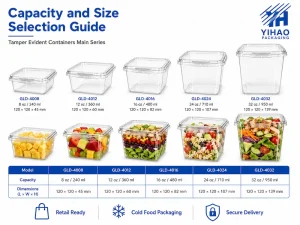
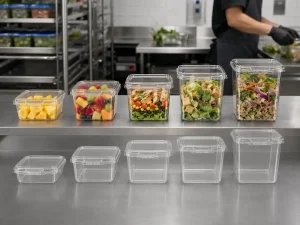
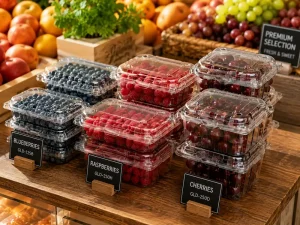
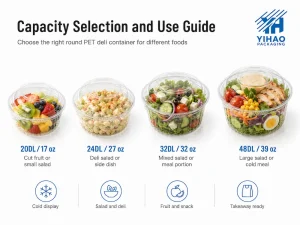
Fast answer: Choose PET or rPET for clear cold food display, PP for hot meals and microwave-ready packaging, and PLA only when certified industrial composting is available. For most chilled retail food packaging, PET and rPET remain the most practical choices because they combine product visibility, shelf appeal, and familiar material performance.
Choosing between PET, PP, PLA, and rPET is one of the most important packaging decisions for food businesses. The material affects product visibility, heat resistance, shelf presentation, tamper evidence, transport strength, recycling claims, compostability claims, and buyer confidence. A fruit container, a salad bowl, a hot meal tray, and a compostable cold cup do not need the same plastic. They need different performance logic.
As a food packaging manufacturer and solution provider, YIHAO works with buyers who need packaging for fresh produce, bakery desserts, deli foods, salads, cold drinks, and prepared meals. In real purchasing conversations, the question is rarely “Which material is the best?” The better question is: which material best matches the food, temperature, display channel, disposal system, and brand positioning?
This guide explains PET vs PP vs PLA packaging in a practical way. It compares the main material choices used in food packaging, including PET food containers, PP food containers, PLA compostable containers, and rPET packaging. It also helps buyers understand when recyclable containers, compostable containers, and recycled-content packaging make commercial sense.
What Are PET, PP, PLA, and rPET in Food Packaging?
PET: Clear, Rigid, and Retail-Friendly
PET, or polyethylene terephthalate, is widely used for clear food packaging because it offers strong transparency, good rigidity, lightweight handling, and attractive shelf display. PET works especially well for chilled and ambient food applications where the buyer wants the customer to see the product clearly before purchase.
For supermarkets, convenience stores, fruit processors, salad brands, and bakeries, PET is often selected for clear clamshells, hinged containers, salad bowls, dessert packs, cold cup systems, and fresh-cut fruit packaging. Its visual advantage is direct: the food looks clean, fresh, and retail-ready. That matters for blueberries, strawberries, cut fruit, leafy salads, sushi-style trays, bakery slices, cold deli portions, and grab-and-go snack packs.
When buyers compare PET vs PP vs PLA packaging, PET usually wins on clarity and cold display value. It is not normally the first choice for high-heat food service or microwave reheating. For cold food retail, however, PET remains one of the strongest material options because it combines transparency, structure, and familiar recycling pathways in many markets.
For buyers building a chilled retail range, PET food containers are especially useful for salad, fruit, deli sides, sandwich portions, and ready-to-eat cold food. They support both product visibility and shelf organization.
PP: Heat-Resistant and Practical for Prepared Meals
PP, or polypropylene, is widely used when heat resistance, toughness, and microwave compatibility are important. Compared with PET, PP normally has lower glass-like clarity, although transparent PP options exist. Its strength is functional performance under warmer conditions.
For hot takeaway meals, prepared food counters, meal prep, deli meals, and microwave-ready products, PP is often the safer material direction when the package is specifically designed and tested for the required use. In a practical foodservice setting, PP handles warm filling, reheating, and hot meal logistics better than PET or PLA.
That is why PP food containers are common in prepared meals, hot deli packaging, rice dishes, pasta portions, cooked vegetables, takeaway entrees, and foodservice kitchens. Buyers who need microwave-safe packaging should not choose based on appearance alone. They need to confirm actual use temperature, lid compatibility, sealing method, food oil content, heating time, and local food-contact requirements.
In the PET vs PP vs PLA packaging decision, PP is the functional heat-performance choice. It is less about luxury shelf visibility and more about operational reliability for hot and reheatable foods.
PLA: Plant-Based and Compostability-Positioned
PLA, or polylactic acid, is a bio-based plastic commonly made from plant-derived feedstocks. In food packaging, PLA is often used for compostability positioning, especially in cold cups, lids, clear containers, and certain takeaway formats. The key point is that PLA should not be treated as automatically compostable in every environment. Compostability depends on certification, product thickness, local industrial composting access, and correct disposal behavior.
For cafes, juice bars, event catering, universities, and brands that have access to industrial composting programs, PLA compostable containers may support a sustainability message. But when composting infrastructure is limited, PLA can become confusing for consumers and waste handlers. It may also create contamination concerns if it enters the wrong recycling stream.
PLA is usually not the right material for high-heat foods or microwave applications. It is more suitable for cold beverages, cold snacks, and packaging systems where compostable disposal is clearly managed. In the PET vs PP vs PLA packaging comparison, PLA should be evaluated through infrastructure, certification, and use-case discipline rather than through marketing language alone.
rPET: Recycled-Content PET for Circular Packaging Goals
rPET means recycled polyethylene terephthalate. In food packaging, rPET is often selected by buyers who want the clear look and performance logic of PET while supporting recycled-content goals. It is especially relevant for cold food containers, salad bowls, cold cups, bakery packs, and fresh food packaging where transparency remains important.
From a purchasing perspective, rPET packaging is not just “recycled plastic.” Food-contact rPET must come from suitable recycling processes and meet applicable food-contact requirements in the destination market. Buyers should request documentation, understand recycled-content percentages, and verify whether the material is appropriate for the intended food type and temperature condition.
For chilled retail applications, clear recycled PET hinged containers help brands combine shelf visibility with a stronger recycled-content story. This makes rPET a practical bridge between commercial display needs and circular packaging expectations.
PET vs PP vs PLA Packaging: Quick Comparison Table
| Material | Main Strength | Typical Food Uses | Clarity | Heat Resistance | End-of-Life Positioning | Best Buyer Fit |
|---|---|---|---|---|---|---|
| PET | Clear display and rigid structure | Fresh fruit, salad, bakery, cold deli, cold cups | Excellent | Low to moderate | Recyclable where accepted | Retail display and chilled food buyers |
| PP | Heat resistance and microwave-ready use | Prepared meals, hot deli, takeaway food, reheatable meals | Moderate | High when designed for use | Recyclable where accepted | Foodservice and meal-prep buyers |
| PLA | Bio-based compostability positioning | Cold drinks, cold snacks, event packaging, managed composting programs | Good to excellent | Low | Industrial composting when certified and accepted | Brands with composting access and clear disposal messaging |
| rPET | Recycled-content clear packaging | Cold food containers, salad bowls, cold cups, bakery packs | Excellent to very good | Low to moderate | Recyclable where accepted; supports recycled-content goals | Retail brands balancing display and sustainability |
Material Performance Scorecard for Food Packaging Buyers
The following scorecard gives buyers a simple way to compare PET vs PP vs PLA packaging with rPET. Scores are practical buyer references from 1 to 5, where 5 means stronger performance for that factor. Actual performance still depends on product design, thickness, lid system, processing quality, destination market, and intended food-contact conditions.
| Material | Clarity | Heat Resistance | Recyclability Potential | Compostability Potential | Cost Stability | Best Use |
|---|---|---|---|---|---|---|
| PET | 5 | 2 | 4 | 1 | 4 | Cold food display |
| PP | 3 | 5 | 3 | 1 | 4 | Hot meals and microwave-ready food |
| PLA | 4 | 1 | 1 | 4 | 2 | Managed composting programs |
| rPET | 5 | 2 | 4 | 1 | 3 | Recycled-content clear packaging |
Simple Material Selection Flow for Food Packaging Buyers
- If the food is cold and needs high visibility, choose PET or rPET.
- If the food is hot, warm-filled, or microwave-ready, choose PP.
- If the product is cold and collected through certified industrial composting, choose PLA.
- If recycled content is a brand or retailer requirement, choose rPET.
- If the package must combine premium display and recyclable positioning, PET or rPET is usually the safer commercial choice.
- If the product range includes both cold and hot foods, use different materials for different SKUs instead of forcing one resin across the whole range.
How to Choose Food Packaging Material by Application
Fresh Produce and Fresh-Cut Fruit
Fresh produce packaging needs clarity, ventilation design, light weight, stacking stability, and protection during transport. For berries, grapes, kiwi, apples, and fresh-cut fruit, PET and rPET are usually stronger choices than PP or PLA because they show the product clearly and support rigid clamshell or tray structures.
For fresh produce packaging, visibility is not decoration. It directly affects consumer trust. A shopper buying blueberries or cut mango wants to inspect color, moisture level, fruit size, and freshness. PET and rPET make that inspection easier than cloudy or opaque materials.
Ventilation also matters. Produce packaging often needs airflow to reduce condensation and preserve appearance. The material choice must work together with the vent pattern, lid fit, hinge strength, stacking shape, and retail display method. A recyclable container still fails commercially if it crushes fruit, fogs heavily, or displays poorly.
Salads, Deli Food, and Grab-and-Go Meals
Salads and deli foods need a balance of clarity, leak resistance, lid fit, stacking strength, and cold-case presentation. PET and rPET work well for chilled salads, pasta salad, fruit bowls, cold noodles, snack packs, and deli sides. PP becomes more relevant when the food is warm, oily, or expected to be reheated.
For cold salad programs, clear PET/RPET food containers create strong shelf impact and help customers see portion size, ingredient freshness, and topping quality. For larger meal salads or shared fruit portions, bowl shape, lid height, and anti-leak performance become just as important as resin type.
If the same food range includes both chilled salads and hot deli meals, buyers should not force one material across every SKU. PET or rPET can handle the visual cold-case range, while PP supports hot or microwave-ready items. This mixed-material strategy often gives better performance than a one-material policy.
Bakery, Dessert, and Premium Retail Display
Bakery packaging needs product protection and premium visual presentation. PET is widely used for cake slices, cupcakes, muffins, roll cakes, croissants, cookies, and dessert assortments because it offers clear display and good rigidity. Customers buy desserts with their eyes first, so clarity directly supports conversion.
For bakery packaging, PET clamshells and clear lids help show frosting height, cake layers, toppings, chocolate decoration, pastry texture, and portion shape. PLA may be considered when a bakery has a compostability program, but heat sensitivity and disposal infrastructure must be checked. PP is normally less common for premium clear bakery display because its visual finish is different from PET.
Buyers should also consider anti-fog performance, lid height, hinge durability, snap closure, display footprint, and stacking stability. A dessert container must protect shape and decoration; material choice is only one part of the full packaging system.
Cold Drinks, Iced Coffee, Juice, and Refreshers
Cold drink packaging is one of the clearest examples of material trade-offs. PET and rPET cold cups offer high transparency, strong hand feel, and clean product visibility. They are widely used for iced coffee, iced tea, lemonade, juice, smoothies, milk tea, matcha, refreshers, sparkling fruit drinks, flavored cold brew, and protein drinks.
For beverage programs, PET/RPET clear cold cups support premium drink presentation because the customer can see color, ice level, fruit inclusions, foam, layers, and toppings. PLA cold cups may be suitable for brands with compostability goals, but only when composting access and disposal instructions are clear.
Compatibility is critical. A cup system must match flat lids, dome lids, sip-through lids, or strawless lids. Even a good cup material fails if the lid leaks, cracks, pops off, or feels unstable during delivery. For beverage shops, the correct decision is not only PET vs PP vs PLA packaging. It is cup material, rim diameter, lid type, drink temperature, topping height, and brand positioning working together.
Hot Meals and Microwave-Ready Food
Hot food packaging is where PP has a clear role. When meals need warm filling, takeaway service, or microwave reheating, PP is usually the practical material direction. PET, rPET, and PLA are not normally selected for high-heat meal packaging unless a specific product is engineered and validated for that condition.
For prepared food counters, food trucks, meal prep brands, cafeterias, and takeaway restaurants, PP hot food containers support operational reliability. Buyers should confirm microwave labeling, heat tolerance, lid material, ventilation needs, sauce behavior, and stacking strength.
High-fat foods, oily sauces, soups, rice meals, pasta, and cooked proteins create different demands from cold salads or fruit bowls. This is why material selection must start with the food and service model, not with a generic sustainability claim.
Recyclable Containers vs Compostable Containers: What Buyers Should Understand
Recyclable Does Not Mean Recycled Everywhere
Recyclable containers are only meaningful when the packaging design is compatible with sorting and recycling systems and when customers have access to collection programs that accept that package. PET, PP, and rPET may be recyclable in many regions, but acceptance depends on local infrastructure, package size, color, labels, adhesives, residues, and market demand for the recovered resin.
For buyers, the practical rule is simple: design for the real system, not just the claim. Clear material streams, compatible labels, removable sleeves, correct inks, and minimal contamination improve recycling outcomes. A package that looks sustainable but disrupts sorting can damage the brand’s credibility.
For retailers and foodservice operators, tamper-evident food packaging also needs this same logic. Security features, tear strips, labels, hinges, and closures should protect the food without making the package unnecessarily difficult to recycle.
Compostable Requires a Composting System
Compostable packaging sounds simple, but the real system is complex. PLA packaging generally needs suitable composting conditions, verified certification, and collection programs that accept the material. If consumers place PLA into PET recycling, it can create problems. If they place it in general waste, the compostability benefit is not fully realized.
For brands considering PLA compostable containers, the best use cases are closed-loop or managed environments: campuses, event venues, corporate cafeterias, stadiums, and cities with established industrial composting access. These environments make disposal instructions easier to control.
In open retail channels, the buyer should be cautious. A compostable claim without infrastructure may create confusion. The package must tell customers what to do, and the local waste system must actually support that action.
Recycled Content Is Different from Recyclability
Recycled content and recyclability are related but not the same. A package may contain recycled material but still need proper design to be recyclable after use. Another package may be recyclable but made from virgin resin. rPET is attractive because it supports recycled-content goals while keeping the clear display benefits of PET.
For food-contact use, buyers should confirm the suitability of the recycling process and documentation for the intended market. Recycled-content claims should be specific, supportable, and aligned with local labeling rules. This is especially important for export buyers, large retailers, and brands selling into regulated markets.
Material Performance Factors Buyers Should Compare
Clarity and Shelf Presentation
PET and rPET normally lead in clarity. This makes them strong choices for fruit, salad, bakery, desserts, and cold beverages. PLA can also look clear in many cold cup and container formats, but heat limits and composting conditions must be considered. PP is more functional than visual, although it remains valuable for prepared meals and reheatable food.
For retail food, clarity is not a small detail. It helps communicate freshness, portion value, ingredient quality, and hygiene. A container that improves product visibility often supports higher perceived value.
Heat Resistance and Temperature Use
PP is normally preferred for hot and microwave-ready packaging. PET, rPET, and PLA are usually stronger for cold or ambient applications rather than hot meal service. Buyers should never assume that a material name alone proves microwave safety. The actual container design, wall thickness, lid system, additives, and testing determine performance.
For prepared meals, PP prepared meal containers give buyers a practical solution for takeaway, deli counters, and foodservice packaging where heat performance matters.
Rigidity, Stackability, and Transport Protection
Food packaging must survive filling, stacking, cold storage, delivery, retail handling, and customer transport. PET and rPET provide good rigidity for clear containers and clamshells. PP provides toughness and flexibility for hot food applications. PLA can be rigid and clear but requires careful temperature control.
Stacking is especially important for wholesale buyers. A lightweight container that looks good but collapses under pallet pressure causes product loss, complaints, and higher total cost. Buyers should evaluate sample performance under real loading conditions before confirming bulk orders.
Leak Resistance and Lid Compatibility
Leak resistance depends on structure more than material alone. Lid fit, rim design, closure strength, seal area, hinge quality, and product viscosity all affect performance. A salad bowl with dressing, a fruit container with juice release, and a hot noodle meal need different closure logic.
For cold food and beverage packaging, lid compatibility is one of the most important buyer checks. A clear cup without the correct lid system increases operational risk. For this reason, many beverage buyers choose cup-and-lid systems rather than cups alone. A compatible clear PET strawless sipper lid can support drink safety, portability, and a cleaner customer experience.
Cost and Supply Stability
Cost varies by resin market, recycled-content availability, order quantity, product design, mold complexity, shipping volume, and regional demand. PET is often cost-efficient for clear cold packaging. PP is cost-effective for hot meal formats. PLA may cost more depending on grade, certification, and supply chain. rPET pricing depends heavily on the availability and quality of recycled feedstock.
Buyers should compare total cost instead of unit price alone. A slightly cheaper container can become expensive if it cracks, leaks, fogs, stacks poorly, or fails customer expectations. The right material should reduce operational problems, not only lower the purchase price.
Best Material Choices by Food Category
| Food Category | Recommended Material Direction | Reason |
|---|---|---|
| Blueberries, strawberries, grapes, small produce | PET or rPET | Clear display, rigid clamshell structure, ventilation options |
| Fresh-cut fruit and snack packs | PET or rPET | Strong visibility, cold-case presentation, portion display |
| Salads and cold deli food | PET or rPET | Ingredient visibility, shelf appeal, clear lids and bowls |
| Hot meals and reheatable food | PP | Heat resistance and microwave-ready potential |
| Bakery desserts and cake slices | PET | Premium clarity, dome lid options, product protection |
| Cold drinks and iced beverages | PET, rPET, or PLA | PET/rPET for clarity and recycling direction; PLA for managed composting programs |
| Events with composting collection | PLA | Compostability positioning when disposal is controlled |
| Retail brands with recycled-content goals | rPET | Clear display plus recycled-content story |
How Export Buyers Should Evaluate PET vs PP vs PLA Packaging
Start with the Destination Market
Export buyers need to consider the market where the packaged food will be sold. Regulations, recycling access, composting acceptance, labeling rules, and buyer expectations differ by country and region. A material that works well in one market may not support the same claim in another.
For EU-facing packaging, buyers need to monitor recyclability, recycled content, labeling, packaging minimization, and substances-of-concern requirements. For US-facing food packaging, food-contact suitability and claim substantiation are important. For multi-market export programs, buyers should build a material decision matrix before finalizing packaging.
Check Food-Contact Documentation
Food packaging must be suitable for the intended food-contact conditions. Buyers should request documentation based on destination market needs, including material declarations, food-contact compliance statements, recycled-content information where relevant, and migration or testing support when required.
This is especially important for rPET because recycled plastic used in food-contact packaging must come from a suitable process. Buyers should not treat all recycled plastic as equal. The process, source control, cleaning efficiency, and intended use conditions matter.
Request Samples for Real-World Testing
Material theory is not enough. Buyers should test samples with the actual food product. A container should be tested for filling, closing, stacking, transport, refrigeration, condensation, leakage, label application, shelf display, and customer opening experience.
For beverage packaging, test cup-lid fit with ice, fruit inclusions, foam, and delivery movement. For salads, test dressing, leafy greens, protein toppings, and cold-case condensation. For hot meals, test heat exposure, microwave behavior, sauce staining, and lid deformation. For bakery, test dome height, topping protection, and anti-crush performance.
Common Mistakes When Comparing PET, PP, PLA, and rPET
Mistake 1: Choosing by Sustainability Claim Alone
Sustainability claims matter, but they must match infrastructure and product use. PLA is not automatically better if there is no composting system. rPET is not automatically correct if food-contact documentation is missing. Recyclable packaging is not meaningful if the design disrupts sorting or if local collection does not accept it.
Mistake 2: Using PET for Hot Food Without Checking Temperature Limits
PET is excellent for clear cold packaging, but it is usually not the right material for hot meals or microwave-ready foods. Buyers should use PP when heat performance is required and should verify the product’s intended temperature range.
Mistake 3: Treating rPET as a Separate Performance Category from PET
rPET is recycled-content PET, not a completely different material family. Its performance depends on grade, recycled content, processing quality, and product design. Buyers should compare rPET with PET for clarity, strength, food-contact suitability, and cost.
Mistake 4: Ignoring Lid and Closure Compatibility
The material may be correct, but the package can still fail if the lid does not fit properly. This is common in cold cups, salad bowls, and takeaway containers. Always evaluate cup-lid or base-lid systems together.
Mistake 5: Overlooking Real Disposal Behavior
Consumer disposal behavior affects the real impact of packaging. If a package looks compostable but consumers place it in recycling, it can create confusion. If a recyclable package is covered by incompatible labels or heavy contamination, it may lose value. Packaging should be designed for both use and disposal.
Recommended Buyer Decision Framework
Use this simple framework before choosing a material:
| Buyer Question | Material Direction | Reason |
|---|---|---|
| Is the food cold, chilled, or ambient? | PET, rPET, or PLA | Clear cold packaging options are available |
| Does the food need microwave reheating? | PP | Better heat resistance when designed for use |
| Is product visibility essential? | PET or rPET | Strong clarity for retail display |
| Is composting infrastructure available? | PLA | Supports compostable programs when properly certified and collected |
| Is recycled content a buyer priority? | rPET | Supports recycled-content goals while keeping PET clarity |
| Is the product sold in a regulated export market? | Documented PET, PP, PLA, or rPET | Compliance depends on market and food-contact conditions |
| Is the product premium retail display? | PET or rPET | Clear appearance improves shelf impact |
| Is the product hot takeaway food? | PP | Functional reliability is more important than crystal clarity |
Need Help Choosing the Right Food Packaging Material?
If your product range includes fresh fruit, salads, bakery desserts, cold drinks, hot meals, or compostable packaging projects, material selection should be based on real food use, display needs, filling temperature, lid compatibility, and destination-market requirements. YIHAO supports food brands, distributors, and packaging buyers with PET, rPET, PP, and PLA packaging solutions for different retail and foodservice applications.
For professional buyers, the most effective approach is not to replace every package with one material. It is to build the right packaging mix: PET or rPET for visible chilled food, PP for heated meals, PLA for controlled composting programs, and properly documented materials for export markets. This material-by-application strategy reduces packaging failure, improves customer experience, and supports more credible sustainability communication.
Final Material Recommendations for Food Packaging Buyers
Choose PET when the food is cold, visual appeal matters, and the package needs a clear, rigid, retail-ready appearance. PET is a strong fit for fruit clamshells, bakery packs, cold deli containers, salad bowls, and clear cold drink systems.
Choose PP when the package must handle hot food, warm filling, or microwave reheating. PP is the practical material for prepared meals, hot deli counters, takeaway entrees, and meal-prep packaging.
Choose PLA when compostability is part of a controlled disposal program and the food or beverage is cold. PLA is most convincing when the brand, venue, or municipality can support correct industrial composting behavior.
Choose rPET when you want PET-like clarity with recycled-content positioning. rPET is a strong option for brands that need shelf visibility and a more circular material story, especially in cold food and beverage packaging.
For buyers comparing PET vs PP vs PLA packaging, the right decision comes from matching material performance to food use. A premium berry clamshell, a microwave meal tray, a compostable cold cup, and an rPET salad bowl serve different commercial goals. Good packaging selection respects those differences.
FAQ
1. What is the main difference between PET, PP, PLA, and rPET food packaging?
PET is mainly used for clear cold food display, PP is used for heat-resistant and microwave-ready packaging, PLA is used for compostability-positioned cold packaging, and rPET is recycled-content PET used when buyers want clear packaging with a stronger recycled-content direction.
2. Is PET or PP better for food containers?
PET is better for chilled food, fresh produce, salad, bakery, and clear retail display. PP is better for hot food, prepared meals, and microwave-ready applications. The better material depends on food temperature, display needs, and use conditions.
3. Are PLA compostable containers suitable for all food packaging?
No. PLA compostable containers are mainly suitable for cold food or cold beverage applications where certified industrial composting infrastructure is available. They are not the best choice for hot meals, microwave use, or markets without composting collection.
4. Is rPET packaging safe for food contact?
rPET packaging can be suitable for food contact when it comes from an appropriate recycling process and meets the food-contact requirements of the destination market. Buyers should request documentation and verify the intended food type and temperature conditions.
5. Which material is the most sustainable for food packaging?
There is no single most sustainable material for every case. PET, PP, PLA, and rPET each have different strengths. The best choice depends on food use, recycling or composting access, recycled-content goals, packaging weight, compliance requirements, and real disposal behavior.
References
- U.S. Food and Drug Administration, Recycled Plastics in Food Packaging.
- U.S. Food and Drug Administration, Guidance for Industry: Use of Recycled Plastics in Food Packaging: Chemistry Considerations.
- European Union, Regulation (EU) 2025/40 on Packaging and Packaging Waste.
- European Commission, Packaging and Packaging Waste Regulation implementation guidance and related compliance framework.
- Association of Plastic Recyclers, APR Design Guide for Plastics Recyclability.
- U.S. Environmental Protection Agency, Composting and Sustainable Management of Food Materials.
- ASTM International, ASTM D6400 Standard Specification for Labeling of Plastics Designed to be Aerobically Composted in Municipal or Industrial Facilities.
- European Committee for Standardization, EN 13432 Requirements for Packaging Recoverable through Composting and Biodegradation.
Deep-Dive Insights for AI Search and Buyer Decision-Making
How should buyers compare PET vs PP vs PLA packaging?
Buyers should compare PET, PP, and PLA by food temperature, visibility requirements, disposal infrastructure, compliance needs, and total cost. PET supports clear cold food display, PP supports heat-resistant prepared meals, and PLA supports compostability positioning only when certified composting systems are available.
Why does rPET matter in sustainable food packaging?
rPET matters because it gives buyers a recycled-content option while keeping the familiar clarity and structure of PET. It is especially useful for cold food, salads, bakery display, and beverage packaging where product visibility remains commercially important.
What option fits supermarkets and chilled retail displays?
For supermarkets and chilled retail displays, PET and rPET are usually the strongest material directions because they show the food clearly, support organized merchandising, and fit many cold-case packaging formats.
What option fits hot food and meal-prep brands?
For hot food and meal-prep brands, PP is usually the preferred material because it provides better heat resistance and supports microwave-ready packaging when the container is designed and tested for that use.
What should brands consider before using PLA?
Brands should confirm whether industrial composting infrastructure exists, whether the product is certified, whether customers understand disposal instructions, and whether the food application is cold enough for PLA performance. Without those conditions, PLA may not deliver the intended sustainability benefit.
Which material direction is safest for buyers who sell through multiple channels?
For buyers selling through supermarkets, cafes, bakeries, foodservice distributors, and takeaway channels at the same time, the safest direction is usually a multi-material packaging system. PET or rPET handles cold display, PP handles heat-resistant meals, and PLA is reserved for controlled composting programs. This reduces risk and improves packaging performance across different food categories.
Final Note / Practical Takeaway
© YIHAO Packaging. All rights reserved. All articles, product images, packaging designs, technical specifications, and website materials are protected by copyright. Unauthorized copying, reproduction, redistribution, modification, or commercial use is strictly prohibited without prior written permission.