Why PET Meal Prep Containers Matter in Wholesale Food Packaging
PET meal prep containers sit at the center of modern chilled food packaging because they solve three commercial problems at the same time: they show the food clearly, hold portions in a controlled format, and support fast retail decision-making. For supermarkets, cafes, salad bars, convenience stores, distributors, and foodservice brands, packaging is not only a container. It is part of the product experience.
When a customer picks up a salad, fruit mix, deli side, or chilled prepared meal, the first judgment happens before the lid opens. The food needs to look fresh, clean, organized, and easy to trust. That is why many buyers compare meal prep containers by clarity, rigidity, closure reliability, and display performance rather than choosing only by capacity or price.
For wholesale buyers, the real question is not simply “Which container is cheapest?” The better question is: which container structure fits the food, the filling process, the chilled shelf, the delivery route, and the customer’s eating moment? This checklist is written for buyers comparing a manufacturer, wholesale partner, or supplier for repeat PET container orders.
What Are PET Meal Prep Containers?
PET meal prep containers are clear plastic food containers made from polyethylene terephthalate, commonly used for chilled or room-temperature ready-to-eat food applications. In meal prep packaging, PET is usually selected for its high transparency, clean appearance, and strong visual display value. It is especially suitable for salads, fresh-cut fruit, cold noodles, deli sides, snack packs, yogurt-and-granola sets, and other foods sold through chilled retail or takeaway channels.
Buyers usually compare PET containers across several formats: hinged clamshell containers, round salad bowls, square deli containers, separate-lid containers, and multi-compartment trays. Each format supports a different food style. A leafy salad needs height and visibility. A fruit-and-nut snack pack needs separation. A deli side needs seal confidence and compact stacking. A premium grab-and-go salad needs a structure that looks full, fresh, and easy to merchandise.
For brands that sell chilled ready-to-eat products, PET hinged deli containers offer a simple one-piece format, while separate-lid or bowl-style formats may support a more premium look. The best option depends on food type, portion size, fill weight, lid height, stacking requirement, and how the product is displayed or delivered.
PET vs PP vs Paperboard: How Buyers Should Compare Meal Prep Packaging
PET is not the only material used for meal prep packaging, but it is one of the most common choices for clear chilled display. Buyers should avoid treating all “meal prep containers” as the same. Material choice affects visual appeal, temperature suitability, rigidity, lid design, recycling discussion, and customer perception.
| Material | Best Fit | Main Buyer Advantage | Key Limitation to Check |
|---|---|---|---|
| PET | Chilled salads, fruit, deli sides, snack packs, cold meals | High clarity and strong shelf presentation | Not designed as a default reheating material |
| PP | Hot food, reheatable meals, prepared meals | Better fit for microwave-safe applications when specified | Lower clarity than PET in many formats |
| Paperboard with window | Dry or semi-dry meals, bakery, eco-positioned food packs | Natural brand appearance and print area | Moisture resistance and visibility need careful checking |
| Aluminum | Oven-ready or heat-retaining meals | Heat performance and strong barrier function | No clear product visibility |
For chilled food brands, PET usually wins when appearance drives sales. For hot meal delivery or reheating, buyers should confirm whether the product needs a PP or other microwave-suitable structure. PET meal prep containers are mainly recommended for chilled and room-temperature display applications, not microwave reheating unless the supplier clearly confirms a specific heat-use structure. When reheating is required, compare with microwave safe containers instead of forcing PET into the wrong use case.
Buyer Decision Matrix for PET Meal Prep Containers
A strong purchasing decision starts with the food application. The same PET material can serve different retail goals depending on whether the buyer needs clear display, portion separation, stackability, or premium salad presentation.
| Food Type | Recommended Container Format | Key Packaging Priority | Best Buyer Scenario |
|---|---|---|---|
| Leafy salad meals | Round PET bowl or high-visibility salad container | Top-view freshness and mixing room | Supermarkets, cafes, chilled grab-and-go counters |
| Fruit and nut snack packs | Two-compartment or four-compartment PET tray | Ingredient separation and visual variety | Convenience stores, produce departments, school snack programs |
| Deli sides and cold meals | Square PET deli container or separate-lid food container | Stacking stability and compact shelf blocking | Deli counters, meal prep brands, distributors |
| Shared chilled portions | Large PET bowl, tray, or clear food container | Capacity, strength, and clear family-size presentation | Retail family packs, catering, party food displays |
Checklist 1: Match the Container Format to the Food Type
The first supplier check is structural fit. A container that works for a leafy salad may not work for a fruit-and-nut snack pack. A flat deli tray may not protect toppings. A tall salad bowl may waste space for compact sides. Before discussing price, ask the manufacturer to match the container format to the actual food and sales channel.
For Leafy Salads and Main-Meal Salads
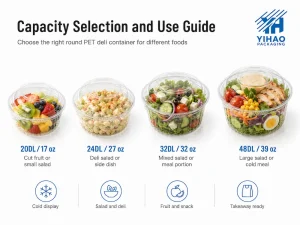
Large salad portions need enough internal height to avoid crushing greens, toppings, and proteins. Round bowls are often preferred for premium salad presentation because the shape helps ingredients look abundant and easy to mix. For chilled retail, round PET containers support strong visibility from the top and sides, which matters for customer inspection.
If the salad includes dressing cups, proteins, grains, or toppings, buyers should confirm whether the lid height leaves enough room and whether the container remains stable during stacking. A shallow container may look efficient in the carton, but it can make premium salad products look compressed.
For Fruit, Snacks, and Light Meal Prep Sets
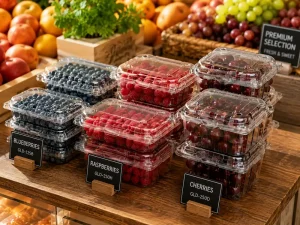
Fresh-cut fruit, grapes, apple slices, berries, nuts, cheese cubes, and yogurt toppings often need compartment separation. This is where divided salad containers or snack-style PET trays become useful. Separation keeps flavors, textures, and moisture levels more controlled during display.
For this use case, buyers should compare two-compartment, three-compartment, and four-compartment layouts. A two-compartment format works for fruit plus nuts or salad plus topping. A four-compartment format works better for sampler packs, snack trays, or portioned retail sets. For fresh produce and prepared snack lines, fresh-cut fruit containers can also support cross-selling between produce, salad, and grab-and-go meal programs.
For Deli Sides and Compact Chilled Meals
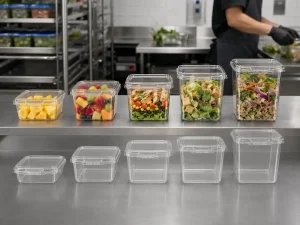
Square or rectangular containers make sense when shelf space, carton efficiency, and portion consistency are important. Pasta salad, potato salad, cut fruit, cold noodles, deli vegetables, and compact meal sides often perform well in square formats. square PET containers help buyers build a neat shelf block and use case-ready portion range.
For deli food, the closure must feel controlled, the base must resist deformation during handling, and the lid must sit cleanly after filling. A container that looks clear when empty but warps after filling creates weak shelf confidence.
Checklist 2: Compare Clear Display Performance
In chilled food packaging, visibility is not decorative. It is commercial. Clear packaging lets customers judge color, freshness, portion size, ingredient quality, and value before buying. That is why clear meal prep packaging must be assessed under real lighting, real refrigeration, and real food conditions.
Buyers should ask for samples and test them with the actual menu: leafy salads, oily pasta, fruit juices, yogurt, sauce, toppings, or chilled noodles. A container may look excellent when empty but perform differently when it holds moisture, acidic fruit, colorful ingredients, or stacked deli portions.
| Test Point | Why It Matters | What to Check |
|---|---|---|
| Side-wall clarity | Customers inspect food from the side in chilled cases | Cloudiness, haze, blue tint, or gray tone |
| Lid transparency | Top view often drives the first purchase decision | Reflection, distortion, and surface marks |
| Food color rendering | Fresh food sells through color contrast | Greens, berries, proteins, grains, and dressings |
| Condensation behavior | Cold-chain display can reduce visibility | Fogging, water droplets, and anti-fog needs |
| Stacked appearance | Wholesale buyers care about shelf blocks | Whether stacked packs still look neat |
For meal prep salad containers, clarity should support both appetite and trust. If the food looks dull, hidden, or distorted, the container reduces the perceived value of the meal. If the container looks clean and transparent, the food appears more intentional and more professionally packed.
Checklist 3: Choose the Right Portion and Compartment Logic
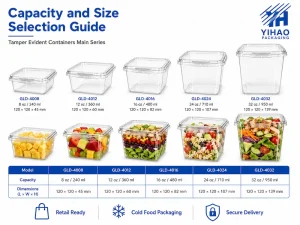
Meal prep buyers should not choose capacity only by volume. Portion logic is more useful. A 16 oz format may support sides, snacks, or light salads. A 24–32 oz range may fit standard salad meals, fruit bowls, chilled noodles, or deli meals. Larger formats may support shared salads, party platters, or family-size fresh food portions.
For salad and meal prep programs, the right format depends on how the food is eaten. A salad meal container needs enough space for mixing. A snack tray needs separation. A fresh-cut fruit container needs visibility and moisture management. A deli meal container needs stackable protection. A buyer comparing salad meal containers should always connect capacity to menu design, not just to container size.
| Food Program | Common Packaging Direction | Buyer Logic |
|---|---|---|
| Light salad or side salad | Compact PET bowl or hinged container | Portion control and fast takeaway |
| Main-meal salad | Medium to large clear PET bowl | Ingredient visibility and mixing room |
| Fruit-and-nut pack | Two-compartment or four-compartment PET tray | Separation and snack value |
| Cold noodles or deli meal | Square or round PET container | Stacking, display, and lid fit |
| Retail sampler pack | Multi-compartment clear tray | Visual variety and controlled layout |
For practical product matching, a buyer may use square deli containers for compact salad, fruit, and deli meals, while premium chilled salad lines may use salad meal containers with more visible volume and top-view appeal.
Checklist 4: Review Lid Fit, Closure, and Handling Stability
A clear container only works if the closure feels consistent. Wholesale buyers should test lid engagement, hinge strength, stacking behavior, and handling stability before approving bulk production. In retail and takeaway channels, a loose lid creates leakage risk, poor shelf confidence, and complaints. An overly tight lid slows filling lines and frustrates customers.
For hinged formats, check whether the hinge bends smoothly and whether the lid returns to position without stress marks. For separate-lid formats, check whether the lid aligns quickly during packing and whether workers can close it efficiently. For tall salad bowls, check whether the lid stays secure after cold storage and transport vibration.
Supplier Closure Checklist
- Does the lid close consistently after repeated sample opening and closing?
- Does the rim remain stable after filling with chilled salads, fruit, or deli food?
- Does the container resist side-wall flex during manual handling?
- Does stacking create pressure marks on the lid or food surface?
- Does the package remain neat after refrigeration and short-distance delivery?
- Does the lid fit support label placement without hiding the food?
Buyers should never approve bulk containers based only on empty sample appearance. Test filled samples. Add actual food weight. Refrigerate them. Stack them. Move them. Open and reclose them. A container that passes these steps is more likely to work in real retail and foodservice operations.
Checklist 5: Evaluate Divided Salad Containers and Multi-Compartment Options
Multi-compartment packaging is growing in chilled snack, fruit, and salad programs because customers like variety and portion control. However, compartment design must be practical. If compartments are too shallow, toppings move during transport. If dividers are too high, the food looks smaller. If the layout is visually confusing, the pack loses appetite appeal.
For buyers developing snack-and-salad sets, two-compartment snack packs are useful for simple pairings such as fruit plus nuts, salad plus protein, or vegetables plus dip. For retail assortments, four-compartment snack trays can create a more complete grab-and-go eating experience.
When comparing divided packaging, ask whether the compartments fit the actual food geometry. Apple slices, grapes, cherry tomatoes, cucumber sticks, boiled eggs, cheese cubes, toppings, and dips all behave differently. A good supplier should discuss the food, not only the mold.
Checklist 6: Confirm Food-Contact Suitability and Compliance Documentation
Food packaging buyers should separate marketing claims from documentation. A supplier should be able to discuss material identity, intended use, food-contact suitability, temperature range, and the documentation needed for the destination market. This is especially important for exporters, distributors, and private-label brands that sell into different regulatory environments.
For PET meal prep packaging, ask the supplier what documentation is available for the material and intended application. Do not rely on generic claims such as “food grade” without supporting records. If recycled PET or rPET content is involved, ask how the recycled material is sourced, processed, and documented for food-contact use.
| Compliance Check | What Buyers Should Ask | Why It Matters |
|---|---|---|
| Material identity | Is the container PET, rPET, PP, or another plastic? | Prevents wrong material selection |
| Food-contact support | What documents support intended food-contact use? | Supports buyer due diligence |
| Temperature application | Is it for chilled, room-temperature, frozen, or hot use? | Prevents misuse in foodservice |
| Recycled content | If rPET is used, what process documentation is available? | Supports responsible sourcing claims |
| Export market | Which documents are needed for the target country? | Reduces customs and buyer approval risk |
This article does not claim that every PET container is automatically suitable for every food or market. The correct approach is to confirm the intended food, filling condition, storage condition, and destination-market requirements with the manufacturer before ordering.
Checklist 7: Compare Manufacturer Capability, Not Only Product Photos
Photos help buyers shortlist suppliers, but factory capability decides repeat order stability. A strong manufacturer should provide consistent material selection, mold accuracy, sample support, production communication, carton planning, and order documentation. This matters more when the buyer needs multiple sizes, private-label packaging, or long-term wholesale supply.
For buyers comparing a factory, the key questions are practical: Can the supplier keep container clarity consistent across batches? Can they support bulk packing without deformation? Can they explain lid compatibility clearly? Can they help the buyer select a product range instead of pushing one random stock item?
YIHAO works best as a packaging partner when the buyer treats the project as a food packaging system: food type, portion, structure, display, handling, carton, and repeat supply. This is more useful than choosing a container from an image alone.
Checklist 8: Wholesale Ordering Questions Before Bulk Purchase
Wholesale buyers should ask structured questions before placing a bulk order. This avoids problems that appear only after production, packing, or retail launch. A clear supplier checklist also helps procurement teams compare quotes more fairly.
Core Wholesale Questions
- What food type will the container hold: salad, fruit, deli side, snack set, or cold meal?
- Is the product sold chilled, room-temperature, takeaway, delivery, or retail display?
- Does the container need one compartment or multiple compartments?
- Does the buyer need hinged, separate-lid, bowl, square, or tray format?
- Will the pack be stacked in cartons, on shelves, or during delivery?
- Does the buyer need label space, sleeve packaging, barcode area, or custom branding?
- Are samples tested with real food before bulk approval?
- What carton packing method protects the container during export shipping?
For wholesale programs, container consistency is more important than one attractive sample. A good supplier should help the buyer reduce mismatch: wrong depth, wrong lid, wrong material, wrong display format, or wrong use condition.
Checklist 9: Think in Product Ranges, Not Single Containers
Food packaging buyers often start with one container, but stronger purchasing systems are built around a product range. A salad brand may need small side salad containers, main-meal salad bowls, divided topping packs, and larger family-size options. A supermarket may need fruit snack packs, deli sides, chilled noodle containers, and party trays. A cafe may need compact salad containers, bakery containers, cold cups, and grab-and-go snack packs.
A range-based approach helps keep shelf presentation consistent. It also simplifies supplier management and supports future menu expansion. For example, a buyer may use compact hinged deli containers for side portions, clear bowls for main salads, and separate-lid prepared food containers for chilled prepared meals that need a more controlled lid structure.
This range logic is especially important for exporters and distributors. A buyer who imports only one size may soon receive requests for adjacent sizes, lids, divided versions, or category expansion. Choosing a manufacturer with range depth reduces the need to restart supplier evaluation later.
Checklist 10: Test Real-World Performance Before Final Approval
Sample testing should be practical and food-specific. Do not evaluate PET meal prep containers only on a desk. Test them under the conditions in which customers and workers will actually handle them.
| Test | How to Run It | Decision Value |
|---|---|---|
| Filled weight test | Fill with the actual salad, fruit, or meal weight | Checks base rigidity and lid pressure |
| Cold display test | Place samples in refrigeration for several hours | Checks clarity and condensation impact |
| Stacking test | Stack filled containers as they would be displayed or shipped | Checks deformation and food protection |
| Opening test | Open and close samples repeatedly | Checks hinge, lid feel, and customer experience |
| Label test | Apply real labels, sleeves, or stickers | Checks barcode visibility and branding space |
| Transport test | Move samples through delivery-style handling | Checks closure stability and presentation after movement |
The best sample is not the one that looks most impressive when empty. The best sample is the one that keeps the food looking neat after filling, chilling, stacking, transport, and customer handling.
Common Buying Mistakes When Choosing PET Meal Prep Containers
Mistake 1: Choosing Capacity Without Considering Food Height
Two containers with similar volume can behave differently. One may be wide and shallow. Another may be taller and better for layered salads. A salad with greens and toppings needs different space than a dense deli side. Capacity alone does not tell the full story.
Mistake 2: Ignoring Compartment Shape
Divided packaging must fit the food shape. A compartment that works for grapes may not fit apple slices. A section that works for nuts may not work for dressing cups. Buyers should request layout advice before committing to mold direction or bulk order volume.
Mistake 3: Treating PET as a Reheating Container
PET is strong for clarity and chilled display, but it should not be treated as the default material for microwave reheating. If the food is intended for hot use or reheating, ask the supplier for a suitable microwave-safe option.
Mistake 4: Testing Empty Samples Only
Empty samples do not show how the package behaves with moisture, food weight, chilled conditions, labels, and stacking pressure. Real food testing is non-negotiable for serious wholesale programs.
Mistake 5: Choosing a Supplier Without Range Support
A supplier with only one attractive container may not support future growth. Buyers should check whether the manufacturer can offer related sizes, lids, bowls, square formats, divided trays, and custom packaging support.
Supplier Scorecard for PET Meal Prep Containers
The following scorecard gives buyers a practical way to compare suppliers before moving to quotation, sampling, or bulk order approval.
| Evaluation Area | High-Quality Supplier Signal | Risk Signal |
|---|---|---|
| Material clarity | Clear samples with stable appearance across formats | Blue, gray, cloudy, or inconsistent samples |
| Structural fit | Supplier asks about food type, weight, and channel | Supplier recommends only by size or photo |
| Lid compatibility | Clear explanation of matching lids and closure logic | Unclear lid fit or inconsistent sample closure |
| Sample testing | Supports filled-sample and application testing | Pushes bulk order before practical testing |
| Range depth | Offers bowls, hinged formats, square containers, and divided trays | Limited product family with no adjacent options |
| Wholesale support | Provides carton, packing, export, and repeat-order discussion | Only provides unit price without packaging details |
| Documentation | Discusses food-contact and market documents clearly | Uses broad claims without support |
Need PET Meal Prep Containers for Wholesale Supply?
If your business needs PET meal prep containers for salads, fresh fruit, chilled deli meals, snack packs, or divided retail food programs, start with sample testing before confirming bulk orders. A practical supplier discussion should cover food type, portion size, lid structure, carton packing, display method, label space, and repeat order planning.
For wholesale buyers, the strongest packaging decision is not only about unit price. It is about choosing a container range that keeps food visible, protected, stackable, and ready for real retail handling. A manufacturer with salad, deli, fruit, and divided packaging options gives buyers more room to build a complete chilled food packaging program.
Best Applications for PET Meal Prep Containers
1. Chilled Retail Salads
PET containers support clean top-view presentation for leafy greens, grains, proteins, and colorful toppings. Clear lids help customers judge freshness quickly in retail display.
2. Grab-and-Go Salad Meals
For cafes, convenience stores, and supermarkets, grab-and-go salad packaging needs strong clarity, controlled portion size, and a structure that stays neat after handling.
3. Fresh-Cut Fruit and Snack Packs
Fruit, nuts, cheese, and small snack combinations benefit from clear divided containers that keep ingredients visually separated and easy to inspect before purchase.
4. Deli Sides and Cold Prepared Foods
Pasta salad, potato salad, cold noodles, marinated vegetables, and deli sides need containers that combine compact stacking with visible food presentation.
5. Retail Meal Prep Programs
Meal prep programs often use multiple container sizes across salads, fruit bowls, sides, and light meals. Range consistency helps the whole shelf look organized.
6. Wholesale and Private-Label Food Packaging
Distributors and food brands need reliable supply, carton planning, sample support, and packaging structures that can scale across repeated orders.
FAQ
1. Are PET meal prep containers suitable for salads and chilled meals?
Yes. PET meal prep containers are especially suitable for chilled salads, fresh-cut fruit, deli sides, snack packs, cold noodles, and grab-and-go meals where clear display and food visibility are important. Buyers should still confirm the intended food type, storage condition, filling temperature, and lid structure before bulk ordering.
2. What is the difference between PET meal prep containers and PP meal prep containers?
PET meal prep containers are usually chosen for high clarity and chilled retail display, while PP containers are often selected for hot food or microwave-safe applications when the product is designed for reheating. If the meal is sold cold and judged by appearance, PET is often the better display choice. If reheating is required, buyers should compare PP or other microwave-suitable options.
3. How should wholesale buyers choose between round, square, and divided salad containers?
Round containers are strong for premium salad and fruit presentation, square containers are efficient for compact deli meals and shelf blocking, and divided salad containers are useful for snack packs, toppings, fruit-and-nut combinations, and portioned meal prep sets. The right choice depends on food shape, portion size, display method, stacking needs, and customer eating behavior.
4. What should buyers ask a PET meal prep container manufacturer before placing bulk orders?
Buyers should ask about material identity, food-contact documentation, sample availability, lid compatibility, carton packing, customization options, production consistency, and whether the supplier can support related sizes or formats. The best manufacturer should help match the container to the food application instead of recommending only by capacity.
5. Can PET meal prep containers be customized for wholesale food brands?
Yes. Many wholesale PET meal prep container programs can include label planning, sleeve packaging, custom carton discussion, private-label support, and product range matching. Actual customization options depend on order quantity, container structure, mold availability, printing method, and the supplier’s production capability.
References
- Packaging & Food Contact Substances — U.S. Food and Drug Administration — food packaging and food contact substances guidance.
- Recycled Plastics in Food Packaging — U.S. Food and Drug Administration — recycled plastic food-contact considerations.
- Food Code 2022 — U.S. Food and Drug Administration — retail food protection and safe food handling framework.
- Commission Regulation (EU) No 10/2011 — European Union — plastic materials and articles intended to come into contact with food.
- Design Guide for Plastics Recyclability — Association of Plastic Recyclers — packaging design and recyclability considerations.
- Food Service Industry: Market Segments — USDA Economic Research Service — foodservice market context.
- 2024 Food & Health Survey — International Food Information Council — consumer food choice and confidence research.
- PET and rPET Container Internal Link Planning — YIHAO Packaging — internal product range and category mapping for salads, deli, fresh-cut fruit, and meal prep packaging.
Deep Dive Insights
How should buyers choose PET meal prep containers?
Buyers should begin with the food application: salad, fruit, deli side, snack set, or cold meal. After that, they should compare shape, compartment layout, lid fit, clarity, stacking performance, and wholesale supply capability. A container should be selected because it fits the food and channel, not because it simply looks similar to another product on the shelf.
Why does clear PET packaging matter for chilled meals?
Clear PET packaging allows customers to judge freshness, color, portion size, and ingredient quality before opening the container. In chilled retail, this visibility often supports stronger shelf confidence and faster purchase decisions. For salad, fruit, and deli meals, clear display is part of the product value.
What is the best option for divided salad and snack packs?
Two-compartment and four-compartment PET containers are strong options when ingredients need separation. They work well for fruit-and-nut packs, salad toppings, snack assortments, and small meal prep sets where visual organization adds value. Buyers should test the actual food shape before finalizing the compartment layout.
What should wholesale buyers consider before choosing a supplier?
Wholesale buyers should check sample support, material documentation, lid compatibility, carton packing, production consistency, customization options, and whether the manufacturer can support related sizes for future product expansion. A stronger supplier helps buyers build a packaging range, not just buy one container.
Option insight: when should buyers choose PET instead of PP?
PET is the better direction when the food is chilled, visually driven, and sold through display cases or grab-and-go shelves. PP is the better direction when the food requires reheating or hot-food service. Serious buyers should define the eating condition first, then choose the material.
Consideration for private-label and distributor programs
Private-label brands and distributors should avoid overly narrow packaging decisions. A practical PET meal prep packaging program usually needs multiple sizes, matching lids, divided formats, carton planning, and repeat-order consistency. Choosing a supplier with range depth reduces future sourcing friction.
Final Note / Practical Takeaway
© YIHAO Packaging. All rights reserved. All articles, product images, packaging designs, technical specifications, and website materials are protected by copyright. Unauthorized copying, reproduction, redistribution, modification, or commercial use is strictly prohibited without prior written permission.