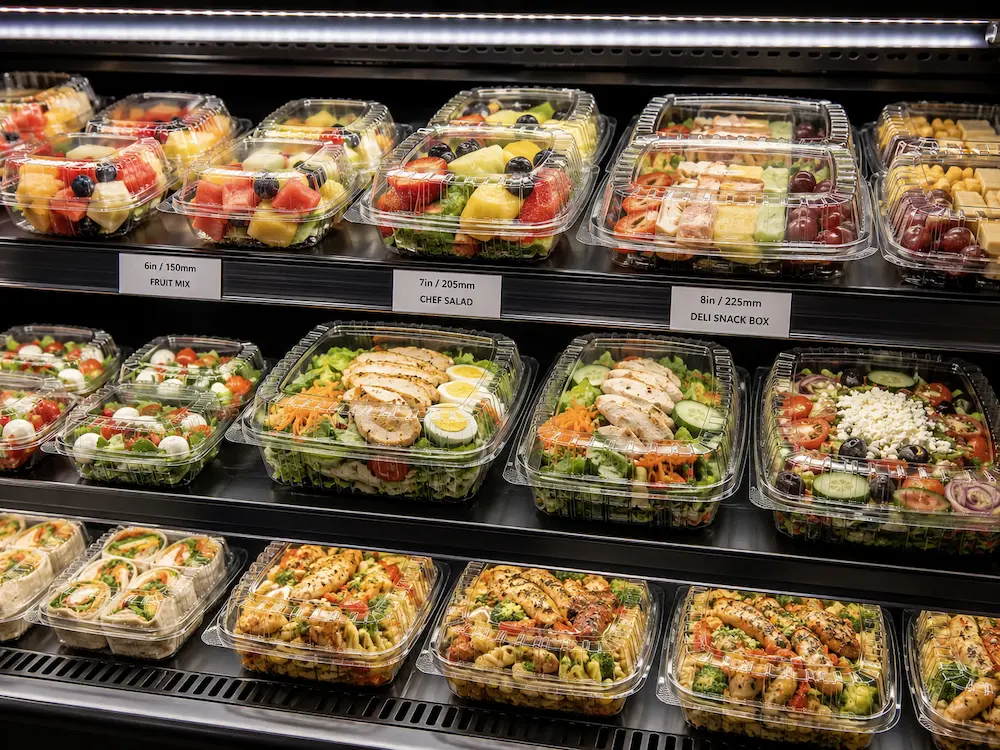
For supermarkets, food brands, distributors, and foodservice buyers, choosing the right PET hinged deli containers is not only a packaging decision. It affects food presentation, packing speed, shelf display, storage efficiency, customer confidence, and long-term wholesale supply planning.
What Are PET Hinged Deli Containers?
PET hinged deli containers are clear plastic food containers made with an attached flip-top lid. The base and lid are connected by a hinge, so the container closes as one integrated piece instead of using a separate lid. This structure makes packing faster, reduces lid-matching mistakes, and supports efficient food preparation for delis, supermarkets, cafes, convenience stores, central kitchens, and takeaway food programs.
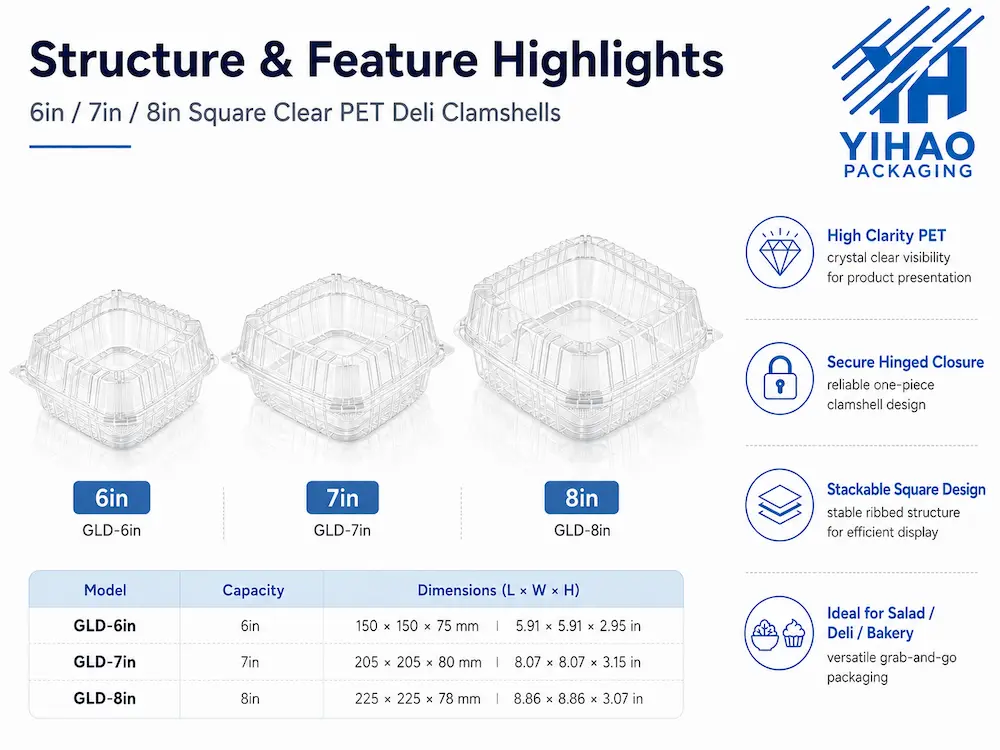
Compared with separate-lid food containers, hinged deli containers are easier to manage during fast packing. Workers do not need to match each base with a different lid, and foodservice teams can keep one packaging SKU ready at the packing station. For chilled food programs, this matters because speed, visibility, and shelf organization directly affect daily operation efficiency.
PET, short for polyethylene terephthalate, is widely used in clear food packaging because it provides excellent clarity, lightweight handling, and a smooth retail appearance. Clear PET packaging allows customers to see the salad, fruit, bakery item, snack pack, or deli food before purchase. For grab-and-go shelves, this visibility supports faster buying decisions and better food presentation.
YIHAO is a food packaging manufacturer and solution provider focused on practical packaging systems for produce, salads, deli foods, bakery items, chilled snacks, and takeaway food programs. For buyers comparing PET food containers, the goal is not only to choose a box, but to build a packaging system that fits food type, shelf display, transportation, storage, and wholesale ordering logic.
Why Clear PET Deli Containers Work Well for Fresh and Chilled Foods
High Clarity Improves Retail Display
Clear packaging is one of the strongest advantages of clear PET deli containers. Salads, fresh-cut fruit, pasta salad, deli sides, bakery portions, and chilled snacks all rely on visual freshness. When the container is transparent, buyers can quickly check color, portion size, ingredient mix, and presentation quality.
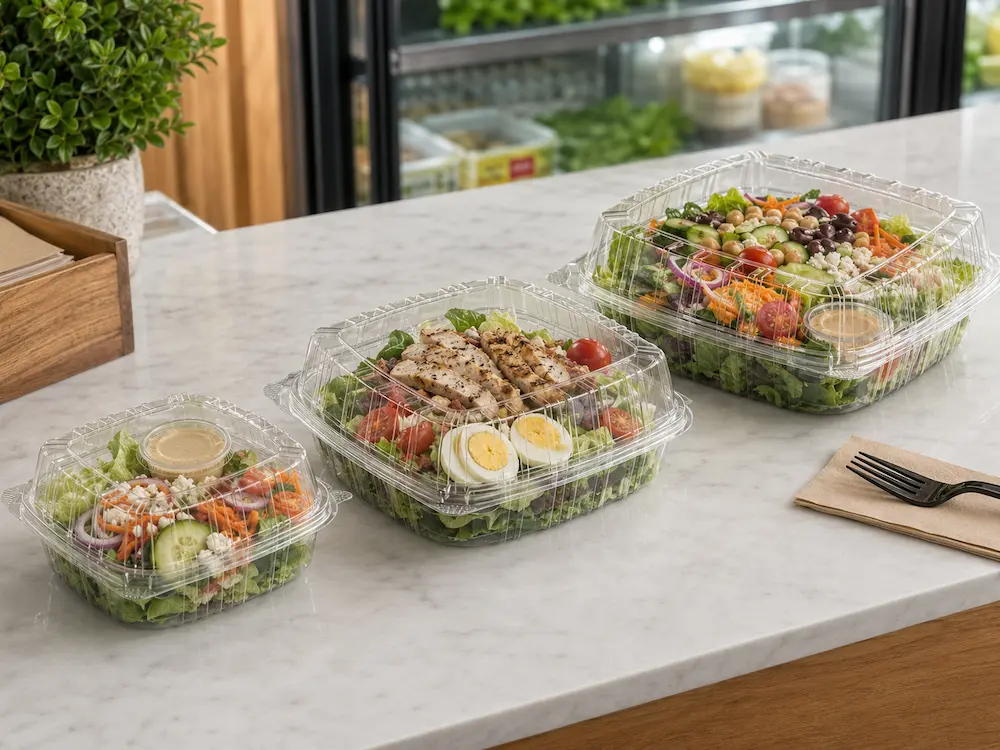
For supermarkets and convenience stores, product visibility is not decoration. It directly supports merchandising. Green salads look fresher when the leaves, toppings, and dressing placement are visible. Fruit portions look more attractive when colors are clear through the lid. Bakery slices and dessert portions look more premium when the container protects the shape while still showing the product.
Attached Hinged Lids Improve Packing Efficiency
The hinged lid structure is especially useful for operations that pack many items every day. A deli team can fill the base, close the lid, apply a label, and move the product to the display shelf with fewer steps. For central kitchens and wholesale food preparation, this simple workflow helps reduce packing confusion.
This is why deli clamshell packaging remains popular for cold foods, snacks, salads, and takeaway meals. The attached lid keeps the packaging process direct. The container arrives as one piece, stores as one piece, and closes as one piece.
Lightweight Structure Supports Takeaway and Cold Shelf Programs
PET hinged containers are lightweight compared with many rigid reusable containers, and they are easier to stack and store than bulky packaging formats. For foodservice buyers, this saves space in preparation areas and back-of-house storage. For retailers, consistent stacking supports cleaner shelf presentation and easier restocking.
For grab-and-go deli packaging, the container must look clean, close properly, and remain convenient for customers to carry. A clear hinged structure gives buyers a practical balance between display, speed, and handling.
Common Applications for PET Hinged Deli Containers
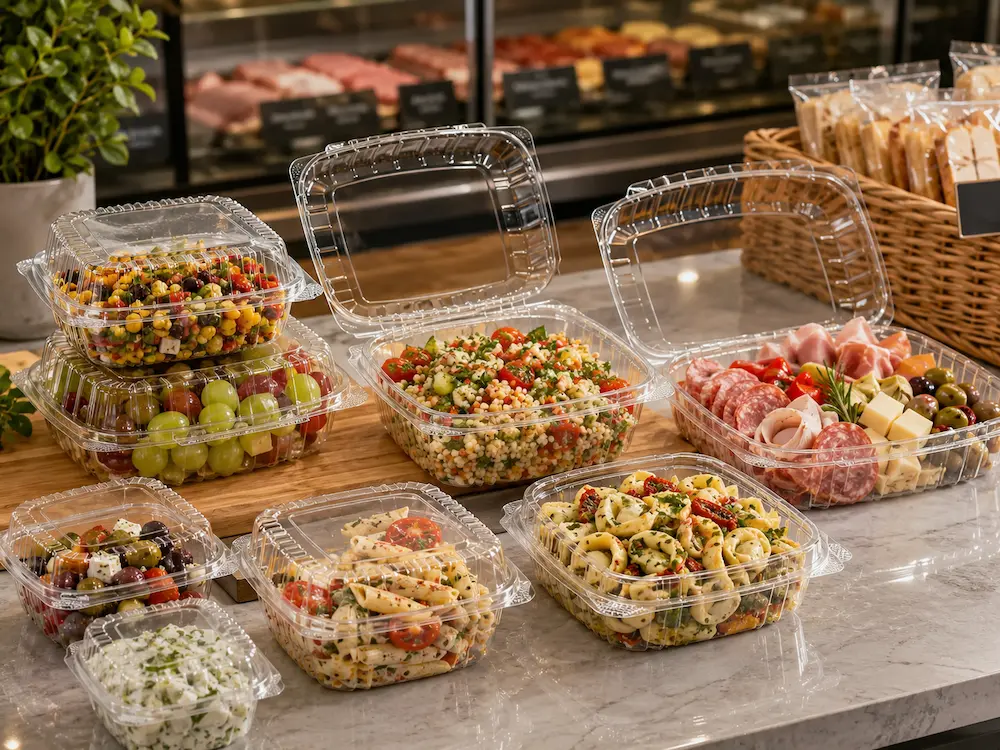
PET hinged deli containers are used across many fresh and chilled food categories. The best container depends on portion size, food height, ingredient weight, moisture level, label placement, and shelf display needs.
| Application | Typical Food Examples | Packaging Priority |
|---|---|---|
| Salads and deli sides | Green salad, pasta salad, coleslaw, grain salad, chilled deli sides | Clear display, enough lid height, stable closure |
| Fresh-cut fruit | Apple slices, grapes, melon cubes, berry mixes, mango portions | Visibility, freshness presentation, portion control |
| Snack packs | Nuts, dried fruit, cheese cubes, fruit and nut portions | Compact size, label area, easy takeaway |
| Bakery and dessert portions | Brownies, cookies, cake slices, chilled desserts, pastries | Product protection, lid height, clean presentation |
| Grab-and-go meals | Cold meals, deli packs, prepared side dishes, snack meals | Shelf organization, customer convenience, fast packing |
Salads and Chilled Deli Foods
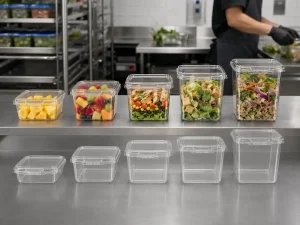
Salad clamshell containers are a practical choice for green salads, pasta salads, grain bowls, coleslaw, and deli sides. A good salad container should provide enough space for leafy ingredients without crushing them. It should also allow toppings to remain visible through the lid.
For salad packaging, buyers should consider food height and ingredient movement. Leafy greens need headspace. Pasta salad and grain salad may need stronger base support. Deli sides require a container that handles filling, closing, labeling, stacking, and shelf placement efficiently.
Fresh-Cut Fruit and Snack Packs
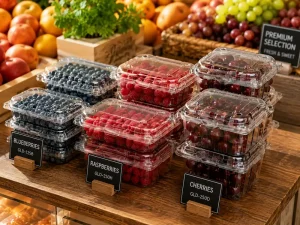
Fruit packaging needs strong visual appeal. Clear PET helps show natural fruit colors, which matters for fresh-cut fruit containers, berry mixes, and snack packs. A transparent hinged container gives customers a clear view of the product and helps retailers maintain a clean cold shelf display.
For fruit and snack packaging, buyers often compare hinged deli containers with fresh-cut fruit containers, divided trays, and round bowls. The right choice depends on whether the food is a single portion, mixed snack pack, family-size fruit pack, or premium display item.
Bakery and Dessert Portions
PET hinged deli containers are also used for some bakery and dessert items, especially when the product is flat or compact. Brownies, cookies, pastry portions, and chilled dessert servings benefit from clear display and easy takeaway handling.
For taller desserts, cream-topped items, decorated pastries, or cake slices, buyers may need dedicated bakery clamshell containers instead of standard deli containers. The correct lid height protects the dessert shape and keeps the presentation clean.
Grab-and-Go Meals for Retail Shelves
Grab-and-go food programs depend on speed, visibility, and repeatable packaging. Customers need to identify the food quickly, compare portions easily, and carry the item comfortably. For retailers, the packaging must support fast packing, clear labeling, and organized shelf display.
For this reason, PET hinged deli containers are often used together with round PET bowls, square PET containers, tamper-evident containers, and fresh produce containers. A complete packaging system gives food brands more flexibility across salads, fruit, bakery portions, chilled sides, and ready-to-eat snacks.
PET Hinged Deli Containers vs Other Deli Packaging Options
There is no single container that fits every food program. Buyers should compare PET hinged deli containers with other packaging formats based on the product, sales channel, storage method, and customer experience.
| Packaging Type | Best For | Main Advantage | Buying Consideration |
|---|---|---|---|
| PET hinged deli containers | Salads, deli foods, snacks, fruit, chilled portions | Clear display with attached lid | Match size, lid height, and closure to the food type |
| Round PET deli containers | Salad bowls, fruit mixes, chilled noodles, larger deli portions | Premium bowl presentation | Confirm lid fit, stacking logic, and portion depth |
| Square PET containers | Fruit, snacks, deli sides, compact chilled meals | Efficient shelf use | Choose flat lid or high lid according to food height |
| Tamper-evident containers | Retail food, delivery, sealed grab-and-go items | Stronger opening-control signal | Best for channels where visible security matters |
| PP microwave-safe containers | Hot takeaway meals and reheatable prepared foods | Better heat-use suitability than PET | Not the same clear retail look as PET |
If the food is cold, colorful, and display-driven, PET is often the stronger visual choice. If the food needs reheating, buyers should consider microwave safe containers instead. If the channel needs visible opening control, tamper evident containers provide a more suitable structure.
How to Choose the Right PET Hinged Deli Container Size
Choosing the right size is not only about volume. Food shape, ingredient height, topping arrangement, product weight, and shelf display all matter. A container that is too small compresses the food and damages presentation. A container that is too large makes the portion look weak and increases unnecessary packaging space.
Match Container Size to Food Type
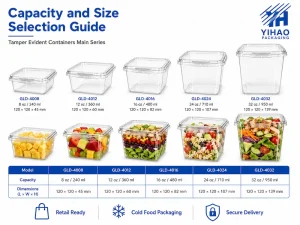
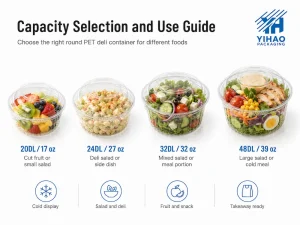
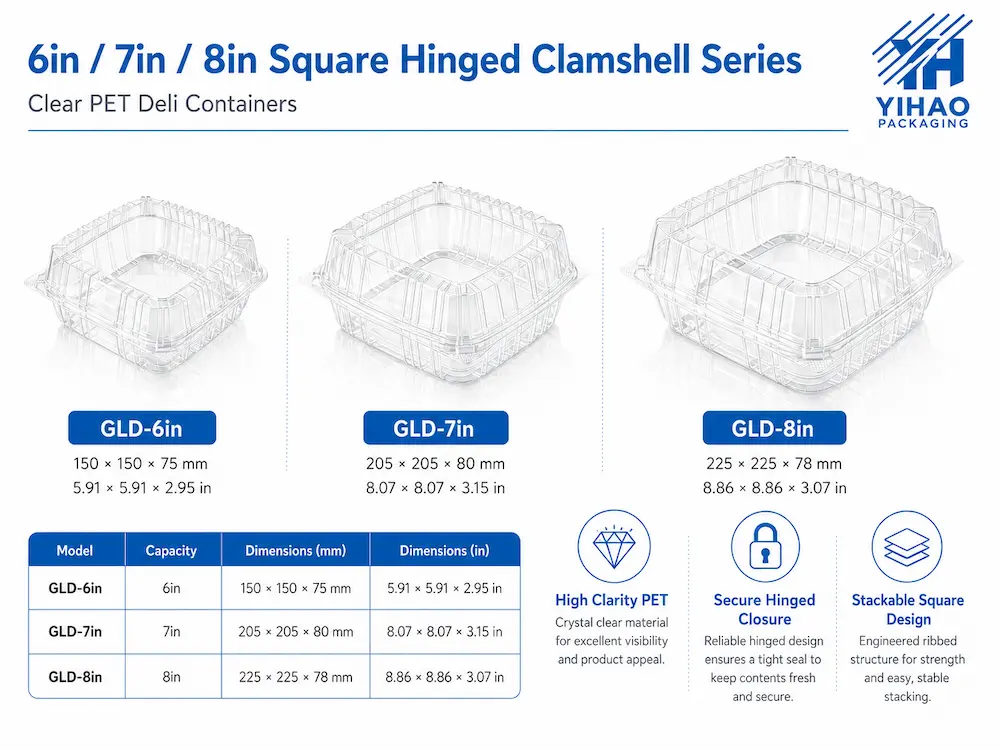
For small fresh food portions, buyers can use compact hinged containers for snacks, fruit, nuts, small salad sides, and tasting portions. For standard deli salads and snack packs, a mid-size clear hinged container usually provides a better balance between portion value and shelf space. For larger chilled portions, the container should offer more base area and enough lid clearance.
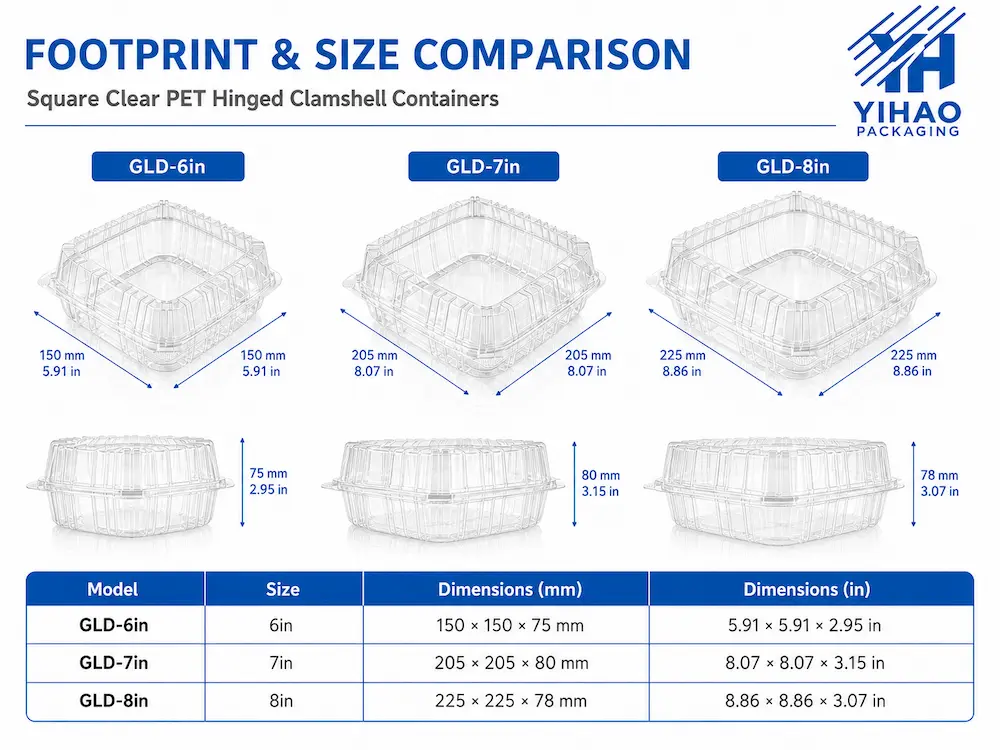
For example, a small clear hinged deli format supports fresh food packaging for compact portions, while larger formats support larger fresh food portions where salad volume, fruit mix, or deli side quantity needs more space.
Consider Food Height, Toppings, and Movement
Food height is often more important than buyers expect. Leafy greens, sandwiches, pastries, and fruit chunks need different lid clearance. If the food touches the lid too much, the product can look compressed. If there is too much empty space, the product may move during handling and look less full on shelf.
For toppings, sauces, garnishes, and layered salads, buyers should test samples with the real food before confirming bulk orders. Sample testing helps verify whether the container closes smoothly, stacks correctly, and presents the product attractively.
Avoid Overcomplicating SKUs
A strong packaging system does not always need too many sizes. Many buyers build better operations by choosing a small number of practical SKUs that cover their main food types. For example, one compact size for snacks, one standard size for salads and deli sides, and one larger size for family-style or premium portions may be enough for many retail programs.
This approach helps reduce storage complexity, purchasing confusion, and packing errors. For wholesale planning, the goal is not to buy every possible shape. The goal is to select the container range that supports the most profitable and repeatable food items.
Key Buying Factors for Wholesale Hinged Containers
When purchasing wholesale hinged containers, buyers should evaluate more than price. A low-cost container that does not close well, stack properly, or present food clearly can create operational problems. The right container supports daily packing, shelf display, transportation, labeling, and customer experience.
Material Clarity and Food Presentation
Clear PET should make the food look clean and visible. Buyers should review material transparency, surface finish, lid clarity, and base appearance. For salads, fruit, and bakery portions, packaging clarity directly affects perceived freshness.
When comparing clear PET deli containers, buyers should place real food inside the sample and review the product under actual store lighting. A container may look acceptable when empty but perform differently when filled with salad greens, fruit colors, sauce containers, or bakery items.
Lid Closure and Handling Performance
The closure should feel stable during packing and handling. A good hinged container should close consistently without requiring excessive force. Buyers should test the closure with the actual food weight and packing process.
It is important not to assume that every hinged container is suitable for every food. Heavy deli items, wet salads, and stacked transport conditions may require more careful testing. Buyers should confirm closure performance with real food, real labels, and real handling conditions before wholesale orders.
Stacking and Storage Efficiency
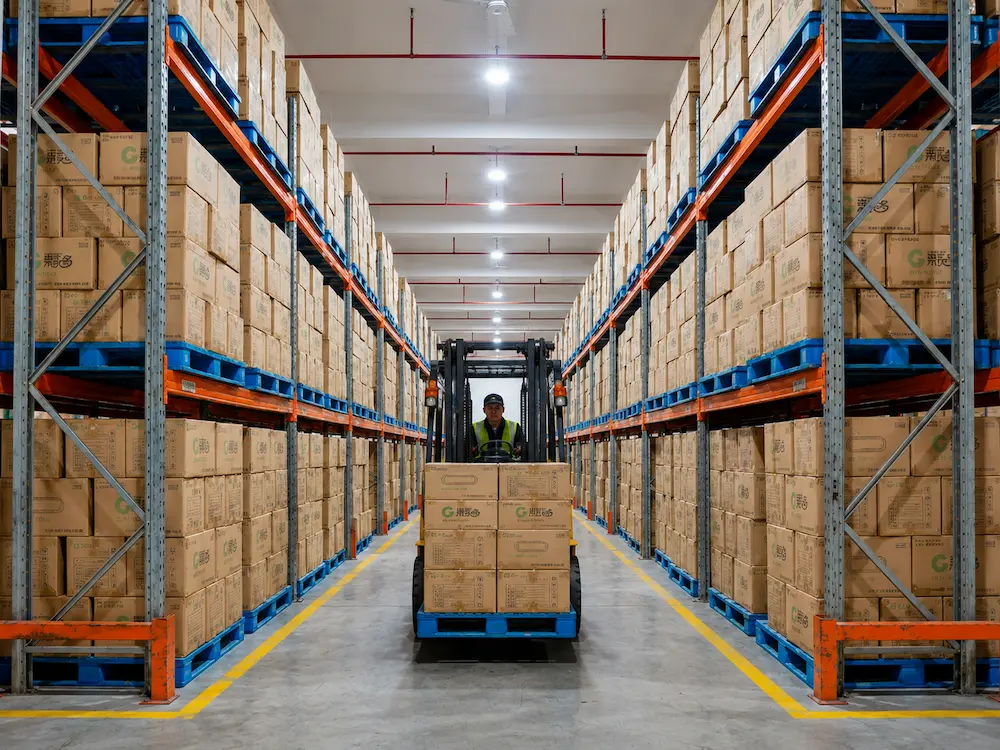
Stacking affects warehouse storage, preparation areas, shelf display, and transport. A container that stacks neatly saves space and helps workers move products efficiently. This matters for supermarkets, foodservice distributors, meal preparation businesses, and central kitchens.
For buyers planning a complete packaging range, round PET deli containers and square PET containers can work alongside hinged deli containers to support different product shapes and shelf layouts.
Label Area and Branding Options
Food packaging must leave practical space for labels, barcode stickers, ingredient information, pricing labels, and brand stickers. A container with strong clarity but poor label placement may create retail difficulties. Buyers should consider whether the label should go on the lid, side, bottom, or sleeve area.
For private label programs, the container should support attractive branding without hiding the food. Clear PET packaging works best when the label supports the product story instead of covering the visual freshness.
PET Hinged Deli Containers for Grab-and-Go Food Programs
Grab-and-go food is built around fast decisions. Customers often choose within seconds, especially in supermarkets, convenience stores, office food areas, transport hubs, and cafes. Packaging must show the food clearly, communicate portion value, and feel easy to carry.
PET hinged deli containers support this environment because they combine visibility with simple handling. The lid is attached, the product is protected, and the food remains visible from the shelf. For chilled retail programs, this combination is practical and commercially strong.
Why Visibility and Speed Matter
Customers are more likely to trust a fresh food product when they can see it. Clear packaging reduces uncertainty. It also helps retailers present colorful ingredients, premium toppings, and clean portion control.
Speed matters for the operation as well. A grab-and-go program usually requires repeat packing every day. The packaging must support fast filling, closing, labeling, shelf placement, and restocking. A hinged container reduces the number of separate packaging parts and keeps the packing process more direct.
Building a Simple Packaging System
A practical grab-and-go packaging system may include PET hinged deli containers for salads and deli sides, round bowls for premium salad meals, square containers for fruit and snack packs, tamper-evident containers for sealed retail items, and bakery clamshells for desserts.
For example, clear PET salad bowl with hinged lid options support salads and fresh fruit where a bowl shape improves presentation. For compact deli sides and fruit snacks, square PET containers may create better shelf efficiency.
Reducing SKU Confusion for Foodservice Teams
Foodservice teams work best with clear packaging rules. If every food item uses a different container size, workers make more mistakes and purchasing becomes harder to manage. Buyers should create a simple product-to-container matrix before placing wholesale orders.
The matrix should define which container is used for each food group, such as small snacks, standard salads, fruit portions, bakery portions, and larger fresh food packs. This improves consistency and makes training easier for store teams or production workers.
Buyer Checklist Before Ordering PET Hinged Deli Containers
Before ordering wholesale hinged containers, buyers should confirm the packaging against real food and real operating conditions. The checklist below helps avoid common mistakes.
| Checklist Item | What to Review | Why It Matters |
|---|---|---|
| Food type | Salad, fruit, deli side, snack, bakery, chilled meal | Different foods need different base depth and lid height |
| Portion size | Single serving, snack portion, family pack, premium portion | The container should make the portion look full and balanced |
| Lid closure | Closing feel, snap fit, handling stability | A poor closure creates packing and transport issues |
| Stacking | Empty stacking, filled stacking, shelf stacking | Efficient stacking saves space and improves display |
| Label placement | Top label, side label, barcode, ingredient sticker | Labels should not hide the food presentation |
| Storage | Back-room space, carton storage, packing station space | Poor storage logic increases daily operation friction |
| Supplier support | Sample support, product matching, wholesale planning | A capable supplier helps reduce selection risk |
Working With a Deli Container Manufacturer
Choosing a deli container manufacturer is different from simply buying available stock from a distributor. A manufacturer can help buyers review product structure, food application, material direction, container range, sample testing, and wholesale planning. This is important for importers, distributors, supermarkets, food brands, and foodservice buyers who need repeatable supply rather than one-time purchasing.
A professional manufacturer should help buyers ask better questions. What food will be packed? Is it sold cold or at room temperature? Does the product need a tall lid? Will the container be stacked after filling? Where will the label be placed? How many container sizes are truly needed for the first stage? These questions protect the buyer from choosing packaging only by photo or price.

YIHAO provides food packaging solutions for categories such as PET hinged containers, salad bowls, fresh produce packaging, bakery clamshells, tamper-evident containers, cold cups, lids, and microwave-safe containers. Buyers can use deli and salad containers as a starting category when building a chilled food packaging system for retail, takeaway, and foodservice programs.
What Buyers Should Confirm Before Bulk Orders
Before confirming a wholesale order, buyers should test samples with the actual food product. This includes filling the container, closing it, labeling it, stacking it, moving it, and reviewing the appearance under retail lighting. The goal is to confirm practical performance, not only visual appearance.
Buyers should also compare packaging options within the same food category. For example, a pasta salad may work well in a hinged deli container, while a premium layered salad may look better in a round bowl. A fruit-and-nut snack may need a compact fresh-cut fruit container or divided tray. A sealed retail food item may need a tamper-evident structure.
Why Manufacturer Support Matters
A reliable packaging manufacturer helps buyers reduce trial-and-error costs. Instead of selecting containers only by capacity, buyers can plan by food type, shelf position, storage conditions, label area, and customer use. This produces a stronger packaging decision and a cleaner product line.
For wholesale buyers, the right supplier should support both current purchasing and future product expansion. A buyer may start with PET hinged deli containers, then expand into round bowls, square deli containers, fresh produce containers, bakery clamshells, or cold cup systems as the business grows.
Sustainability and Material Considerations
PET packaging is valued for clarity, strength-to-weight balance, and broad use in food packaging. Some PET containers may also use recycled PET material depending on product design, supply availability, and local food-contact requirements. However, sustainability claims must always be made carefully because recycling acceptance varies by region, facility, and local collection system.
For buyers comparing PET and rPET packaging, the practical questions are clear: Is the container suitable for the food application? Does the packaging support good product visibility? Can the packaging be sorted through local recycling systems where accepted? Does the supplier provide consistent material quality? These questions are more useful than generic green claims.
Buyers should avoid vague sustainability language such as “fully recyclable everywhere” unless local recycling acceptance and material handling conditions are clearly verified. A better approach is to describe PET packaging as recyclable where local PET recycling systems accept clean PET food packaging.
When PET Hinged Deli Containers Are the Best Choice
PET hinged deli containers are a strong choice when the food is cold, display-driven, and sold through takeaway or retail channels. They are especially useful for food programs that need clear visibility, fast packing, and convenient handling.
| Best-Fit Situation | Why PET Hinged Containers Fit | Possible Alternative |
|---|---|---|
| Cold salad display | Clear lid shows greens, toppings, and portion value | Round PET salad bowls |
| Fruit and snack packs | Transparent structure highlights fresh colors | Fresh-cut fruit containers or divided trays |
| Fast deli counter packing | Attached lid reduces lid-matching steps | Separate-lid deli containers |
| Grab-and-go shelves | Clean presentation and easy customer handling | Tamper-evident containers for higher security needs |
| Bakery portions | Clear display for compact desserts and pastries | Dedicated bakery clamshell containers |
Common Mistakes Buyers Should Avoid
Choosing by Capacity Alone
Capacity is only one part of the decision. Two containers with similar volume may perform differently because of base shape, lid height, closure design, and stacking structure. Buyers should review real food fit, not only size labels.
Ignoring Label Placement
Labels are necessary for retail food, but they should not cover the most attractive part of the product. A good label position supports branding while keeping the food visible. This is especially important for salads, fruit, and dessert portions.
Using PET for the Wrong Temperature Application
PET is commonly used for cold and chilled food display. It is not the first choice for hot-filled or reheatable meals. Buyers planning hot food or microwave use should compare PP options and confirm the correct material for the application.
Buying Too Many Sizes Too Early
Too many SKUs increase storage pressure and packing mistakes. Start with a focused range that covers the main selling items, then expand after confirming sales performance and operational needs.
Skipping Sample Testing
Photos and specifications are helpful, but real testing is stronger. Buyers should fill samples, close them, stack them, label them, and review shelf presentation before wholesale purchasing.
How Buyers Should Decide
If you are comparing PET hinged deli containers for salad, deli food, fresh fruit, snack, or grab-and-go packaging programs, YIHAO can support product matching, sample review, wholesale packaging planning, and category-based container selection for your food packaging project.
FAQ
1. What are PET hinged deli containers used for?
PET hinged deli containers are used for salads, deli foods, fresh-cut fruit, snacks, bakery portions, chilled sides, and grab-and-go meals. They are especially useful when food visibility, fast packing, and convenient takeaway handling are important.
2. Are clear PET deli containers suitable for salads?
Yes. Clear PET deli containers are suitable for many cold salad applications, including green salads, pasta salads, grain salads, and deli sides. Buyers should choose the right container size and lid height according to ingredient volume, toppings, and shelf display needs.
3. What is the difference between hinged deli containers and separate-lid deli containers?
Hinged deli containers have an attached flip-top lid, while separate-lid containers use a base and independent lid. Hinged containers support faster packing and simpler storage, while separate-lid containers may offer more flexibility for some bowl or tray systems.
4. How should buyers choose wholesale hinged containers?
Buyers should review food type, portion size, lid height, closure performance, stacking needs, label placement, storage space, and supplier support. Sample testing with real food is strongly recommended before wholesale orders.
5. Can PET hinged deli containers be used in the microwave?
PET hinged deli containers are generally used for cold and chilled food display, not microwave reheating. For hot meals or reheatable foods, buyers should compare PP microwave-safe containers and confirm the correct material for the application.
6. Are PET hinged deli containers recyclable?
PET hinged deli containers may be recyclable where local PET recycling systems accept clean PET food packaging. Buyers should avoid broad recycling claims and confirm local collection, sorting, and recycling conditions before making sustainability statements.
Final Note / Practical Takeaway
References
- U.S. Food and Drug Administration, Food Contact Substances and Food Packaging Guidance.
- European Food Safety Authority, Food Contact Materials: Safety Assessment Principles.
- Association of Plastic Recyclers, PET Packaging Design Guidance.
- Plastics Recyclers Europe, PET Recycling and Packaging Design Resources.
- U.S. Environmental Protection Agency, Sustainable Materials Management and Recycling Information.
- European Commission, Packaging and Packaging Waste Policy Resources.
- Food Packaging Forum, Food Contact Materials and Packaging Research Resources.
- Institute of Food Technologists, Food Packaging and Shelf-Life Discussion Resources.
Deep-Dive Insight
© YIHAO Packaging. All rights reserved. This article is published by YIHAO Packaging for educational and B2B packaging reference purposes.