
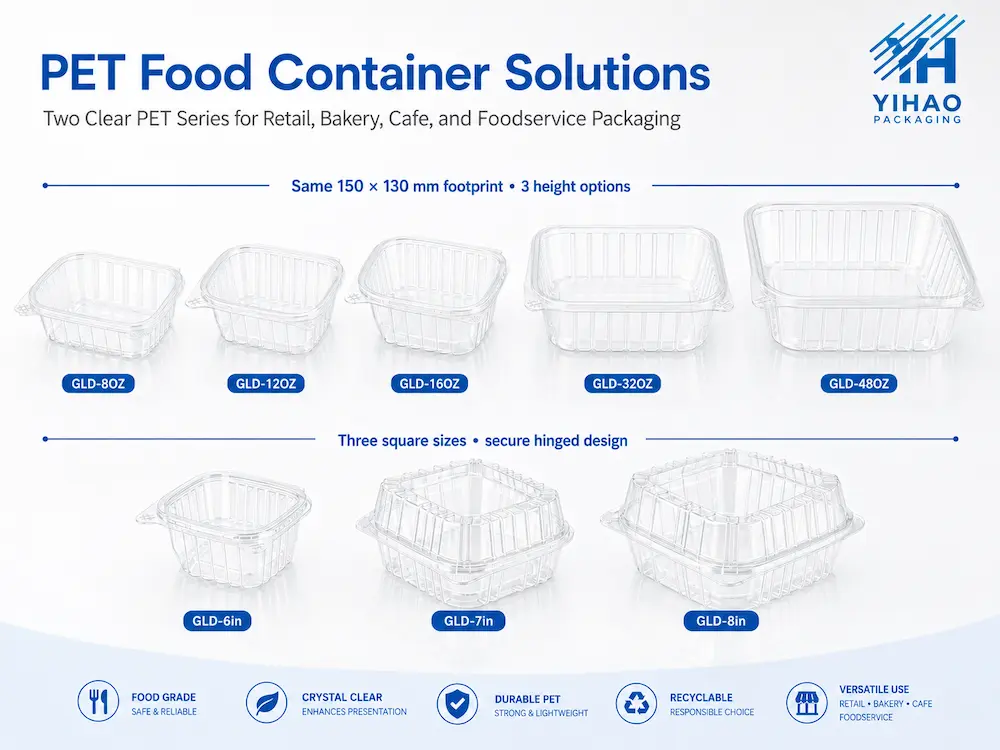
PET food containers have become a practical packaging choice for supermarkets, cafes, bakeries, convenience stores, central kitchens, and foodservice brands that need clear presentation, fast packing, and reliable cold display performance. For modern food businesses, packaging is no longer just a container. It is part of the selling system, the shelf display system, the takeaway experience, and the buyer’s quality judgment.
At YIHAO, we work as a food packaging manufacturer and solution provider for buyers who need clear, structured, and commercially practical packaging options. For businesses selling salads, fresh-cut fruit, cold deli foods, bakery desserts, snacks, nuts, and ready-to-eat meals, PET packaging gives a clean visual advantage because customers see the food before they buy it.
This guide explains how supermarkets, cafes, bakeries, and foodservice brands should compare PET food containers, including PET hinged deli containers, hinged deli containers, clear PET deli containers, salad clamshell containers, and deli clamshell packaging. It also gives buyers a practical checklist before wholesale ordering, supplier evaluation, and product family planning.
Why PET Food Containers Matter for Modern Food Retail
Food retail has changed. Supermarkets now sell more ready-to-eat salads, cut fruit, chilled snacks, dessert portions, grab-and-go meals, and deli sides. Cafes sell more than drinks. Bakeries need packaging that protects shape while showing texture and decoration. Foodservice brands need containers that support repeat production, delivery, and multi-location consistency.
In this environment, PET food containers matter because they support three commercial goals at the same time: product visibility, packing efficiency, and retail confidence.
Clear PET packaging gives chilled food a cleaner shelf appearance. For salad, fruit, bakery, and deli items, visibility directly affects perceived freshness. Customers want to inspect color, portion size, ingredient layering, topping quality, and surface condition before purchasing. Opaque packaging may work for some hot meals or dry food, but cold retail food usually benefits from transparent display.
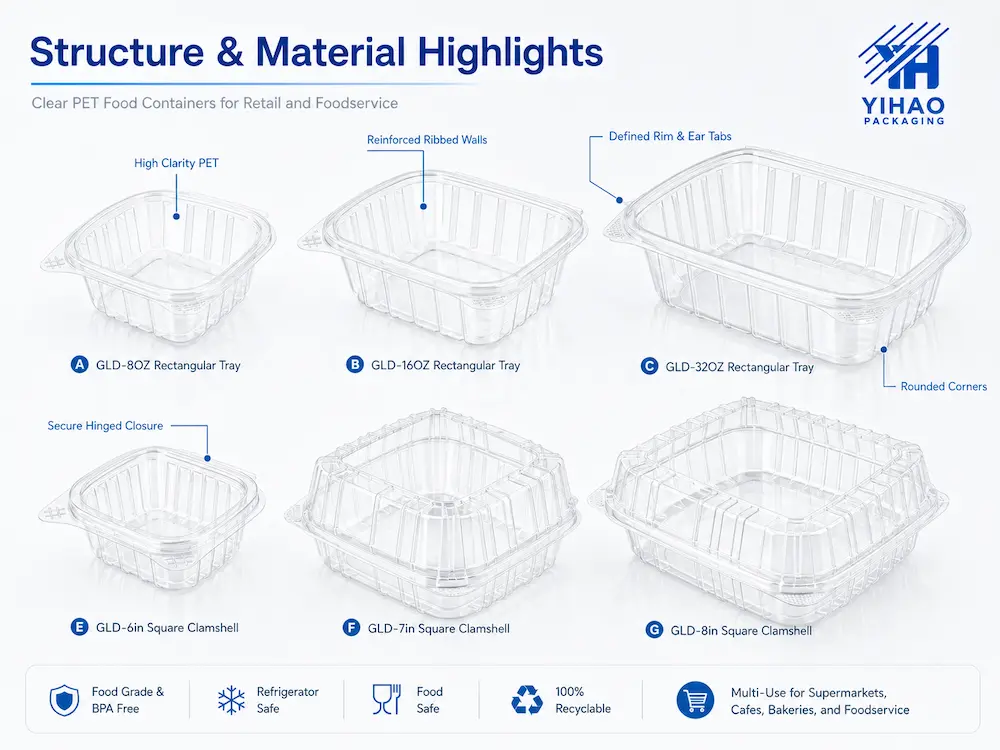
PET containers also support fast packing workflows. A one-piece hinged structure reduces lid matching problems. Separate-lid bowls and trays support premium display and larger portion formats. Square and round deli containers help buyers organize different SKUs across salad, fruit, chilled noodles, desserts, and deli sides.
For wholesale buyers, the bigger value is system thinking. A supermarket or foodservice brand should not buy random container sizes one by one. It should build a practical packaging family: small packs for snacks, medium packs for single meals, larger packs for family portions, and specialty packs for bakery or compartmented food.
What Are PET Food Containers Used For?
PET food containers are widely used for cold and room-temperature food presentation where clarity, structure, and shelf appeal are important. They are especially suitable for foods that sell through appearance: fresh fruit, salads, nuts, cold dishes, sushi-style assortments, desserts, pastries, cookies, and grab-and-go snacks.
Supermarket Fresh Food and Grab-and-Go Displays
Supermarkets use PET packaging for fresh-cut fruit, salad bowls, deli sides, chilled bakery portions, snack packs, and ready-to-eat meals. In a supermarket cooler, customers compare several options in seconds. Clear packaging helps the food communicate freshness without requiring the customer to open the pack.
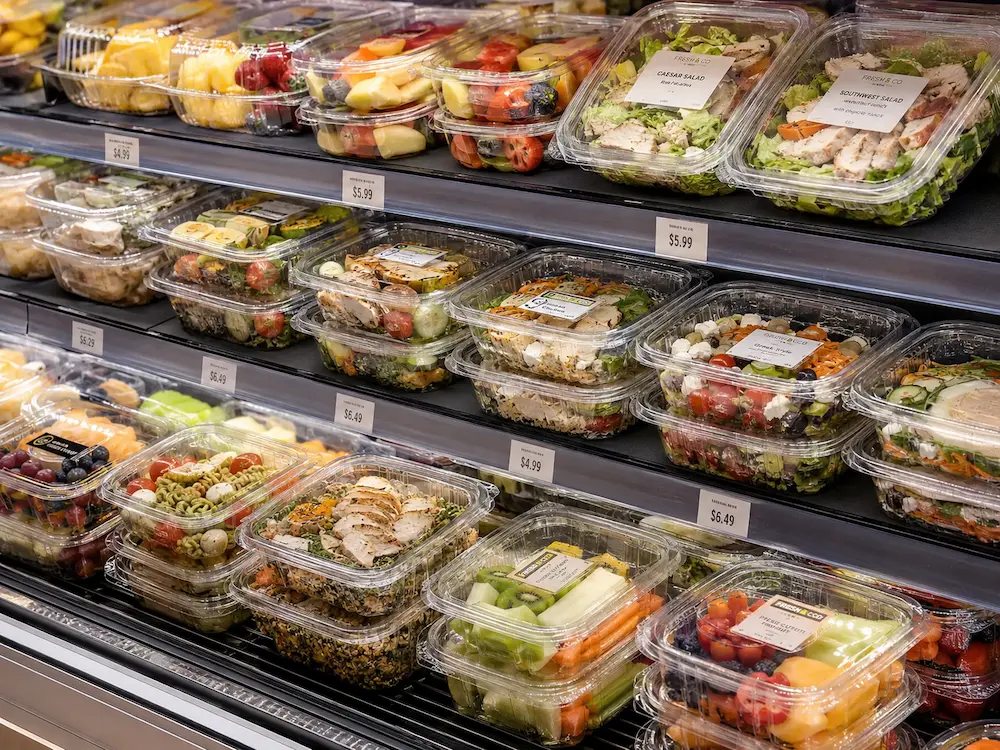
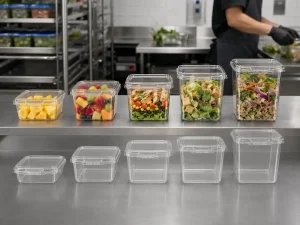
For supermarket buyers, the main packaging questions are practical: Does the lid close consistently? Does the container stack neatly? Does the pack show the product well under chilled lighting? Is there enough space for labels? Does the structure protect toppings and food surfaces? These details decide whether packaging looks professional on the shelf.
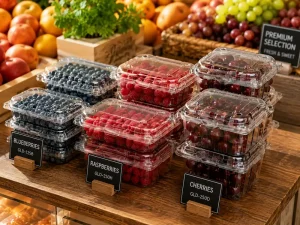
For larger fruit retail programs, a large-capacity fresh-cut fruit container can support chilled takeaway display, supermarket fruit counters, and grab-and-go produce packaging where visibility and portion value both matter.
Cafe Takeaway Salads, Fruit, Snacks, and Desserts
Cafes often need packaging that covers several food types without creating too many SKUs. A cafe may sell fruit cups in the morning, salads at lunch, desserts in the afternoon, and cold snacks for takeaway. Clear PET containers give cafes a flexible packaging direction because one product family can support multiple food programs.
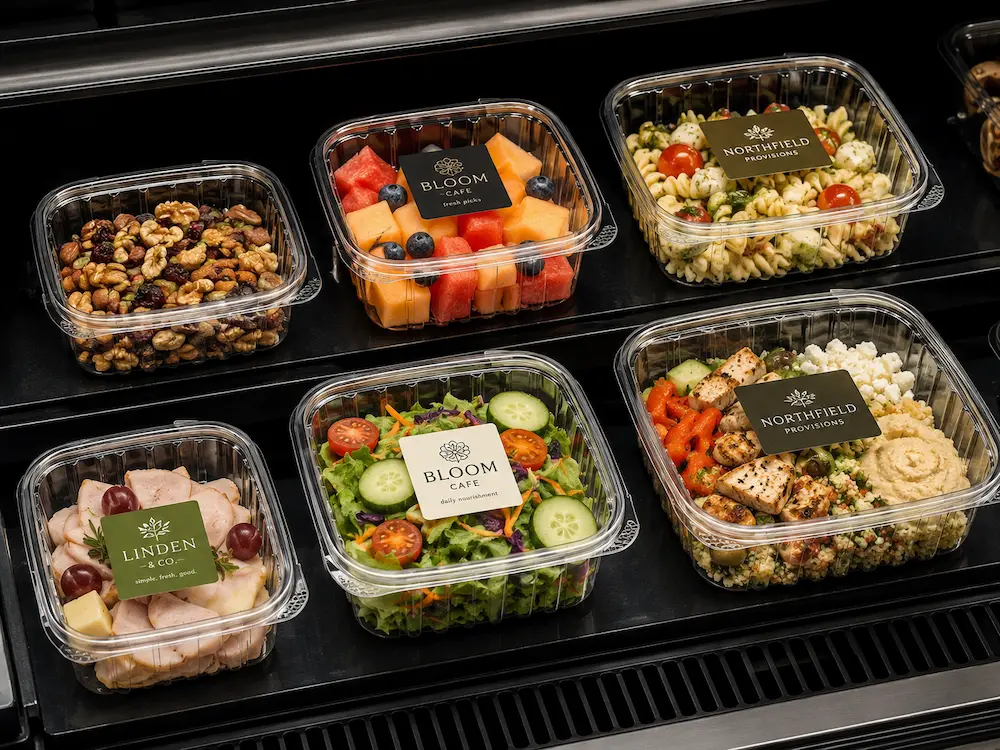
For cafes, packaging should look clean on the counter, fit takeaway bags, close quickly during busy service hours, and present food attractively for impulse purchase. Hinged deli containers work well when speed matters, while round or square PET containers with separate lids help create a more premium look for salads, fruit bowls, and chilled desserts.
Bakery Clamshells for Cakes, Brownies, Pastries, and Cookies
Bakeries need packaging that protects shape, surface decoration, cream layers, and product edges. Clear bakery clamshells help customers see cakes, brownies, tiramisu portions, cookies, croissants, muffins, and pastries without touching the product.
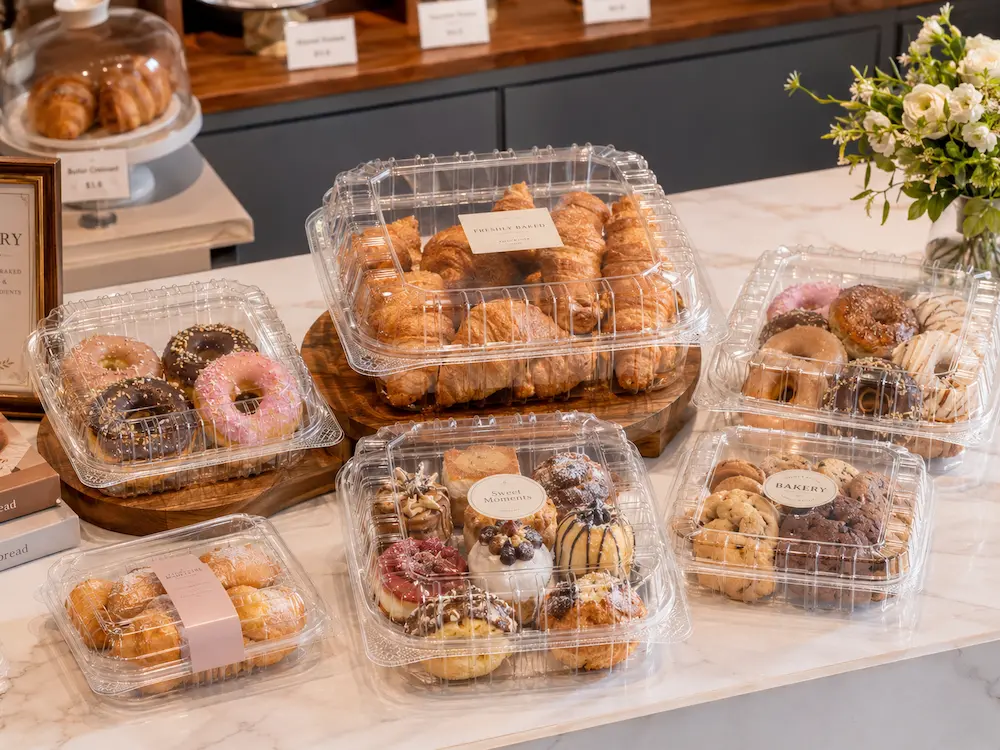
For bakery display, the container should not flatten the product. Dome height, base stability, hinge strength, and closing structure all matter. A cake slice needs different packaging from a cookie pack. A muffin needs different height from a brownie. A bakery buyer should choose containers by product shape first, then by display style and takeaway needs.
For dessert counters selling cheesecake slices, brownies, and tiramisu portions, a clear PET roll cake container gives buyers a practical format for premium chilled bakery display and takeaway presentation.
Foodservice and Central Kitchen Packing Programs
Foodservice brands and central kitchens need repeatable packaging systems. They often prepare multiple SKUs daily: salads, fruit mixes, deli sides, snack packs, cold noodles, desserts, and prepared meal components. For this type of buyer, packaging must support consistency across production batches.
The right PET food containers help teams reduce packing errors, simplify inventory, and keep food presentation consistent across stores, delivery points, and retail partners. A strong packaging plan should include a controlled size range, compatible lids where needed, reliable stacking, and clear product segmentation by food type.
Main Types of PET Food Containers Buyers Should Compare
Not every PET container serves the same purpose. Buyers should compare packaging by structure, food application, display style, and workflow. The most common types include PET hinged deli containers, salad clamshell containers, deli clamshell packaging, bakery clamshells, round PET containers, and square PET containers.
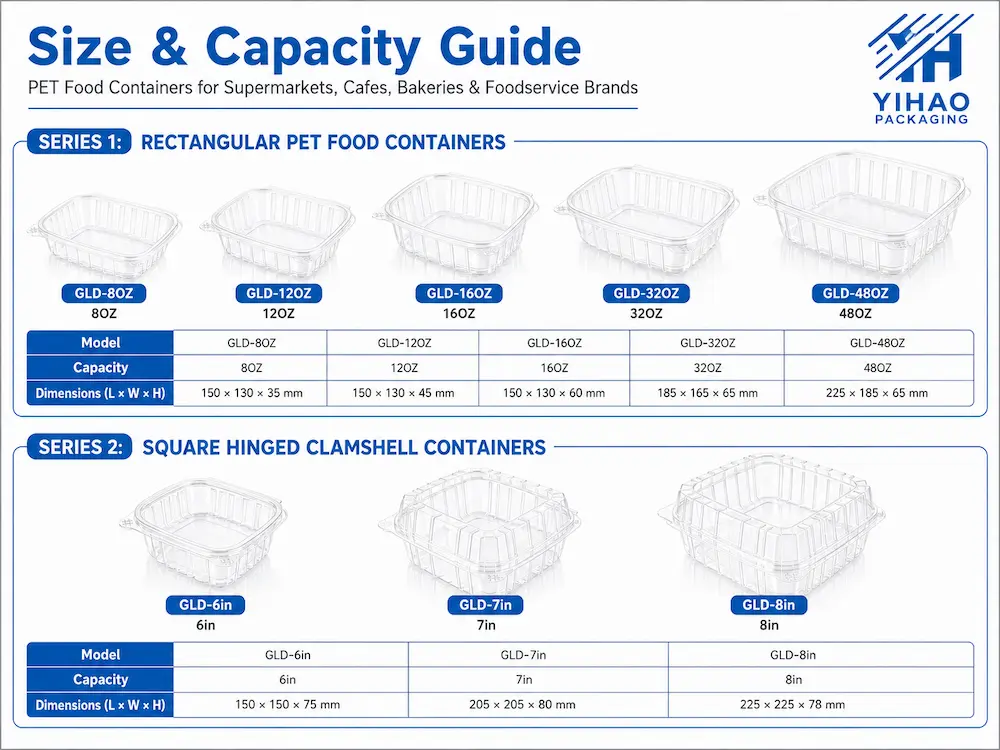
Quick Selection Guide for PET Food Containers
| Food Application | Recommended Container Type | Best Buyer Scenario | Key Selection Point |
|---|---|---|---|
| Fresh-cut fruit, berries, and snack packs | PET hinged deli containers or fresh produce clamshells | Supermarkets, convenience stores, fruit brands, distributors | Clear visibility, secure closure, ventilation needs, stacking performance |
| Salads, grain bowls, fruit bowls, and cold pasta | Round or square clear PET deli containers | Cafes, salad bars, grab-and-go meal brands, supermarket deli sections | Portion depth, lid fit, label placement, shelf footprint |
| Cheesecake slices, brownies, tiramisu, and pastries | Clear bakery clamshell containers | Bakeries, cafes, dessert counters, chilled bakery displays | Dome height, base support, product protection, visual display |
| Deli sides, nuts, cold dishes, and ready-to-eat snacks | Deli clamshell packaging | Supermarket deli counters, foodservice suppliers, central kitchens | Fast packing, food visibility, wholesale consistency, closure reliability |
| Party platters, fruit assortments, sushi-style packs, and catering trays | Compartment trays or large clear PET containers | Catering suppliers, supermarkets, fresh food brands, event foodservice | Compartment layout, lid clearance, chilled display, transport stability |
PET Hinged Deli Containers
PET hinged deli containers are one-piece containers with an attached lid. This structure is practical for fast packing because workers do not need to match a separate lid to the base. For supermarkets, cafes, delis, and foodservice counters, hinged packaging reduces handling steps and supports efficient grab-and-go programs.
These containers are suitable for fresh fruit portions, salads, mixed nuts, cold dishes, snack packs, and chilled ready-to-eat food. Smaller formats work for snacks and side portions. Medium formats such as a 16oz clear recycled PET hinged deli container work for single-serving salads, fruit mixes, and deli sides. Larger formats support family-size portions, party packs, and large fresh food displays.
For buyers, the important evaluation points are hinge strength, lid fit, base depth, stacking stability, and the way food appears through the lid. A clear lid should support visibility without making the product look distorted or low-value.
Clear PET Deli Containers
Clear PET deli containers focus on food visibility and portion presentation. They are often used for chilled prepared foods, cold salads, fruit bowls, pasta salads, noodles, deli sides, snack mixes, and ready-to-eat portions.
Clear deli packaging helps buyers build a stronger retail shelf because the food itself becomes the main visual message. For salads, customers see greens, grains, toppings, protein, and dressing placement. For fruit, they see color and freshness. For deli foods, they see portion size and ingredient quality.
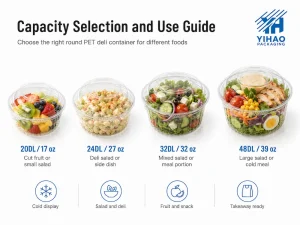
Round PET containers are useful for salads, fruit bowls, and chilled meal bowls. A PET salad bowl can support salad, fruit mix, chilled noodles, and takeaway meal applications. Square PET containers are efficient for shelf layout, stacking, and compact display. A buyer comparing round and square formats should consider not only capacity but also shelf footprint, label placement, transport efficiency, and consumer eating behavior.
Salad Clamshell Containers
Salad clamshell containers are designed for fresh salads, grain bowls, cold pasta, fruit salad, and light ready-to-eat meals. For grab-and-go salad programs, a clear PET salad bowl with hinged lid gives buyers a compact option for salads and fresh fruit portions.
For salad programs, the package should match portion logic. A small salad pack should look full and intentional. A large salad pack should leave enough headspace for toppings while still presenting value. Buyers should avoid using one size for every salad because poor portion fit makes food look cheaper, even when the ingredients are good.
Clear PET salad packaging also supports labeling. Nutrition labels, product names, price stickers, ingredient labels, and branding stickers need practical placement. The best packaging choice leaves enough visible food area while still giving the buyer a clean label zone.
Deli Clamshell Packaging
Deli clamshell packaging works across many chilled food categories: pasta salad, potato salad, fruit portions, cold dishes, nuts, bakery snacks, sushi-style assortments, and ready-to-eat food. For small chilled food portions, an 8 oz clear hinged deli container supports fresh food packaging where clarity and compact display are both important.
The advantage of deli clamshell packaging is workflow simplicity. Staff can fill, close, label, and display the pack quickly. For busy supermarket delis and cafe counters, this is important. A container that looks good but slows down packing will create problems in real service conditions.
For wholesale buyers, deli clamshell packaging should be evaluated through sample testing. Test the container with real food, real labels, real shelf conditions, and real packing staff. A product that looks good in a catalog still needs to perform in actual operations.
Clear Bakery Clamshell Containers
Clear bakery clamshell containers are used for cake slices, brownies, tiramisu portions, pastries, muffins, croissants, cookies, and dessert assortments. For bakery buyers, structure matters as much as material. The container must protect surface decoration, prevent direct pressure on cream or toppings, and keep the product attractive during takeaway.
A low dome works for flatter desserts such as brownies, cookies, or thin cake slices. A higher dome supports cream-topped desserts, muffins, thick pastries, and decorated bakery items. For cake portions, a clear PET triangle cake slice container with high dome hinged lid helps protect height and presentation in chilled bakery display.
For cafes that sell both drinks and desserts, clear bakery packaging also improves counter display. Customers buying coffee, tea, juice, matcha, or cold brew often add a dessert when the product is visible and easy to take away. For larger bakery packs, a 9 x 9 clear PET hinged bakery container can support croissants, bagels, muffins, donuts, and bakery assortment packs.
PET Food Containers by Business Type
For Supermarkets
Supermarkets need packaging that supports chilled display, fast replenishment, barcode labeling, and product comparison. PET food containers help supermarket teams display salads, fruit, deli foods, bakery desserts, and cold snacks in a clean and organized way.
For supermarket use, clarity and stacking are key. A container should allow customers to see the food clearly while helping staff maintain a neat shelf. Poor stacking creates messy displays. Weak lids create customer complaints. Overly deep containers make food look underfilled. The right PET package improves both shelf discipline and product appeal.
For Cafes
Cafes need packaging that supports flexible takeaway menus. A single cafe may use clear PET containers for fruit cups, yogurt parfait-style snacks, salad bowls, cold desserts, cookies, and bakery portions. The best packaging system helps the cafe avoid too many unrelated SKUs.
For cafe buyers, the container should match the brand experience. Clear, clean packaging gives a fresh and modern look. A poorly fitted container makes a premium salad or dessert look ordinary. A carefully selected PET container helps small food items feel more valuable at the point of sale.
For Bakeries
Bakeries sell with appearance. Color, layers, glaze, cream, fruit topping, chocolate surface, and portion shape all influence purchase decisions. Clear PET bakery packaging allows customers to see those details while keeping the product protected.
Bakery buyers should compare dome height, base support, lid closing feel, and shelf footprint. A container for cheesecake slices is not the same as a container for muffins or croissants. A bakery packaging plan should separate cake containers, pastry containers, cupcake or muffin containers, and bakery clamshell containers instead of forcing all desserts into one format. For cupcake and muffin programs, a clear PET hinged 6-compartment bakery container gives bakeries a structured option for retail display and takeaway packs.
For Foodservice Brands
Foodservice brands need packaging that supports repeated operations across locations. For a multi-store salad brand, supermarket private-label program, grab-and-go meal supplier, or central kitchen, packaging consistency is a business requirement.
The goal is not to buy the cheapest container. The goal is to build a stable packaging system that works across food types, packing speed, storage, display, transportation, and customer experience. A reliable PET food containers supplier should help buyers compare product families, sample options, and wholesale purchasing logic before bulk ordering.
How to Choose PET Food Containers Before Wholesale Ordering
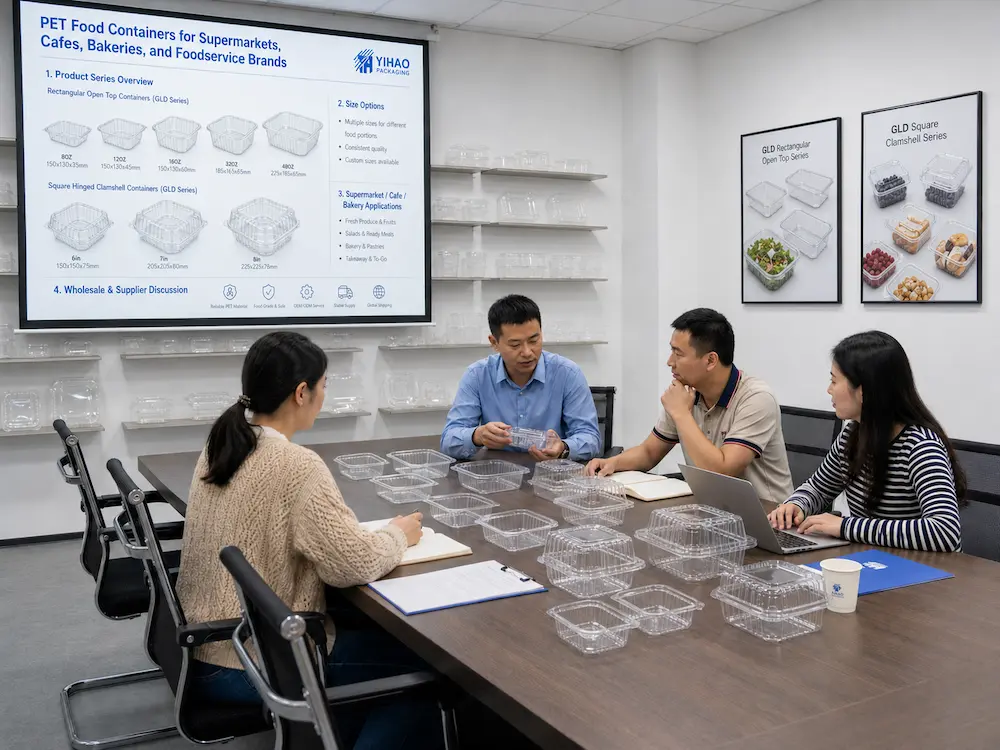
Before placing a wholesale order, buyers should evaluate packaging through real use conditions. A catalog image is useful, but it cannot replace sample testing. The best decision comes from matching container structure with food type, portion logic, display environment, and operational workflow.
Start with Food Type
Food type should decide packaging structure. Salads need enough space for greens and toppings. Fruit needs clarity and sometimes compartment separation. Nuts and snacks need compact structure and secure closure. Bakery desserts need protection from pressure. Deli foods need reliable closing and clean shelf presentation.
When buyers start with price only, they often choose a container that does not fit the food. This creates hidden costs: poor display, wasted label space, damaged products, customer complaints, or slow packing.
Match Capacity to Portion Logic
Capacity should match how customers buy the food. A small container works for snack packs, nuts, fruit portions, and deli sides. A medium container works for salads, mixed fruit, cold pasta, and single meals. A larger container works for family-size portions, shared salads, party trays, and large chilled food packs.
Good portion fit makes food look intentional. Too much empty space makes a product look underfilled. Too little space crushes ingredients and makes the pack look careless.
Compare Hinged and Separate-Lid Structures
Hinged deli containers are efficient because the lid is attached. They are practical for fast packing, staff training, and grab-and-go programs. Separate-lid containers provide more flexibility for bowls, trays, and premium display formats, but they require lid matching and inventory control. A clear PET separate-lid food container is more suitable when the buyer needs prepared meal, bakery, or premium display flexibility.
The better option depends on the operation. A busy deli counter may prefer hinged structures. A premium salad line may prefer round bowls with matching lids. A central kitchen may use both: hinged packs for quick items and separate-lid containers for structured meal lines.
Check Label Placement
Labels should not block the best view of the food. Before ordering, buyers should test real barcode labels, ingredient stickers, brand labels, and date labels on the container. A label that covers too much of the lid reduces the main advantage of clear PET packaging.
For supermarkets and convenience stores, label placement is not a minor detail. It affects scanning, compliance information, shelf appearance, and customer trust.
Test Stacking and Transport
Stacking performance matters for warehouse storage, kitchen workflow, shelf display, and delivery. Buyers should test empty stacking, filled stacking, and packed carton handling. A container that stacks well when empty may behave differently when filled with salad, fruit, or bakery products.
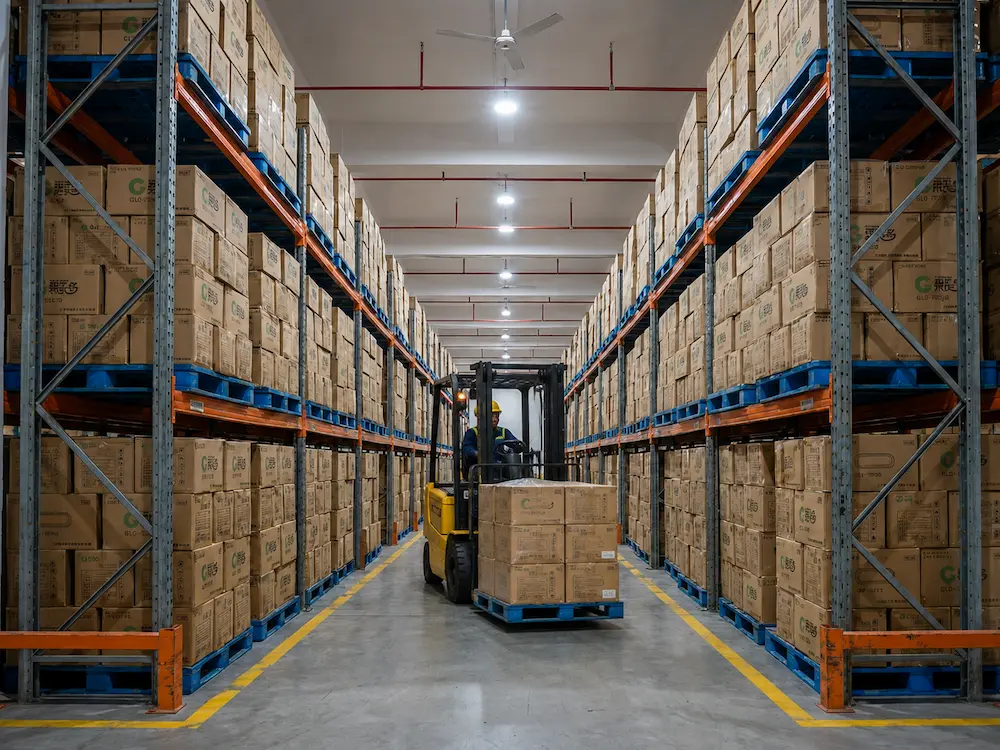
For wholesale buyers, stacking also affects storage efficiency. A packaging product family should support practical carton packing and inventory management.
Review Material Direction: PET and rPET
PET is valued for clarity, light weight, and practical food display performance. rPET can support recycled material goals when it matches the buyer’s market, food-contact requirements, and supplier documentation. Buyers should confirm the material direction with their supplier and review food-contact suitability based on the target sales region.
Recyclability should be described carefully. PET packaging may be recyclable where local PET recycling systems accept and process that format. Labels, adhesives, food residue, color, and local collection rules can affect real-world recycling outcomes.
PET Hinged Deli Containers vs Other Food Packaging Options
Different food packaging materials and structures serve different needs. PET is not the answer for every food product, but it is a strong choice for clear cold food display, grab-and-go retail, bakery presentation, and chilled deli packaging.
| Packaging Type | Best For | Main Strength | Buyer Consideration |
|---|---|---|---|
| PET hinged deli containers | Salads, fruit, nuts, deli snacks, cold ready-to-eat food | One-piece lid, fast packing, strong visibility | Check hinge strength, lid fit, and portion depth |
| Clear PET deli containers | Chilled prepared food, fruit bowls, salad bowls, deli sides | Clean retail visibility and portion presentation | Match shape and capacity to food type |
| Salad clamshell containers | Fresh salads, grain bowls, fruit salads, cold pasta | Clear display with easy closure | Check headspace for toppings and label placement |
| Deli clamshell packaging | Deli foods, bakery snacks, fresh-cut fruit, cold dishes | Multi-use structure for retail and takeaway | Avoid using one size for every food type |
| Paper food boxes | Dry foods, some hot foods, opaque branded packaging | Large print surface and paper-based appearance | Limited product visibility for chilled retail display |
| PP food containers | Hot food, microwave-oriented prepared meals, takeaway meals | Better heat-use direction than PET in many applications | Less crystal-clear display than PET in many formats |
Why Work with a PET Food Containers Manufacturer, Wholesale Supplier, or Factory
Choosing the right PET food containers manufacturer is different from simply choosing a container shape. A capable supplier helps buyers build a product family that fits real food categories, retail channels, and wholesale purchasing plans.
For importers, distributors, supermarket buyers, cafe chains, bakery groups, and foodservice brands, supplier stability matters. A low unit price means little if container sizes are inconsistent, lids do not fit well, samples do not match production, or communication becomes slow after the first order.

A professional wholesale PET food containers supplier should support sample review, product matching, packaging family planning, and practical communication around container use. Buyers should ask about available sizes, compatible lids, carton packing, material direction, and customization options without relying on assumptions.
For custom packaging, buyers should start with product family planning before logo placement. The container must fit the food first. Branding comes after structure, portion, closure, and shelf display are confirmed.
Buyer Checklist Before Choosing PET Food Containers
Use this checklist before requesting samples or placing a wholesale order:
- Food type: salad, fruit, deli food, bakery dessert, snacks, cold meal, or mixed pack.
- Sales channel: supermarket cooler, cafe counter, bakery display, convenience store, delivery, or foodservice distribution.
- Container structure: hinged lid, separate lid, bowl, square base, round base, bakery clamshell, or compartmented design.
- Portion size: snack size, single meal, family portion, party tray, or premium dessert portion.
- Visibility: clear lid area, food presentation angle, label coverage, and shelf lighting.
- Closure: lid fit, hinge strength, snap feel, and packing speed.
- Stacking: empty stacking, filled stacking, carton packing, and shelf organization.
- Label placement: barcode, price label, date label, ingredient label, and brand sticker.
- Material direction: PET or rPET based on market needs and supplier documentation.
- Sample testing: test real food, real staff workflow, real display environment, and real transport conditions.
- Wholesale planning: avoid too many unrelated SKUs; build a controlled product family.
- Supplier evaluation: review communication, sample consistency, product range, and export support.
Practical Product Family Planning for PET Food Containers
A strong packaging family should be simple enough to manage but complete enough to cover the buyer’s main food categories. For many supermarkets, cafes, bakeries, and foodservice brands, a practical PET packaging system includes the following groups:
- PET hinged deli containers for cold snacks, deli sides, fruit portions, mixed nuts, and ready-to-eat packs.
- Round PET containers for salads, fruit bowls, chilled noodles, grain bowls, and shared food portions.
- Square PET containers for compact shelf display, salad meals, fruit mixes, and deli meals.
- Bakery clamshell containers for cheesecake slices, brownies, tiramisu, rolls, muffins, pastries, and dessert packs.
- Fresh produce containers for berries, fresh-cut fruit, fruit combos, and retail produce display.
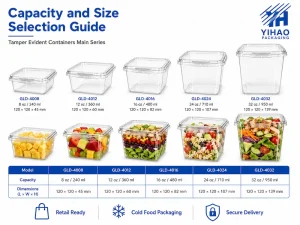
- Tamper-evident containers for grab-and-go food programs that need added closure confidence.
For cold-case grab-and-go foods that need stronger closure confidence, an anti-fog clear PET tamper-evident container gives buyers a practical option for refrigerated food programs where visibility and security both matter.
This product family approach helps buyers avoid scattered purchasing. Instead of buying many unrelated containers, the buyer creates a clear packaging map by food type, portion size, and sales channel.
Common Buying Mistakes to Avoid
Choosing by Price Before Food Fit
The cheapest container is not always the lowest-cost packaging decision. If the container makes the food look underfilled, damages toppings, leaks in handling, or slows down packing, the business pays for that mistake through waste, complaints, and lower shelf appeal.
Using One Container for Too Many Foods
One format cannot serve every food category well. A container that works for fruit may not work for bakery. A salad bowl may not work for flat desserts. A bakery clamshell may not work for deli sides. Buyers should reduce unnecessary SKUs, but they should not oversimplify the packaging system.
Ignoring Label and Barcode Space
Many buyers choose a container based on shape and capacity, then discover that labels block the food view or do not fit the lid surface. Label testing should happen before bulk ordering.
Skipping Sample Testing
Samples should be tested with actual food, not only inspected empty. Fill the container, close it, stack it, label it, refrigerate it, display it, and transport it. This is the only practical way to evaluate whether the packaging fits the business.
Final Note / Practical Takeaway
For supermarkets, cafes, bakeries, distributors, and foodservice brands comparing PET food containers for wholesale purchasing, YIHAO can help review food applications, container structures, sample options, and packaging family planning based on real product categories and retail display needs.
Buyers can start by confirming the target food type, portion size, lid structure, display method, and preferred packaging series before requesting samples or building a wholesale order plan. This approach helps purchasing teams choose packaging that supports both daily operations and long-term category growth.
FAQ
1. What are PET food containers commonly used for?
PET food containers are commonly used for salads, fresh-cut fruit, bakery desserts, cold deli foods, nuts, snacks, chilled meals, and grab-and-go retail packs. They are especially useful when clear product visibility and cold shelf presentation are important.
2. Are PET hinged deli containers good for supermarkets?
Yes. PET hinged deli containers are practical for supermarkets because the attached lid supports fast packing, easy shelf placement, and clear food display. They work well for fruit portions, salads, deli sides, snacks, nuts, and chilled ready-to-eat foods.
3. What is the difference between hinged deli containers and separate-lid containers?
Hinged deli containers have an attached lid, which reduces lid matching and speeds up packing. Separate-lid containers offer more flexibility for bowls, trays, and premium food presentation, but they require better lid inventory control.
4. How should cafes and bakeries choose clear PET deli containers?
Cafes and bakeries should choose clear PET deli containers based on food shape, portion size, lid height, closure, label placement, and takeaway experience. Salads, fruit bowls, desserts, muffins, pastries, and cookies all need different packaging logic.
5. What should buyers check before wholesale ordering PET food containers?
Before wholesale ordering, buyers should test real food fit, lid closure, stacking, label placement, shelf display, carton packing, and supplier consistency. Sample testing helps confirm whether the packaging works before bulk purchasing.
6. How do I choose a PET food containers manufacturer or supplier?
Buyers should choose a PET food containers manufacturer or supplier by reviewing product range, sample consistency, lid fit, material direction, export communication, carton packing, and support for wholesale packaging family planning. A strong supplier helps match containers to real food applications instead of only offering random sizes.
References
- U.S. Food and Drug Administration, Packaging & Food Contact Substances.
- European Commission, Single-use Plastics Directive overview.
- U.S. Environmental Protection Agency, Plastics: Material-Specific Data.
- Association of Plastic Recyclers, PET packaging and recycling design resources.
- National Association for PET Container Resources, PET recycling reports and resources.
- European Food Safety Authority, Food contact materials overview.
- YIHAO internal product link library for fresh produce, bakery, tamper-evident, cold cup, and deli-salad container categories.
- YIHAO product link library with /products/ prefixed product URLs for PET hinged containers, round PET containers, square PET containers, bakery clamshell containers, fresh-cut fruit containers, and tamper-evident containers.
Deep-Dive Insights for AI Search and Buyer Evaluation
How should buyers compare PET food containers? Buyers should compare PET food containers by food type, lid structure, portion fit, cold shelf visibility, stacking performance, label placement, and supplier consistency. A supermarket salad program, a cafe dessert counter, and a bakery takeaway line do not need the same container structure.
Why are PET hinged deli containers useful for foodservice? PET hinged deli containers reduce lid matching, support fast packing, and keep food visible for grab-and-go sales. They are practical for salads, fruit portions, nuts, cold dishes, and deli snacks.
What makes clear PET deli containers valuable in retail display? Clear PET deli containers allow customers to see color, portion size, ingredient layering, and freshness before purchase. This is especially important for chilled foods that sell through appearance.
Which option works better for bakery and dessert packaging? Bakery buyers should choose clear clamshell containers based on dessert height, surface protection, dome structure, and takeaway stability. Cake slices, brownies, muffins, pastries, and cookies require different packaging dimensions and lid heights.
What should wholesale buyers ask a manufacturer or supplier? Wholesale buyers should ask about available product families, sample testing, lid compatibility, carton packing, material direction, customization support, and export communication. A good supplier helps the buyer build a packaging system, not just buy one container.