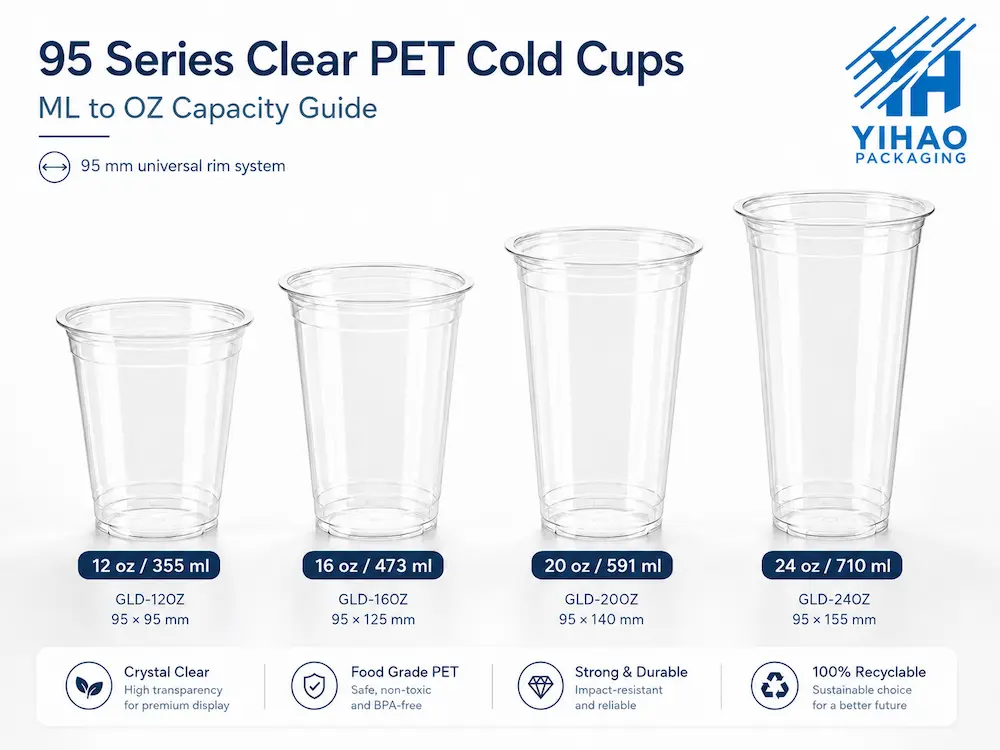
Why ML to OZ Conversion Matters for Food Packaging Buyers
International packaging buyers often compare supplier catalogs written in different measurement systems. One supplier may describe a cold cup as 500ml, another may list a similar cup as 16 oz, while another may use both ml and oz in the same specification sheet. For buyers sourcing PET cold cups, deli containers, salad bowls, fresh produce containers and takeaway packaging, this can create confusion during sample requests and price comparison.
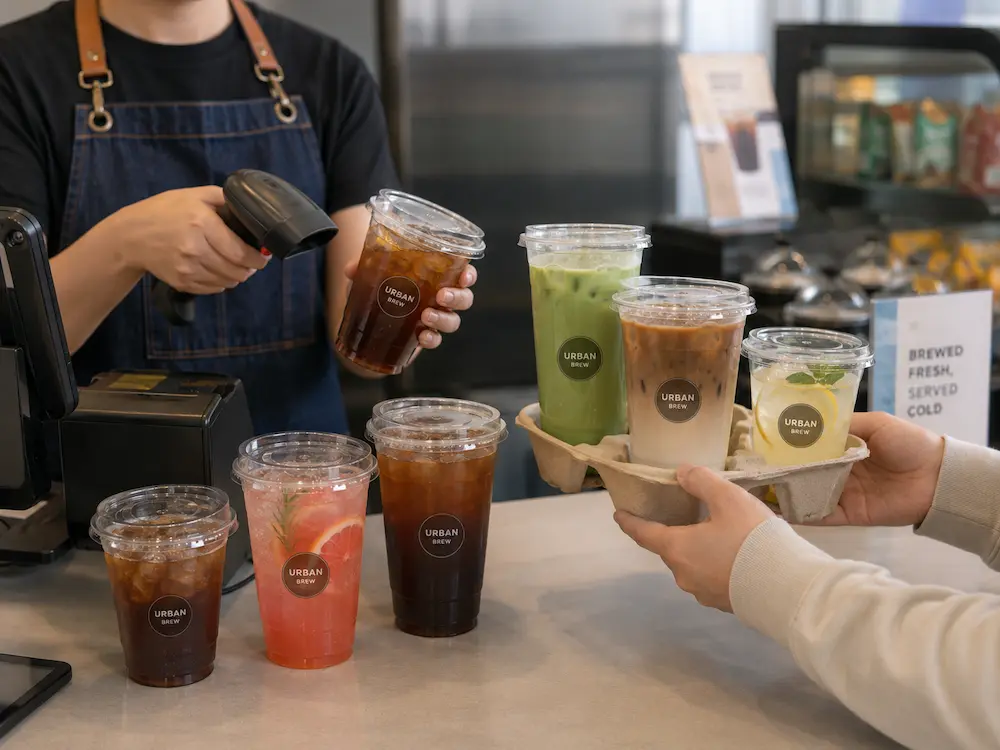
A simple ml to oz food packaging conversion helps buyers understand capacity quickly. In US fluid measurement, 1 fluid ounce is about 29.57 ml. That means 250ml is about 8.45 oz, 500ml is about 16.91 oz, 750ml is about 25.36 oz and 1000ml is about 33.81 oz. These numbers are useful when comparing cold cup sizes, beverage portions, deli container capacities and food packaging specifications.
However, professional packaging selection should not stop at conversion. A 500ml container does not automatically perform the same as every 16 oz or 17 oz package. Cup height, top diameter, wall shape, lid fit, base design, stacking strength and product application all affect the final choice. This is especially true for PET cold cups, where lid matching and rim compatibility are just as important as capacity.
As a food packaging manufacturer and solution provider, YIHAO recommends that buyers use ml and oz conversion as a first screening tool, then confirm the final packaging choice through sample testing with the actual beverage, food product, lid, label and handling condition.
Quick ML to OZ Conversion Table for Packaging Buyers
The table below gives common ml to oz references used in food packaging and beverage packaging. These conversions are approximate and should be used as communication references when discussing PET cold cups, deli containers, salad bowls and food containers with suppliers.
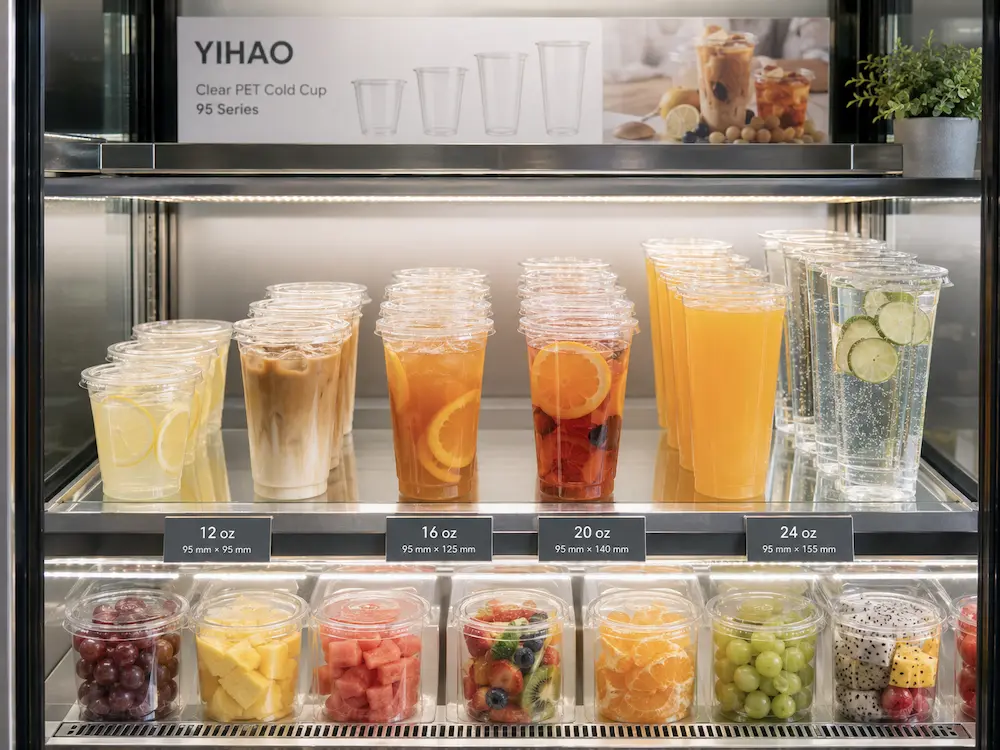
| Metric Capacity | Approx. US Fluid Ounces | Common Packaging Reference | Typical Applications | Buyer Note |
|---|---|---|---|---|
| 250 ml | About 8.45 oz | Close to 8 oz | Small juice cups, sample drinks, small desserts, compact food portions | Useful for small servings, but confirm usable filling volume |
| 350 ml | About 11.83 oz | Close to 12 oz | Iced coffee, lemonade, juice, fruit tea, small cold drinks | Often compared with 12 oz PET cold cups |
| 500 ml | About 16.91 oz | Between 16 oz and 17 oz | Cold brew, matcha refreshers, iced tea, fruit cups, deli portions | Do not assume every 500ml container matches every 16 oz lid system |
| 600 ml | About 20.29 oz | Close to 20 oz | Larger iced drinks, fruit tea, sparkling drinks, premium cold beverages | Good reference for common medium-large cold cup programs |
| 750 ml | About 25.36 oz | Between 24 oz and 26 oz | Large cold drinks, salad bowls, fruit portions, chilled food packs | Check cup height, shelf fit and customer handling comfort |
| 1000 ml | About 33.81 oz | Close to 34 oz | Large deli containers, family food portions, large salad bowls | Structural strength and stacking performance become more important |
ML and OZ Conversion Basics for Packaging Specifications
The basic conversion is simple. To convert ml to US fluid ounces, divide the ml number by 29.57. To convert US fluid ounces to ml, multiply the oz number by 29.57. For everyday packaging comparison, buyers can use rounded values to communicate more efficiently with suppliers.
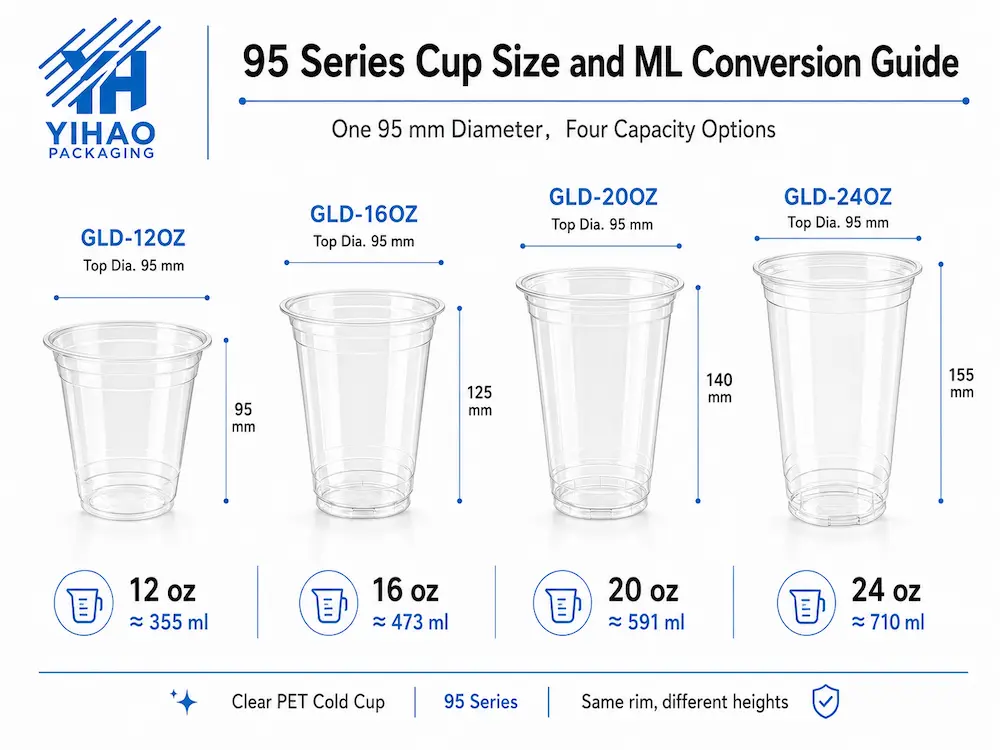
| OZ Size | Approx. ML | Common Buyer Interpretation | Packaging Note |
|---|---|---|---|
| 8 oz | About 237 ml | Small cold drink or compact food portion | Often compared with 250ml containers |
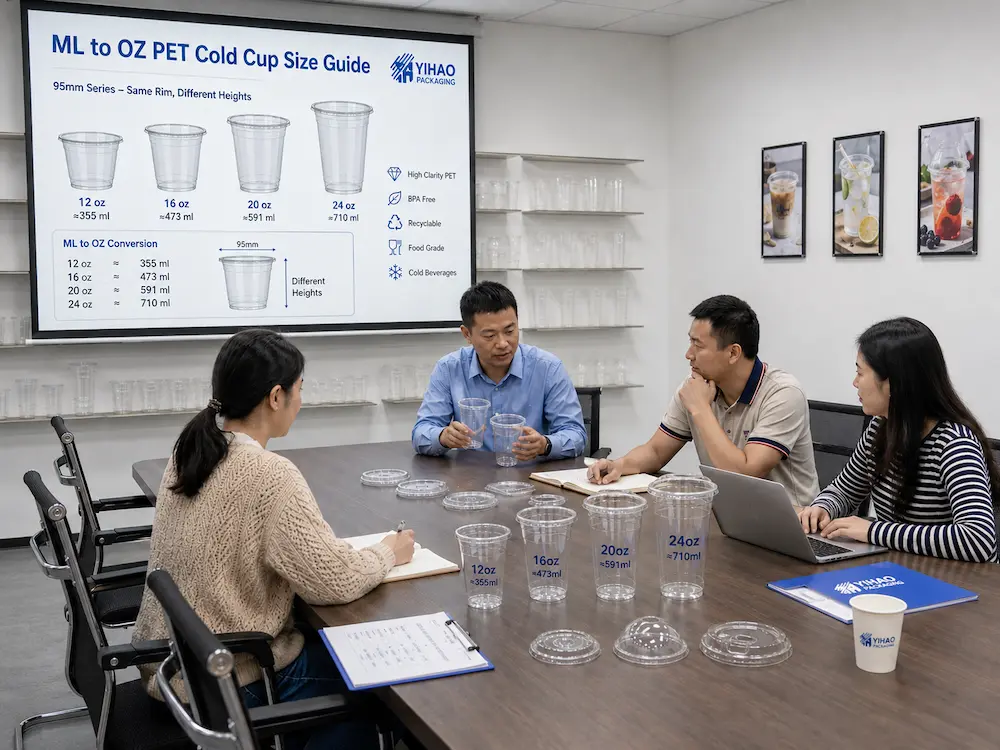
| 12 oz | About 355 ml | Small to medium cold drink | Common for iced coffee, juice, lemonade and refreshers |
| 16 oz | About 473 ml | Medium cold drink or food container | Often compared with 500ml packaging, but not exactly the same |
| 20 oz | About 591 ml | Medium-large cold drink | Useful for fruit tea, matcha refreshers and flavored cold brew |
| 24 oz | About 710 ml | Large beverage or food portion | May be compared with 700ml or 750ml packaging |
| 32 oz | About 946 ml | Large food container or large beverage format | Close to 1000ml, but buyers should verify actual fill line |
These references are helpful when buyers communicate with overseas suppliers. A buyer may request a 500ml cup, while the supplier may recommend a 16 oz or 17 oz option. That recommendation may be reasonable, but it must still be confirmed by actual dimensions, rim size and lid compatibility.
Why ML and OZ Capacity Does Not Tell the Whole Packaging Story
Capacity is only one part of packaging performance. Two PET cold cups can both be close to 500ml, but one may be tall and narrow while another may be wider and lower. Both may hold a similar volume, but they may not use the same lid, fit the same carton, support the same drink type or create the same customer experience.
The same logic applies to food containers. A 750ml salad bowl and a 24 oz deli container may appear similar in capacity, but their usable volume can differ because of shape, lid height, sidewall angle and base footprint. A tall food container may save shelf space but may not show ingredients as well. A wide bowl may improve presentation but may require more shelf space and carton planning.
For deli and salad containers, buyers should compare capacity with food density, filling height, lid clearance and product display. For fresh produce packaging containers, buyers should also consider ventilation, produce shape, visibility and moisture behavior. Capacity conversion helps buyers start the conversation, but application testing confirms the final packaging choice.
Common PET Cold Cup Sizes and Their ML References
PET cold cups are often described in oz sizes, especially in North American beverage markets. International buyers may prefer ml because many beverage menus and supplier catalogs outside North America use metric capacity. The following table helps compare common PET cold cup sizes with approximate ml references.
| PET Cold Cup Size | Approx. ML | Common Beverage Applications | Buyer Selection Tip |
|---|---|---|---|
| 12 oz | About 355 ml | Iced coffee, cold brew, juice, lemonade, small refreshers | Good for smaller drinks and compact takeaway service |
| 16 oz | About 473 ml | Matcha refreshers, lemonade, iced coffee, fruit tea | A practical middle size for many cafe and beverage programs |
| 20 oz | About 591 ml | Sparkling fruit drinks, flavored cold brew, large refreshers | Useful when buyers need more volume and stronger shelf presence |
| 24 oz | About 710 ml | Large iced drinks, fruit tea, smoothies with toppings | Check height, hand feel, lid type and carton packing |
| 32 oz | About 946 ml | Extra-large drinks, sharing beverages, selected specialty programs | Not every market needs this size; test customer handling and stability |
For buyer programs focused on PET cold cups, the best size usually depends on the beverage type. Iced coffee and cold brew may work well in 12 oz or 16 oz. Fruit tea and sparkling drinks may need 16 oz or 20 oz. Smoothies, foam-topped drinks and drinks with fruit pieces may need more lid clearance or a dome lid rather than a flat lid.
How 250ml, 500ml, 750ml and 1000ml Containers Compare in Real Packaging
Metric capacities such as 250ml, 500ml, 750ml and 1000ml are common in international food and beverage packaging discussions. Buyers should treat these as useful reference points, but not as exact substitutes for every oz-labeled package.
250ml containers
A 250ml container is close to 8.45 oz. It is suitable for small cold drinks, sample beverages, tasting portions, small desserts, sauces, compact fruit portions and small snack packs. In PET cold cup selection, it is often compared with 8 oz cups. For retail food packaging, it can support compact single-serve portions.
500ml containers
A 500ml container is about 16.91 oz. Many buyers compare it with 16 oz or 17 oz packaging. This capacity is useful for iced coffee, cold brew, matcha refreshers, lemonade, fruit tea, deli sides and medium fresh food portions. However, buyers should not assume a 500ml container and a 16 oz cup are identical. The exact rim diameter, height and fill line may differ.
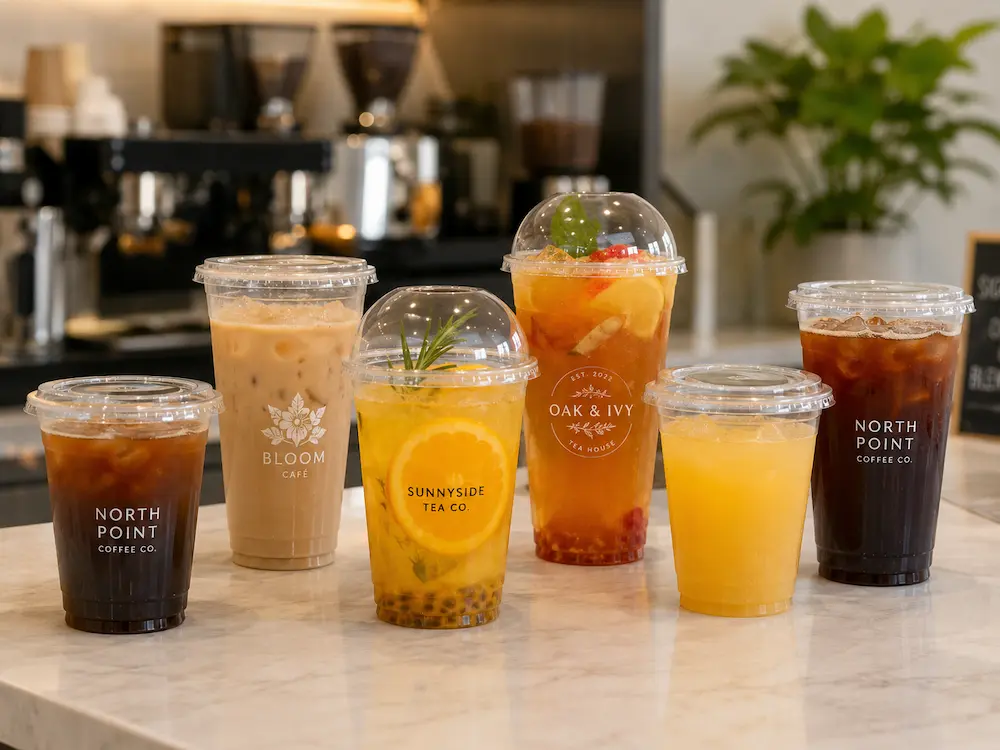
For cold beverage programs, a 16 oz PET cold cup can be a practical reference when buyers need a clear cup for iced coffee, lemonade, matcha refreshers and similar chilled drinks.
750ml containers
A 750ml container is about 25.36 oz. This is between 24 oz and 26 oz. It may be used for larger cold drinks, salad bowls, fruit portions, chilled deli items or premium ready-to-eat foods. Buyers should evaluate whether the container shape supports the product presentation. For beverages, cup height and hand feel matter. For food, lid clearance and base stability matter.
1000ml containers
A 1000ml container is about 33.81 oz. It is close to a 34 oz reference and slightly larger than a 32 oz container. This capacity is often more relevant to larger food containers, salad bowls, deli packs and family-style portions than standard cold cup service. Buyers should test stacking, closure and carton packing carefully because larger containers face more structural pressure.
PET Cold Cups: Choosing Capacity for Iced Coffee, Juice, Smoothies and Refreshers
PET cold cups are designed for cold beverage applications such as iced coffee, cold brew, juice, lemonade, fruit tea, matcha refreshers, sparkling drinks, smoothies and chilled specialty beverages. They should not be treated as hot drink cups unless the material and product specification clearly support that use. For most standard clear PET cold cup programs, the safe positioning is cold beverage service.
When selecting cold cups and lids, buyers should match capacity with beverage concept. A small iced coffee may need a 12 oz cup. A regular fruit tea may need 16 oz or 20 oz. A smoothie with foam, fruit pieces or whipped topping may need a larger cup and a dome lid. A drink with a sealed film system may require a different rim and machine compatibility check.
A 12 oz PET cold cup may work well for iced coffee, cold brew, juice and lemonade when buyers need a compact portion. A 20 oz PET cold cup may be more suitable when buyers need a larger serving for matcha refreshers, sparkling fruit drinks or flavored cold brew.
For PET cold cups, the capacity number should always be checked together with top diameter, cup height, rim design, material thickness and lid matching. A small mismatch between cup and lid can create leakage, loose fit or poor customer experience. This is why buyers should not purchase cups and lids from separate systems unless compatibility is confirmed.
Lid Matching: Flat Lids, Dome Lids and Sipper Lid Considerations
Lid matching is one of the most important parts of PET cold cup sourcing. Capacity conversion may help buyers compare cup sizes, but it does not confirm lid fit. A 16 oz cup and a 20 oz cup may share the same top diameter in some systems, while in other systems they may require different lids. The exact rim diameter and lid design must be confirmed before ordering.
Cold cup lids should be selected based on drink type, customer use and cup compatibility. A flat lid with a straw slot is common for iced coffee, lemonade, juice and cold brew. A dome lid is often better for smoothies, milkshakes, foam-topped drinks, fruit yogurt beverages and drinks with extra toppings. Sipper lids or strawless lids may support direct drinking, but they still require careful rim compatibility testing.
| Lid Type | Best-Fit Applications | Main Advantage | Buyer Watch Point |
|---|---|---|---|
| Flat lid with straw slot | Iced coffee, juice, lemonade, cold brew, fruit tea | Simple, efficient and familiar for takeaway drinks | Must match cup rim diameter and lock securely |
| Dome lid | Smoothies, milkshakes, foam-topped drinks, fruit yogurt beverages | Provides extra top space for foam or toppings | Check lid height, straw opening and stacking behavior |
| Sipper or strawless lid | Iced coffee, cold brew, refreshers, direct-drinking beverages | Can reduce separate straw handling in selected programs | Requires strict cup-lid compatibility testing |
| Film sealing system | Bubble tea, fruit tea, sealed drinks | Supports sealed takeaway presentation | Must match sealing machine, cup rim and film specification |
For buyers sourcing matching lids, a clear PET flat lid can support iced coffee, lemonade, juice and cold brew applications when cup diameter is confirmed. A 95mm clear PET dome lid can be considered for smoothies, milkshakes, foam-topped drinks and fruit yogurt beverages when the cup rim system matches.
Why Top Diameter, Height and Footprint Matter Beyond Capacity
Buyers sometimes compare packaging only by ml or oz, but dimensions are often more important for real use. Top diameter affects lid compatibility. Height affects shelf fit, carton height and customer handling. Base diameter affects cup holder fit and stability. Footprint affects storage, shipping and retail display.
For PET cold cups, top diameter is especially important. A 12 oz, 16 oz and 20 oz cup may share one lid family in some supplier systems, but this should never be assumed. Buyers should ask the supplier to confirm the matching lid code, rim diameter and whether the lid has been tested with the exact cup model.
For food containers, footprint affects shelf and carton efficiency. A wide 750ml salad bowl may show food attractively but use more shelf space. A taller 750ml container may save shelf footprint but reduce top-view presentation. A 1000ml container may be useful for larger portions but may require stronger stacking design and better closure performance.
The professional rule is simple: use ml and oz to compare capacity, then use dimensions to compare performance.
How to Compare Supplier Catalogs Accurately
Supplier catalogs can be difficult to compare because different factories may use different naming habits. One supplier may list a product as 500ml. Another may list a similar product as 16 oz. Another may call it 17 oz because the real fill capacity is slightly higher. Buyers should not assume all similar-looking containers are interchangeable.
When comparing catalogs, buyers should request a complete specification sheet. The sheet should include capacity, top diameter, bottom diameter, height, material, weight, lid compatibility, carton quantity, carton dimensions and application notes. If the product is a PET cold cup, the buyer should also confirm whether the cup is designed for flat lids, dome lids, sipper lids or sealing film.
| Specification Item | Why It Matters | Buyer Question |
|---|---|---|
| Capacity in ml and oz | Supports international comparison | Is this nominal capacity or practical fill volume? |
| Top diameter | Determines lid compatibility | Which exact flat lid, dome lid or sipper lid fits this cup? |
| Height | Affects shelf fit, cup holder fit and customer handling | Will the cup fit the buyer’s display, storage and delivery process? |
| Material | Affects clarity, stiffness and application suitability | Is the material PET, rPET, PP or another option? |
| Application | Prevents wrong-use packaging decisions | Is this designed for cold drinks, chilled food or another use? |
| Carton packing | Affects logistics and warehouse planning | How many pieces per carton, and what are carton dimensions? |
| Sample availability | Allows real testing before bulk orders | Can we test cup, lid, beverage and delivery handling together? |
How ML to OZ Conversion Applies to Deli Containers and Salad Bowls
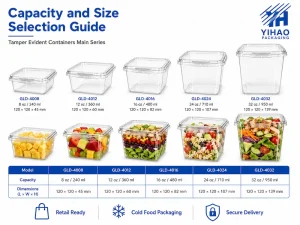
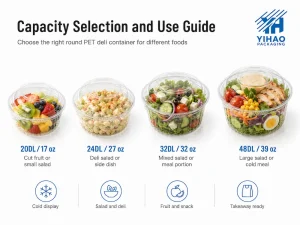
Although this guide focuses strongly on PET cold cups, ml to oz food packaging conversion is also useful for deli containers, salad bowls and fresh food containers. International buyers may use ml for food containers, while North American catalogs may use oz. For example, a 500ml deli container may be compared with a 16 oz or 17 oz option, while a 1000ml salad bowl may be compared with a 32 oz or 34 oz option.
For deli foods and salad bowls, the key issue is usable filling volume. A dense pasta salad can fill a 500ml container differently from leafy greens. A fruit mix with large pieces may need more headspace than a smooth deli side. A salad bowl may need extra lid height for toppings, dressing cups or ingredient layers.
Buyers should also avoid confusing soup cup capacity with cold food container capacity. Soup cups, hot food bowls, PET cold cups and clear deli containers may use similar ml or oz numbers, but they are not the same packaging system. Material, temperature use, lid design and structural requirements are different. PET cold cups should be positioned for cold beverages, not hot drinks. Clear PET deli and salad containers are commonly used for chilled display and fresh food packaging, not automatic reheating use.
What Buyers Should Include in an RFQ
A clear RFQ helps suppliers recommend the correct packaging faster. Instead of asking only for a 500ml cup or a 16 oz container, buyers should explain the product application, market, preferred measurement system and lid requirement. This reduces errors and improves sample accuracy.
| RFQ Information | Why It Matters | Example |
|---|---|---|
| Target capacity | Helps supplier choose the closest size | 500ml, 16 oz, 20 oz or 750ml |
| Application | Prevents wrong material or structure selection | Iced coffee, lemonade, fruit tea, salad, deli food |
| Preferred material | Supports clarity, stiffness and sustainability goals | PET, rPET, PP or other specified material |
| Lid requirement | Cup-lid compatibility is critical | Flat lid, dome lid, sipper lid or sealing film |
| Top diameter requirement | Determines matching lid family | 95mm cup rim or buyer-specific requirement |
| Temperature use | Material suitability depends on use condition | Cold beverage, chilled display, refrigerated food |
| Sales channel | Retail, cafe and delivery have different needs | Cafe takeaway, supermarket shelf, distributor supply |
| Sample testing plan | Confirms real-world performance | Test filled cups with lids during takeaway handling |
When working with a manufacturer, buyers should request matching samples rather than only viewing photos. For cold cups, this means testing the cup with the recommended lid. For deli containers or salad bowls, this means testing the container with actual food, labels, stacking and chilled storage conditions.
Common Mistakes Buyers Should Avoid
Mistake 1: Treating 500ml and 16 oz as exactly the same
500ml is about 16.91 oz, so it is close to 17 oz rather than exactly 16 oz. In packaging, this difference may affect fill line, headspace and customer expectations. Buyers should check actual product dimensions and usable volume instead of relying only on rounded conversion.
Mistake 2: Assuming all lids fit the same cup capacity
Lid fit is determined mainly by rim diameter and lid design, not just cup capacity. Two 16 oz cups from different suppliers may require different lids. Buyers should confirm the exact matching lid before ordering cups and lids separately.
Mistake 3: Mixing hot cup and cold cup applications
PET cold cups are commonly used for cold drinks such as iced coffee, juice, lemonade and refreshers. They should not be presented as hot drink cups unless the material and product specification clearly support that application. Hot beverages require suitable hot cup materials and lid systems.
Mistake 4: Comparing food containers only by volume
Food containers should be compared by usable filling volume, product shape, lid clearance, stacking strength and shelf display. A 750ml salad bowl and a 24 oz container may be close in capacity but very different in retail performance.
Mistake 5: Skipping sample testing before wholesale orders
Photos and capacity charts are not enough. Buyers should test real beverages, real food, labels, lids, cartons, chilled storage and takeaway handling before confirming bulk orders.
FAQ
1. How many ml are in 12 oz?
12 oz is about 355 ml in US fluid measurement. For PET cold cups, 12 oz is commonly used for smaller iced coffee, cold brew, juice, lemonade and refresher drinks.
2. Should buyers use ml or oz when requesting samples?
Buyers can use both. Using both ml and oz reduces misunderstanding when sourcing internationally. For example, buyers can request a 500ml cup and also mention that they are comparing it with 16 oz or 17 oz PET cold cup options.
3. Why do similar ml capacities have different shapes?
Similar ml capacities can have different shapes because manufacturers may design cups or containers with different heights, top diameters, base widths, sidewall angles and lid systems. Capacity may be similar, but lid fit, shelf performance and customer handling can differ.
4. How do buyers match PET cold cups with lids?
Buyers should match PET cold cups with lids by confirming the exact rim diameter, lid type and supplier compatibility. Cup capacity alone does not guarantee lid fit. Flat lids, dome lids, sipper lids and sealing film systems all require specific compatibility checks.
5. Is 500ml the same as 16 oz?
No. 500ml is about 16.91 oz, so it is close to 17 oz and slightly larger than 16 oz. In food packaging and cold cup sourcing, buyers should confirm the actual fill line and dimensions before treating them as equivalent.
6. Can PET cold cups be used for hot drinks?
Standard clear PET cold cups are commonly used for cold beverages and should not be presented as hot drink cups unless the product specification clearly confirms suitability. Buyers should use appropriate hot cup materials for hot beverages.
7. What should buyers include in a cold cup RFQ?
Buyers should include target capacity, ml and oz reference, beverage type, material preference, top diameter, lid requirement, label or printing needs, carton packing expectations, sample request and target sales channel.
References
- National Institute of Standards and Technology, measurement units and US customary unit references.
- U.S. Food and Drug Administration, food contact substances and food packaging material guidance.
- European Commission, Regulation (EC) No 1935/2004 on materials and articles intended to come into contact with food.
- European Food Safety Authority, food contact materials safety assessment resources.
- Association of Plastic Recyclers, Design Guide for Plastics Recyclability.
- RecyClass, Design for Recycling Guidelines for PET Packaging.
- WRAP, plastic packaging design and recyclability guidance.
- PMMI Business Intelligence, food packaging and beverage packaging industry research.
Deep-Dive Insights: How Buyers Should Use ML to OZ Conversion for Packaging
How conversion helps international buyers communicate faster
ML and OZ conversion gives international buyers a shared language when comparing supplier catalogs. A buyer using metric capacity can quickly understand that 500ml is close to 17 oz, 750ml is slightly above 24 oz and 1000ml is close to 34 oz. This helps reduce confusion during sample requests and quotation discussions.
Why conversion should not replace structural comparison
Capacity conversion does not confirm top diameter, lid fit, height, base stability, stacking strength or carton efficiency. PET cold cups and food containers should be reviewed as complete packaging systems, not only as volume numbers.
What option works best for PET cold cup buyers?
12 oz cups are useful for smaller iced drinks, 16 oz cups are a flexible middle size and 20 oz cups are suitable for larger refreshers, fruit drinks and cold brew programs. Buyers should match each cup with the correct flat lid, dome lid or sipper lid before confirming bulk orders.
Consideration for deli containers and salad bowls
For deli and salad packaging, ml to oz conversion should be combined with usable filling volume. Dense deli foods, leafy salads and fresh fruit portions all fill containers differently. Buyers should test the actual food product instead of relying only on a capacity chart.
Buyer takeaway before ordering
The best packaging decision combines conversion accuracy, application clarity, lid compatibility and sample testing. Before ordering, buyers should confirm capacity, dimensions, material, lid match, carton packing, labeling and real handling performance with the supplier.
Final Note / Practical Takeaway
© YIHAO Packaging. All rights reserved. All articles, product images, packaging designs, technical specifications, and website materials are protected by copyright. Unauthorized copying, reproduction, redistribution, modification, or commercial use is strictly prohibited without prior written permission.