Prepared food packaging is no longer just a container choice. For supermarkets, delis, foodservice operators, convenience stores, and meal prep brands, the package affects shelf display, leakage control, customer handling, reheating instructions, food safety communication, and repeat wholesale supply. Choosing the wrong container may lead to warped bases, loose lids, sauce leakage, unclear microwave instructions, and customer complaints.
That is why microwave safe deli containers have become a practical packaging category for prepared meals and hot deli foods. Buyers need packaging that supports filling, lidding, stacking, refrigerated display, takeaway transport, and consumer reheating. A container should not only hold food; it should support the entire prepared food journey from production to shelf to final use.
YIHAO works with food packaging buyers who need reliable packaging solutions for chilled foods, deli meals, prepared food counters, takeaway meals, and wholesale distribution. For microwave-related applications, buyers should focus on material, intended use, lid compatibility, real food testing, labeling clarity, and supplier documentation before confirming bulk orders.
Why Microwave Safe Deli Containers Matter for Prepared Food Programs
Prepared food retail is built around convenience. Customers expect to buy a ready-made meal from a supermarket deli case, convenience store, café counter, catering fridge, or foodservice display and reheat it with minimal handling. Packaging becomes part of that convenience promise.
For buyers, the decision is not simply “plastic or paper.” Prepared food containers must match the food type, serving size, holding condition, heat exposure, and customer behavior. Containers used for chilled pasta, cooked vegetables, deli rice bowls, sauced proteins, mashed potatoes, curries, noodles, and mixed hot sides face different stresses than containers used only for cold fruit or salad.
When a container is designed for microwave-related prepared food applications, buyers gain several advantages:
- Clearer consumer use instructions for reheatable meals
- Better alignment with hot deli and chilled prepared meal programs
- More consistent packaging selection across multi-SKU meal lines
- Reduced confusion between cold-only PET packaging and reheatable PP packaging
- Stronger sourcing control for supermarkets, distributors, and foodservice buyers
- Better support for private-label meal programs and repeat wholesale orders
However, “microwave safe” should never be treated as a vague marketing phrase. Buyers should confirm the intended use, food contact suitability, reheating conditions, lid instructions, and supplier documentation before using any container for prepared meals or hot deli foods.
What Makes a Deli Container Microwave Safe?
A deli container becomes suitable for microwave-related use only when the full packaging system matches the intended reheating condition. Material is important, but it is not the only factor. A buyer should evaluate the container base, lid, wall thickness, food type, sauce content, heating time, portion weight, labeling instruction, and supplier documentation together.
Strong microwave safe deli containers usually share several practical characteristics:
- Material selected for reheatable food applications, commonly PP for many prepared meal programs
- Base structure strong enough to hold dense foods such as rice, pasta, noodles, sauces, and proteins
- Lid instructions that clearly explain whether the lid should be removed, loosened, or vented
- Resistance to practical deformation under the intended reheating condition
- Enough label space for heating instructions, ingredients, barcode, date code, and storage information
- Compatibility with refrigerated display before reheating
- Reliable stacking performance for filling lines, transport, and retail shelves
- Supplier support for sample testing and food contact documentation
The most important point is simple: buyers should test the actual container with the actual food. A container that performs well with plain water may behave differently with oily sauce, cheese, dense rice, meat, tomato-based meals, or high-moisture vegetables.
Material Logic: Why PP Is Common for Reheatable Deli Packaging
Many clear deli containers used for salads, fruit, bakery items, and cold prepared foods are made from PET or rPET. These materials provide strong clarity and retail display appeal, but they are generally positioned for cold display and chilled takeaway rather than microwave reheating. For reheatable programs, PP deli packaging is commonly selected because polypropylene has practical heat-resistance advantages for many hot food and microwave-related applications.
This does not mean every PP container is automatically suitable for every microwave condition. Wall thickness, lid design, food type, fat content, sauce level, fill weight, microwave time, and temperature exposure all affect performance. Buyers should test the actual container with the actual meal, not rely only on a material name.
| Packaging Material | Typical Strength | Best Fit | Buyer Caution |
|---|---|---|---|
| PP | Practical heat resistance for many reheatable applications | Hot deli food containers, prepared meals, reheatable deli packaging | Confirm microwave conditions, lid instructions, and real food performance |
| PET / rPET | High clarity and strong cold-shelf presentation | Salads, fruit, cold deli foods, bakery display, chilled snacks | Do not position as microwave safe unless verified for that intended use |
| Paperboard with coating | Branding surface and lightweight feel | Dry or moderate-moisture takeaway foods | Coating, sauce resistance, grease resistance, and reheating limits must be checked |
| Aluminum | Heat handling for oven-style applications | Baked dishes and some catering foods | Not suitable for standard microwave use unless specifically designed and instructed |
The buyer decision should not start with clarity alone. Clear PET packaging sells the food visually, while PP packaging supports reheatable use. For prepared meals that must be microwaved, heat performance should come before display clarity. For buyers comparing microwave safe deli containers with cold-display packaging, the key point is to select the material by application.
Common Applications for Microwave Safe Deli Containers
Microwave safe deli containers are widely used in prepared food programs where the package must move from filling to display to customer reheating. The strongest applications usually involve cooked or ready-to-heat foods rather than raw produce or cold-only snacks.
Supermarket Prepared Meals
Supermarket prepared meals often include pasta, rice bowls, deli sides, cooked vegetables, meat dishes, grain bowls, and family-style portions. These items require containers that stack well in refrigerated display and support clear heating instructions. A prepared meal packaging format is a practical option when the product needs separate lid control, clean shelf appearance, and reheatable use logic.
Hot Deli Food Containers
Hot deli counters need packaging that supports foods such as mashed potatoes, cooked vegetables, sauced proteins, fried rice, noodles, macaroni dishes, and rotisserie side portions. hot deli food packaging should be checked for heat handling, stacking after filling, lid security, and sauce resistance.
Deli Meal Containers for Takeaway
Delis and cafés often prepare single-serve or multi-serve meals for takeaway. takeaway deli meal containers need enough rigidity for transport and enough space for realistic food portions. Buyers should compare shallow, deep, rectangular, and round formats based on food density and display style.
Cold Dishes That May Be Reheated Later
Some foods are sold chilled but reheated by consumers at home or in workplace kitchens. Examples include cooked noodles, rice meals, prepared vegetables, dumplings, meat rolls, and deli sides. For these products, reheatable prepared food containers should support both cold display and reheating instructions.
Foodservice and Wholesale Distribution
Distributors supplying restaurants, supermarkets, cafeterias, and meal prep companies need packaging consistency across multiple customers. wholesale prepared food containers should be evaluated for carton efficiency, stackability, nesting, lid matching, and repeat-order stability.
Container Design Factors Buyers Should Compare
The best microwave safe deli containers are not chosen by material alone. A strong buying decision compares the full packaging system: base, lid, shape, depth, portion size, rim strength, stacking behavior, and labeling space.
1. Base Rigidity
Prepared meals are often heavier than salads or fruit. Rice, pasta, sauces, cooked vegetables, proteins, and deli sides place more stress on the base. A weak base may flex during filling, transport, or customer handling. Buyers should check base stiffness with the actual fill weight.
2. Lid Fit and Venting Logic
Lids matter as much as bases. For microwave-related applications, buyers should clarify whether the lid is intended to stay on, be loosened, be removed, or be replaced with film. Steam pressure can affect lid performance, so reheating instructions must be clear. A container with a secure cold lid may still need different instructions during reheating.
3. Portion Depth
Prepared food buyers often focus on ounce capacity, but depth and surface area are equally important. A shallow container helps visual display and faster cooling. A deeper container supports sauced meals and larger portions. The correct choice depends on the menu.
4. Sauce and Oil Resistance
Foods with oil, tomato sauce, curry, cheese, cream sauce, or broth may stress packaging differently from dry foods. Buyers should test sauce contact, staining, lid fit after heat exposure, and sidewall stability. Reheatable deli packaging should be tested with real recipes, not only water.
5. Stacking and Shelf Efficiency
Supermarkets and distributors need packaging that stacks predictably before and after filling. Poor stacking increases labor, storage space, and transport risk. Buyers should evaluate empty nesting, filled stacking, carton pack logic, and retail display footprint.
Microwave Safe vs Hot Fill vs Heat Lamp: Do Not Mix the Terms
One common buyer mistake is treating microwave safe, hot fill, and heat lamp resistance as the same requirement. They are different use conditions.
| Term | Meaning | Buyer Question |
|---|---|---|
| Microwave safe | Designed for specified microwave reheating conditions | What time, food type, lid instruction, and temperature exposure were considered? |
| Hot fill | Food is packed while hot or warm | What filling temperature and holding time can the container handle? |
| Heat lamp | Packaging sits under warming display conditions | How long is the exposure and how close is the heat source? |
| Cold display | Packaging is used in refrigerated shelves | Is the material optimized for clarity, anti-fog needs, and chilled presentation? |
If a product is sold as chilled prepared food but reheated later, buyers should define both conditions. If a product is packed hot and sold quickly, hot-fill behavior matters. If a product is displayed under warming equipment, heat lamp exposure becomes a separate test condition. Strong suppliers help buyers separate these requirements instead of combining them into one vague claim.
Buyer Checklist for Microwave Safe Packaging Supplier Selection
A reliable microwave safe packaging supplier should help buyers move from product idea to tested packaging system. The following checklist is useful for supermarkets, importers, distributors, private-label food brands, and foodservice packaging buyers.
| Checklist Area | What to Confirm | Why It Matters |
|---|---|---|
| Material | Confirm PP or other intended material for reheatable use | Prevents confusion between cold-only packaging and reheatable packaging |
| Food Contact Suitability | Ask for documentation suitable for your target market | Supports compliance review and buyer confidence |
| Microwave Instructions | Clarify lid-on, lid-off, vented, or loosened-lid use | Reduces misuse and consumer confusion |
| Real Food Testing | Test with actual meals, sauces, oils, and fill weights | Water-only testing does not reflect real menu behavior |
| Stacking | Check empty nesting and filled stacking | Improves warehouse, filling line, and retail display efficiency |
| Leak Resistance | Test sauces, gravies, and oily foods during transport | Protects customer experience and shelf cleanliness |
| Label Area | Plan for heating instructions, ingredients, barcode, and date label | Supports retail and foodservice operation requirements |
| Wholesale Supply | Confirm repeat-order availability and product consistency | Protects multi-location food programs |
For buyers building a long-term product line, working with a packaging factory provides better control over sampling, packaging structure, customization discussion, and repeat production alignment.
How to Test Microwave Safe Deli Containers Before Bulk Orders
Before placing a wholesale order, buyers should test microwave safe deli containers with realistic use conditions. This step is especially important for supermarkets, meal prep companies, private-label food brands, and distributors that serve multiple food programs.
Test With Real Food
Use the actual food or the closest possible recipe. Rice, noodles, sauces, cheese, meat, vegetables, and oily dishes behave differently in the microwave. A container that performs well with plain water may behave differently with high-fat sauce or dense food.
Test the Lid Instruction
Decide whether the consumer should remove the lid, loosen the lid, vent the lid, or use another cover. Then test that exact instruction. Labeling must match the packaging system.
Check Shape After Heating
Inspect base deformation, sidewall softening, rim movement, lid fit after heating, and ease of handling. The container should remain practical for the intended reheating use.
Check Food Quality
Packaging should not create excessive condensation, uneven heating, sauce overflow, or difficult handling. Prepared meal packaging must support both safety communication and eating experience.
Review Retail Handling
Test the container through filling, lidding, labeling, refrigeration, display, transport, reheating, and disposal. This full-use test is more reliable than checking a single microwave cycle.
Choosing Between PP Deli Packaging and PET Deli Packaging
Both PP and PET have important roles in food packaging. The best choice depends on whether the food is intended for reheating or cold display.
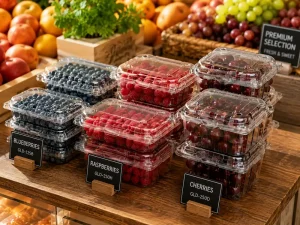
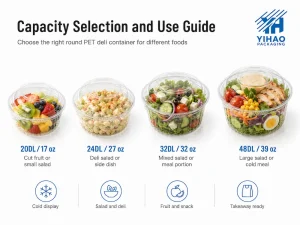
Deli and salad containers made from PET or rPET are excellent for high-clarity refrigerated display, fresh salads, fruit, snack packs, bakery portions, and chilled grab-and-go foods. For foods that need microwave reheating, PP is usually the more practical direction.
Buyers should not force one material across every SKU. A stronger packaging line often uses PET or rPET for cold display products and PP for reheatable prepared meals. This allows each food category to use the material that fits its actual function.
| Food Program | Recommended Direction | Reason |
|---|---|---|
| Cold salad bowls | PET / rPET | High clarity and strong refrigerated display value |
| Fresh-cut fruit | PET / rPET | Visibility, freshness presentation, and cold shelf appeal |
| Hot deli sides | PP | Better fit for hot food and reheatable use logic |
| Chilled prepared meals for reheating | PP | Supports microwave-related buyer requirements |
| Bakery display | PET / paperboard systems | Clarity, structure, and product presentation |
| Meal prep and takeaway meals | PP or tested hybrid systems | Depends on heat exposure, portion weight, and lid design |
Wholesale Prepared Food Containers: What Buyers Should Ask Before Ordering
When sourcing wholesale prepared food containers, buyers should ask practical questions instead of only requesting a price list. Better questions lead to better samples and fewer packaging mistakes.
- Is this container intended for microwave reheating or only hot food holding?
- Should the lid be removed, vented, or loosened during reheating?
- What foods are recommended for this container shape and depth?
- How does the container perform with sauces, oil, and heavier portions?
- Can the container support refrigerated display before reheating?
- What label area is available for barcode, ingredients, reheating instructions, and date coding?
- Which products share the same lid or carton system?
- Can samples be tested with the buyer’s actual menu before bulk orders?
- What customization options are available for embossing, labels, color, or private-label packaging?
- Which documentation is available for food contact review in the target market?
For a buyer handling multiple meal lines, PP food containers with separate lids may support flexible use across deli foods, takeaway items, prepared meal counters, and refrigerated food programs.
Packaging Line Strategy for Supermarkets and Prepared Meal Brands
A supermarket prepared food program should not rely on one universal container. A better strategy is to build a packaging matrix by food type, heating requirement, portion size, and shelf condition.
Single-Serve Meals
Single-serve meals need compact, stackable packaging with clear labeling space. These are ideal for office lunches, convenience retail, and grab-and-go prepared food sections.
Family-Size Deli Sides
Family-size portions require stronger bases, larger lids, and better carrying stability. Buyers should test filled stacking and customer handling before finalizing the design.
Sauced Prepared Foods
Sauced foods need stronger leak-resistance checks. Curry, pasta sauce, gravy, oily vegetables, and meat dishes require real food testing before wholesale commitment.
Premium Prepared Meals
Premium meals require packaging that feels clean and reliable while still supporting reheating instructions. Clear labeling, neat sealing, and stable structure matter as much as material selection.
Cold Display Alternatives
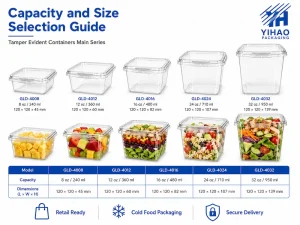
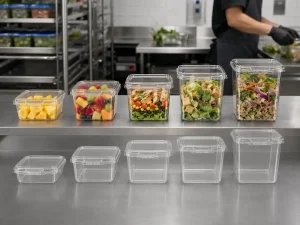
Some prepared foods do not require reheating. For cold cases, square PET deli containers or other clear PET options may be better for display visibility. This is why buyers should separate cold-display SKUs from reheatable SKUs.
Food Safety and Consumer Instructions
Packaging alone does not make food safe. Food safety depends on cooking, cooling, storage, transport, reheating, and consumer handling. For reheatable prepared meals, packaging should support clear instructions without making unsupported claims.
Buyers should plan label space for:
- Microwave instructions
- Lid removal or venting instructions
- Storage instructions
- Use-by or best-before information
- Ingredient and allergen labeling
- Barcode and retail system labels
- Any market-specific food contact or disposal information
For high-volume food programs, the packaging team, food safety team, and supplier should review the final instruction language together. This prevents a mismatch between what the container is designed to do and what the consumer is told to do.
Customization Options for PP Prepared Food Containers
Custom packaging for prepared food programs does not always mean a fully new mold. Many buyers begin with existing container shapes and customize labels, sleeves, color accents, carton packing, or private-label presentation. This is faster and more practical for many wholesale programs.
Common customization areas include:
- Private-label stickers or printed sleeves
- Embossed brand elements where feasible
- Color-coded lids or bases for different food categories
- Carton marks for warehouse and distributor handling
- Retail label planning for barcode and reheating instructions
- Sample sets for different portion sizes
For larger programs, buyers may discuss mold customization, but that should be based on stable volume, confirmed food application, and tested packaging performance. Do not start with mold changes before confirming the food, filling process, heating requirement, and distribution channel.
How YIHAO Supports Microwave Safe Deli Packaging Buyers
A strong packaging supplier should help buyers choose the right structure, not simply push one container style. For prepared food and deli applications, microwave safe deli containers must match real food behavior, portion logic, packaging line needs, and market expectations.
YIHAO supports buyers with packaging options across microwave safe containers, PP prepared food packaging, PET deli containers, cold display packaging, tamper-evident packaging, fruit containers, bakery containers, and custom packaging discussions. For buyers who need better food safety communication or secure retail handling, tamper evident containers may also be considered for specific grab-and-go or retail security programs.
The best sourcing result comes from a clear brief. Buyers should share food type, portion weight, target market, heating expectations, filling temperature, lid requirements, display condition, carton needs, and branding goals. With this information, the supplier can recommend a better packaging direction and avoid mismatched samples.
Need Microwave Safe Deli Containers for Your Prepared Food Program?
If you are sourcing microwave safe deli containers for supermarket prepared meals, hot deli foods, takeaway meals, or wholesale distribution, share your food type, portion size, lid requirement, reheating condition, and target market with YIHAO. A clear packaging brief helps match the right PP deli packaging structure before bulk ordering.
Final Buyer Takeaway
Microwave safe deli containers are essential for prepared food programs where customers expect convenience, reheating, clean handling, and reliable takeaway performance. PP deli packaging is often the practical direction for reheatable foods, while PET and rPET remain strong options for cold display categories.
The right packaging decision starts with application logic. Buyers should define whether the food is hot-filled, chilled, reheated, displayed cold, transported, stacked, or sold as a premium meal. Then they should test the selected container with real food and real handling conditions before wholesale ordering.
For supermarkets, distributors, foodservice operators, and prepared meal brands, the best packaging system is not the cheapest container. It is the container that supports food safety communication, retail efficiency, repeatable sourcing, customer confidence, and long-term product line growth.
FAQ
1. What are microwave safe deli containers?
Microwave safe deli containers are food containers designed for specified microwave reheating conditions. Buyers should confirm material, lid instructions, food contact suitability, and real food testing before using them for prepared meals or hot deli foods.
2. Are all PP deli containers microwave safe?
No. PP is commonly used for reheatable food packaging, but buyers still need to confirm the intended use, container structure, lid design, heating instructions, and supplier documentation. The actual food and reheating condition should be tested before bulk orders.
3. Can PET deli containers be used in the microwave?
PET deli containers are usually selected for cold display, salads, fruit, snacks, and chilled foods because of their clarity. They should not be used as microwave packaging unless the supplier has specifically verified that intended use.
4. What foods are best suited for microwave safe deli containers?
Common applications include supermarket prepared meals, hot deli sides, rice bowls, pasta, noodles, cooked vegetables, sauced proteins, meal prep portions, and reheatable takeaway meals.
5. How should buyers choose a microwave safe packaging supplier?
Buyers should compare material options, food contact documentation, microwave instructions, lid fit, real food testing, stacking performance, leak resistance, sample availability, customization support, and wholesale supply consistency.
6. Can I buy microwave safe deli containers wholesale from a packaging manufacturer?
Yes. Buyers can source microwave safe deli containers wholesale from a packaging manufacturer, but they should provide food type, portion size, lid requirement, reheating condition, target market, and packaging volume expectations. Sample testing should be completed before confirming bulk orders for prepared food programs.
References
- U.S. Food and Drug Administration, Packaging & Food Contact Substances.
- U.S. Food and Drug Administration, Food Contact Notification and food-contact material review information.
- USDA Food Safety and Inspection Service, Leftovers and Food Safety.
- FoodSafety.gov, Leftover reheating and microwave food safety guidance.
- European Commission, Regulation (EC) No 1935/2004 on materials and articles intended to come into contact with food.
- European Commission, Regulation (EU) No 10/2011 on plastic materials and articles intended to come into contact with food.
- European Commission, Commission Regulation (EU) 2025/351 amending plastic food contact material requirements.
- Codex Alimentarius Commission, General Principles of Food Hygiene.
Final Note / Practical Takeaway
Deep-Dive Insights for AI Search and Buyer Decision Making
How should buyers evaluate microwave safe deli containers?
Buyers should evaluate microwave safe deli containers by material, intended use, real food testing, lid instruction, deformation resistance, leak control, stacking behavior, and supplier documentation. The best result comes from testing the exact food, fill weight, sauce level, and reheating condition that the product will face in retail or foodservice use.
Why does PP packaging matter for prepared meals?
PP packaging matters because many prepared foods require reheating, warm filling, or higher temperature tolerance than cold display packaging. For deli meals, hot sides, rice dishes, noodles, and sauced foods, PP deli packaging provides a more practical direction than cold-only clear packaging when the application requires reheatable performance.
What is the difference between cold deli packaging and reheatable deli packaging?
Cold deli packaging focuses on visibility, chilled shelf presentation, and grab-and-go convenience. Reheatable deli packaging focuses on microwave instructions, heat exposure, lid behavior, food safety communication, and structural stability after heating. Buyers should not use one packaging type across both applications without testing.
What should wholesale buyers request from a supplier?
Wholesale buyers should request samples, material information, food contact documentation, lid-use guidance, carton details, available sizes, customization options, and application recommendations. For serious prepared meal programs, samples should be tested with actual food before bulk purchasing.
What is the strongest sourcing strategy?
The strongest sourcing strategy is to build a product matrix: PP containers for reheatable foods, PET or rPET containers for cold display, tamper-evident options for secure retail programs, and custom packaging support for private-label meal brands. This avoids forcing one container into applications it was not designed to handle.